Laudable Linkage

Laudable Linkage

Even though I’m a little behind on my blog-reading, I found some great articles in the time I did read:

God . . . the Father? “As a dad, I don’t want my presentation of fatherhood to hurt my kids’ ability to see God as their heavenly Father. But it’s perhaps more important that we help our children recognize the foundational truth here: that God, in all His power and glory, is best understood as a loving, intimate Father.”

Don’t Give Up Dad. “‘Don’t give up dad.’ I remember looking into the mirror and saying those words to myself one dark Father’s Day, years ago. And I was about to give up.”

Fighting for Faith When Doubts Abound, HT to Challies. “There’s a pervasive belief that subtly infiltrates my thought life. One that, deep down, still believes God would keep me from harm and rescue me from pain if he truly loved me. And if he’s truly in control, and a good, loving Father, why does he answer other’s prayers, but continue to seem silent to ours?”

God’s Heart for the Elderly and Infirm Reminds us of the Sanctity of Senior Life. “One of the many problems facing Western society is that we worship youth and make the elderly disposable. Euthanasia, which is legal in my home state of Oregon, is simply abortion of the elderly, disabled, and terminally ill. The same logic and arguments and appeals to ‘compassion’ and quality of life and financial concerns are used for both. God’s perspective on the elderly is vastly different.”

The Incredible Blessing of My Father’s Difficult Final Months, HT to Challies. “The agony of watching Dad suffer like that was unbearable. I begged God to give him a quick end. But Dad was otherwise robust and exhibited a fierce will to live. The doctor said that death did not look imminent. I absolutely did not want to hear that. How could someone live in such a state? But God had an important lesson in store for me. Dad lived for nine more months, and we would have missed an incredible blessing had he died when I wanted.”

Antihistamines for Your Soul. “You don’t HAVE to memorize or read this much to follow Jesus. It’s also true that you can be in the Word every day and still not be anything like Jesus. But the subtle lie underneath is that you can ever have ‘too much’ Scripture in your life. Friends, you CANNOT overdo it on God’s Word and fellowship with him.”

Observation: The First Step in Bible Study. “The first step in studying God’s Word is to carefully observe what the passage is saying. In the observation stage, we give our complete attention to the text to find out what’s there. We must investigate the passage in the same way that a detective investigates a crime scene. How do we do that? Get the “big picture” and then discover the little details. Ask questions… lots of them! Look for certain key clues to discover meaning. See how the little details relate to the big picture.”

Use Discretion (& a Bucket). We’re told to be discerning and compare what is taught with Scripture. But no writer or speaker will be completely without sin. God works through fallen people, and we miss a lot of goodness if all we can see are the flaws.

Paul’s Shocking Ideas About Marriage. “In the typically patriarchal culture of Paul’s day, what he says to wives may not sound that new except for the key point he emphasizes—the motivation and means for being a wife is centered on Christ. Everything Paul says to husbands, however, is very different from what they would have heard from their society. So Paul needs extra time to impress these differences on them.”

A Christian perspective on the new Twitter / X adult content policy changes, HT to Redeeming Productivity. “In May 2024, there was a policy change on adult content, making it acceptable to share adult content. . . . So, with these recent Twitter policy changes, what should we do as Christians?”

Happy Father’s Day to the dads tomorrow!

quote about fathers

“To be popular at home is a great achievement. The man who is loved by the house cat, by the dog, by the neighbor’s children, and by his own wife, is a great man, even if he has never had his name in Who’s Who.” Thomas Dreier

Friday’s Fave Five

Friday's Fave Five

I know it sounds cliche to talk about how fast time passes every week—but it does seem to keep going faster. All the more reason to pause and reflect once in a while. I do that on Fridays with Susanne and friends at Living to Tell the Story. Here are five favorites from the week:

1. An impromptu get-together. Sunday afternoon, Jason asked if we minded if they invited themselves over. They are always welcome, of course. We hadn’t seem them much the previous week because Timothy was in VBS and Mittu was helping with a class. We didn’t have an organized dinner—we rummaged around for leftovers or heat-and-eat things in the freezer. We enjoyed time with them, as we always do.

2. Feeling better. I had a routine cardiologist visit this week—nothing new to report, EKG went well. But that evening and through the next two days, my heart was more fluttery than usual. It wasn’t full-fledged afib. It’s not unusual to have little flutters or abnormal beats every now and then–they say that’s nothing to worry about. But I don’t normally have that many that close together. I was just on the verge of calling the cardiologist back when everything went back to normal.

3. Dinner and flowers. One of the nights I wasn’t feeling well, Jason and Mittu brought dinner and flowers. Timothy either made or helped make cupcakes.

Roses

4. VBS, or Vacation Bible School. Some of the FFF friends are from other countries, and I don’t know if they have VBS everywhere. Here, many churches host a week-long Vacation Bible School for kids to have fun, get together, and most importantly learn about God. We weren’t involved this year except to pray and donate supplies. Sunday morning, the kids sang a song they learned and the director told about some things that happened that week. The decorations were amazing. I’m so thankful for the people who pour themselves into that ministry and for the opportunity to share truth with kids. I pray that the seeds planted will be watered and come to fruition. I saw one sweet photo on FaceBook with a little girl who fell asleep holding the Bible she had received that week. This was Timothy’s first time to attend, and he enjoyed it.

5. Machine recovery. I was using the Cricut machine to make a card this week that was rather involved. I usually go for simple designs, but I liked this one so much, I decided to go for it. It had multiple parts to be cut out. On the next to last one, the lights that indicate when to load the machine and when to start cutting stopped working and the machine stopped responding. So frustrating! The power light was still on, so it hadn’t died completely. I tried turning it off and back on and various other things, then looked up online what to do. Nothing was working, and I stated filling out a customer service form on their site. I tried one more thing–and that worked, for which I was extremely thankful. I had to do it for each step, but I was able to complete my project. I’m hoping it just got a little confused with the complicated project and this isn’t a regular thing.

Bonus: a new old song. I was looking for something else on YouTube when one of their suggested videos caught my eye, a song titled “Dear Refuge of My Weary Soul.” I saw it was written by Anne Steele, a hymnwriter from the 18th century known as “the Baptist equivalent of Isaac Watts.” I listened, and have listened many times since then. The words are here.

Also, the nest in the flower arrangement I mentioned last week has two more eggs in it. They came two at a time, which I was surprised at. But the birds are so small, it makes sense that she couldn’t lay all those at once. We caught a glimpse of the mama bird–she’s reddish but not a cardinal. Since this is right by the front door, she startles and flies away every time we open it. So we’re trying to use other doors as much as possible.

Nest with eggs in a flower arrangement

That’s our week. How was yours?

Review: Everything Sad Is Untrue

Everything Sad Is Untrue (A True Story) by Daniel Nayeri is, on one level, a story about a boy who came to America as a refugee from Iran. Besides encountering a different language, different ways of doing things, even different kinds of toilets, Daniel has to deal with losses.

First he lost his name, Khosrou, because no one could pronounce it. He lost the presence of his father, who stayed behind in Iran. He lost his language and culture. He lost his position in society: his mother had been a doctor in Iran but worked cutting cardboard in a company that made business cards in the US. And he lost his connection with his extended family, his memories of them in fragments. “A patchwork memory is the shame of a refugee” is something he says often.

That was when I realized I had to write down the memories and myths and the legends—and even the phrases and jokes. Or I’d lose everything. Maybe even the recipes (p. 235, Kindle version).

Another layer of the story is the sad human tendency not only not to welcome anyone “different,” but to actively persecute them.

Yet another major facet is Daniel’s mother’s conversion to Christianity and the fatwa that was placed on her head, which led to her fleeing Iran with her two children. They ended up in a refugee camp in Italy for three years before finally making it to the US.

Sima, my mom, read about him and became a Christian too. Not just a regular one, who keeps it in their pocket. She fell in love. She wanted everybody to have what she had, to be free, to realize that in other religions you have rules and codes and obligations to follow to earn good things, but all you had to do with Jesus was believe he was the one who died for you (p. 195).

How can you explain why you believe anything? So I just say what my mom says when people ask her. She looks them in the eye with the begging hope that they’ll hear her and she says, “Because it’s true.” Why else would she believe it? It’s true and it’s more valuable than seven million dollars in gold coins, and thousands of acres of Persian countryside, and ten years of education to get a medical degree, and all your family, and a home, and the best cream puffs of Jolfa, and even maybe your life. My mom wouldn’t have made the trade otherwise (p. 196).

If you believe it’s true, that there is a God and He wants you to believe in Him and He sent His Son to die for you—then it has to take over your life. It has to be worth more than everything else, because heaven’s waiting on the other side. That or Sima is insane (pp. 196-197).

Daniel tells his story from his viewpoint as a twelve-year-old boy in the style of Scheherazade, the storyteller in One Thousand and One Nights. Sometimes he addresses the reader directly. Sometimes he addresses his teacher as if what he is writing is for an assignment.

If you listen, I’ll tell you a story. We can know and be known to each other, and then we’re not enemies anymore (p. 1).

The point of the Nights is that if you spend time with each other—if we really listen in the parlors of our minds and look at each other as we were meant to be seen—then we would fall in love. We would marvel at how beautifully we were made. We would never think to be villain kings, and we would never kill each other. Just the opposite. The stories aren’t the thing. The thing is the story of the story. The spending of the time. The falling in love. All the good stuff is between and around the things that happen (p. 299).

Being a Persian/Eastern tale, it isn’t told in a way we’re used to.

Mrs. Miller says I have “lost the plot,” and am now just making lists of things that happened to fill space. But I replied that she is beholden to a Western mode of storytelling that I do not accept and that the 1,001 Nights are basically Scheherazade stalling for time, so I don’t see the difference. She laughed when I said this (p. 299).

I had heard marvelous things about the book, but was confused when I started reading it. It jumps from a scene at school to a story about Daniel’s ancestors to a story about his mother or something that happened on their journey here. At first I thought this was because the narrator is a twelve-year-old boy. Then I realized it was a different style. I don’t often do this with fiction, but when I finished the book, I immediately started rereading it. I understood it much better the second time–I felt I had all the pieces, so I wasn’t confused. Plus, I just wasn’t ready to let go of the book yet.

I hadn’t paid much attention to the cover until another reviewer mentioned the tornado (which is in the book) is swirling around various things Nayeri mentions throughout his story. Plus, his style of storytelling is cyclical, like the tornado. That helped things click into place for me, plus it made me think the cover designer was a genius.

The title of the book comes from a scene in The Lord of the Rings when Samwise Gamgee “sees Gandalf come back and it’s like seeing his grandpa return from the land of death and memories.” “And Sam thinks maybe all the sad parts of the adventure will come untrue, now that this one has. And the beautiful part is that they do” (p. 232).

Though the story stops at a sad place, it seems a turning point towards hope.

Daniel makes his mother the heroine of story, the one who always had hope, who was unstoppable. “What you believe about the future will change how you live in the present” (p. 347).

The legend of my mom is that she can’t be stopped. Not when you hit her. Not when a whole country full of goons puts her in a cage. Not even if you make her poor and try to kill her slowly in the little-by-little poison of sadness. And the legend is true. I think because she’s fixed her eyes on something beyond the rivers of blood, to a beautiful place on the other side (p. 213).

Once I got into the book, I totally loved it. Well—almost totally. There were a lot of poop stories—maybe because the narrator is a twelve-year-old boy. But there were such poignant moments as well as many funny ones. I couldn’t help but admire and connect with Daniel’s mother. But my eyes were also opened to what refugees experience and to Persian culture.

Some of my other favorite quotes from the book:

I am ugly and I speak funny. I am poor. My clothes are used and my food smells bad. I pick my nose. I don’t know the jokes and stories you like, or the rules to the games. I don’t know what anybody wants from me. But like you, I was made carefully, by a God who loved what He saw. Like you, I want a friend (p. 2).

To lose something you never had can be just as painful—because it is the hope of having it that you lose (p. 51).

The lesson here is that people have scales in their heads and they measure other people for their value and ugly refugee boys are near the bottom and pretty blond girls are at the top. This is not a happy lesson. But you either get the truth, or you get good news—you don’t often get both (p. 80).

Does writing poetry make you brave? It is a good question to ask. I think making anything is a brave thing to do. Not like fighting brave, obviously. But a kind that looks at a horrible situation and doesn’t crumble. Making anything assumes there’s a world worth making it for . . . making something is a hopeful thing to do. And being hopeful in a world of pain is either brave or crazy (p. 122).

My mom comes home exhausted every night. I have never seen her not exhausted. And also, I have never seen her not working (p. 154).

Love is empty without justice. Justice is cruel without love (p. 217).

I found this video of the author and his mother making cream puffs, which I thought was really sweet. I had almost finished my second reading of the book when I saw this, and it was neat to actually see Daniel and his mother

I loved what Kathryn Butler said in her review of this book: “He weaves fragments of myth and personal history into his story, with threads intricately looping like the magnificent Persian rugs he describes (some of them studded with jewels, as can also be said of his prose).”

I’m sure this will be one of my favorite books of the year . . . and of all time.

Review: Lenten Lands: My Childhood with Joy Davidman and C. S. Lewis

Douglas Gresham was the son of Joy Davidman Gresham, who married C. S. Lewis when Douglas was eleven years old. In 1973, ten years after Lewis’s death, Gresham wrote Lenten Lands: My Childhood with Joy Davidman and C. S. Lewis, partly because he was asked to, partly to correct some misconceptions concerning C. S. Lewis. Yet Lenten Lands is his own biography, not Lewis’s.

The title of the book comes from a poem that Lewis had originally written for a friend, but then adapted to be put on Joy’s tombstone:

Here the whole world (stars, water, air,
And field, and forest, as they were
Reflected in a single mind)
Like cast off clothes was left behind
In ashes, yet with hopes that she,
Re-born from holy poverty,
In lenten lands, hereafter may
Resume them on her Easter Day.

Joy married fellow writer William Gresham in 1942. They had two sons, David and Douglas. But their marriage was troubled. They had been atheists, but searched other religions. Joy was drawn to the writings of C. S. Lewis as he told of his own journey from atheism to Christianity. She began writing to Lewis and eventually visited him in England.

When she returned home, she found that her husband was having an affair with the cousin she had left to keep house for her husband and sons while she was away. She tried to reconcile the marriage, but it was too late. Joy took her two sons and moved to England.

Joy and Lewis and Lewis’s brother, Warnie (Warren) enjoyed a strong, intellectual friendship. Joy and Lewis influenced each other’s writing. When Joy’s visa was not renewed in 1956, Lewis married her in a civil ceremony.

But before long, the couple grew to love each other as more than friends and sought a Christian marriage, difficult since the church of England did not condone Joy’s divorce. But they found someone who would perform the ceremony.

Joy developed bone cancer but went into remission. The cancer came back a few years later, and Joy died in 1960. C. S. Lewis wrote A Grief Observed under a pseudonym. He had not been well himself, and died three years after Joy.

Douglas experienced all these things as a child: he was just eighteen when Lewis passed. He kept in touch with Warnie for some years, but Warnie’s grief and alcoholism were too much for Douglas to bear. He later regretted that he was not more attuned to Warnie’s grief and more of a help to him.

Douglas then tells of his various jobs, marriage, and children.

In his afterword, written in 2003, thirty years after the original publication of the book, he tells how he “committed [his] life to Christ and His service.” He had “always believed in God and in Jesus Christ; my problem was not one of belief, but one of arrogance and pride. I did not want to submit my life to any authority other than my own and it took me a long time to realize that I am simply not qualified to run it myself.” At that time he “was working more and more for the C. S. Lewis Literary Estate.” His Wikipedia page says he “hosted Focus on the Family Radio Theatre’s adaptations of his stepfather’s most famous works, and he was named co-producer for the series of theatrical films adaptations of The Chronicles of Narnia” and is now a “stage and voice-over actor, biographer, film producer, and executive record producer.”

Not much is said of his brother, David, in the book. Douglas’s Wikipedia page says David returned to Judaism and was later diagnosed as a paranoid schizophrenic.

My heart went out to Douglas, having experienced so much loss at heartache at such a young age. His young adult years were somewhat tumultuous. A good talking to by the woman who would become his wife helped set him on the right course.

One of my favorite moments in the book was when Douglas actually met Jack. He had regarded him as “a cross between Sir Galahad and Merlin the Wise (p. 27), “on speaking terms with King Peter, with the Great Lion, Aslan himself” (p. 55). But Jack was “a slightly stooped, round-shouldered, balding gentleman whose full smiling mouth revealed long, prominent teeth, yellowed like those of some large rodent, by tobacco staining” (p. 55). “Well, so much for imagery,” Douglas concluded. But he also noticed “His florid and rather large face was lit as if from within with the warmth of his interest and his welcome. I never knew a man whose face was more expressive of the vitality of his person” (p. 55).

Another favorite part was when Douglas said “When I was home from school, the dinner table of The Kilns was the scene of my real education. Jack and Warnie were both brilliant at sustaining a conversation at any one of a dozen different levels and on almost any topic, and I learnt more sitting and conversing over meals than I ever learnt at school (p. 81). I imagine so!

I appreciated what was said about the interaction between Joy and a friend named Jean: “Though they did not always agree upon matters of religion, politics, or taste, they could argue for hours and finally simply agree to disagree, without the dissent having the slightest adverse effect on their friendship” (p. 92).

I became interested in this book after reading a fictional account of the relationship between Joy and Lewis, Becoming Mrs. Lewis by Patti Callahan (linked to my review). Since much of what the author wrote (like letters between the two) was made up, I wanted to read the account from one who was actually there at the time. It’s taken me a few years to get to it, but I am glad I finally did.

Jesus Satisfies the Longing Soul

Jesus Satisfies the Longing Soul

How do you feel after Thanksgiving dinner?

Stuffed, right? Sated. Glutted. You feel like you won’t need to eat again for days.

But what happens in a few hours? You start rummaging around for leftover turkey or pumpkin pie.

Are you eating again because your first meal was so unsatisfying that you need something else?

No–you’re eating again because your first meal was so good, you want more.

Isn’t it that way with Jesus as well?

Jesus said, “Blessed are those who hunger and thirst for righteousness, for they shall be satisfied” (Matthew 5:6). Adrian Rogers points out that “We often think of righteousness as something we do, but righteousness in the Bible is wrapped up in a person whose name is Jesus (1 Corinthians 1:30). Jesus Christ is our righteousness. He is made righteousness for us. When we hunger and thirst after righteousness, we are hungering and thirsting after Jesus Christ.”

Jesus is the bread of life.

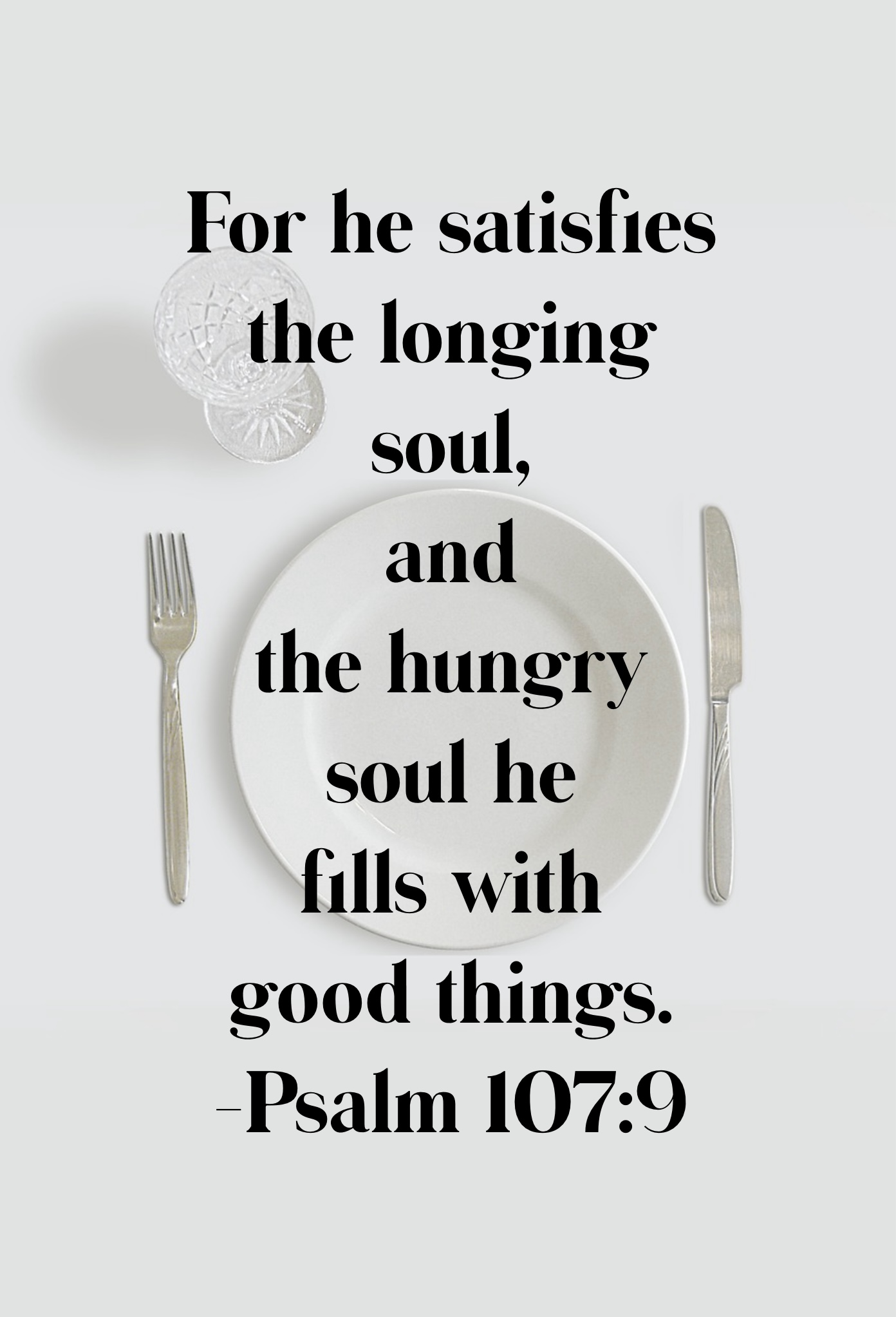
When we come to Him, we find that “he satisfies the longing soul, and the hungry soul he fills with good things” (Psalm 107:9).

That’s one reason Paul prays, and we can pray for ourselves and each other, “that according to the riches of his glory he may grant you to be strengthened with power through his Spirit in your inner being, so that Christ may dwell in your hearts through faith—that you, being rooted and grounded in love, may have strength to comprehend with all the saints what is the breadth and length and height and depth, and to know the love of Christ that surpasses knowledge, that you may be filled with all the fullness of God (Ephesians 3:16-19).

And you know what verse comes right after this one? It’s one we pull out of context to apply to any number of other things, but it was written in this context: that we might know God’s love and be filled with Him: “Now to him who is able to do far more abundantly than all that we ask or think, according to the power at work within us, to him be glory in the church and in Christ Jesus throughout all generations, forever and ever. Amen” (Ephesians 3:20-21).

Jeremiah prophesied that after Israel returned to the Lord, He would “satisfy the weary soul, and every languishing soul I will replenish” (Jeremiah 31:25). Other translations say “satiate,” “to satisfy to the full”.

God “redeems your life from the pit, who crowns you with steadfast love and mercy,
who satisfies you with good so that your youth is renewed like the eagle’s” (Psalm 103:4-5).

We can pray with Moses, “Satisfy us in the morning with your steadfast love, that we may rejoice and be glad all our days” (Psalm 90:14).

Now, as we “[behold] the glory of the Lord,” we “are being transformed into the same image from one degree of glory to another. For this comes from the Lord who is the Spirit.” (2 Corinthians 3:18). Someday, we “shall behold your face in righteousness; when I awake, I shall be satisfied with your likeness” (Psalm 17:15).

We try to fill up with other things. But only Jesus can satisfy our souls. We continually seek His truth, His fellowship, His presence, not because He didn’t satisfy us the first time, but because He satisfied us so well, we want to keep coming.

He satisfies the longing soul, and the hungry souls he fills with good things. Psalm 107:9)

(I don’t know the folks in this video—I just liked this arrangement. I have a lovely arrangement of this song sung by Sena Rice and Julie Potter on a CD titled Love Lifted Me, but I couldn’t find it on YouTube.)

(This post, especially the first few lines, was inspired by part of a message by Adrian Rogers titled The Secret of Satisfaction.)

(I often link up with some of these bloggers.)

Laudable Linkage

Laudable Linkage

I have a short but good list of links to share from this week’s reading.

Between Faith and Doubt: Five Questions for Our Skepticism, HT to Challies. “I sympathize with doubters who may feel drawn to Christianity but find plenty of objections to keep them at arm’s distance. If you’re drawn to the message of Jesus but can’t seem to get past your doubts, perhaps it would be helpful if I share how I worked through some of my doubts.”

The Sanction of Sin, HT to Challies. “Does a wolf in sheep’s clothing know what he’s doing? Of course. That’s what makes it so terrifying when you catch the glint of teeth inside the fleecy face. He came to eat sheep. But he knows if he comes leaping and snarling, his targets will scatter. He has to look nonthreatening. He has to look like one of them. He has to earn their trust.”

Lessons From a Job Season, HT to Challies. “In my own recent Job season, I yearned for answers that did not always come and prayed for relief that often seemed long delayed. But there were also plenty of ways in which I saw God’s hand clearly at work, and I want to share just a few of them.”

Is the Trend Reversing? “Where I live, in Scotland, for at least the last 75 years, Christianity has been in decline. (I wrote more about it here.) . . . It’s hard to imagine and sad to see how far we have come. However, over the last six months or so, I’ve had a growing sense that maybe things are changing, maybe the trend is starting to reverse. I’ve seen too many things and heard too many stories recently to reach any conclusion other than: God is doing something in Scotland!”

While it looks like things are out of control, behind the scenes there is a God who has not surrendered authority. A. W. Tozer

While it looks like things are out of control,
behind the scenes there is a God who has not surrendered authority.
A. W. Tozer

Friday’s Fave Five

Friday's Fave Five

The first week of June has been busy, fast, and also good. I’m sharing favorites of the week with Susanne and friends at Living to Tell the Story.

1. A surprise chicken biscuit. Jim brought back biscuits from Chick-Fil-A after his time at the gym Friday morning. Those are always welcome, but that day I had some extra tasks to do in the morning. So it was especially nice to have breakfast already made.

2. Leftovers and family time. Jason and Mittu had several friends over on Friday night. They had a good bit of food left over and asked if we wanted to share it on Saturday. So we enjoyed a meal with them and some fellowship.

3. Lunch with Melanie. We tried something different from our usual meeting places and went to Lulu’s Tea Room. We both had Chicken Pecan Quiche, and we enjoyed catching up with each other even more.

4. A long overdue haircut. I go to a walk-in place and usually have to wait for my stylist to finish with one or two people in front of me. When I walked in on Thursday, she had no customers, so I got right in.

5. A surprise in the flower arrangement. I noticed there was some kind of viny thing hanging from my spring flower arrangement on the front porch. I tried to pull it out, but it was stuck. Then I noticed it was attached to a little nest on top which kind of smushed the flowers. It has four eggs in it. I had been meaning to change the spring arrangement out for a summer one–I guess I’ll have to wait a bit now. 🙂

flower arrangement
nest and eggs

Have a good weekend!

Review: The British Booksellers

The British Booksellers by Kristy Cambron

The British Booksellers by Kristy Cambron shifts back and forth from WWI to WWII.

Amos Darby and Charlotte Terrington are secret childhood friends with a love for books. But that’s all they can ever be. Amos is a tenant farmer’s son, and Charlotte is an earl’s daughter. Though Charlotte loves Amos, her parents arrange her marriage with Will Holt, the future Earl of Harcourt.

Amos goes off to WWI and comes back scarred. He opens a book shop on Bailey Lane in Coventry, England, but becomes something of a recluse.

Charlotte, now widowed Lady Harcourt, has opened a bookshop as well across the lane with her daughter, Eden. The booksellers have been rivals and enemies for over twenty years, though Eden has tried to negotiate a peace between them.

When an American lawyer, Jacob Cole, shows up with alarming news for Charlotte and Eden, they fight back to keep their estate, even though it is becoming ever harder to maintain.

But when WWII begins and German bombers fly across Coventry, Amos, Charlotte, Eden, and Jacob have to work together to help each other and their neighbors survive.

The Coventry Blitz is referred to as the Forgotten Blitz. The London Blitz received so much attention, Coventry was overlooked in the press. Kristy Cambron says in her author’s notes that some officials suppressed news of the devastation of Coventry so as not to damage morale.

The story includes four Land Girls, part of the Women’s Land Army in Britain who helped out at various farms and homes across the nation. I had read of these women in other books, so it was neat to see their roles fleshed out a bit more.

The historical story was quite interesting, but Charlotte and Amos’ story was so touching.

With characters who have a common love for books and who become rival booksellers, the importance of books comes up often. One of my favorite quotes about this aspect:

Books are an escape that beckons the reader from the heavy burdens of this world.’ Isn’t that what you told me once? They can challenge as well as comfort. Entertain and educate. Even save us in ways we’d never expect. You’ve used the words art, oxygen, and life all to describe them. Anyone who can see such value in these pages ought to also see that they could take him away from a future he doesn’t want. If anything, that is what Dickens wrote for his characters. Isn’t that what you wish for yourself?

I listened to the audiobook, beautifully read by Barrie Kreinik. Happily, this time the audiobook did contain author’s notes about the historical aspects of the book. There weren’t any notes about what inspired the personal stories, though.

With going back and forth between timelines, it was a little hard to keep up sometimes with where we were in the story. It’s not as easy with an audiobook to flip back to the beginning of the chapter to check the dates. Plus 1914 and 1940 sound alike. But it didn’t take too long to get oriented.

Overall, I loved the book and the characters and felt for them.

Review: Be Complete (Colossians)

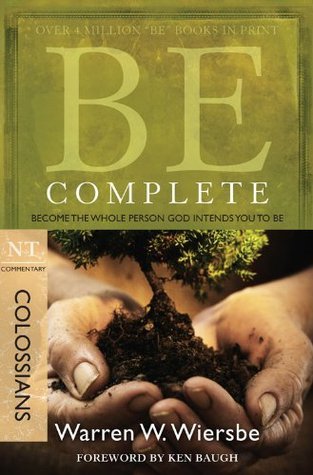
Be Complete (Colossians): Become the Whole Person God Intends You to Be by Warren Woersbe

I think most of Warren Wiersbe’s “Be” commentaries are about the same size. So a commentary on Isaiah, which has sixty-six chapters, discusses large portions at a time.

The book of Colossians just has four chapters. So Be Complete (Colossians): Become the Whole Person God Intends You to Be covers just a few verses of Colossians in each of its twelve chapters.

Since Colossians is so densely packed, and the ESV Study Bible had a lot of notes on it as well, plus Wiersbe’s book had more detail, I decided to slow down my usual pace of reading and take time to soak in what was written.

Wiersbe calls Colossians “one of the most profound letters Paul ever wrote.”

The church in Colossae was not one that Paul started; in fact, he had never been to that city. But Paul had been in nearby Ephesus for three years, from which the Bible says “‘all they which dwelt in Asia heard the word of the Lord Jesus, both Jews and Greeks'” ‘ (Acts 19:10). This would include people in Colossae, Laodicea, and Hierapolis.” A Colossian named Epaphras seems to have heard Paul preach in Ephesus and then brought the gospel back to Colossae.

At the time Colossians was written, Paul was in prison. Epaphras was with him and evidently shared that a dangerous teaching was making the rounds in Colossae. So Paul wrote to help these believers. Wiersbe believed the false teaching was Gnosticism; the ESV Study Bible notes say that “an improved understanding of Gnosticism” due to more information having been discovered about it has led scholars to think Gnosticism was not the problem, but they don’t know exactly what false teaching was being promoted. Nevertheless, there’s much we can learn from Colossians even without knowing exactly what teaching was being combated.

Paul begins the book with greetings and thankfulness for the Colossians faith. Then he shares what he prays for them, one of my favorite prayers in the Bible:

And so, from the day we heard, we have not ceased to pray for you, asking that you may be filled with the knowledge of his will in all spiritual wisdom and understanding, so as to walk in a manner worthy of the Lord, fully pleasing to him: bearing fruit in every good work and increasing in the knowledge of God; being strengthened with all power, according to his glorious might, for all endurance and patience with joy; giving thanks to the Father, who has qualified you to share in the inheritance of the saints in light. He has delivered us from the domain of darkness and transferred us to the kingdom of his beloved Son, in whom we have redemption, the forgiveness of sins.

I have prayed this often for myself and loved ones.

Paul then writes about the preeminence of Christ, “the image of the invisible God,” the one who created everything and holds it all together, the head of the church. “In him all the fullness of God was pleased to dwell, and through him to reconcile to himself all things, whether on earth or in heaven, making peace by the blood of his cross” (1:19-20).

And, amazingly, “you, who once were alienated and hostile in mind, doing evil deeds, he has now reconciled in his body of flesh by his death, in order to present you holy and blameless and above reproach before him” (1:21-22).

Paul says his stewardship was “to make the word of God fully known, the mystery hidden for ages and generations but now revealed to his saints. To them God chose to make known how great among the Gentiles are the riches of the glory of this mystery, which is Christ in you, the hope of glory. Him we proclaim, warning everyone and teaching everyone with all wisdom, that we may present everyone mature in Christ. For this I toil, struggling with all his energy that he powerfully works within me” (1:25-29). In the Bible, a mystery wasn’t something to figure out from clues: it was something that was not previously revealed but now is.

Paul warns them to “See to it that no one takes you captive by philosophy and empty deceit” or “delude(s) you with plausible arguments” (2:8, 4).

Paul goes on to exalt Christ as the one “in whom are hidden all the treasures of wisdom and knowledge” (Colossians 2:3). As we received Him, we’re to “walk in him, rooted and built up in him and established in the faith, just as you were taught, abounding in thanksgiving (2:6-7).

After sharing the gospel, Paul gives practical instruction for how the gospel affects our lives, families, and workplaces. There are certain behaviors we’re to put off, others we’re to put on. We’re to “seek the things that are above, where Christ is, seated at the right hand of God. Set your minds on things that are above, not on things that are on earth” (3:1-2).

Paul wraps up his teaching by encouraging believers to pray, give thanks, and “Walk in wisdom toward outsiders, making the best use of the time. Let your speech always be gracious, seasoned with salt, so that you may know how you ought to answer each person” (4:5-6).

I can get so caught up in the affairs of this life, I need the reminder to “set my mind on things above” and exalt Christ above all.

A few more quotes from the book that stood out to me:

The gospel message does not center in a philosophy, a doctrine, or a religious system. It centers in Jesus Christ, the Son of God (p. 30, Kindle version).

Uniformity is the result of compulsion from the outside; unity is the result of compassion from the inside (p. 37).

Satan is so deceptive! He likes to borrow Christian vocabulary, but he does not use the Christian dictionary (p. 43).

The false teachers in Colossae, like the false teachers of our own day, would not deny the importance of Jesus Christ. They would simply dethrone Him, giving Him prominence but not preeminence. In their philosophy, Jesus Christ was but one of many “emanations” that proceeded from God and through which men could reach God. It was this claim that Paul refuted in this section (p. 57).

In the New Testament, saints are not dead people who during their lives performed miracles and never sinned. New Testament saints were living people who had trusted Jesus Christ. Paul wrote this letter to living saints (Col. 1:2), (p. 73).

Prayer is not our trying to change God’s mind. It is learning what is the mind of God and asking accordingly (1 John 5:14-15) (p. 81).

It does little good if Christians declare and defend the truth, but fail to demonstrate it in their lives (p. 113).

Paul did not ask for the prison doors to be opened, but that doors of ministry might be opened (1 Cor. 16: 9; Acts 14: 27). It was more important to Paul that he be a faithful minister than a free man. It is worth noting that in all of Paul’s prison prayers, his concern was not for personal safety or material help, but for spiritual character and blessing (p. 154).

I like how Wiersbe closed his commentary on Colossians:

As we come to the close of our study of this remarkable letter, we must remind ourselves that we are complete in Jesus Christ. We should beware of any teaching that claims to give us “something more” than we already have in Christ. All of God’s fullness is in Him, and He has perfectly equipped us for the life that God wants us to live. We do not live and grow by addition, but by appropriation (p. 173).

Life Doesn’t Always Turn Out Like We Thought It Would

Life doesn't always turn out like we thought it would.

Several years ago, two individuals from my college who were known for their close walk with the Lord found each other and began to date. They married and attended a local church, the same one we came to later, while the husband finished his graduate degree. He became an elder. The wife was active in the ladies ministry and teaching children. They had a couple of children.

After several years, they left to go to the mission field. There never seemed a family more perfect for missionary work.

After a few years, our pastor went to visit them on the field. He had nothing but positive things to say. He reported that the wife, in particular, seemed in her element.

A few years later, though, we received devastating news. The husband had been caught in infidelity. The family came home, and the elders met with the husband. He refused to repent, saying he loved his sin too much.

The wife was crushed. Not only had her husband turned into someone she didn’t know any more, but she lost the ministry she loved and was so suited for. Plus their coworkers back on the mission field had to pick up the pieces and minister to the people who were shattered by the fall of their leader.

I don’t know if the wife asked herself these questions, but in her place, I would have wondered if I made a mistake somewhere along the way. Had I married the wrong man? Had I missed signs that he had fallen away from the Lord? Had I failed him in some way that caused him to turn to someone else?

I do know that the pastor encouraged her that the situation was not her fault. Not that she was sinless, of course. No one is. But her husband’s sins were his own and he bore the responsibility of them. She was in the center of God’s will even with such things going on in her life.

It’s a shock that you can do everything “right,” so to speak, and end up with a life seemingly in shambles.

I imagine Joseph must have felt the same way, going from the favored son to being sold as a slave by his own brothers and then thrown into an Egyptian prison.

Or Job, described by the Lord as an upright man, yet he lost everything he owned as well as ten children all in one day.

Or John the Baptist. He was the forerunner of the Messiah, preparing the way for Jesus, pointing people to Him. Yet he ended up in prison, and ultimately was beheaded.

The Apostle Paul enjoyed a little over twenty years of public ministry. He took three long missionary trips, shared the gospel with who knows how many people, instructed and encouraged believers, and wrote several epistles which were incorporated into the canon of Scripture.

To be sure, life wasn’t all rosy. Paul experienced beatings, stonings, shipwrecks, sleeplessness, hunger, and more (2 Corinthians 23-28). But overall, his life could be considered a success in terms of being able to minister to large numbers of people.

But then Paul got arrested. He had not done anything wrong, but others supposed he had, and the resulting riot ended with Paul being taken into custody.

Paul was imprisoned for two years, released for a couple, then imprisoned again for a couple of years until he was beheaded.

Paul went from a leading apostle and well-known traveling preacher to a prisoner for many of his last years.

To the world, it might look like Paul’s life ended in failure.

But God encouraged Paul all through the book of Acts that he was on the right path.

And Paul’s ministry didn’t end just because he was in prison.

In the course of explaining why he was imprisoned, Paul was able to share his testimony before Felix, the governor of Judea, Festus, the governor who replaced Felix, and King Agrippa—all people he would not have been able to talk to under normal circumstances.

Paul wrote Ephesians, Philippians, Colossians, and Philemon during his first imprisonment and 2 Timothy during his second. Philippians is one of the most joyful books in the Bible, and Philippians and Colossians both have an emphasis on Thanksgiving—though they were written from prison.

Paul was chained to a Roman guard while imprisoned, so the guards heard all he had to say to his visitors. Paul tells the Philippians, “All the saints greet you, especially those of Caesar’s household” (Philippians 4:22). So evidently the gospel had filtered even into Caesar’s staff from Paul’s witness.

Friends were able to come talk with Paul and be taught or encouraged by him. Acts ends by telling us Paul “welcomed all who came to him, proclaiming the kingdom of God and teaching about the Lord Jesus Christ with all boldness and without hindrance” (Acts 28:30-31).

“Without hindrance.”

In 2 Timothy 2:9, Paul says, “I am suffering, bound with chains as a criminal. But the word of God is not bound!” Though Paul was bound, the word of God was not.

God can redeem and work in and through a life in shambles.

It was Paul who wrote of God’s strength in our weakness: “But he said to me, ‘My grace is sufficient for you, for my power is made perfect in weakness.’ Therefore I will boast all the more gladly of my weaknesses, so that the power of Christ may rest upon me. For the sake of Christ, then, I am content with weaknesses, insults, hardships, persecutions, and calamities. For when I am weak, then I am strong” (2 Corinthians 12:9-10).

And what God can do in our lives through suffering: “Not only that, but we rejoice in our sufferings, knowing that suffering produces endurance, and endurance produces character, and character produces hope, and hope does not put us to shame, because God’s love has been poured into our hearts through the Holy Spirit who has been given to us” (Romans 5:3-5).

And the glory that waits us after suffering: “So we do not lose heart. Though our outer self is wasting away, our inner self is being renewed day by day. For this light momentary affliction is preparing for us an eternal weight of glory beyond all comparison, as we look not to the things that are seen but to the things that are unseen. For the things that are seen are transient, but the things that are unseen are eternal” (2 Corinthians 4:16-18).

Others in the Bible found the same grace to endure.

Joseph was released from prison and became second to Pharaoh, eventually saving his own family, the future nation of Israel, from starvation.

Job’s fortune, family, and health were all restored to him, but most important of all, he encountered God in a way he never had before.

John was not spared in this life, but there was a place prepared for him in heaven.

The wife I mentioned at the beginning found God’s grace to sustain while she did the best she could in difficult circumstances.

We tend to equate spiritual success and God’s blessings with smooth sailing and positive circumstances. Saints through the ages have not found this to be the case. In fact, some whose lives seem to shine brightest for the Lord have experienced great trials—maybe because they have to seek the Lord and His strength to navigate their circumstances.

Meanwhile, God’s Word encourages us to “Rejoice in hope, be patient in tribulation, be constant in prayer” (Romans 12:12) because “after you have suffered a little while, the God of all grace, who has called you to his eternal glory in Christ, will himself restore, confirm, strengthen, and establish you” (1 Peter 5:10).

1 Peter 5:10

(I often link up with some of these bloggers.)