Review: Whose Waves These Are

Whose Waves These Are by Amanda Dykes

Whose Waves These Are by Amanda Dykes begins in September, 1944. Identical twin brothers in a small Maine village, Ansel-by-the -Sea, have just turned eighteen. Enlistment in military service has been closed “to protect the home-front work force,” but the draft is in effect. A letter arrives from the President ordering one of the twins to report for duty. Robert Bliss assumes, hopes, the letter is for him. He’s single, ready to go. His brother, Roy, is married to Jenny–the girl Robert has loved for years but didn’t speak up for soon enough. Roy and Jenny have just discovered they’re going to be parents.

But, no. The letter is for Roy.

Robert proposes that he could go in Roy’s place. They’ve stood in for each other many times. But Roy argues that it’s his turn to help save others.

Then we’re whisked to Chicago in 2001, where Annie Bliss crunches numbers. She was an anthropology major, but her first assignment to help a small village ended in disaster. In her current job, at least she can’t hurt anybody.

Then she receives news that her “Grandbob” back in Ansel-by-the-Sea is in grave condition in the hospital.

Annie speeds back to Maine, where she had visited as a child when her parents’ deployments overlapped and they left her with Bob. There she is known as “Bob’s Annie.”

While Bob is unconscious, Annie gets reacquainted with the people she knew. There’s one newcomer since she lived there, a quiet, brooding postman and EMT named Jeremiah Fletcher, or Fletch. Annie discovers boxes of rocks in a closet in Bob’s house. Jeremiah shows her even more in the boathouse. Bob has left her a key, but no word about what it belongs to. As Annie asks around town, people either don’t know or aren’t sharing what Bob was up to.

The point of view switches back and forth between these two time frames. The older one unfolds what happened with the brothers during the war and the years afterward. As one grieves the loss of the other, he writes the only poem of his life asking for rocks to represent people lost during the war. He plans to build something to represent hope and healing. But another tragedy halts his efforts.

The twenty-first century timeline shares Annie’s story and shows her discovering the pieces of her history that she had not known.

I loved this book. I just wanted to sit and hug it after finishing it. It left me wishing I could visit Ansel-by-the-Sea, if it were a real place and these people lived there. I love books with a strong sense of place, whose stories could not have taken place anywhere else.

I loved the characters. I loved the way the author unfolded and wove together everyone’s stories.

I also loved many of the author’s turns of phrases. A few:

A wake is a ripple left after a departure (p. 41).

He said it was time to be part of the unbreaking, of the making of something. He told me there was a Carpenter who was going to build me right up, too (p. 75).

She looks at Bob lying there, face mapped in wrinkles carved from compassion (p. 79).

She’s used to city life, rich in its own way, with an energy and bustle from the lives there, but where eye contact is a safety issue and a good neighbor is your insurance company’s tagline (p. 87).

Annie tries for small talk. Which, as she’d learned, could sometimes lead to large talk. Which made the small talk bearable (p. 131).

Don’t get stuck in the dark . . . There’s a whole lotta light . . . Go there instead (p. 171).

Saluting—a stance of the fiercest heartache schooled into firmest respect (p. 173).

The song she offered up was all the more beauitful in its wavering and brokenness. Courageous, and offering. The laying out of her broken heart before her God (p. 188).

Words begin to light up, pour right through, like someone turned on a faucet and he’s just trying to catch them. They’re not his, really, he’s just the one scratching them out (p. 188).

He slaps courage back into himself and goes to church (p. 202).

I choose to believe there is some shred of light left in him. A light I pray he fights for (p. 238).

His thoughts are becoming more like an ongoing conversation with heaven, these days—usually more questions than anything else. And this was a big one. What now? (p. 249).

He looks like someone who’s been cut loose to drift and hasn’t found shore (p. 252).

Not healed . . . but held. Like the pieces of him have been gathered right up, and that is enough for now. The rest will follow (p. 275).

The strength of the storm does not change whose waves these are. There is One mightier still (p. 348).

I was motivated to read this book because I had seen high praise for it. That praise was well-deserved. I’ll be looking up more of Amanda Dykes’ books to read.

Review: You’re the One that I Want

You're the One that I Want by Susan May Warren

You’re the One that I Want is the sixth book in Susan May Warren’s Christiansen family series set in Deep Haven. Minnesota.

Though each book involves the whole family, each focuses primarily focuses on one of the adult children. This time it’s Owen’s turn, the fifth child and youngest brother.

Owen had figured heavily in the first two books as well, especially the second. He had played hockey since his earliest childhood and excelled through the ranks until he landed a spot on the MN pro team. The fame, acclaim, and money all went to his head, however. He became something of an entitled jerk until a tragic accident took the sight in one eye, derailing his career.

Exploding with anger and grief, Owen roamed about, working different jobs, leaving a trail of one-night stands behind him.

What he doesn’t know is that one of those encounters resulted in a pregnancy. The girl in question later met and fell in love with Owen’s brother, Casper.

If that sounds kind of soap-opera-ish, yes, even one character admitted as much. However, people do get themselves entangled in such messes, though maybe not within their own family.

As this book opens, Owen’s anger has been spent. He’s cleaned up his act, more or less, no longer involved in reckless behavior. He’s on a crab-fishing boat in the Bering Sea with a reputation for kindness and hard work. He just takes life a day at a time, too ashamed to go home.

Scotty is the captain’s daughter and first mate. Her mother had died in childbirth. Her father makes her call him Red rather than Dad and suppresses emotion. Scotty has been on the boat most of her life. She’s had to be tough to command the men in her father’s stead and ward off any unwanted attention.

When Scotty is swept overboard in a storm, Owen jumps in to save her. They spend a night in a life raft until they’re rescued, nursing injuries and telling each other their lives.

Casper and Raina had worked out their issues in the fourth book. Casper wants to marry Raina and raise her daughter as his own. But he feels the right thing to do would be to track down Owen, tell him the situation, and bring him home. He wants to get Owen’s blessing and ask him to sign over his rights to his daughter.

Meanwhile, Casper is unaware that he’s wanted for questioning in the murder of Raina’s old boyfriend, Monty. He and Casper had an altercation the night Monty was killed, and Casper seems to be the last one who saw him alive.

When Owen and Casper try to fly home, Casper is taken into custody. Scotty, who has taken a job in the police force in Alaska since her dad is selling their boat, agrees to accompany them back to Deep Haven in an official capacity. Owen is thrilled to have more time with her.

There, Scotty encounters the love and loyalty of a family like she has never known. Though she’s drawn to them, she’s also not sure she would ever fit in. She’s had a very different upbringing and has no use for faith—even though she did break down and pray through Owen’s injuries.

If that sounds like a lot of drama for one book—it is! I’ve mentioned before that though these books fall into the romance genre, they’re something of a family drama as well.

Reading, or listening to, six of these books in a row, one catches some of the writer’s repeated quirks. Here are a few:

  • Several of the female characters are said to catch their lip in their teeth.
  • All the males are “sculpted” and “chiseled.”
  • Most of the kissing scenes involve saying what one or the other “tastes” like, usually involving whatever they last ate or drank (yuck) and and then adding that they taste of “freedom” or “summer days” or some such.

I roll my eyes at some of that, but that seems to go with this genre—one reason I don’t read it much.

I did like how the series wrapped up, though. Amid some of the silly moments were embedded some deep truths about faith, grace, and forgiveness.

Some of my favorite quotes:

In order to live without the haunting voice of regret, you must learn to forgive yourself, to embrace mercy, to open your eyes and see God in your past and His grace in your future. Your mistakes don’t define you. Your past doesn’t define you. You are not the sum of your bad decisions. You are the decision you make right now.

Fresh-baked cookies do not make a successful marriage . . . It’s knowing each other, valuing the same things, being what the other person can’t be, making each other better people.

So you made some bad choices. Some of God’s best players were His imperfect, broken prodigals. In fact, iffy players are God’s best picks. He specializes in short-tempered, reckless, flawed people to accomplish his plans.

God is constantly using broken, messy people to restore the world and bring glory to Himself, to touch other people.

Once you became a Christiansen, you had to get used to being loved large, to belonging to a family that didn’t have it all figured out, but weathered life by holding on to faith.

Unfortunately, the audiobooks didn’t include author’s notes, and Susan didn’t have any notes or background information on her website for the last two books in the series as she did for the previous ones.

Besides these major books in the series, there’s a prequel novella focused on the relationship of the parents, John and Ingrid, as well as two Christmas novellas. There’s also another collection of novels set in Deep Haven written after the Christiansen family series with other authors. However, though I enjoyed the series, I want to get away from romances for a while. I’ll probably read John and Ingrid’s story just to finish out the series and save the Christmas ones for December.

When People Don’t Understand

When People Don't Understand

Whenever Hannah’s story is taught from the Bible, one phrase stands out to me that I rarely hear comment on.

Hannah dearly longed for a child. In those days, men had more than one wife, and her husband’s other wife did have children. That would have been hard enough, but this rival wife “used to provoke her grievously to irritate her, because the Lord had closed her womb.” This went on for years.

It seems understandable that Hannah would be grieved. But her husband, Elkanah, said, “Hannah, why do you weep? And why do you not eat? And why is your heart sad? Am I not more to you than ten sons?”

This is the part of the story I don’t hear teaching about. Elkanah seems a little clueless here. At the worst he sounds arrogant: “Hey, you’ve got me. What else do you need?”

To give him the benefit of the doubt, he may have been thinking of the shame associated with childlessness in that day, or the concern that a childless widow would have no one to care for her after her husband died. Perhaps he means, “Don’t worry about those things, Hannah. My status and provision are enough.”

Even with the best of intentions, Elkanah didn’t seem to understand the longing of his wife’s heart, not just for status or elder care, but for her own child to love. Her yearning for a child did not lessen her love for her husband.

So what did Hannah do? She went to the temple to pray.

Normally this would be a good thing to do. We’re often told these days to draw close to our spiritual community. But sometimes our community rubs salt in the wound instead of helping.

This story occurred during the time of the judges, when “everyone did what was right in his own eyes,” leading to some of the most bizarre behavior recorded in the Bible. This was a low point in Israel’s history. Apparently, the priest, Eli, had seen so little fervent prayer that he thought Hannah was drunk and rebuked her.

So what’s a woman to do when her loved ones and her spiritual community don’t understand her, and, in fact, add to her burden?

Hannah poured out her heart to the Lord. She “was deeply distressed and prayed to the Lord and wept bitterly.” She could safely share the depths of her feelings and cares with Him. She knew He was the only one who could meet her need.

She answered kindly. When Eli accused her of being drunk, she didn’t lash out at him. She just explained a little about her heart’s burden. There’s no record that she responded to her rival in kind or fussed at Elkanah.

She did not become bitter. She could have harbored negative feelings against everyone involved, but there’s no record that she did.

She had faith. After she prayed and asked the Lord for a son, she promised to give her child back to God to serve Him. And then “her face was no longer sad.” She left her burdens at His feet. When God did answer her prayers with a son, she kept her vow and gave Him the glory and praise.

In our day, we have more of the Scripture than Hannah did. So we have an extra layer of help. Hebrews 2:17-18 says, “Therefore he [Jesus] had to be made like his brothers in every respect, so that he might become a merciful and faithful high priest in the service of God, to make propitiation for the sins of the people. For because he himself has suffered when tempted, he is able to help those who are being tempted.” The writer of Hebrews goes on to say in 4:15-16: “For we do not have a high priest who is unable to sympathize with our weaknesses, but one who in every respect has been tempted as we are, yet without sin. Let us then with confidence draw near to the throne of grace, that we may receive mercy and find grace to help in time of need.”

Jesus is more than our example: He is our Lord and Savior. But He has also suffered the same things we do and shown us how to cope with them.

I don’t know if anyone in history was more misunderstood than Jesus. His family, his disciples, and his community all questioned His teaching and His mission.

What did He do?

He kept sharing truth. He knew some would never understand. He knew His disciples wouldn’t understand much until later. He kept sharing truth anyway, trusting that one day it would make sense to them.

He prayed frequently to the One who did understand and could help others understand, His Father.

He kept loving and working with people even when they misunderstood.

He forgave those who wronged Him. “When he was reviled, he did not revile in return; when he suffered, he did not threaten, but continued entrusting himself to him who judges justly” (1 Peter 2:23).

When others misunderstand our hurts and concerns, it’s easy to pull away and wrap a protective cloak around ourselves.

Though He often does give us human helpers to counsel, encourage, uplift, and empathize, sometimes they fail us. We need not hold it against them: they’re only human. We fail others sometimes, so we shouldn’t be surprised when others fail us. And sometimes He takes them away so that we may draw closer to Him.

We can do what Hannah did: pour out our hearts to the only One who can truly understand our heart’s longings and our deepest needs. As the old hymn says, “No One Understand Like Jesus.” He may not answer our prayer exactly like we want. But we can trust He knows best.

Because He has been in our place, we know He empathizes with us. He understands thoroughly; He cares intimately; He alone has the power and the wisdom and the grace to meet our needs in the best possible time and way.

1 Kings 8:39

(Parts of this post have been revised from the archives.)

(I often link up with some of these bloggers.)

Laudable Linkage

Laudable Linkage

Here’s my latest roundup of good reads found online:

Courage for Those with Unfatherly Fathers. HT to Challies. “This is our Heavenly Father. Though our earthly dads were meant to reflect him, he in no way mirrors them. Take courage, and run with abandon to the open arms of your Father.”

Should Ethnicity and Race Never Cross Our Minds When We Meet Another Believer? “The notion of being ‘colorblind’ doesn’t lend itself to oneness but to blindness. It suggests that if we recognize or admit differences, we would be forced to say some are better than others. No, we should recognize the differences and celebrate that God’s image-bearers come in all shapes and sizes and colors, and we are the beneficiaries of His providence in creating us this way.”

4 Reasons You Shouldn’t Be Colorblind. This was referenced in the above post but was so good I wanted to list it separately. “I’d like to suggest that we aren’t colorblind, we don’t need to be colorblind, and we actually should strive to not be colorblind. Colorblindness leads us in the wrong direction. Instead, I want to encourage us to be colorsmart.Here are four reasons why.”

Theology and the Eclipse. “An eclipse is more than a cool phenomenon of nature. It is an extra gift that God built into the structure of the universe to arrest the attention of humans amid their busy little ant-like activities long enough to listen to creation’s silent, speechless declaration of the Creator’s glory (Ps 19:3).”

What to Expect When a Loved One Enters Hospice. “With a million and a half people in the U.S. receiving hospice care annually, many families will walk this troubling road, suffering doubts and heartache along the way. How do we shepherd caregivers and families as they aim to love the dying? How do we walk with them through the valley of the shadow of death, reminding them all the while of the Good Shepherd whose love covers them when the light dwindles (Ps. 23:4)?”

Lessons Learned from a Wolf Attack, HT to Challies. “Some of the most painful lessons of ministry are learned when a wolf in sheep’s clothing infiltrates your church. We had a wolf once, a local man I’ll call Ahab*, and it has taken me years to know how to write about it. The things we learned from exposing him, trying to counter him, and then responding to the carnage he caused have been forever branded on my soul.”

It’s Okay to Be a Two-Talent Christian. “There is no shame in being a one-talent servant when God gave you one-talent ability. There is no need to compare yourself unfavorably to those who have achieved more success on the basis of their greater gifts. And that’s because God’s assessment of you is made on the basis of what you did with what he gave you.”

Hospitality Is not a Personality Trait. “If you limit your idea of hospitality to what can be flawlessly presented in social media squares, you’ll miss her: the woman who is more comfortable working a spreadsheet than a room full of people . . . the woman who is analytical and introverted and a hospitable force for the kingdom of God. “

Quite . . . Able to Communicate,” HT to Challies. A sweet story from Brother Andrew’s book, God’s Smuggler, about a time when he and his contacts didn’t speak the same language.

Robert Murray McCheyne

No amount of activity in the Father’s service
will make up for the neglect of the Father Himself.
– Robert Murray McCheyne

Friday’s Fave Five

Friday's Fave Five

I’m joining in once again with Susanne and friends at Living to Tell the Story to share the blessings of the week.

1. Timothy’s birthday! My grandson turned 10 this week! Double digits!

Grandson's birthday

He wanted a banana split pie instead of cake, and Mittu made a gorgeous and tasty one. And he also wanted a Buc-cee’s themed party. He loves that place, which, if you don’t know, is basically a gas station that advertises the cleanest bathrooms ever, but also is something like a mini mall. I guess a lot of other people like it as a party theme, too, because there were party plates and decorations with Buc-cee the beaver all over them. 🙂

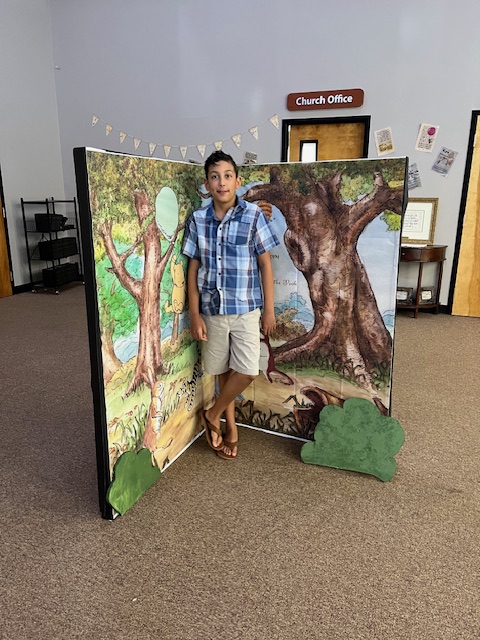
2. Play and dinner. The school associated with our church was putting on a play of Winnie the Pooh and invited the church folks to come for a free showing of their last dress rehearsal Tuesday afternoon.

Winnie the Pooh play

3. Dinner out. After the play, we tried out a new Mexican food restaurant. We hadn’t actually eaten in a restaurant in a long time: we usually get takeout to bring home. It was really noisy, but otherwise enjoyable.

4. A rediscovered turntable. We have our medications in a corner cabinet in the kitchen. There’s a lot more storage on either side of the cabinet door, but it’s hard to get to. So we have Lazy Susan turntables on one shelf for our prescription medications. The shelf below has nonprescription medicines and supplements, and we were getting so many that I was frustrated having to move containers around to find what I needed. Then I remembered I had tucked away in the pantry a turntable I had bought for another cabinet but which was too big to fit there. Thankfully, I hadn’t given it away yet, and it worked perfectly for the stray medications.

5. Tooth removal recovery. Last Friday I had just had a problem tooth removed. I was envisioning chipmunk cheeks, living on broth and applesauce, and constant pain. It did hurt, and I was on soft foods and Tylenol for a few days. But it wasn’t as bad as I was expecting. It’s still a little tender, but thankfully, there have been no complications.

And that wraps up another week! I hope yours has been enjoyable, too.

Review: The Wonder of You

The Wonder of You by Susan May Warren

The Wonder of You is the fifth in Susan May Warren’s Christiansen family series.

So far, each book has focused on one of the six siblings in small-town Minnesota family in birth order. The last two books flip the order, though.

Amelia is the youngest and always wanted to venture out, away from Deep Haven. She took a photography course in Prague, but came home early. She had met a man there, Roark St. John, and thought they were in love. But when she saw him with someone else, she came home, brokenhearted.

She’s disappointed in herself, but figures maybe she was wrong about her life direction: maybe she’s meant to stay in Deep Haven after all and marry the boy she’s known all her life and dated through high school, Seth.

Then Roark shows up on her family’s doorstep one day with flowers and an apology. Her brothers run him off, but Amelia feels she should at least listen to what he has to say.

Roark has given himself two months to try to win Amelia back before giving in to his uncle’s insistence that he come home to Brussels and take over the family business.

Amelia has insisted that there be no lying between them, but Roark is not sure how much he should tell her about his past mistakes and his fear that God has forsaken him.

In one subplot, a visiting family drowns, leaving behind their newly-adopted daughter from Ukraine who speaks no English. She comes to stay with the Christiansen family, growing close to Grace. When it appears she might be sent back to the Ukraine, Grace begins to wonder if she and Max could adopt her. But Max had long ago determined not to have children. He carries the gene of a disease that killed his father, and he is not going to leave behind fatherless children to experience the same tragedy he did.

Amelia’s character is somewhat immature, but she’s only twenty. She deals with what a lot of young people go through in trying to discern what God wants them to do in life. I liked that the author brought out that calling is not only a matter of which guy, which vocation, and which country one should choose, but having a heart that pursues God, trusts in His sufficiency, and wants to do His will.

And Roark needed to learn that the past is forgivable and God gives grace for each new day.

As I’ve said before, I like stories where the characters learn and grow, whether that story is a romance or another genre. That’s certainly the case in this series.

Don’t Just “Don’t”

What happens if someone tells you not to think of the number “eight?”

It’s likely that “eight” will be all you can think about. The more you try not to think about it, the more it fills your mind.

But if we think of other numbers, work equations, read or concentrate on something else, then it’s easier not to think about “eight.”

Erwin Lutzer shared that helpful illustration in How to Say No to a Stubborn Habit.

When we try to avoid doing the wrong thing, too often we concentrate on that thing even in an effort to keep from it.

Every dieter knows that if your mind is filled with trying to avoid a certain temptation (chocolate for me), sooner or later you’re going to find an excuse to partake of it.

We once knew a preacher whose main sermon topic was battling sexual sin. What happened to him? He fell into sexual sin.

The Bible does tell us what things are wrong, what things we should stop doing. We shouldn’t minimize or overlook the “don’ts” in the name of love and positivity or an effort to be inoffensive.

But the Bible doesn’t stop with telling us what to avoid.

It also tells us what to pursue.

For instance, Ephesians 4:28 says, “Let the thief no longer steal, but rather let him labor, doing honest work with his own hands, so that he may have something to share with anyone in need.” It’s good and necessary to stop stealing, but the converted thief shouldn’t stop there. He needs to work not only to provide his own needs, but to give to others.

Likewise, 2 Timothy 2:22 instructs us to “flee youthful passions and pursue righteousness, faith, love, and peace, along with those who call on the Lord from a pure heart.” Telling yourself over and over “Don’t think about lust” is probably not going to work. We not only flee youthful passions, but we pursue “righteousness, faith, love, and peace.” And we don’t do this alone, but “with those who call on the Lord from a pure heart.”

The next couple of verses in 2 Timothy tell us to avoid “foolish, ignorant controversies” which lead to quarrels. Instead, “the Lord’s servant must not be quarrelsome but kind to everyone, able to teach, patiently enduring evil, correcting his opponents with gentleness.”

Colossians 3:5-9 tells us to “Put to death ” or “put away” “sexual immorality, impurity, passion, evil desire, and covetousness, which is idolatry . . . anger, wrath, malice, slander, and obscene talk from your mouth. Do not lie to one another.”

But then it goes on to tell us “Put on then, as God’s chosen ones, holy and beloved, compassionate hearts, kindness, humility, meekness, and patience, bearing with one another and, if one has a complaint against another, forgiving each other; as the Lord has forgiven you, so you also must forgive. And above all these put on love, which binds everything together in perfect harmony. And let the peace of Christ rule in your hearts, to which indeed you were called in one body. And be thankful.”

And how do we do this?

We’re not aiming just for “positive thinking”: we’re seeking a balanced focus. We don’t do good things in order to gain favor with God. We focus on these good traits not to become righteous but rather to demonstrate that God has changed us and made us righteous.

Ephesians 4:17-32 tells us to “be renewed in the spirit of your minds.”

Colossians 3:16:17 says, “Let the word of Christ dwell in you richly, teaching and admonishing one another in all wisdom, singing psalms and hymns and spiritual songs, with thankfulness in your hearts to God. And whatever you do, in word or deed, do everything in the name of the Lord Jesus, giving thanks to God the Father through him”

Romans 12:2 tells us “Do not be conformed to this world, but be transformed by the renewal of your mind.”

Colossians 3:10 says us our “new self…is being renewed in knowledge after the image of its creator.”

How do we renew our minds in the knowledge of Him? By beholding Him in His Word: “And we all, with unveiled face, beholding the glory of the Lord, are being transformed into the same image from one degree of glory to another. For this comes from the Lord who is the Spirit” (2 Corinthians 3:18).

As we see Him in His Word, we get to know Him better, and we become more like Him. As we pursue the pure and good and holy, lesser things fall away.

(Revised from the archives)

(I often link up with some of these bloggers.)

Laudable Linkage

Laudable Linkage

I have several good reads to share with you today.

God the Father: Who Am I to You? “God the Father was someone to fear, someone to please so I wouldn’t “get into trouble.” I knew Jesus died for me, and He’s the one to whom I related. As a result, I had a warped view of myself in God, too. I don’t know when it happened, but eventually I began to see the flaw in my thinking. I began to see ways in which God—and especially God the Father—loved me. Just as I am.”

Why Cancel Culture Needs the Breathtaking Mercy of God’s Kingdom, HT to Challies. “Cancellation is possible these days for anyone who commits actions or makes statements that one group or another considers beyond the pale. But what happens when cancel culture meets the breathtaking mercy of God’s kingdom?”

What Temptation Is and Is Not, HT to Challies. “Temptation, therefore, is not a friendly voice but a deadly invitation. To better understand the nature of temptation, let’s consider what it isn’t and what it is.”

Both Worm and Worthy, HT to Challies. “In these Scriptures and songs, we find a good corrective to the temptation to overestimate ourselves. But the answer to a wrongheaded emphasis on humanity’s “worthiness” isn’t to focus solely on what has sometimes been called “worm theology.” There’s a way of going astray here on the other side, of debasing humanity to the point we lose the power in the paradox of original sin.”

Advocates, not Merely Adherents: Lay-of-the-Land Observations and Challenges for Complementarians, HT to Challies. “Over the past five to ten years, it seems to me that we have had a swing of momentum: self-inflicted wounds; moral failings by leaders; crudeness and rudeness on social media and other places; militant egalitarianism that is always on the hunt for a complementarian to shoot down. All of this and more presents those of us who are complementarians with significant challenges.”

A Beautifully Mundane Life. “We live in the day of the superlative. Normalcy is so twentieth century. Everything today must be ‘hard core’ or ‘radical’ or ‘extreme,’ even in the church. (Bonus points if you spell it ‘Xtreme.’) The push for Christians to take risks and get out of their comfort zones for the sake of gospel advance is good. But an unintended consequence of all the talk about “risk-taking Christianity” is that normal Christian people—including normal Christian moms—can be made to feel left out, selfish, and useless.”

How Should We Then Die? I don’t usually post reviews of books I haven’t read yet. But this post has some good points to consider about euthanasia.

Hard Isn’t Bad, or Is It? “That is a snapshot of our current hardship; a type of ‘hard’ that is difficult to define with any sense of ‘good’. Yes, we can try to look for a ‘silver lining’ or a higher purpose in hardship and loss. And as believers it’s appropriate to be optimistic people with eternity in view. But I think we do ourselves and others a disservice if we gloss over every hard experience as ‘good.’ We might even be in danger of misrepresenting God’s providence simply because we do not know his long-term plan and we make a rushed conclusion to feel better in the moment.”

7 Tips for Reading the Book of Revelation, HT to Challies. My favorite point here is the first one: “The Apostle John wrote Revelation to encourage the embattled first-century church. That means that when Revelation was read aloud to the churches (1:3), everyday believers—without advanced theology degrees or fancy interpretations—were expected to understand and apply the message as God intended. If they could hear and keep that message back then, so can we today.”

Sharing Even What’s Sparse. “Although my logic is sound, it also reveals a lie that we all tend to believe: I only have to share if I have a lot of something. In reality, that type of thinking flies directly in the face of what Scripture teaches. If he had only one car, my son should still share it with his sister. His call to share isn’t predicated on what he’ll have left over when she takes one. It should be predicated on love. “

5 Simple Ways to Extend Biblical Hospitality. “Thankfully, we can live out God’s command to practice hospitality in ways as different as we are. Remember—there’s a huge difference between entertaining and hospitality.

Laura Ingalls Gunn (related to Laura Ingalls Wilder through Charles’ brother) had the opportunity to attend the Little House 50th Anniversary Festival and cast reunion celebrating the Little House on the Prairie TV show. Laura is a talented seamstress who likes to make period costumes on a shoestring budget. She recreated many outfits from the show, like Laura’s sweet sixteen dress and one of teacher Miss Beadle’s skirt and blouse sets seen here. Laura has been sharing features from the festival since she got back. Someone recreated replicas of many of the LH buildings, like the Ingalls’ house, The Merchantile, the church/ schoolhouse, and more. Laura got to meet many of the actors from the show. If you enjoyed the LH series, as I did, you’ll probably enjoy the vignettes from the festival. Laura also has links to some videos from the festival, though I haven’t seen those yet. Her YouTube channel is here.

gospel forgiveness quote from Horatius Bonar

“The gospel comes to the sinner at once with nothing short of complete forgiveness as the starting-point of all his efforts to be holy. It does not say, ‘Go and sin no more, and I will not condemn thee.’ It says at once, ‘Neither do I condemn thee: go and sin no more.’”
Horatius Bonar

Friday’s Fave Five

Friday's Fave Five

It’s been a rainy, overcast, dreary week. That kind of weather can get me down a bit when it lasts so long. That’s one reason it’s important to deliberately look for the blessings in the week. They’re there, but they can be overshadowed by gloom if we let them. I join up with Susanne and friends at Living to Tell the Story to look for five good things from the week just past.

1. Dinner at Jesse‘s, my youngest son. He made chili, Mittu made gluten-free cornbread, and I made gluten-free blondies. We got to see the progress he had made in setting up his new house. And Jim and Jason helped him set up his wall-mounted TV. Then we all played Jackbox games on it.

2. The eclipse. Jim, Jason, and Timothy drove six or so hours to Sidney, OH, to view the eclipse. Jim’s main motivation was that Timothy be able to see it. We had seen the one in 2017, but Timothy was only three then and didn’t remember much. They had safe travels, clear skies, and good weather. Jim brought a couple of his telescopes so they could see the progression on screen.

Telescope at eclipse

He got some neat pictures with the telescope as well. Here’s just one:

Eclipse
OLYMPUS DIGITAL CAMERA

They went to a hotel that night, with Jim using the last of the hotel reward points he had accumulated from work. They enjoyed the pool, then drove back the next day.

Back at home here in TN, this was all I got of the eclipse, in a short break in the clouds. 🙂 So I was glad the guys got a fuller experience.

Eclipse in clouds

3. Jeremy in Montreal. My oldest son in RI took a few days off and drove to Montreal to see the eclipse. He had not ever really taken a vacation beyond coming to see us or going camping with friends, so he thought this would be a good time to travel and explore. He went on a walking tour the first day, which I thought was a great way to start (and it was only $5). Among other things, he went to the “Aura Experience,” a kind of light and music show, at the Notre Dame Basilica and walked up 339 steps to the Mount Royal Park, which overlooks the city. He regaled us with photos and text comments about the places he visited. It was fun to experience it with him in that way.

4. Tax refund. Jim did our taxes this week, and for the first time in years, we’re getting a refund.

5. Tooth extractions are no fun, but getting it over with is helpful. This particular tooth has been a problem for a long time and had about everything done to it that can be done. It had a root canal, crown, and bridge, then got a cavity underneath all that somehow. There was some question about whether it would support another root canal or whether it should be extracted. In the meantime, it got infected again. So we made the decision to remove it. That was done Thursday afternoon, and they said it went as well as it could have. I’m still numb at the moment, a couple of hours after the procedure, but taking it easy for a couple of days.

6. Bonus: the dogwoods around town have been blooming, but our backyard ones are just getting started.

Dogwood
Pink dogwoods blooming

I wrote this on Thursday afternoon. Now, Friday morning, the sun is out! And should be all day!

Have a great weekend!

Who Was Isobel Kuhn?

Who was Isobel Kuhn?

Several weeks ago, the chapter I submitted to my critique group mentioned Isobel Kuhn a couple of times. I was surprised that several of the women in the group weren’t familiar with her.

In my early married life, the ladies’ group of the church we attended had a lending library. Isobel’s books were among the most often checked-out. She was as well known in that time and place as Elisabeth Elliot or Amy Carmichael. I believe that’s where I first heard of Isobel: I know that’s when I started reading her books.

Isobel was a Canadian missionary with China Inland Mission (founded by Hudson Taylor) to the Lisu tribe in China from 1928 to 1950, when forced out by the Communists. She and her husband, John, ministered in Thailand for just a few years until she was diagnosed with cancer. She died in 1957 at the age of 55.

She had grown up in a Christian home in Vancouver. In her book, By Searching: My Journey Through Doubt Into Faith, she writes that when she left for a secular college, her parents armed her with all kinds of arguments against modernism.

In one of her first classes, her professor asked if anyone still believed in heaven and hell, in Genesis, etc. Only Isobel and one other student raised their hands. The professor didn’t present arguments against the Bible: he only said, “Oh, you just believe that because your papa and mama told you so.”

On the way home from class, Isobel examined why she believed what she believed in light of what she was learning in her classes and concluded the professor was right: she only believed because of what her parents said. She determined to “accept no theories of life which [she] had not proved personally” (p. 7). She wouldn’t say there was no God, but rather that she didn’t know whether there was or not. Instead of seeking out the answer to such an important question, she determined that, since one can’t know, then it really didn’t matter what one did. She gave up going to church so she could sleep in on Sunday to rest up after parties and dances through the week. She set aside Bible reading, and she gave herself to the activities she had always been taught were “worldly.”

At first everything was pleasant and fun, but she discovered before long that nothing satisfied. One night she was so low that she even contemplated taking her own life. A groan from her father in his sleep in another room reminded her of the devastating effect suicide would have on her family. She prayed, “God, if there be a God, If You will prove to me that You are, and if You will give me peace, I will give you my whole life.”

The rest of the book tells how He answered that prayer. “To find that He is, this is the mere starting-point of our search. We are lured on to explore what He is, and that search is never finished, for it grows more thrilling the further one proceeds” (p. 94).

God led her to a few summer missions conference at The Firs. During one conference, she heard J. O. Frasier speak about the Lisu tribe he ministered to. Her heart was stirred, and eventually she felt led to go to China herself. Frasier became a mentor to Isobel and later to John.

The problem was Isobel’s mother. For all of her missionary work in the church, Isobel’s mother declared that her daughter would go to the mission field only over her dead body. Her mother wanted her to marry well and move in “good society.” The thought of her daughter depending on the charity of others was more than she could bear. Isobel consulted with Frasier, who gave her some sound advice.

Isobel’s second book, In the Arena, tells how God turned her mother’s heart, provided for Isobel to go to Moody Bible College, led her to her husband, John, and then led them both to China. She tells of different events in their family and ministry, then her cancer diagnosis.

Some incidents in Isobel’s life were highly influential to my own. Here are a few of them:

She had covenanted with a group of friends to read the Bible an hour a day for a year. She divided up her hour into two thirty-minute sessions. One day she got back to her room right before dinner. She hadn’t had her second session with the Bible that day and only had the next thirty minutes in which to do so. She had a program to participate in that night and a devotional she was supposed to give which she had not even started to prepare for. She knew she’d be dead tired when she got home: her class was supposed to clean up after the event as well. She debated whether to have her devotional time, go to dinner, or prepare for her talk. Finally she said, “Lord, I choose you.” And in the time with Him, she felt He gave her what to say for her talk.

When she was a little older and living in a noisy boarding house, she couldn’t find a quiet time to read her Bible. She asked God to wake her up at 2 a.m., when the house was quiet.

In her early married life, she joyfully set up her home with weddings gifts. She was excited to receive her first women guests. As she began to talk with them, one blew her nose and wiped the stuff on a her new rug. The other’s baby was allowed to wet all over another rug. Isobel knew that they were not being deliberately offensive: those were just the customs of the country people in that time and place. Yet, naturally, resentment welled up and she had a battle in her heart. She wrote, “If possessions would in any way interfere with our hospitality, it would be better to consign them to the river. In other words, if your finery hinders your testimony, throw it out. In our Lord’s own words, if thine hand offend thee, cut it off. He was not against our possessing hands, but against our using them to hold on to sinful or hindering things.”

Whom God Has Joined is a collection of essays about marriage. It was originally titled One Vision Only and published with biographical remarks by a Carolyn Canfield. I think later versions were published without Canfield’s remarks.

When John proposed, Isobel wrote, “John and I are of very opposite dispositions, each rather strong minded. Science has never discovered what happens when the irresistible force collides with the immovable object. Whatever would happen if they married one another?”

One incident she writes of here occurred when she was telling a story to friends. She was artistic and exuberant and commented that it was “pouring rain.” John corrected her, saying it was “merely raining.” She was indignant that her story was being interrupted by such a minor detail and said, “I didn’t stop to count the raindrops.” He replied that that was just what she should do. He felt she exaggerated and wanted to break her of it. He began “correcting” her prayer letters and stories and began to use the catch-phrase, “Did you count the raindrops?” It was discouraging and distressing to her and she felt it had a stilted effect on her writing. She tells how over time the Lord used this to help her husband appreciate his wife’s gift of imagination and expression and helped her to be more accurate. She commented on the need for prayer, bearing with one another, and forgiveness. “The passion for accuracy plus a sympathetic imagination which relives another’s joys and sorrows—that is double effectiveness. Either quality working unrestrained by itself would never have been so effective. But it cost mutual forgiveness and endurance to weld these two opposites into one!”

Another time, she and her husband had a sharp disagreement. Angry and resentful, she walked out of the house, not caring where she went, just to get away from it all. Gradually she came to herself and realized she was in a little Chinese village as darkness was nearing. In that time and culture that was not done: “good women were in their homes at such an hour.” She felt as if the Lord were saying to her, “You have not considered Me and My honor in all this, have you?” She felt convicted her that she had not even invited Him into the situation. She confessed that was true, asked Him to work it out, and went home. And He did.

One of my favorite pieces of Isobel’s writings was a chapter titled “A Sense of Him” in her book, Second-Mile People. I wrote more about it here. She tells of one particular friend who carried a sense of God’s presence and peace through everything she did, even laughing and chatting.

Her book Green Leaf in Drought is not about her at all, but rather about Arthur and Wilda Mathews, who were the last CIM missionaries to leave China after it fell under Communist rule. Even though they were not welcome, they were not allowed to leave for some time. I was moved by the hardships they endured, what they learned, and how God provided for them (my review is here).

Most of her other books are about their work in China and Thailand. Some of the people they ministered to became dear to me as well. I anticipate meeting them in heaven some day!

Through her mentions of J. O. Fraser, I read two good biographies of him: Behind the Ranges by Geraldine Taylor and a later one, Mountain Rain, by his daughter, Eileen Crossman.

Isobel’s writing style was engaging and relatable. She was transparent about her faults and foibles and the hard lessons she had to learn.

As I suppose could be said about anyone, I wouldn’t agree with every little thing Isobel said and did. But overall, she sought to follow, serve, love, and obey God. Her life inspired me many times over. If you’ve never read her books, I hope you will.

(Note: some portions of this post were taken from previous posts about Isobel.)

(I often link up with some of these bloggers.)