Friday’s Fave Five

Friday's Fave Five

I often remark how the week has flown by, but this one seemed faster than most. I often keep a running list of what to include in each week’s Friday’s Fave Fives. Somehow I didn’t this week, and I am scrambling to remember what actually happened. 🙂 That’s one of many things this exercise is good for: encouraging us to stop, consider, remember, and be thankful. I’m grateful for our hostess, Susanne, at Living to Tell the Story.

1. Strands, another once-a-day game from the NY Times in the same family as Wordle and Connections. It’s sort of like Boggle or Ruzzle in that you find words in a grid of several letters. But each letter is only used once, and all the words have a common theme. Jesse, my youngest son, introduced me to it. I like these things not only because they’re fun, but they’re good brain exercise.

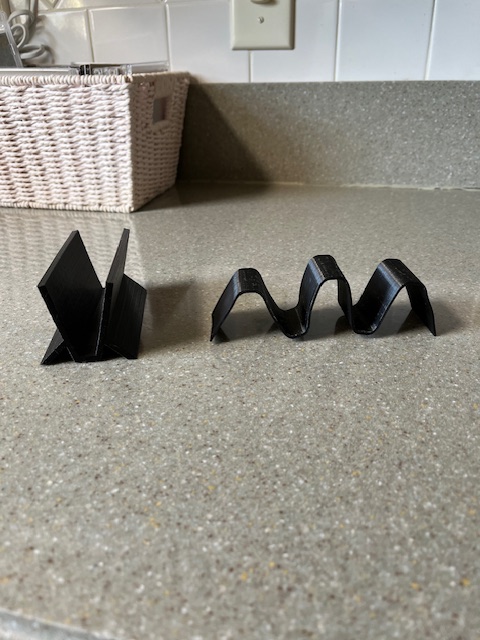
2. Taco or pita holders. My husband made these with his 3-D printer. I told him he should make more and sell them on Etsy.

The one on the right holds two, or it can be turned over to hold three.

3. Another quiet week. Some of the spring-break-canceled activities were back this week, but otherwise, there were no events or appointments til this weekend. I enjoy activities once I’m actually there, but I *love* quiet weeks. I’ve got some medical appointments over the next three weeks and had several earlier this year, so it was nice to have a couple of appointment-free weeks.

4. Our writing critique group. I may have mentioned this before. We meet every other week via Zoom and take turns offering our edits and critiques on one person’s work each session. Then we added a fifteen minute free-time extension for those who could stay just to talk about writing or publishing, ask questions, etc. I’m so inspired by the discussions, no matter whose work we’re discussing.

5. Prayer. Some in our church are going through rough times. It’s such a blessing not only to pray for them, but to hear the care and concern as people ask about them.

And that’s a wrap for this week! How was yours?

Review: When I Fall in Love

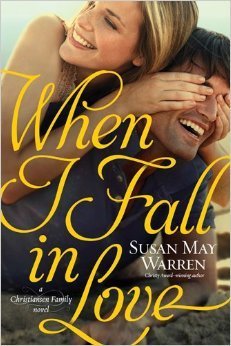
When I Fall in Love by Susan May Warren

Susan May Warren’s Christiansen family series centers on six fictional adult siblings and their parents and friends in the small town of Deep Haven, Minnesota. The family runs an old-fashioned resort (cabins but no Internet).

Though all the family plus several side characters appear in each book, each focuses mainly on the story of one sibling.

When I Fall in Love is the third in the series, about second-oldest sister Grace. Grace loves cooking and wants to go to culinary school. But she’s also a homebody who doesn’t like to venture out of her comfort zone.

When she caters her oldest brother’s wedding, the family thanks her by pitching in to surprise her with a three-week trip to a cooking school in Hawaii.

But Grace is not pleased. She’s terrified.

Her sister’s fiance, a hockey player on the professional team in Minneapolis, chose this particular school because his teammate, Max Sharp, is going there, too. He asks Max to keep an eye on Grace and help her out.

Max is less than thrilled. He goes on a cooking vacation each year somewhere where he’s not known. He gives the bulk of his year to hockey. For that one month, he just wants to get away by himself and do something different.

Grace is not happy, either. She doesn’t want Max to feel he has to baby-sit her.

But when they meet on the airplane, each not knowing who the other is at first—well, this is a romance novel, so you know they are going to be attracted.

The problem is, Max never planned to be attracted to anyone. He’s the carrier for a disease that killed his father early and will probably take his life as well. He can never ask a woman to be part of his life knowing what she will have to go through, only to end up alone.

Grace tests his resolve, though.

In the subplot, Grace’s friend and coworker, Raina, had helped cater Grace’s brother’s wedding. She’s fairly new to town and has had a hard background. Her only remaining family is her aunt Liza in Deep Haven. Raina is not religious, but she attends church because her aunt requires her to.

Grace’s brother, Owen, seeks Raina out after the wedding, making Raina feel special. But she doesn’t know that Owen is in a downward spiral. He was a rising hockey star, only to be sidelined by a devastating injury. The fame and money had gone to his head, and the injury and loss of his career has sent him further to the wild side. He only uses Raina for a one-night stand.

Raina is bitter against all the Christiansen men. But when she gets to know Casper, the college-aged brother home for a semester, she finds he is much different from Owen.

I liked the themes of getting out of one’s comfort zone and trusting God with the unknowns in life.

I didn’t like so much the family pushing Grace out of her comfort zone. Older sister Eden, in particular, comes across really pushy and bossy here. I hadn’t gotten that vibe from her in the book focusing on her (It Had to Be You). Not only does she propel Grace into the trip, she wants Grace to cater her wedding with Hawaiian food–as if cooking in Hawaii for three weeks makes Grace an expert. The fact that Eden didn’t listen to Grace and kept insisting really bothered me.

Plus, the author has God answering Grace directly several times when she prays about something.

Also, though we’re spared a bedroom scene with Owen’s indiscretion, we’re still shown more than I would have liked.

Even with those caveats, though, I found much to enjoy in this story. Just like in real life, we get ourselves in messes. But God offers healing and redemption.

I had listened to the audiobook, which unfortunately didn’t contain any of the author’s notes about what inspired this story. However, I did find a bit of background on Susan’s site here.

Review: Be Skillful (Proverbs)

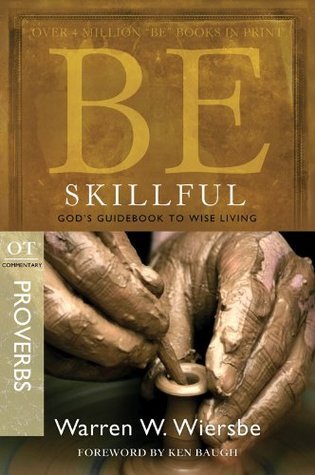
Be Skillful: Wiersbe Commentary on Proverbs.

In Be Skillful (Proverbs): God’s Guidebook to Wise Living, pastor and Bible teacher Warren Wiersbe notes, “We are living in the information age, but we certainly are not living in the age of wisdom” (p. 11, Kindle version).

The book of Proverbs is one of the Bible’s wisdom books. Of course, we can gain wisdom all through the Bible, but Job, Psalms, Proverbs, Ecclesiastes, and the Song of Solomon, are grouped together as wisdom books.

Wiersbe goes on to say, “It isn’t enough simply to be educated and have knowledge, as important as education is. We also need wisdom, which is the ability to use knowledge. Wise men and women have the competence to grasp the meaning of a situation and understand what to do and how to do it in the right way at the right time” (p. 16).

“Biblical wisdom has little if any relationship to a person’s IQ or education, because it is a matter of moral and spiritual understanding. It has to do with character and values; it means looking at the world through the grid of God’s truth” (p. 17).

“Biblical wisdom begins with a right relationship with the Lord. The wise person believes that there is a God, that He is the Creator and Ruler of all things, and that He has put within His creation a divine order that, if obeyed, leads ultimately to success” (p. 17).

“The first essential for an effective study of Proverbs is faith in Jesus Christ so that you can honestly call God your Father. You can’t make a life until you first have life, and this life comes through faith in Jesus Christ (John 3: 16, 36)” (p. 26).

The bulk of Proverbs is made up of individual sayings. “Proverbs are pithy statements that summarize in a few choice words practical truths relating to some aspect of everyday life. The Spanish novelist Cervantes defined a proverb as ‘a short sentence based on long experience'” (p. 20). But these proverbs are not just clever sayings: they are God’s inspired Word and profitable for doctrine, correction, reproof, and instruction just like the rest of the Bible (2 Timothy 3:16-17).

Normally, Dr. Wiersbe’s comments follow the chapters of the book of the Bible he is discussing. In this commentary, however, he groups his remarks as to the categories in Proverbs: the contrast between wisdom and foolishness, diligence and laziness, the virtuous woman and the “strange” woman, etc., and characters like the drunkard, glutton, the simple, scoffer, fool, king, parents and children, and so on.

As to why God directed the writers of Proverbs to lay out the book this way, Wiersbe has a couple of suggestions. Most people didn’t have their own copies of the Scriptures. Short, pictorial statements would have been easier to remember that a lecture. Plus, “Just as the Bible itself isn’t arranged like a systematic theology, neither is Proverbs. What Solomon wrote is more like a kaleidoscope than a stained-glass window: We never know what the next pattern will be” (p. 22). Some make a practice of reading a chapter of Proverbs each day of the month. They receive wisdom on a variety of topics to carry with them throughout the day.

It had been a while since I had read Proverbs. I enjoyed thinking through it again along with Dr. Wiersbe’s insights.

(I often link up with some of these bloggers.)

We Won’t Understand All, But We’ll Trust More

We won't understand fully, but we'll trust more

I used to sometimes hear a song titled “Farther Along.” The chorus said:

Farther along we’ll know all about it,
Farther along we’ll understand why;
Cheer up, don’t worry, live in the sunshine,
We’ll understand it all by and by.

The stanzas talked about temptations, trials, toil, death of loved ones, and seeming injustices with the comfort that someday, when Jesus takes us home to heaven, we’ll understand it all.

The Bible does tell us to encourage and comfort one another with the truth that someday we’ll be with God in heaven where there is no sorrow, pain, or death. It also assures us that although we only know in part now,  “then I shall know fully, even as I have been fully known” (1 Corinthians 13:12). I’m sure a lot of things will make sense then that don’t now and we’ll know exponentially more than we do now.

But I don’t know if we’ll understand everything that God did and allowed while we were on earth. Because He will still be God and we still won’t be. He is omniscient, and we will never be.

This is just speculation, but I think we’ll experience something of what Job did. Throughout the book bearing his name, Job wished he could plead his case before God. When God finally spoke to Job, He really didn’t answer his questions or tell him why he suffered what he did. He pretty much just shared how He took care of creation.

If you’ve ever wondered, as I have, what God’s discussion of animals had to do with Job’s suffering, Layton Talbert suggests in Beyond Suffering: Discovering the Message of Job, “By belaboring this point with Job, God unveils one of His divine qualities. The Lord is powerful and majestic and wise beyond man’s comprehension, but He is also compassionate . . . even towards beasts. He talks as if He has intimate knowledge of their nature and needs because He does. That’s the point” (p. 206).

Somehow that was enough for Job. He responded, ““I know that you can do all things, and that no purpose of yours can be thwarted. . . .  I had heard of you by the hearing of the ear, but now my eye sees you; therefore I despise myself, and repent in dust and ashes” (Job 42:2, 5-6).

Even though Job’s suffering wasn’t explained to him, his encounter with God humbled him, silenced his questions, and inspired his worship.

I think it might be much the same for us.

I’ve often wondered if God will show us in heaven some of the behind-the-scenes activities of our time on earth: how a frustrating delay kept us from a fatal accident, how a closed door to a seemingly perfect opportunity guided us towards God’s best. We see parts of such things now, the “edges of His ways,” as Job said (26:14),  but I am sure there is much more to God’s working and guidance in our lives than we realize here.

We struggle to trust Him perfectly now. We know from His Word, from testimonies of others, and from our own experience that He is good, wise, kind, trustworthy and so much more.

But there is still much that doesn’t make sense to us. Why that venture failed. Why our loved one died so early. Why that nagging disease that took up so much time, thought, and energy was part of His plan. We trust that He really does work all things together for those that love Him (Romans 8:28). But we still wonder why certain things happen as they do.

Perhaps God doesn’t explain everything because He wants to increase our trust and dependence on Him. Perhaps we wouldn’t understand even if He did explain, just as a child won’t understand why he can’t have ice cream before dinner or why he has to stop playing and go to bed. I love what John Piper wrote in his poetic version of Job, The Misery of Job and the Mercy of God: “Beware, Jemimah, God is kind, In ways that will not fit your mind.”

Elisabeth Elliot wrote in On Asking God Why:

There are those who insist that it is a very bad thing to question God. To them, “why?” is a rude question. That depends, I believe, on whether it is an honest search, in faith, for his meaning, or whether it is a challenge of unbelief and rebellion. The psalmist often questioned God and so did Job. God did not answer the questions, but he answered the man–with the mystery of himself.

He has not left us entirely in the dark. We know a great deal more about his purposes than poor old Job did, yet Job trusted him. He is not only the Almighty–Job’s favorite name for him. He is also our Father, and what a father does is not by any means always understood by the child. If he loves the child, however, the child trusts him. It is the child’s ultimate good that the father has in mind. Terribly elementary. Yet I have to be reminded of this when, for example, my friend suffers, when a book I think I can’t possibly do without is lost, when a manuscript is worthless.

“God did not answer the questions, but he answered the man–with the mystery of himself.”

I don’t know if we’ll ever understand all the mystery of God, even in heaven. But when we see Him, we’ll be “lost in wonder, love, and praise,” as the hymn says.

When we see Him, whatever doesn’t make sense to us here won’t matter. Our faith will be sight. Our trust will be perfect.

May we be growing toward more perfect trust even now as we behold Him through His Word.

1 Corinthians 13:12

(I often link up with some of these bloggers.)

Laudable Linkage

Laudable Linkage

Here are some of the posts that caught my attention this week:

Hard-Pressed: The Soul Anguish of Christ.Gethsemane. The word comes from a Hebrew term that means ‘oil press’—appropriately named, because that night, among the olive trees, the Son of God would be ‘pressed’ beyond anything we can fathom.”

How to Do an Inductive Bible Study, HT to Knowable Word. “Learning to read and study Scripture is an important part of the Christian life. And while pastors and teachers are essential gifts of Christ to his church, individual Christians should also be able to pick up any passage and read it with basic understanding and application. How do you do that? The inductive Bible study method is one reliable way.”

We Who Have Few Talents and Sparse Gifts. “The fact is, the God who used spit and dust to cure a man of his blindness can most certainly make use of you. And I assure you that if you had great talents, you would simply compare yourself to those who have more still.”

Six Simple Ways to Handle False Guilt. “God has given each of us a conscience, and this conscience guides us in doing right. When we become a child of God, we are gifted with the Holy Spirit, which fine tunes our consciences to align with the will and view of God. If we choose to ignore the promptings of the Holy Spirit, we’ll be chided. This is true guilt. . . . False guilt is the opposite. It’s what we feel for imagined wrongs or for past wrongs for which we’ve been forgiven.”

My Body Reminds Me. “Every day as I live within my body, care for it, and consider my reflection in the mirror, I am faced with a series of undeniable realities.”

Am I the Quarrelsome Wife? HT to Challies. “Rather than being a haven in the storm, the contentious woman is the storm. She is, herself, the poor weather conditions; her presence is an inhospitable place.”

Nothing in you that has not died will ever be raised from the dead. C. S. Lewis

Keep back nothing. Nothing that you have not given away will be really yours. Nothing in you that has not died will ever be raised from the dead. C. S. Lewis, Mere Christianity

Friday’s Fave Five

Friday's Fave Five

It’s Friday once again, time to share the blessings of the week with Susanne and friends at Living to Tell the Story.

1. A clear week. Our church has a school which is out this week for spring break. So our usual Wednesday night activities were canceled this week, too–I guess because so many people travel this week. Plus our writing critique group meets every other week, and this was an off week. I enjoy all of those activities, but it’s also nice to have some extra time. And, for the first time in weeks, I haven’t had some type of appointment to get to. Lovely!

2. Free books. Our church’s school library was thinning out some books and left them on a table in the church lobby for browsers to pick up. I got three classics.

3. Pi Day. We had a pie potluck for Pi Day (3.14). I made hamburger pie and Mittu made a Chicago-style pizza for dinner. I made Chocolate Pretzel Pie and Mittu made banana cream pie for dessert. We had talked about going to Blaze Pizza that day, as they have their pizzas on sale for $3.14 then. But we figured they’d be swamped.

Pie Potluck for Pi Day

4. A clever and hard-working husband. I mentioned being the recipients of my youngest son’s fairly new washer and dryer last week when he bought a house with a stackable set. His dryer is electric, and our current one is gas. We talked about whether to sell his electric one and buy a gas one. I proposed the idea that it might help resale value to have an electric line for a dryer as well as a gas hook-up, so the laundry room could accommodate either one. I didn’t realize how involved that process would be. Jim had to run wire from the laundry room up to the attic and across to the breaker box, set aside a breaker especially for the dryer, install the outlet especially for the dryer, and change the plug on it to a four-pronged rather than a three-pronged one so it would be up to the current code standards. In one significant blessing, when Jim was at Home Depot, the worker there who asked if he needed help finding anything knew just what he needed, where it was, what the current code standards were, etc.

5. Getting rid of the old washer and dryer. I knew Jim wouldn’t want to just trash the old washer and dryer, since they still had some life in them. But we didn’t think it would be a good idea to donate them to the thrift store since there was no telling how long they’d last. So he listed them on the local sales page on Facebook with an honest description. We had a few offers right away. Someone bought them for $75 and came and picked them up. It was nice to have them taken away so quickly.

And that wraps up another week! It’s hard to believe we’re halfway through March already!

Review: It Had to Be You

In It Had to Be You by Susan May Warren, Eden Christiansen feels like she’s forever on the sidelines. Her other siblings have stand-out talents. Eden always dreamed of being a reporter. She landed a job with the city newspaper, but she’s stuck as an obituary writer.

Since she lives in the same town as her younger hockey-player brother, Owen, and she’s the only family member there, she goes to his games and watches out for him. She sees that the fame, acclaim, and money has gone to his head. But he won’t listen to her admonitions. It doesn’t help that Owen idolizes his team captain, Jace, who has a bad-boy reputation on and off the ice.

When Jace and Eden meet, they clash immediately. She berates him for not being a better example to his team.

Jace, meanwhile, has his own problems. Several slams on the ice have resulted in too many concussions and regular migraines. He has nothing else but hockey, so he keeps going despite doctors’ warnings. When he tries to avoid fights during games, his value drops in the eyes of his team, agent, and the spectators.

And there is a side to Jace that others rarely see. He helps his best friend, Sam, run a restaurant and helps Sam take care of his daughter, a heart transplant patient.

Owen, in a moment of carelessness, sustains a devastating injury. While visiting him in the hospital, Jace and Eden accidentally discover a John Doe, an unidentified patient in a coma. They are thrown together to try to find John Doe’s family.

I don’t read romance novels very often. They can be somewhat silly and too focused on the physical. But Susan’s don’t seem to be that way so far.

I got a little irritated with both characters’ tendency to create a whole scenario of what they thought the other was thinking from a line or gesture or silence. It’s not usually good to assume motives no matter how well we know someone. But learning not to judge or assume is part of what they experienced here.

Another theme throughout the book is letting go of things we can’t and weren’t meant to control.

Overall, I enjoyed the story. A couple of my favorite quotes:

Minnesota grew hockey players like pine trees.

There’s always light . . . God’s love is too bright for the darkness to win.

This book is the second in the Christiansen family series. The first was Take a Chance on Me. Since the sequels were free in Audible’s Plus Catalog, I am listening to them before they are rotated out.

Review: Life Without Limits

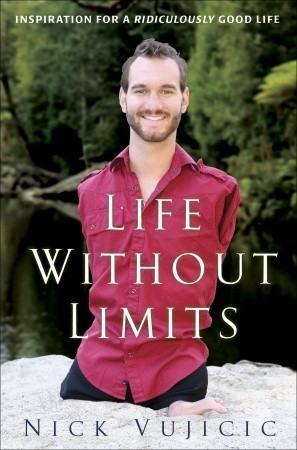
When Nick Vujicic was born without arms and legs, his parents were shocked and grieved. They were concerned about how he could ever grow up to be independent. They were devout Christians yet wondered why God would allow such a thing to happen.

Nick wondered the same thing as he got older.

I have to confess, I wondered the same thing. Even with as much comfort and reassurance I’ve received studying God’s reasons for allowing suffering, and as much as I have come to trust His character and will, thinking of a person growing up in this condition was hard to come to grips with.

Maybe that’s why I had Nick’s book, Life Without Limits: Inspiration for a Ridiculously Good Life, on the shelf for so long without picking it up. It was one we had bought for my husband’s mother. I remember her saying her tears were streaming as she read this, and she felt she had nothing to complain about after reading this book.

Recently, I saw several Facebook posts from friends about a young wife and mother they knew who ended up in the hospital with several severe infections. The doctor said her condition was a 10 out of 10 on the scale of a serious illness. The treatment reduced blood flow to her limbs, which resulted in amputation of both arms and legs. She’s been in the hospital since December.

As my heart went out to this family and I’ve been praying for them, I decided to pick up Nick’s book to see how he dealt with his situation.

After his parents’ initial shock, they strove to give him as normal a life as possible. He was a determined little boy and found ways to do most things he wanted to do.

However, school was a different story. His family wanted him to attend regular classes rather than special-needs classes. He faced the cruel remarks of some of his classmates, which was depressing. He was even suicidal at one point until his father encouraged him.

Nick found that often he had to be the one to reach out to make people feel comfortable approaching him. That and a good sense of humor helped people to see he was just a regular guy on the inside.

Discussions with others about how he coped with no limbs led to speaking to student, church, and youth organizations. In the years since, speaking became Nick’s vocation and ministry, not only in his native Australia, but around the world.

This book is part memoir, part motivational encouragement. He does include Christian principles but also a lot of secular motivation (love yourself, etc.).

Some of the quotes that stood out to me:

Experiences like that helped me realize that being “different” just might help me contribute something special to the world. I found that people were willing to listen to me speak because they had only to look at me to know I’d faced and overcome my challenges. I did not lack credibility. Instinctively, people felt I might have something to say that could help them with their own problems (pp. 20-21).

As difficult as it might be to live without limbs, my life still had value to be shared. There was nothing I lacked that would prevent me from making a difference in the world. My joy would be to encourage and inspire others. Even if I didn’t change this planet as much as I would like, I’d still know with certainty that my life would not be wasted. I was and am still determined to make a contribution (p. 24).

Often the very challenges that we think are holding us back are, in fact, making us stronger. You should be open to the possibility that today’s handicap might be tomorrow’s advantage (pp. 43-44).

Nick was encouraged by the man who was born blind in John 2. The disciples asked Jesus, “Who sinned, this man or his parents, that he was born blind?” Jesus responded, “It was not that this man sinned, or his parents, but that the works of God might be displayed in him.”

This book was published in 2010. Since then, Nick has gotten married, had four children, written more books and traveled and spoken to even more people.

I appreciated Nick’s attitude and willingness to help and encourage others.

You might be interested in this piece about Nick on Australia’s 60 Minutes program:

(I often link up with some of these bloggers.)
The Power of Words

The Power of Words

I was surprised to hear in a song recently the line “Love doesn’t need any words.”

The song went on to say that love is “proven by the things we do and not say —
for actions speak louder than words.”

Well, it’s true that actions can belie words. It’s true that actions and words need to line up. It’s true that love needs actions as well as words.

But I wouldn’t say that love doesn’t need words.

If you’re familiar with the five “love languages” as taught by Gary Chapman, you know that words are one of the five. The rest are quality time, gifts, acts of service, and physical touch. Chapman’s premise is that we all give and receive love in these ways, but usually one or two of them make us most feel loved. He tries to make people understand that if you do things for your loved one all day (acts of service), but their love language is words of affirmation, they are not going to feel loved. Conversely, if their love language is acts of service, and you tell them several times a day that you love them, the words are going to ring hollow if you never help them in the kitchen or do anything for them. So we should try to find the way our loved one most perceives love and express our love that way.

I’ve not read Chapman’s book, but I have heard these things taught many times. There may be some caveats concerning the idea of love languages, but I think the basic idea is sound.

But this idea of not needing words reminds me of a quote attributed to St. Francis of Assisi: “Preach the gospel at all times. If necessary, use words.” I just saw that Francis is not known to have said this. I am not surprised, because it always bothered me. It’s true that our lives should demonstrate what we believe. But someone likened this to saying, “Feed starving children; when necessary use food.”

The gospel is made up of words. It’s “the power of God for salvation” (Romans 1:16).

Jesus Himself is called the Word of God. He said, “The words that I speak unto you, they are spirit, and they are life” (John 6:63). He also said, “Now ye are clean through the word which I have spoken unto you” (John 15:3).

Paul said, “So faith comes from hearing, and hearing through the word of Christ.” (Romans 10:17). Paul also said the gospel is the power of God unto salvation.

The Bible has much to say about words.

There is one whose rash words are like sword thrusts, but the tongue of the wise brings healing (Proverbs 12:18).

Death and life are in the power of the tongue, and those who love it will eat its fruits (Proverbs 18:21).

I tell you, on the day of judgment people will give account for every careless word they speak, for by your words you will be justified, and by your words you will be condemned (Matthew 12: 36-37).

Let no corrupting talk come out of your mouths, but only such as is good for building up, as fits the occasion, that it may give grace to those who hear (Ephesians 4:29).

There are times not to use words. Ecclesiastes tells us there is “a time to keep silence, and a time to speak” (3:7). When Elijah was so discouraged after his encounter with Jezebel, an angel let him sleep and fed him before his encounter with the Lord. Jesus told His disciples at one point, “I still have many things to say to you, but you cannot bear them now” (John 16:12).

The Bible says so much more about words: the power of the Word of God, how we use words, what we use them for.

We’re to speak true words, but we’re not to browbeat with them.

A soft answer turns away wrath, but a harsh word stirs up anger (Proverbs 15:1).

With patience a ruler may be persuaded, and a soft tongue will break a bone (which Pulpit Commentary says means, “gentle, conciliating words, overcome opposition, and disarm the most determined enemy, and make tender in him that which was hardest and most uncompromising) (Proverbs 25:15).

A gentle (wholesome, healed, soothing in other translations) tongue is a tree of life, but perverseness in it breaks the spirit. (Proverbs 15:4).

Words can tear down, wound, and deceive. Words can build up, sooth, and encourage,

May God give us wisdom to know when to speak and when to be silent and grace to help our words and actions to honor and rightly reflect Him.

Death and Life are in the power of the tongue, Proverbs 18:21

(I often link up with some of these bloggers.)
Laudable Linkage

Laudable Linkage

Here are a few thought-provoking posts from the last week:

7 Blessings Older Saints Offer the Church, HT to Challies. “My grandparents, with their godly example, aren’t alone. Their example of faithfulness is afforded to every saint who lingers on this earth into old age. In fact, older Christians have some of the most important lessons to teach the local church today.”

Be the Church Member You Want Your Church to Have. HT to Challies. “Paul addresses the Romans who are having some disputes, and he starts with this glorious phrase: ‘so far as it depends on you’ (Rom 12:18). In other words, he deflects the attention away from ‘those people’ and shines the light on ‘you’. Paul knows that focusing on ‘those people’ is a dead end street. You can’t do anything, not really, about anyone else. But do you know who you can affect? YOU!”

Visible Grace in Disagreements, HT to Challies. “Here are three things we should strive for: Christians who are willing to confront but aren’t eager for controversy. Christians who pursue a gentle revival, not a holy war. Christians who eavesdrop on Jesus’ intercession instead of joining Satan’s accusations.”

Do You Want My Opinion? HT to Challies. “In the past week, I’ve had two experiences that confirm a need to get a better grip on how I share what I think about current events.”

Elisabeth Elliot, My Dear Mother. This was a blog by Elisabeth Elliot’s daughter, Valerie, and this particular post was written just after Elisabeth passed away in 2015. I don’t remember if I have seen it before, but it was shared this week on the Elisabeth Elliot Quotes Facebook page.

Doesn’t a Library-Themed Hotel sound ideal for a book-lover’s vacation? It’s expensive, and it’s located in NYC, not a place I have any desire to go to. But maybe this idea will catch on with more accessible places and prices. HT to Dan Balow.

Thomas Watson quote about flawed saints

A saint in this life is like gold in the ore, much dross of infirmity cleaves to him, yet we love him for the grace that is in him. A saint is like a fair face with a scar: we love the beautiful face of holiness, though there be a scar in it. The best emerald has its blemishes, the brightest stars their twinklings, and the best of the saints have their failings. You that cannot love another because of his infirmities, how would you have God love you?” Thomas Watson