Thursday Thirteen #26: The Resurrection of Jesus Christ

butterfly.jpeg

You get a double thirteen today. 🙂 With Easter, or Resurrection Day, coming up, first are quotes, mostly from scholars, about the resurrection of Jesus Christ from the dead; then there is a list of people who saw Him after His resurrection.

The following quotes are all taken from chapter 20, “The Resurrection of Jesus Christ” of the book A Ready Defense by Josh McDowell.

1. “I have been used for many years to study the histories of other times, and to examine and weigh the evidence of those who have written about them, and I know of no one fact in the history of mankind which is proved by better and fuller evidence of every sort, to the understanding of a fair inquirer, than the great sign which God hath given us that Christ died and rose again from the dead.”– Thomas Arnold, author of History of Rome and chair of modern history at Oxford

2. “If all the evidence is weighed carefully and fairly, it is indeed justifiable, according to the canons of historical research, to conclude that the tomb in which Jesus was buried was actually empty on the morning of the first Easter. And no shred of evidence has yet been discovered in literary sources, epigraphy or archaeology that would disprove this statement.”

— Dr. Paul L. Maier, professor of ancient history at Western Michigan University

3. “My faith began with and was grounded on what I thought was revealed in the Bible. When, particularly, I came to the New Testament, the Gospels and other writings of the men who had been friends of Jesus Christ seemed to me to make an overwhelming case, merely as a matter of strict evidence, for the fact therein stated … The same approach to the cardinal test of the claims of Jesus Christ, namely, His resurrection, has led me, as often as I have tried to examine the evidence, to believe it as fact beyond dispute.”

— Lord Caldecote, Lord Chief Justice of England

4. Dr. Simon Greenleaf, Royall Professor of Law at Harvard University and author of A Treatise on the Law of Evidence, examined the value of the historical evidence for the resurrection of Jesus Christ to ascertain the truth. He applied the principles contained in his three-volume treatise on evidence. His findings were recorded in his book, An Examination of the Testimony of the Four Evangelists by the Rules of Evidence Administered in the Courts of Justice. Greenleaf came to the conclusion that, according to the laws of legal evidence used in courts of law, there is more evidence for the historical fact of the resurrection of Jesus Christ than for just about any other event in history.

5. Dr. Frank Morrison, a lawyer who had been brought up in a rationalistic environment, had come to the opinion that the resurrection was nothing but a fairy-tale happy ending which spoiled the matchless story of Jesus. He felt that he owed it to himself, and to others, to write a book that would present the truth about Jesus and dispel the myth of the resurrection. Upon studying the facts, however, he, too, came to a different conclusion. The sheer weight of the evidence compelled him to conclude that Jesus actually did rise from the dead. Morrison wrote his book-but not the one he had planned. It is titled, Who Moved the Stone? The first chapter, very significantly, is called, “The Book That Refused to Be Written.”

6. “What does the critical historian do when his evidence points very strongly to the reality of an event, which contradicts his expectations and goes against the naturalistic view of reality? I submit that he must follow his critically analyzed sources. It is unscientific to begin with the philosophical presupposition that miracles cannot occur. Unless we avoid such one-sided presuppositions, historical interpretation becomes mere propaganda. We have a right to demand good evidence for an alleged event, which we have not experienced, but we dare not judge reality by our limited experience. And I would suggest that we have good evidence for the resurrection of Jesus of Nazareth.”

— Historian Ronald Sider

7. “If the stone were simply rolled to one side of the tomb, as would be necessary to enter it, then they might be justified in accusing the men of sleeping at their posts, and in punishing them severely. If the men protested that the earthquake broke the seal and that the stone rolled back under the vibration, they would still be liable to punishment for behavior, which might be labeled cowardice. But these responsibilities do not meet the case. There was some undeniable evidence, which made it impossible for the chief priests to bring any charge against the guard. The Jewish authorities must have visited the scene, examined the stone, and recognized its position as making it humanly impossible for their men to have permitted its removal. No twist of human ingenuity could provide an adequate answer or scapegoat and so they were forced to bribe the guard and seek to hush things up.”

— Dr. Bill White

8. “What gives a special authority to the list [of witnesses] as historical evidence is the reference to most of the five hundred brethren being still alive. St. Paul says in effect, ‘If you do not believe me, you can ask them.'”

— Dr. Ewin M. Yamauchi, associate professor of history at Miami University in Oxford, Ohio

9. “It is noteworthy that these appearances are not stereotyped. No two of them are exactly alike. The appearance to Mary Magdalene occurred in early morning; that to the travelers to Emmaus in the afternoon; and to the apostles in the evening, probably after dark. He appeared to Mary in the open air. Mary was alone when she saw Him; the disciples were together in a group; and Paul records that on one occasion He appeared to more than five hundred at one time (1 Corinthians 15:6).

“The reactions also were varied. Mary was overwhelmed with emotion; the disciples were frightened; Thomas was obstinately incredulous when told of the Lord’s resurrection, but worshiped Him when He manifested Himself. Each occasion had its own peculiar atmosphere and characteristics, and revealed some different quality of the risen Lord.”

— Professor Merrill C. Tenney of Wheaton College

10. Dr. Maier accurately observes that since the testimony of a woman was deemed unreliable, the “initial reaction of the Eleven was understandably one of suspicion and disbelief. Again, if the resurrection accounts had been manufactured … women would never have been included in the story, at least, not as first witnesses.”

11. “A third factor very crucial to interpreting Christ’s appearance is that He also appeared to those who were hostile or unconvinced. Over and over again I have read or heard people comment that Jesus was seen alive after His death and burial only by His friends and followers. Using this argument, they attempt to water down the overwhelming impact of the eyewitness accounts -but this line of reasoning is so pathetic it hardly deserves comment.

“No author or informed individual would regard Saul of Tarsus to have been a follower of Christ. The facts show the exact opposite. He despised Christ and persecuted Christ’s followers (Acts 8:1; 9:1,2; Philippians 3:5,6). For Paul it was a life-shattering experience when Christ appeared to him (Acts 9:3-6). Although Paul was not at the time a disciple, he later became one of the greatest witnesses for the truth of the resurrection.”

— Josh McDowell

12. There was the skeptical family of Jesus (John 7:1-5). His brothers did not believe in Him. They were embarrassed to hear their brother say to the people, “I am the way, the truth and the life, no man cometh unto the Father but by Me,” and “I am the vine, you are the branches,” and “I’m the shepherd, you are the sheep” (John 14:6; 15:5; 10:11). What would you do if your brother did that?

There was James, His brother. He was found in the company of the Pharisees. James and his brothers mocked Jesus. However, after Jesus went to that degrading death on the cross, disgracing the family, and was buried, where do we find those hardest to convince -His own family?

We find them in the upper room with the disciples waiting for the Holy Spirit to be sent (Acts 1:13,14). Now, since they mocked Him while He was alive, what happened in a matter of a few days to turn their lives upside down?

James became a leader in the early church and wrote an epistle stating, “I James, a bond-servant of God and of the Lord Jesus Christ [his brother]. . ” (James 1). Eventually, for the cause of Christ, James died a martyr’s death -he was stoned.

What happened?

The best explanation I know is recorded by Paul: “Then He appeared to James” (I Corinthians 15:7).

— Josh McDowell

13. “It was therefore impossible that they could have persisted in affirming the truths they have narrated, had not Jesus actually risen from the dead, and had they not known this fact as certainly as they knew any other fact. The annals of military warfare afford scarcely an example of the like heroic constancy, patience, and unflinching courage. They had every possible motive to review carefully the grounds of their faith, and the evidences of the great facts and truths they asserted.”

— Harvard law professor Simon Greenleaf

Bonus from Evidence for the Resurrection by Josh McDowell:

“I claim to be an historian. My approach to Classics is historical. And I tell you that the evidence for the life, the death, and the resurrection of Christ is better authenticated than most of the facts of ancient history . . .”

— E. M. Blaiklock, Professor of Classics, Auckland University


Witnesses of the resurrected Christ
:

Between 518 and 641 people are recorded to have seen the risen Christ.

1. Mary Magdalene—John 20:14, Mark 16:9
2. Women returning from the tomb—Matthew 28:9-10
3. Peter—Luke 24:34, 1 Corinthians 15:5
4. Two disciples (not the 11 Apostles) on the road to Emmaus—Luke 24:13:33
5. Ten Apostles without Thomas—Luke 24:36-43, John 20:19-24
6. Eleven Apostles with Thomas present—John 20:26-29
7. Seven disciples by the Lake of Tiberias — John 21:1-23
8. A multitude of more than 500 on a Gallilean mountain—1 Corinthians 15:6
9. James—1 Corinthians 15:7
10. The eleven Apostles—Matthew 28:16-20
11. 120 (?) at the Ascension—Acts 1:3-12
12. Paul—Acts 9:3-6, 1 Corinthians 15:8
13. Stephen—Acts 7:55
14. Paul in the temple—Acts 22:17: 23:11
15. John on the Isle of Patmos—Revelation 1:10-19

Compiled by The Thinking Christian

 I Corinthians 15: 3-4:  For I delivered unto you first of all that which I also received, how that Christ died for our sins according to the scriptures; And that he was buried, and that he rose again the third day according to the scriptures…

Happy Easter!

Get the Thursday Thirteen code here!The purpose of the meme is to get to know everyone who participates a little bit better every Thursday. Visiting fellow Thirteeners is encouraged! If you participate, leave the link to your Thirteen in others comments. It’s easy, and fun! Trackbacks, pings, comment links accepted!View More Thursday Thirteen Participants

Book Reviews

I finished two of the books on my spring reading list: Sense and Sensibility by Jane Austen and Forever by Karen Kingsbury.

I have to say I didn’t like Sense and Sensibility as much as I did Pride and Prejudice, though I liked the film version of it more. It may be because I read it in kind of a disjointed way. The “show, don’t tell” mantra of writing apparently wasn’t in vogue then. 🙂 And there seemed to me to be a lot of derogatory sarcasm rather than a gentle poking of fun at the foibles of others. I felt that I got a fully-fleshed out version of Elinor, Marianne, Mrs. Jennings, and a few others, but not really of Edward Ferrars and Colonel Brandon. I liked Marianne’s progression in the book. I was disappointed that one of the main  storylines was wrapped up with the anticlimactic, “About three hours after his arrival he had secured his lady’s hand, engaged her mother’s consent, and was not only in the rapturous profession of the lover, but in the reality of reason and truth, one of the happiest of men.” I thought, “That’s all you’re going to tell us after waiting for this moment all through the book?!” It may be that in that time such moments were considered private and handled with discretion — I can’t remember how the similar scenes in P&P were handled. It also may be that the events leading up to a climax just before this were considered the major components of the story, and this result considered just a natural outflow. Overall I am glad I read the book, though, and want to continue on exploring Austen’s works.

Forever is the last in the second series about the Baxter family: the first was the Redemption series with five books; the Firstborn series followed and ends with this fifth book. The Baxter saga will continue and conclude with the Sunrise series, the first book of which is due out May 8 (I didn’t know that when I made my reading list, but will definitely add this one on!)

One thing that you can definitely say about Karen is that she knows how to spin a story, how to draw you in and make you care about the characters.  I have heard her speak three times now, and between that and her comments at the end of her books, I know her heart is to convey Scriptural truth to her audience. And I think she does do that. My only relatively minor criticisms are that I think she overplays the emotional aspects of a story a little bit, and I have heard her say that she tends to write fast, and I think that shows just a little (I didn’t think to make note of particular examples).

Some of her books do have kind of a made-for-TV-movie feel to them. But I don’t think that’s necessarily a bad thing. I have heard some criticize many of the modern Christian fiction writers for not being very “literary.” But, you know — a high-end literary classic style just isn’t going to appeal to everyone. I think of it kind of like this: I love some of the meaty, doctrinal, literary hymns of the 1700s. But I also like short and simple choruses that emphasize one truth that I hum around the house while I’m dusting. I think there is a place for both styles. And I think that’s true in literature, too. Some of these thoughts have me considering a post along the lines, “Just what does make a classic, anyway?” I might explore that some time.

But for now, back from general principles to this book, this continues the story of Dayne Matthews and Katy Hart and a major obstacle to their wedding plans, while the rest of the Baxter family is still coming to grips with the reality of Dayne’s being part of the family. The underlying theme has to do with loving and serving others, and this is played out in several different directions. One of my favorite scenes was when Regan thinks her husband, Luke, is leaving her alone with the children when he gets home in the evening, cleaning the stovetop in the kitchen piece by piece, after she’s been alone with the kids all day and wants not only a break but time with him, but later realizes that that’s his way of showing love (“acts of service,” if you’ve ever read or heard of the Five Love Languages.) I think Luke’s and Regan’s struggles to find a way to get on the same page in the midst of the problems in their lives is probably pretty typical of many couples.

I was a little disappointed that one of the major storylines wasn’t wrapped up at the end of the book — I discovered that accidentally at an author event with Karen Kingsbury when someone from the crowd mentioned it, so I was a little sad knowing ahead of time. But, when I got to the end, I could understand why it was written that way.

I am looking forward to Sunrise. I don’t know how many books will be in this final series, but it will be a little sad to have the Baxter’s story come to an end.

I went to the library this morning to try to check out A Tree Grows in Brooklyn or The Princess Bride, but they didn’t have a copy of either one at any library in our system. :O  There’s always Amazon.com, I know, but I hadn’t intended to buy them (my bookshelves are over-flowing). I guess I can always resell them if I decide I don’t want to keep them. I just got a Barnes and Noble coupon in my e-mail this morning — I may go see if they have one or the other.

Works-For-Me Wednesday: Car Clutter

wfmwheader_4.jpgThis week’s WFMW is a themed one, the theme being car tips — anything related to your car upkeep, traveling, etc. I’m afraid I don’t have much in the way of car tips, so it will be interesting to see what others have.

I’m even hesitant to mention this, because I am thinking several others might, and we never did get it down perfectly. But it is a good goal to aim for, and that is to have everyone be responsible to take what he or she brought to the car back out of the car when we get home (including anything bought along the way, like drinks, meals, or snacks). That should help to cut down on the clutter — if you remember to remind everyone when you pull to a stop in the driveway, because they are not likely to remember on their own. 🙂

car-org.jpg

Also, we never used these, but friends who were on missionary deputation did, and I thought it was a great idea: backseat organizers. The kids could have things within arm’s reach, have them separate from their siblings, and have a storage place so things weren’t strewn all over. You can find this one at Lillian Vernon’s.

Head over to Shannon’s at Rocks In My Dryer for more car tips.

Easter quotes 2

ecross10.gif

The resurrection of Jesus Christ is the birth of a new, glorious, immortal life on the realms of the midnight of death, the rising of the new sun on the terrors of darkness and night. It is the opening of a bright and noble highway to Heaven where everything had been closed and sealed and every hope withered. The resurrection of Christ not only lifts darkness and dread from the tomb but also spans the abyss which separates us from our loved dead and puts into us the strength and hope of a glorious reunion. — E.M. Bounds

God expects from men something more…at such times, and that it were much to be wished for the credit of their religion as well as the satisfaction of their conscience that their Easter devotions would in some measure come up to their Easter dress.
— Robert South

(Other Easter quotes are  here, here, here, and here.)

(Graphic courtesy of Anne’s Place)

One of life’s little pleasures….

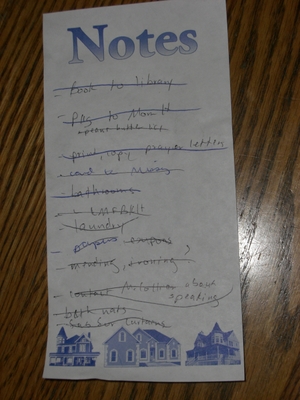
…..is a crossed-off to-do list:

cimg0509.jpg

 “The desire accomplished is sweet to the soul…” (Proverbs 13:19a). I had originally desired to accomplish those things by last Saturday, and got all but one of them crossed off. But I just couldn’t get the remaining one taken care of til this morning.

It’s funny how things that have been needing attention for weeks months get taken care of with ease once they are on a list. I had been needing to sew a couple of buttons on clothes here and there and remove a patch from Jesse’s old Awana shirt before giving it away for ages. It only took me a few minutes to take care of that — I just kept forgetting about it.

Of course, I need to make another whole list for this week. But it’s nice to savour that moment of getting things done. 

I don’t know why it always seems to happen this way, but so often when we schedule one event when the calendar looks clear, as the time approaches then the calendar seems to fill up. We signed up to host a teen fellowship after church April 15. We had never had one since living in this house because, though the house itself is not small overall, the individual rooms where you’d have company are. We had a family of five over once and ended up with people sitting on the floor. So having a big group over just wasn’t something we felt we could handle. But this year they are splitting up some of the teen fellowships into smaller groups — jr. high and sr. high or guys or girls or one team or the other. So we’re having the junior high over that night.

Then the seniors at our school sponsor a “Spring Fling” on a Friday and a yard sale on a Saturday as a fund-raiser for their senior trip. I’ve known for a long time that I wanted to participate in this year’s yard sale — and found out a couple of weeks ago that it is Saturday the 14th, the Saturday before the fellowship. Aaauugh!!

One problem with going through things in the attic and shed that we know we want to get rid of is that the prime times for doing that, when there is not much else going on, are summer and winter after Christmas. But that’s when those areas are the hottest and coldest. Spring and fall, when it would be easier to get into those places, are busy times on our calendar.

I think what I have resolved to do is spend this week sorting through things for the yard sale as much as I can, reminding myself it’s not likely I’ll get through the whole attic and shed — will just have to have another yard sale later on, maybe, or take the remainder to Salvation Army when we can. Then next week I’ll be getting ready (read: more than basic cleaning — you know how it is when company is coming) for the fellowship. Because I know if I clean the burner pans on the stove today, I’ll have a major boil-over between now and the fellowship and will have to do it again. 🙂

Jesse is on Easter break this week and was going to sort through some things in his room as well as have a friend over one night. Sunday evening he said he had a sore throat and a few sniffles, but we thought it was just allergies. He even had a friend over yesterday with plans to spend the night, but felt progressively worse during the day, then started running a fever, so I guess he has a full-blown cold or flu. We sent his friend home to hopefully come back later in the week. Then last night Jesse asked for the “throw-up pan” because he felt sick — and lost his lunch. I don’t know if there is a stomach bug, too, or is just the gunk in his throat is setting off his gag reflex. Jeremy used to have problems with that when he was younger, too. We were doing cold medicine and acetaminophen on an as-needed basis yesterday, but today I am giving it to him every four hours, so hopefully he’ll feel better than he did yesterday. He hasn’t eaten much — a little applesauce, Jello, and Sprite — and he’s the only one of us who doesn’t have any extra to lose.

The “throw-up pan” is a bigger pan that I don’t use much — somehow when the older guys were little we’d let them keep it near by when they were sick in case they couldn’t make it to the restroom. Once we got alliterative with it and called it the vomit vessel, the barf bucket, the upchuck urn….

Then they’d get really grossed out when I’d use that pan for things like corn on the cob. I’d assure them it had been well-cleaned and sterilized since they last used it.

One thing I am dearly hoping to be able to get done before the fellowship is to get the curtains up in the family room that I mentioned here and here.  I did finally order fabric this morning — that was the last thing on my to-do list from last week. In case anyone is waiting on pins and needles to know this ( 😀 ), I decided on this fabric –the blue check with the toile as an contrast lining for the valance — and this pattern (bottom right-hand corner). All the other fabric I looked at around town was more expensive (even at outlets) and I just didn’t like it as well. The pattern is fairly simple, so I am hoping I can whip them up. By the way, Fabric.Com is a great site — easy to use, and no charge for shipping on the first order.

I guess I have rambled on enough and should get busy. 🙂 I’ll post a couple more Easter quotes in a separate post. Oh, and I want to remind you that a month from yesterday, on May 2, I’ll be having a Q&A session with Lynn Walker, author of Queen of the Castle. She’s doing a “30 Blogs in 30 Days” author tour, and I am delighted to be one of her stopping-places. I am jotting down questions as I think of them, but if you have any questions you’d like for me to ask, let me know!

Have a great day.

Fun with Peeps

This has nothing to do with Easter, except that Peeps make their appearances in stores this time of year, but if you’ve never seen the Lord of the Peeps site, go check it out — it’s hilarious.

Then there is also Peeps Research.

Christians=American fascists???

I usually avoid politics here — it so easily stirs people up and too easily lends itself to people carrying on about things they don’t really know about. But I just read an article this evening that astounds me. A man named Chris Hedges has written a book titled American Fascists: The Christian Right and the War on America. He asserts that “Those arrayed against American democracy [i.e., evangelical Christians] are waiting for a moment to strike, a national crisis that will allow them to shred the Constitution in the name of national security and strength” (pp. 201–202).

Since when are Christians arrayed against democracy and just waiting to shred the Constitution???

For a review of the ridiculousness and inconsistencies of this book, see this article.

Psalm Sunday: Psalm 13

psunday.png

Psalm 13

1 How long wilt thou forget me, O LORD? for ever? how long wilt thou hide thy face from me?

2 How long shall I take counsel in my soul, having sorrow in my heart daily? how long shall mine enemy be exalted over me?

3 Consider and hear me, O LORD my God: lighten mine eyes, lest I sleep the sleep of death;

4 Lest mine enemy say, I have prevailed against him; and those that trouble me rejoice when I am moved.

5 But I have trusted in thy mercy; my heart shall rejoice in thy salvation.

6 I will sing unto the LORD, because he hath dealt bountifully with me.

In the midst of trouble, one of the first things people tend to think is that God has forgotten them or is angry with them. We know from other Scripture passages that there are many reasons for suffering and trouble and that God has promised not to forget or forsake His own. In Dr. Jim Berg’s book Changed Into His Image, he refers to “reasoning yourself back to reality” — taking your thoughts and feelings and applying Scripture, reminding yourself of what God has said, and depending on that instead of your feelings. David does that so often in the Psalms.

David is also completely honest with God. In the midst of feeling forgotten, he knows where to go: he cries out to his God for help. I am reminded of and old song Hale and Wilder used to sing that goes something like:

Where shall I run, Lord, when all around me
Sorrow and strife seem to be everywhere?
Have you not said that you would protect me?
Safe in your hand I will evermore be.
With such protection, none can alarm me
Though the storms of life almost kill.
Ever to this shelter I will be fleeing;
No other one can provide these for me.

I was struck by the faith evidenced in the last two verses. David trusts in God’s mercy and looks ahead to God’s deliverance: he says with certainty his heart “shall rejoice in God’s salvation.” And the last verse doesn’t seem to be saying that he will sing unto the Lord because God has in the past dealt bountifully with him, though that is always a good thing to do — and maybe he is doing that both to praise God and to encourage himself in the Lord’s coming deliverance. But it seems to me to be looking ahead with the eye of faith, trusting that God will deliver him out of the present trial and that he will then sing to Him because of His bountiful dealings with him. Either way, David always remembers to praise the Lord for His deliverance. He doesn’t just shoot up quick prayers for help and then go on about his business after the help comes: he remembers to thank and praise God, not out of duty, but with a heart overflowing with love and gratitude.

One exercise Dr. Berg mentions in one of his books (I forget which one — it’s either Changed Into His Image, which I mentioned above, or the video series Quieting a Noisy Soul) he recommends looking up the definitions to key words in a passage, even words we’re familiar with, to enrich our study of the passage. I didn’t do that with this whole passage, but I did look up the word “bountiful” at Dictionary.com. Some of the words used in the definition were “liberal, munificent, generous, ample, abundant.” Isn’t that just like the Lord? He doesn’t just barely answer prayer with the minimum requirements: He answers “exceeding abundantly above all we could ask or think.” (Ephesians 3:20).

Thanks to Erica at Butterfly Kisses for beginning and hostessing Psalm Sundays. You can find more meditations on this Psalm there.

Easter quotes

I’ll be back later this evening with Psalm Sunday, but for now I wanted to put up the first of a series of quotes about Easter (or Resurrection Day, if you prefer). For past holidays I have put a series of quotes all in one post, but some of these are really meaty, and I think they’d lose their effectiveness all together. So I am going to post one or two a day throughout this week.

As I collected these through the years, I did note the author, but not where I found the quote — one of the changes experienced in becoming a blogger is keeping track of sources to link to. 🙂 But since I don’t have the source for these (except for this first one), I will just post them as I have them in my files.

“Easter is not primarily a comfort, but a challenge. If it is true [as he and others indeed demonstrate], then it is the supreme fact of history, and to fail to adjust one’s life to its implications means irreparable loss.”
— J.N.D. Anderson, late Dean of the School of Law at the University of London, The Evidence for the Resurrection (Downer’s Grove, Illinois: InterVarsity Press, 1966), p. 4. (I haven’t read this book — all I know about it is this quote.)

On this side of the resurrection the cross is no less vulgar–the vulgarity of the cross is the vulgarity of the sin that erected it–but the cross flames with light, the light of the glory of the grace of God, Who took sin into His own heart and canceled it by the shedding of blood. —G. Campbell Morgan

ecrosses2gif.jpg

(Graphic courtesy of Anne’s Place)

(Other Easter quotes are here, here, here, and here.)