Everyday Hallelujahs

Last Sunday, as I set the table for breakfast, the music I was listening to on BBN Radio transitioned to the “Hallelujah chorus” from Handel’s magnificent oratorio, The Messiah.

Just a couple of weeks before, we had attended a Christmas concert in which the “Hallelujah chorus” was performed. The audience stood as one when the first notes were played, a tradition said to have begun with King George on his very first hearing of this tribute to the King of kings.

So in my kitchen, I almost felt like I should pause at attention while the chorus played. Was it disrespectful, even sacrilegious, to keep placing silverware and stirring eggs while such praise to God played in the background?

There will come a time when all other endeavors will cease and everyone will praise the King.

After this I looked, and behold, a great multitude that no one could number, from every nation, from all tribes and peoples and languages, standing before the throne and before the Lamb, clothed in white robes, with palm branches in their hands, and crying out with a loud voice, “Salvation belongs to our God who sits on the throne, and to the Lamb!” And all the angels were standing around the throne and around the elders and the four living creatures, and they fell on their faces before the throne and worshiped God, saying, “Amen! Blessing and glory and wisdom and thanksgiving and honor and power and might be to our God forever and ever! Amen” (Revelation 7:9-12).

I can only imagine what a glorious day that will be. We get a little foretaste of it now in church, when we lay aside our ordinary pursuits of the week to gather with God’s people and sing His praises together.

But worship isn’t just for Sundays or public gatherings. We don’t acknowledge God on Sundays and then go back to our regular work without giving Him any more thought.

We can worship Him in everything we do because He is with us and has given us all we have.

I have set the Lord always before me;
because he is at my right hand, I shall not be shaken.

Therefore my heart is glad, and my whole being rejoices;
my flesh also dwells secure.

You make known to me the path of life;
in your presence there is fullness of joy;
at your right hand are pleasures forevermore (Psalm 16:8-9, 11).

If then you have been raised with Christ, seek the things that are above, where Christ is, seated at the right hand of God. Set your minds on things that are above, not on things that are on earth (Colossians 3:1-2).

So, whether you eat or drink, or whatever you do, do all to the glory of God (1 Corinthians 10:31).

God reigns over creation and nations. But He also reigns over homes and kitchens. We don’t have to wait til heaven or even Sunday to praise Him. We can raise our hallelujahs for everyday blessings as well as the major events of life, in joy as well as trouble and sorrow.

So I continued folding napkins, setting out condiments, flipping over the hash browns, and pulling out the crescent rolls while singing in my heart.

The Lord God omnipotent reigneth!

He shall reign for ever and ever!

Hallelujah!

Hallelujah!

Laudable Linkage

Happy first Saturday of January! As might be expected, a lot of posts I found this week dealt with getting ready for a new year.

His Feet, HT to Challies. “I was fourteen and small for my age, a reserved shy shadow of the man I might one day grow into. Others struck me for an unknown reason, some imagined offence I had committed. Verbal assault soon became physical, yet it wasn’t the impact of fist on face that hurt most. I felt alone. I felt small. I felt undone. But then his feet were there.”

Say It, HT to Challies. A short account of Charles Spurgeon’s conversion, which is always delightful to read, but with a few good points added.

Grant Me One Muslim Friend, HT to Challies. “The most strategic thing we could do to reach the Muslim world is for every Muslim to simply have a believing friend.”

Three Faith-Focused Strategies to Welcome the New Year. “Some of us deliberate over annual goals or resolutions while others invite God to give us a word for the New Year. As we invest time in these pursuits, let’s walk through the following four steps as we consider how He led us through last year and as we seek His guidance in the New Year.

How Can We Have Peace and Confidence in the New Year? “With all the turmoil and instability over the last few years, most of us want more peace, more joy, and more confidence in the future. Are we at the mercy of the government or the economy or the culture around us if we’re to have those things? Or is it possible that the right goals and habits can play a big part? If so, what kind of goals and habits?”

5 Tips to Reinforce Your Bible Study and Prayer Routine, HT to Knowable Word. Although aimed at church leaders, these are good for anyone trying to develop a “sustainable habit for personal Bible study and prayer.”

7 Reasons Winter Reminds Us to Hold on to Hope, HT to Challies. “Many people suffer from seasonal depression or feel down in the winter. The trees seem lifeless, we spend a lot more time inside, and it gets darker earlier and for longer stretches of the day. It can also mean we spend more time pondering upon the difficult seasons in our own lives.”

Assign It a Day and Time. A great time management principle!

8 Tips to Have a More Productive Year, HT to Lisa. “I am all about To Do lists and planners! However, that doesn’t always make me as productive I could be. There has to be some follow-through to be productive. I am going to share 8 tips on how to have a more productive year in whatever area you are working.”

Gladys Hunt on Little Golden Books, HT to the Story Warren. I loved the little Golden books as a child and read many of them to my own children. It was interesting to read the story behind them.

Friday’s Fave Five

It’s hard to believe we’re near the first week of January already. These Friday pauses with Susanne at Living to Tell the Story invite us to capture and be thankful for the blessings that come our way.

1. Bowling and pizza. Our last Saturday when everyone was here, we went bowling in the afternoon. I don’t think we’ve done that since before the pandemic began. We went home to rest and met up again at Timothy’s favorite pizza place. The people working that night were exceptional in their service. When I got a chocolate chip cookie for dessert, they warmed it in the same oven where they warm their pizzas. It was so good.

2. A new iPad mini was one of my Christmas presents. My old one was acting clunky and running out of battery way too quickly. The new one has been a pleasure.

3. A leak in our bathroom seems to have been coming from the handle that turns off the water rather than from under the toilet, as we had feared. My husband’s fix seems to be holding.

4. New calendars are one of my favorite parts of January. Even though we all have calendars on our phones and tablets, I still like the big family calendar in the kitchen and one near my desk I can glance at. Plus I like turning the pages and seeing new photos or art work every month.

5. A quiet week was much needed after the holidays, though I loved the activities and family time. I had intended to take one whole day just to vegetate. That didn’t quite work out, but the week has been more relaxed. Plus we got take-out for dinner a few times and had leftovers one night, so it’s been a light cooking week.

Bonus: beautiful weather. After enduring 3 degrees during Christmas, afternoon highs in the 50s this week felt great. Plus we’ve had sunshine and blue skies toward the end of the week. Winter’s not done yet, I’m sure. But I am basking in the nice weather while we have it.

Bonus 2: Normalcy. I was struck this week that with the activities we went to over the holidays and even just going to the grocery store this week, it feels normal to do these things for the first time since the pandemic started. I guess it has felt that way for a while now and I just realized it. Covid is still out there, and we’re thinking it probably always will be. And we still have some supply issues. But it’s so nice not to have it all hanging over us like a dark cloud, as it did for so long.

What’s something good from your week?

Be Transformed

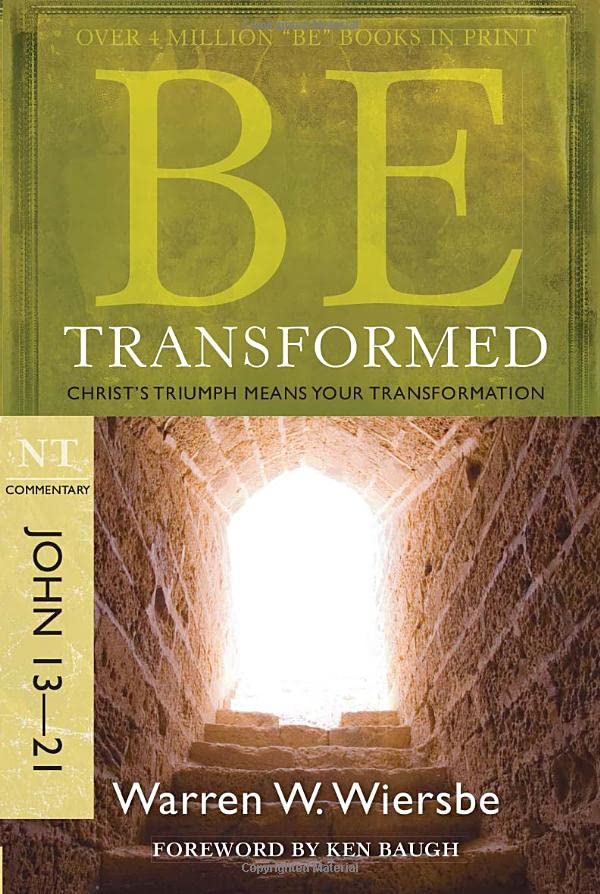
Warren Wiersbe divided his commentary on the gospel of John into two books. The first was Be Alive (John 1-12): Get to Know the Living Savior. The second is Be Transformed (John 13-21): Christ’s Triumph Means Your Transformation. The first twelve chapters of John “focus on our Lord’s public ministry, especially the signs (miracles) that Jesus performed and the messages that grew from them” (Location 150, Kindle version). Chapters 13-21 share more of the private ministry of Jesus with His closest disciples, “preparing them for their future service when the Holy Spirit would come and empower them” (Location 150). Chapter 13 opens with the Passover meal the night before Jesus was betrayed where He washes the disciples’ feet and institutes what we call the Lord’s supper (communion). The rest of John details Jesus private discourse with the disciples that night, His betrayal, arrest, crucifixion, and resurrection.

John shares his purpose statement in John 20:31: “these are written so that you may believe that Jesus is the Christ, the Son of God, and that by believing you may have life in his name.” “The basic theme of John’s gospel is that Jesus Christ of Nazareth is the very Son of God, and all who believe in Him receive eternal life (20: 30–31). John’s subject is the deity of Christ. John’s object is to lead people into the life—eternal life, abundant life—that only Christ can give. John is both a theologian and an evangelist” (Location 150).

John attests to Jesus deity not only through His many signs, or miracles, but through other witnesses, through Jesus’ “I am” statements, through His fulfillment of the Old Testament festivals and prophecies about Himself.

John said throughout the first part of his book that Jesus’ “hour” had not yet come. Then in John 12:23, at this transition between public and private ministry and the week leading up to the cross, Jesus said, “The hour has come for the Son of Man to be glorified.” Jesus says a little later, in verse 27, ““Now is my soul troubled. And what shall I say? ‘Father, save me from this hour’? But for this purpose I have come to this hour.”

As I mentioned in Let Not Your Hearts Be Troubled, Wiersbe points out that Jesus comforted and reassured the disciples that though He was about to leave the earth, they had the Father’s love and care, the peace Jesus gave them, the comfort and ministry of the Holy Spirit within them, access in prayer, and a home in heaven to look forward to.

He then teaches them to abide in Him, as a branch abides in the vine (John 15). “The key word is abide; it is used eleven times in John 15: 1–11 (‘continue’ in John 15: 9 and ‘remain’ in John 15: 11). What does it mean to ‘abide’? It means to keep in fellowship with Christ so that His life can work in and through us to produce fruit. This certainly involves the Word of God and the confession of sin so that nothing hinders our communion with Him (John 15: 3). It also involves obeying Him because we love Him (John 15: 9–10)” (Location 777). “This abiding relationship is natural to the branch and the vine, but it must be cultivated in the Christian life. It is not automatic. Abiding in Christ demands worship, meditation on God’s Word, prayer, sacrifice, and service—but what a joyful experience it is!” (Locaion786).

Jesus tells them more of the work the Holy Spirit will do in their lives (John 16) and then offers up His wonderful “high priestly prayer” to the Father for us (John 17).

Then John tells of Jesus’ betrayal by Judas, His encounter with Pilate, His crucifixion, burial, resurrection, appearances to Mary and the disciples..

A few other quotes from Wiersbe’s commentary:

To “keep” His commandments means to value them, treasure them, guard them, and do them. “I have esteemed the words of his mouth more than my necessary food” (Job 23: 12) (Location 559).

Our English word comfort comes from two Latin words meaning “with strength.” We usually think of “comfort” as soothing someone, consoling him or her, and to some extent this is true. But true comfort strengthens us to face life bravely and keep on going. It does not rob us of responsibility or make it easy for us to give up. Some translations call the Holy Spirit “the Encourager,” and this is a good choice of words. Parakl ∑ tos is translated “Advocate” in 1 John 2: 1. An “advocate” is one who represents you at court and stands at your side to plead your case (Location 587).

Shalom—peace—is a precious word to the Jewish people. It means much more than just the absence of war or distress. Shalom means wholeness, completeness, health, security, even prosperity in the best sense. When you are enjoying God’s peace, there is joy and contentment. But God’s peace is not like the “peace” that the world offers (Location 662).

We do not study the Word of God in order to “argue religion” with people, or to show off our grasp of spiritual things. We study the Word to see Jesus Christ, to know God better, and to glorify Him in our lives (Location 1133).

“Be of good cheer!” is one of our Lord’s repeated statements of encouragement. Literally it means, “Cheer up!” There is the “good cheer” of His pardon (Matt. 9: 1–8), His power (Matt. 9: 18–22), and His presence (Matt. 14: 22–27). Here in John 16: 33, He announces the “good cheer” of His victory over the world. We are overcomers because He has first overcome for us (Location 1318).

Human history began in a garden (Gen. 2: 8ff.), and the first sin of man was committed in that garden. The first Adam disobeyed God and was cast out of the garden, but the Last Adam (1 Cor. 15: 45) was obedient as He went into the garden of Gethsemane. In a garden, the first Adam brought sin and death to mankind, but Jesus, by His obedience, brought righteousness and life to all who will trust Him. He was “obedient unto death, even the death of the cross” (Phil. 2: 8). History will one day end in another garden, the heavenly city that John describes in Revelation 21 and 22. In that garden, there will be no more death and no more curse. The river of the water of life will flow ceaselessly, and the tree of life will produce bountiful fruit. Eden was the garden of disobedience and sin; Gethsemane was the garden of obedience and submission; and heaven shall be the eternal garden of delight and satisfaction, to the glory of God (Location 1629).

It is a sad thing when well-meaning but ignorant Christians take up the sword to “defend” the Lord Jesus Christ. Peter hurt Malchus [the high priest’s servant whose ear Peter cut off), something no believer should do. Peter hurt the testimony of Christ and gave the false impression that His disciples hate their enemies and try to destroy them. (Note our Lord’s reply to Pilate in John 18:36.) (Location 1713).

The cup He prepares will never contain anything that will harm us. We may suffer pain and heartbreak, but He will eventually transform that suffering into glory (Location 1737).

God does not reveal new truth to us if we fail to act on the truth we already know (Location 2005).

I enjoyed spending time in December thinking of Jesus birth in the context of the rest of His life and ministry and teaching in John. Dr. Wiersbe, as always, was a helpful companion.

Reading Plans for 2023

For most of my life, I’ve just read whatever was next in the stack or something I was in the mood for. Reading challenges have helped broaden my horizons and be more intentional in my reading. Plus it’s fun to share reading lists with the other participants. And some challenge hosts offer drawings for prizes!

I dropped one challenge I participated in last year. All of these are categories I already read anyway. Plus they leave me some room to still delve into something new and unexpected through the year.

I have not heard or seen anything from Karen at Books and Chocolate about whether she is hosting the Back to the Classics Challenge again this year–so that probably means she isn’t. That’s too bad, as this was one of my favorites. But I’m sure she has other priorities in her life right now.

I will still read classics, though. I’ve made it a mission to since I wasn’t exposed to many growing up. I’ve been trying to read through Dickens novels that I haven’t read yet. All I have left are Martin Chuzzlewit, Barnaby Rudge, Dombey and Son, and The Mystery of Edwin Drood, so I’ll read at least one of those. I also got the audiobooks for Pilgrim’s Regress by C. S. Lewis and Martyr of the Catacombs. I finished Anthony Trollope’s Barsetshire series last year, so I’d like to explore some of his other works.

Bev at My Reader’s Block hosts the Mount TBR Reading Challenge, which encourages us to get to those books we already own but have not read yet. That’s something I need to do every year, and I have enjoyed participating with Bev the last few years. She has the goals set out as a series of mountains, and we’re supposed to declare which one we’re aiming for. I think I’ll stay with Mt. Vancouver (36 books), even though I’ve reached the next level a couple of years. The sign-up and more information for this challenge are here.

Shelly Rae at Book’d Out hosts the Nonfiction Reader Challenge. This can be done one of two ways. Shelly has twelve books in different categories that we can aim for. Or we can be a “Nonfiction Grazer” and make our own goal. Although I might hit a few of her categories, I’ll go the grazer route. I normally read several nonfiction books (over 30 last year). This year, I’d like to hit these categories:

  • At least one biography, autobiography, or memoir.
  • One writing book
  • One book of humor
  • One Bible study book
  • One Christian living book
  • One book of letters or journals
  • One book by C. S. Lewis that I have not read yet
  • One book on organization or productivity
  • One book pertaining to a holiday (probably Christmas)
  • One book related to midlife or aging

Finally, The Intrepid Reader. hosts the Historical Fiction Reading Challenge. A good many of my fictional reads fit this category. I’m going to aim for the Medieval level at 15 books.

And that does it for this year, I think!

Do you participate in reading challenges? Which ones.

Heaven and Nature Sing

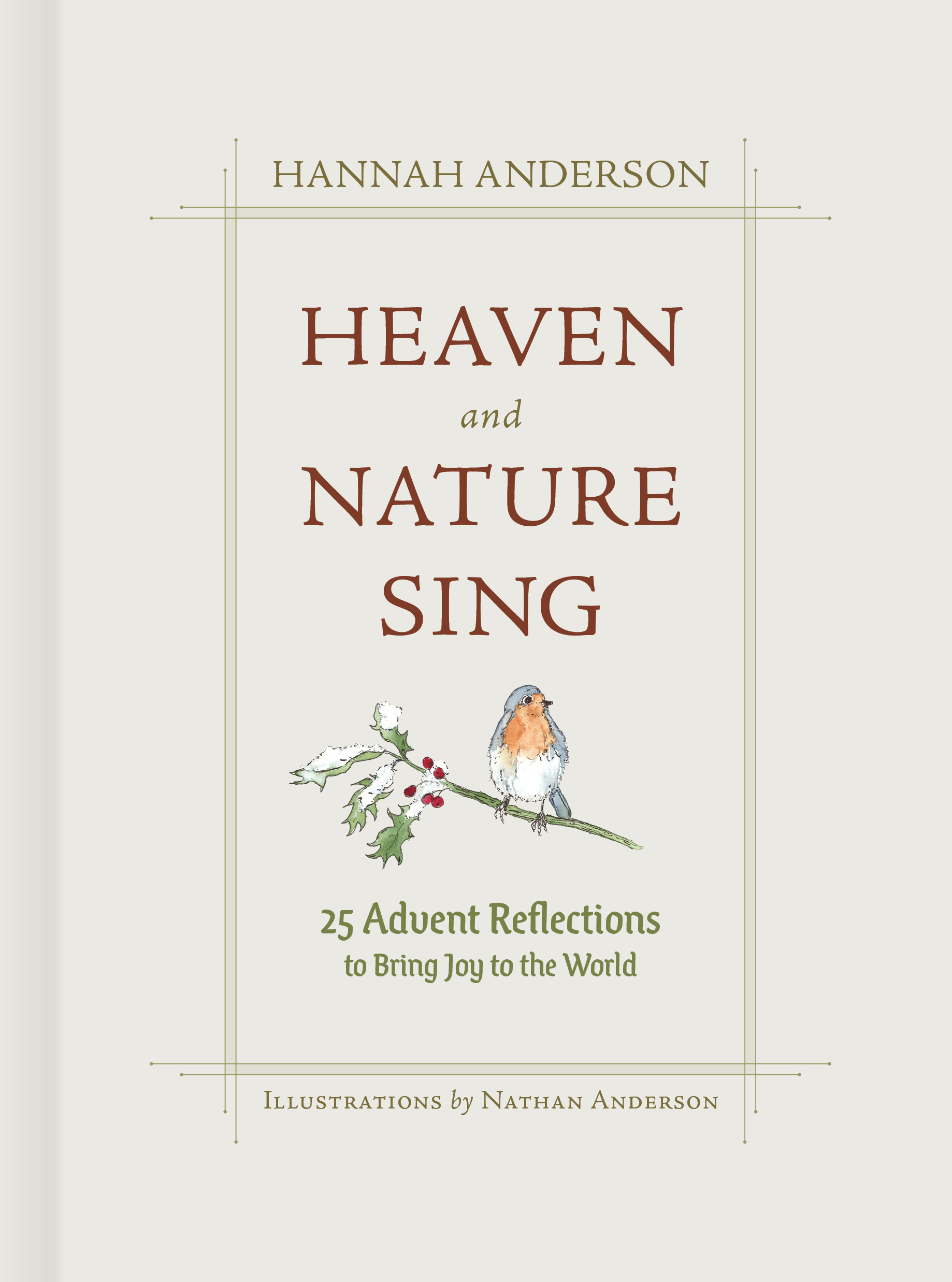
Heaven and Nature Sing: 25 Advent Reflections to Bring Joy to the World by Hannah Anderson was just released last fall. I’m so glad I heard of it in time to use for Advent.

“Heaven and nature sing” is a phrase from “Joy to the World,” written by Isaac Watts. Watts’ hymn looks forward to Jesus’ second coming more than His first, but it’s regularly used as a Christmas carol. Hannah took inspiration from this phrase and wrote 25 Advent devotions based on various aspects of nature connected with the birth of Christ. The Bible tells us creation groans from the effects of sin, waiting for redemption. We also groan or yearn for things to be set right. Hannah writes, “I want to offer you hope—not by ignoring the brokenness but by looking it squarely in the face, knowing your Redeemer has and will come” (p. 1).

One thing that struck me about these meditations was how much sheer thought must have been behind them, to weave so many threads together.

For instance, in the chapter “Family Tree,” Hannah writes of her husband’s discovering some old family genealogies which were written not in flow charts like we’re used to, but in concentric circles. Then she tells of a family visit to see the redwood trees in CA. One cross-section of a stump showed rings developed over the millennia the tree had been alive, and Hannah contemplates all the history the tree lived through. Then she brings up the records of Jesus’ human genealogy. His people were often faithless and disobedient, resulting in judgment by enemy armies taking over Israel and exiling its people. Isaiah compares this to God lopping boughs off a tree (Isaiah 10:33). But He promises “There shall come forth a shoot from the stump of Jesse, and a branch from his roots shall bear fruit. And the Spirit of the Lord shall rest upon him. . . In that day the root of Jesse, who shall stand as a signal for the peoples—of him shall the nations inquire, and his resting place shall be glorious” (Isaiah 11:1-2, 10).

“The story of Christmas is this: the tree is not dead” (p. 20). And eventually, others were grafted into the family (Romans 11:17-24), “strangers and foreigners and all those who thought they’d never know family again, those who never dared to hope that life would run through them” (p. 20).

You and I are links in the chain of generations, called to steward the fragile hope we’ve received. The seventy or eighty years given to us on this earth pale in light of those who have come before us and those who follow after. . .

So whether his work happens over the course of a thousand years or one day, whether it is given to us to play a prominent role in it or simply to stand as a faithful witness to the promise, we will wait on him. And we will wait in hope.

The tree is not dead. The quiet, steady work that came before us will continue on after us. The quiet, steady work we do today—even if it’s as simple as celebrating the Promised Son during this season—will echo through the years (pp. 20-21).

And thus Hannah writes about winter, stars, serpents, holly, evergreens, swaddling bands, shepherds, stars, and more.

One of my favorite quotes is in the chapter “Among the Beasts.”

Yes, the manger signals something about this baby, but it is not simply his poverty. By being placed in the manger, he is revealed as both the rightful son of Adam charged with caring for his creation and also the eternal Son of God who created them and who provides for them. So instead of filling the manger with hay or corn, he fills it with himself (p. 80).

I spent many mornings after my reading in this book in tears or joy, touched and awed by the contemplation of the “old, familiar” Christmas story.

Each devotion is about five pages long and written in an easily readable style. The illustrations on the cover and between chapters were drawn by Hannah’s husband, Nathan.

I can’t recommend this book highly enough. I’m sure I’ll use it again in future Advent seasons. But since these truths are timeless, you could read it any time of year.

I have some of Hannah’s other books in my Kindle app, and I am eager to read them. The only trouble is deciding which one to start with!

Let Not Your Hearts Be Troubled

The scene is in the upper room, where Jesus met with His disciples to observe the Passover. He washed their feet as an example of humble serving. He instituted what we call the Lord’s supper. He predicted that one of them will betray Him. He gave them a new commandment, to love each other as He loved them.

And now He tells them He is about to leave them.

Peter, almost always the first one to speak up, wants to know where Jesus is going and why they can’t follow. He pledges to lay down his life for Christ.

And then Jesus stuns Peter by predicting Peter will deny Him—not once, but three times.

In John’s narrative, it looks like immediately after this exchange, Jesus goes on to some of His final teaching before He is betrayed and arrested. John is the only gospel-writer to record this extended discourse.

The disciples only know part of what’s coming: that Jesus is leaving, and that at some point persecution will come. Peter is told that he will spectacularly fail. None of them knows that Jesus is about to be arrested that very night and die the next day. But Jesus knew they needed comfort, hope, and strength for what was ahead.

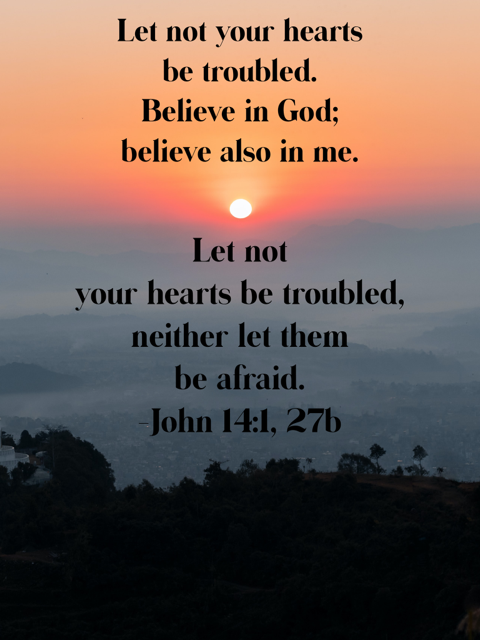
Jesus opens and closes these words with the phrase, “Let not your hearts be troubled” (John 14:1, 27). I had never realized before this reading that Jesus said it twice or that He said it right after predicting Peter’s denial.

In Warren Wiersbe’s book, Be Transformed (John 13-21: Christ’s Triumph Means Your Transformation), he brings out six truths Jesus shared with His disciples at this time:

They are going to heaven (13:36-14:6). Not immediately, but someday they will follow Him to the place He went ahead to prepare.

They know the Father now (14:7-11). Wiersbe points out that “the word Father is used fifty-three times in John 13-17.” Heaven is “my Father’s house.” “Jesus said that knowing Him and seeing Him was the same as knowing and seeing the Father. He was claiming to be God.” Jesus is “the way, the truth, and the life” (John 14:6). They could trust in the Father’s loving care.

They have the privilege of prayer (14:12-15). “Whatever you ask in my name, this I will do, that the Father may be glorified in the Son” (14:13). Wiersbe notes:

The “whatsoever” in John 14: 13 is qualified by all that God has revealed in His Word about prayer; likewise, the “anything” in John 14:14. God is not giving us carte blanche; “in My name” is the controlling element. To know God’s name means to know His nature, what He is, and what He wants to do. God answers prayer in order to honor His name; therefore, prayer must be in His will (1 John 5:14–15). The first request in “the Lord’s Prayer” is, “Hallowed be thy name” (Matt. 6:9). Any request that does not glorify God’s name should not be asked in His name (Location 587).

They have the Holy Spirit (14:16-18). In God’s plan, the Holy Spirit would come to minister to God’s people in a special way when Jesus went back to heaven. He’s called the Helper and the Comforter. “He will teach you all things and bring to your remembrance all that I have said to you” (14:26).

They enjoy the Father’s love (14:19-24). Our love for Him will be manifested by keeping His Word.

They have the gift of His peace (14:25-31). “Peace I leave with you; my peace I give to you. Not as the world gives do I give to you. Let not your hearts be troubled, neither let them be afraid” (v. 27).

Though our circumstances are different, there is much in the world that could trouble us. The world has never been a friend of God, but it seems to be going further away from Him. Those who know God in Western society have had many privileges the last several decades, but those are fading fast. Christianity is not popular these days. Christ foretold a variety of bad things that would happen before the end.

And besides the large-scale issues, we face rising prices, discord in our country, new diseases, and physical issues.

And, like Peter, sometimes our personal failures haunt us.

Yet God has given us the same resources He gave the first disciples, hasn’t He? We have a relationship with the Father, Son, and Holy Spirit. God has prepared a place in heaven for us to look forward to. Meanwhile, we have the Father’s love, care, forgiveness, and grace, the Word of God, the Holy Spirit’s help, comfort, and guidance, and the peace of Jesus that overcomes the world.

Truly we have every reason to “let not our hearts be troubled,” no matter what comes our way in the future.

(I often link up with some of these bloggers.)

Laudable Linkage

This has been a light blog reading week for me, but I did find a few things I wanted to share:

What I Long For More Than Miracles. “I suppose it is possible that I have witnessed a miracle in my lifetime, but if so, I’m not aware of it. . . . And if I’m honest, this doesn’t bother me in the least. It doesn’t bother me in the least because on many occasions I’ve witnessed something I count equally significant or perhaps even more so: I have witnessed the evidence and the intricacy and the perfect timing of God’s providence.”

Stooping to Filthy Feet, HT to Challies. “The man on his knees, rinsing sweat from Peter’s athlete’s foot and getting between Judas’s toes to wipe away the dung was our Creator, who is before all things and in him all things hold together; the hands that washed those verrucae and blisters would one day be the only ones qualified to break the seals and open the gates to the New Jerusalem.”

Winning Your Child’s Heart With Winsome Words, HT to Challies. “My years as a parent have helped me understand that my words do more than guide my children through their day. They shape how they think about themselves, other people, and how the world works. Most importantly, my words are one way my children learn about the gospel.” I wish I has this to read 40 years ago.

Bible Reading and Vain Vows. “We know the history of the people who made that vow at the foot of Mt. Sinai. Almost all of them ended up dead for disobedience and never set their feet in the promised land. They swore to do everything God told them to do, then they didn’t do it. We also know our own history when it comes to New Years Resolutions. These aren’t necessarily ‘vows,’ unless we actually vow something to the Lord, but we know that we are as frail as ancient Israel was. The spirit might be willing, but the flesh is exceedingly weak.” Includes several Bible reading plans.

Two sides of the issues from the same blogger: 3 Reasons Why You Should Make New Year’s Resolutions and 3 Reasons You Should NOT Make New Year’s Resolutions. HT to Challies.

I’d like to leave you with the last half of a poem by John Newton titled “At the Close of the Year.” (You can find the whole poem here.)

And since his name we knew,
How gracious has he been:
What dangers has he led us through,
What mercies have we seen!

Now through another year,
Supported by his care,
We raise our Ebenezer here,
“The Lord has help’d thus far.”

Our lot in future years
Unable to foresee,
He kindly, to prevent our fears,
Says, “Leave it all to me.”

Yea, Lord, we wish to cast
Our cares upon thy breast!
Help us to praise thee for the past,
And trust thee for the rest.

Friday’s Fave Five

Here we are at the last FFF of December, and of 2022. Before we set up next year’s calendars, it’s good to pause and think through the blessings large and small of the last week. Susanne at Living to Tell the Story invites us to do just that.

1. Christmas cards and letters. Fewer people seem to be sending these, understandable with rising postal costs. One friend said that since many of us stay in touch through the year on Facebook, she wondered if a yearly recap letter was really necessary. But, thankfully, she sent one anyway. 🙂 I enjoy sending and receiving them and having a little visit with friends through them.

2. Wellness in time for Christmas. I mentioned some of these faves on my end-of-December reflections yesterday, but I know some are only here for FFF. So I hope you’ll forgive a bit of overlap. Timothy had Covid right before Christmas, causing us to wonder if we should push the celebrations back a day or two. But his fever broke and symptoms abated just in time to be able to go ahead as planned.

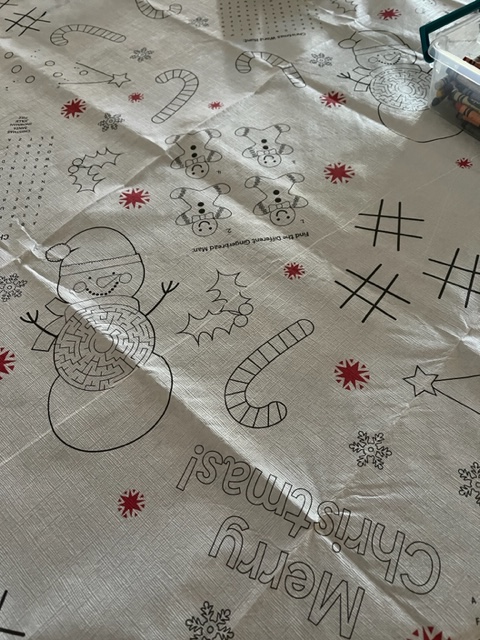
3. Christmas and all its blessings: family together, feasting, thoughtful gifts. We also enjoyed a disposable tablecloth that had puzzles, games, and pictures to color. We all worked on it at points throughout the day.

4. My husband made numerous trips to the store for me the last couple of weeks since he was off. That was immeasurable help in freeing me up to get things done at home.

5. Extra time to visit. My oldest son is here for an additional week. He did this last year, too. Even though he is working from our home during the day, we have evenings and an extra weekend before he heads back to RI. That’s been so nice, especially with how busy last week was and with Timothy and Mittu not feeling well part of the time.

Bonus: Friends. Jeremy got a call this week that his refrigerator in RI died. A friend who stopped by to feed his cat noticed a bad odor and discovered the frig was at room temperature with a puddle of oil at the bottom. She cleaned up the puddle and another friend came over and cleared out the ruined food. Thankfully, he had already planned and budgeted for a new refrigerator, so it should be there a couple of days after he gets home.

As we head into a new year, I hope and pray it’s a blessed one for you.

December Reflections

I imagine your December was filled with many of the same things ours was: Christmas decorating, shopping, wrapping, addressing Christmas cards and writing family newsletters, cleaning and preparing for family members or friends to visit. I’ve often thought that the Christmas “extras” would be a lot more manageable without the everyday stuff that still needs to be done. 🙂 Thankfully, my husband offered to get take-out several times before Christmas week and helped me with some tasks.

Jim and I celebrated our 43rd anniversary with a dinner out at a nice restaurant.

The week before Christmas, my grandson, Timothy, tested positive for Covid. We were thinking about whether it would be best to put Christmas celebrations off for a day or try to celebrate separately over FaceTime. But, thankfully, his fever broke and symptoms lessened in time to do Christmas as scheduled.

This was not a white Christmas, but it was the coldest one we’ve had since we were married. We’ve reached a low of 7F in the middle of some winter nights, but this year we were at 3 or 4 for a couple of days.

We managed to get to a Christmas concert by the Knoxville Symphony Orchestra and a small new drive-through light show as well as dinner out a couple of times.

And we had a wonderful Christmas together with lots of catching up and games on the other nights.

Thankfully, my oldest son is here for two weeks. I’m so glad, because Christmas week was so busy and went by so fast. Even though he’s working from our home this week, we have an extra weekend and evenings this week to be together. And with Timothy sick over a few days and Mittu one day, it’s nice to have a few extra days built into this visit.

Creating

I send out store-bought cards to extended friends and family, but make cards for immediate family. That makes December a busy card-making month with family Christmas cards as well as our anniversary and my step-father’s birthday.

This was my card to Jim for our anniversary:

The birds and branch were done on the Cricut. The white background was embossed on the Cuttlebug.The writing was printed on the computer–I usually do all my greetings and inside sentiments on cardstock through the computer, several on one page, and cut them apart.

This was Jim’s card for Christmas.

The white trees were embossed with the Cuttlebug and the deer was made with the Cricut.

This was Jeremy’s:

The fox was from a free download found on Pinterest. I printed him off on cardstock and cut him out with an Exacto knife. The trees were made via Cricut and dabbed with a glue stick and then doused with glitter. This was the first card I made this year, because I wanted Jeremy’s to be done before he came. I made a note to myself not to make the first card with glitter unless I want all the cards to have glitter. 🙂 I think I still have glitter on my work table and even had some embedded on my glue stick.

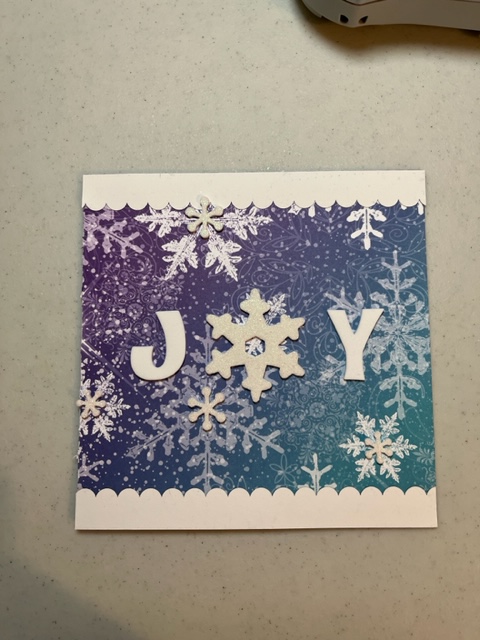
This was Jason’s:

I don’t know if you can tell, but the letters and center snowflake are big spongy stickers. Then I put a few more of the snowflake stickers in the center of the snowflakes on the background paper.

This was Mittu’s:

I was especially pleased with this one. I couldn’t find a design on the Cricut for a long branch of a pine or fir tree, so I cut out four smaller ones and arranged them.

This was Timothy’s:

The gingerbread stickers from Hobby Lobby were made out of fabric, ribbon, and buttons. I was delighted to find scrapbooking paper with Christmas cookies for the background on one of my multi-packs of paper.

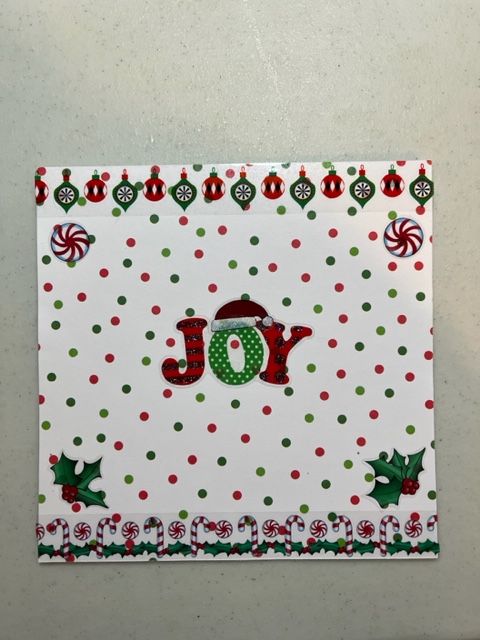
And this was for Jesse:

This is all done with stickers except the background scrapbooking paper. After it was too late, I realized I should have cut apart the “JOY” sticker and spread out the letters a bit.

This was for my step-father’s after-Christmas birthday.

I found this paper in a pad of Christmas scrapbooking paper, too, but thought it looked like it would do for a non-Christmas card.

Watching and Listening

Somehow we didn’t watch some of our usual favorite Christmas movies. But we did see a really good new-to-us one. My husband likes WWII movies and somehow found one set during Christmas. Silent Night was made in 2002, starring Linda Hamilton. She plays a mom in Germany whose home gets bombed. Her husband is a soldier, but she’s not in sympathy with the war. She and her son travel to their family’s hunting cabin, which happens to be near the front lines. Three American soldiers burst in on Christmas Eve, one of them wounded. They take over her cabin and distrust her efforts to help. She has her son hide the soldiers’ guns. And then three German soldiers come. . . She tries to negotiate a Christmas peace for the night while the soldiers are all wary of each other.

We also watched Meet John Doe, and old black and white film with Barbara Stanwyck and Gary Cooper. A newspaper columnist is fired but has one last column to write. She makes up a story about receiving a letter from an unemployed John Doe saying he’s going to jump off a building on Christmas Eve in protest of the state of the world. A number of people write in, offering John Doe jobs and giving him reasons to stay. The reporter convinces the newspaper to hire a man to impersonate “John Doe.” As people do for publicity, the newspaper and backers push and milk the story for all it’s worth, and the whole thing grows into a movement. But one businessman funding the scheme has his own agenda.

And, I’m not much for Hallmark Christmas movies, but I did enjoy The Mistletoe Promise while wrapping presents one afternoon. A lawyer is not fond of Christmas after some disappointments earlier in his life.He runs into a businesswoman in the food court who feels the same way due to her scheming ex-husband, with whom she still works. The lawyer is up for partner, but his boss is big on family values. He feels his chances would increase if he had a girlfriend and was heading towards marriage. So he proposes the “mistletoe contract” with his businesswoman friend, where she’ll pretend to be his girlfriend. To make it more realistic, they attend several Christmas events together. And, of course, you now what happens. 🙂 But it was a sweet movie overall.

I finished listening to the Literary Life podcasts on Dracula. They ended the series with a program on “Dracula At the Movies,” showing how the film adaptations changed over the years as society’s perception of evil changed. The book comes from the view that Dracula represents evil and must be destroyed.But later films change the story to provoke sympathy for Dracula and eventually to regard him as the mistreated hero.

I also listened to Your Best Writing Life’s podcasts on Organize Your Writing Life for Higher Productivity with Liana George and Writing Hybrid Devotional Studies with Kathy Howard (hybrid devotional studies being something between one verse and a couple of paragraphs on one hand and a full-fledged Bible study with an hour’s homework on the other hand).

Reading

I recapped all the books I read this year here and chose my top twelve here. But just to be consistent and share what I read since last month:

I’m currently reading:

  • Seasons of Sorrow: The Pain of Loss and the Comfort of God by Tim Challies. Almost done!
  • Writing for the Soul: Instruction and Advice from an Extraordinary Writing Life by Jerry B. Jenkins
  • Be Transformed (John 13-21): Christ’s Triumph Means Your Transformation by Warren W. Wiersbe
  • Hope for Christmas by Malissa Chapin

Blogging

Besides the weekly Friday Fave Fives, Saturday Laudable Linkage, and book reviews and book recap posts previously mentioned, I’ve posted these since last time:

  • The Meekness of Wisdom. It takes meekness both to receive and share wisdom.
  • God Does Not Forget Prayers or Promises. God ended 400 years of silence with an announcement of John the Baptist’s birth. He cares and has not forgotten His people, even though His timing is different than ours.
  • Why Did Jesus Come as a Baby? There are a number of reasons Jesus came to earth as a human, but why specifically as a baby? Some thoughts here.
  • The Savior of the World Is Here. Herod was once called “the Savior of the World.” But a baby born to poor parents in a stable was the only one with a claim to that title.

Writing

Not much, if any, this month! Our critique group disbanded for the holidays and will start back up in January. I hope to really dig into my writing then.

I wish you all the best for the coming year!