Laudable Linkage

Here are a few of the thought-provoking reads found this week:

Peace That Passes All Understanding, HT to Challies. “Now what? I just tried one of the classic passages on anxiety and it didn’t work. A-ha, there is a clue. I was looking for a pill. I visited God-my-pharmacist and asked what to take for my anxiety. That’s not the way Scripture works. I should have noticed it when I reduced the passage to a formula.”

Trusting God Through Terminal Illness, HT to Challies. “I am very thankful that I have an eye-tracking device so that I can still use a computer and turn on the TV. When my voice gives up, I can use my eyes to slowly type a few phrases which my mechanical voice speaks out loud. It would be easy to look at me and feel that there was no purpose to my life, but that’s not what God says.”

To the Impetuous and Impulsive. “As people repent of their sins and profess their loyalty to him, he does not eradicate their personalities as if he created them wrong in the first place or as if there is nothing within them he can use or redeem. Rather, he channels their personality, he redirects it, masters it, perfects it. Though he does sanctify his people, he does not completely destroy and then recreate them in such a way that they are all the same.”

Four Practical Ways to Cultivate Personal Evangelism, HT to Challies. “Let’s be honest, evangelism can be intimidating. For most, it can induce certain anxiety that can be crippling. It is easy to leave this high call that every believer has to a select few – elders, extroverts, or “experts.” Where does this intimidation come from when it comes to evangelism?”

Can Christians Date Nonbelievers? HT to Challies. The author answers from passages other than the usual go-to verse on this issue.

Eleven Factors for Helpful Short Term Mission Trips from one who has been on both sides of such trips, HT to Challies.

Welcoming the World’s Oldest Babies, HT to Challies. “Three weeks ago—on Monday, October 31—Rachel Ridgeway gave birth to the oldest babies in the world. Nearly 30 years ago, Lydia Ann and Timothy Ronald were conceived in a fertility clinic. Hours later, they were frozen.”

Gray Hair Is a Crown of Glory, HT to Challies. “This age-group will never be the “target” group for church growth strategists. However, if you want a church that actually does the work of the church and gives back to you as a pastor and to the congregants on the whole – then pray for a group of elderly saints.”

How Jesus Cares for Caregivers, HT to Story Warren. “Caregiving is hard. Not only do we grieve the suffering of our loved one, but we also process our own losses. Caregiving requires us to lay down our preferences and plans and pick up the holy calling of meeting the needs of another.”

Chosen Isn’t So Special If You’re a Turkey, HT to Challies. “My kids used to say I should write a how-to-hide-the-turkey-recipe book. We ate a lot of turkey when we lived in Italy. Affordable and easily available, I disguised wings, thighs and breast, every possible way. But turkey, as often as it showed up at our house, didn’t come whole.” A fun story with a great application.

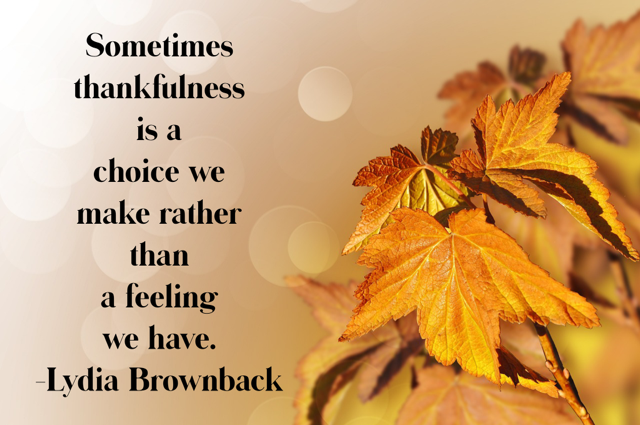
The quote above is from Joy: The Godly Woman’s Adornment by Lydia Brownback.

Friday’s Fave Five

Some weeks overflow with blessings. Other weeks, we have to be more intentional in looking for them. This week has been full, and it’s a joy to share with Susanne and friends at Living to Tell the Story. Please feel free to join in!

1. Thanksgiving. I am thankful we have a day set aside to remind us to be thankful. We had a wonderful day with all the family except our out-of-state one, plus had an abundance of good food. We watched a couple of episodes of The Santa Clauses, though we each dozed in different parts. 🙂 We tried to play some Jackbox games, but the system kept crashing–probably a lot of other people had the same idea. We did our “Thanksgiving tree” throughout the day, writing on leaves the things we were grateful for.

I forgot to mention last week I’m thankful we found a turkey! I had heard they might be scarce and expensive, but we didn’t find that to be the case.

2. Testimony times. The church we’ve been visiting had an opportunity both in Sunday School and then in the midweek service to share what we’re thankful for. It’s been a long time since we’ve been in a service given over to testimonies, and this one reminded me that churches used to do this regularly. It was such a joy to hear different ones’ stories of how God worked in their lives.

3. Bad news/good news from the dentist. I hadn’t had any dental problems for years and wasn’t expecting any. But at my regular dental cleaning, the hygienist found a cavity in a tooth under a bridge. She thought that repairing it would mean removing the bridge, and if there was not enough of the original tooth left, she predicted I’d need an implant. She went on and on about what getting an implant involved (a six-month process). I was pretty overwhelmed and discouraged. There are worse things to endure, but it was still dismaying to discover out of the blue that all this would need to be done. But when the dentist came in to check me, she thought she could patch the cavity with a regular filling. She said there was a small chance that, once she got in there, she’d find that more work needed to be done. But she felt pretty confident a filling would do what was needed. That was a relief.

4. A productive errand-running day. Whether due to age or physical issues–or both–it’s hard for me to be out all day. But while I had to be out to go to the dentist, I wanted to try to get as much errand-running done as I could so I didn’t have to go out again later in the week. I prioritized my list and got everything done except the couple of things that there was no urgency for. Those things could even wait til the new year if need be.

5. Safety. While out on those errands, I was trying to tentatively back out in a busy parking lot. It was nerve-racking because cars and people were coming from all directions, so I inched out a bit at a time while trying to look every which way. Then I saw in my rear-view mirror the car behind me was backing out quickly, coming straight towards me. God gave me the presence of mind to hit the brake and horn at the same time, and the other car stopped and then pulled back into its space.

Are you Black Friday shopping? We’re gratefully spending the day indoors, but we might shop online a bit.

Happy Friday!

A Confession of Praise

A study Bible footnote unexpectedly intersected with thoughts about Thanksgiving.

I’m not a Hebrew scholar by any means. But the ESV Study Bible noted that the Hebrew word todah could be translated as “make confession” or “give thanks or praise,” depending on the context. The footnote goes on to say, “Some overlap of these meanings is not surprising because rightful confession is itself a kind of worship of God” (p. 820).

We don’t usually connect confession of sin with worship and praise, but the one does lead to the other, doesn’t it? Once we’ve confessed sin to the Lord and rested in His grace and forgiveness, we overflow with joy and thankfulness.

“Blessed is the one whose transgression is forgiven, whose sin is covered. Blessed is the man against whom the Lord counts no iniquity, and in whose spirit there is no deceit” (Psalm 32:1-2).

But I began to wonder at another connection.

I was taught that confession of sin means saying the same thing God says about it. In other words, we don’t downplay our sin. We’re honest about it. We don’t say, “Oh, I just told a little fib.” No, to adequately confess sin, we have to call it what it is and own up to it: “I lied.”

So I wonder if giving thanks or praise carries that same connotation. When we praise God, we’re agreeing with what He says about Himself. It’s not that He needs the affirmation, but we need to recognize Him for who He is. And when we do, we can’t help but praise Him. And the more we behold Him, the more our cares and concerns melt away, because we remind ourselves He is more than able to handle any need we have.

Confessing also seems to carry the connotation of personal experience. I might share or rejoice in what God has done in someone else’s life. But if I am confessing, whether it’s sin or praise, I’m sharing what God has done in my life.

In Psalm 95:2, todah is the word translated thanksgiving: “Let us come into his presence with thanksgiving; let us make a joyful noise to him with songs of praise!”

Many of the psalms combine confession of sin, thankfulness for God’s grace, amazement at His greatness, and confession of His people’s personal experience of His provision, protection.

Psalm 145 is a beautiful example of this. Part of it says:

One generation shall commend your works to another,
    and shall declare your mighty acts.
On the glorious splendor of your majesty,
    and on your wondrous works, I will meditate.
They shall speak of the might of your awesome deeds,
    and I will declare your greatness.
They shall pour forth the fame of your abundant goodness
    and shall sing aloud of your righteousness.

The Lord is gracious and merciful,
    slow to anger and abounding in steadfast love.
The Lord is good to all,
    and his mercy is over all that he has made.

10 All your works shall give thanks to you, O Lord,
    and all your saints shall bless you!
11 They shall speak of the glory of your kingdom
    and tell of your power,
12 to make known to the children of man your mighty deeds,
    and the glorious splendor of your kingdom.
13 Your kingdom is an everlasting kingdom,
    and your dominion endures throughout all generations.

Psalm 65 does as well:

Praise is due to you, O God, in Zion,
    and to you shall vows be performed.
O you who hear prayer,
    to you shall all flesh come.
When iniquities prevail against me,
    you atone for our transgressions.
Blessed is the one you choose and bring near,
    to dwell in your courts!
We shall be satisfied with the goodness of your house,
    the holiness of your temple!

These thoughts brought to mind Ron and Shelly Hamilton’s song, “Worthy of Praise”:

My heart overflows with praise to the Lord
I will lift up my voice to the King
He brought me out of the pit of despair
And taught my heart to sing


Worthy of all my praise
You are worthy of all my praise
I bow at Your throne
And I worship You alone
Lord You are worthy
Worthy of praise

I wish you all a wonderful Thanksgiving filled with food, family, and praise for Him who is worthy.

(I often link up with some of these bloggers.)

God is always working, even when we don’t see

One morning last week, I was a little discouraged as I prayed for a long-term prayer request. I hadn’t seen any movement on that front in a long time. It didn’t look like anything was happening.

I felt sure that I was praying according to God’s will. 1 John 5:14-15 says, “And this is the confidence that we have toward him, that if we ask anything according to his will he hears us. And if we know that he hears us in whatever we ask, we know that we have the requests that we have asked of him.” That doesn’t mean He will answer everything in just the time and way we want. Sometimes He might even say no if that is better for us than a yes. Sometimes He has something different and better in mind. Sometimes He wants us to wait.

But as I was praying for His working in a heart to bring a person to faith in Himself, I felt sure that He would do all in His power to answer that request.

Sometimes sin can hinder answers to prayer, but I wasn’t aware of anything I needed to confess to the Lord or anything that would hinder answered prayer.

I’ve had enough experience with the Lord that I know He’s working, even if I don’t see any evidence of it. So I encouraged myself by reminding myself of times in Scripture or in my own life where I saw His answer after an extended period of seeming inactivity.

From the garden of Eden, God promised Adam and Eve that a redeemer would come to defeat Satan. It was thousands of years before that redeemer came. “But when the fullness of time had come, God sent forth his Son, born of woman, born under the law, to redeem those who were under the law, so that we might receive adoption as sons” (Galatians 4:4-5). God was at work all those years, preparing people for the coming of His Son.

Abraham and Sarah waited 25 years before the son God promised them arrived. Why did God make them wait so long? Perhaps to strengthen their faith.

David was anointed king years before actually coming to the throne. Meanwhile he had to flee for his life while the current king, Saul, sought to kill him.

Daniel and others were in exile in Babylon for seventy years before God brought some of them back to Israel.

Hebrews 11 lists several more who saw God do great things after long years. Some of them even “died in faith, not having received the things promised, but having seen them and greeted them from afar” (verse 13). They trusted God would answer and bring about His will even though they never saw the answer in their lifetime.

In my own life, I remember aching over the breakup of my family and the loss of all that was familiar when we moved to a new city when I was a teenager. I clung with all my might to Romans 8:28: “And we know that for those who love God all things work together for good, for those who are called according to his purpose.” I am not even sure I was saved then. I had made a profession as a young child, but had not been in church or in the Bible regularly. I couldn’t remember much about what I prayed when I came forward in a friend’s church in third grade. But I knew enough that I could go to God for help. After a very long and lonely summer, God led us to a school and church where I was regularly taught His Word and where I made sure of my salvation in my teens. God had been drawing me to Himself all the while, even when I felt so alone.

I didn’t have a long period of singleness, but it felt plenty long at the time. I spent several years in a Christian college with eligible young men all around me. But none of them seemed interested in me. Then after several years of praying for the right one, a friendship blossomed into something more. God had been laying the foundation and preparing both of us for each other, even when we were unaware of what He had in mind.

One of the biggest demonstrations of God’s unseen working occurred in my father. I knew my father loved me, but he also got angry easily. He was big on respect and authority, and he took any arguments or disagreements from his children as disrespect or “sass.” Consequently, I was afraid to talk to him about things he might disagree with. He had always believed there was a God, but as far as I knew hadn’t believed in Him in a personal way.

When I went off to college, I’d share verses at the end of letters to my father. I always wrote them out because I didn’t figure he’d look up the references. He never responded to them. I pictured him either skipping over them in disgust or shaking his head and thinking, “There she goes again.”

Several years after my husband and I got married and had a couple of children, my father came to visit us in SC for the first time. He wasn’t well. He had gotten out of the hospital with pneumonia not long before flying out, so we felt maybe he just traveled too soon. But on the day he was supposed to fly back to TX, he ended up in the hospital.

One evening as we came down the hospital hall to visit him, the nurse told us they had almost lost him, and he was in ICU. When she took us to him, he said, “I know one thing. When I get home, me and the pastor are going to have a long talk.” We asked if he would like our pastor in SC to come and see him. He said yes.

On an interesting side note, before he got so sick, he had come with us to the field day at my oldest son’s elementary school. He met my pastor and his wife there, as they had a child in the same school. My pastor’s wife was from west TX, as my dad was. She knew the little town he was from, a town most people had never heard of. I think that little detail drew him to them and caused my dad to be open to the pastor’s coming when he might not have been if he had never met them.

While my dad was in ICU, we could only visit with him 15 minutes at a time once or twice a day. My pastor came often—I think he may have come every day for a while.

Finally my dad was moved out of ICU into a private room. The first day we visited him there, almost as soon as we walked in, he said something like, “I just want you to know that the pastor came by today, and I accepted Jesus Christ as my Lord and Savior.”

I almost fell over. To have my father express faith so clearly and openly was something I hadn’t expected.

Later, as we talked with my pastor, he shared with us some of the discussions he’d had with my dad. He said at one point, my dad talked about the verses I used to send him and said, “My daughter has been trying to get me to do this for years.” To my shame, I had been praying for his salvation but had not wanted to push. I think I might have written out the full plan of salvation once or twice. But mostly I just sent verses as a postscript without comment. All that time I thought my dad had just skipped over those verses, God had been using them to plant seeds in his heart.

He came with us to church before he went home. I wish he had lived closer, so he could have come with us more and we could have encouraged him spiritually. For some reason, he never got into the church back in TX.

So there wasn’t a dramatic change in his life. My pastor encouraged me that when someone is saved later in life (my dad was 61), they’ve had more years on the other side of things. It takes a lifetime to grow spiritually, and my dad had had more time on one side than the other.

But there were subtle changes. He liked to read, and he was open to my sending him Christian books. One of them was about Christians behind the Iron Curtain. On the phone we discussed the amazing ways God helped and encouraged those people in such hard circumstances.

As I hung up the phone, I thought, “I just had a conversation with my dad about the Lord.” A miracle.

When seeds are planted, they remain underground for a while before anything of the plant comes up. Different plants grow at different rates: some take a long time. The flat ground looks lifeless. But underneath, things are happening. Then that first green blade appears and rejoices the heart of the planter.

I love John Piper‘s quote that “God is always doing 10,000 things in your life, and you may be aware of three of them.”

Though sometimes we have to wait long, we can wait in faith and hope, knowing God is at work behind the scenes.

(I often link up with some of these bloggers.)

Laudable Linkage

Here are some of the articles that resonated with me this week:

Love Is a Skill, HT to Challies. “Anyone who has tried very hard to love other people well will know that love doesn’t always feel very natural. A lot of times it feels more like hard work.”

The Problem with Reading the Bible Verse-by-Verse, HT to Knowable Word. The verses divisions, subheadings, footnotes, charts, etc., in most of our Bibles “break up the text into little chunks (often arbitrarily), and we do not naturally read in little chunks, we read in big chunks. You read ordinary books section by section, not word by word, but all the footnotes and verse numbers condition us to read the Bible verse by verse.” Those tools are good for study later, “but the first and most important rule for interpreting and appropriating any biblical book is to actually read the book.”

Dig Deeper, HT to Challies. “Think of the scriptures like a fancy layered dessert — maybe a cake or parfait. There are several layers, and each offers new delights. If you don’t dig down into all the layers, you’re missing out.”

A Call for Endurance and Faith, HT to Challies. “We are not without encouragement in times like these, and sometimes the call for endurance comes in ways that seem strange to the contemporary churchgoer who has enjoyed religious freedom all their lives.”

What Does God Want of Me? HT to Challies. “But what I do remember are the three questions that came out of this difficulty, questions that my husband raised in the midst of this trial to help provide us with direction and guidance. These questions have stayed with me ever since, and have given me clarity and lessened my burden in a wide variety of situations: problems with children or other family members, issues in my marriage, dilemmas in church, personal trials, and more.”

Is Your Way Really God’s Way? ‘While the Bible is heavy on function (what we are to do) it is light on form (how we are to do it).” This article helps discern between form and function and the errors of insisting on our form of doing things.

Protecting Your Teenagers Online, HT to Proclaim and Defend. “We have a pool in our backyard. We also have young children. What steps do we take to protect them? 1. A fence; 2. Swim lessons; 3. Supervision.” Kristopher Schaal then applies these three levels of protection to internet usage.

Cultivating Attention: The Challenge of Reading Great Literature, HT to Linda. “As a literary critic, writer, and professor, I have the great privilege of working with literature every day, and helping others to encounter the beauty of great stories as well. Evangelization and discipleship through beauty is vitally important for our modern culture, for God is perfect Beauty as well as perfect Goodness and Truth. Stories, poetry, and all the arts can help us both to grow in our own faith and to share that faith with others in a compelling way . . . But it’s not easy. Many readers find themselves discouraged, encountering a gap between their desire to engage with great tales and the rather more difficult reality of the experience.”

Why the World Needs Readers (Like You), HT to Linda. “I’ll be honest. It’s in my own self-interest to say that reading is important. I am the author of a book blog, after all. But I believe—passionately—that reading is more than your average pastime. Much more. Here’s why I think that readers, people like you and me, are critical to preserving civilization—and helping it flourish.”

How an Introvert Does Thanksgiving, HT to Linda. “As a large and diverse group, we introverts love our families and the holidays no more or less than anyone else. So the fear and loathing with which we sometimes face this season is not an intro-aversion to the whole concept of family or holidays. It’s more the specifics of the experience that exhaust us; many of us are right now anticipating Thanksgiving with equal parts of delight and anxiety. Yes, pie. But also forced togetherness, lots of chitchat, and old family scripts replaying again and again. It’s a tradeoff. So, before the holidays flatten you like a runaway truck, perhaps take a minute to sort through their delights and the stresses to sketch out some strategies for Thanksgiving so you can enjoy more of the former and less of the latter.”

I Could Never Get Grandma’s Dressing Quite Right—Until She Was Gone, HT to Linda. “Back then I hadn’t yet learned that the most important thing about cooking for other people is the joy your food can bring them. . . .that on Thanksgiving, it’s a waste of time to roast a whole entire pumpkin for pie (the canned stuff is superior anyway!), and that investing in six great dishes is far better than churning out 12 I’m too exhausted to actually eat, and that turkey tastes approximately the same no matter what you do to it.”

thankful heart

Friday’s Fave Five

Another week is almost in the books. How good it is to pause a moment with Susanne and friends at Living to Tell the Story to remember some of the highlights and blessings of the week before they fade from memory.

1. Desk chair arm covers. I love my desk chair. It fits me just right, and everything is at the right height. The back is high enough, and the whole chair is comfortable enough, that I can lean back and take a power nap when needed. So I was dismayed when the armrests started cracking, then little bits chipped away, then the cracks started snagging my clothes. I started mentally designing a cloth that could wrap around the arm rest and keep in place with Velcro. Then—light bulb moment—I thought that somebody had probably already come up with a solution to this dilemma. I looked on Amazon and found arm chair covers at a really reasonable price ($8.95). They’re elasticized rather than wrapping around and look so much more professional than what I was thinking. I’ve found a ridiculous amount of delight in these things.

2. A meal together. It had been a few weeks since I had made a meal for the whole family (minus the out-of-state son). So I invited everyone over for spaghetti last Saturday night. We enjoyed some games afterward

3. Gluten Free cookies turning out well. I had been wanting to try one of my favorite cookie recipes with gluten-free flour. Since my daughter-in-law and grandson began having gluten issues, baked goods were the hardest things to make well–they usually came out very dense. I don’t know if the makers of GF flour have improved or what, but these cookies came out so well. I used King Arthur Measure for Measure flour. I don’t bake much any more with just the two of us home who don’t need the temptation of extra sugar around the house. But I just made one batch and sent some home with the kids.

These are Choco-Peanut Butter Dreams. The recipe is included with some of my other favorites here.

4. Unexpected help. My husband is a blessing to me every week. 🙂 But he outdid himself this week. He has a little sweeper/mopper/steamer gadget that he got out to use on a stubborn stain on our bathroom floor. Then he decided, while he had the device out, to go ahead and do the other bathroom floor. Then he decided he might as well do all the wood floors. What he didn’t know was that sweeping was on my agenda that morning. We have a pretty big expanse of hardwood floors, it was such a joy to come out and find them being cleaned. I was able to go straight on to the cookie baking mentioned above. Then I had time to rest for an hour before making dinner.

Then, just as I started making the cookies mentioned above, I realized I needed more brown sugar. Jim stopped what he was doing and offered to go to the store for me.

5. A dinner-making marathon. Jason and Mittu are painting their kitchen, and they asked if they could come over to make up a bunch of meals for the week so they could just warm them up in the microwave at their house. I mostly hung out with Timothy in the living room, and Jason and Mittu were in and out through the night. They also brought Mexican food take-out and left me with a few of the muffins they made.

I hope those of you in the US have a wonderful Thanksgiving Day with loved ones and friends.

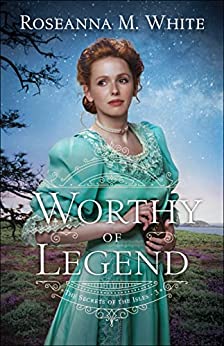
Worthy of Legend

Worthy of Legend is the third installment in Roseanna M. White’s Secrets of the Isles trilogy. The first was The Nature of a Lady; the second was To Treasure an Heiress.

The Secrets of the Isles involves two different groups in search of legendary pirate treasure. One loves “the hunt” and the thrill of archeological finds. The other wants the fame and fortune of such discoveries and employs underhanded means in the race to discover treasure.

Lady Emily Scofield is good friends with the people in the first group. But her father and brother are the primary instigators in the bad group.

Emily has lived her entire life in the background of her brother, Nigel. Nigel was her father’s favorite, and his misdeeds were excused away. Emily is expected to desert her friends and show loyalty to her family. But she can’t.

Instead of writing off her family completely, though, she tries to show love to them. Her friends fear she’ll be taken advantage of again.

Bram Sinclair, Earl of Telford, is the brother of the heroine in the first book. He has had an interest in the King Arthur legends since childhood. As he and his friends piece together clues to the artifact that both groups are pursuing, he realizes what they are looking for might be related to King Arthur. They try to keep this information secret from the other group.

As Bram and Emily’s group works together, Bram is concerned for Emily. He recognizes her conflict with her family and her lack of confidence and self-esteem from having been dismissed and overlooked for so many years. As he tries to encourage her, he discovers a true treasure in her character and heart.

A secondary plot line involves Emily’s maid, Thomasina, who has, unknown to Emily, been violated by Nigel. When a young man from the islands becomes interested in Tommie, she feels he would not be if he knew what had happened to her.

A couple of my favorite quotes from the book:

And if she lost everything all over again . . . well then, she’d just have to trust that the Lord could do more with her shattered than He could with her as she was now, barely holding together. That He meant her to be a mosaic instead of a whole.

Your worth, Thomasina, rests on no one else’s opinion of you. It doesn’t rest even on you. It rests in the Lord. He sees your heart, your soul. And that is all the approval any of us needs.

Bram and Emily were background characters in the previous books, and I enjoyed getting to know them better. I also loved the humorous bantering between Bram and his friend, Sheridan.

I especially liked the fact that these books were in a place I had never heard of, the Isles of Scilly. Now I feel I know the isles and the people on them. And the time frame of the early 1900s isn’t one we see often in historical fiction.

I enjoyed these stories very much and am going to miss these characters.

Hope in Darkness

God gives hope in darkness.

The darkness and barren landscape and often overcast skies of late autumn and winter can be depressing to me. I probably could not live in a country with just a few hours of daylight. I’ve written before about some things that help me through the “winter blues.”

But I decided this week to do a quick Bible study about darkness to encourage myself (and hopefully you, as well).

I remind myself God made the seasons. He mentions them in creation (Genesis 1:14-15). And he told Noah, after the flood, “While the earth remains, seedtime and harvest, cold and heat, summer and winter, day and night, shall not cease” (Genesis 8:22). He has a purpose for winter’s darkness as well as summer’s light.

God created light and darkness that we might know Him and know He is the only God: “I am the Lord, and there is no other, besides me there is no God; I equip you, though you do not know me, that people may know, from the rising of the sun and from the west, that there is none besides me; I am the Lord, and there is no other. I form light and create darkness; I make well-being and create calamity; I am the Lord, who does all these things” (Isaiah 45:5-7).

Darkness signals time to rest. The need for rest reminds us of our limitations. We can trust he who “will neither slumber nor sleep” (Psalm 121:4) will watch over us. Psalm 104:19-23 says:

He made the moon to mark the seasons;
    the sun knows its time for setting.
20 You make darkness, and it is night,
    when all the beasts of the forest creep about.
21 The young lions roar for their prey,
    seeking their food from God.
22 When the sun rises, they steal away
    and lie down in their dens.
23 Man goes out to his work
    and to his labor until the evening.
24 O Lord, how manifold are your works!
In wisdom have you made them all.

Darkness sometimes indicates God’s chastening. This is a recurrent theme in the prophets. “Hear and give ear; be not proud, for the Lord has spoken. Give glory to the Lord your God before he brings darkness, before your feet stumble on the twilight mountains, and while you look for light he turns it into gloom and makes it deep darkness. But if you will not listen, my soul will weep in secret for your pride; my eyes will weep bitterly and run down with tears, because the Lord’s flock has been taken captive” (Jeremiah 13:15-17). But Micah looks forward with hope even though Israel is in darkness due to sin: “I will bear the indignation of the LORD because I have sinned against him, until he pleads my cause and executes judgment for me. He will bring me out to the light; I shall look upon his vindication” (Micah 7:9).

God delivers us from darkness. Many verses bring out this truth. Psalm 107:10-12 speaks of people imprisoned in darkness because of their sin and rebellion. Then verses 13-15 say, “Then they cried to the Lord in their trouble, and he delivered them from their distress. He brought them out of darkness and the shadow of death, and burst their bonds apart. Let them thank the Lord for his steadfast love, for his wondrous works to the children of man!”

Another passage is Ezekiel 34:11-12: “For thus says the Lord God: Behold, I, I myself will search for my sheep and will seek them out. As a shepherd seeks out his flock when he is among his sheep that have been scattered, so will I seek out my sheep, and I will rescue them from all places where they have been scattered on a day of clouds and thick darkness.”

Darkness is not a problem for God. We don’t like darkness partly because we can’t see. We don’t know what’s outside when we hear a strange noise. But “If I say, ‘Surely the darkness shall cover me, and the light about me be night,’ even the darkness is not dark to you; the night is bright as the day, for darkness is as light with you” (Psalm 139:11-12).

God knows what is in the darkness: “He reveals deep and hidden things; he knows what is in the darkness, and the light dwells with him” (Daniel 2:22).

God protects us in darkness: “He will cover you with his pinions, and under his wings you will find refuge; his faithfulness is a shield and buckler. You will not fear the terror of the night, nor the arrow that flies by day, nor the pestilence that stalks in darkness, nor the destruction that wastes at noonday” (Psalm 91:4-6).

God gives the treasures of darkness. “I will give you the treasures of darkness and the hoards in secret places, that you may know that it is I, the Lord, the God of Israel, who call you by your name” (Isaiah 45:3). In context, this passage is addressed to Cyrus, a foreign king who did not know the Lord, about how God chose him and was going to use him and reward him. The couple of commentaries I looked at said that “treasures in darkness” referred to the fact that in that day, people hid treasures away in dark places so no one else could find them. But God was going to give these hidden treasures to Cyrus. I think we have to be careful about over-spiritualizing historic events in the Bible, but I think we can see a parallel with the treasures that God will give His children.

We can trust God in darkness. “Who among you fears the Lord and obeys the voice of his servant? Let him who walks in darkness and has no light trust in the name of the Lord and rely on his God” (Isaiah 50:10).

“But as for me, I will look to the Lord; I will wait for the God of my salvation; my God will hear me. Rejoice not over me, O my enemy; when I fall, I shall rise; when I sit in darkness, the Lord will be a light to me” (Micah 7:7-8).

We can serve others in darkness. “If you pour yourself out for the hungry and satisfy the desire of the afflicted, then shall your light rise in the darkness and your gloom be as the noonday” (Isaiah 58:10).

Darkness will not overcome God’s light. “In him was life, and the life was the light of men. The light shines in the darkness, and the darkness has not overcome it” (John 1:4-5).

Then I thought of the darkness of the seed in the ground and the butterfly forming in the chrysalis. Some day beauty will come from patient waiting in darkness. Light and warmth will surge into new growth. Elisabeth Elliot used to say that you can’t have resurrection without first having death. “Truly, truly, I say to you, unless a grain of wheat falls into the earth and dies, it remains alone; but if it dies, it bears much fruit” (John 12:24).

This turned out to be a more extensive study than I thought it would be. And that’s not even including verses about night.

Darkness is still not my favorite, but I don’t think it’s supposed to be. In John 3:19, Jesus said, “And this is the judgment: the light has come into the world, and people loved the darkness rather than the light because their works were evil.” There’s so much imagery, especially in the New Testament, about Jesus being light and our need to turn from darkness to light (Acts 26:18), cast off the works of darkness (Romans 13:12), and so on.

Also, sometimes darkness doesn’t indicate evil, but something hidden and unknown. For instance, in 1 Kings 8, Solomon’s temple has just been finished and the ark of the covenant has been brought in. “And when the priests came out of the Holy Place, a cloud filled the house of the Lord, so that the priests could not stand to minister because of the cloud, for the glory of the Lord filled the house of the Lord. Then Solomon said, ‘The Lord has said that he would dwell in thick darkness'” (verses 10-12). When Moses was given the Ten Commandments, “These words the Lord spoke to all your assembly at the mountain out of the midst of the fire, the cloud, and the thick darkness, with a loud voice; and he added no more. And he wrote them on two tablets of stone and gave them to me” (Deuteronomy 5:22).

Ecclesiastes 11:8 says, “So if a person lives many years, let him rejoice in them all; but let him remember that the days of darkness will be many. All that comes is vanity.” A note on the word vanity says it means “vapor” or “a mere breath.” Our lives seem to pass away like mist.

But “It is you who light my lamp; the Lord my God lightens my darkness” (Psalm 18:28). God gives us abundant hope in darkness.

Psalm 18:28. God lightens my darkness.

(I often link up with some of these bloggers.)
Laudable Linkage

Some of the thought-provoking reads from this week:

The Worshiper, HT to Challies. Interesting twist at the end of this one.

How to Make the Bible Come Alive. I always cringe at this phrase, because the Bible IS living (Hebrews 4:12)–we don’t make it come alive. But that’s exactly what Ryan Higginbottom talks about here: how to deal with and present the Bible in the faith that it is living and active. I especially liked this: “Some leaders break out the bells and whistles. They think that if they jazz up the setting, or the presentation, or the activities, then people will really pay attention and get a lot out of the Bible study. However, this approach is doomed from the start. It presumes that the Bible is (at worst) boring or (at best) inert, and that what God really needs is a good carnival barker.”

The Halloween Night That Changed My Life, HT to Challies. I loved reading this testimony that “God’s grace is stronger than the hardest heart.”

When Art Reminds Us of Eternal Truth, HT to the Story Warren. “‘…The Lion of Lucerne is the most mournful and moving piece of stone in the world.’ —Mark Twain. Art has a transcendent quality. It can cause us to contemplate the struggles and joys of human experience. Sometimes it overwhelms us with the beauty of the mundane or the eternal. I believe that the search for truth, beauty, and goodness is inherent to the artistic process and is so embedded in the human heart that even if artists do not acknowledge the Creator in their hearts, their art often communicates some truth of the Divine.”

Toxic, HT to Challies. “‘Toxic’. It’s a word that has invaded Christian speech, but could I suggest a moratorium on this adjective, please? For two reasons: . .” I especially like the second one.

In the End, There Are Yellow Tulips, HT to Challies. “When I walked into the church, she stood there with an apron on and a bouquet of yellow tulips extended towards me. I put my hands out and took them as she pulled me close in a hug. She knew those yellow tulips wouldn’t fix the hurt. She knew those yellow tulips would die in a few days. But that wasn’t the point. She saw me.”

A Grandmother’s Heart for Her Loved Ones, HT to Challies. “Grandmama bear wanted to confront those who’d wreaked havoc, demand an explanation, and describe the painful aftermath of their actions. But in the two decades since the horn-blowing incident, my spirit has become quieter and gentler because of the influence of the Spirit that dwells within me. So instead of lashing out, I took my jumbled emotions to the One who hears it all and bears it all.”

Should I Charge Other Christians for My Expertise? HT to Challies. “People just ask them to do little jobs or little consultations, say, in the evening or after church — it’s their gift, after all — without even thinking how this may be unbiblical by mooching or exploiting.”

It’s not about the nail, HT to Tammy. This video is a hilarious take on the “Don’t try to fix it, just listen” stance.

Thankful quote from Spurgeon

Friday’s Fave Five

Once again another week has flown by, and we’re pausing with Susanne and friends at Living to Tell the Story to remember some of the good things that have happened.

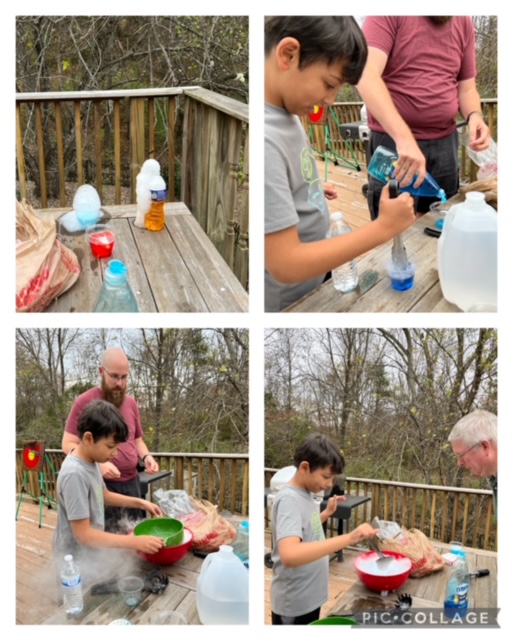
1. Dry ice “experiments.” We had gotten some dry ice to use at our family Halloween party, but had quite a bit left. Jim texted Jason and Mittu a link about some other things they could do with dry ice. They invited us over on Saturday to do some of those dry ice activities with Timothy. As it happened, when Jason went to get the dry ice out of the freezer–the bags were empty. The dry ice had turned back into a gas, I guess because their freezer wasn’t as cold as dry ice needs to stay solid. Since we were set up and planning to play with it, Jason set out to find some more, having to go to four stores before he found any. But Timothy had such fun mixing up water with food coloring or dish soap and dropping dry ice in, then using different utensils on it. We found that if you squeeze dry ice with tongs, it makes a screeching sound. And Jim and Jason got curious about what would happen if you put water and dry ice in a water bottle with the lid on. Short answer: it explodes loudly. (There’s a sheriff’s deputy living in Jason’s neighborhood, and we were a little afraid he would come over to investigate the noises we were making on the back deck. He didn’t, thankfully.) Near the end of the activities, Timothy proclaimed, “I love science!” 🙂 Then Mittu made stir-fry for us, and we played a couple of rousing hands of Uno.

2. Voting. I’m thankful we have that privilege in this country.

3. Veteran’s Day in the USA today. I am abundantly thankful for those who have served our country, often in unseen ways, at great sacrifice to their families.

4. Getting an hour back. I don’t really like changing the time back and forth, nor the early darkness. But I do like that extra hour once a year from “falling back.”

5. Apple cider. We usually just have this a couple of times a year, but Jim and I discovered we both like having an alternative hot drink. Neither of us likes hot tea, but we usually want more warm drinks in cold weather than coffee.

I hope you’ve had a good week as well!