

I’ve always tended towards quieter pursuits, alone or with a small group of friends. I tolerated noise and bustle and busyness better as a child. But by my teens, pep rallies were one of my least favorite things. I could get caught up in the excitement of a basketball game, but then wanted some quiet time afterward.
The older I get, the more I enjoy quiet. I don’t want to be a hermit. I do enjoy getting out of the house and around people. But as an internal processor, I seem to need quiet time just to think.
One can have absolute silence and solitude, though, and yet not have a quiet spirit.
I love the way the KJV and NKJV put Psalm 42:5: “Why art thou cast down, O my soul? and why art thou disquieted in me?” Other translations say in turmoil, disturbed, or restless. The Hebrew word sheds more light: “to murmur, growl, roar, cry aloud, mourn, rage, sound, make noise, tumult, turbulent, be clamorous, be disquieted, be loud, be moved, be troubled, be in an uproar, be in a stir, in a commotion, boisterous, clamorous.”The lack of quietness here has nothing to do with decibels, but a lack of peace and well-being.
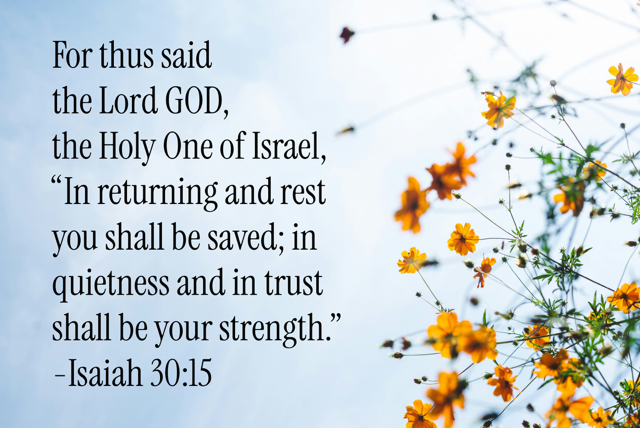
One verse that I’ve leaned on a lot, and that came to mind before my recent surgery, is Isaiah 30:15: “For thus said the Lord GOD, the Holy One of Israel, ‘In returning and rest you shall be saved; in quietness and in trust shall be your strength.'” One definition of the Hebrew word for quietness there is undisturbed.
Any number of things can disturb our peace and unsettle and disquiet us. A diagnosis. A fractured relationship. A news report. From the state of the world at large to the neighbor who plays music too loud or the driver who cuts us off, opportunities to be disturbed abound.
Sometimes God uses that disturbance to stir us up to prayer or some helpful action. But when our disturbed spirits are fomenting because of this or that problem, we’re a mess internally and often not much use to others. If, as Isaiah 30:15 says, in quietness and trust is our strength, then we’re weak when we are disquieted and faithless.
The rest of Isaiah 30:15 helps us.
In returning. We need to come back to the Lord and put our focus back on Him. I mentioned a couple of weeks ago that when we fixate on the problem, it looms large. But if we look at it through the lens of God, we’re reminded no problem is too big for Him. He’s just, wise, omniscient, loving, and kind. He knows what to do and the best time to do it. He might deliver us from the problem or give us grace to go through it. But He promises never to leave us or forsake us.
Returning carries the concept of repentance. In the context of Isaiah, Israel was not walking with God. Sometime our problems are the consequences of our own actions. When that happens, “If we confess our sins, he is faithful and just to forgive us our sins and to cleanse us from all unrighteousness” (1 John 1:9). God may still allow some consequences for our discipline, but we can go to Him with a contrite and humble heart and then stand before Him with a clean conscience, with nothing negative between us.
In rest. When we rest in the Lord, we release control to Him.
- “Rest in God alone, my soul, for my hope comes from him.” (Psalm 62:5, CSB).
- “Rest in the LORD, and wait patiently for Him; Do not fret because of him who prospers in his way, Because of the man who brings wicked schemes to pass” (Psalm 37:7, NKJV).
- “Come to me, all who labor and are heavy laden, and I will give you rest” (Matthew 11:28).
In quietness. Quietness doesn’t mean we just squelch disturbing thoughts and push them to the back of our minds. But we don’t let them run rampant, either. We redirect them to the One who can do something about the problem.
In trust. Isaiah 26:3 says, “You will keep in perfect peace all who trust in you, all whose thoughts are fixed on you!” Instead of meditating on the problem, turning it over and over in our minds, considering all the angles and what-ifs, we can purposefully meditate on the Lord: His goodness, love, wisdom, and power. Look at Him from all angles, look at what He’s done throughout Bible history, look at what He has done for us in the past.
Sometimes God stills the storm for us. I was concerned with my recent surgery because I would have to be off blood thinners for a couple of days. My heart rhythm problems have not been stable, so there was some possibility of a stroke if my heart went out of rhythm during that time. As I prayed about the situation, my prayers were mixed with worries. At one point, God brought to mind a song, “I Will Follow Thee, My Savior,” by Mac Lynch. The chorus goes:
I rest in Thee, trust in Thee,
I place my life in Thy hands.
I will follow Thee, my Savior;
Lead on, my Shepherd, lead on.
Even though these were not new truths to me, and I knew them on some level, that reminder led me to peace of heart.
Other times, God wants us to take our thoughts captive (2 Corinthians 10:5) by deliberately looking into His Word to remind ourselves of His truth. This is one reason it’s so important to be in God’s Word regularly. But if we’re too stressed to think clearly, or we don’t know where to look, we can ask a friend for help or even Google verses about worry, rest, and fear.
The rest of Isaiah 30:15 has a sad response. God told His people that returning and rest, quietness and trust was what they needed. However, He goes on to say, “But you were unwilling.” Jesus wept over Jerusalem because “I have gathered your children together as a hen gathers her brood under her wings, and you were not willing!” (Matthew 23:37).
God offers His grace and help. Let’s be willing to accept it. He’s given us so many promises in His Word that He will be with us and take care of us. Let’s turn our minds from our turmoil to His sufficiency.
After the psalmist asks himself why he’s cast down in Psalm 42:5, he goes on to say, “Hope in God; for I shall again praise him, my salvation and my God. My soul is cast down within me; therefore I remember you.”
Drop Thy still dews of quietness,
till all our strivings cease;
take from our souls the strain and stress,
and let our ordered lives confess
the beauty of Thy peace.John Greenleaf Whittier, from “Dear Lord and Father of Mankind“
(I often link up with some of these bloggers.)

