Review: Bloom In Your Winter Season

Bloom In Your Winter Season

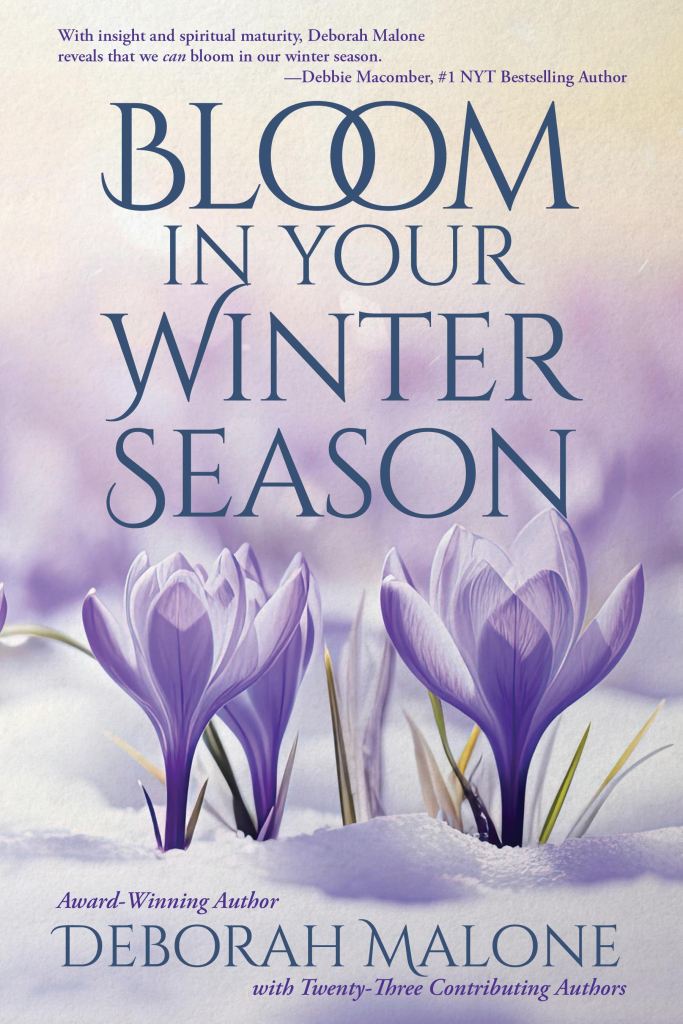
Bloom In Your Winter Season was written by Deborah Malone “with twenty-three contributing writers” for older women as a reminder that God can both minister to them and use them in their later years.

They don’t really define what constitutes a “winter season.” One of the authors is in her fifties, which I would say is more autumnal than wintry. Still, we’re all facing that time of life and getting closer every day, so we can tuck the lessons away for future reference if we don’t need them immediately.

The book is divided up into six chapters, each featuring a couple, or sometimes three, women in the Bible: Miriam and Anna; Mary and Martha; Mary and Elizabeth; Lois and Eunice; Lydia, Joanna, and Susanna; and Naomi and the widow with two coins. (I’m surprised there wasn’t a chapter on Sarah, maybe couple with Rebekah.) All of the women focused on are not “older,” but there are things about their lives we can learn from whatever season we’re in.

Each chapter is designed to be read over five days. The first four days’ reading contains short essays written by different women, each ending with application questions and a prayer. Day 5 is a Bible study on the focus women written by Deborah with passages to read, questions to answer, and blank lines to jot down notes .

The overall theme of the book is that God can still use you whatever age you are, and that’s brought out in most of the chapters. Some of the writers discuss specific situations like adjusting to the empty nest, widowhood, aging, sharing faith with our grandchildren, and living in a nursing home (one woman wrote over 70 books while in a nursing home!) But other chapters are more general.

One problem with five writers contributing to each chapter is that there’s a bit of overlap. But perhaps repetition reinforces the details. On the other hand, the chapter on Naomi only mentioned her once in passing in the essays.

The chapter that stood out the most to me was the one on Lydia, Joanna, and Susanna–I think partly because we don’t usually hear much about these women, especially the last two. They are mentioned in Luke 8:1-3 with “some women who had been healed of evil spirits and infirmities” who traveled with Jesus and the disciples and “who provided for them out of their means.” Joanna is mentioned again at the cross with other women in Luke 24. Writer Sherye Green points out that these women served Jesus out of “pure, unbridled gratitude” (p. 123).

I only knew of a couple of the authors here before reading this book. There are a few with whom I might not agree in every point, judging from their biography information. But I didn’t find anything objectionable in this volume.

Some of the quotes that stood out to me:

Anna worshiped in the waiting (p. 29).

Is there a mother or grandmother in your life who prays, encourages, and supports the younger generation in the faith? Godly women invest in a heavenly treasury of prayers and a heritage of faith for their loved ones. Praying mamas deposit a foundation of wisdom and understanding into their children’s lives, building up their character and committing their future to God (p. 91).

I used to pray for my daughter’s strength and personality–stating what I wanted God to place in her. I failed to realize that the parenting challenge is knowing God already has a plan and purpose for our little people. Our prayer should ask God to show us their developing talents so that we cultivate His gifts in them (p. 96).

When my focus was on me, I felt my broken heart intensely. I began noticing those around me with their own trials and doing small things I could to help ease their burdens: visiting a young friend dying of breast cancer, training as a hospice volunteer, taking food to new widows, and generally loving on people. It was different from the lay ministry my husband and I shared as a team, but just as important in God’s economy (p. 143).

The essays are designed to read one a day. I usually read two or three, because they were so short. If I ever read this book again, though, I think I’ll stick to one a day and ponder it more before moving on. 

Still, the book did its job in encouraging me that God has something for me to do and has promised to be with me in every season.

The Mission for My Remaining Years

My Mission

After age 30 or so, each milestone birthday becomes more sobering. Age 60 hit me particularly hard. There’s no question that there are more years behind me than ahead of me. Though I hope to still have another two or three decades, my strength and stamina show obvious signs of slowing down.

I’ve never had trouble admitting my age until I turned 60. I was past the time of claiming to be middle-aged, yet I didn’t consider myself to be really old yet. I still felt relevant, but I was afraid younger people would see me as past my prime, no longer worthy to be listened to.

One frustration of aging is increasing health problems. I suppose most people don’t go full steam until the day they die. Most of us undergo a gradual breaking down of various functions. I heard a radio preacher say one reason our bodies start failing is to make us willing to let go of them. We have a strong instinct to survive, but at some point, this body will get to a place where we’ll realize it’s no longer worth trying to preserve it. But even long before that time, doctor’s visits and medications increase.

What’s even more unsettling for me is that the age I will turn this August is the same age both my parents died. They had bad health habits and conditions that I don’t have–but I have some that they didn’t have. I am reminding myself that my times are in God’s hands.

I’m encouraged by reports of people my age and older achieving great things. Laura Ingalls Wilder was 65 when she published her first book. Grandma Moses began serious painting at the age of 78. Harlen Sanders established the Kentucky Fried Chicken restaurants when he was 65. Peter Mark Roget published his first thesaurus at the age of 73.

Most of us don’t have such lofty goals for our later years (although I would like to publish a book). We’d be happy just to be able to get around on our own steam and not be a burden to anyone.

In a recent post by Tim Challies, he included a quote by De Witt Talmage that arrested me:

. . . there is something for you yet to do. Perhaps it may be to round off the work you have already done; to demonstrate the patience you have been recommending all your lifetime; perhaps to stand a lighthouse at the mouth of the bay to light others into harbor; perhaps to show how glorious a sunset may come after a stormy day.

Those are things any of us could do. With however many years I have left, I want to share with my family, readers here, and friends at church and elsewhere, that God is faithful, God is good, and God is worth knowing.

When it feels like God is silent or absent, He is not. He has promised never to leave or forsake His own. 

When answers to prayer seem a long time coming, God’s timing is best. 

When you feel forsaken, God is with you.

He is the truest friend, the wisest guide, the strongest ally, the most loving Father.

His Word is a treasure chest. Delve into as often as you can, not just as an exercise or ritual, but to know the Author. 

On all of my sons’ graduation materials, whether a card or the “senior page” in their yearbooks, I shared the first part of this verse:

And you, Solomon my son, know the God of your father and serve him with a whole heart and with a willing mind, for the LORD searches all hearts and understands every plan and thought. If you seek him, he will be found by you, but if you forsake him, he will cast you off forever. (1 Chronicles 28:9).

I usually share this verse on graduation cards:

You make known to me the path of life; in your presence there is fullness of joy; at your right hand are pleasures forevermore (Psalm 16:11).

I’ve also often shared this with others:

And now I commend you to God and to the word of his grace, which is able to build you up and to give you the inheritance among all those who are sanctified (Acts 20:32).

These are the messages I want to share and demonstrate for as long as I live. 

Rosalind Goforth shared this poem at the beginning of her book, Climbing: Memories of a Missionary Wife. It has stayed with me for years and epitomizes what I want my life, ministry, and legacy to be:

If you have gone a little way ahead of me, call back;
‘Twill cheer my heart and help my feet along the stony track;
And if, perchance, Faith’s light is dim, because the oil is low,
Your call will guide my lagging course as wearily I go.

Call back, and tell me that He went with you into the storm;
Call back, and say He kept you when the forest’s roots were torn;
That when the heavens thundered and the earthquake shook the hill,
He bore you up and held you where the very air was still.

O friend, call back and tell me, for I cannot see your face;
They say it glows with triumph, and your feet bound in the race;
But there are mists between us, and my spirit eyes are dim,
And I cannot see the glory, though I long for word of Him.

But if you’ll say He heard you when your prayer was but a cry,
And if you’ll say He saw you through the night’s sin-darkened sky
If you have gone a little way ahead, O friend, call back
‘Twill cheer my heart and help my feet along the stony track.

Author Unknown

Whatever else we can or can’t do as we get older, we can join with the psalmist in praying:

I will open my mouth in a parable;
I will utter dark sayings from of old,
things that we have heard and known,
that our fathers have told us.
We will not hide them from their children,
but tell to the coming generation
the glorious deeds of the Lord, and his might,
and the wonders that he has done.

He established a testimony in Jacob
and appointed a law in Israel,
which he commanded our fathers
to teach to their children,
that the next generation might know them,
the children yet unborn,
and arise and tell them to their children,
so that they should set their hope in God
and not forget the works of God,
but keep his commandments . . . 

Psalm 78:2-7

Psalm 78:4

(I often link up with some of these bloggers.)

Laudable Linkage

Laudable Linkage

I have quite a long list of links that piqued my interest to share this week. I hope you’ll find some useful reading here.

Occasionally I like to repeat the reminder that links don’t imply 100% endorsement of everything on a site.

What Does Trouble Do? “To live is to experience trouble. There is no path through this life that does not lead through at least some kind of difficulty, sorrow, or trial—and often through a cornucopia of them. This being the case, we rightly wonder: What does trouble do? Though we may not see an answer in the immediate circumstances of our lives, we can begin to put one together as we look at the lives of other believers.”

On Mother’s Day, Rinse and Repeat with Truth. This is one of my favorites from Michele–good not just for moms and not just on Mother’s Day. “As mothers, as women, as grace-dependent creatures, we rely on the cleansing properties of God’s Word as it removes the gunk, as it scrubs away the Slime that the culture leaves in our thoughts and our habits. And since we are constantly swimming in lies, we constantly need the truth before our eyes, in our ears, and in our minds to counteract the Slime.”

Tell the Truth About Children, HT to Challies. I’ve been considering writing a post about the worth of children. This author does an admirable job. “Perhaps we zealously undertake the rescue mission of motherhood while our hearts still cling to the names the world reserves for children: Chaos. Burdens. Busyness. Craziness. But God bestows on them different names: Heritage. Power. Blessings. Gifts. Our children do not need to ‘grow up’ to earn given titles. Rather, mothers’ hearts need to hear afresh God’s words about children.”

When Prayer Starts With Panic, HT to Challies. “Notice what Paul actually says. He does not say, ‘don’t feel anxious and then pray,’ but rather, ‘in everything, by prayer and supplication… let your requests be made known.’ It’s a call to bring our panic into conversation with God, while it’s still happening. And he even includes thanksgiving, not as a command to pretend, but as a practice to remind ourselves that God’s character remains steady—even when everything else feels fragile.”

When Christ Is En Vogue, Christians Beware, HT to Challies. “I want to have the perspective of Paul, that ‘whether in pretense or in truth, Christ is proclaimed, and in that I rejoice. Yes, and I will rejoice’ (Phil 1:18). But with this widespread cultural acceptance comes a level of danger. I want to give three warnings about the dangers of Christian popularity.”

Sharpen Your Sword for Victory in Spiritual Battles. “Sometimes we use fleshly methods to deal with spiritual matters, like lashing out when people mistreat us. Situations never end well when we utilize worldly ways. But when we use the Sword of the Spirit—which is the Word of God—we invite the Lord to intervene in our circumstances, and the outcome is different. Do you know how to sharpen your sword? It’s crucial we understand how to skillfully use and maintain the Sword of the Spirit.”

Wounded Intercession: Turning Pain Into Prayer. HT to The Story Warren. “What we see in these examples is something deeper than mere forgiveness. It’s wounded intercession: taking the wounds inflicted on us by others and turning the pain into prayer.”

On Silence During Chaos. This post is the fifth in a series by Dan Olinger about caution with how we express ourselves over political issues or news in public forums.

17 Gospel Encouragements to Overcome Barriers to Biblical Hospitality. “Hospitality is a beautiful calling, but sometimes the reality of our lives looks very different from the picture we have in our minds. We might feel like our circumstances create barriers to offering the kind of welcome we long to extend. What if biblical hospitality is simply about welcoming others as Christ has welcomed us? Many barriers to hospitality can be overcome by embracing the gospel and looking to Jesus as our example.”

How Moms Can Care for Women Experiencing Infertility, HT to Challies. “The weight of infertility is heavy, and those experiencing it need all kinds of women in the body of Christ to help carry their burden (Gal. 6:2). If you’re a mother who hasn’t experienced infertility, you can still minister to women navigating it. There are no magical words to say, but in my experience, some attitudes and actions can be a soothing salve to a wounded heart.”

Why Boys No Books? Though the topic of this post is why boys don’t read, I was especially interested in a discussion there about an essay C. S. Lewis wrote on chivalry. He says men are mostly divided into the warrior/jock type (which he calls “stern”) or the nerd/artist type (which he calls “meek”). But every now and then comes a man who is a blending of the two, which he calls a “knight,” which this author says is “A Davidic kind of man with gentle hands that can deftly strum a harp, or chop off Goliath’s head.” He then discusses how reading can help point boys to this ideal.

More Than Skin Deep, HT to Linda. “We’re urged to focus our finite energy on fixing our external appearance, as though that will bring us some sort of deep and lasting life satisfaction. Unfortunately, spending too much precious life energy on the externals is … exhausting. And although I enjoy feeling reasonably put together as occasion warrants, I really don’t want to spend my remaining lifetime on a fruitless quest to look like the me of thirty years ago.”

Job’s Friends Versus Bob’s Friends. I mentioned a few weeks ago this podcast called Dead Man Talking by Bob Roberts, someone from one of our former churches. He has stage 4 liver cancer and wanted not to “waste” it, so he and four friends from college days meet to discuss various facets of what he is learning and going through. Someone suggested the subject of Job’s friends compared to Bob’s as a joke, but a valuable discussion grew from there. I linked to the YouTube version, but the podcast is also on Spotify and Apple podcasts.

“We often treat Jesus the way Saul treated David. We want him to slay giants and sing evil spirits away, but we don’t want him to be King.” – A.W. Tozer

Laudable Linkage

Laudable Linkage

I found several noteworthy blog posts this week:

The Good We Cannot See, HT to Challies. “I wanted to see the purpose of the suffering; at least a small glimpse. I wanted to understand even a small piece of why God allowed it. I wanted to see the man that Ezra would become because of the pain he endured. I wanted to see a piece of redemption. I wanted to experience the tangible comfort of knowing that God intended the suffering for good with good defined by me. Therein lies the trouble.”

All the Books I’ll Never Read, HT to Linda. This resonated with me so much! “Not only will I never read all the books I wish I could, but I’ll never be all the things that I want to be, or do all the things that I want to do. When this realization first hit me, I have to confess I did not roll with it well.”

What We Miss When We Skip the Prophets. “The prophetic books of the Old Testament make up 250 of the Bible’s 1189 chapters. That’s about 21% of the Bible! And I think those books are sorely neglected.”

Big Heads or Big Hearts, HT to Knowable Word. “Truth and love ought not be thought of as if they are opposites — as if the pursuit of one will automatically detract from the pursuit of the other. Even in specific situations, we shouldn’t think that we need to decide between standing for the truth and loving. We can always do both!”

Beware Toxic Servant Leadership, HT to Challies. “Sometimes, what people mean by servant leadership is not leadership at all. If I only understand leadership as deferring to others and not stepping on people’s toes, then I’m at risk of ignoring what God has called me to do. We have become so allergic to authority that anytime someone expresses any authority at all we immediately recoil. This is not good.”

Why Does John Mention That He Outran Peter to Jesus’ Tomb? HT to Challies. I don’t remember if I ever wondered about this, but I appreciate this answer.

The 15-Minute Block, HT to Redeeming Productivity. “I am obsessed with this idea of the 15-minute block. Anything and everything becomes possible when you break it down into a manageable chunk.”

Should We Capitalize Divine Pronouns? I’ve been taught all my life that capitalizing pronouns referring to God was a sign of respect to Him. But lately I’ve found several sources saying that capitalizing divine pronouns is not necessary–partly because they are not capitalized in the original languages nor in many Bible translations. I’m glad Tim categorizes this as a conscience issue. Author and editor Lori Hatcher discusses the same question in To Capitalize or not to Capitalize: Exploring the Deity Pronoun Question.

Dead Man Talking. Bob Roberts is frequent camp speaker and the founder of Kids4Truth Clubs. We attended the same church for several years. Bob had cancer a few years ago, which went into remission. But now it’s back in his liver, and the prognosis is not good. While undergoing some experimental treatments as a last effort, Bob didn’t want to “waste” his cancer. So he began a podcast with five men who have been his friends for 30+ years to discuss what God is doing in his life. The one I linked to is the third, where he discusses the first half of his “bucket list.” The first one was more general; the second one discussed friendship and the impact of the group potentially losing one member. These are available wherever one listens to podcasts and on YouTube.

If I listened to the wretched talk of proud men, I might sometimes fancy sin was not so very sinful! But I cannot think little of sin, when I look at the cross of Christ. — J. C. Ryle

Laudable Linkage

Laudable Linkage

I found quite a few good reads this week:

Taking Our Stress to the Lord, HT to the Story Warren. “The world invites us into its fear and its solutions to that fear constantly. We live in a particularly tense and defensive time. Fried nervous systems and dialed up threat responses crowd our communities, near and far. Well-meaning tips about stress management often invite more stress with additional tasks to incorporate into our packed lives. And if we’re honest, unhelpful messages about stress are not exclusively external.”

We Can’t Fear Questions. “If you have the truth on your side, you don’t have to be afraid of questions. If you fear questions, people might wonder if you really have the truth on your side. If we want to successfully pass off our faith to the next generation, we can’t be afraid of their questions.”

To Go Forward, We Must Go Backward, HT to the Story Warren. “Other mediums require you to give your attention and, like books, paintings, songs, and even food, sometimes will point you to the transcendent. That’s what art does. But our phones are different. They’re black holes for attention. Social media, when it is primarily used to consume content instead of connecting with others, takes your attention and gives you nothing back.”

Prove Me, Try Me, Test Me, HT to Challies. “I don’t think I can do it. I don’t want to be proven, tried, and tested again. Not now; not tomorrow; not ever. Can we take a little break, God? How about a month? Can we take a month off from being proven, tried, and tested? Just a little vacation from trials? Can life just be easy for a little while?”

Quiet Invitations. A tip for engaging children in activities works for oneself as well.

What Does the Bible Mean When It Teaches Wives to Submit? HT to Challies. “Many people cringe at the teaching that wives are to submit to their husbands. A clear understanding of this teaching will lead us to marvel at the goodness of God’s plan for marriage and society.”

8 Marriage Pitfalls to Avoid Like the Plague. “We’re focusing on marriage’s irritating, foolish snares. When all is said and done, these pitfalls ultimately emerge as spiritual issues, because no one loves to fan the flames of inappropriate, subtly destructive behavior more than the enemy of our souls who most certainly hates any loving, loyal, compassionate commitment. On the table? Eight marriage bugaboos to be aware of. And if you’re not married, you’ll probably glean some helpful insights for other relationships.”

The Enormous Significance of Small Tasks. This is written in the context of parenting, but it’s true of teaching, caregiving, and so many other activities.

Walking with Those Who Weep, HT to Challies. “I have had the opportunity and privilege of walking with many through various forms of loss and trial. It was not until we lost our 18-year-old son, however, that I truly learned that there is a huge difference between knowing about grief and knowing grief. Walking through the death of our son revealed to me that I knew far less about what is actually helpful in supporting others than I thought.”

The Spiritual Problem of Being Overinformed, HT to Challies. “In a sense, ‘being informed’ is more of a liability than an asset in today’s world. The quality of digitally mediated information is simply too untrustworthy. What happens to us when we’re overinformed but underactivated? From my experience and observations, some common side effects occur.”

It Only Gets Better, HT to Challies. “Youth has many advantages, like strength and energy. Getting older has some drawbacks, but it has its perks too.”

Wings and a Prayer, HT to nikkipolani. A fascinating story of a Vietnamese pilot’s escape with 52 family members before the fall of Saigon.

J. C. Ryle quote

Pain that brings you closer to God will always be better
than comfort that keeps you away from Him.-
-J. C. Ryle

Laudable Linkage

Laudable Linkage

Here is some of the thought-provoking writing I found online this week:

The Corner of Sanity. “The Corner of Sanity has ended up being the most graciously extended metaphor for my life as a Mom; I’ve willingly handed over my sleep schedule, my to-do list, and certainly my standards of cleanliness each time a new baby comes along. But from the beginning, I’ve learned the vital importance of holding fast to morning time with God to get me through. Many other priorities can be downgraded or abandoned entirely, but going without time in the Word and in prayer has been akin to spiritual starvation. Trying to love and tend young life while starving is impossible to sustain—at some point, I will just run dry.”

When You Fear Your Best Days Are Behind You. “We notice how our struggles have changed us and fear we may never be able to do anything significant again. We look at how we are now, compare ourselves to how we used to be, and think our most fruitful years are behind us.”

Complaining to God. “In the book of Numbers the people of Israel are judged for moaning and groaning about not having enough food. Then why are there so many Psalms of lament, suggesting that complaining to God is okay?”

How Hannah Found Peace in the Middle of Pain. “Sometimes I’ve told myself, ‘When I get past this, then I’ll quit fretting.’ However, if my peace depends on my circumstances or other people, then peace is fragile and illusive. The story of Hannah in 1 Samuel 1-2 shows sorrow and challenges can either rob our peace or push us toward the Source of peace.”

Proverbs Purpose #4: To Transform People. “He desires nothing less than the transformation of the simple person (‘the youth’) into a wise person (who has ‘prudence’), and of a wise person (‘one who understands’) into a wiser person (one who will ‘increase in learning’).”

Guard Your Heart When Suffering, HT to Challies. “In an effort to pull us away from fellowship with the Lord and our effectiveness in the kingdom of God, Satan is always looking for weak spots to target his assaults on God’s children. His long experience with humans has taught him that we are especially vulnerable in times of physical weakness. This is why he delights in or taking advantage of times of physical suffering.”

What If He’s Faithful? HT to Challies.”I’d like to pose another question when life is hard and you’re fearful of the future. What if He’s faithful? Instead of immediately defaulting to all the potential disasters, what if we take our thoughts captive and force them to settle down in front of the 100% likelihood of who God will be to us no matter how hard life gets?”

He’s Still Working on Me. “As he and I don’t go away by ourselves very often, I had a verrrry hard time with this turn of events. Since I’m a Christian and believe in the sovereignty of God, I knew God could have changed the timing of this sickness or just not allowed it to happen in the first place. But he didn’t. And though it wasn’t a life-threatening illness, I was still less than pleased.”

Clearing Up Confusion About Humility, HT to Challies.”Here’s the simple guideline: To develop humility, don’t put yourself up relative to others, and don’t put others down relative to you. Instead, do the opposite.”

“The only thing that keeps me stable and settled in these days of uncertainty is the absolute dependability of God’s Word.” — Elisabeth Elliot

“The only thing that keeps me stable and settled in these days of uncertainty
is the absolute dependability of God’s Word.” — Elisabeth Elliot

Laudable Linkage

Laudable Linkage

I found quite a few good reads this week:

Yes, God Really Does Desire Your Happiness, HT to Challies. “I have heard that exact line so many times (“God wants us holy, not happy”), and I agree that it contributes to untold, unnecessary suffering in the lives of Christians.

When Suffering Shakes Your Faith. “For the last decade, I’ve wanted to write to her: the woman overwhelmed by suffering, who feels herself crumbling under the weight of all that’s on her shoulders. But recently, I’ve been paying more and more attention to the woman watching from the other side of the television and the other side of the table. Her faith is also formed as she witnesses someone else’s suffering—her faith will either be forged by the reality of a sovereign and good God or be weakened one storm at a time.

Maybe We Make Meditation Too Difficult. “What is meditation? Meditation is pondering the words of the Bible with the goal of better understanding and sharper application. Ideally, meditation leads us to understand the words we have read and to know how God may call us to work them out in our lives. It is one of the ways that we output wisdom after inputting knowledge.” Tim points out that we usually think of meditation as something done in solitude and silence, but that may not always be the case.

Cultivating Christlike Compassion on Social Media. “As followers of Jesus, we should be known for our Christlike compassion, but the anonymity of social media can make it easy for us to forget that there’s a person created in the image of God on the other side of the screen. This sometimes leads us to forget our call to be different from the world and causes us to abandon the compassionate ways of our Lord.”

Confessions of a Chronic Yeller. “I didn’t set out to be a yeller. There were many aspects of my childhood I vowed not to repeat in my own family, but yelling somehow didn’t make the list. I was Portuguese Italian, after all. Portuguese Italians had dark hair, ate pasta, and yelled. Then I became a Christian. And strange things began to happen.”

A Mother to Me, Too, HT to Challies. “Mothering well does not depend on having Instagram-worthy kitchens or the laundry neatly folded and put away. Instead, it is about welcoming and nurturing the ones within our circle, caring for their hearts and their hurts through the tender love of Jesus. And then opening that circle to include those hungering outside the door.”

‘Never Look Your Age’: Shiny Lies We Often Buy, HT to Challies. “In Christ, the physical signs of aging are not marks to despise, but signs of how God has worked through your circumstances to turn you into the person you are today. Seen this way, they can encourage you to trust him with your future, whatever your fears.”

What Does It Mean to Die with Dignity? HT to Challies. Clue: it’s not what those who advocate euthanasia say it is.

Corrie ten Boom quote

If you look at the world, you’ll be distressed.
If you look within, you’ll be depressed.
If you look at God you’ll be at rest.

— Corrie ten Boom

Fading with Age

Fading with age

I remember sometime in my youth talking with an elderly person and noting that not only was his hair very white, but his skin was pale almost to the point of being white as well. Even his eyes seemed faded. I wondered, “Is that what happens when you get old? Do you just . . . fade away?”

Now that I’m nearer the category of “old,” I’ve learned that not everyone gets paler as they age. And no one ages in quite the same way: we’ve known people well into their eighties who traveled internationally as public speakers and even got married.

But it does seem we fade a bit in many ways. Win Couchman called it “The Grace to Be Diminished.”

First, energy decreases. We may not be able to do all we once did. We can’t push ourselves like we used to. Physical issues of various forms may creep up.

Then our influence can decrease. When we first visited a particular church in one state, a young woman was showing us where our Sunday School class would meet. As we passed one room, she said, “You don’t want to go there; that’s the old people’s class.” I suppose I should have felt gratified that she didn’t think I belonged in the old people’s class yet. But the attitude disturbed me. Later, in the same church, when facilitating a ladies’ group, a younger woman maybe in her mid-thirties told me she didn’t come to the ladies’ meetings because the attendees were all older women. Most of us were in our forties and fifties—we were by no means ancient. But I remember being shocked and hurt that someone would not want to be with us just because of our age.

We can lose our jobs and ministries as we retire.

We lose our independence as we have to give up our car keys and may not be able to live alone any more.

We lose our dignity as someone else has to feed and change us.

And eventually, we lose life itself.

That would all sound pretty dreary if that were the end of things.

But we were told that life would be fleeting.

“What is your life? For you are a mist that appears for a little time and then vanishes” (James 4:14).

“My days are swifter than a weaver’s shuttle” (Job 7:6).

The years of our life are seventy, or even by reason of strength eighty; yet their span is but toil and trouble; they are soon gone, and we fly away (Psalm 90:10).

“We all do fade as a leaf” (Isaiah 64:6, KJV).

A radio preacher said one reason our bodies start falling apart as we get older is to encourage us to let loose of them. We need the reminder that this life is not forever.

C. S. Lewis said in The Problem of Pain, “Our Father refreshes us on the journey with some pleasant inns, but will not encourage us to mistake them for home.” “For here we have no lasting city, but we seek the city that is to come” (Hebrews 13:14). This world, as the old song says, is not our ultimate home. Our transitions as we age help prepare us for our true home.

Does that mean when we reach a certain age, we just sit in our rocking chairs and wait to die? By no means.

Elisabeth Elliot has said that our limitations don’t hinder our ministry; they define our ministry. We may not be able to coordinate VBS for 100 children any more (if you can, go for it!) But we can pray with the psalmist, “O God, from my youth you have taught me, and I still proclaim your wondrous deeds. So even to old age and gray hairs, O God, do not forsake me, until I proclaim your might to another generation, your power to all those to come” (Psalm 71:17-18).

How we proclaim His might and wondrous deeds may vary. We might be able to teach a class, write a book, or speak to groups. However, I’ve often thought that when Paul told older men and women to teach the younger, he probably didn’t have classes and retreats in mind. There’s nothing wrong with those; I have been blessed by many of them. But they probably weren’t done in Bible times. I think he probably had in mind interaction in the everyday course of life.

Godly women have influenced my life in just that way. One family had me over frequently as a teenager who came to church alone. I don’t think the wife of the family thought of me as a “project.” She was just being hospitable. Yet visiting their family and seeing her interact as a wife, mother, and homemaker was instructive for me.

Another woman passed along a vital piece of advice as we worked on a church bulletin board together that shaped my thinking in parenting teens. Another said something in passing while we worked in the church nursery that greatly encouraged me. Another was an invaluable and unwitting example to me as she was trying to prepare an event for a group, and her husband asked her for something in a critical moment. She didn’t snap; she closed her eyes briefly and then calmly directed him to what he needed.

Jesus said that we speak with our mouths out of the abundance of our hearts. As we fill our souls with God’s presence and Word and seek His guidance, then we will be able to share about Him in odd moments as we interact with others.

As another psalmist said, we can tell “things that we have heard and known, that our fathers have told us. We will not hide them from their children, but tell to the coming generation the glorious deeds of the Lord, and his might,and the wonders that he has done. . . that the next generation might know them, the children yet unborn, and arise and tell them to their children, so that they should set their hope in God and not forget the works of God, but keep his commandments” (Psalm 78:3-4, 6-7).

We don’t have to approach our old age with dread.

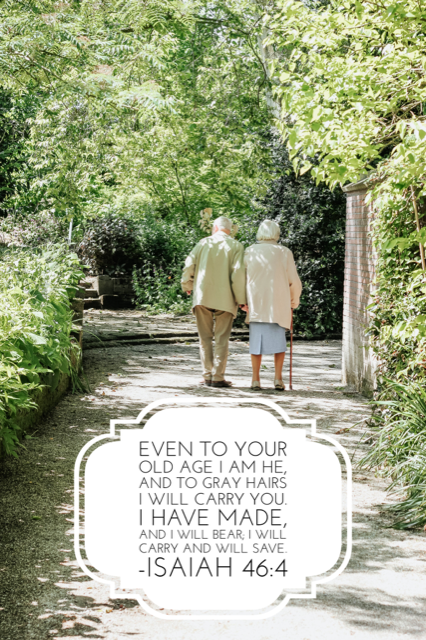
God has promised to take care of us: “Even to your old age I am he, and to gray hairs I will carry you. I have made, and I will bear; I will carry and will save” (Isaiah 46:4).

He has promised our fruitfulness: “They still bear fruit in old age; they are ever full of sap and green, to declare that the Lord is upright; he is my rock, and there is no unrighteousness in him” (Psalm 92:14-15).

He has promised a bright future to those who know Him. “So we do not lose heart. Though our outer self is wasting away, our inner self is being renewed day by day. For this light momentary affliction is preparing for us an eternal weight of glory beyond all comparison, as we look not to the things that are seen but to the things that are unseen. For the things that are seen are transient, but the things that are unseen are eternal” (2 Corinthians 4:16-18).

As we look back at His faithfulness all our lives, we can trust Him for the future. These stanzas from John Greenleaf Whittier’s poem, “My Birthday,” encourage me: I hope they’ll encourage you as well.

I grieve not with the moaning wind
As if a loss befell;
Before me, even as behind,
God is, and all is well!

His light shines on me from above,
His low voice speaks within,–
The patience of immortal love
Outwearying mortal sin.

Not mindless of the growing years
Of care and loss and pain,
My eyes are wet with thankful tears
For blessings which remain.

Let winds that blow from heaven refresh,
Dear Lord, the languid air;
And let the weakness of the flesh
Thy strength of spirit share.

And, if the eye must fail of light,
The ear forget to hear,
Make clearer still the spirit’s sight,
More fine the inward ear!

Be near me in mine hours of need
To soothe, or cheer, or warn,
And down these slopes of sunset lead
As up the hills of morn!

Psalm 71:18

(I often link up with some of these bloggers.)

Birthday Meditations on Aging

Birthday meditations on aging

Since my birthday is this week, and I had a “milestone” birthday last year, I’ve been thinking about aging.

My husband and I often remark that we don’t feel “old” (“old,” to me, has always been about twenty years beyond where I am now). We might tire a little more easily and have a plethora of aches and pains. But looking closely in the mirror often yields unpleasant surprises. When did that happen?

Seeing my mother-in-law through her last ten years of life brought up a long list of concerns about what we’ll face as we age. I once heard a preacher say that one reason our bodies start to fail us as we get older is so that we’ll be more willing to let loose of them. Each year reminds us that we’re in a temporary habitation.

But probably what most concerns me about aging is not being taken seriously any more, being thought of as out of touch or irrelevant.

On the other hand, there are perks to getting older. I’m more settled in my own skin. I’ve wrestled through questions and problems. Hopefully I’ve gained some wisdom through the years.

I wish Elisabeth Elliot had written a book on aging. She was my mentor-from-afar since my college days and helped me prepare for womanhood, marriage, motherhood, and Christian life and service. I did just discover that she had a series about aging on her radio program. I might spend my birthday week listening to those.

But I found in my files of her old e-mail devotionals an excerpt from her book On Asking God Why titled “Happy Birthday—You’re Heading Home.” She writes what she would say to an old friend on her birthday. The last few paragraphs encourage me:

You’ve heard those bad news/good news jokes. Well, this isn’t cheap birthday card humor. The bad news is that another year has gone by and we haven’t done all we meant to do and it’s not going to come back to give us another chance. The good news is the Gospel. We can be reconciled to God–sins forgiven, fears taken care of. That old cross, the emblem of suffering and shame, stands between us and our sins and fears, our past and future, and on its outstretched arms we see Love. The Love that would die for us is the Love that lives for us–Jesus Christ, Lord, Master, Savior of the World, wanting to give you (for your birthday if you’ll take it) something that will really quench your thirst, rivers among the sand dunes and wells in the valley; wanting to hold your hand, help you, give you–not only a happy birthday, but everlasting joy.

I’m not the least bit bashful about telling my age. I’m glad for every birthday that comes, because it is the Lord, my faithful Guide, who “summoned the generations from the beginning.” I look in the mirror and see the increasingly (and creasingly) visible proofs of the number of years, but I’m reconciled. Christ reconciles me to God and to God’s wonderful plan. My life is his life. My years are his years. To me life is Christ, and death is nothing but gain. When I remember that, I really can’t think of a thing I ought to be afraid of. I can’t be sorry I’m a year older and nearer to absolute bliss.

I pray for you on your birthday, that your path, as is promised to the just man, will shine not less and less but more and more; that you will still bring forth fruit in old age; that the Lord will give you a thankful heart like the psalmist’s who sang,

O God, thou hast taught me from boyhood,
all my life I have proclaimed thy marvellous works:
and now that I am old and my hairs are gray,
forsake me not, O God….
Songs of joy shall be on my lips;
I will sing thee psalms, because thou has redeemed me.
All day long my tongue shall tell of thy righteousness.

(Psalms 71:17, 18, 23, 24 NEB)

So–happy birthday! If you have friends and parties and presents, be thankful for such bonuses. If you have no friends with you today, no party, not a package to open, you still have a long list of things to thank God for, things that matter much more. A birthday filled with thanksgiving and hope is the happiest kind of birthday. Have one of those! Deck yourself with joy!

I agree with Elisabeth and Paul that “to me to live is Christ, and to die is gain” (Philippians 1:21) and that heaven will be bliss. But I am encouraged that many through Scripture pleaded for more years of this life in which to serve and praise the Lord.

Elisabeth quoted the first part of Psalm 71:18. The whole verse, along with 17, stood out to me as I read it recently:

So even to old age and gray hairs,
    O God, do not forsake me,
until I proclaim your might to another generation,
    your power to all those to come.

That’s what I want to do with as many days as God gives me.

(I often link up with some of these bloggers.)

Laudable Linkage

Here are some of the posts that resonated with me this week:

Did You Know You Might Be Someone’s Blessing in Disguise? “I don’t remember that nurse’s name, but God does. She never knew how her warmth, genuineness, and kindness blessed us that day. But God does.”

Counseling Your Child About Salvation. When my kids were young, I was greatly concerned with how to know they were ready to be saved rather than just praying a prayer to please parents or fit in. This article has some wise advice.

Something to Eat, HT to Challies. “Too often, when someone first believes in Jesus – especially someone famous – we rush to push them on stage, or sign a book deal, asking them to tell their stories while they still have an empty stomach. They have been raised to new life, but they still need something to eat.”

Judge Not, HT to Challies. “Matthew 7:1 is one of the most needed and one of the most abused statements in the Bible. . . .Yet just because people can misuse a verse does not give us a reason to throw out that verse. The fact is that Matthew 7:1 is a necessary corrective that many Christians need to hear. If we can first clear away the false claims, we will be in a position to let Matthew 7:1 shape us as Jesus intended.”

The American Dream Couldn’t Save My Marriage, HT to Challies. “I am grateful to this country which granted me asylum and opened the door for my permanent residence status. I received many opportunities through which I was able to continue my education, find a better job, and travel freely without fear. When I purchased my first home, I felt I had accomplished the American dream. This and lots of other things ended up going right for me before I had to realize how wrong I had been.”

On Losing Consciousness in Public, HT to Challies. Though I don’t have Seth Lewis’ health problems, my own have frustrated me due to their seeming waste of time and hindrance of doing the things I need and want to do. “My body betrayed me and flipped the power switch without my permission. When something like that happens, I am forced to remember two realities: that I am not in control, and that I am not as strong as I think I am.” But instead of being distressed by those truths, I can trust “there’s no need for despair over weakness because God is still in control and still strong enough to keep his promises for his children.”

What to Remember When God Feels Distant. “Often, it is in seasons of struggle and weariness that we find God’s peace to be most sustaining, His comfort most reassuring, His presence most stabilizing. Maybe we have to come to the end of ourselves to realize He truly is the only Source of everything we need?”

When Church Leadership Goes Wrong. “But it is my conviction, and Honeysett’s, that the majority of leaders who eventually go wrong set out with good desires and noble motives. Their good intentions were not enough to protect them from eventually abusing their power and misusing their authority. Some of them may have even behaved in abusive ways without knowing they were doing so. Yet ‘lack of intention doesn’t remove culpability. The heart is deceitful, and we are never fully aware of our own motives.'”

Being Senior. “In any other context but aging, the word senior is very positive.”