Laudable Linkage

Laudable Linkage

I found quite a few good reads this week:

Taking Our Stress to the Lord, HT to the Story Warren. “The world invites us into its fear and its solutions to that fear constantly. We live in a particularly tense and defensive time. Fried nervous systems and dialed up threat responses crowd our communities, near and far. Well-meaning tips about stress management often invite more stress with additional tasks to incorporate into our packed lives. And if we’re honest, unhelpful messages about stress are not exclusively external.”

We Can’t Fear Questions. “If you have the truth on your side, you don’t have to be afraid of questions. If you fear questions, people might wonder if you really have the truth on your side. If we want to successfully pass off our faith to the next generation, we can’t be afraid of their questions.”

To Go Forward, We Must Go Backward, HT to the Story Warren. “Other mediums require you to give your attention and, like books, paintings, songs, and even food, sometimes will point you to the transcendent. That’s what art does. But our phones are different. They’re black holes for attention. Social media, when it is primarily used to consume content instead of connecting with others, takes your attention and gives you nothing back.”

Prove Me, Try Me, Test Me, HT to Challies. “I don’t think I can do it. I don’t want to be proven, tried, and tested again. Not now; not tomorrow; not ever. Can we take a little break, God? How about a month? Can we take a month off from being proven, tried, and tested? Just a little vacation from trials? Can life just be easy for a little while?”

Quiet Invitations. A tip for engaging children in activities works for oneself as well.

What Does the Bible Mean When It Teaches Wives to Submit? HT to Challies. “Many people cringe at the teaching that wives are to submit to their husbands. A clear understanding of this teaching will lead us to marvel at the goodness of God’s plan for marriage and society.”

8 Marriage Pitfalls to Avoid Like the Plague. “We’re focusing on marriage’s irritating, foolish snares. When all is said and done, these pitfalls ultimately emerge as spiritual issues, because no one loves to fan the flames of inappropriate, subtly destructive behavior more than the enemy of our souls who most certainly hates any loving, loyal, compassionate commitment. On the table? Eight marriage bugaboos to be aware of. And if you’re not married, you’ll probably glean some helpful insights for other relationships.”

The Enormous Significance of Small Tasks. This is written in the context of parenting, but it’s true of teaching, caregiving, and so many other activities.

Walking with Those Who Weep, HT to Challies. “I have had the opportunity and privilege of walking with many through various forms of loss and trial. It was not until we lost our 18-year-old son, however, that I truly learned that there is a huge difference between knowing about grief and knowing grief. Walking through the death of our son revealed to me that I knew far less about what is actually helpful in supporting others than I thought.”

The Spiritual Problem of Being Overinformed, HT to Challies. “In a sense, ‘being informed’ is more of a liability than an asset in today’s world. The quality of digitally mediated information is simply too untrustworthy. What happens to us when we’re overinformed but underactivated? From my experience and observations, some common side effects occur.”

It Only Gets Better, HT to Challies. “Youth has many advantages, like strength and energy. Getting older has some drawbacks, but it has its perks too.”

Wings and a Prayer, HT to nikkipolani. A fascinating story of a Vietnamese pilot’s escape with 52 family members before the fall of Saigon.

J. C. Ryle quote

Pain that brings you closer to God will always be better
than comfort that keeps you away from Him.-
-J. C. Ryle

Laudable Linkage

Laudable Linkage

Here is some of the thought-provoking writing I found online this week:

The Corner of Sanity. “The Corner of Sanity has ended up being the most graciously extended metaphor for my life as a Mom; I’ve willingly handed over my sleep schedule, my to-do list, and certainly my standards of cleanliness each time a new baby comes along. But from the beginning, I’ve learned the vital importance of holding fast to morning time with God to get me through. Many other priorities can be downgraded or abandoned entirely, but going without time in the Word and in prayer has been akin to spiritual starvation. Trying to love and tend young life while starving is impossible to sustain—at some point, I will just run dry.”

When You Fear Your Best Days Are Behind You. “We notice how our struggles have changed us and fear we may never be able to do anything significant again. We look at how we are now, compare ourselves to how we used to be, and think our most fruitful years are behind us.”

Complaining to God. “In the book of Numbers the people of Israel are judged for moaning and groaning about not having enough food. Then why are there so many Psalms of lament, suggesting that complaining to God is okay?”

How Hannah Found Peace in the Middle of Pain. “Sometimes I’ve told myself, ‘When I get past this, then I’ll quit fretting.’ However, if my peace depends on my circumstances or other people, then peace is fragile and illusive. The story of Hannah in 1 Samuel 1-2 shows sorrow and challenges can either rob our peace or push us toward the Source of peace.”

Proverbs Purpose #4: To Transform People. “He desires nothing less than the transformation of the simple person (‘the youth’) into a wise person (who has ‘prudence’), and of a wise person (‘one who understands’) into a wiser person (one who will ‘increase in learning’).”

Guard Your Heart When Suffering, HT to Challies. “In an effort to pull us away from fellowship with the Lord and our effectiveness in the kingdom of God, Satan is always looking for weak spots to target his assaults on God’s children. His long experience with humans has taught him that we are especially vulnerable in times of physical weakness. This is why he delights in or taking advantage of times of physical suffering.”

What If He’s Faithful? HT to Challies.”I’d like to pose another question when life is hard and you’re fearful of the future. What if He’s faithful? Instead of immediately defaulting to all the potential disasters, what if we take our thoughts captive and force them to settle down in front of the 100% likelihood of who God will be to us no matter how hard life gets?”

He’s Still Working on Me. “As he and I don’t go away by ourselves very often, I had a verrrry hard time with this turn of events. Since I’m a Christian and believe in the sovereignty of God, I knew God could have changed the timing of this sickness or just not allowed it to happen in the first place. But he didn’t. And though it wasn’t a life-threatening illness, I was still less than pleased.”

Clearing Up Confusion About Humility, HT to Challies.”Here’s the simple guideline: To develop humility, don’t put yourself up relative to others, and don’t put others down relative to you. Instead, do the opposite.”

“The only thing that keeps me stable and settled in these days of uncertainty is the absolute dependability of God’s Word.” — Elisabeth Elliot

“The only thing that keeps me stable and settled in these days of uncertainty
is the absolute dependability of God’s Word.” — Elisabeth Elliot

Laudable Linkage

Laudable Linkage

I found quite a few good reads this week:

Yes, God Really Does Desire Your Happiness, HT to Challies. “I have heard that exact line so many times (“God wants us holy, not happy”), and I agree that it contributes to untold, unnecessary suffering in the lives of Christians.“

When Suffering Shakes Your Faith. “For the last decade, I’ve wanted to write to her: the woman overwhelmed by suffering, who feels herself crumbling under the weight of all that’s on her shoulders. But recently, I’ve been paying more and more attention to the woman watching from the other side of the television and the other side of the table. Her faith is also formed as she witnesses someone else’s suffering—her faith will either be forged by the reality of a sovereign and good God or be weakened one storm at a time.“

Maybe We Make Meditation Too Difficult. “What is meditation? Meditation is pondering the words of the Bible with the goal of better understanding and sharper application. Ideally, meditation leads us to understand the words we have read and to know how God may call us to work them out in our lives. It is one of the ways that we output wisdom after inputting knowledge.” Tim points out that we usually think of meditation as something done in solitude and silence, but that may not always be the case.

Cultivating Christlike Compassion on Social Media. “As followers of Jesus, we should be known for our Christlike compassion, but the anonymity of social media can make it easy for us to forget that there’s a person created in the image of God on the other side of the screen. This sometimes leads us to forget our call to be different from the world and causes us to abandon the compassionate ways of our Lord.”

Confessions of a Chronic Yeller. “I didn’t set out to be a yeller. There were many aspects of my childhood I vowed not to repeat in my own family, but yelling somehow didn’t make the list. I was Portuguese Italian, after all. Portuguese Italians had dark hair, ate pasta, and yelled. Then I became a Christian. And strange things began to happen.”

A Mother to Me, Too, HT to Challies. “Mothering well does not depend on having Instagram-worthy kitchens or the laundry neatly folded and put away. Instead, it is about welcoming and nurturing the ones within our circle, caring for their hearts and their hurts through the tender love of Jesus. And then opening that circle to include those hungering outside the door.”

‘Never Look Your Age’: Shiny Lies We Often Buy, HT to Challies. “In Christ, the physical signs of aging are not marks to despise, but signs of how God has worked through your circumstances to turn you into the person you are today. Seen this way, they can encourage you to trust him with your future, whatever your fears.”

What Does It Mean to Die with Dignity? HT to Challies. Clue: it’s not what those who advocate euthanasia say it is.

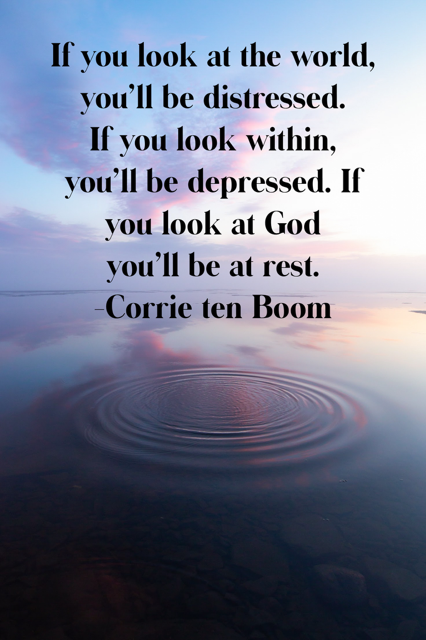
Corrie ten Boom quote

If you look at the world, you’ll be distressed.
If you look within, you’ll be depressed.
If you look at God you’ll be at rest.

— Corrie ten Boom

Fading with Age

Fading with age

I remember sometime in my youth talking with an elderly person and noting that not only was his hair very white, but his skin was pale almost to the point of being white as well. Even his eyes seemed faded. I wondered, “Is that what happens when you get old? Do you just . . . fade away?”

Now that I’m nearer the category of “old,” I’ve learned that not everyone gets paler as they age. And no one ages in quite the same way: we’ve known people well into their eighties who traveled internationally as public speakers and even got married.

But it does seem we fade a bit in many ways. Win Couchman called it “The Grace to Be Diminished.”

First, energy decreases. We may not be able to do all we once did. We can’t push ourselves like we used to. Physical issues of various forms may creep up.

Then our influence can decrease. When we first visited a particular church in one state, a young woman was showing us where our Sunday School class would meet. As we passed one room, she said, “You don’t want to go there; that’s the old people’s class.” I suppose I should have felt gratified that she didn’t think I belonged in the old people’s class yet. But the attitude disturbed me. Later, in the same church, when facilitating a ladies’ group, a younger woman maybe in her mid-thirties told me she didn’t come to the ladies’ meetings because the attendees were all older women. Most of us were in our forties and fifties—we were by no means ancient. But I remember being shocked and hurt that someone would not want to be with us just because of our age.

We can lose our jobs and ministries as we retire.

We lose our independence as we have to give up our car keys and may not be able to live alone any more.

We lose our dignity as someone else has to feed and change us.

And eventually, we lose life itself.

That would all sound pretty dreary if that were the end of things.

But we were told that life would be fleeting.

“What is your life? For you are a mist that appears for a little time and then vanishes” (James 4:14).

“My days are swifter than a weaver’s shuttle” (Job 7:6).

The years of our life are seventy, or even by reason of strength eighty; yet their span is but toil and trouble; they are soon gone, and we fly away (Psalm 90:10).

“We all do fade as a leaf” (Isaiah 64:6, KJV).

A radio preacher said one reason our bodies start falling apart as we get older is to encourage us to let loose of them. We need the reminder that this life is not forever.

C. S. Lewis said in The Problem of Pain, “Our Father refreshes us on the journey with some pleasant inns, but will not encourage us to mistake them for home.” “For here we have no lasting city, but we seek the city that is to come” (Hebrews 13:14). This world, as the old song says, is not our ultimate home. Our transitions as we age help prepare us for our true home.

Does that mean when we reach a certain age, we just sit in our rocking chairs and wait to die? By no means.

Elisabeth Elliot has said that our limitations don’t hinder our ministry; they define our ministry. We may not be able to coordinate VBS for 100 children any more (if you can, go for it!) But we can pray with the psalmist, “O God, from my youth you have taught me, and I still proclaim your wondrous deeds. So even to old age and gray hairs, O God, do not forsake me, until I proclaim your might to another generation, your power to all those to come” (Psalm 71:17-18).

How we proclaim His might and wondrous deeds may vary. We might be able to teach a class, write a book, or speak to groups. However, I’ve often thought that when Paul told older men and women to teach the younger, he probably didn’t have classes and retreats in mind. There’s nothing wrong with those; I have been blessed by many of them. But they probably weren’t done in Bible times. I think he probably had in mind interaction in the everyday course of life.

Godly women have influenced my life in just that way. One family had me over frequently as a teenager who came to church alone. I don’t think the wife of the family thought of me as a “project.” She was just being hospitable. Yet visiting their family and seeing her interact as a wife, mother, and homemaker was instructive for me.

Another woman passed along a vital piece of advice as we worked on a church bulletin board together that shaped my thinking in parenting teens. Another said something in passing while we worked in the church nursery that greatly encouraged me. Another was an invaluable and unwitting example to me as she was trying to prepare an event for a group, and her husband asked her for something in a critical moment. She didn’t snap; she closed her eyes briefly and then calmly directed him to what he needed.

Jesus said that we speak with our mouths out of the abundance of our hearts. As we fill our souls with God’s presence and Word and seek His guidance, then we will be able to share about Him in odd moments as we interact with others.

As another psalmist said, we can tell “things that we have heard and known, that our fathers have told us. We will not hide them from their children, but tell to the coming generation the glorious deeds of the Lord, and his might,and the wonders that he has done. . . that the next generation might know them, the children yet unborn, and arise and tell them to their children, so that they should set their hope in God and not forget the works of God, but keep his commandments” (Psalm 78:3-4, 6-7).

We don’t have to approach our old age with dread.

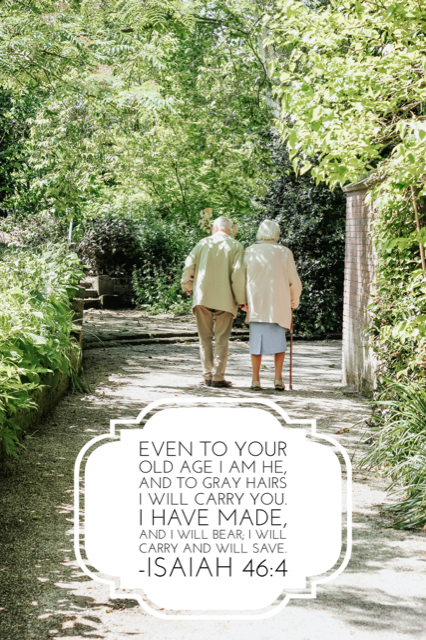
God has promised to take care of us: “Even to your old age I am he, and to gray hairs I will carry you. I have made, and I will bear; I will carry and will save” (Isaiah 46:4).

He has promised our fruitfulness: “They still bear fruit in old age; they are ever full of sap and green, to declare that the Lord is upright; he is my rock, and there is no unrighteousness in him” (Psalm 92:14-15).

He has promised a bright future to those who know Him. “So we do not lose heart. Though our outer self is wasting away, our inner self is being renewed day by day. For this light momentary affliction is preparing for us an eternal weight of glory beyond all comparison, as we look not to the things that are seen but to the things that are unseen. For the things that are seen are transient, but the things that are unseen are eternal” (2 Corinthians 4:16-18).

As we look back at His faithfulness all our lives, we can trust Him for the future. These stanzas from John Greenleaf Whittier’s poem, “My Birthday,” encourage me: I hope they’ll encourage you as well.

I grieve not with the moaning wind
As if a loss befell;
Before me, even as behind,
God is, and all is well!

His light shines on me from above,
His low voice speaks within,–
The patience of immortal love
Outwearying mortal sin.

Not mindless of the growing years
Of care and loss and pain,
My eyes are wet with thankful tears
For blessings which remain.

Let winds that blow from heaven refresh,
Dear Lord, the languid air;
And let the weakness of the flesh
Thy strength of spirit share.

And, if the eye must fail of light,
The ear forget to hear,
Make clearer still the spirit’s sight,
More fine the inward ear!

Be near me in mine hours of need
To soothe, or cheer, or warn,
And down these slopes of sunset lead
As up the hills of morn!

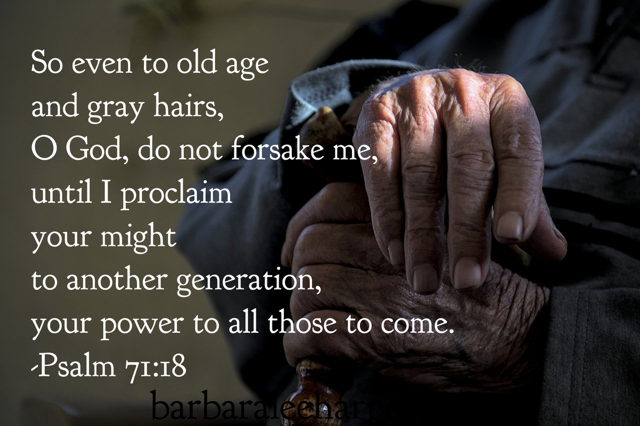
Psalm 71:18

(I often link up with some of these bloggers.)

Birthday Meditations on Aging

Birthday meditations on aging

Since my birthday is this week, and I had a “milestone” birthday last year, I’ve been thinking about aging.

My husband and I often remark that we don’t feel “old” (“old,” to me, has always been about twenty years beyond where I am now). We might tire a little more easily and have a plethora of aches and pains. But looking closely in the mirror often yields unpleasant surprises. When did that happen?

Seeing my mother-in-law through her last ten years of life brought up a long list of concerns about what we’ll face as we age. I once heard a preacher say that one reason our bodies start to fail us as we get older is so that we’ll be more willing to let loose of them. Each year reminds us that we’re in a temporary habitation.

But probably what most concerns me about aging is not being taken seriously any more, being thought of as out of touch or irrelevant.

On the other hand, there are perks to getting older. I’m more settled in my own skin. I’ve wrestled through questions and problems. Hopefully I’ve gained some wisdom through the years.

I wish Elisabeth Elliot had written a book on aging. She was my mentor-from-afar since my college days and helped me prepare for womanhood, marriage, motherhood, and Christian life and service. I did just discover that she had a series about aging on her radio program. I might spend my birthday week listening to those.

But I found in my files of her old e-mail devotionals an excerpt from her book On Asking God Why titled “Happy Birthday—You’re Heading Home.” She writes what she would say to an old friend on her birthday. The last few paragraphs encourage me:

You’ve heard those bad news/good news jokes. Well, this isn’t cheap birthday card humor. The bad news is that another year has gone by and we haven’t done all we meant to do and it’s not going to come back to give us another chance. The good news is the Gospel. We can be reconciled to God–sins forgiven, fears taken care of. That old cross, the emblem of suffering and shame, stands between us and our sins and fears, our past and future, and on its outstretched arms we see Love. The Love that would die for us is the Love that lives for us–Jesus Christ, Lord, Master, Savior of the World, wanting to give you (for your birthday if you’ll take it) something that will really quench your thirst, rivers among the sand dunes and wells in the valley; wanting to hold your hand, help you, give you–not only a happy birthday, but everlasting joy.

I’m not the least bit bashful about telling my age. I’m glad for every birthday that comes, because it is the Lord, my faithful Guide, who “summoned the generations from the beginning.” I look in the mirror and see the increasingly (and creasingly) visible proofs of the number of years, but I’m reconciled. Christ reconciles me to God and to God’s wonderful plan. My life is his life. My years are his years. To me life is Christ, and death is nothing but gain. When I remember that, I really can’t think of a thing I ought to be afraid of. I can’t be sorry I’m a year older and nearer to absolute bliss.

I pray for you on your birthday, that your path, as is promised to the just man, will shine not less and less but more and more; that you will still bring forth fruit in old age; that the Lord will give you a thankful heart like the psalmist’s who sang,

O God, thou hast taught me from boyhood,
all my life I have proclaimed thy marvellous works:
and now that I am old and my hairs are gray,
forsake me not, O God….
Songs of joy shall be on my lips;
I will sing thee psalms, because thou has redeemed me.
All day long my tongue shall tell of thy righteousness.

(Psalms 71:17, 18, 23, 24 NEB)

So–happy birthday! If you have friends and parties and presents, be thankful for such bonuses. If you have no friends with you today, no party, not a package to open, you still have a long list of things to thank God for, things that matter much more. A birthday filled with thanksgiving and hope is the happiest kind of birthday. Have one of those! Deck yourself with joy!

I agree with Elisabeth and Paul that “to me to live is Christ, and to die is gain” (Philippians 1:21) and that heaven will be bliss. But I am encouraged that many through Scripture pleaded for more years of this life in which to serve and praise the Lord.

Elisabeth quoted the first part of Psalm 71:18. The whole verse, along with 17, stood out to me as I read it recently:

So even to old age and gray hairs,
    O God, do not forsake me,
until I proclaim your might to another generation,
    your power to all those to come.

That’s what I want to do with as many days as God gives me.

(I often link up with some of these bloggers.)

Laudable Linkage

Here are some of the posts that resonated with me this week:

Did You Know You Might Be Someone’s Blessing in Disguise? “I don’t remember that nurse’s name, but God does. She never knew how her warmth, genuineness, and kindness blessed us that day. But God does.”

Counseling Your Child About Salvation. When my kids were young, I was greatly concerned with how to know they were ready to be saved rather than just praying a prayer to please parents or fit in. This article has some wise advice.

Something to Eat, HT to Challies. “Too often, when someone first believes in Jesus – especially someone famous – we rush to push them on stage, or sign a book deal, asking them to tell their stories while they still have an empty stomach. They have been raised to new life, but they still need something to eat.”

Judge Not, HT to Challies. “Matthew 7:1 is one of the most needed and one of the most abused statements in the Bible. . . .Yet just because people can misuse a verse does not give us a reason to throw out that verse. The fact is that Matthew 7:1 is a necessary corrective that many Christians need to hear. If we can first clear away the false claims, we will be in a position to let Matthew 7:1 shape us as Jesus intended.”

The American Dream Couldn’t Save My Marriage, HT to Challies. “I am grateful to this country which granted me asylum and opened the door for my permanent residence status. I received many opportunities through which I was able to continue my education, find a better job, and travel freely without fear. When I purchased my first home, I felt I had accomplished the American dream. This and lots of other things ended up going right for me before I had to realize how wrong I had been.”

On Losing Consciousness in Public, HT to Challies. Though I don’t have Seth Lewis’ health problems, my own have frustrated me due to their seeming waste of time and hindrance of doing the things I need and want to do. “My body betrayed me and flipped the power switch without my permission. When something like that happens, I am forced to remember two realities: that I am not in control, and that I am not as strong as I think I am.” But instead of being distressed by those truths, I can trust “there’s no need for despair over weakness because God is still in control and still strong enough to keep his promises for his children.”

What to Remember When God Feels Distant. “Often, it is in seasons of struggle and weariness that we find God’s peace to be most sustaining, His comfort most reassuring, His presence most stabilizing. Maybe we have to come to the end of ourselves to realize He truly is the only Source of everything we need?”

When Church Leadership Goes Wrong. “But it is my conviction, and Honeysett’s, that the majority of leaders who eventually go wrong set out with good desires and noble motives. Their good intentions were not enough to protect them from eventually abusing their power and misusing their authority. Some of them may have even behaved in abusive ways without knowing they were doing so. Yet ‘lack of intention doesn’t remove culpability. The heart is deceitful, and we are never fully aware of our own motives.'”

Being Senior. “In any other context but aging, the word senior is very positive.”

Aging with Grace

In Aging with Grace: Flourishing in an Anti-Aging Culture, Sharon Betters and Susan Hunt “want readers to ask, ‘What if aging, though challenging, is not a season of purposelessness, but rather an opportunity to discover our true identity in a way we couldn’t in the first half of life? What if we purposefully prepare for the afternoon of life while we are in the first half of life?'” (p. 18, Kindle version). The book is helpful for those already in their later years as well as those wanting to prepare for them adequately.

Susan writes, “The world tells us aging is our enemy, and we should fight it; the Bible says it’s our friend: ‘Wisdom is with the aged, and understanding in length of days'” (Job 12: 12)” (p. 27).

God promises the righteous “still bear fruit in old age; they are ever full of sap and green” (Psalm 92:14). Susan acknowledges that, with the physical problems that often accompany getting older, we don’t always feel fruitful, full of sap, and green. But “this promise of growth does not mock my physical reality; it transcends it” (p. 28).

The gospel imperative to “grow in the grace and knowledge of our Lord and Savior Jesus Christ” (2 Pet. 3: 18) does not have an age limit. The same grace that gives us new life in Christ empowers that life to develop, mature, and flourish. We never finish growing. There is always more grace to experience and more to know of Christ’s love. This growth is gradual. We don’t produce it, but as we trust and obey God’s word, we can anticipate it (p. 28).

Susan and Sharon alternate chapters. Some chapters delve into the Bible’s teaching about getting older, particularly Psalm 92 and 71. The chapters in-between take a closer look at some of the older women in the Bible: Anna, The “matriarchs of the exile,” Elizabeth, and Naomi.

Anna was the older widow who came up when Mary and Joseph brought baby Jesus to the temple in Luke 2. At first the elderly Simeon rejoiced that he had lived to see “the Lord’s Christ” and prophesied about Him. Part of that prophesy was to Mary, that “a sword will pierce through your own soul also” (Luke 2:35). I hadn’t thought about it this way before, and the Bible doesn’t specifically say that Anna spoke to Mary, but Sharon proposes that Anna’s coming right at that moment helped comfort Mary.

Simeon told Mary the hard reality that a sword would pierce her soul. Can you sense Mary holding her baby boy a little tighter, her throat constricting and tears welling up? This young mother needed a tangible touch of God’s tender love. At this intense moment we meet eighty-four-year-old Anna. God providentially met Mary’s need through an old woman who hoped in God. At exactly the right moment, Anna shows up (p. 48).

The exile Sharon refers to occurred after Israel had repeatedly rejected God and turned to idols. God had sent prophets and sometimes delivered his people into the hands of their enemies. But even if they repented for a while, they eventually turned away from God again. So God allowed Nebuchadnezzar to remove them from their land and take most of them to Babylon for 70 years. God tells the people as a whole in Jeremiah 29 to settle down, plant, build, marry, and pray for the land of their exile. The older people would have realized they would die in exile and never see their country again. Again, I don’t think the Bible specifically mentions the older women in this scenario, but Sharon posits what they might have done.

Though the elderly women might not be able to physically build houses, their status in the family gave them a key opportunity to influence the attitudes and stability of their households. They could be life-givers or life-takers. They could choose to joyfully embrace God’s call to cultivate a godly, peaceful community or they could choose bitterness, whining, and complaining, and so can we (p. 84).

A few of the other quotes that stood out to me:

There are many things we can no longer do as we age, but age does not keep us from fulfilling our purpose to glorify and enjoy God. An ever-growing knowledge of God’s undeserved love—his grace—changes our motivation: “The love of Christ controls us” (2 Cor. 5: 14)” (p. 39).

Repenting women who find rest in Jesus become life-giving women who flourish as gatherers. When our heart is Christ’s home, we can become homey places for troubled hearts to find refuge,” (p. 70).

The world equates flourishing with activity and productivity. A biblical perspective does not mean we do more; it means we become more like Christ. We mature in faith, hope, and love” (p. 98).

As counterintuitive as it sounds, flourishing is a slow and progressive death that brings abundant life. Our new heart has new desires. Even as our physical bodies grow old, God causes our new desires to flourish as they are fertilized by his word and Spirit, and we die to self-centered desires, dreams, and demands (p. 99).

As life slows down, we can become controlling and critical, or we can reflect on God’s sovereign love that chose and planted us in his house. The more we live in the light of the reality of his presence, the more we flourish as his Spirit fills us with sap to nurture and encourage others to flourish (p. 105).

One joy of aging is a stillness of soul that helps us see the small moments as sacred moments when we can reflect God’s glory to someone else (p. 145).

The plot of dirt where we die [to self] is also the place where we flourish (p. 146).

To me, flourishing means gratefully accepting the past and present trials God gives me, and looking for opportunities to use what I have learned to help others. . . Whatever situations we find ourselves in as we age, there are nuggets of gold in our past that we can pass on to others. God never wastes a trial, a grief, or a wilderness wandering. We flourish when we give to others the lessons God has taught us (p. 151).

Naomi did not know her ordinary little family would become an extraordinary link to the coming Messiah. In fact, she died without knowing how her seemingly insignificant life fit into God’s magnificent eternal tapestry (p. 154).

At the end of each chapter, the authors include testimonies from older women in various circumstances who share how they found God’s grace to flourish. 

I very much enjoyed this book and it’s encouragement that we can keep growing and flourishing at any age. I’m pretty sure I’ll be reading it again in years to come to keep reminding me of its truths.

Updated to add: I forgot to mention that I’ve been reading this book in conjunction with InstaEncouragements. They’ve been going through the book and summarizing chapters each Tuesday the last few weeks. The comments have been enlightening as well. This book was on my to-read list anyway, and when I saw they were going through it, I jumped in. Reading with a group helps reinforce what I learn plus draws out things I missed. So, if you read this book, you might want to check out those posts as well.

Laudable Linkage

Here are some of the good reads found this week:

My Reconstructed Faith, HT to Challies. This is encouraging. “What I don’t often hear are stories of those who have reconstructed their faith. Since I couldn’t find many, I thought I would offer my own story of reconstruction after I abandoned Christianity for progressive Christianity.”

Debunk 8 Abortion Myths. “While Christians rejoice to see a step taken toward justice for unborn life, many of our neighbors are experiencing the decision as an existential threat. That angst gets channeled in attacks against religious groups, blaming them for what they understand to be a hypocritical and crippling national tragedy. Why are they so afraid? What can we do to help our friends, family, and coworkers understand why people of faith celebrate what they lament?”

A Declaration of Dependence, HT to Challies. “I am incredibly grateful for and deeply benefit from the Declaration of Independence penned by Thomas Jefferson; however, my soul needs to be stamped with deeper declaration daily: a declaration of dependence.”

Community: A Struggle to Fit In, HT to Challies. “When it comes to community in the church, many people feel like onlookers. For many, deep fellowship seems far off. Some feel excluded because they “do not fit in,” and others are unsure how to engage. In the church of Jesus, this should not be.”

40-Year-Old Moses vs. 80-Year-Old Moses, HT to The Story Warren. “Moses has gone from It makes sense that God would use me to Who am I that God would use me? And in that change, he demonstrates he’s now ready.”

Transformation of a Transgender Teen, HT to Challies. “Eva was in a church luncheon when she got an email from her 12-year-old daughter Grace. (Their names have been changed.) ‘Mom and Dad, I need to tell you I’m not actually a girl,’ she read. ‘My pronouns are they/them.'”

Pilgrimage to Dust, HT to Challies. “As saints united to Christ by faith, we follow after our Savior. Our bodies will continue to weaken in this life as we walk each day closer to death, but our story doesn’t end there either. Because of Christ’s death and resurrection, we know we too walk towards something greater.”

In a World of Loud, Be a Whisperer. “There are so many women who seek to gain control over others by being loud. (Often, me included.) By demanding . . . by parading . . . by yelling . . . But the women who have had the most influence in my own life have taken a much softer approach.”

Chapters, Verses, and Their Five Avoidable Challenges. Chapter and verse divisions weren’t in the original manuscripts of the Bible. They were added later and are extremely helpful for finding references. But they can cause some problems, too, if we use them the wrong way.

The Unappreciated Blessing of Busyness. “Is busyness always a bad thing? Like every time? Always? Hmm. I think we can nuance this better. See, there’s a difference between busy and hurry. Busy is when you have a lot on your plate. Hurry is when you have too much on your plate.”

But we also sometimes have to learn How to Graciously Say No. “I’m a people pleaser. So in the moment, it’s easier just to say ‘yes’ when someone asks me to do something. But ‘yes’ is a check future me must cash. And that’s when the problems start…”

Why Would You Steal My Words When I Might Give Them Freely, HT to Linda. On plagiarism, intentional or accidental.

I can’t decide whether this is remarkable or scary. Maybe both. HT to Steve Laube.

Have a good Saturday!

Edited to add: I meant to mention that I’m being interviewed on Kurt and Kate Mornings on Moody Radio Florida on Tuesday, July 12, around 8:10 a.m. EDT or shortly thereafter. They want to talk about my blog post on regret. There’s a link on their page to listen live if you’d like to. Plus I’ll try to have someone record it like we did before. I’d appreciate your prayers!

Laudable Linkage

Here’s the latest thought-provoking reads seen around the Web lately.

Our Hope In the Ascension, HT to Challies. “Of all the aspects of Christ’s work in his state of exaltation, the Ascension is one of the most overlooked.”

God Matures Us Through Suffering, not Miracles, HT to Challies. “Suffering, not miraculous deliverance, is the primary way God matures his children. A supernatural event can encourage us, of course, but it doesn’t mature us. Maturity comes through trusting God when things are really hard, even seemingly unbearable. Will we trust God when the miracles don’t happen?”

A Letter to All the Marthas. “It struck me that Jesus hadn’t written Martha off. He saw her faith and hard work as well as her weaknesses. And he loved Martha just as much as Mary. I began to view Jesus’ words through a lens of love.”

Why You Should Stop Being Responsible and Start Being Faithful. “Losing my mother as a teenager accompanied by my father’s paralyzing grief amped my firstborn sense of responsibility. I equated being responsible with being dependable. But when being responsible means depending on myself and my resources instead of relying on God it’s unhealthy and ungodly.”

Are Cuss Words Sinful? HT to Challies. “You hear them in movies, television series, and in actual conversations. To some, these words sound cool, and they have made them part of their lives. Yet when you learn their meaning, cuss words will make you cringe.”

The Sugar Coating, HT to Challies. “I have some authority to say that self-pity doesn’t get you anywhere. Trust me, I’ve tried it. Even on those occasions when people who really ought to know better don’t recognise the sheer weight of the scars you bear, and you feel like you must delve into the pools of pity to shake them out of their repose—it still isn’t worth it.”

4 Guidelines for Dating Without Regrets. “Somewhere between my generation and the current one, dating became difficult—far more difficult than it had once been. I am sure the so-called “purity movement” bears at least some of the responsibility as does the modern-day hookup culture. So, too, do the ubiquity of pornography and the rise of social media and dating apps. What was once relatively straightforward seems to have become strangely complicated.”

Adventures in Aging. Melanie writes about a change of heart from being depressed about age to embracing new possibilities.

Dementia’s Drowning Caregiver. Lots of good tips.

How to Think Wisely About Becoming a Social Media Celebrity, HT to Challies. In these days when we’re told we have to have a big enough “platform” before an agent or publisher will even consider looking at our manuscripts, we need to keep grounded in God’s truth of who we are in Him.

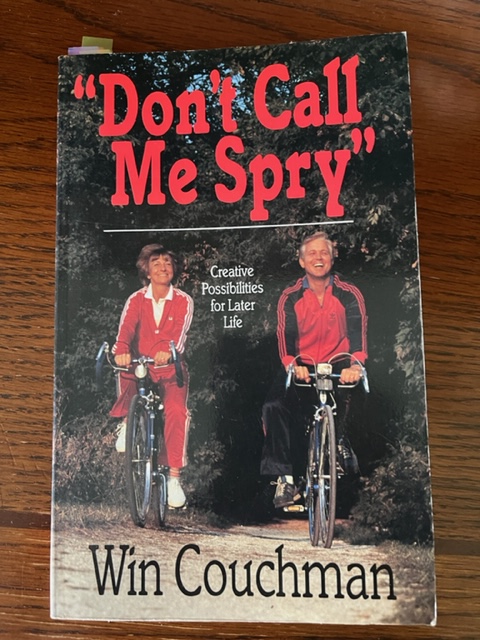
“Don’t Call Me Spry”

It’s a shock to the system when you realize someone thinks of you as “old.”

For me, it happened when a fast-food cashier rang up my order with a senior discount—and I was only 50.

For Win Couchman, it happened when she ran into an old friend who commented, “You’re so spry!” “Spry” was a “compliment reserved for exclusively for old people.”

As the shock of this well-meant statement brought Win to tears, she began to consider aging.

I am at the young end of old: junior-high old. Youth is gone and now, also, middle age. My life at sixty-four is rich, adventurous, blessed, and full of joy (p. 2).

I am not only wrinkling. I am growing. And while I am forgetting some things, I am learning much that is new. This season of my life is as fearsome and exciting as turning fourteen. Nobody told me it would be this way (p. 3).

She decided to investigate “what it means to grow old” from the Bible, culture, the examples of older people in her life (“Not everything I learned from Grandmother about aging was glamorous, but all of it was valuable” [p.84]). She wanted to “notice and enjoy the perks that come with old age” (p. 4).

The results of her study and contemplation is “Don’t Call Me Spry”: Creative Possibilities for Later Life.

Win noted, “The halves of my life each merit my attention. The tension between the material and spiritual aspects of reality are normal. The struggle is to keep a balance: to live in light of the unseen while resetting the washer from ‘permanent press’ to ‘delicate fabrics.’ In order to live for God’s glory and not lose heart, I have the perspective of the eternal as a gift” (p. 4).

In their fifties, Win and her husband, Bob, began to pray and consider what to do when he retired. For many years, they had hosted a ministry called Forever Family which combined hospitality, mentoring, counseling, and teaching. But they were sensing maybe the time had come to do something different.

Through a series of events and contacts, the door eventually opened for them to minister in a variety of other countries eight months out of the year. They enjoyed the novelty and the opportunities to minister, resulting in some never-to-be forgotten experiences.

But they also experienced stresses with travel and continual adjustments, and they handled them differently. She liked to talk things out when stressed or anxious; he withdrew and became quiet. I’m sure those tendencies were always a part of their personalities, but these new experiences brought them to the forefront and required them to meet each other half-way.

Bob’s retirement brought other stresses and adjustments, like sharing space that she had previously had to herself.

Then new stresses arose when Win developed a heart issue which brought not only their international travel to a close, but their full-time active ministry as well. She had to rethink what she could do within her new reality. “It grieved me to give up thinking I could do anything anyone even a generation or two younger than I can do” (p. 45).

It saddened me to give up the illusion that I could always push myself a bit more if I needed to, that pushing was the thing to do. I could no longer be casual about getting too tired. I was newly aware of another true separation between me and those who are younger (p. 46).

She tells how God led her to other types of ministry, mainly mentoring, prayer, being involved with her grandchildren. She still taught and spoke on a limited basis.

One of my favorite chapters is “The Downside,” dealing with some of the negative aspects of aging. “When you ask me how I am, sometimes it is a little hard to know how to answer” (p. 107).

But even though Win describes herself as a pessimist, overall the book is hopeful and positive. The Bible assures that God’s care and love and grace will always be with us. In addition:

As I have looked repeatedly into the mirror of these verses, I have not only been provided with new assurance of God’s caring for me, but I have a greatly enhanced concept of the possibility of lifelong usefulness (p. 136).

While searching for more information about Win, I came across this video of her.

I had not heard of Win before until I read a chapter by her in The Wonder Years: 40 Women over 40 on Aging, Faith, Beauty, and Strength compiled by Leslie Leyland Fields. I didn’t discover until recently that her chapter, “The Grace to Be Diminished,” originally came from a magazine here. Then I found her poignant article, “The Beds I Have Known,” about living separately from her husband of 72 years when she could no longer care for him. I saw somewhere that she had written this book, so I searched for it. It’s out of print, but I found a used copy in good condition for $5 at Amazon.

I am glad to have found and read it. It gave me much encouragement as I look ahead.