Laudable Linkage

Laudable Linkage

Some good reads found this week:

Just Not Feeling It”: How Routine Awakens Devotion. “To some, the word routine carries the stiffness of stale bread and the rot of dead plants, the stuffiness of library books never opened and attics dusty with age. The very thought of routine spirituality — planned, scheduled, disciplined — seems to undermine the ministry of the life-giving, freedom-bestowing Spirit. ‘Where the Spirit of the Lord is, there is freedom’ (2 Corinthians 3:17) — and where the spirit of routine is (we may think), there is bondage. The dichotomy, however, is self-imposed, self-imagined. If routine smells stale to us, the problem lies in our own sniffer.”

Delays Are as Much a Part of God’s Plan as Answered Prayers. “At times, we may find ourselves in situations where we are eagerly waiting for answers to our prayers, hoping for our dreams, goals, and aspirations to come to fruition. However, it’s during these moments of uncertainty and delay that we may become overwhelmed with frustration, anxiety, and even a sense of disillusionment.”

2 Ways Anxiety Affects Parents, HT to Story Warren. “In my thirty-plus years of counseling, I’ve never seen parents feel as much pressure or as much like failures as they do today. I’ve never had as many parents in tears in my office. And I’ve certainly never seen as many parents who live in a perpetual state of worry.”

5 Lies Teenagers Believe & Biblical Truth to Set Them Free. “I sometimes fear this generation of young people is stuck in a giant game of Where’s Waldo? They only see the things they are looking for. When you fear rejection, you see it on every face in the crowd. When you want to escape your responsibilities, you spot exits everywhere. When you crave affirmation, you will find it in all the wrong places. 1 Peter 5:8 HCSB says, ‘Be sober-minded, be alert. Your adversary the devil is prowling around like a roaring lion, looking for anyone he can devour.’ Sadly, teens are primary targets in the enemy’s strategy to dismantle the kingdom of God.”

Purposes of Predicative Prophecy. “Why has God given revelation in the form of prophecy? And why so much? What is the goal of prophecy? Or are there multiple intended effects? A number of passages answer these questions. The answers are surprisingly diverse.”

Lists are Menus, HT to Linda. I don’t have the negative feelings this writer has about working through a list. But there is something appealing about looking at a list like a menu. “These menus also help clarify a critical way a menu differs from a to-do list: picking just one or two items from a menu is something you get to do, not something you have to do. The myriad things you could order – so far in excess of your capacity to consume them – don’t constitute a problem.”

The Bible has to go through our head to affect our heart and life.

Laudable Linkage

Here are some of the good reads found this week:

The Myth of a Balanced Life. “Are we looking for some perfect equilibrium—the precisely right amount of sleep, exercise, and time with family, work, and church? And if we found that perfect formula, is that then supposed to become the norm for every day of the week? What about when you have kids? What about when you’re traveling? What about the weekend?” I appreciate the better perspective presented here.

Is There a Danger of Worshiping the Bible Instead of God? HT to Challies. “I agree that there is a danger of having our faith in the wrong object. And there have been some people who seemingly hold the Bible in higher esteem than they do Jesus. But seen properly, the Bible is not a competitor with God; on the contrary, it is our God-given means of knowing Him through His revealed truth.

A Pastor’s Journey with Anxiety, HT to Challies. A pastor shares his own experience, what he has learned, and shares how to walk alongside others who are struggling.

The Psalms: A Tool for Cultivating Godly Emotions, HT to Knowable Word. “The Psalms not only help us know what we can say in prayer (often one of our biggest struggles), they help us know what to feel. They . . . share all shades of human emotion from deepest despair to exuberant praise. We find saints processing the good and bad of life in a godly way. Reading and praying the Psalms takes us into their emotional world, how they wrestled with God and eventually found hope.”

When the Sermon Fizzles Instead of Sizzles. It may or may not be the pastor’s fault. It may be ours.

Becoming Writers Who Write the Truth Beautifully, HT to Challies. “To be published doesn’t mean you’re a good writer. There are many books out there; some contain the most beautifully written heresies while others contain solid truths slapped together with cringe-worthy analogies and dense, dry paragraphs. As believers, we want to be not just published writers but good writers. Someone who brings truth and beauty together in the written word.”

Beautiful Hand-Painted Bookmarks, HT to the Story Warren. This touched my heart. A 100-year-old housebound woman has found a unique way to share God’s love with others.

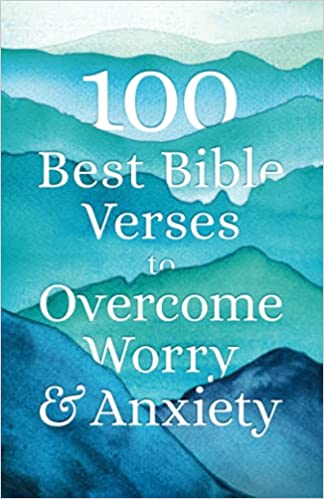
100 Best Bible Verses to Overcome Worry and Anxiety

100 Best Bible Verses to Overcome Worry and Anxiety is compiled from writings of several authors and published with Bethany House.

Each two- to three-page spread begins with a Bible verse. The author then adds a brief paragraph about the context the verse was set in. Then several paragraphs about the meaning of the verse and one or two of application are included. Then a few references are listed for additional reading.

When I first saw this book reviewed at Joanne’s, I thought it was a great idea. I’ve mentioned before that anxiety is probably not something that can be conquered by answering an altar call or sitting down for one massive Bible study. Rather, battling anxiety is a matter of continually feeding our souls truth. This book is a wonderful way to keep God’s provision, protection, and promises continually before us in small but substantial doses.

I very much appreciated that the writers delved into the context of the verses before explaining the meaning and applying them. The context enriches our understanding of the passage and keeps us from spinning our own take on a single sentence.

I’ve repeatedly heard that there are 365 Bible verses that say, “Fear not.” That declaration is often followed by the quip, “One for every day of the year.” I had thought this would be a collection of those verses. It’s not (though such a collection would be a great idea for a devotional book). I was surprised at some of the verses used, as they didn’t seem to directly relate to anxiety or worry. But I came to understand they were foundational verses about God’s character or promises. The more we know Him, the less reason we have to be anxious about anything.

Here are just a few of the quotes I marked in this book:

[On John 16:33] It’s a strange way to promise peace—Jesus starts by telling his disciples that they are about to go through a time of sorrow and fear. How is that peaceful? they might have wondered, especially after Good Friday, when their teacher was killed, and it seemed like the world had won.

Still, Jesus’ words, “Take heart!” are a command in the original language, not just an inspirational phrase but something God wanted them—and us—to actively do. It could be phrased “Choose hope!” or “Be encouraged!” (p. 39).

Some seasons, taking heart might be among the hardest of God’s commands to follow. Until we remember the rest of the verse: “I have overcome the world” (p. 40).

[On 2 Timothy 1:7] Fear is a tool of the enemy that exists to keep us from advancing the kingdom of God. It distracts us from trusting him, and instead tempts us to protect ourselves and rely on our own abilities” (p. 51).

In verses 7 and 8 [of Joshua 1], God connects being strong and courageous to faithfully following his Word. Not believing in God’s Word nor taking it seriously had been the sin that forced the Israelites to wander in the wilderness for forty years (p. 62).

[On Lamentations 3:57] His response will always be, “Do not fear.” Not condemnation for being afraid, but telling us there is no need for it. He is holding on to us tightly, a good Father whose perfect love casts out fear . . . if we just ask (p. 65).

[On Genesis 50:20] [Joseph] endured some of the most difficult circumstances and betrayals and still honored the Lord in the midst of them. He refused to see his journey as one setback after another, but instead chose to believe that God was writing a much bigger story (p. 78).

Allow your confidence to be informed by your faith, not your circumstance (p. 79).

[On Psalm 61:2] We don’t need to strive so hard to be self-sufficient when the chaos threatens to overwhelm us, but we can rest in the truth that God is infinitely more capable than we are (p. 121).

[On Psalm 23:4] Dark valleys don’t stay dark. The beauty of a valley is that it dips down but then rises back up. Valleys aren’t endless stretches of defeat, but stretches we walk through and rise from. What a beautiful promise. We are not alone in our valleys. Even as we “walk through,” we don’t need to sprint through in a panic; we will walk through our valley with Jesus by our side and emerge safely, made stronger by the experience (p. 125).

This book doesn’t just try to make readers feel better. It continually points the reader back to God’s character and His Word. Thus, it is an excellent resource when worries or fears try to pull our gaze away from Him.

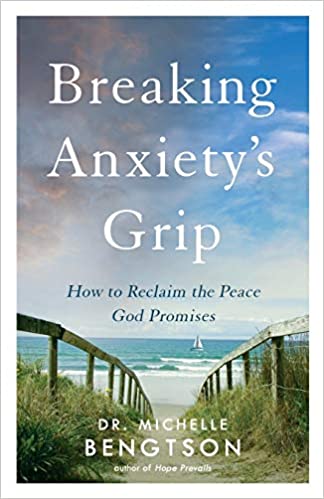
Book Review: Breaking Anxiety’s Grip

Dr. Michelle Bengston writes from her own experience as an anxiety sufferer, a neuropsychologist, and most of all, as a Christian, in Breaking Anxiety’s Grip: How to Reclaim the Peace God Promises.

Everyone experiences worry, anxiety, and fear on occasion to some degree. But for some, they are regular companions.

After defining terms, Dr. Bengston discusses what contributes to anxiety, etc., brain chemistry, heredity, example, our own thoughts and heart, and Satanic influence. Interestingly, “While brain chemistry can impact mood and behavior, thoughts (e.g., ‘This place isn’t safe,’ ‘I can’t handle this any more,’ ‘I’m overwhelmed,’ etc.) actually impact brain chemistry” (p. 35).

The author spends the rest of the book explaining “the tools to effectively exchange our worry, anxiety, and fear for his peace” (p. 28). She doesn’t spout empty platitudes: she has put these principles to work in response to cancer diagnoses for herself and her husband, problems in her practice, a son’s major obstacles in his career path, as well as “everyday” problems and concerns. Her tools are based on the sure foundation of Scripture.

I had read a few of Michelle’s posts when she participated in some of the same of the same blog link-ups I participate in. I always enjoyed what she had to say, so when I saw she had written this book, I got it. It sat on my shelf for a while, then I picked it up, then set it aside for another book. When I finally delved into it in earnest, I knew God had led me to read it at just the perfect time. The coronavirus pandemic began just after I started this book, and the chapters I read then helped me immensely in the uncertainty and anxiety of that unprecedented situation.

Here are just a few of the principles that most helped me:

Dealing with worry, anxiety, and fear isn’t a one-time event: it’s a process.

I’m not in control. God is. He knows best and knows the big picture. What He allows may not be what I would have chosen, but He has a purpose in it for my good.

“When concern about the future comes, we can recognize it and then refuse to entertain it. We can determine to stay in the present and in God’s presence, trusting in his perfect plan” (pp. 70-71).

We can reframe our worried thoughts to focus on God’s provision: “Instead of saying, ‘I’m worried I won’t be able to make ends meet,’ exert your trust in God and declare, ‘God, I’m trusting you to provide because you promised to supply all my needs according to your glorious riches.’ Or instead of saying, ‘I’m afraid to be alone,’ look to his promises and declare your trust in him: ‘Thank you, God, that you promise you will never leave me and will always be with me so I won’t be alone'” (p. 119).

“God’s peace is not the calm after the storm. It is the steadfastness during the storm. It is in his presence that we can find peace in the midst of the storm” (p. 140).

“When self-protection is our goal, there’s no room for trusting God’s protective love. That self-protective stance leaves us lonely and unwilling to invite others in, including God. Fear is not from God. It is a direct attack from the one who wants to prevent us from drawing close to God or knowing his trustworthy love. In reality, we are powerless to protect ourselves. Fear doesn’t protect. So self-protection is futile. What we really need is a sure protector—and only a trustworthy God can be that for us” (pp. 171-172).

“Emotions are the outward manifestations of the thoughts we believe. So when we feel anxious, it’s because we’ve believe the thoughts that prompt anxiety. Instead of acting on our feelings, we must speak out against the thoughts that caused them. We must recognize that the thoughts are from the enemy, refute them, and speak back to them” (p. 186).

2 Timothy 1:7 says, “God gave us a spirit not of fear but of power and love and self-control” (the KJV and NKJV says “sound mind”). Michelle spends a lot of time unpacking and applying those verses.

There were just a couple of places in the book where I had a question mark or maybe would have had a somewhat different view. And I wish she would have said a little more about anxiety that seems to come out of nowhere, not triggered by worry, as described here. But whatever the cause, the solution of taking our thoughts captive and applying God’s truth would be the same.

Overall, however, I found this book a great encouragement to my faith. Much of it was truth I already knew, but as was said earlier, fighting against anxiety is an ongoing process rather than a once-for-all victory. This book is an excellent tool and help in the fight.

(Sharing with Grace and Truth, Literary Musing Monday, Hearth and Soul,
Senior Salon, Global Blogging, InstaEncouragement, Worth Beyond Rubies,
Carole’s Books You Loved, Booknificent Thursday)


Laudable Linkage

IMG_0195

I used to share good reads found online only a couple of times a month. But I’ve found enough lately to post them every week. Here are the latest:

Easter Week in Real Time, HT to True Woman. A synthesis of the gospel accounts of what happened the week of the crucifixion and resurrection.

Locked Down Alone. Words of advice from those in other countries who went into lockdown due to the virus, especially for those who live alone.

Confined to Quarters. Written two years ago, but timely now. “Most of us in our lives will experience a season of confinement. But God has His way. Confinement may liberate us for service that we otherwise would not do. Or God may place us strategically where a Christian testimony is most needed. Confinement may also simply be God’s way of sanctifying us and weaning us from this world to look with greater longing for our heavenly home.”

Weapons for Fearful Times. “God didn’t leave us without options, weapons if you will. Instead of a fearful spirit, what did he give us?”

Loose Lips Sink Families. “For both men and women, our words have tremendous power. They can motivate others to live more like Christ or be exactly the push they need to make choices that are less than God-honoring.”

Sorting Through Our COVID Anxieties, HT to Challies. “Replace ‘what if’ with ‘even if’ and identify the relevant attributes of God that would be relevant. For example, instead of thinking, ‘What if I lose my job’ replace that with, ‘Even if I lose my job God will still be faithful and has given me a church family to walk through those times.'”

Helping Children with Scary News, HT to Story Warren.

Remember the Grandladies. I loved this!

I Love You from Over Here, HT to Challies. “Maybe instead of just saying ‘we miss you’ we can say to our friends ‘I love you from over here.'” Good suggestions of ways to show love from afar.

I know some of you are fond of castles. Since it would be too expensive to reconstruct the damaged ones, someone has Digitally Reconstructed Medieval Castles to show what they’d look like. HT to Challies.

Perhaps, like me, you are old enough to remember Jayne Torvill and Christopher Dean’s beauitful ice dancing routine to Ravel’s Bolero, for which they won a gold medal and broke records in the 1984 Olympics. Or perhaps you’ve seen the video since then. Someone organized a mass reenactment with people from many occupations, ethnicities, shapes, and ages. It’s pretty cool to watch.  HT to The Story Warren.

Sing the Psalms. Like This. This paraphrase of Psalm 46 from Joe Tyrpak and Church Works Media is beautiful, timely, and encouraging. They’re offering it as a free download here.

Laudable Linkage

Here’s my latest collection of thought-provoking reads:

Eleven Practices for Growing Love.

Could a Lack of Purpose Be Stealing Your Joy?

Anxious for Nothing: Addressing the Worry I Can’t Explain, HT to Challies. This is what I wish more people understood about certain types of anxiety and panic attacks: that they’re not a deliberate violation of Phil. 4:6-7 or worry about anything in particular. Some good thoughts about dealing with anxiety.

Intersectionality and the Church, HT to Challies. This post explains the term and demonstrates why it doesn’t work for the church.

Jesus, the Prostitutes, and Transgender Outreach, HT to Challies. “We must never assume that Jesus’ loving welcome of prostitutes indicates the slightest endorsement or toleration of their sin. Notice how Jesus explained his behavior: ‘Those who are well have no need of a physician, but those who are sick’ (Mt. 9:12). Jesus said that he came to cure people of their sinful disorder – that is, to remove it and render them free from it – but not to promote or explore its experience. When he added, “I desire mercy and not sacrifice” (Mt. 9:13), the mercy he offered was deliverance from sin to his righteousness.”

When Parents Feel Like We Are Mostly Failing Most of the Time, particularly in regard to  modern technology.

I Illustrated National Parks In America Based On Their Worst Review and I Hope They Will Make You Laugh, HT to Challies. One-star reviews are often ridiculous, but never more so than these. Loved how this artist turned them around.

Don’t forget to set your clocks back an hour tonight (bah, humbug).

And to end with a smile:

Happy Saturday!

Biblical Self-Talk

I once heard a preacher say that sometimes he had to sit himself down and have a talk with himself. Have you ever felt that way?

For years after I had transverse myelitis, I struggled with panic attacks and extreme fears. I didn’t realize until fairly recently that, just as I had to recover from the physical effects of the disease, I also had to recover emotionally and mentally from the trauma of the disease itself.

We all know anything can happen any time. We’re not guaranteed our next breath. But then when something catastrophic does happen, it can throw us for a loop. Our foundations are shaken, our security is threatened. Looking back now, it’s no wonder I had panic attacks. Unfortunately, some of the things I feared were psychiatrists and psychiatric drugs, so I didn’t tell anyone what I was going through. I was given Xanax for a while in the hospital, but no one explained why. I heard it was addictive, so I didn’t take it when I got home. I even wondered if they thought my symptoms were in my head.

If I had it to do over again, I’d talk to my neurologist, who was primarily in charge of my care at the time. I’d ask why I was given Xanax, explain what was going on, see what he had to say, and evaluate the options. That’s what I would advise anyone else to do.

Instead, I read what I could about anxiety and panic attacks. I learned that breathing in slowly through my nose and out through my mouth had a calming effect. I would think through or sing through hymns to get my thoughts on another track. And I would remind myself of truth and common sense, which I later learned was self-talk.

For instance, on our way to the church we attended at the time, we almost always got caught at a red light on an overpass. This overpass was one that trembled when an 18-wheeler passed, which happened often. When a visiting speaker’s wife mentioned that this overpass scared her, my own fears escalated. We knew no other way to get to church than this route. So I would tell myself, “Seriously, how often do you hear of these things falling down? Not very often. It’s more likely not to happen than to happen. If it does happen, there’s nothing you can do about it. You’ll either go straight on to heaven, or God will help you through whatever happens just as He did with TM. Don’t ruin or waste your day by worrying about something that is not likely to happen.” Then I’d sing hymns to myself not only to guide my thoughts away from scary things, but also to remind myself of God’s care and promises.

That helped with things not likely to happen. But what about things that could very well happen? TM was a one-time occurrence with lasting ramifications. But one form of it did cause repeat occurrences. And sometimes what was thought was TM was actually found to be MS when repeated attacks occurred. My TM had started with one hand feeling a little funny, like I had slept on it wrong. Within three hours, my whole left arm and both legs were numb and I couldn’t walk on my own. So every time a limb fell sleep, every time I had a funny, not-quite-right feeling, every time symptoms flared up, so did the fears of a repeat attack. I had to remind myself that this probably was not another attack, but just a flare-up. If it was another attack, God would help me just as He did the first time. Eventually, after multitudes of flare-ups without another full-fledged attack, and after a significant amount of healing, I learned to just roll with the symptoms and eventually to hardly notice them.

Sometimes we have to talk to ourselves over spiritual issues, too, don’t we? A tragedy occurs, and we feel like maybe God doesn’t love us like we thought He did. We remind ourselves that God loves us “with an everlasting love” (Jeremiah 31:3), that He loved us even when we were His enemies. Or we feel worthless and remind ourselves we are accepted in the Beloved.

We have several instances of Scriptural self-talk in the psalms. The psalmist asks himself three times, “Why are you cast down, O my soul, and why are you in turmoil within me?” (Psalm 42:5, 11; 43:5, ESV). Then he answers himself, “Hope in God; for I shall again praise him, my salvation and my God.” David tells himself to “Bless the Lord, O my soul”  in Psalm 103 and then reminds himself why he could do so. He reminds himself about God’s character, what He had done for Israel in the past, what He had done for David himself.In Psalm 57, David is hiding in a cave from Saul. After pleading for God’s mercy and reminding himself of God’s power, love, and faithfulness, David tells himself to wake up and praise God:

My heart, O God, is steadfast, my heart is steadfast; I will sing and make music. Awake, my soul!  Awake, harp and lyre! I will awaken the dawn. (Psalm 57:7-8, NIV).

Other psalms don’t employ that exact language, but they show the writer coming to God with a problem or an issue: Where are you? Why are you not acting? The wicked are faring better than Your people. I’m hurting here. People are persecuting me for no reason.

And then the writer reminds himself of truths about his God: He’s here. He loves us. He cares. The wicked will face their consequences some day if they don’t repent. God will strengthen me and help me.

I shared this quote before from David Martyn-Lloyd Jones in Spiritual Depression, but I love it:

Have you realized that most of your unhappiness in life is due to the fact that you are listening to yourself instead of talking to yourself? Take those thoughts that come to you the moment you wake up in the morning. You have not originated them but they are talking to you, they bring back the problems of yesterday, etc. Somebody is talking. Who is talking to you? Your self is talking to you. Now this man’s treatment [in Psalm 42] was this: instead of allowing this self to talk to him, he starts talking to himself. “Why art thou cast down, O my soul?” he asks. His soul had been depressing him, crushing him. So he stands up and says, “Self, listen for moment, I will speak to you.”

Instead of being at the mercy of our thoughts, we challenge them and correct them. We need to take our thoughts captive (2 Corinthians 10:5). We set aside wrong thoughts and actively pursue truth. We steady our souls with God’s truth. We fill our minds with God’s Word so the Holy Spirit can remind us of it.

Have you ever had to give yourself a good talking-to?

(Sharing with Inspire Me Monday, Global Blogging, Senior Salon, Hearth and Soul, Purposeful Faith, Tell His Story, Happy Now, InstaEncouragement, Anchored Abode, Recharge Wednesday, Worth Beyond Rubies, Share a Link Wednesday,
Let’s Have Coffee, Heart Encouragement, Faith on Fire, Grace and Truth,
Blogger Voices Network, Literary Musing Monday)

Laudable Linkage

Here’s my latest collection of thought-provoking posts:

Do Christians, Jews, and Muslims Worship the Same God? HT to Challies.

When You’re Tempted to Hate People, Part 10. Aspects of God’s forgiveness that we don’t often think about: He knows whether our repentance is sincere and He knows we’re going to fall again in the same way, yet still forgives.

For Childhood Fears, Bible Memory is Not Enough. “Did you notice how God doesn’t just speak to the mind, but also to the imagination?”

Exactly Where I Need to be When I Need to Be There. “Recently the Lord took a frustrating situation that tested my patience and reminded me my timing and priorities are different than His and that He often places me exactly where I need to be when I need to be there.”

The Importance Of Doing What Anyone Could Do, HT to Challies. “It’s a good thing for all of us that people have developed these skills. It’s also true that the world is always in need of the non-specialised abilities that all of us are capable of using: Love. Friendship. Shared time. A listening ear. A hard day’s work. Loyalty. Respect.”

Embodying Masculinity in a World that Rejects It.

A Writer’s Evening Prayer.

Getting Your Digital Accounts Ready in Case of Death, HT to Challies.

101 Fun Fall Activities for Kids, HT to the Story Warren.

Finally, someone posted this on Facebook. I couldn’t figure out who originally made it to give them credit, but it made me smile.

Happy Saturday!

Laudable Linkage

IMG_0195

Here are a number of noteworthy reads discovered recently:

How Christians Should Respond to Kanye’s Reported Conversion, or any celebrity profession of faith. HT to Challies.

Our Words as an Instrument of Gentleness. An example of a soft word turning away wrath in a volatile situation.

Living a Legacy Life. The older we get, the more we realize how little time we have left. Make it count.

Be Patient with Us as We Learn, HT to Challies. “Older saint, we need you to make the first move and keep pursuing us. We need you to seek, mentor, disciple, and love the younger Christians in our church. I’m asking you to be patient with younger Christians with a patience such as our Lord Jesus exemplified. When we act in pride, please patiently endure us.”

How to Help an Anxious Child.

3 Things to Keep in Mind When Hospitality is Hard, HT to Story Warren.

Announcements at Church: Why Do We Do Them? HT to Challies. I love this description: “It’s being like the family at Sunday lunch, sharing about what’s happened and what’s coming up. It’s about connecting, lining up, knowing what we are all up to. It’s about love.”

For Those Who Turn Up Their Noses at Christian Fiction.

To Infinity . . . “I’m thankful for stories that awaken our imaginations and, in so doing, encourage us to press on. I’m thankful for the adventures that happen in Narnia and Middle Earth and Aerwiar and Natalia. I’m thankful for the imaginary world and surprising wisdom of Andy’s toys. And I’m thankful for the Story that all good stories ultimately point to, whether the authors themselves realize it or not . . .”

Finally, this is amazing. A man with cerebral palsy creates art using just ten keys on a typewriter:

Laudable Linkage

IMG_0195

I found a lot of good reading this week, so I have a little longer list than usual. I hope you find something edifying here.

How to Fall . . . Again. HT to Challies. “You may have some obvious boundaries in place to keep you from the explicit routes back to your old sins. But there are some ways your new life might make you vulnerable to new sins. The devil is cunning and is perfectly willing to cut you in the left side while you protect your right. How might this happen? What are some ways you might fall again?”

What If the Worst Comes to Pass? Developing a What If Theology, HT to Challies.. Dealing with anxiety by facing the “what ifs” full on rather than hiding from them.

From Gay to Gospel: The Fascinating Story of Becket Cook, HT to Challies. Moving testimony.

6 Powerful Keys To Overcoming Anger, HT to Challies. “What is it that I want right now that I’m not getting? This question has changed my life. This question has helped me again and again to overcome the temptation to anger in my life. I try to ask myself this question when I’m tempted to be angry. What is it I want right now that I’m not getting?”

4 Ways to Grow in Self-Control, HT to Challies. “Self-control is one of the biggest indicators of Christian character. Without it, you’ll eventually ruin your life and legacy. With it, you can thrive and be a blessing to others around you. You’re probably convinced of the need for self-control. But how do you get it?”

Aspire to Live Quietly, HT to Challies.. “Be honest, do you love the conflict? Do you love the argument? If so, be insignificant on social media and preserve your soul. For what use is it to you if you gain all the world’s likes but lose your soul?”

Prime Prayer Attitude. Has Amazon prime affected our praying? Do we expect the answer at our front door in two days or free returns if we don’t like what we get?

Friend, What’s Your Name? Learning how to make friends from a child’s example.

No Pang Shall Be Mine? HT to Challies. Being a Christian doesn’t necessarily make for an easy death. Death is still the final enemy.

Was Jesus a Person of Color? An Immigrant? A Palestinian? HT to Challies. “Jesus should not be a political pawn whose identity shifts to match whatever the political cause is of the day. It is better for us to orient our lives around him than him around our politics.”

A Sad Tale of a Wealthy Millennial’s Moral Confusion, HT to Challies. I am coming across this idea more and more that wealth is immoral. I’ve toyed with the idea of writing a post about it, but this says almost everything I would want to.

The Deepfake Artists Must be Stopped, HT to Challies. This is disturbing. People have found ways to copy a person’s voice to make fake recordings of them saying and doing whatever the creator wants.

Creating a Bible Study Notebook. The ladies at Do Not Depart have been discussing this topic all month and share some free printables.

Downton Abbey Cast Reverses Roles, HT to Laura. Fun!

Finally, I stumbled across this and really enjoyed it. Some of you may remember Jim Varney’s Ernie or Ernest character. I had no idea that Varney was a trained classical actor. It was also interesting seeing how Ernest got started. I think this must have aired before some of his later movies, since it doesn’t reference them.