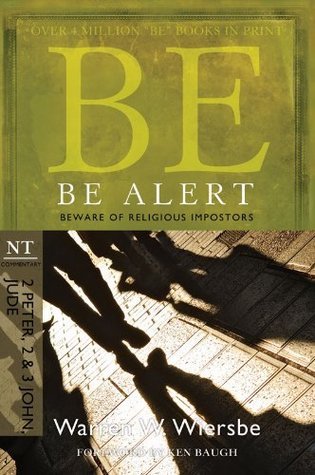
Review: Be Alert: (2 Peter, 2 & 3 John, Jude); Beware of Religious Imposters

Be Alert: Beware of Religious Imposters

At first glance, it might seem like Warren Wiersbe collected leftover short epistles to review in Be Alert: (2 Peter, 2 & 3 John, Jude); Beware of Religious Imposters. However, as his subtitle indicates, these four books near of the end of the New Testament have a common theme.

Often we go to the Bible for comfort, affirmation, assurance that God loves us and will take care of us. Those motives aren’t wrong: we find all those things in the Bible.

But the Bible’s purpose isn’t just to make us feel warm and cozy. God is truth, and anything that isn’t in line with His Word is falsehood. Satan, as God’s enemy, works seemingly tirelessly to question and pervert what God said. Indeed, his first recorded temptation was to question Eve in the garden of Eden about what God said and then to twist it. Often Satan includes enough truth to hook unsuspecting individuals.

That’s one reason to know God’s truth well (the first being that we learn to know God by learning His truth). Paul warned that “Men will rise up even from your own number and distort the truth to lure the disciples into following them” (Acts 20:30). Peter shared that false teachers will “twist” the Scriptures (“wrest” in the KJV). “The Greek word translated ‘wrest’ means ‘to torture on the rack, to distort and pervert’” (p. 113).

2 Peter, 2 and 3 John, and Jude all share what false teachers do, what motivates them, and what judgement is coming to them.

We’re not to support false teachers in any way, not even allowing them into our homes (2 John 10-11), but we’re to help those who have been influenced by them. “And on some have compassion, making a distinction; but others save with fear, pulling them out of the fire, hating even the garment defiled by the flesh” (Jude 22-23).

While the call to beware of false teachers is meant to help us to be alert and careful, we don’t need to panic or live in fear. 2 Peter opens with the reminder that “His divine power has granted to us all things that pertain to life and godliness, through the knowledge of him who called us to his own glory and excellence, by which he has granted to us his precious and very great promises, so that through them you may become partakers of the divine nature, having escaped from the corruption that is in the world because of sinful desire” (2 Peter 1:3-4) and closes with “You therefore, beloved, knowing this beforehand, take care that you are not carried away with the error of lawless people and lose your own stability. But grow in the grace and knowledge of our Lord and Savior Jesus Christ. To him be the glory both now and to the day of eternity. Amen” (2 Peter 3:17-18).

Likewise, Jude ends his warnings with “But you, beloved, building yourselves up on your most holy faith, praying in the Holy Spirit, keep yourselves in the love of God, looking for the mercy of our Lord Jesus Christ unto eternal life” (verses 20-21). Wiersbe comments, “He did not write, ‘Keep yourselves saved!’ because he had already assured them that they were ‘preserved in Jesus Christ’ (Jude 1). He wrote, ‘Keep yourselves in the love of God.’ Our Lord made a similar statement recounted in John 15: 9: ‘Continue ye in my love’” (p. 191). After several paragraphs on Christian love, he concludes, “We grow in our love for God as we listen to His Word, obey it, and delight in doing what pleases Him. That is how we keep ourselves in God’s love” (p. 192).

Finally, Jude concludes with this wonderful benediction: “Now to Him who is able to keep you from stumbling, And to present you faultless Before the presence of His glory with exceeding joy, To ]God our Savior, Who alone is wise, Be glory and majesty, Dominion and power, Both now and forever. Amen” (verses 24-25).

Here are a few more thoughts Wiersbe shared:

In his first epistle, Peter emphasized the grace of God (1 Peter 5: 12), but in this second letter, his emphasis is on the knowledge of God. The word know or knowledge is used at least thirteen times in this short epistle. The word does not mean a mere intellectual understanding of some truth, though that is included. It means a living participation in the truth in the sense that our Lord used it in John 17: 3: “This is life eternal, that they might know thee the only true God, and Jesus Christ, whom thou hast sent” (italics Wiersbe’s) (p. 19, Kindle version).

God has not only given us all that we need for life and godliness, but He has also given us His Word to enable us to develop this life and godliness. These promises are great because they come from a great God and they lead to a great life. They are precious because their value is beyond calculation. If we lost the Word of God, there would be no way to replace it. Peter must have liked the word precious, for he wrote about the “precious faith” (2 Peter 1: 1; cf. 1 Peter 1: 7), the “precious promises” (2 Peter 1: 4), the “precious blood” (1 Peter 1: 19), the precious stone (1 Peter 2: 4, 6), and the precious Savior (1 Peter 2: 7) (p. 22).

God gives His children all that they need to live godly lives, but His children must apply themselves and be diligent to use the “means of grace” He has provided. Spiritual growth is not automatic. It requires cooperation with God and the application of spiritual diligence and discipline. “Work out your own salvation.… For it is God which worketh in you” (Phil. 2: 12–13) (pp. 22-23).

It is a frightening fact that many people who are now zealous members of cults were at one time attending churches that at least professed to believe the Christian gospel (p. 79).

And with that, I have finished all 50 of Warren Wiersbe’s “Be” commentaries!

Review: Help for the Hungry Soul

Kristen Wetherell’s book, Help for the Hungry Soul: Eight Encouragements to Grow Your Appetite for God’s Word, is not about how to read or study the Bible. She goes further back than that to our appetite for God’s Word. We’re made to hunger for God. Satan tempted Adam and Eve to hunger for the wrong thing for the wrong reasons. Our spiritual appetites have been skewed ever since.

People often sense longing for something real, something beyond this life, but don’t know, or turn away, from where to find it. Even those of who know and love God’s Word can start filling our souls with other things, lessening our appetite for the Bible.

“The stirring up of our souls is something only God can do” (p. 18, Kindle version), but Kristen hopes this book will whet appetites to engage with God’s Word.

Kristen discusses different kinds of spiritual hunger, hindrances to Bible reading, the need to ask God to help us hunger for His Word and then position ourselves for Him to do so. She encourages us to remember to seek Jesus in our reading. She reminds us what a privilege it is to have the Bible: just five hundred years ago, it was not available on a wide scale to everyday people. She also reminds us that the church is vital in our taking in God’s Word. She tells us “There is no one ‘right’ way to meet with the Lord in Scripture” (p. 83), so we can try different methods and plans. But we need to “feed and not just read” what it says, taking time to meditate on it. She inspires us to trust the process when we don’t feel different or see “results” after reading. “When you engage with God’s Word, more is happening than you can see” (p. 87).

There are exercises at the end of most of the chapters to help apply what was said as well as testimonies from others concerning the aspect of the individual chapters.

Overall, I thought this was a very helpful, encouraging book. Probably my favorite chapter was the one about trusting God is nourishing us through His Word even when we don’t feel we’ve “gotten anything” out of it.

There was one place where I disagreed with the author, when she said, “Your main spiritual meal is to be enjoyed at church” (p. 72). She wrote that “quiet time” or “devotions” as we think of them today started with the Pietist Movement in the seventeenth century, when German Protestants encouraged people to read the Bible for themselves after years of being told they shouldn’t by the Catholic church. But there are examples in Scripture of people meditating on God’s Word alone (the psalmist on his bed at night; Daniel studying Jeremiah, and others). I agree that we heap a lot of false guilt on ourselves over devotions. Gathering with others to feast on the Word is as important as feeding on it alone, but I don’t see in Scripture that it is more important.

Here are some of the quotes that especially stood out to me:

Right there is the blessing of true Godward hunger: the more of God we come to know, the more of God we want to know. This doesn’t mean perfection, for all our yearnings in this life will be incomplete until we see Jesus; but it does mean we have endless potential to grow, as we seek more of God and receive the fullness of joy that only he can give (Ps. 16: 11)” (pp. 25-26).

Will we allow these discouragements to drive us to his word or away from it? (p. 28).

Do we recognize our helplessness, that even our very desires need to be changed by the Spirit’s transforming grace? Or do we approach Scripture pridefully, thinking we’ve “got this,” attempting to impress God, others, and even ourselves by our obedience? (p. 39).

For too many years, this was the way I approached Scripture, because I didn’t understand my neediness. I thought that by opening my Bible I was seeking something good and right to do, rather than primarily seeking someone to love (p. 39).

There is no magic bullet here, only a constant dependence on God’s supernatural help as we put ourselves in the position to receive from him (p. 53).

Obedience is evidence of true faith in Jesus. It demonstrates that we trust him enough to do what he says. It demonstrates that we love him and actually want to know him. It demonstrates that we acknowledge that, without him, we would be lost (p. 101).

God’s words are purposeful, nourishing, and invaluable. They are worth trusting, for God’s words come from God’s heart. We cling to them because God is the only trustworthy, unchanging rock upon which we can stand. And so we keep coming to God’s word, and we keep clinging to the promises we find there (p. 101).

The beautiful thing about the story of the Bible is its realism. Scripture does not provide an escape from reality, but enters right into it. If you feel like every day is a struggle, you’re right; it is. If you feel like your desires are messed up (even those related to the Bible) and that you can’t get your act together, you’re right; they are, and you can’t (p. 110).

Every hardship—whether obvious and acute suffering, or the daily, lingering futility we all feel—is readying us for Jesus. Every groan anticipates glory. Every hunger pang points us to heaven (p. 111).

What would you lose by turning away from Scripture? What would you gain by staying in the word? . . . What might others gain by your endurance in the word? (p. 116).

I don’t recommend starting with a BHAG (a “big hairy audacious goal”) but rather with a realistic goal. . . Small adjustments can bring meaningful change (p. 119).

I think this book is an excellent resource both for those just beginning to establish a habit of regularly reading God’s Word as well as those of us who have been reading for a while but need to be reminded of these truths. Thanks to Michele for alerting me to this book.

(I often link up with some of these bloggers.)

Laudable Linkage

Laudable Linkage

Some of the thought-provoking posts found this week:

A Sycamore Tree. a Car Crash, and God’s Provision, HT to Challies. “When we think of God’s providential provision for his children, we often think in immediate terms—the unexpected financial gift that comes on the day the bill is due, the odds-defying recovery, or the new job starting right when the severance pay ended. These kinds of immediate interventions are marvellous. They should lead us to praise and give thanks to the God who gives them. But we should also be ready to see that many of God’s provisions are prepared for us long before our needs arise.”

Brussels Sprouts or Brownies? How Would You Describe Your Bible Reading? “I wanted to love my Bible, but I didn’t. It seemed more like brussels sprouts than brownies. Something I consumed because it was good for me, not because it tasted good. I wish I could say my attitude toward the Bible changed overnight. Instead, it was a slow but steady transformation that began when I read a passage the apostle James wrote to the church. There I learned how to position myself to learn from and love God’s Word.”

Let the Cursor Blink, HT to Challies. “The path of wisdom has footprints of restraint. It’s the idea of holding back or keeping back. There’s an intentional restriction of what is said. This is the self-control that knows that sometimes it’s better to be slow to speak (James 1:19) or even not to speak (or text, or email, or post).”

Are Christians Parents Too Protective of Their Children? HT to Challies. “As nervous Christian parents, we sometimes think our number one job is to make sure our kids are never exposed to any non-Christian thinking. We may be tempted to place them inside a sanitized theological bubble, safe from all forms of intellectual contamination. But, as for germ-conscious parents, this may not be accomplishing what we think.”

You Can Parent Teens with Hope in a Secular Age. “All this leads Christian parents to their greatest concern: Is it possible for my teen to develop a strong faith in God amid a culture that celebrates sin, promotes self, and declares truth to be whatever feels good in the moment?

Exercising an Idle Mind. “I see in myself the need to flee not just from idle hands but also an idle mind. As is true of many women, unless I’m sleeping, my mind is quite active. And if I do not give my mind a steady intake of good fuel to burn, I will often be burning whatever fuel I can find. The result? Lots of thoughts about aimless things.”

Walking Our Wives Through the Valley of Miscarriage: An Encouragement to Husbands, HT to Challies. “Miscarriage brings a unique grief in the valley of death; and it’s not an area well-known to us, especially us husbands. There are no maps; no entry and exit signs. There is only darkness, grief, and pain. And while, as fathers, we certainly grieve when our unborn children die, mothers seem to bear a far greater burden, a far deeper wound to the soul.”

Why We Worry When Choosing a Bible Translation, HT to Challies. There are difficulties but also benefits of having multiple Bible translations.

Why a Good God Commanded the Israelites to Destroy the Canaanites, HT to Challies. This is something atheists love to throw at Christians, and it’s something difficult to understand. This post raises some good points.

Elisabeth Elliot quote

This hard place in which you, perhaps, find yourself, is the very place in which God is giving you opportunity to look only to Him. –Elisabeth Elliot

Review: Be Hopeful (1 Peter): How to Make the Best of Times Out of Your Worst of Times

Be Hopeful: Commentary on 1 Peter by Warren Wiersbe

The book of 1 Peter was written to the “elect exiles of the Dispersion in Pontus, Galatia, Cappadocia, Asia, and Bithynia” by Jesus’ disciple, Peter. Warren Wiersbe shares his commentary on 1 Peter in Be Hopeful (1 Peter): How to Make the Best of Times Out of Your Worst of Times.

The folks Peter wrote to were suffering. “At least fifteen times in this letter, Peter referred to suffering, and he used eight different Greek words to do so” (p. 22, Kindle version).

Some of these Christians were suffering because they were living godly lives and doing what was good and right (1 Peter 2: 19–23; 3: 14–18; 4: 1–4, 15–19). Others were suffering reproach for the name of Christ (1 Peter 4: 14) and being railed at by unsaved people (1 Peter 3: 9–10). Peter wrote to encourage them to be good witnesses to their persecutors, and to remember that their suffering would lead to glory (1 Peter 1: 6–7; 4: 13–14; 5: 10). But Peter had another purpose in mind. He knew that a “fiery trial” was about to begin—official persecution from the Roman Empire (1 Peter 4: 12) (p. 22).

Peter wanted to encourage these believers in their faith. “We have noted that the theme of suffering runs throughout the letter, but so also does the theme of glory (see 1 Peter 1: 7–8, 11, 21; 2: 12; 4: 11–16; 5: 1, 4, 10–11)” (p. 24).

Wiersbe notes that the word “grace” appears in every chapter of 1 Peter.

Grace is God’s generous favor to undeserving sinners and needy saints. When we depend on God’s grace, we can endure suffering and turn trials into triumphs. It is grace alone that saves us (Eph. 2: 8–10). God’s grace can give us strength in times of trial (2 Cor. 12: 1–10). Grace enables us to serve God in spite of difficulties (1 Cor. 15: 9–10). Whatever begins with God’s grace will always lead to glory (Ps. 84: 11; 1 Peter 5: 10) (p. 24).

Peter reminds his readers that they were “born again to a living hope through the resurrection of Jesus Christ from the dead” (1 Peter 1:3), and they have “an inheritance that is imperishable, undefiled, and unfading, kept in heaven for you” (verse 4). The “the tested genuineness” of their faith was “more precious than gold” and would “result in praise and glory and honor at the revelation of Jesus Christ” (verse 7).

He reminds them of their call to holiness and of the example of Christ in His suffering and submission.

He tells them not to be “be surprised at the fiery trial when it comes upon you to test you, as though something strange were happening to you. But rejoice insofar as you share Christ’s sufferings, that you may also rejoice and be glad when his glory is revealed” (4:12-13). “Therefore let those who suffer according to God’s will entrust their souls to a faithful Creator while doing good” (4:19).

Along the way, Peter has instructions to servants, husbands, wives, and shepherds—shepherds of God’s flock, His people. He reminds the flock that they need to be submissive to authority and each other.

Clothe yourselves, all of you, with humility toward one another, for “God opposes the proud but gives grace to the humble.” Humble yourselves, therefore, under the mighty hand of God so that at the proper time he may exalt you, casting all your anxieties on him, because he cares for you (1 Peter 5:5-7).

And, in one of my favorite verses in the book, Peter says, “And after you have suffered a little while, the God of all grace, who has called you to his eternal glory in Christ, will himself restore, confirm, strengthen, and establish you” (5:10).

More of Wiersbe’s comments:

Trials produce what he called “heaviness.” The word means “to experience grief or pain.” It is used to describe our Lord in Gethsemane (Matt. 26: 37) and the sorrow of saints at the death of loved ones (1 Thess. 4: 13). To deny that our trials are painful is to make them even worse. Christians must accept the fact that there are difficult experiences in life and not put on a brave front just to appear “more spiritual” (p. 34).

When God permits His children to go through the furnace, He keeps His eye on the clock and His hand on the thermostat (p. 34, emphasis mine).

How can we grow in faith during times of testing and suffering? The same way we grow in faith when things seem to be going well: by feeding on the Word of God (Rom. 10: 17). Our fellowship with Christ through His Word not only strengthens our faith, but it also deepens our love. It is a basic principle of Christian living that we spend much time in the Word when God is testing us and Satan is tempting us (p. 36).

We do not study the Bible just to get to know the Bible. We study the Bible that we might get to know God better. Too many earnest Bible students are content with outlines and explanations, and do not really get to know God. It is good to know the Word of God, but this should help us better know the God of the Word (p. 48).

What does it mean to “sanctify Christ as Lord” in our hearts? It means to turn everything over to Him, and to live only to please Him and glorify Him. It means to fear displeasing Him rather than fear what men might do to us. How wonderfully this approach simplifies our lives! It is Matthew 6: 33 and Romans 12: 1–2 combined into a daily attitude of faith that obeys God’s Word in spite of consequences. It means being satisfied with nothing less than the will of God in our lives (John 4: 31–34) (p. 97).

Christ is with us in the furnace of persecution (Isa. 41: 10; 43: 2). When the three Hebrew children were cast into the fiery furnace, they discovered they were not alone (Dan. 3: 23–25). The Lord was with Paul in all of his trials (Acts 23: 11; 27: 21–25; 2 Tim. 4: 9–18), and He promises to be with us “to the end of the age” (Matt. 28: 20 NASB). In fact, when sinners persecute us, they are really persecuting Jesus Christ (Acts 9: 4) (p. 132).

In my current trek through the Bible, going back and forth between OT and NT books, I would normally be in Thessalonians next. But our pastor is going through 1 Peter on Sunday mornings, so I thought it might be beneficial to study through that book during this time. It has been!

Wiersbe’s ” Be” books are about the same length. So a book like Isaiah, which has 66 chapters, would be discussed in much less detail. 1 Peter only has five chapters, so each chapter of Wiersbe’s only covered a few verses. Most of the epistles are so packed, it’s good to slow down through them.

All of God’s Word is good, important, needful, and helpful all the time, but I think 1 Peter will be especially applicable to us in the postchristian era of our country and in the days ahead.

Review: Be Decisive (Jeremiah)

Be Decisive commentary on Jeremiah

Pastor and Bible teacher Warren Wiersbe shared his thoughts and insights on the book of Jeremiah in Be Decisive (Jeremiah): Taking a Stand for the Truth.

Jeremiah had a tough job. God’s people had worshiped idols for decades. They hadn’t obeyed His laws. They had also gone to other nations for help instead of God, in spite of the fact that He had provided for them and delivered them time and again. He sent prophets at various times to point them back to Him. But they refused.

The time came that God had to deal with them more severely. He was sending punishment in the form of the Babylonians, who would conquer their nation, destroy their temple, and take most of the population back to Babylon.

God would not annihilate them completely. He would preserve a remnant. He would keep His promises to maintain David’s lineage and bring forth the promised Messiah. “The purpose of chastening is that we might seek the Lord, confess our sins, and draw near to Him (Heb. 12: 3–13)” (p. 140). But for now, they were to go to Babylon, make their homes there, and settle in for seventy years.

God called Jeremiah to give this message to His people. They didn’t listen any better than they had before.

The false prophets preached what the people wanted to hear, but Jeremiah preached what the people needed to hear (p. 134).

The civil and religious leaders of Judah preferred the pleasant messages of the false prophets to the strong words of God’s true servant, because the human heart wants to rest, not repent. It wants peace, but it wants it without having to deal with the basic cause of unrest—unbelief (p. 211).

Further, Jeremiah’s instruction to actually submit to Babylon sounded like treason.

Jeremiah is sometimes called the “weeping prophet.” Though he had to point out the people’s sins in order to try to bring them to repentance, and though he knew they deserved what was coming, he still had compassion on them.

At least sixty-six times the word heart is found in the book of Jeremiah, for he is preeminently the prophet of the heart (p. 16).

We call Jeremiah “the weeping prophet,” and he was (9: 1), but he was also a courageous man who faced many dangers and trials and remained true to the Lord (p. 22).

Like many of us, Jeremiah balked at first at God’s calling.

Jeremiah hesitated as he looked at the work before him and the wickedness around him, and when he looked at the weakness within himself, Jeremiah was certain that he wasn’t the man for the job.

When it comes to serving the Lord, there’s a sense in which nobody is adequate. “And who is sufficient for these things?” (2 Cor. 2: 16) asked the great apostle Paul as he pondered the responsibilities of ministry. Paul then answered his own question: “Not that we are sufficient of ourselves to think any thing as of ourselves; but our sufficiency is of God” (3: 5).

When God calls us, however, He isn’t making a mistake, and for us to hesitate or refuse to obey is to act on the basis of unbelief and not faith (p. 20).

At the end of Jeremiah’s ministry, it may not have looked like he accomplished much.

By today’s human standards of ministry, Jeremiah was a dismal failure. He preached to the same people for over forty years, and yet few of them believed him or obeyed his message. He had few friends who stood with him and encouraged him. The nation he tried to save from ruin abandoned their God and plunged headlong into disaster (p. 213).

Jeremiah may have thought he had failed, but God saw him as a faithful servant, and that’s all that really counts (p. 213).

Jeremiah is one of Scripture’s greatest examples of faithfulness and decisive action in the face of physical danger and national decay (p. 20).

Some other quotes that stood out to me:

Any theology that minimizes God’s holiness and tolerates people’s deliberate sinfulness is a false theology (p. 52).

That on which I center my attention and affection and for which I am willing to sacrifice is my god, and if it isn’t Jesus Christ, then it’s an idol. “Little children, keep yourselves from idols” (1 John 5: 21) (p. 60).

The remedy for idolatry is for us to get caught up in the majesty and grandeur of God, the true God, the living God, the everlasting King. An idol is a substitute, and you would never want a substitute once you have experienced the love and power of the Lord God Almighty (p. 60).

That, however, is what faith is all about: obeying God in spite of what we see, how we feel, and what may happen. It’s well been said that faith is not believing in spite of evidence but obeying in spite of consequence” (p. 153).

Lamentations, the book that follows Jeremiah in the Old Testament, is thought by some to also be authored by Jeremiah. Whether it is or not, I thought it would be included with this commentary, because its author laments the devastation that has come to Jerusalem after the Babylonian invasion. I looked at the table of contents of Wiersbe’s “Be” books on the minor prophets and later historical books, thinking his commentary on Lamentations might have been included with other books. But I couldn’t find it anywhere

The middle of the Lamentations contains some of the most hopeful verses. In the midst of sorrow over deserved chastening, the prophet said:

But this I call to mind,
    and therefore I have hope:
The steadfast love of the Lord never ceases,
    his mercies never come to an end;
they are new every morning;
    great is your faithfulness.
“The Lord is my portion,” says my soul,
    “therefore I will hope in him.”

The Lord is good to those who wait for him,
    to the soul who seeks him.
It is good that one should wait quietly
    for the salvation of the Lord.

For the Lord will not
    cast off forever,
but, though he cause grief, he will have compassion
    according to the abundance of his steadfast love;
for he does not afflict from his heart
    or grieve the children of men.

Let us test and examine our ways,
    and return to the Lord!
Let us lift up our hearts and hands
    to God in heaven.

Lamentations 3:21-27, 31-33, 40-41

Most of the prophets did that: issued warnings, pointed out sins, yes, but also shared God’s love, compassion, and willingness to forgive.

I benefited from reading Jeremiah again, and Dr. Wiersbe’s insights were a great help.

Laudable Linkage

Laudable Linkage

Here are some of the good reads found this week:

Everything Short of Hell Is a Mercy, HT to Challies. “Everything short of hell is mercy. This one truth should change the way we view our hardships and frustrations, no matter how terrible they may be. If we, as sinners, are not facing the wrath of the infinitely Holy God at this moment, our life is better than we deserve. That is true for every Christian and non-Christian alive right now.”

What to Say to Dave About Regular Bible Reading, HT to Challies. “Few of us have it fully sorted, and so we don’t feel qualified to tell others what they should be doing. I certainly don’t feel like I can speak from anything other than the wisdom that comes from regular failure. But failure is a good teacher, even if I’m not a good student, so here are five tips I might give to Dave.”

Should You Send Your Kids to Catholic School? HT to Challies. Some considerations.

In a Day’s Work: God’s Pattern for Productivity. “I’ve been studying the book of Genesis in depth, and something struck me recently about how God structured the days of creation. I think there may be something in this pattern that we can imitate in our own work.”

How Vocational Stewardship Leads to Human Flourishing, HT to Redeeming Productivity. “By ‘vocational stewardship,’ I mean the intentional and strategic use of one’s vocational power (skills, knowledge, network, position, platform) to advance human flourishing.” I would add that those things can be done on a smaller scale with neighbors, relatives, and church members.

The Porcelain Room. “Do I worry so much that I’ll forget to give them something they’ll need that I forget to point them toward the Lord who knows what they’ll need—and who will make sure they have it? Am I so preoccupied with the thorns and thistles of life that I allow them to crowd out the good growth of the gospel in our family?”

The Best a Man Can Get, HT to Challies. I enjoyed watching the American men’s gymnastics team win their bronze medal, the first US men’s team to medal in some time. This article about the team was great, too. “It’s a quintessentially American success story about a quintessentially American team, made up of distinct, memorable characters. The phrase ‘Diversity is our strength’ has become a cheap leftist nothing, but there are times and places when it actually means something, and the Olympics is one of them.”

The Curse of Knowledge, HT to Redeeming Productivity. “Have you ever had a teacher who was very smart but terrible at teaching? An expert who used so much jargon you could not follow their explanation? This is called the ‘curse of knowledge.'” The author shares ways to bridge the gap.

The Quiet Grief of Caregiving: Four Balms for the Overburdened, HT to Challies. “I forced a smile, swallowed down the tightness in my throat, and struggled against the tide of grief that’s become as familiar and worn as a tattered coat. It’s a mantle common to many who walk beside the hurting — the heaviness that presses upon the heart when we’ve witnessed others’ suffering over and over and over.”

Church Skills: Use Them or Lose Them, HT to Challies. “You might not think you have church skills, but you almost certainly do. You will have developed ways of making conversation, showing interest in people, caring for them, serving in all sorts of ways and lots of other such things. But as with anything we have learnt to do, if you don’t keep using it, you will lose it.”

I’ve experienced His presence in the deepest darkness hell that men can create. I’ve tested the promises of the Bible, and believe me, you can count on them.” — Corrie ten Boom, survivor of Ravensbruck concentration camp after helping hide Jewish people during WWII

One Book That Can Speak to Everyone

One Book That Can Speak to Everyone

A few years ago, I attended my first writer’s conference. I hadn’t given any thought to attending one until I learned of a small one in a town where I used to live. I decided to try it out, and it spurred me to get serious about my desire to “write a book someday.”

I kept hearing at that conference that publishing was not what it used to be. Writers could no longer simply finish a manuscript and send it to a publisher, who would do the rest. Now publishers want potential authors to have an audience before their company will consider taking on a book.

Since shortly before that conference, I’ve been reading books, blog posts, magazine articles, and listening to podcasts about writing and publishing.

One piece of wisdom I’ve seen over and over is that telling a potential agent or publisher our manuscript is for “everyone” is a fast route to a closed door. Authors are advised to be as specific as possible in the audience they aim for.

I confess I struggle with this a little. For several years I wrote a newsletter for the ladies of the church we attended. I’m used to writing to women of all ages and stages. Occasionally we’d have an article focusing on one aspect of womanhood or another–single women, young wives and moms, older women—but most of what was written was applicable across the board. I’ve had the same approach with this blog.

Some of my favorite books seem the same way. The authors may have had a specific age group in mind, but it’s not obvious to me as I read their books. People of various ages and situations have bought certain books for years.

This trend towards specific audiences has led some books, like Gary Chapman’s Five Love Languages, to be transformed into versions for parents of children. parents of teens, singles, couples, men, and women. I wondered how he managed to write the same material for all these different groups. The illustrations would likely change in each, but it seems the basic principles would be the same.

Similarly, Stormie Omartian’s The Power of a Praying Wife led to the power of a praying husband, praying woman, praying mom, praying kid, praying teen, praying grandparent, and more.

In my more cynical moments, I wonder if this converting general books to several different audiences is a ploy of publishers and their marketers to sell more books.

But I can see that it would be helpful to take general principles and apply them to different specific situations.

These musings led me to this thought: there is one book that’s good for any age, gender, or life situation. The Bible is inspired and “for teaching, for reproof, for correction, and for training in righteousness” (2 Timothy 3:16).

There are study Bibles packaged in camouflage or sports paraphernalia for boys and pink or unicorns for girls. Bibles have been designed and illustrated for teens, women, men, even outdoorsmen.

The packaging would appeal to different specific groups, as would any devotional material or added notes. Those things can be useful. But I wouldn’t say they are truly necessary. The Holy Spirit can help us understand and apply the Bible at any age and stage of life.

Someone has said that the Bible is shallow enough for a child to wade in, but deep enough for an elephant to swim in. (1)

There are parts a child can understand. God told parents in the Old Testament to teach His Word to their children and grandchildren. Paul says Timothy has “from childhood . . . been acquainted with the sacred writings, which are able to make you wise for salvation through faith in Christ Jesus” (2 Timothy 3:15).

Of course, there are parts a child would not understand. There are parts the wisest theologian doesn’t understand completely. But I can testify, coming up on fifty years of reading the Bible with some degree of regularity, that it speaks to us and is applicable to us all through life. As we read it through different life stages, we continue to find applications to our situations.

The Bible is even good for those who oppose it. Psalm 119:130 says, “The entrance of Your words gives light; It gives understanding to the simple.” Viggo Olsen tells in his book, Daktar, how he and his wife promised her Christian parents that they would look into the claims of Scripture. However, they secretly planned to disprove the Bible so they could get her parents off their backs about Christianity. Instead, they became convinced the Bible was true and God was real. They became Christians and later went as missionaries to Bangladesh.

The same thing happened to Lee Strobel. He and his wife were both atheists and planned to remain that way. When his wife became a Christian, he tried to disprove the Bible’s reliability and claims with the zeal of the investigative reporter he was. He says in his book, The Case for Christ, that the more he searched, the more convinced he became that the Bible was true after all. He became a Christian and went on to become a minister and wrote several more books about Christianity.

There are multitudes of reasons for reading the Bible: it provides light, joy, comfort, encouragement, builds our faith, helps us fight sin, tells us more about God. But the primary reasons for reading Scripture are that it is God’s message for us and our main means of getting to know Him.

If you’ve never read the Bible, I encourage you to. You might start with one of the gospels. John gives the most in-depth look at the Son of God and His ministry.

If you’ve had a stop-and-start pattern of Bible reading, don’t be discouraged. Many of us tried in fits and starts before getting into some kind of regular pattern of Bible reading. I shared tips for finding time to read the Bible here. I’d advise starting small and simple. Too often, we make grandiose plans but then can’t keep up with them.

If you’ve been reading the Bible regularly for years, wonderful! Keep at it! There’s always more to learn, but we need the reminders of old lessons, too. If you feel you’re in a devotional rut, these tips might help.

Whatever stage of life you are in, the Bible can speak to you.

Psalm 119:130

_____

(1) Variations of this statement have been attributed to Augustine, Gregory the Great, Jerome, and John Owen, among others. Andy Naselli tells why he thinks Gregory the Great is the original source here.

(I often link up with some of these bloggers.)
Review: Read This First

Gary Millar wrote Read This First: A Simple Guide to Getting the Most from the Bible to “help people who would like to read the Bible but don’t really know where to start or how to go about it” (p. 2, Kindle version). Whether one is a new Christian or has never really gotten into regular reading, Millar hopes you will “read this first and go back to the Bible with the skills and confidence to truly enjoy it (p. 3).

First, Gary deals with the question, “Why bother with the Bible?” and lists reasons people don’t.

But he says, “I’ve written this book to help you meet a person—a living, loving, being like no other—through the pages of a book like no other. . . He made us, he loves us, he knows us inside out, and he speaks to us. And he does that through the Bible. That’s why reading the Bible matters so much—because when we read it, we meet the one and only God ” ( p. 10).

Millar assures that “the Bible was written to be understood by ordinary people like us. It doesn’t need insider knowledge or a special code to make sense of it. It’s not written for experts and professionals. It’s written for people like you and me (pp. 17-18).

Millar then gives tips on how to read, to pick up what he calls the “vibe” of a given passage, to understand different genres within the Bible, to discern meaning, and to apply what we’ve learned.

Every chapter ends with a couple of examples of Scripture to work through using the skills detailed in that chapter.

The appendix, titled “What Is the Bible?” gives a little background such as the difference between the two testaments, how we got the chapter and verse references that weren’t in the original manuscripts, and more.

Gary writes in a warm and simple style, so this book would be accessible to almost anyone.

This would be an excellent resource for someone new to reading the Bible or to anyone who feels they need a refresher course in how to do so.

Laudable Linkage

Laudable Linkage

Even though I’m a little behind on my blog-reading, I found some great articles in the time I did read:

God . . . the Father? “As a dad, I don’t want my presentation of fatherhood to hurt my kids’ ability to see God as their heavenly Father. But it’s perhaps more important that we help our children recognize the foundational truth here: that God, in all His power and glory, is best understood as a loving, intimate Father.”

Don’t Give Up Dad. “‘Don’t give up dad.’ I remember looking into the mirror and saying those words to myself one dark Father’s Day, years ago. And I was about to give up.”

Fighting for Faith When Doubts Abound, HT to Challies. “There’s a pervasive belief that subtly infiltrates my thought life. One that, deep down, still believes God would keep me from harm and rescue me from pain if he truly loved me. And if he’s truly in control, and a good, loving Father, why does he answer other’s prayers, but continue to seem silent to ours?”

God’s Heart for the Elderly and Infirm Reminds us of the Sanctity of Senior Life. “One of the many problems facing Western society is that we worship youth and make the elderly disposable. Euthanasia, which is legal in my home state of Oregon, is simply abortion of the elderly, disabled, and terminally ill. The same logic and arguments and appeals to ‘compassion’ and quality of life and financial concerns are used for both. God’s perspective on the elderly is vastly different.”

The Incredible Blessing of My Father’s Difficult Final Months, HT to Challies. “The agony of watching Dad suffer like that was unbearable. I begged God to give him a quick end. But Dad was otherwise robust and exhibited a fierce will to live. The doctor said that death did not look imminent. I absolutely did not want to hear that. How could someone live in such a state? But God had an important lesson in store for me. Dad lived for nine more months, and we would have missed an incredible blessing had he died when I wanted.”

Antihistamines for Your Soul. “You don’t HAVE to memorize or read this much to follow Jesus. It’s also true that you can be in the Word every day and still not be anything like Jesus. But the subtle lie underneath is that you can ever have ‘too much’ Scripture in your life. Friends, you CANNOT overdo it on God’s Word and fellowship with him.”

Observation: The First Step in Bible Study. “The first step in studying God’s Word is to carefully observe what the passage is saying. In the observation stage, we give our complete attention to the text to find out what’s there. We must investigate the passage in the same way that a detective investigates a crime scene. How do we do that? Get the “big picture” and then discover the little details. Ask questions… lots of them! Look for certain key clues to discover meaning. See how the little details relate to the big picture.”

Use Discretion (& a Bucket). We’re told to be discerning and compare what is taught with Scripture. But no writer or speaker will be completely without sin. God works through fallen people, and we miss a lot of goodness if all we can see are the flaws.

Paul’s Shocking Ideas About Marriage. “In the typically patriarchal culture of Paul’s day, what he says to wives may not sound that new except for the key point he emphasizes—the motivation and means for being a wife is centered on Christ. Everything Paul says to husbands, however, is very different from what they would have heard from their society. So Paul needs extra time to impress these differences on them.”

A Christian perspective on the new Twitter / X adult content policy changes, HT to Redeeming Productivity. “In May 2024, there was a policy change on adult content, making it acceptable to share adult content. . . . So, with these recent Twitter policy changes, what should we do as Christians?”

Happy Father’s Day to the dads tomorrow!

quote about fathers

“To be popular at home is a great achievement. The man who is loved by the house cat, by the dog, by the neighbor’s children, and by his own wife, is a great man, even if he has never had his name in Who’s Who.” Thomas Dreier

Review: Be Complete (Colossians)

Be Complete (Colossians): Become the Whole Person God Intends You to Be by Warren Woersbe

I think most of Warren Wiersbe’s “Be” commentaries are about the same size. So a commentary on Isaiah, which has sixty-six chapters, discusses large portions at a time.

The book of Colossians just has four chapters. So Be Complete (Colossians): Become the Whole Person God Intends You to Be covers just a few verses of Colossians in each of its twelve chapters.

Since Colossians is so densely packed, and the ESV Study Bible had a lot of notes on it as well, plus Wiersbe’s book had more detail, I decided to slow down my usual pace of reading and take time to soak in what was written.

Wiersbe calls Colossians “one of the most profound letters Paul ever wrote.”

The church in Colossae was not one that Paul started; in fact, he had never been to that city. But Paul had been in nearby Ephesus for three years, from which the Bible says “‘all they which dwelt in Asia heard the word of the Lord Jesus, both Jews and Greeks'” ‘ (Acts 19:10). This would include people in Colossae, Laodicea, and Hierapolis.” A Colossian named Epaphras seems to have heard Paul preach in Ephesus and then brought the gospel back to Colossae.

At the time Colossians was written, Paul was in prison. Epaphras was with him and evidently shared that a dangerous teaching was making the rounds in Colossae. So Paul wrote to help these believers. Wiersbe believed the false teaching was Gnosticism; the ESV Study Bible notes say that “an improved understanding of Gnosticism” due to more information having been discovered about it has led scholars to think Gnosticism was not the problem, but they don’t know exactly what false teaching was being promoted. Nevertheless, there’s much we can learn from Colossians even without knowing exactly what teaching was being combated.

Paul begins the book with greetings and thankfulness for the Colossians faith. Then he shares what he prays for them, one of my favorite prayers in the Bible:

And so, from the day we heard, we have not ceased to pray for you, asking that you may be filled with the knowledge of his will in all spiritual wisdom and understanding, so as to walk in a manner worthy of the Lord, fully pleasing to him: bearing fruit in every good work and increasing in the knowledge of God; being strengthened with all power, according to his glorious might, for all endurance and patience with joy; giving thanks to the Father, who has qualified you to share in the inheritance of the saints in light. He has delivered us from the domain of darkness and transferred us to the kingdom of his beloved Son, in whom we have redemption, the forgiveness of sins.

I have prayed this often for myself and loved ones.

Paul then writes about the preeminence of Christ, “the image of the invisible God,” the one who created everything and holds it all together, the head of the church. “In him all the fullness of God was pleased to dwell, and through him to reconcile to himself all things, whether on earth or in heaven, making peace by the blood of his cross” (1:19-20).

And, amazingly, “you, who once were alienated and hostile in mind, doing evil deeds, he has now reconciled in his body of flesh by his death, in order to present you holy and blameless and above reproach before him” (1:21-22).

Paul says his stewardship was “to make the word of God fully known, the mystery hidden for ages and generations but now revealed to his saints. To them God chose to make known how great among the Gentiles are the riches of the glory of this mystery, which is Christ in you, the hope of glory. Him we proclaim, warning everyone and teaching everyone with all wisdom, that we may present everyone mature in Christ. For this I toil, struggling with all his energy that he powerfully works within me” (1:25-29). In the Bible, a mystery wasn’t something to figure out from clues: it was something that was not previously revealed but now is.

Paul warns them to “See to it that no one takes you captive by philosophy and empty deceit” or “delude(s) you with plausible arguments” (2:8, 4).

Paul goes on to exalt Christ as the one “in whom are hidden all the treasures of wisdom and knowledge” (Colossians 2:3). As we received Him, we’re to “walk in him, rooted and built up in him and established in the faith, just as you were taught, abounding in thanksgiving (2:6-7).

After sharing the gospel, Paul gives practical instruction for how the gospel affects our lives, families, and workplaces. There are certain behaviors we’re to put off, others we’re to put on. We’re to “seek the things that are above, where Christ is, seated at the right hand of God. Set your minds on things that are above, not on things that are on earth” (3:1-2).

Paul wraps up his teaching by encouraging believers to pray, give thanks, and “Walk in wisdom toward outsiders, making the best use of the time. Let your speech always be gracious, seasoned with salt, so that you may know how you ought to answer each person” (4:5-6).

I can get so caught up in the affairs of this life, I need the reminder to “set my mind on things above” and exalt Christ above all.

A few more quotes from the book that stood out to me:

The gospel message does not center in a philosophy, a doctrine, or a religious system. It centers in Jesus Christ, the Son of God (p. 30, Kindle version).

Uniformity is the result of compulsion from the outside; unity is the result of compassion from the inside (p. 37).

Satan is so deceptive! He likes to borrow Christian vocabulary, but he does not use the Christian dictionary (p. 43).

The false teachers in Colossae, like the false teachers of our own day, would not deny the importance of Jesus Christ. They would simply dethrone Him, giving Him prominence but not preeminence. In their philosophy, Jesus Christ was but one of many “emanations” that proceeded from God and through which men could reach God. It was this claim that Paul refuted in this section (p. 57).

In the New Testament, saints are not dead people who during their lives performed miracles and never sinned. New Testament saints were living people who had trusted Jesus Christ. Paul wrote this letter to living saints (Col. 1:2), (p. 73).

Prayer is not our trying to change God’s mind. It is learning what is the mind of God and asking accordingly (1 John 5:14-15) (p. 81).

It does little good if Christians declare and defend the truth, but fail to demonstrate it in their lives (p. 113).

Paul did not ask for the prison doors to be opened, but that doors of ministry might be opened (1 Cor. 16: 9; Acts 14: 27). It was more important to Paul that he be a faithful minister than a free man. It is worth noting that in all of Paul’s prison prayers, his concern was not for personal safety or material help, but for spiritual character and blessing (p. 154).

I like how Wiersbe closed his commentary on Colossians:

As we come to the close of our study of this remarkable letter, we must remind ourselves that we are complete in Jesus Christ. We should beware of any teaching that claims to give us “something more” than we already have in Christ. All of God’s fullness is in Him, and He has perfectly equipped us for the life that God wants us to live. We do not live and grow by addition, but by appropriation (p. 173).