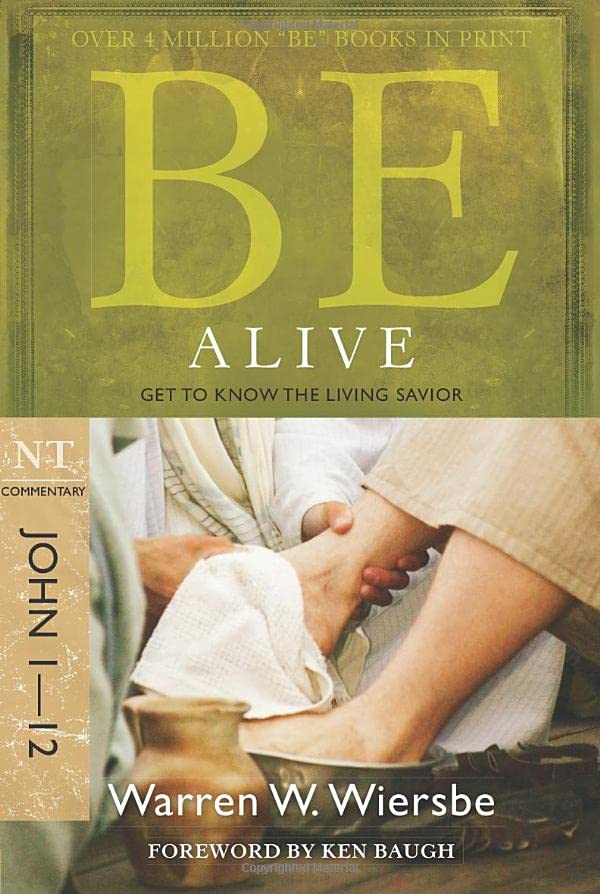
Be Alive: Get to Know the Living Savior

I veered from my Bible reading plan because I wanted to be in one of the gospels over December, and because the plan had not taken me through John in the last few years.

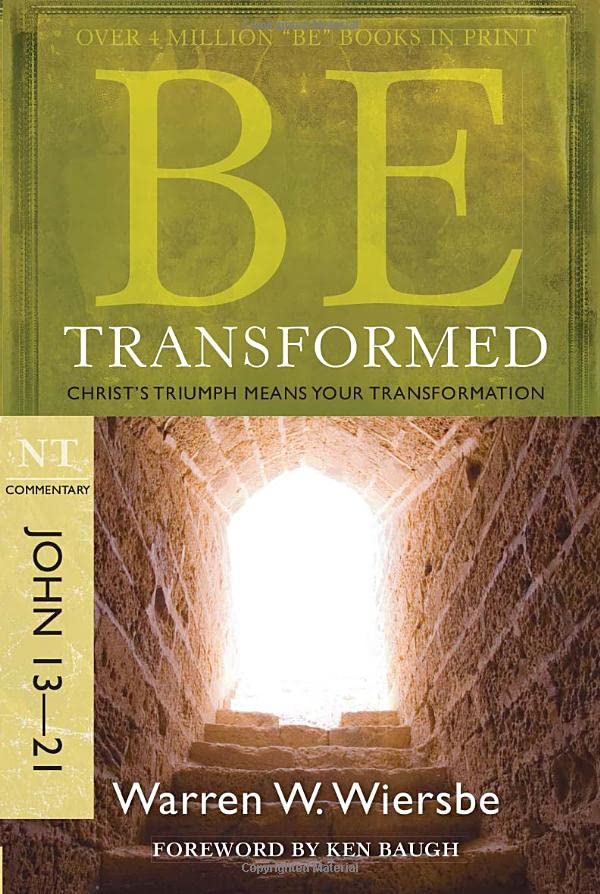
Warren Wiersbe divided his commentary on John into two books, the first being Be Alive (John 1-12): Get to Know the Living Savior.

Each of the four gospels presents Jesus from a different aspect. John’s gospel portrays Jesus as the Son of God.

John shares different titles for Jesus: the eternal, incarnate Word of God (“Much as our words reveal to others our hearts and minds, so Jesus Christ is God’s ‘Word’ to reveal His heart and mind to us”–p. 20); the light of the world; the eternal Son of God; the lamb of God; the Messiah, long promised and prophesied in the Old Testament; the king of Israel; the Son of Man; the good shepherd, the water and bread of life, the door.

When John shares some of the miracles Jesus did, he “seeks to share the inner meaning—the inner significance—of our Lord’s works, so that each miracle is a ‘sermon in action” (p. 38). “Our Lord’s miracles were testimonies (John 5: 36), giving evidence of His divine sonship; but they were also tests, exposing the hearts of the people (John 12: 37ff.). The same events that opened some eyes only made other eyes that much more blind (John 9: 39–41)” (p. 44).

One theme through John’s gospel is Jesus’ “hour.” Throughout, Jesus says His hour was not yet come. Then it was at hand, then it finally culminated in His death for us.

Another theme is that Jesus loves and came to die for the world, not just the Jews.

One of John’s major themes is that Jesus is the Savior of the world, not simply the Redeemer of Israel. He is the Lamb of God who takes away the sin of the world (John 1: 29). “For God so loved the world” (John 3: 16). The Samaritans rightly identified Him as “the Savior of the world” (John 4: 42). He gave His life for the world, and He gives life to the world (John 6: 33). He is the Light of the World (John 8: 12). The universal emphasis of John’s gospel is too obvious to miss. Jesus will bring the “other sheep” who are outside the Jewish fold (John 10: 16; and see 11: 51–52) (p. 190).

The crowds at first flocked to Jesus for His teaching and His provision. They hoped He would throw off Roman oppression and set up His kingdom. Some believed and became loving followers of Christ. Many began to fall away when He spoke of the cost of discipleship and when it became clear that He was not the type of Messiah they had envisioned.

The Pharisees were supposed to be experts in the law of God, but they missed the Savior portrayed in the law.

When a person starts to resist the light, something begins to change within him, and he comes to the place where he cannot believe. There is “judicial blindness” that God permits to come over the eyes of people who do not take the truth seriously. (The quotation of Isa. 6: 9–10 is found in a number of places in the New Testament. See Matt. 13: 14–15; Mark 4: 12; Luke 8: 10; Acts 28: 25–27; Rom. 11: 8.) It is a serious thing to treat God’s truth lightly, for a person could well miss his opportunity to be saved. “Seek ye the LORD while he may be found, call ye upon him while he is near” (Isa. 55: 6)” (p. 194).

John’s gospel is a full and rich portrayal of Christ. There is so much in it, I am not surprised Wiersbe took two books to cover it. I look forward to the next one.

Why Did Jesus Come as a Baby?

“Often in the account of salvation history, the future of God’s plan rests with a baby or a child.” (1).

“In Bible history, very often the birth of a baby has made the difference between defeat and victory for God’s people” (2)

In one sense, every baby born represents a new beginning with potential and hope for the future. But sometimes a baby was a major turning point in Bible history.

The first child born on earth, Cain, killed his brother, Able. Cain was exiled, but God sent Adam and Eve another son, Seth.

God had made a historic covenant with Abraham that his descendants would be as many as the dust of the earth (Genesis 13:14-17) or the stars in the sky (Genesis 15:5). In him all the nations of the earth would be blessed (Genesis 12:1-3). But Abraham had no child with Sarah, his wife, for about 25 years after the promise was made. Finally Isaac, the child of promise, was born.

When God’s people were captive in Egypt, Pharaoh demanded that all the Jewish baby boys be killed. But “By faith Moses, when he was born, was hidden for three months by his parents, because they saw that the child was beautiful, and they were not afraid of the king’s edict” (Hebrews 11:23). Moses grew up to be the deliverer of his people: God used him to bear witness to Egypt through the plagues, to lead Israel out of Egypt and to the promised land, and to give them God’s law.

In another low point in Israel’s history, when injustice was running rampant, one desperate woman prayed for a child that she promised she would give back to the Lord. God gave her Samuel, who was the pivot between the time of the judges and the kings and who called his people back to worship and serve the one true God.

A bitter woman named Naomi had lost her husband and both sons. Now she was alone with her daughter-in-law, Ruth. But God raised up a godly man to marry Ruth and give Naomi a grandson—a grandson whose grandson would be David, the great king of Israel, a man after God’s own heart.

God had promised that the Messiah would come through David’s line. But wicked queen Athaliah killed all the king’s sons—she thought. Jehosheba, the aunt of little Joash, hid him away with a nurse until he could be made king and carry on the Davidic line.

Malachi ends the Old Testament with a promise that God would “send you Elijah the prophet before the great and awesome day of the Lord comes. And he will turn the hearts of fathers to their children and the hearts of children to their fathers” (4:5-6). Then there were 400 years of silence. And suddenly one day, an old, childless priest was startled by an angel’s visit announcing that he and his aged wife, after many long years of now-abandoned prayers, would have a baby who would “turn many of the children of Israel to the Lord their God, and he will go before him in the spirit and power of Elijah, to turn the hearts of the fathers to the children, and the disobedient to the wisdom of the just, to make ready for the Lord a people prepared” (Luke 1:16-17).

And then, in yet another low point in the history of God’s people, when they were under the Rome’s rule, “when the fullness of time had come, God sent forth his Son, born of woman, born under the law, to redeem those who were under the law, so that we might receive adoption as sons” (Galatians 4:4-5).

Why did God send His Son to earth as a baby? I don’t know all the reasons. But here are a few:

To be the Son of Man But he took on our flesh that he might be Son of Man as well as the Son of God.

To defeat death. “Since therefore the children share in flesh and blood, he himself likewise partook of the same things, that through death he might destroy the one who has the power of death, that is, the devil, and deliver all those who through fear of death were subject to lifelong slavery” (Hebrews 2:14-15).

To be made like His brethren (Hebrews 2:17a).

To become a merciful and faithful high priest in the service of God (Hebrews 2:17b).

To make propitiation for the sins of the people (Hebrews 2:17c), To take our sin and punishment on Himself to atone for our sins.

To help those who are being tempted “because he himself has suffered when tempted” (Hebrews 2:18).

Those things explain why He took on flesh. But why as a baby? Partly so that He could live a whole righteous life in our place. But perhaps Charles Spurgeon is on to another reason when he says, “We might tremble to approach a throne, but we cannot fear to approach a manger. Never could there be a more approachable being than Christ.” (3)

“The greatest forces in the world are not the earthquakes and the thunderbolts. The greatest forces in the world are babies” (4). Especially this baby.

____________
1. Warren W. Wiersbe, Be Distinct (2 Kings & 2 Chronicles): Standing Firmly Against the World’s Tides, p. 224.

2. Warren W. Wiersbe, Be Basic (Genesis 1-11): Believing the Simple Truth of God’s Word, p. 94.

3. Charles Spurgeon, Joy to the World: Daily Readings for Advent.

4. Dr. E. T. Sullivan as quoted in Warren Wiersbe, Be Compassionate (Luke 1-13): Let the World Know That Jesus Cares, p. 26.

Thanks to Dr. Wiersbe for emphasizing God’s use of babies in so many of his commentaries and whose thoughts inspired mine.

(I often link up with some of these bloggers.)

Laudable Linkage

Here are some of the articles that resonated with me this week:

Love Is a Skill, HT to Challies. “Anyone who has tried very hard to love other people well will know that love doesn’t always feel very natural. A lot of times it feels more like hard work.”

The Problem with Reading the Bible Verse-by-Verse, HT to Knowable Word. The verses divisions, subheadings, footnotes, charts, etc., in most of our Bibles “break up the text into little chunks (often arbitrarily), and we do not naturally read in little chunks, we read in big chunks. You read ordinary books section by section, not word by word, but all the footnotes and verse numbers condition us to read the Bible verse by verse.” Those tools are good for study later, “but the first and most important rule for interpreting and appropriating any biblical book is to actually read the book.”

Dig Deeper, HT to Challies. “Think of the scriptures like a fancy layered dessert — maybe a cake or parfait. There are several layers, and each offers new delights. If you don’t dig down into all the layers, you’re missing out.”

A Call for Endurance and Faith, HT to Challies. “We are not without encouragement in times like these, and sometimes the call for endurance comes in ways that seem strange to the contemporary churchgoer who has enjoyed religious freedom all their lives.”

What Does God Want of Me? HT to Challies. “But what I do remember are the three questions that came out of this difficulty, questions that my husband raised in the midst of this trial to help provide us with direction and guidance. These questions have stayed with me ever since, and have given me clarity and lessened my burden in a wide variety of situations: problems with children or other family members, issues in my marriage, dilemmas in church, personal trials, and more.”

Is Your Way Really God’s Way? ‘While the Bible is heavy on function (what we are to do) it is light on form (how we are to do it).” This article helps discern between form and function and the errors of insisting on our form of doing things.

Protecting Your Teenagers Online, HT to Proclaim and Defend. “We have a pool in our backyard. We also have young children. What steps do we take to protect them? 1. A fence; 2. Swim lessons; 3. Supervision.” Kristopher Schaal then applies these three levels of protection to internet usage.

Cultivating Attention: The Challenge of Reading Great Literature, HT to Linda. “As a literary critic, writer, and professor, I have the great privilege of working with literature every day, and helping others to encounter the beauty of great stories as well. Evangelization and discipleship through beauty is vitally important for our modern culture, for God is perfect Beauty as well as perfect Goodness and Truth. Stories, poetry, and all the arts can help us both to grow in our own faith and to share that faith with others in a compelling way . . . But it’s not easy. Many readers find themselves discouraged, encountering a gap between their desire to engage with great tales and the rather more difficult reality of the experience.”

Why the World Needs Readers (Like You), HT to Linda. “I’ll be honest. It’s in my own self-interest to say that reading is important. I am the author of a book blog, after all. But I believe—passionately—that reading is more than your average pastime. Much more. Here’s why I think that readers, people like you and me, are critical to preserving civilization—and helping it flourish.”

How an Introvert Does Thanksgiving, HT to Linda. “As a large and diverse group, we introverts love our families and the holidays no more or less than anyone else. So the fear and loathing with which we sometimes face this season is not an intro-aversion to the whole concept of family or holidays. It’s more the specifics of the experience that exhaust us; many of us are right now anticipating Thanksgiving with equal parts of delight and anxiety. Yes, pie. But also forced togetherness, lots of chitchat, and old family scripts replaying again and again. It’s a tradeoff. So, before the holidays flatten you like a runaway truck, perhaps take a minute to sort through their delights and the stresses to sketch out some strategies for Thanksgiving so you can enjoy more of the former and less of the latter.”

I Could Never Get Grandma’s Dressing Quite Right—Until She Was Gone, HT to Linda. “Back then I hadn’t yet learned that the most important thing about cooking for other people is the joy your food can bring them. . . .that on Thanksgiving, it’s a waste of time to roast a whole entire pumpkin for pie (the canned stuff is superior anyway!), and that investing in six great dishes is far better than churning out 12 I’m too exhausted to actually eat, and that turkey tastes approximately the same no matter what you do to it.”

thankful heart

You Don’t Have to Choose a Word for the Year

We’re almost at the time of year when bloggers start considering their word for the next year.

For many, choosing a word for the year replaces a list of resolutions. That one word gives them focus for the year. Christians who do this usually pray about it leading up to the new year and feel this word has been given to them or impressed on them by God. They often plan activities, reading, or Bible study around their word.

I’ve read wonderful testimonies about how God has worked in someone’s heart through meditating on their word for the year.

It’s a fine practice.

I’ve never felt particularly led to do it myself. I’ve studied or focused on one topic for a while, but not necessarily from Jan. 1 to Dec. 31.

Perhaps you’ve never felt led to choose a word for the year and you wonder if you’re missing out. Or perhaps you’ve chosen one in the past but, like a forgotten New Year’s resolution, it soon faded out of memory.

I just want to emphasize a few truths:

God never tells anyone in the Bible to choose a word, a theme, or a verse for the year. He never tells anyone not to do any of those things, either. It’s just one method of studying and applying God’s Word.

God may lay on your heart to study a certain topic, truth, characteristic, etc. from the Bible, and that may or may not coincide with January 1 and may or may not last a year.

Psalm 119:105 says “Your word is a lamp to my feet and a light to my path.” Commentary I’ve read for that verse said that the lighting they had in Bible times only shone a step or two ahead. God often guides that way–day by day, just enough for the next step. Of course, He knows what is ahead and may well prepare people for it through a word for the year. But I have found that to happen through my daily Bible reading or sermons or Sunday School lessons I hear. It’s amazing how often God’s truth intersects my experience through a book I picked up seemingly randomly.

What’s more vital than a word for the year is daily seeking God in His Word.

Whether or not one chooses a word for a year, it’s good to read the Word of God every day. God can teach us through an extended focus on one word or concept. But He promises to give us guidance, hope, encouragement, and so much more as we meet with Him daily.

Granted, most people who choose a word for the year don’t do so at the exclusion of other Bible reading. Their main focus might be that one word, but they probably also follow a Bible reading plan and attend a Bible study group or church where they hear other parts of the Bible taught.

There’s value in reading large chunks of the Bible to keep the big picture in mind, and there’s value in camping out in a smaller section for a while. We need the panoramic lens to take in the beauty and wonder of the big picture of God’s Word and to place everything in context. We also need the macro lens for close-ups, for camping out with a verse at a time and mining its truths. I wrote about reasons and ways to do both here. For many, their one word is that close scrutiny.

While many people find great value in choosing a word for the year, those who don’t use that method shouldn’t feel they’re missing out or somehow not as spiritual. People have gotten by for millennia without a word for the year. On the other hand, just because this practice is relatively new doesn’t mean there is anything wrong with it. If choosing a word for the year has been a great blessing for you, or you think it might be, or you think it’s something God wants you to do, go for it, and may God bless you in it.

Jesus said, “Man shall not live by bread alone, but by every word that comes from the mouth of God” (Matthew 4:4). Let’s be faithful to partake of that bread in some way every day.

(Revised from the archives)

(I often link up with some of these bloggers.)

Laudable Linkage

Here is the latest round-up of good reads found this week:

Hearts Painted by the Word Again and Again, HT to Challies. “The job of painting the Golden Gate Bridge in San Francisco is never-ending. I heard once that they paint it end-to-end, but by the time they get to the end—however many years that may take—it is time to start over.” I love the analogy drawn from this!

When Working for God Becomes the Goal. “It is not God’s design or will that any of His children find their personal worth in what they achieve. God never tells us that if we fail to ‘make a difference’ or ‘leave our mark’ in some profound way that we are insignificant. But this ambition to ‘leave a legacy’ through measurable success is mainstream in some cultures. It has a glittering appeal to those who have a genuine heart to serve Christ and be good stewards of their gifts.”

The Silent Sin that Kills Christian Love, HT to Challies. “Perhaps the test of faithfulness in a day of moral degradation will be our love for people across chasms of difference. Faithfulness isn’t in showy displays that we hate all the right people. Faithfulness isn’t in adopting a contemptuous posture toward the current president or the former one. The way of the cross rejects the path of sneers and jeers, whether in the form of elite condescension or populist passion.”

Mothering with Humility, HT to the Story Warren. “I didn’t have much choice but to be completely transparent with my seven-year-old son. A few minutes earlier, his concerned little face had peered down the stairs, trying to figure out why I was responding angrily to something his dad had said. Now, I found myself trying to calm him down and convince him to apologize to his older brother, with whom he was furious.”

Parents, Just Go to Church. “Getting to church is hard. But that’s part of the value of attending church every Sunday. It sets the tone for the Christian’s daily struggle to live in personal relationship with Christ.”

Why Study Doctrine? “Some dismiss doctrine as uninteresting, irrelevant, or just plain boring. ‘Don’t give me doctrine. Just give me Jesus! Doctrine may be cool for pastors or Bible nerds, but I live in the real world. I need practical stuff that works!’ Why study doctrine? Let me suggest a few reasons…”

Why We Go Light on Polemics, HT to Challies. “I am not saying there is never a time to do polemics. After all, Paul says that we “destroy arguments and every lofty opinion raised against the knowledge of God” (2 Cor 10:5). . . . The main issue I’ve faced with polemical approaches is that they risk triggering a defensive response, where someone is overtaken by the sense that they are duty-bound to protect their community’s honor from the attacks of an outsider.”

Becoming a Better Bibliophile. “I keep convincing myself that I would be a better person if I simply buy another book.”

Laudable Linkage

Some of you have told me that you really enjoy the links I share on Saturdays. I share more through the week on my Twitter account as I come across them. That’s about the only thing I use Twitter for, as well as sharing my own posts (and my Wordle scores. 🙂 ). Then I share here the ones that particularly resonated with me or that I think readers would like. The lists here and there don’t match exactly, but they overlap a great deal.

Immovable Hope in the Wake of Hurricane Ian, HT to Challies. “Psalm 46 describes an earth-shattering ocean storm. These verses will never again be an abstraction for those of us from Sanibel. Yet we must not forget how the psalm begins. God is our refuge.”

Be Angry and Do Not Sin, HT to Challies. “The problem is that we are happy to exploit what seems to be a legal loophole. Anger, in its very nature, is self-justifying. My anger is righteous; your anger is not. So if we are to find some righteous wiggle room here, we must proceed very carefully.”

A three-part series on uprooting bitterness: Part 1, Part 2, and Part 3.

Three Battles to Fight for Personal Bible Study. “What if your life schedule has ticked up a notch and your desire for the Word has cooled and you’re rusty on your Bible study methods? If we hope to protect our daily time with God, we must keep up the fight on all three fronts. We must get ‘triple protection’ for our time with God if we hope the habit will last.”

Prioritizing Evangelism, HT to Challies. “But knowing the gospel and loving the lost isn’t enough. Just loving the lost is like crying at the bedside of a dying patient with the cure in our hands. We must administer it. What good is the medicine? What good are our tears? So speak forth the very Word of God. It’s the only medicine that can save the sin-sick souls from eternal physical damnation.”

When You Can’t Meet Every Need, HT to Challies. “I want to meet their needs and it brings me great joy to meet their needs. But I cannot meet every need for every person in the ways they want or even in the ways I would like to. It’s impossible. And so, as I was explaining this conundrum to my husband, I told him how I’ve reconciled the tension in my heart.”

You Can’t Do Everything and Not Everything Is for Everyone, HT to Challies. This is a similar idea to the article above except that one is about individuals and this one is about the church, but could also be applied to groups and organizations. “All these are valid questions to ask and think through. The problem is not in their being asked, nor in their being thought through, but in the stymying effect whatabouttery can have on actually doing anything at all.”

Mom, Jesus Is Praying for You, HT to Challies. “‘You’ve got this’ is a popular encouragement for moms. But what’s behind it? If it’s the belief that I naturally have what it takes to keep my children alive, help them flourish, and even see them come to Christ without completely losing my mind in the process—then I definitely don’t ‘have this.’ Not on my own.”

People Pleasing Is a Shapeshifter, HT to Challies. “Lo and behold, my consuming worries had very little to do with the other person at all. The anxiety was actually about me – my desire to be liked, respected, admired…and my craving to please people. Well, what do you know? I’m still a People Pleaser, after all. Apparently, People Pleasing is a shapeshifter, disappearing in one form and reappearing as something else.”

The More We Know Him, the More We Trust Him

It’s natural—or should be—for Christians to go to the Bible for our spiritual needs. God has promised to meet our needs. His Word gives us hope, assurance, comfort, guidance, and so much more.

But if we’re not careful, we can approach Bible reading with an “all about me” attitude. What’s in it for me, how does it relate to me, how does it make me feel.

Instead, the Bible is all about God. God wants to meet our needs, but more than that, He wants us to know Him. He told Jeremiah of the exiles He was punishing, “I will give them a heart to know that I am the Lord, and they shall be my people and I will be their God, for they shall return to me with their whole heart” (Jeremiah 24:7). Throughout the Bible we see His longing for a people to know Him.

Eternal life begins with coming to know God. Jesus said, “And this is eternal life, that they know you, the only true God, and Jesus Christ whom you have sent” (John 17:3). But when Paul said “that I may know him” in Philippians 3:10, he already knew Him as Lord and Savior. Yet he longed to know God more. Peter tells us to “grow in grace, and in the knowledge of our Lord and Savior, Jesus Christ” (2 Peter 3:18).

My husband and I met and started dating in college in SC. But in May, he went home to Idaho, and I went home to TX for the long summer until we saw each other again the next fall. I’m sure I spent much of those summers apart gazing at the photos I had of him. But to get to know him better, I heard his words during the few phone calls we could afford and read them in his letters.

2 Corinthians 3:18 says, “And we all, with unveiled face, beholding the glory of the Lord, are being transformed into the same image from one degree of glory to another.” We can’t behold an accurate physical image of God in a painting or photograph. But we behold Him in His Word.

And in His Word, we find that He is good, loving, kind, merciful, righteous, powerful, wise, always present. We see His declarations about Himself. We read what the prophets of old said about Him. We see His actions in dealing with people throughout the Bible.

When we see our capable God, we’re assured He can handle anything, and anxiety melts away. When we see Him as the God of all comfort, our sorrow or pain is eased. When we see His ability to provide abundantly, over and above our need, we trust Him. When we see His calm and control, our fretfulness dissipates as we rest in Him.

The more we get to know Him, the more secure we are in His love, the more confidence we have in His wisdom, character, and provision.

And as we get to know Him, we trust Him more. We trust His promises in individual Bible verses, but more than that, we trust His character and His ability to take care of every need we have. We move beyond just getting our needs met and we find the ways He wants us to show His love and truth to others.

We don’t get to know Him just to get our needs met. But in getting to know Him, our needs are met.

So as we come to His Word, let us look for Him on every page. Let’s know and trust and love Him more and more each day.

In Thy truth Thou dost direct me
by Thy Spirit through Thy Word;
and Thy grace my need is meeting
as I trust in Thee, my Lord.
Of Thy fullness Thou art pouring
Thy great love and pow’r on me
without measure, full and boundless,
drawing out my heart to Thee.

From “Here Is Love” by William Rees

(I often link up with some of these bloggers.)

When Spiritual Routines Get Boring

I watched, amused, as my husband prepared to go to work. He checked to make sure he had his wallet, keys, backpack, and water, then he kissed me goodbye.

But then he remembered something else he needed, or something else he needed to do, before he left. He’d run through his checklist again—keys, wallet, backpack, water, wife—and remember something else he needed to get. He went through this process three times, ending each time with kissing me goodbye.

I suppose I could have gotten upset that he forgot he had already kissed me goodbye several times, that kissing me was part of the routine. Or I could have reveled in getting four kisses instead of one.

But I was amused because I have similar routines.

Some routines arise to help us remember what’s vital. When I get out of the car, I stop to check for my phone, purse, glasses and keys, saying each one aloud. This routine grew out of having locked one or more of these items in the car in the past (all of them one time when one of my then-young children closed the car door before I was ready).

I also have a checklist before I leave the house to make sure I have those same items and have turned off the oven and burners (because I have accidentally left one on for hours, though thankfully not while I was gone) and have locked all the doors (because I have come home to a forgotten unlocked door).

Routines also help us get into the right mindset. Michael Phelps had an elaborate routine before races to prepare both his mind and body. A basketball player preparing for a free throw will usually dribble the ball a few times before aiming for the hoop.

Routines also save us time and brain power by not having to think through everyday decisions. We follow more or less the same schedule with eating breakfast, brushing teeth, showering, dressing. Routines can help us avoid distractions and give more time to creative thought.

But operating on automatic pilot gets us into trouble. I don’t know how many times I’ve missed a turn while driving because I was following my usual path instead of remembering I was going somewhere different that day. Or I’ve gotten to the end of my shower and forgotten if I washed my hair.

When I read articles about establishing a regular quiet time of Bible reading and prayer, I find many authors encourage setting up a routine. If we plan a quiet time at the same time and place with the same tools every day, soon it becomes regular and we don’t have to stop and think about whether, when, or where we’re going to have devotions.

Well and good.

But I’m sure you’ve had the same experience I have of running through your quiet time as a routine and then forgetting what you read five minutes later. Or looking at the same prayer list with a bit of dismay at praying for the same things over again.

I like to start my prayer time with what we call “the Lord’s prayer” and expand from there. But when I look at those same words every morning, sometimes I am in danger of running through them thoughtlessly.

How can we help our spiritual practices not to become so routine that we move through them on autopilot?

Remember who we are interacting with. Warren Wiersbe said in With the Word “The end result of all Bible study is worship.” He meant Bible study isn’t an end in itself: it should lead us to worship of the God in its pages. But it helps to start Bible reading with worship as well, to rejoice in the fact that the God of the universe wants to talk with and hear from me. The Bible says His thoughts are precious to us, highly valuable (Psalm 119:72). Stopping to think about who He is and what a treasure His Word is helps get me in the right mind set. Sometimes I do that with thought and prayer, other times by reading or quietly singing a hymn or reading a psalm or two.

Pray. Sometimes I just stop in the middle of what I am doing and ask God to clear the cobwebs and wake me up spiritually. Sometimes I’ll read through parts of Psalm 119, which is mostly prayer, like verse 24″ “Your testimonies are my delight; they are my counselors,” or 25: “My soul clings to the dust; give me life according to your word!” Verses 36-37 are good, too: “Incline my heart to your testimonies, and not to selfish gain! Turn my eyes from looking at worthless things; and give me life in your ways.”

Change up the routine. It helps sometimes to change the order in which we do things or the translation or study method we’re using. Maybe go out on the patio or somewhere else in the house instead of our usual spot. I mentioned starting with the Lord’s prayer. But some years ago I made a list of other biblical prayers like Colossians 1:9-12 and Philippians 1:9-11, and I’ll use one of those instead.

Find study aids. If boredom comes from not understanding what we’re reading, a study Bible or simple commentary will help.

Examine our hearts. I think boredom in spiritual routines is often the result of familiarity or fatigue. But if we always feel bored when we read the Bible or pray, something deeper might be wrong. Maybe we’ve gotten our focus off the Lord or we’re harboring some sin. We need to ask Him to examine our hearts and show us anything that displeases Him. The Israelites were in worse trouble than they realized when they complained of weariness in the spiritual routines of their day.

Do it anyway. We shouldn’t let the feeling of boredom and routine stop us. Often, once we get going, we find something special in the day’s reading. One former pastor said one of his best times of prayer occurred when he started out confessing to the Lord that he didn’t feel like praying. Sometimes at the end of my quiet time, I’ve prayed, “God, you know I didn’t feel these things as fully as I have at other times. But you know I mean them.” Feelings help, but we do right whether feelings are there or not.

If over-familiarity with the Bible is a problem, these reasons to keep reading it might help.

God understands our human frailty. “For he knows our frame; he remembers that we are dust” (Psalm 103:14). He’s not looking for a stellar “performance” in our time with Him. He invites us to “with confidence draw near to the throne of grace, that we may receive mercy and find grace to help in time of need” (Hebrews 4:16).

Do you have any other tips for alleviating boredom when reading the Bible or praying?

(I often link up with some of these bloggers.)

Laudable Linkage

I’ve been saying for weeks that I was behind on my blog reading. I’m almost caught up now, as evidenced by this long list of good reads.

Imagine Reading The Lord of the Rings the Way You Read the Bible, HT to Challies. “The aim of the story is really to sweep you away in the narrative, to carry you along in a story in which you are not the starring character but in which the idea is to fall in love with other characters. That’s how epic stories are meant to be read—not as tiny little morality tales, but as horizon-busting, eye-bugging, world-broadening, even life-shaping experiences.

Sometimes I Struggle With the Bible, HT to Challies. “I relate to what Mark Twain allegedly said, that ‘it ain’t the parts of the Bible that I can’t understand that bother me; it’s the parts that I do understand.’ It is comforting to know that one of my personal heroes, C.S. Lewis, shared similar feelings about the more perplexing parts of the Bible.”

I Should. . . “When we’re here, sighing over “shoulds” that overwhelm, our brain space ends up reading more like a to-do list than an ongoing conversation with God. We spend less time listening to God, and more time just asking him to help us get enough done today. The words of Jesus in Luke 10:42 strike a chord when the shoulds start to drive our days.”

Harmony of the Gospels. “When you carefully read the four Gospels, you will inevitably . . . encounter what might appear to be discrepancies or contradictions between the Gospels. How should you approach apparent contradictions? The following four starting points will help readers of the Gospels approach apparent contradictions in a helpful way.”

Is Your Gospel an Urban Legend? HT to Challies. “If you talk a big game about ‘the gospel,’ but don’t live like it’s true, the people you do life with will begin to suspect you don’t actually believe it. Worse yet, they may begin to disbelieve it themselves.”

Intersectionality and My Adoptive Family, HT to Challies. “If our family took these ideas seriously — as serious proponents intend — they would suffocate our love, steal our joy, and destroy my family. Intersectionality brings the division of mother against child and son against father in very different ways than Christ does.”

The Purpose of Discipline. “God gives us His grace during seasons of discipline so that we come to know Him more deeply. His desire is for us to know Him increasingly and intimately.”

4 Truths for Your Insecure Moments. “The next time you feel insecure, remind yourself that the parts of you that make you unique are the precise parts God wants to use to fulfill his purpose through you.”

I Didn’t Want to Go to Church, HT to Challies. “Recently it took everything within me to drag myself to church (for Wednesday night Bible study). My body was tired, my mind exhausted, and my heart fatigued. Further, it meant bringing both children who, for one reason or another, always decide to act wild on those nights. Long story short, I went to church that evening.”

First Friday Prayers; Galatians 1:24. Lauren takes every first Friday of the month to share how we can convert Scripture into prayer. This time an overlooked phrase from Galatians packs a big punch.

Living With a Legacy. The Elisabeth Elliot Foundation newsletter referenced a nice article in World Magazine about Valerie, Elisabeth’s daughter, growing up with the legacy of Jim and Elisabeth (I can see the article on my phone but not on my computer. World only allows a few views before hiding their articles behind a paywall).

These verses grabbed my attention when I was in another part of 1 Timothy 6. Don’t they sound just like the spirit of our age? May we share right words with a right heart.

What Can We Learn from Bible Genealogies?

If Leviticus doesn’t kill your Bible reading plans, Chronicles might.

When our church was going through 1 Chronicles, our Bible study leader said his children asked, “Do we have to read the genealogies?” He admitted he was thinking the same question.

The genealogical sections of the Bible are probably no one’s favorite part of Scripture. Our pastor has often said, “Every part of the Bible is inspired by God, but not every part is inspirational.” We’re probably not going to get warm fuzzies from those lists of unfamiliar names.

But because the genealogies are as inspired by God as every other part of Scripture (2 Timothy 3:16), they have much to teach us.

The Holy Spirit doesn’t waste words. God’s works and thoughts are “more than can be numbered” (Psalm 40:5, NKJV). A former pastor used to say the Bible is divinely brief: of all the things God could have shared with us, He chose the particular words in the Bible. So everything in the Bible is there for a purpose.

Our pastor’s wife used to say of some of the “drier” passages of the Bible, “Keep digging until you find the golden nuggets.”

So what can the genealogies teach us?

God keeps records. Detailed records. Every person on those lists was someone known of God and loved by God. And He knows and cares about us as well.

Some genealogies act as bookends or transitions. For example, Genesis 36 wraps up Esau and his descendants before Jacob’s story switches focus to Joseph.

The Bible is history. Bible professor Dan Olinger said he was thrown for a loop when he learned that some theologians teach that the narratives of the Bible, particularly the Old Testament, are fables. These teachers say we’re meant to learn lessons from OT stories like we do from Aesop’s fables, but the stories and people were made up. Dan struggled with this view until he realized that the genealogies ground the Biblical narratives in history. In fables, it doesn’t matter where the characters lived or came from or who their descendants were. But those details do matter in history.

God keeps His promises. Part of God’s covenant with Abraham was that in him, “all the families of the earth shall be blessed” (Genesis 12:3). God repeated this promise to Jacob three times (Genesis 12:18; 26:4; 28:14). God had promised David that his throne would be established for ever. Paul says God “promised beforehand through his prophets in the holy Scriptures, concerning his Son, who was descended from David according to the flesh and was declared to be the Son of God in power according to the Spirit of holiness by his resurrection from the dead, Jesus Christ our Lord” (Romans 1:2-4). Matthew’s genealogy establishes Jesus’ human and royal lineage from Abraham through David. Jesus was the long-awaited fulfillment of God’s promises to His people through the ages.

Jesus loves sinners. Luke’s genealogy traces the line of Christ all the way back to Adam, establishing His humanity. Matthew mentions some people we might be surprised to see there.

All of the names shout that Jesus is not only the long-awaited King but that He is the King of grace! This entire family deserved to be rejected by God for notorious wickedness—for lying (Abraham), deceit (Jacob), immorality (David), double-mindedness (Solomon), arrogance (Rehoboam), unbelief (Ahaz), and idolatry which included child sacrifice (Manasseh). And this family had a history of disreputable women, who were “outsiders” for one reason or another. Tamar was the seductive Canaanite (v. 3), Rahab, the prostitute from Jericho (v. 5), Ruth, the Moabitess (v. 5), and Bathsheba, the adulteress (v. 6). You see, Jesus was born into a family that was notoriously deserving of judgment. But that means He’s not afraid to be associated with sinners, including immoral Gentiles—including me and you! (Joe Tyrpak, Gospel Meditations for Christmas, p. 11).

Thomas Overmiller writes:

If the genealogy of Jesus himself featured mothers with disgraced or shameful reputations, then why should you expect anything different? God does not weave people into his purposes and plans because they come from a pristine family background. He weaves people into his plan instead who have disgraceful backgrounds, the kind of disgrace that comes from our own sin and the kind that comes from the sin of others towards us. God delights to find sinners and save them. He delights to redeem us from the power of sin and from the pain of sinful things that other people have done to us. The grace of God shines through disgraced people (A Genealogy of Grace: Mothers of the King).

Genealogies encourage God’s people. I don’t think I realized before this trek through 1 Chronicles that it was written to the Israelites going back to their land after having been in exile in Babylon for 70 years. They needed to be reminded of their identity and encouraged that they were “still God’s people and retain their central place in God’s purposes for humanity” (Brian E. Kelly, ESV Study Bible, p. 705).

The Chronicler sought to address some urgent questions of his day concerning the identity of Israel. He wanted to instill fresh confidence in the people. The genealogies of Israel that begin the work (1 Chronicles 1–9) start by tracing the people’s ancestry back to Adam, a striking reminder that Israel was at the center of God’s purpose from the very beginning of creation. Although only a “remnant” and a provincial outpost in a great empire, Israel must remember that its security and destiny rest with Yahweh, “who rule[s] over all the kingdoms of the nations” and has given the land to Abraham’s descendants “forever” (2 Chron. 20:6-7) (Brian E. Kelly, ESV Study Bible, p. 701).

Genealogies remind us that life is short and death is sure until the Lord returns. I don’t remember the details or the source, but I heard about a girl who invited her unsaved dad to church. The pastor happened to be in a section of genealogies. The girl was discouraged, thinking this was the worst of all sermons for her dad to hear. But her dad became a believer. He said that hearing over and over that so-and-so lived, had children, and then died struck him. The repeated phrase “and he died” drummed itself into his mind, and he decided he needed to prepare for his own end.

Many of the Bible genealogies are “telescoped”: they don’t include every ancestor in a given line. This accounts for some discrepancies between lists. Each of the genealogies is there for a particular purpose, so the author will only include the names that are pertinent to his theme.

I hope you’re more encouraged about Biblical genealogies now. They still might not be the most exciting parts of the Bible, but they’re a rich and integral part.

Does anything in this list of what genealogies teach us resonate with you? Can you think of other purposes for genealogies in the Bible?

(I often link up with some of these bloggers.)