Book Review: Fahrenheit 451

F451Fahrenheit 451 is, as far as I can remember, the first book I have read by Ray Bradbury. It has the same feel as the old Twilight Zone series, but it was published a few years before.

The story takes place in a future version of America where most books are illegal. Fireman, instead of putting fires out, now start them by burning books and the houses of those caught with books. Society had lost its taste for deep thinking, preferring instead sporting events, fast driving, endless entertainment via earpieces they listen to and parlour walls that act as an expanded TV and directly involve the viewer. Concurrently, books were shortened, and then books that made people think fell out of favor and then were deemed upsetting to the peace and happiness of society, as different groups would protest what different books said, so they were banned. As a fire captain later explained, “We must all be alike. Not everyone born free and equal, as the constitution says, but everyone made equal . . . A book is a loaded gun in the house next door. Burn it. Take the shot from the weapon. Breach man’s mind.” It is interesting, and scary, that what passes for tolerance today is this idea of making everyone equal and unobjectionable to each other rather than a willingness to let others have their differences.

Guy Montag is a fireman who likes his job, until he meets a different, free-spirited teen-age neighbor named Clarisse. Though I don’t think they ever talk about books specifically, her unconventional approach to life and way of thinking spark something in him, a questioning, a wondering if there is more to life. Several things fan this spark into flame: his vapid wife overdoses on sleeping pills and has to have her stomach pumped, but remembers nothing about it the next day; Clarisse and her family disappear; and a woman whose house Guy and his crew are supposed to torch chooses to die with her books. What can there be in books that someone would die for them? Guy has secretly taken a few of them and intends to find out. But he can’t make sense of them himself, so he goes to an old professor named Faber for help.

I’ll leave the plot there so as not to spoil it for those who haven’t read it. Though it was written during the McCarthy era, when there was an increased sensitivity to anyone having the remotest possibility of a tie to Communism, and Bradbury was concerned about censorship, he  “usually claimed that the real messages of Fahrenheit 451 were about the dangers of an illiterate society infatuated with mass media and the threat of minority and special interest groups to books,” according to Wikipedia. He has an interesting afterward that tells how he came to write the book and something of the history of it. He also tells of one publisher wanting to publish one of his stories in an anthology with 450 others, including some from Twain and Shakespeare, all shortened, seeming a fulfilling of his predictions in the book. The book itself has been banned at times in the past due to language (many “damns,” “hells,” and taking of the Lord’s name in vain), its mention of one woman’s abortion, and its depiction of firemen. There were valid reasons for the mention of abortion and the firemen. The language I could have done without. I am not shocked by it: my father spoke that way, and I know people do, but I don’t want to fill my brain with it, so I usually avoid books with much of it. I have mixed emotions about censorship. I don’t think I believe in it at the government level, but I have no problem with reserving certain books from student’s required reading. There are some books and magazines that are just pure filthiness and at least shouldn’t be right out there next to Good Housekeeping and such. I would have no problem with censoring those, personally, but then other people would have no problem censoring some books I like: some parents protest their children having to read anything religious. Thus we have the problem Bradbury depicted: if everything can be banned that anyone would have some objection to, we’re left with nothing. As Christians, the best way to deal with the situation, I think, is not to necessarily to seek to ban everything objectionable, though there are times to protest certain actions (like one library I heard of that had the “adult” section next to the children’s section, or a required book for a student that a parent objects to, or unnecessary foul language and sex scenes in books I review): rather, if we concentrate on doing what Jesus told us to do – share the gospel and make disciples – people’s hearts will be changed and they won’t want the bad stuff. That’s not the main reason to share the gospel, but it is one side effect.

The book has a great many more layers to it than there would appear to be at first glance. SparkNotes helped me catch some of that that I missed at first and caused me to appreciate Bradbury’s skill as a writer. The book is one of those classics I had heard of for years and always wanted to get to someday: I am glad that now I have.

(This will also be linked to Semicolon‘s Saturday Review of Books.)

Book Review: Ella Enchanted

Ella EnchantedWhen I first heard of Ella being “cursed” with the gift of obedience by her fairy godmother, I was a little suspect. But I watched and enjoyed the film starring Anne Hathaway and Hugh Dancy. Then I discovered and just listened to the audiobook Ella Enchanted by Gail Carson Levine, and it is almost completely different from the film. I had really liked the film, but now that I’ve read the book, I’m really disappointed that the film veered so far from it.

The book Ella Enchanted is a clever retelling of Cinderella. When Ella is first born, her fairy godmother bestows what she feels is a wonderful gift: the gift of obedience. But the gift seems more of a curse, as Ella is at the mercy of anyone who gives her an order. And she still finds ways not to quite do what she has been told, or to add to it, and she confesses at one point that there is a difference between being obedient and being good.

She hides her “condition” well, until Dame Olga and her two daughters come into her life. The older daughter, Hattie, doesn’t know about the curse but does figure out quickly that Ella obeys direct orders, and Hattie uses that knowledge in multitudes of ways, especially when the girls are all sent to finishing school. Olive catches on soon as well, and Ella is at their mercy, until she runs away from school to try to find her fairy godmother to ask her to lift the curse, which she refuses to do. Then she discovers that her father is going to marry Dame Olga, and her doom is sealed.

Earlier in the book Ella had met Prince Char at her mother’s funeral. His attempts to comfort her began a friendship which grows until they are old enough to realize they love each other. Ella’s initial joy turns into sorrow, however, when she realizes that she can’t marry the prince while she is cursed: any enemy could use her against the prince to do him harm. So she refuses him, but can’t resist going to the balls thrown in his honor just to see him and be near him again.

This book has delightful fairy tale elements and characters – giants and ogres and elves and gnomes (even a baby gnome with a beard!) The glass slippers and pumpkin coach are there are well as a different kind of a fairy tale book.

Some see it as a feminist version of Cinderella, with strong characters who take action rather than sitting in a castle with no will of one’s own while waiting to be rescued by a prince. I do not know if that is the author’s intent. I am no feminist, and I would disagree that meekness equals passivity, but I think this can be enjoyed as a fun story as is without bringing political correctness or ideologies into it.

This was a nicely-written, lighter read after some of the heavier subject material I’ve been into lately.

(This will also be linked to Semicolon‘s Saturday Review of Books.)

Book Review: On Distant Shores

On Distant ShoresOn Distant Shores by Sarah Sundin is the second in her Wings of the Nightingale series about flight nurses during WWII, the first being With Every Letter, but it could be read as a stand-alone book.

Georgie Taylor followed her best friend, Rose, into flight nurse training, but doesn’t really have confidence in herself. Her tendency to panic in a crisis causes her to wonder if maybe her fiance and family are right, that this life is too much for her, that she should resign and come back home to Virgina where it’s safe. Coddled by both her family and fiance, she is usually reliant on them to make decisions for her, but she questions whether she should push herself to grow and develop in her current situation.

Her friends seem to think she can grow into a great flight nurse, and a new friend, Hutch, encourages her to step out of her comfort zone. Sgt. John Hutchinson, or Hutch, is a pharmacist looking forward to becoming an officer some day. His father is working on the development of a Pharmacy Corps, but in the meantime, Hutch has to work under an officer who knows nothing about pharmacy and coworkers who have only had three months of training. Hutch chafes under the lack of respect for his profession and position, but he feels that once he becomes an officer, everything can be set to rights. Letters from his fiancee tend to upset him rather than encourage him, though, due to her rampant jealousy and worry.

As Hutch and Georgie cross paths on throughout Europe, their friendships grows, but as they find themselves becoming attracted to each other, they make an effort to step back. Meanwhile each faces crises of their own, involving grief, hurt, and betrayal, both at home and overseas.

Sundin’s characters are always likeable but realistically flawed, and part of their journey is how they have to come to grips with their flaws and seek change. Georgie has to learn to stand on her own two feet, among other things; Hutch has to learn humility and contentment.

Sundin also weaves interesting history and detail in her stories. She and her husband are both pharmacists, and at the end she shares where some of the inspiration and facts came from for this story.

My only tiny quibble is that Georgie’s “Southern Charm” is a little thick sometimes. I consider myself a Southerner, but I cringe when people “Sugar” and “Honey” everybody. On the other hand, some people do do that, so it’s not unrealistic, and it’s not overwhelming here.

On Distant Shores is another great WWII-era read from Sarah Sundin that I am happy to recommend.

(This will also be linked to Semicolon‘s Saturday Review of Books.)

Book Review: The Boy in the Striped Pajamas

Striped Pajamas The Boy in the Striped Pajamas by John Boyne is told from the viewpoint of 9 year old Bruno, who comes to his lovely home in Berlin one day to find everyone packing up the house. Father has gotten a promotion, “the Fury” has big plans for him, and the family has to move. Bruno doesn’t want to move and leave his “three best friends for life,” his grandparents, or his home, but he has no choice.

The new destination at what Bruno understands to be “Out-with” does nothing to change his mind. The house isn’t nearly as nice: Bruno wonders if perhaps Father got punished for something by being sent here. Worse, there is no nice neighborhood nor are there children to play with. But out his window he can see a lot of small buildings with a number of people milling about, all wearing the same striped pajamas.

One day Bruno goes exploring, and after walking a long way along a fence, he meets one of the boys in striped pajamas, alone quite a way from the buildings. They begin to talk, and eventually they become friends and continue to talk almost every day, with Bruno sometimes bringing food, until..

Well, I can’t tell you much more than that without spoiling the story. Out-with, if you haven’t guessed, is Auschwitz, and, knowing that, you know this tale will be sad and somewhat disturbing. It ended as I thought it would when I first heard of it, but along the way I did think of other possible endings.

Why write and read a story like this? Because even though Bruno’s part is fictional, Auschwitz was a real place, and the horrible things that happened there really happened. And horrible things happen in some places in the world even now.

The story being told from Bruno’s vantage point allows for a contrast between the evil of Naziism and the innocence of childhood. As Bruno finds out that the people in the pajamas are Jews and that no one seems to like them, he can’t understand why. His new friend seems fine.

I’ve read some criticism that Bruno seems excessively naive, but I think in that day children weren’t as streetwise as they are today. Plus at the time there were even adults who did not pick up on what was happening, so we can hardly expect an inexperienced nine year old boy to have figured it out.

Despite the sadness and starkness, their is a certain charm in Boyne’s prose. There are a number of recurring phrases in Bruno’s world that bring a smile: he inwardly calls his sister “a hopeless case,” his father’s office is “Out of Bounds at All Times and No Exceptions.” “‘Heil Hitler,’ …he presumed, was another way of saying, ‘Well, goodbye for now, have a pleasant afternoon,’” since everyone said it as they parted.

Boyne’s simple and sparse narrative fits the story well. He has a nice way of suggesting things without spelling them out. I did see the film version after reading the book, and though the basic structure is the same and some scenes are the same, many details have been changed (unnecessarily, in my opinion), and the filmmakers seemed to want to intensify the drama. The drama is pretty intense on its own, and some things are more dramatic when left to the imagination.

I listened to the audiobook version narrated by Michael Maloney, who did a wonderful job matching the elements of the story with his tone. There is an interesting interview with Boyne at the end of the book that was also included in the audiobook.

Only the victims and survivors can truly comprehend the awfulness of that time and place; the rest of us live on the other side of the fence, staring through from our own comfortable place, trying in our own clumsy way to make sense of it all. (From the Author’s Note).

(This will also be linked to Semicolon‘s Saturday Review of Books.)

Daniel Deronda

Daniel Deronda is a young man of uncertain parentage brought up to be an English gentleman as the ward of kind-hearted Sir Hugo Malinger in England in the 1870s. The pain and shame of the possibility of being illegitimate and the lack of knowing his family has worked in him a tender heart and an inclination to help and rescue others in need. He is uncertain about what to do with his life, dropping out of university and resistant to Sir Hugo’s urging that he take up politics. “To make a little difference for the better was what he was not contented to live without; but how to make it?”

But though he is the title character, he appears silently in the first chapter and then not again until about the 15th. Those intervening chapters and the intertwining storyline are taken up with Gwendolen Harleth, a beautiful, vain, self-centered, seemingly heartless young woman. Used to getting everything she wants, her world is shaken when her family loses its fortune and the only option they can find is to move and for her to “take a situation” as a governess. To escape that fate she goes against her conscience to marry Henley Grandcourt. She knows he has a shameful secret, but she doesn’t know he knows she knows, and his knowledge gives him power over her. She was initially attracted to him because he didn’t fawn and act “ridiculous” around her like the other smitten young men in her wake, and he was rich and seemed to indulge her. But after the marriage, the niceties are off and he turns out to be a cold and cruel man whose main source of pleasure is in mastering others.

Daniel had crossed her path in the first chapter, and when they meet again, her misery in her marriage and her tormented conscience draw her to him almost as an alternate conscience and confessor.

Meanwhile Daniel finds Mirah Lapidoth at the lowest point in her life and undertakes to help her as much as he can. She is a young Jewess who was taken from her mother and brother and forced to work on the stage, but she escaped and returned to try to find them again. In Daniel’s search through the Jewish quarter of town for Mirah’s family, he meets a young zealous Jew named Mordecai, who is dying and thinks Daniel is the answer to his prayers for a successor and future leader of his people. Daniel can’t help him in that aspect because he is not Jewish, but Mordecai insists he could be since he doesn’t know his own parentage. Though Daniel continues to resist him, they do become friends and Daniel learns more about Jewish culture.

The rest of the book is taken up with the intersection and development of these lives and Daniel’s ultimately finding his identity and purpose.  In fact, identity could be an overarching theme of the book: Daniel searches for his, Gwendolen wrestles with hers, Grandcourt hides his, Mirah and Mordecai are guided by theirs.

This is the first of George Eliot’s books that I’ve ever read, though I heard a performance of Silas Marner (and want to read it as well as Middlemarch some time). I enjoyed the psychology of her writing, the way she delved into and displayed each character’s pysche. Though, as with many older classics, there is a lot more explaining than there is in modern work, the author still tucks in neat scenes that expose a lot about the characters without further explanation, like the one where Grandcourt shows his cruelty by baiting one dog and then rejecting it.

Since Eliot is a “a writer who, for many, embodies the ideals of the liberal, secular humanism of the Victorian age,” according to Wikipedia, obviously the book is written from that standpoint, and though there are Biblical allusions, grace and forgiveness are largely and sadly missing: e.g., when Gwendolen confesses to having hateful thoughts and is stricken by her conscience, she is urged to try to live a better life, serve a purpose outside herself, etc., rather than to confess to God and seek His help. That’s not surprising when you read a bit about Eliot and find that she either missed or resisted that grace in her own life as well.There are also some weird mystical allusions in regard to Mordecai, who thinks his soul will be reincarnated in Daniel.

The Wikipedia article on Daniel Deronda also goes into the influences leading to the Jewish elements in the book in a time when society was rather anti-Semitic. I thought these lines from the book were telling:

Deronda, like his neighbors, had regarded Judaism as a sort of eccentric fossilized form which an accomplished man might dispense with studying, and leave to specialists. But Mirah, with her terrified flight from one parent, and her yearning after the other, had flashed on him the hitherto neglected reality that Judaism was something still throbbing in human lives, still making for them the only conceivable vesture of the world…This awakening of a new interest–this passing from the supposition that we hold the right opinions on a subject we are careless about, to a sudden care for it, and a sense that our opinions were ignorance–is an effectual remedy for ennui, which, unhappily, cannot be secured on a physician’s prescription.

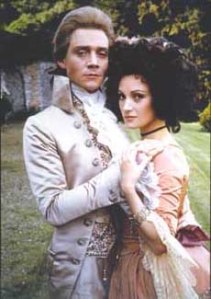
I first became acquainted with this novel when I saw the BBC film several years ago starring Hugh Dancy as Daniel, Romola Garai as Gwendolen, and Hugh Bonneville (currently of Downton Abbey fame) as Grandcourt. I think it was one of the first period dramas I ever saw, and except for too many shots of Gwendolen’s cleavage, I was enamored with movie. I just watched it again this week on Netflix and I was less so. The filmmakers were attentive to many details, such as Daniel’s tendency to grasp his coat high near the collar and Grandcourt’s to keep a thumb and forefinger in one pocket, and many lines and scenes are taken straight from the book. But they turned Daniel and Gwendolen’s relationship into more of a romance, almost an adulterous one, and changed some scenes and lines in others (such as Gwendolen’s visit to Mirah). I still enjoyed the film, though not as much as I would have without the changes, and it does follow the overall structure of the book, but of course it condenses it.

I listened to much of the book via audiobook, and Nadia May’s reading and accents were delightful. But some of the philosophical parts were harder to comprehend without pondering the words in print, so I referred often to the free (at this time) e-book version as well.

I’m thankful to Heather at Do Not Let This Universe Forget You for choosing Daniel Deronda for Carrie’s Reading to Know Book Club for August. I enjoyed the journey!

(This will also be linked to Semicolon‘s Saturday Review of Books.)

What’s On Your Nightstand: August 2013

What's On Your NightstandThe folks at 5 Minutes For Books host What’s On Your Nightstand? the fourth Tuesday of each month in which we can share about the books we have been reading and/or plan to read.

It has been a long and busy summer, but thankfully there have been pockets of time to read. Here’s what I’ve been reading since the last Nightstand post and what I plan to read next.

Since last time I have completed:

The Last Battle by C. S. Lewis for Carrie‘s Chronicles of Narnia Reading Challenge, reviewed here.

The Fruitful Wife by Hayley DiMarco, applying the fruit of the Spirit specifically to marriage, but it had so much and I felt I had only grasped a handful of it, so I’m going back through the chapters and outlining them. I hope to review it later this week or early next week.

The Hidden Art of Homemaking by Edith Schaeffer, reviewed here.

Invisible by Ginny Yttrup, reviewed here. Good!

The Wedding Dress by Rachel Hauck, reviewed here. Meh.

Gulp: Adventures on the Alimentary Canal by Mary Roach, reviewed here. Interesting, funny in parts, unnecessarily vulgar in a few places.

The Incorrigible Children of Ashton Place, Book III: The Unseen Guest by Maryrose Wood, audiobook, not reviewed. It had all the elements I loved from Book I and Book II, with some new information about the children’s backgrounds, but it had the negative element of a seance.

I’m currently reading:

Daniel Deronda by George Eliot for Carrie’s Reading to Know Book Club for August. Enjoying it very much, but I’m going to have to step on it to finish by the end of the month!

On Distant Shores, brand new from Sarah Sundin.

Overcoming Overeating by Lisa Morrone

Next up:

The Boy in the Striped Pajamas by John Boyne. I have been wanting to read this for a long time.

Lost and Found by Ginny Yttrup

Jennifer: An O’Malley Love Story by Dee Henderson

I hope you have had a good reading month as well!

Bookish fun

813359_book_stack_4.jpgI saw this over at Joyful Reader, who found it at Two weeks from everywhere, and it looked like a fun thing to do. I haven’t done this kind of thing in a while. All links are to my thoughts or reviews.

1. Favorite childhood book?  Little Women by Louisa May Alcott

2. What are you reading right now?  The Fruitful Wife by Hayley DiMarco (actually for the second time in a row. I finished it, but it was so full and I didn’t feel I had really grasped a fraction of it, so I am going back and outlining the chapters), Daniel Deronda by George Elliot, and Overcoming Overeating by Lisa Morrone.

3. What books do you have on request at the library?  None at the moment

4. Bad book habit?  Probably buying too many. 🙂

5. What do you currently have checked out at the libraryGulp! by Mary Roach

6. Do you have an e-reader?  I have a Kindle app on my HP tablet and iPhone. It took some getting used to, and I still prefer an actual paper book, but I have enjoyed some electronically. I especially enjoy finding free or very inexpressive e-books!

7. Do you prefer to read one book at a time or several at once?  I usually have 2, sometimes 3 going at once.

8. Have your reading habits changed since starting a blog?  My To Be Read list has grown quite a bit longer! And I probably read things I might not have otherwise because I saw them recommended.

9. Least favorite book you read this year (so far)?  Probably The Duet by Robert Elmer. It was not a bad book at all – I just couldn’t engage with the characters. I loved his Wildflowers of Terezin, though.

10. Favorite book you’ve read this year?  The Secret Thoughts of an Unlikely Convert by Rosaria Champagne Butterfield.

11. How often do you read out of your comfort zone?  Occasionally, usually if a book is highly recommended by someone whose judgement I trust or if the subject matter is really interesting to me.

12. What is your reading comfort zone?  Christian fiction, biographies, classics.

13. Can you read on the bus?  I haven’t had occasion to in many years, but the last time I tried it I could. I can read in the car as well, thankfully. I am not a good traveler and reading is the only thing that makes it endurable.

14. Favorite place to read? Curled up on the couch with a throw blanket and something to drink.

15. What is your policy on book lending?  I don’t mind lending books out generally, but you have to be prepared that something might happen to it or you might not get it back. For that reason I might not lend one that wasn’t easily replaceable or had sentimental value or that I had a lot of notes in that I wanted to keep.

16. Do you ever dog-ear books?  Rarely.

17. Do you ever write in the margins of your books?  Sometimes.

18. Not even with text books?  Textbooks were my most marked-up books.

19. What is your favorite language to read in?  English – I can’t read any other language.

20. What makes you love a book?  That would take a while to answer…but I guess I’d say I have to really connect with it in some way. Sometimes it is the plot, sometimes one of the characters, sometimes beautiful writing, with the best  books connecting all of those.

21. What will inspire you to recommend a book? Probably any of the elements mentioned above, or if it is non-fiction, if I found it helpful and truthful.

22. Favorite genre?  Christian fiction when it is good.

23. Genre you rarely read (but wish you did)?  I can’t think of any I wish I did read more of. There are some I don’t read and have no intention of ever reading.

24. Favorite Biography?  That’s a hard one – I have several favorites. But the top ones would be Amy Carmichael of Dohnavur by Frank Houghton, By Searching and In the Arena by Isobel Kuhn, and Climbing by Rosalind Goforth.

25. Have you ever ready a self help book?  Oh, sure.

26. Favorite cookbook?  My old faithful falling-apart Betty Crocker cookbook that I have used for 30+ years and the church cookbook put together at our last church.

27. Most inspirational book you’ve read this year (fiction or non-fiction)? Through Gates of Splendor by Elisabeth Elliot.

28. Favorite reading snack?  I don’t usually snack while reading, because I don’t want to get food stains on my books, but I usually do have either a cup of decaf coffee or a decaf Diet Coke nearby.

29. Name a case in which hype ruined your reading experience.  I know I have had that experience, but at the moment I can’t think of any particulars.

30. How often do you agree with critics on a book?  I don’t usually read the critics, but I do peruse Amazon.com reviews as well as that of several bloggers I follow.

31. How do you feel about giving bad/negative reviews?  I feel it is important to give an honest review, whether it is good or bad, both as a matter of character and because people have told me they have bought a book on my recommendation, so I feel a heavy responsibility in what I say about a book. I don’t usually read books that I am expecting to review negatively, but if I find something that troubles me, I feel compelled to mention it, and my readers can take that information and make their own decisions.

32. If you could read in a foreign language, which language would you choose?  I don’t know – I really have no desire to learn a foreign language, despite all the reasons I have heard for doing so. Probably Greek, as I’d love to read the New Testament in its original language.

33. Most intimidating book you’ve ever read? The unabridged Les Miserables just because of its size, but I loved it.

34. Most intimidating book you’re too nervous to beginWar and Peace or Crime and Punishment. I have heard both are good and not as hard to read as one might think.

35. Favorite poet?  Hmmm…probably Robert Frost or Edgar Allen Poe.

36. How many books do you usually have check out of the library at any given time?  1

37. How often have you returned a book to the library unread?  Not often.

38. Favorite fictional character?  Oh wow. That is a hard one. Maybe Aslan. Or Jean ValJean in Les Miserables. Or Mr. Peggoty, the old fisherman in David Copperfield. Or…

39. Favorite fictional villain?  Javert in Les Miserables.

40. Books I’m most likely to bring on vacation?  Just whatever I am reading at the time, but probably Christian fiction or biographies rather than non-fiction or older classics with older language styles that require more concentration.

41. The longest I’ve gone without reading. I’ve not gone more than a few hours without having read something, but I’ve gone a day or so without dipping into whatever book I am currently in.

42. Name a book that you could/would not finish. The Shop on Blossom Street by Debbie Macomber. I’ve seen bloggers mention this name for years and I finally decided to check out one of her books. I had to put this one aside due to quite explicit sexual content. I had no idea that would be in a story about ladies coming together over knitting! Very disappointing as I have seen a lot of bloggers favorably mention her books and they look so good.

43. What distracts you easily when you’re reading?  Other people talking or playing videos on their electronic devices.

44. Favorite film adaptation of a novelAnne of Green Gables and The Lion, the Witch, and the Wardrobe.

45. Most disappointing film adaptation? Anne of Green Gables: The Continuing Story.

46. The most money I’ve spent in the bookstore at one time?  Several hundred dollars – but that was not for myself. 🙂 That was when I was in charge of buying items for our church’s mission closet. For myself – I don’t really know. Maybe upwards of $75…or more….on occasion…

47. How often do you skim a book before reading it?  I will usually skim the table of contents and occasionally look at a page or two ahead of time with non-fiction, but I don’t want to ruin the surprise of fiction.

48. What would cause you to stop reading a book half-way through?  Bad language or illicit sexual scenes. Otherwise, if the writing is poor or the characters uninteresting, I keep hoping it will get better and usually persevere til the end.

49. Do you like to keep your books organized?  Yes, they are organized by genre and some genres are organized by author name or subject.

50. Do you prefer to keep books or give them away once you’ve read them? I prefer to keep them, but one only has so much room, so I have to be discriminating about what I keep.

51. Are there any books you’ve been avoiding?  I don’t know if I’d use the word avoiding. I haven’t gotten into the Harry Potter books because I just have no interest in them and have stacks of books I do want to read. If my kids had been interested in them I probably would have read them.

52. Name a book that made you angry. There was a book we checked out from the library when my kids were younger that was like a New Age allegory complete with a personal note from the “spirit guide” in the back. Much of it was subversive, and I wanted to destroy it.

53. A book you didn’t expect to like but did? I can’t say I liked The Picture of Dorian Gray per se, but it was fascinating in some respects, and though it wasn’t meant as a book to draw lessons from, I did glean many pertinent observations.

54. A book that you expected to like but didn’tIntroverts in the Church by Adam McHugh. I did glean many good things from it, but I expected to thoroughly love it, and instead I found many things that troubled me or that I could not endorse.

55. Favorite guilt free, pleasure reading?  I think about all of my reading could be described that way.

Wow….that was a long meme and took a lot longer to do that I thought it would. But if you decide to do it, too, let me know and I’ll come read your answers.

(Graphic courtesy of the stock.xchng)

Book Review: Invisible

InvisibleI sought out Invisible by Ginny Yttrup because I dearly loved her first novel, Words: it was one of my favorite books of 2011.

Invisible tells the story of three very different women who become friends. Normally I don’t just copy the publisher’s description of a book, but in this case it seemed the fullest yet the most concise way to sum them up:

Ellyn DeMoss — chef, café owner, and lover of butter — is hiding behind her extra weight. But what is she hiding? While Ellyn sees the good in others, she has only condemnation for herself. So when a handsome widower claims he’s attracted to Ellyn, she’s certain there’s something wrong with him.

Sabina Jackson — tall, slender, and exotic — left her husband, young adult daughters, and a thriving counseling practice to spend a year in Northern California where she says she’s come to heal. But it seems to Ellyn that Sabina’s doing more hiding than healing. What’s she hiding from? Is it God?

Twila Boaz has come out of hiding and is working to gain back the pounds she lost when her only goal was to disappear. When her eating disorder is triggered again, though she longs to hide, she instead follows God and fights for her own survival. But will she succeed?

Though two of the characters have issues pertaining to weight, the book is not about weight: it’s about what it means to be made in the image of God and what the implications of that are in our lives. Each character has to learn that we don’t do certain things outwardly in order to be made in the image of God: we already are. And when rightly understood, that truth permeates our being and affects our thinking and then our outward actions.

I don’t want to reveal much more about the plot than that. Though the book didn’t grab me from the first page and not let go like Words did, it still provided much food for thought and I enjoyed it.

The character I liked the most was Miles, friend to all three main characters and potential love interest of one. His walk with God and the way he sought His guidance in everyday life was very realistic to me. This is one reason I love Christian fiction: this is the missing element, the ultimate reality missing in secular stories, no matter how good they are. Sometimes people accuse Christian fiction of being a sermon disguised as a story or a story with spiritual bits put in in order to make it “Christian,” but neither is the case in Ginny’s work (or even of the great majority of Christian fiction I’ve read.) Her characters are genuine (if sometimes a bit unconventional, in the case of Twila), and though there is spiritual truth she is trying to convey, each character grapples with it in a natural and realistic way.

Here are a few quotes that stood out to me from the book:

“I’ve learned enough through the years that when God is silent, it’s my cue to hold on tight. Do nothing. Wait on Him” (p. 49).

“When I pass from the discomfort of need to the tranquility of satisfaction, the very transition contains for me the insidious trap of uncontrolled desire. Augustine” (p. 168).

“I have forgiven him and I will forgive him again. But I won’t allow him to use me or mistreat me” (p. 262).

“Oh, Lord, remind me that this confrontation is an act of love and respect for both myself and my mom. It is not retaliation for years of pain” (p. 310).

There were just a couple of things that bothered me to a degree. One was Twila’s worship experience (pp. 166-167), which seemed a little New Age-y to me but would probably be called contemplative (which I don’t know a lot about yet but am not a fan of what I do know). The other was Ellyn asking if a dress had too much cleavage and Sabina telling her it was “lovely and appropriate” (p. 326). In my book no amount of cleavage is appropriate for anyone other than one’s husband in private.

But with those caveats, this is a book I am happy to recommend.

(This will also be linked to Semicolon‘s Saturday Review of Books.)

Book Review: The Last Battle

Last BattleThe Last Battle is the last book in the Narnia series by C. S. Lewis. It opens with a false Aslan: a confused donkey coerced to wear a lion skin by a conniving ape, who in turn is being controlled by others. In Aslan’s name, talking beasts are turned into slaves, dryads are dying because their trees are being cut down, Calormenes are overseers. Strange things are afoot, everything seems not quite right to everyone, but Aslan is not a tame lion, after all, so his ways will of course be a little different, and they think they must obey.

King Tirian sees at once that something is wrong, but he sets off rashly without thinking and winds up in trouble, He calls out for help, and Eustace and Jill show up. Together with the few Narnians who don’t believe in the false Aslan, they wage a last battle to save Narnia.

Even though the Narnia series is not an allegory per se, it’s still not hard to see the Biblical allusions to the end times and the antichrist. In Narnia as on Earth, things will get much, much worse before the end comes. And “Aslan’s country” has always typified heaven. All the beasts and creatures and people going “further up and further in” to Aslan’s country, the joyful reunions with those who have gone before, the sense that “this is what I have been seeking and waiting for my whole life” are the best parts of the books to me.

I think this time through the series, that is most what I have carried away with me: that longing, as in the song “Beulah Land”: “I’m kind of homesick for a country where I’ve never been before.” I have to admit that too often I am caught up with the joys and cares of this life. I look forward to having no more sin, sorrow, suffering, and tears some day, but I don’t always carry that personal longing just to be with Christ there, and this series as a whole stirs up that longing for Narnia and Aslan that all who visit experience while they’re away. It calls to mind Biblical texts like Hebrews 11:16: “But now they desire a better country, that is, an heavenly: wherefore God is not ashamed to be called their God: for he hath prepared for them a city,” and Colossians 3:1-2: “If ye then be risen with Christ, seek those things which are above, where Christ sitteth on the right hand of God. Set your affection on things above, not on things on the earth,” as well as Lewis’s own words from Mere Christianity: , “If I find in myself a desire which no experience in this world can satisfy, the most probable explanation is that I was made for another world…I must [therefore] keep alive in myself the desire for my true country, which I shall not find til after death.”

There is sadness for those who choose not to believe, such as the dwarves who are only for the dwarves and refuse to be “taken in.” As Aslan says, “They will not let us help them. They have chosen cunning instead of belief. Their prison is only in their own minds, yet they are in that prison, and so afraid of being taken in that they cannot be taken out.” Unfortunately there will be people like that as well.

There is a point of confusion with the Calormene Emeth, who served the Calormene god Tash, yet is admitted to Aslan’s country, not because Tash and Aslan are one, as some tried to proclaim (Aslan shook the earth with his growl at the very thought), but because Aslan took to himself everything Emeth had done for Tash. For, he says, “he and I are of such different kinds that no service which is vile can be done to me, and none which is not vile can be done to him. Therefore if any man swear by Tash and keep his oath for the oath’s sake, it is by me that he has truly sworn, though he knew it not, and it is I who reward him. And if any man do a cruelty in my name, then, though he says the name Aslan, it is Tash whom he serves and by Tash his deed is accepted…unless thy desire had been for me thou wouldst not have sought so long and so truly. For all find what they truly seek.” I don’t know how much of this reflects Lewis’s personal belief system, but I can’t endorse the idea that someone sincerely serving and seeking a false God is really serving the one true God unaware.

A couple of my favorite quotes:

“I have come home at last! This is my real country! I belong here. This is the land I have been looking for all my life, though I never knew it til now. The reason why we loved the old Narnia is that it sometimes looked a little like this.”

“Your father and mother and all of you are – as you used to call it in the Shadowlands – dead. The term is over: the holidays have begin. The dream is ended: this is the morning.”

It was only the beginning of the real story. All their life in this world and all their adventures in Narnia had only been the cover and title page: now, at last they were beginning Chapter One of the Great Story which no one on earth has read, which goes on forever.”

I have to thank Carrie for sponsoring the Chronicles of Narnia Reading Challenge, which spurred me on to revisit the series. I’ve so enjoyed being in Narnia again! I also marvel at how someone with an intellect as large and complex as Lewis’s can write something simple enough for children to understand yet engaging to adults, too, with such nobility and depth and beauty.

Here are my posts from the whole series:

The Lion, the Witch, and the Wardrobe
Prince Caspian
Voyage of the Dawn-Treader
The Silver Chair
The Horse and His Boy
The Magician’s Nephew
The Lion, the Witch, and the Wardrobe Graphic Novel.
The Way Into Narnia
Narnian Magic.

Chronicles of Narnia Reading Challenge

(This will also be linked to Semicolon‘s Saturday Review of Books.)

What’s On Your Nightstand: July 2013

What's On Your NightstandThe folks at 5 Minutes For Books host What’s On Your Nightstand? the fourth Tuesday of each month in which we can share about the books we have been reading and/or plan to read.

Wow, it’s been another super busy month. Here’s what I’ve been reading and plan to read next.

Since last time I’ve finished:

Through Gates of Splendor, by Elizabeth Elliot, a missionary classic about the lives and deaths of Jim Elliot, Nate Saint, and their three friends who tried to reach a savage tribe in Ecuador, for Carrie’s Reading to Know Book Club for June, reviewed here.

The Hidden Art of Homemaking by Edith Schaeffer along with Cindy at Ordo Amoris who is hosting a read-along book club where we discuss a chapter at a time. My discussions are here.

The Incorrigible Children of Ashton Place, Book II: The Hidden Gallery by Maryrose Wood, reviewed here, another fun one.

The Magician’s Nephew by C. S. Lewis for Carrie‘s Chronicles of Narnia Reading Challenge, reviewed here.

Light From Heaven by Jan Karon, last of the Mitford series, via audiobook. I summed up all the Mitford books here.

I’m currently reading:

The Last Battle by C. S. Lewis for Carrie‘s Chronicles of Narnia Reading Challenge

The Fruitful Wife by Hayley DiMarco.

The Wedding Dress by Rachel Hauck.

Next up:

Invisible by Ginny Yttrup.

On Distant Shores, hot off the press by Sarah Sundin.

Gulp: Adventures on the Alimentary Canal by Mary Roach.

Daniel Deronda, by George Eliot for Carrie’s Reading to Know Book Club for August.

If I should finish those, I have others lined up and just have to decide which to delve into. 🙂

What’s on your nightstand?