The Middle Matters

I’ve often thought that the “middle-aged spread” refers not to an expanding waistline, but to the number of years we claim middle age. Because what’s next after middle age? Old? Elderly? We need some designation between the middle and the end.

At any rate, even though I’m on the far side of middle age, Lisa -Jo Baker’s book caught my eye when it was on sale for the KIndle app: The Middle Matters: Why That (Extra)Ordinary Life Looks Really Good on You. I had heard Lisa Jo’s name but never read her, and I’ve not often seen books for this stage of life.

Lisa-Jo discusses the impact of our middle years in eight areas: our bodies, marriage, parenting (which gets two chapters), our homes, failures, friendship, and faith. “Discusses” is probably too formal a word. Each topic is addressed in three to seven essays. Lisa-Jo writes in a breezy chatting-with-girlfriends style.

It’s hard to summarize a series of essays, so I’ll just give you some samples.

One of my favorite chapters is “When You Think Your Love Story Is Boring.” The epigraph of this chapter comes from a teenager quoted in Huffington Post who feels her love life will never be adequate “until someone runs through an airport to stop me from getting on a flight.” Lisa-Jo shares many examples of love demonstrated in the everyday rather than the once-in-a-lifetime grand gesture.

He lays down his life, and it looks like so many ordinary moments stitched together into the testimony of a good man who comes home to his family driving the old minivan, the one with the broken air-conditioning (p. 40).

And this is a love life: to live each small, sometimes unbearably tedious moment… together. To trip over old jokes and misunderstandings. To catch our runaway tongues and tempers and tenderly trust them to the person who now knows firsthand our better and our much worse (p. 41).

He’s never run through an airport for me. But he goes to Walmart at 9: 30 p.m. for back-to-school supplies that we’ve had all summer to get and of course have left till the last minute. When he walks into the living room at 11: 00 p.m. with bags full of the obligatory red, green, yellow, and blue folders and all the million pre-sharpened number-two pencils, it’s the sexiest thing I’ve seen all week (p. 41).

Another chapter that I loved told of a joyous night with Lisa-Jo’s daughter’s triumph in a school program. When Lisa-Jo looked at the photos taken that evening, first she saw the joy. Then, looking more closely, she noticed a picture of her “generous muffin top bulging over her jeans as she presses up next to her daughter” (p. 26). Instead of being embarrassed or deleting the photo, she decided “There was too much happiness to ever diminish it by worrying about waistlines” (p. 26).

In “What You Don’t Know About Parenting,” Lisa-Jo tells of a time her daughter was in another program, where she struggled with what Lisa-Jo thought was pre-program jitters which would be fine once the performance started. But her daughter had full-blown stage fright, tears streaming as she danced her part. Lisa-Jo struggled with indecision as to the best course of action—sweeping her daughter off the stage or letting her finish. “I don’t know if we can ever actually protect our kids from their own fears. Maybe all we can do is show them how brave they are to face them” (p. 90). After the program was over and everything settled down, Lisa-Jo called her mother-in-law to pour out her heart.

And as mothers have always done, she listened and loved me and then encouraged me with the deep understanding born of her own lifetime of learning what you don’t know by simply walking through it. This is what we mothers do for each other—we offer our own failures as proof that our sisters and daughters, our nieces and grands, will make it through the perilous journey of mothering too. Because no matter how many books you read or podcasts you listen to, nothing can prepare you for the fall you weren’t expecting (p. 91).

When heroes fall, Lisa-Jo wants her children to know, “fame is not where we go when we’re looking for something to believe in. Neither is the pulpit nor the soccer field, nor the stage nor the movie studios, for that matter. . . . power and influence and fame can be a slippery, lying slope” (p. 95).

When her son wants to race in the Olympics:

When they ask you if you believe that they’ll make their way to the Olympics someday, what do you—that mother behind the steering wheel who can’t see the future—tell your son?

Do I really want to be the anchor here holding him back? How do I cheer for him while also being a plumb line for truth? (p. 163).

Concerning a twice-monthly potluck hosted at her home: “Some weeks I look forward to it. Some weeks I’m exhausted at the thought of it. But we just keep opening the door no matter how we feel” (p. 136).

A couple more quotes:

Sometimes friendship is a deep conversation. Sometimes it’s a shared ugly cry. But sometimes friendship is the gift of not being afraid of silence (p. 204).

I don’t have easy answers to the hard questions, whether they’re on the news or coming from your doctor or your kid’s teacher or your coworker or a dear friend. I have only the hope of a hand in mine. The hand of this man, Jesus, who isn’t afraid and who builds things that don’t sink (p. 242).

I enjoyed this book and found it very easy to read. Lisa-Jo definitely has a way with words and weaves them with humor and poignancy. Some reviewers felt the book was more of a memoir or only appealed to women in the exact same stage of life–forty-something, married with kids. But I benefited from it even though I am an older empty-nester. Even though Lisa-Jo’s style is not didactic, readers can learn much from what she shares.

(This book will count for the Nonfiction Reader Challenge, where I am doing the Nonfiction Grazer track of basically doing my own thing. 🙂 But this would also fit in the “Linked to a Podcast” category a of the challenge since Lisa-Jo has a podcast [which I have not yet listened to] with Christie Purifoy called Out of the Ordinary.)

Framley Parsonage

Framley Parsonage is the fourth of Anthony Trollope’s Barsetshire Chronicles.

The story opens with Mark Robarts, boyhood friend of Ludovic Lufton. Lady Lufton, Ludovic’s mother, thinks Mark would make a fine vicar. So she pays for his training, gives him the living connected with Framley, and even finds a wife for him.

Mark is grateful for Lady Lufton’s graciousness to him, but he wants his own way occasionally. The one area he steps outside of Lady Lufton’s preference is in his friendships. He feels that to move up in the world, he needs to seek our relationships with some from higher society, introduced to him by Ludovic. Lady Lufton feels that these associates are not of high moral character, beside their being opposite from her politically. Nevertheless, Mark feels, and convinces his wife, that he needs to move in the circles of the elites.

It’s not long before Mark gets into trouble. He realizes that these people do not have the same values he has. But then he gets himself entangled in a mess when a Mr. Sowerby urges him to sign a bill for him (essentially to cosign a loan). Mark knows he doesn’t have the money to pay the bill if it should come to him, and he knows Sowerby has an awful reputation for running up debts. Yet Mark lets himself get talked into signing the bill.

Another plot line involves Mark’s sister, Lucy. When their father dies, Mark and his wife, Fanny, take Lucy into their home. Ludovic tries to draw out the quiet young women and soon becomes attracted to her. But his mother has another bride in mind for him—the statuesque beauty, Griselda Grantly, daughter of the archdeacon. Ludovic accommodates his mother by dancing with Griselda, but he finds her cold.

As these two plot lines develop and intersect, a few subplots wind in and out as well: a political falling out, a severe parson “proud of his poverty” whose family needs help that he won’t accept, two mothers trying to one-up each other in the choice of their daughters’ suitors, and even a visit from Dr. Thorne, the main character from the previous book in the Barsetshire Chronicles which bears his name.

It took me a little while to get into this story. I was not much interested in the political aspect and got irritated by Mark’s lack of backbone. But when his circumstances began to catch up with him and affect him, I began to sympathize with him more. Lucy was my favorite character, and I loved her story. The book has a heart-warming ending, with even Lady Lufton seeming more human and less severe.

Trollope continues to have his narrator speak as one of the community, though he never inserts himself into any of the scenes. The narrator also often breaks the “fourth wall” to speak directly to the reader.

Some of my favorite quotes:

It includes two populous villages, abounding in brickmakers, a race of men very troublesome to a zealous parson who won’t let men go rollicking to the devil without interference (p. 93).

I know it will be said of Lord Lufton himself that, putting aside his peerage and broad acres, and handsome, sonsy face, he was not worth a girl’s care and love. That will be said because people think that heroes in books should be so much better than heroes got up for the world’s common wear and tear. I may as well confess that of absolute, true heroism there was only a moderate admixture in Lord Lufton’s composition; but what would the world come to if none but absolute true heroes were to be thought worthy of women’s love? What would the men do? and what—oh! what would become of the women? (p. 136).

She confessed to herself that Griselda’s chance of a first-rate establishment would be better if she were a little more impulsive. A man does not wish to marry a statue, let the statue be ever so statuesque (p. 164).

She was so glad she knew it, that she might comfort him. And she did comfort him, making the weight seem lighter and lighter on his shoulders as he talked of it. And such weights do thus become lighter. A burden that will crush a single pair of shoulders will, when equally divided—when shared by two, each of whom is willing to take the heavier part—become light as a feather. Is not that sharing of the mind’s burdens one of the chief purposes for which a man wants a wife? For there is no folly so great as keeping one’s sorrows hidden (p. 218).

To endure with her lord all her lord’s troubles was easy to her; it was the work to which she had pledged herself. But to have thought that her lord had troubles not communicated to her,—that would have been to her the one thing not to be borne (p. 218)

So he went his way . . . thinking as he went which was most unreasonable in her wretchedness, his friend Lady Arabella or his friend Lady Scatcherd. The former was always complaining of an existing husband who never refused her any moderate request; and the other passed her days in murmuring at the loss of a dead husband, who in his life had ever been to her imperious and harsh, and had sometimes been cruel and unjust. (p. 254).

Wounds cannot be cured as easily as they may be inflicted (p. 271).

At the time of this writing, the Kindle edition of this book was free and the Audiobook was included as part of my Audible subscription. I mostly listened to the audiobook wonderfully read by Simon Vance, but I read a few parts in the Kindle edition.

I’m counting this book for the Classic from the 19th century category for the Back to the Classics Reading Challenge.

Laudable Linkage

IMG_0195

Once again, I’m behind on my blog-reading due to a busy week. But here are a few noteworthy reads:

A Special Valentine Invitation: Will You Be Mine? “Many of us have experienced both highs and lows when it comes to love and special valentine invitations.But the most lavish, epic, and monumental Valentine’s Day to ever take place in history, celebrates the best kind of love—God’s extravagant love.”

All This Wasted Worry, HT to Challies. “A few months ago, I was about to begin onto one of my nighttime worry rituals. There was a flight the next day, and I pictured myself gripping the armrest tightly throughout the flight like I always do—as though holding the armrest with all my might somehow keeps the plane in the air. And I laughed because there isn’t anything as ludicrous as believing that one’s white-knuckled grip on a piece of plastic in economy seating has anything to do with keeping an airplane in the sky.”

The Education of Whoopi Goldberg and Race in Christian Culture. “Whoopi Goldberg was suspended two weeks from The View for stating on air that the holocaust was not about race. . . Personally, I am not sure she should have been suspended. What she said was ignorant and insensitive, but such statements do foster discussion, education, and eventually enlightenment. If we constantly penalize one another for saying stupid things, we will eventually stop talking with one another altogether.”

How Did the Apostle Paul Stand for His Rights? “As we’ve discussed religious liberty in recent months, several people said something along these lines to me, ‘Didn’t Paul stand up for his rights when the Romans threatened him?’ This is a fair question since Paul did use his Roman citizenship on two occasions when interacting with representatives of the government. Let’s look at both incidents and think about how Paul went about this.”

On Christians Reading Fiction: Stealing Past the Watchful Dragons. This is the first in a series about the value to Christians of reading quality fiction. I especially like the last reason given here, and I’m looking forward to the rest of the series.

An 8-year-old slid his handwritten book onto a library shelf—and now it has a yearslong waitlist, HT to Linda. I love that the library staff’s reaction.

Do you remember Irene Ryan, who played “Granny” on The Beverly Hillbillies? It’s hard not to think of her as perpetually Granny, because that’s the only way we ever saw her. I’m not sure why, but a couple of videos of her were in my YouTube suggestions. This was from one of her early films. The other was a pre-Granny episode of Password against fellow actor Bob Crane of Hogan’s Heroes. I also just recently learned that she was only five years older than co-star Buddy Ebsen, who played her son-on-law, Jed.

Happy Saturday!

Book Review: The Road Home

In Malissa Chapin’s debut novel, The Road Home, Cadence Audley has started a new life with a new name—for the second time. Her past has dogged her steps, but she’s determined to lead a quiet, peaceful life in Deercrest, Wisconsin. She’s found a good job as a barista with a great boss. Antique stores in the area fulfill her taste for vintage purchases.

On one such shopping trip, Cadence finds an old recipe box filled with hand-written recipes. Her coworker Googles the name written inside the box and found that the owner had lived in town. Thinking to return a valued heirloom, Cadence finds Fredonia, the middle-aged daughter of the recipe box owner. Fredonia had donated the recipe box in the first place and is not thrilled to see it again—or Cadence, for that matter. But, upon learning that Cadence likes antiques, Fredonia invites the younger woman to drive with her to Kentucky to help clean out her mother’s home.

Fredonia’s offer comes just in time, because Cadence’s past has caught up with her—again.

This is a split-time novel. The second timeline belongs to Ida Beale Evans, owner of the recipe box. She had been a banker’s daughter in Indiana when she married her sweetheart, Bud, and moved with him to his new pastorate in Kentucky. Though she enjoys life as a country preacher’s wife, she has one sorrow. Suddenly one night, her deepest desire is unexpectedly fulfilled—but to keep it will call for a lifetime of secrecy.

Though Ida is a Christian and Cadence is not, both women struggle with trusting that the truth will set them free. The truth seems like it will destroy them. But Cadence has come to the end of her road. Can she escape and start over yet again? Or must she face her past and its consequences, even though doing so means losing everything she holds dear? Can she trust the young preacher who tells her, “Your sin caused problems everywhere, but God is bigger than this. He’s big enough to help you live a new life” (Location 3415, Kindle version).

I enjoyed following the journey of both women and the truths they learned. I also enjoyed the sense of place in the book, especially the Kentucky sections. There was a nice mix of both funny and poignant moments in the story. Sprinkled throughout the book are recipes from Ida Beale’s box. It was fun to learn on Malissa’s blog what inspired the pink Cadillac road trip in the book and to peruse her Pinterest board for the people and items that inspired or contributed to the story.

As of this writing, the Kindle edition is $2.99, but a paperback version is also available.

Book Review: Half-Finished

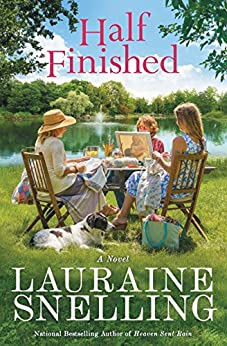
In Lauraine Snelling’s novel, Half Finished, two friends get fed up with all their half-done craft projects and decide to do something about it. One, Roxie, had heard about UFO clubs—not for discovering alien life, but for finishing UnFinished Objects, or projects in their case. They discuss the idea with a few other friends and decide on a time to meet together with each choosing one project to work on while they meet.

As word of the UFO club spreads, more people want in on it—because who doesn’t have unfinished projects of some kind. Soon there are morning and evening clubs at several different locations. Even some of the men get it on the meetings.

But the clubs grow beyond projects. Relationships form and people band together to help each other through the sorrows and joys they encounter.

Lauraine said in her afterword that the book was inspired by such a UFO club in her own town. And this story brought up fond memories of a group of women who did something similar in my early married days. We didn’t focus on unfinished projects—though that’s what they were. But it wasn’t a matter of projects that had been lying around for years. We were too young to have many like that. We just met to spend some time fellowshipping while working on our various projects. We’d rotate houses, and ladies would take turns bringing snacks. I always felt we were a little inspired by the sisters in the Little Women sequels, who would meet together and visit with each other while doing their mending. I was sorry to see our group disbanded after a while: I think some of the ladies felt guilty spending time working on crafts during the day.

The beginning of the book was hard to get into: it was very busy. There were so many characters, they and their families were hard to keep straight. Plus the pages seemed to be stuffed with unnecessary details. For instance, there was one paragraph all about one woman’s two credit cards and which she used for what and why she was using the one she did for a purchase that day. Unless something about the credit cards was going to come up later in the story, there was no need to know any of that, or even that she paid for the purchase with a credit card. I don’t remember seeing that kind of thing in any of Lauraine’s other books.

But once the narrative settled down into a few of the main characters’ stories, the book became more enjoyable. There’s Roxie, a widowed real estate agent and a founding member of the UFO club. She has a grown daughter, Loren, who lives with her. Fred and Ginny own a farm and share their bounty with others. Their son and his family live nearby, and they enjoy getting together often. Their granddaughter, Addy, is an expert cookie baker. Amalia is one of my favorite characters: she is widowed and sold her own farm to live in senior apartments. But, even though she couldn’t keep up with the farm alone, she’s still able-bodied and mentally sound. She spends her days helping out some of the other seniors with physical needs or her friends.

One of the themes of the book is that we’re all half-finished projects. We’re all in a state of growth. So we need to be patient with ourselves and each other, but we also need to keep growing and learning.

The Writer’s Desk

I saw The Writer’s Desk by Jill Krementz mentioned by literary agent Wendy Lawton at the Books and Such blog. I was able to find a used copy at Amazon for around $6. I’ve enjoyed leafing through it the past few days.

The book is made up of large black and white photos of over 50 writers at their desks. Alongside each photo is a paragraph or two from the writer about his or her workspace, style, routine, etc.

It’s interesting to see the wide variety of styles, routines, and even dress. Some of the men came to their desks with sports jackets and ties. James Michener preferred very loose tee shirts and shorts so he was unimpeded as he worked.

The work space for some was clean and sparse. Many had very cluttered desks and offices.

Some had a routine; others were more free form in style.

Some needed absolute quiet and solitude; some were able to concentrate in the midst of everyday family life.

Some wrote longhand, some used a typewriter, others a computer. The book was published in 1996, and some of the pictures are much older. I don’t know how many chose pencils or typewriters instead of computers or just because that’s what was available in their day.

I loved many of the insights:

John Updike writes “by hand, when the fragility of the project—a poem, the start of a novel—demands that I sneak up on it with that humblest and quietest of weapons, a pencil” (p. xi).

Archibald MacLeish: “I am sure—I mean I am not sure at all but I believe—the master poets must come at their poems as a hawk on a pigeon in one dive. I can’t. I chip away like a stonemason who has got it into his head that there is a pigeon in that block of marble. But there’s a delight in the chipping” (p. 77).

Joseph Heller said many of his ideas come when he’s doing things like walking the dog or brushing his teeth. “I don’t get my best ideas while actually writing” (p. 85).

Isaac Bashevis Singer: “Some writers say that they can only write if they go to a far island. They would go to the moon to write not to be disturbed. I think that being disturbed is a part of human life and sometimes it’s useful to be disturbed because you interrupt your writing and while you rest, while you are busy with something else, your perspective changes or the horizon widens. All I can say about myself is that I have never really written in peace” (p. 91). That’s encouragement for people like me who are easily disturbed.

Saul Bellow: “I think that art has something to do with an arrest of attention in the midst of distraction” (p. 99).

Jill Krementz is the wife of Kurt Vonnegut and the author of several other books. She says in her acknowledgements that many of these excerpts came from George Plimpton’s “Writers at Work” series in his magazine.

Of the 56 authors mentioned here, I had only heard of nineteen and read about six of them. So I took a little bit of time to look up the desks of other favorite authors. I had looked up Louisa May Alcott’s desk after reading the novel The Orchard House, taken from the name of the house Louisa lived in while writing Little Women. It’s hard for me to imagine writing much on such a small area, but it was unusual for a woman to have a desk in those days. Her father made the semicircle desk especially for her. I also enjoyed this view of C. S. Lewis at his desk with his cup of tea nearby and Lucy Maude Montgomery at hers. I stopped there, as this rabbit trail could take hours. But maybe someday I’ll explore some more.

I enjoyed this glimpse of writers’ spaces and styles.

The Other Bennet Sister

If you are a Pride and Prejudice fan, you might remember middle sister Mary Bennet as being bookish and quiet. In fact, the only significant scene of hers I can recall is when she’s playing the piano at the Bingley ball (the one where all the Bennet family comes across as ridiculous in front of Mr. Darcy) to the point that her father has to pull her away with “You’ve entertained us enough for now.”

Janice Hadlow has crafted a novel from Mary’s point of view: The Other Bennet Sister. Hadlow delves more deeply into Mary’s character and what might have been after P&P ended.

The Bennets had five daughters. Mr. Bennets property is entailed, meaning it will go to a male cousin upon Mr. Bennet’s death rather than a Bennet daughter.

Even though the Bennets are landed gentry, there’s not enough money for any of the girls to have large enough dowries to attract the “right” kind of husband. But most of the girls are pretty enough to attract attention, and their ambitious mother is determined to place them where they can be seen and admired.

Mary, however, is plain. In Mrs. Bennet’s book, that’s almost a sin. At the very least, Mary’s plainness is a great disappointment to her mother. Mrs. Bennet is one of the most annoying characters in literature, and one of my least favorite. Mary’s mother not only has little use for Mary, she constantly berates her daughter. “She had learned from Mrs. Bennet that without beauty, no real and lasting happiness was attainable. It never occurred to her to question what she had been taught.” Mrs. Bennet didn’t even want Mary to get needed glasses because they would further hamper her ability to get a husband.

Since Mary doesn’t have the looks or personality to be “pleasing,” and she loves to learn, she sets herself to study in her father’s library. Perhaps at some point she can discuss books with him. But he demands absolute silence in the library—except when Lizzie, his favorite, is there.

Mary tries other venues, like music, in which to stake her significance, with poor results.

Mary is also in the very middle of the five sisters. The older two are close, as are the younger two, leaving Mary with no one. Lizzie and Jane are not unkind, but they don’t draw Mary in, either.

Since Mary feels invisible, she looks invisible as well, wearing very plain dresses with no color or frill.

The first part of the book covers the events of P&P, but from Mary’s point of view.

Then the book jumps ahead a couple of years. Mr. Bennet had died, and all the Bennet daughters are married except Mary. Mary and her mother go to live with Jane and Mr. Bingley. But the days there are dreary for Mary, with her mother’s constant harping and Caroline Bingley’s sniping remarks. Mary goes to visit Elizabeth and Mr. Darcy for a while, then Charlotte (Elizabeth’s close friend) and Mr. Collins, the obsequious cousin who inherited the Bennet family home. Charlotte and Mary have several talks about life as a plain woman.

Single women did not have many options in those days. Spinsters were pitied and often poor, earning money as governesses or music teachers. Mary is not interested in either profession, but living with one of her sisters is not ideal, either.

Finally Mary goes to London to stay with her aunt and uncle, the Gardiners—the same aunt and uncle Lizzie stayed with in P&P. Things start to turn a corner as Mrs. Gardiner gently draws Mary out and convinces her that it is not drawing undue attention to herself to dress nicely. And the Gardiner’s friend, Mr. Hayward, convinces Mary’s very rational mind that poetry and feeling are valuable.

I loved a lot of Mrs. Gardiner’s advice, some of which had a double meaning.

Sometimes the very best stuff can seem quite plain, until one examines it closely. It is only then that one sees its true quality.

I see plainly enough that you don’t like to make a fuss about dress—that you dislike having attention drawn to you. But there are times when the best way to ensure you are not remarkable is to conform to the expectations of those around you.

There is a middle way between an obsession with one’s appearance and an absolute denial of its importance.

It’s hard to persuade anyone, especially a man, that your regard is worth having if you have none for yourself.

In our house, no-one is obliged to sparkle. Which, I find, makes it far more likely that they might.

There were several things I liked about this novel. One is Mary’s slow “blossoming,” often with one step forward and two back as she makes mistakes.

I thought the author did an admirable job keeping the personality of each of Austen’s main characters close to what they were in P&P. Even though Hadlow’s style is different from Austen’s, the book still had a cozy Regency feel to it.

I had two minor complaints, though. One is that, especially in the beginning of the book, there was a lot more “telling” than “showing.” That improved after the story got into new material after the P&P timeline.

The other complaint is that sometimes there was too much explanation. The narrative would belabor a point long after the reader understood.

Those two aspects made the story drag just a little in places, but not enough to ruin the book.

Overall, I really enjoyed this story. I wanted to speed ahead to see how things worked out for Mary, but then I didn’t want it to end. Some parts of the book had me in tears.

I listened to the audiobook wonderfully narrated by Carla Mendonca.

Thanks to Lois for putting this book on my radar.

Be Wise (1 Corinthians)

If there was ever a church full of problems, it was the one in Corinthians in the NT era. The church was divided over their favorite preachers. Blatant immorally was tolerated. They turned the Lord’s Supper into a feast which showed up who had plenty and who did not. They were proud of their gifts.

But Paul didn’t wash his hands of them, at least not without trying to help them first. He wrote them in one letter that we don’t have. They responded with questions, and 1 Corinthians is his answer to them

In Be Wise (1 Corinthians): Discern the Difference Between Man’s Knowledge and God’s Wisdom, Warren W. Wiersbe gives us some insights into Paul’s letter.

Wiersbe points out that “when you have proud people depending on human wisdom, adopting the lifestyle of the world, you are going to have problems. In order to help them solve their problems, Paul opened his letter by reminding them of their calling in Christ” (p. 20, Kindle version). Everything Paul would say to the Corinthians would be couched in and would spring from that truth.

Then Paul thanked God for them and commended them. This was not just a softening in preparation for the hard things he would have to say to them, but a recognition that God was at work in them. That’s a good reminder for us when we tend to have “all or nothing” views about people’s standing with the Lord. The Corinthians had some severe problems and some stern truths which needed to be pointed out, yet there was evidence God was at work in them.

Then Paul addresses the Corinthians issues while also answering questions they had sent him. He discusses their divisions, sexual immorality in the church, their ungodly way of handling disputes with each other, marriage, how to handle differences of opinion concerning food offered to idols, the Lord’s Supper (communion), spiritual gifts, and the resurrection.

All of these issues are vital for us today. Most of the world doesn’t have to deal with food offered to idols, but the principles Paul discusses are helpful with differences of opinions believers face over other issues today.

1 Corinthians also contains classic passages like chapter 13 on godly love (placed, interesting, in the middle of discussion about spiritual gifts) and chapter 15 about the resurrection (which we tend to hear a lot from during funerals, but we need its truths daily.

Paul wraps up his letter, as he often does, with personal greetings, news, travel plans. It’s easy just to breeze past this section, but Wiersbe points out good food for thought here as well. For instance, Paul mentions Apollos, one of the preachers that a “fan club” had developed around. The fact that Paul urged Apollos to go to the Corinthians showed that there was no animosity or competition between the men themselves.

Then Wiersbe gives a brief history of Timothy and Priscilla and Aquilla, who are also mentioned in this section, and how their ministries intertwined with Paul’s.

Here are a few of the quotes in the book that stood out to me:

Paul depended on the power of the Holy Spirit. It was not his experience or ability that gave his ministry its power; it was the work of the Spirit of God. His preaching was a “demonstration,” not a “performance” (p. 35).

To “have the mind of Christ” does not mean we are infallible and start playing God in the lives of other people. Nobody instructs God! (Paul quoted Isa. 40: 13. Also see Rom. 11: 33–36.) To “have the mind of Christ” means to look at life from the Savior’s point of view, having His values and desires in mind. It means to think God’s thoughts and not think as the world thinks (p. 43).

A mature Christian uses his gifts as tools to build with, while an immature believer uses gifts as toys to play with or trophies to boast about. Many of the members of the Corinthian church enjoyed “showing off” their gifts, but they were not interested in serving one another and edifying the church (p. 50).

Perhaps we cannot help but have our personal preferences when it comes to the way different men minister the Word. But we must not permit our personal preferences to become divisive prejudices. In fact, the preacher I may enjoy the least may be the one I need the most! (p. 57).

There can be a fine line between a clear conscience and a self-righteous attitude, so we must beware (p. 63).

Church discipline is not a group of “pious policemen” out to catch a criminal. Rather, it is a group of brokenhearted brothers and sisters seeking to restore an erring member of the family (p. 73).

Knowledge can be a weapon to fight with or a tool to build with, depending on how it is used. If it “puffs up” then it cannot “build up [edify]” (p. 99).

“A know-it-all attitude is only an evidence of ignorance. The person who really knows truth is only too conscious of how much he does not know. Furthermore, it is one thing to know doctrine and quite something else to know God. It is possible to grow in Bible knowledge and yet not grow in grace or in one’s personal relationship with God. The test is love, which is the second factor Paul discussed (p. 99).

It is interesting that Paul mentioned the offering just after his discussion about the resurrection. There were no “chapter breaks” in the original manuscripts, so the readers would go right from Paul’s hymn of victory into his discussion about money. Doctrine and duty go together; so do worship and works. Our giving is “not in vain” because our Lord is alive. It is His resurrection power that motivates us to give and to serve (p. 178).

As always, Wiersbe’s knowledge and insights were very helpful in navigating the important truths in this book of the Bible.

Treasures of Encouragement

Although Treasures of Encouragement: Women Helping Women is not primarily about author Sharon W. Betters, the book grew out of her situation. Her teenage son and his friend were killed in a car accident within minutes of leaving the Betters’ home in 1993.

The book’s theme verse comes from Isaiah 45:3, where Sharon found hope in her deep grief: “I will give you the treasures of darkness and the hoards in secret places, that you may know that it is I, the Lord, the God of Israel, who call you by your name.” Though God sometimes leads through dark valleys, treasures are there that can’t be found anywhere else.

Sharon writes:

The healing balm of encouragement eventually stopped the spread of despair’s infection and began replacing it with hope’s healthy glow. God’s Word was the healing balm, and God’s people applied it lavishly to sooth the searing pain in my soul. Biblical encouragement is soul work. God unleashes its mysterious power every time a child of God follows the Holy Spirit’s direction and steps into the suffering of another person (pp. 9-10).

Each chapter starts with one or two women’s testimonies about being either on the receiving or giving end of encouragement.

Throughout the book. two points are repeatedly emphasized. First, encouraging someone else spiritually is the outgrowth of our own walk with the Lord and time spent in His Word. Second, because we have those resources–God’s Word to inform and guide us and His Spirit within us—we have what we need to encourage others.

Part 1 of the book explores thinking Biblically: defining and exploring what encouragement involves and what our responsibilities are as believers to each other.

To ease the guilt of noninvolvement, we charge the church with the job of meeting needs. We forget that we are the church! (p. 18)

Biblical encouragers know that their role is part of a process; it is seldom, if ever, the solution. They understand God is doing soul work through the interaction of members of His body. They recognize that He uses circumstances to strip people of obstacles that keep them from knowing Him, and so they ask themselves, How can I help this person through the peeling process of sanctification without hindering what the Holy Spirit is doing?

Often we want to rush into a difficult situation and make everything better. But that is not God’s method. He uses the rough spots of life to sand away the rough spots in character so that the reflection of “Christ in us” becomes increasingly clear (p. 73).

Because of who our Father is, and because of the riches of our inheritance, we always have something to offer to others (p. 37).

Part 2 covers living Biblically: the necessity of prayer, listening well, helpful vs. non-helpful words, spiritual mothering, pursuing restoration rather than judgment, Biblical exhortation, letting God use your spiritual gifts in large or small ways, offering practical help.

The church, like a home, is not a place where perfect people enjoy each other’s company. It’s a place where spiritual nurture, training, and discipline help imperfect people take on the image of their perfect heavenly Father. The church is not a place for hibernation; it’s a place where we learn, grow, take risks, make mistakes, and get up and try again (p. 99).

Will it be easy? No. Initially, obedience is hard, but in the long run, disobedience is harder (p. 131).

When we have a clear picture of our own sinfulness and inadequacies, we may conclude that we are unfit to carry the great gospel message. But our wrong conclusions will not thwart God’s purposes. For reasons we do not understand, God has chosen us to spread His message of hope and redemption (p. 198).

Spiritual mothering often happens more around a kitchen table that in a structured study (p. 213).

Though the book can be read by individuals, it’s designed for a twelve-week group study. Each chapter ends with six day’s work of questions or exercises. On one hand, I didn’t want to take twelve weeks to read the book. But on the other, I didn’t want to skip over the “homework” between chapters. I felt the time exploring further or meditating on each chapter’s truths would help the ideas take firmer root. I did sometimes combine some of the individual days’ exercises, though.

One appendix shares 50 very practical ideas for extending encouragement to others. All 50 won’t appeal to or be possible for everyone, but they give a rich variety to choose from.

I appreciated the address to older and younger women in the church with encouragement to settle the differences that can sometimes arise between the two groups (pp. 137-138).

This book was originally published twenty-five years ago. It was updated and reprinted in 2021.

Just occasionally, I found the tone in the book got a little more authoritarian than encouraging. One example from the exercise questions after the first chapter: “Who will you encourage today? Write a brief statement about how Christ, through you, can encourage that person. Now do it!” (p. 26).

But overall, I found much good food for thought on both the necessity to be an encourager and the ways God can work in and through us. This is a book I am sure I will return to in the future.

(I often link up with some of these bloggers.)

Books Shape Our Thinking

A couple of times in our lives, my husband and I attended churches where we didn’t quite agree with everything, but we felt these churches were the closest we could find to our own understanding of Scripture. The differences weren’t a matter of false teaching or heresy: they were areas where good people could differ and should be able to give each other grace. We felt as long as the Bible was preached and taught rather than a particular system, then everything would be okay.

In one church, over time, we began to notice that everyone from the pastor to Sunday School teachers to lay leaders began quoting the same authors. Then their vocabulary began changing to match the authors they revered. Concepts that used to be alluded to were now main points. Sermons and lessons changed emphasis to feature points from these authors, and Bible passages were viewed through their lens. When one man spoke about this belief system as being “in the club,” it almost seemed a little cultish.

In another church, the issue wasn’t a particular belief system. But every Christian bestseller that came along was eventually taught in our church. When we moved, I found sermon notes from our first year there which were rich and meaty and directly from the Bible. Later sermons were second- or third-hand thoughts from popular books.

One of my favorite writers reads and quotes authors that I am uncomfortable with because their view of Scriptural truth seems a little skewed to me. Instead of following standard hermeneutics, principles for interpreting Scripture, they twist things a little to get a different outcome more in line with popular culture. They are not quite heretical yet, but this subtle shift will lead that way if continued. This lovely author, with so much talent and potential, is getting more entrenched in this kind of thinking every year. It grieves me to see it.

We’ve seen a couple of young men we’ve known get caught up in belief systems that, again, I don’t think are heretical, but I don’t agree with. It wouldn’t be a problem except that these belief systems now dominate their conversation and online presence. They like to bait and argue over their points of belief. Even though they are not being heretical, their ministry and outreach has been hijacked into debating rather than gently persuading people of God’s truth.

We observed over the course of years a definite shift in thinking and beliefs in each of these cases. The speaker or writer didn’t come to their new views from their Bible reading, but from the books they read. Those books then colored their view of Scripture.

One of our former pastors used to frequently quote Charlie “Tremendous” Jones as saying, “You will be the same person in five years as you are today except for the people you meet and the books you read.

If that’s true, and I think it may be, we need to be watchful about what we read. Of course, these days many people read online articles and listen to podcasts as well.

Does this mean we should only read books where we know we’ll agree with everything? Not necessarily. It’s good to exercise discernment. Sometimes when we are entrenched in our own tenets and lingo, we can get a little myopic.

But we should filter everything we read through the Scriptures. The Bible tells us to “test everything; hold fast what is good” (1 Thessalonians 5:21). Early Christians were called noble because they checked everything even the apostle Paul said against the Scriptures.

We need to be careful not to swallow everything an author says just because they use Scripture or religious talk. The devil does that. “Satan disguises himself as an angel of light. So it is no surprise if his servants, also, disguise themselves as servants of righteousness. Their end will correspond to their deeds” (2 Corinthians 11:14-15). With Eve, Satan questioned what God said and then skewed His meaning. He quoted and misapplied Scripture when tempting Jesus. Peter said of Paul’s writing:

There are some things in them that are hard to understand, which the ignorant and unstable twist to their own destruction, as they do the other Scriptures. You therefore, beloved, knowing this beforehand, take care that you are not carried away with the error of lawless people and lose your own stability. But grow in the grace and knowledge of our Lord and Savior Jesus Christ.(2 Peter 3:16-18).

Some writers don’t go that far–they are not exactly heretical. But a subtle shift in emphasis can skew their teaching, and therefore our thinking. Then a particular facet of their understanding becomes a hobbyhorse. So we need to be discerning not just with writing we might be prepared to be on guard with, but also with popular writing.

We need to make sure we are spending more time with the Bible itself than even books about the Bible. If we’re spending thirty minutes a day in a theological book and ten minutes in the Bible, we’re off balance. One former pastor used to say that bank tellers were instructed in discerning counterfeit money not by studying counterfeits, but by studying the real thing. The more familiar they were with legal money, the more easily they could tell when something was a little off with money they were handling. “Do your best to present yourself to God as one approved, a worker who has no need to be ashamed, rightly handling the word of truth” (2 Timothy 2:15). As we read and study, we need to pray with the psalmist, “I am your servant; give me understanding, that I may know your testimonies!” (Psalm 119:125). Then our “powers of discernment” will be “trained by constant practice to distinguish good from evil” (Hebrews 5:14).

We need to ask God to search our hearts, show us our blind spots, and “Open my eyes, that I may behold wondrous things out of your law” (Psalm 119:18).

I love good books. I’ve had my thinking shaped in good ways by authors who faithfully studied and represented God’s truth shared in His Word. I especially love writers and teachers who, like the Levites in Nehemiah’s time, “read from the book, from the Law of God, clearly, and they gave the sense, so that the people understood the reading” (Nehemiah 8:8).

But we need discernment to know when a teacher is giving the sense of the Word itself or twisting it a bit for their own purposes or from their own mistaken understanding.

And we need to be careful that our thoughts, understanding, and resulting actions are shaped by the Bible itself.

(I often link up with some of these bloggers.)