Book Review: Journey to the Center of the Earth

Journey to the Center of the Earth by Jules Verne opens in Hamburg in 1863, where Professor Otto Lidenbrock has just come home with a prized Icelandic runic manuscript which he is eagerly showing to his uninterested (but pretending to be interested) nephew, Axel, who is also his ward and assistant. The professor’s enthusiasm is diverted, however, when an old piece of paper falls out of the book and is discovered to have a message in code from “Arne Saknussemm!…another Icelander, a savant of the sixteenth century, a celebrated alchemist.” After hours of trying to decipher the code, and asserting that neither he nor anyone else in the house will eat until they have figured it out, he darts out of the room in frustration. Axel works on it a bit, and, to his own surprise, figures out the message – but then determines that his uncle will never know it lest he act upon it. Suffering from hunger, however, Axel finally yields the message, which is:

“Descend, bold traveller, into the crater of the jokul of Sneffels, which the shadow of Scartaris touches before the kalends of July, and you will attain the centre of the earth; which I have done, Arne Saknussemm.”

And act upon it the professor does, immediately preparing for himself and Axel to go explore an extinct volcano called Sneffels (or Snæfell) in Iceland. Part of the professor’s interest is his regard for Saknussemm, but in addition there is a raging controversy about whether the center of the Earth is cold or hot, and this will be his chance to prove his thinking is right. They hire a quiet but handy hunter named Han as a guide, and their adventure begins, fraught with both excitement and danger.

My thoughts:

I have to admit I didn’t like this story nearly as well as the two other Verne books I have read, Around the World in 80 Days and 20,000 Leagues Under the Sea. I think part of it was that the scientific aspect was so improbable, but also the characters don’t change or grow much at all. There is some suspense in determining whether the Professor is an intrepid explorer contrasted with Axel’s neurotic cowardice, or whether Axel’s is the voice of reason vainly opposing the professor as a mad scientist. I did read somewhere that Axel is a teenager, which would make his behavior make more sense, but I tried to find that in the book and couldn’t locate it.

I listened to the audiobook pretty well read by Derek Perkins. My only quibble is that even though Axel is the narrator of the story, Mr. Perkins uses a different voices for him as the narrator or the character, when they should sound the same. The German accent only comes out when Axel the character is speaking.

I looked through the Project Gutenberg version online while searching for Axel’s age, and was surprised by some subtle humor I had missed in the recording. Usually it’s just the opposite: usually I catch nuances in listening that I miss while reading. I don’t think I’ll be revisiting this book, but if I ever do, I’ll read it next time and see if that makes a difference.

There are a variety of translations of this book, and one, for some reason, changes the names of the professor to Hardwigg and Axel to Harry or Henry and rewrites portions of the book. I’d avoid that one. Wikipedia has information on other translations as does this post.

I also would not have considered this a children’s book, and Common Sense Media says, “Verne was writing in an earlier era for a mostly adult audience, presumed, if they were literate enough to be reading novels for pleasure, to be very well educated. The vocabulary is advanced, the descriptions lengthy, and the scientific and literary references removed from the experience of most young readers. Experienced teens will enjoy it, and younger experienced listeners may enjoy hearing it read by an adult with the patience to stop often for explanations.” However, Wikipedia says it was originally published in a boys’ magazine.

Wikipedia also says, “The genre of subterranean fiction already existed long before Verne. However, the present book considerably added to its popularity and influenced later such writings. For example, Edgar Rice Burroughs explicitly acknowledged Verne’s influence on his own Pellucidar series.” So it has its place in literary history, and it was probably a lot more believable then, or, if nor believable, at least enjoyed as an adventure story.

Have you or your children ever read Journey to the Center of the Earth? What did you think of it?

(Sharing with Semicolon‘s Saturday Review of Books, Literary Musing Monday)


Laudable Linkage

IMG_0195

I found a lot of good reads the last week or so:

On Blind Faith and God.

Why You Desperately Need the Holy Spirit , HT to Challies.

The Power of De-Conversion Stories: How Jen Hatmaker is Trying to Change Minds About the Bible, HT to Challies.

Who Is the God of Mormonism?, HT to Challies.“One thing you’ll discover as you’re talking with your Mormon (LDS) friends is that though we use the same terms, we often mean very different things. Mormons have different definitions of Gospel, repentance, salvation, grace, Hell, and nearly every term you’ll be using in your conversation.”

5 Things That People Who Are Dying Want You to Know, by Kerry Egan, HT to Lisa.

How to Choose Worship Songs. Yes, to all the points mentioned here.

My Son, Withhold Judgment, HT to Challies.There are some times we need to act quickly; there are other times to realize we don’t know all the facts and need to wait.

How Do I Fight Pride When Competing in School, Business, and Sports? HT to True Woman.  “If we are better in some subject than someone else, God made us better. And his reasons for doing so are not pride and boasting and elitism. His reason for doing so is that we might use our competencies for the good of others.”

If God Doesn’t Heal You, HT to True Woman. “Although God can heal us, we must never presume that he must.”

The Why of Encouragement.

Why Do I Believe in Credobaptism, HT to Challies.

Why Young Christians Need Old Books, HT to True Woman.

In Defense of Evangelicals Who Support Trump, HT to Proclaim and Defend. Interesting, whichever side you’re on. Not written by an evangelical but by a Jew who acknowledges that “It is usually easier for an outsider to defend a person or a group that is attacked than for the person or group.” As he also says, “Character is a complex issue.” I’m not willing to say it’s not a factor at all – far from it, and I don’t think he’s saying that, either – but it’s true that some people with awful personal lives can be good leaders. But if we acknowledge that on one side of the ballot, we need to concede it for the other as well.

Growing Old Graciously, HT to Challies.”I don’t know everything, but what I do know, I can share.”

The Benefits of Listening to the Elderly, HT to Challies. “Why might the Lord, in his grace, cause the aged to repeat themselves as they do? What is the Lord showing us through it? Rather than rolling our eyes or thinking ‘Here goes Grandma again,’ what can be gained from these times?”

When I Give a Book.

On Writing Books and Getting Published, HT to Challies.

The Incredible “Mehness” Of Social Media, HT to Challies. An aspect we don’t often think of. Even if much of what we do there is harmless or even interesting, how does that impact our everyday lives and responsibilities? Do those things impact those with whom we have to do or take our attention away from them?

Ideas For Things to Do On a Snow Day, HT to Story Warren.

And in the “Seriously?” category: There’s a Reason using a Period In a Text Makes You Sound Angry, HT to Lisa. I never knew this was an issue – and it shouldn’t be. A period is just the end of a sentence, not the end of a conversation or an indicator of anger, disinterest, or insincerity.

Hope you have a fine Saturday!

(Links do not imply 100% endorsement.)

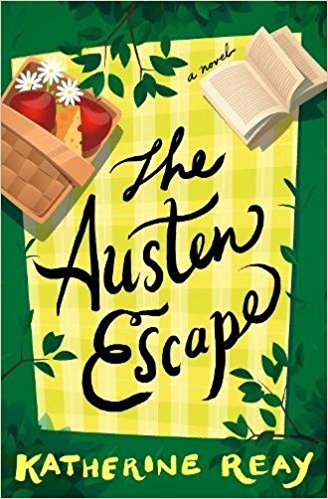
Book Review: The Austen Escape

Austen Escape The Austen Escape by Katherine Reay finds lifelong friends going on vacation to a manor in Bath, England, for a Jane Austen-themed experience. Mary Davies, from whose point of view the story is told, is an engineer, not a Romantic. In fact, all her mother’s Austen books were given to her friend, Isabel Dwyer, who is lively, vivacious, and well-versed in all things Austen. Isabel has some sharp edges, though, and the two friends have been somewhat on the outs for a time. But Isabel begs/drags/insists that Mary go, and as so often happen, Mary concedes.

While at this Austen experience, guests are to choose a character from one of Austen’s books to portray and to dress in Regency outfits provided by the manor. There are a few rough spots until Isabel has some sort of mental issue, forgets who she is, and believes she really is the character she’s portraying.  She’s actually much easier to get along with, though, and some things come out that help Mary put together some of the issues that they’ve had. On the other hand, other issues concerning the guy Mary is interested in come out as well, leaving her feeling betrayed.

My thoughts:

The lost memory issue is mentioned on the back of the book, and I wondered how the author was going to pull that off when it seems likely someone in that condition would be taken to the hospital immediately. But the explanation for why they stay on at the manor seemed plausible. I also had a hard time figuring Isabel out when some times she seemed like Mary’s best-ever friend, and other times she seemed condescending and even haughty. I thought perhaps the back-and-forth was going to be a precursor or related to whatever caused the memory loss. That did not turn out to be the case, at least not directly, but it was explained eventually.

I have read all of Reay’s books and enjoyed them to varying degrees, but I have to confess, this is not a favorite. The premise sounded fun – how great would it be to actually go on an Austen-themed vacation like this?! And all of Reay’s books have a plethora of literary allusions, fun for any reader of classics. Obviously the ones this time were all connected to Austen books.

Two themes in the book have to do with various ways people “escape,” and with vision – lack of seeing things clearly, etc.

But the writing this time just seemed — maybe a little uneven to me. I don’t know quite how to put my finger on it. I didn’t “get” a key factor until the discussion questions after the book, which was probably my own fault.

And then, Reay’s first book was definitely in the Christian or at least inspirational fiction category, but it seems her later books get further away from that category. I don’t recall anything relating at all to Christianity or faith in this book, though it’s possible it’s there and I have forgotten it. But if it’s there, it’s small. Maybe this is meant as a general fiction or romance, I am not sure. There was a comment between Mary and her boyfriend about her chest that totally didn’t need to be there – though it was mild compared to secular standards. And there was a fair bit of alcohol consumption – I know there are Christians with varying degrees of conviction about this issue, and I know alcohol was consumed in the Austen books, but it just seemed like that element was detrimental to me personally.

But all in all it’s an enjoyable story, especially as things come together in the end, and as the discussion questions pulled more of the story together for me.

(Sharing with Semicolon‘s Saturday Review of Books, Carole’s Books You Loved)

Book Review: The Secret Garden and a Discussion of Magic in Children’s Books

Secret Garden I have mixed emotions about The Secret Garden by Frances Hodgson Burnett. I’ll explain why in a moment.

The story opens with nine-year-old Mary Lennox in India with her family. Her father “had held a position under the English government and had always been busy and ill himself, and her mother had been a great beauty who cared only to go to parties and amuse herself with gay people. She had not wanted a little girl at all,” so Mary was left to the care of her Ayah. So as not to bother Mary’s mother and get in trouble, the Ayah and other servants gave Mary her way in everything, leading to her becoming “as tyrannical and selfish a little pig as ever lived.”

A cholera outbreak took her Ayah, both parents, and several others, and everyone else fled the compound, leaving Mary alone and forgotten until some officers discovered her. She was sent to Yorkshire, England, to stay with her mother’s brother, her only relative, Archibald Craven at Misselthwaite Manor. Mr. Craven had a crooked back and had been in deep mourning for the ten years since his wife died. Mary did not meet him for a long time, as he traveled frequently, so she was taken care of primarily by a housemaid named Martha.

No one had thought to provide Mary with books or anything to do. She was strongly instructed not to poke around in the house, rumored to have 100 rooms. Martha encouraged her to go outside, pointing the way to the gardens and mentioning that there was one that had been locked up for ten years. It had been Mrs. Craven’s personal garden, but her husband had it locked up after she died.

That piqued Mary’s curiosity, and, as the title indicates, she does eventually find the garden. And what’s more, she discovers an unexpected person living in another part of the house.

My thoughts:

The story itself is a sweet, cozy, Victorian English tale. It’s not hard to see the symbolism between Mary and the friends she discovers bringing this garden back to life, weeding it, and tending it, and Mary and another orphan’s need for weeding and tending themselves. The story unfolds in a nice way and some of the characters are treasures: Ben Weatherstaff, the gruff gardener who helps Mary make friends with a robin; kindly Dickon, Martha’s brother, who has a way with animals; Mrs. Sowerby, Dickon’s warm and practical mother. I loved Mary’s transformation. The ending is perfect, just the way you’d want a book like this to end.

My mixed emotions are due to the book’s use of magic. Now, magic can mean different things in different books. I wrote some years ago about wrestling with this and concluding that fairy tale magic is not the same thing as the occult (real witches are not warty little old ladies who turn people into frogs). C. S. Lewis uses “magic” as a symbol for God’s ways. When my kids were little, one library haul yielded two books about magic carpets. In one, the “magic carpet” was a rug that the mom and child sat on to read books together – harmless and sweet. The other was a dreadful New Age tale complete with a message from a spirit guide in the back! So when magic comes up in a book, first I have to discern what the author meant by it and how the concept is portrayed.

The gust of wind that revealed the garden door was “a Magic moment.” I didn’t think much about that at first, but more and more as the story went on, Magic was given the credit for many things, until at last the children actually perform an incantation asking Magic (always capitalized) to come and do what they want. Mention is make of tales of Magic Mary heard about in India and the work of fakirs there. As the children themselves ponder what Magic is, one suggests it’s the dead mother of one of them, “lookin’ after Mester Colin, same as all mothers do when they’re took out o’ th’ world.” Other conversations attribute it to some kind of life force, the same thing that makes the flowers grow.

 I am sure there is Magic in everything, only we have not sense enough to get hold of it and make it do things for us—like electricity and horses and steam. When Mary found this garden it looked quite dead…Then something began pushing things up out of the soil, and making things out of nothing. One day things weren’t there and another they were. I had never watched things before and it made me feel very curious. Scientific people are always curious and I am going to be scientific. I keep saying to myself, ‘What is it? What is it?’ It’s something. It can’t be nothing! I don’t know its name so I call it Magic…Sometimes since I’ve been in the garden I’ve looked up through the trees at the sky and I have had a strange feeling of being happy as if something were pushing and drawing in my chest and making me breathe fast. Magic is always pushing and drawing and making things out of nothing. Everything is made out of Magic, leaves and trees, flowers and birds, badgers and foxes and squirrels and people. So it must be all around us. In this garden–in all the places. The Magic in this garden has made me stand up and know I am going to live to be a man. I am going to make the scientific experiment of trying to get some and put it in myself and make it push and draw me and make me strong. I don’t know how to do it but I think that if you keep thinking about it and calling it perhaps it will come. Perhaps that is the first baby way to get it. When I was going to try to stand that first time Mary kept saying to herself as fast as she could, ‘You can do it! You can do it!’ and I did. I had to try myself at the same time, of course, but her Magic helped me—and so did Dickon’s. Every morning and evening and as often in the daytime as I can remember I am going to say, ‘Magic is in me! Magic is making me well! I am going to be as strong as Dickon, as strong as Dickon!’ And you must all do it, too.

When Ben Weatherstaff suggests they sing the Doxology, one of them says, “’It is a very nice song…I like it. Perhaps it means just what I mean when I want to shout out that I am thankful to the Magic.’ He stopped and thought in a puzzled way. ‘Perhaps they are both the same thing. How can we know the exact names of everything?’”

Then when Dickon’s mother is asked whether she believes in Magic, she says:

I never knowed it by that name but what does th’ name matter? I warrant they call it a different name i’ France an’ a different one i’ Germany. Th’ same things as set th’ seeds swellin’ an’ th’ sun shinin’ made a well lad an’ it’s th’ Good Thing. It isn’t like us poor fools as think it matters if us is called out of our names. Th’ Big Good Thing doesn’t stop to worry, bless thee. It goes on makin’ worlds by th’ million–worlds like us. Never thee stop believin’ in th’ Big Good Thing an’ knowin’ th’ world’s full of it–an’ call it what tha’ likes. Tha’ wert singin’ to it when I come into th’ garden…Th’ Magic listened when tha’ sung th’ Doxology. It would ha’ listened to anything tha’d sung. It was th’ joy that mattered. Eh! Lad, lad, what’s names to th’ Joy Maker.

As I read and was trying to discern how to take the Magic in this book, I figured it would be best first to see if I could find out what the author meant by Magic. Wikipedia says, “In the early 1880s [Burnett] became interested in Christian Science as well as Spiritualism and Theosophy.” Sparknotes says “throughout the novel, the idea of magic is heavily inflected by the tenets of both Christian Science and New Thought.” Part of the latter is the idea of “mind over matter,” the thought that repeating something over and over, as the children do in their chanting, can make it become real. Also, near the end of the book, the author writes:

One of the new things people began to find out in the last century was that thoughts—just mere thoughts—are as powerful as electric batteries—as good for one as sunlight is, or as bad for one as poison. To let a sad thought or a bad one get into your mind is as dangerous as letting a scarlet fever germ get into your body. If you let it stay there after it has got in you may never get over it as long as you live.

So long as Mistress Mary’s mind was full of disagreeable thoughts about her dislikes and sour opinions of people and her determination not to be pleased by or interested in anything, she was a yellow-faced, sickly, bored and wretched child. Circumstances, however, were very kind to her, though she was not at all aware of it. They began to push her about for her own good. When her mind gradually filled itself with robins, and moorland cottages crowded with children, with queer crabbed old gardeners and common little Yorkshire housemaids, with springtime and with secret gardens coming alive day by day, and also with a moor boy and his “creatures,” there was no room left for the disagreeable thoughts which affected her liver and her digestion and made her yellow and tired.

There’s a sense in which it’s true that both positive and negative thoughts can affect one’s outlook and even one’s health. But it’s possible to take that philosophy too far. SparkNotes goes on to say:

One of the book’s underlying themes is the way in which happiness begets happiness, and misery begets only more of itself….The source of this notion can again be found in Burnett’s fascination with the New Thought and Christian Science movements, which held that one must think only positive thoughts if one wants good things to happen. The fact that this idea is patently false miraculously did nothing to deter its adherents. Dickon’s remark that “the springtime would be better [for Colin] than doctor’s stuff” provides another instance of Christian Scientist tenets in the novel. Christian Science, as a philosophy, disapproves of medical intervention: no disease is truly corporeal (caused by the body), but is in fact the result of morbid and negative thinking. Colin must have contact with the life of the world if he is to go on living, because this contact will dispel his thoughts of death: Dickon (guided by Burnett’s Christian Scientist beliefs) says that Colin “oughtn’t to lie there thinking [of death and illness]… No lad could get well as thought them sorts of things.” The fact that Colin’s fury at Ben Weatherstaff provides him with sufficient strength to stand reinforces the notion that his previous inability to do so was entirely a product of his negative thinking. It also underlines the idea that if one only wishes to overcome one’s illness, one can. Negative thoughts are the human error to be found at the root of all disease; one must therefore force out ugly thoughts with agreeable ones, for “two things cannot be in one place.” This notion is responsible for both Colin and Mary’s wondrous metamorphoses. Once they are thinking of the garden and nature, of Dickon and of their own blossoming friendship, they can no longer concern themselves with their own contrariness or with the fear of becoming a hunchback and dying an early death. Instead, they become normal, healthy children, full of dreams of the future. This questionable (and inarguably syrupy) goal is given inane epigraphic expression in the phrase “Where you tend a rose, my lad, a thistle cannot grow.”

So there is a sense in which you could think of the Magic in the book as “positive thinking” or the same force that makes the plants grow. Or, as this writer did, you could see it as pluralism, wanting to lump all of these philosophies in with Christianity as if they are the same thing, when they’re not. Knowing more of Burnett’s background and philosophy makes me wary. I don’t know if I would read this to my children, if they were still young enough to read to: we’d at least have to discuss some of these issues as we read.

There is also a bit of colonialism, I guess you’d call it, in the book, with Mary being disdainful of the Indian servants and seeing them always as only servants, and Martha’s ignorance in calling them “blacks.”

A brief biography of the author, unusual in audiobooks, mentions that “Later in life, reporters criticized her lifestyle, and turned public sentiment against her.” But it doesn’t say what exactly they criticized, so I don’t know if it was her philosophies or the fact that she was divorced or something else.

I listened to the audiobook wonderfully read by Josephine Bailey and also looked up some passages in a library copy and on Project Gutenberg.

(Sharing with Semicolon‘s Saturday Review of Books, Carol’s Books You Loved, Literary Musing Monday)

Laura Ingalls Wilder Reading Challenge 2018 Sign-up

It’s time for the Laura Ingalls Wilder reading Challenge for 2018! The basic idea is to read anything by, about, or relating to Laura Ingalls Wilder during February, the month of her birth and death. I have an extensive book list here if you’d like some ideas beyond the Little House series, but if course the Little House series is delightful to read or reread.

In the comments below let us know what you’re planning to read. On Feb. 28 I’ll have a wrap-up post where you can tell us how you did and what you thought, either in the comments or with a link back to your posts. You don’t have to have a blog to participate, but if you do I’d appreciate your linking back here.

Sometimes participants have done projects or made recipes from the series as well. If you do so, please do share with us! Annette at Little House Companion has some activities and other resources.

I like to have some sort of drawing to offer a prize concluding the challenge, and I decided to once again offer one winner the choice of:

The Little House Cookbook compiled by Barbara M. Walker

OR

Laura’s Album: A Remembrance Scrapbook of Laura Ingalls Wilder by William Anderson

If neither of those suits you, I can substitute a similarly-priced Laura book of your choice. To be eligible, leave a comment on the wrap-up post at the end of the month telling us what you read for this challenge. I’ll choose a name through random.org. a week from then to give everyone time to get their last books and posts finished.

This year I am planning to read:

  • The First Four Years, the last in the Little House series
  • Death On the Prairie by Kathleen Ernst, a modern mystery set around some of the places Laura lived.
  • Little Blog on the Prairie by Cathleen Davitt Bell. I had not heard of this, but it happened to catch my eye while I was in the library. It’s about a modern family with problems going to a “Camp Frontier.”
  • Last year I bought a set of My First Little House Books, after reading Rebekah’s wonderful review. I haven’t even opened them yet, but I want to look through them and hopefully see if Timothy might sit still long enough to look at one or two.

How about you? Will you be joining us this year? What will you be reading?

(Sharing with Literary Musing Monday)

What’s On Your Nightstand: January 2018

Nightstand82The folks at 5 Minutes For Books host What’s On Your Nightstand the last Tuesday of each month in which we can share about the books we have been reading and/or plan to read.

Here we are a month into 2018, and I feel like I have gotten off to a pretty good start on my reading goals for the year.

Since last time I have completed:

The Biggest Story: How the Snake Crusher Brings Us Back to the Garden by Kevin DeYoung, reviewed here. I actually finished this back in December, but after that month’s Nightstand post. It’s a book aiming to help children see the overarching story of the Bible and place individual stores in their place in the bigger picture.

Gospel Meditations for Christmas by Chris Anderson, Joe Tyrpak, and Michael Barrett, reviewed here. Excellent. I read most of it in December but finished up the last couple of pages early in January.

Conscience: What It Is, How To Train It, and Loving Those Who Differ by Andrew David Naselli and J. D. Crowley, reviewed here. Excellent – both Biblically based and very practical.

Ghost Boy: The Miraculous Escape of a Misdiagnosed Boy Trapped in His Own Body by Martin Pistorius, reviewed here. Excellent.

Watership Down by Richard Adams, reviewed here. My first time through this classic, and I enjoyed it very much.

The Man Who Was Thursday by G. K. Chesterton, reviewed here. My first Chesterton book, and not at all what I was expecting, but it kept me pondering for a long time after closing it.

20,000 Leagues Under the Sea by Jules Verne, reviewed here. Not my usual cup of teas, but I enjoyed it.

Mozart’s Sister by Nancy Moser, reviewed here. Very good.

I’m currently reading:

The Secret Garden by Frances Hodgson Burnett

Trust: A Godly Woman’s Adornment by Lydia Brownback

The Austen Escape by Katherine Reay

A Spectacle of Glory: God’s Light Shining through Me Every Day by Joni Eareckson Tada. This is a year-long devotional book, so I probably won’t list it every month.

Up Next:

Journey to the Center of the Earth by Jules Verne

The Story of My Life by Helen Keller

Death On the Prairie by Kathleen Ernst for the Laura Ingalls Wilder Reading Challenge beginning here Feb. 1! It’s a modern mystery set around some of the places Laura lived.

The First Four Years by Laura Ingalls Wilder, also for the Laura Ingalls Wilder Reading Challenge.

After those – something from my reading plans for the year.

If you are interested in the Laura Ingalls Wilder Reading Challenge taking place next month, there is more information and a book list here.

Have you spent any of these winter days in a cozy book?

(Sharing with Literary Musing Monday)

Book Review: Mozart’s Sister

Mozart's Sister Mozart’s Sister by Nancy Moser tells the story of Maria Anna Mozart, known as Nannerl, Mozart’s older sister by four and a half years. The two of them were the only surviving children of seven, the other five having died in infancy. When their father started giving Nannerl lessons on the harpsichord, Wolfgang, then three, wanted to learn, too, to be like his sister. He picked it up quickly, as well as other instruments, and was composing by age five, completing his first symphony by age eight. Their father took them on tours from their native Salzburg to various royal courts and other venues in European cities like Munich, Vienna, Paris, London, Zurich, and others as the Wunderkind – Miracle Children. Their father, Leopold, even lied about their ages, making them out to be even younger than they were so as to play up the “Wunder” even more. Nannerl received top billing at first and was well-known for her playing, but “Wolfie” seemed even more a prodigy, being so much younger, and eventually most of the attention went to him.

Leopold was a composer, violinist, teacher, and finally the assistant director of music (Kapellmeister) for the archbishop of Salzburg. He eventually laid aside his own composing and performing and poured himself into promoting the children’s talent, then just Wolfie’s, then seeking out a position for Wolfgang. They made money on the tours, but Leopold was only paid for his position when he was actually there is Salzberg, understandably, and he almost lost his position due to so much time away. Thus there was always a tension between what they wanted to do and the need for finances.

The story is told from Nannerl’s point of view and begins with the various experiences with travels and concerts, delighting to play, interactions with royalty, expectations to play dressed up as little adults with adult-looking clothing and massive powdered wigs. Both she and Wolfie became seriously ill with smallpox, and once he had rheumatic fever.

Their parents encouraged Wolfie’s composing but discouraged Nannerl’s on the grounds that it was hard enough for men to get music accepted and published; for women it was considered impossible. Wolfie was groomed for a musical career but Nannerl was expected to lay all of that aside to marry and bear children. When she was of marriageable age,  Leopold and Wolfgang went on tours together, leaving the women behind.

When Nannerl fell in love, she was not allowed to marry the man of her choosing, but there’s no evidence to explain why. Some sources, according to Wikipedia, think Leopold did not allow it. Nancy portrays it as the archbishop, who employed Nannerl’s intended and from whom they had to receive permission, denying it as part of his adversarial relationship with Leopold. Whatever the reason, the two remained close friends.

Wolfgang, though a genius musically, seemed egocentric, lacking in common sense, and unwise in money matters. The author played up the tension she thought Nannerl felt as the dutiful, obedient daughter whose life did not turn out as she wanted it to, even though she did everything “right,” as opposed to Wolfie, who was irresponsible and self-willed, yet seemed to get everything he wanted, including marrying the girl his father did not at first approve of. Yet, whereas a number of modern people seem to leave it as “poor, Nannerl, born in the wrong time period and kept down by the oppressive customs of the times,” from the brief bit of reading I have done online since finishing the book, Nancy portrays her as having to wrestle through all those disappointments while maintaining her love for family and coming to a place of acceptance and even finding her own place of worth, even though it was not what she originally planned.

A few quotes:

To Papa, getting Wolfie back in Salzburg, safely ensconced in a salaried position, would save our family’s finances. I couldn’t see that he was wrong in this, but I knew keeping Wolfie in such a position would be like trying to cage a hummingbird.

Having no musical challenge—as was the case in Salzburg—sapped his life breath and made him suffocate for lack of creative air.

If only Wolfie didn’t have to think about money but could concentrate on creating and performing for the sheer joy of it. If only we all could do what we wanted to do.

Wolfie had to adapt the music to the limitations and egos of the singers, which was both frustrating and time-consuming.

“Will that boy ever understand the world does not revolve around him?” I did not mention Papa’s part in creating that belief.

A few small criticisms:

At the end the author has an extended list of what was fact, based on historical records and family letters, and what was fiction based on the best information she had. A lot of Nannerl’s inward wrestlings were based on what the author would have felt in her position or what she “felt sure” Nannerl felt, but I think she may have overdone it a bit. Nannerl seemed a bit whiny at times in the first half of the book.

The use of modern phrases – like “hard for me to wrap my mind around” something, “It seemed that Wolfie was settling,” “purple prose” – seemed jarringly out of place in a historical context.

“All musicians feel this bond with the Divine.” I wasn’t sure how that was meant. Feeling God working in and through them – that’s fine and I can understand that. But if it’s meant to convey a “spark of Divinity” in the individual, I would disagree. I think from what I have read of the author that she would mean the former, but the statement was vague enough to make one wonder.

Otherwise, I very much enjoyed learning about the Mozarts and appreciated the author’s encouragement to “Take Nannerl’s story as an impetus to look at your own life and make it the most it can be. You too have a unique, God-given purpose. The trick is to find out what it is.”

(Sharing with Semicolon‘s Saturday Review of Books, Carol’s Books You Loved)

Book Review: 20,000 Leagues Under the Sea

20,000 LeaguesJules Verne’s 20,000 Leagues Under the Sea opens in 1866 when reports come in front various countries of sightings of…something in various waters, giving rise to assorted speculations. It is described as “a long object, spindle-shaped, occasionally phosphorescent, and infinitely larger and more rapid in its movements than a whale.” In a couple of instances it damaged nearby vessels, leaving a large hole in one ship. These kinds of accidents and the unexplained disappearance of several ships lead to the general sentiment that the creature must be found and destroyed. An expedition is arranged from New York aboard the Abraham Lincoln, and Pierre Aronnax of France, Professor of Natural History at the Museum of Paris and author of Mysteries of the Great Submarine Grounds, is currently in NY and invited to come along. He accepts, along with his servant, Conseil.

After a number of days of searching, they do encounter the creature. Ned Land, a Canadian expert harpooner, had also been invited on this expedition, and when he tries to harpoon the thing, his harpoon bounces off. The thing then sprays an enormous amount of water at the ship, causing, among other things, Professor Aronnax to fall into the depths.

His faithful servant Conseil goes in after him, and they find Ned Land on top of something solid – and metallic. The Abraham Lincoln’s rudder has been broken, so they can’t count on it to come after them. When whatever they are on starts to submerge, they pound on the outside. A hatch opens, and they are taken in.

After a couple of days locked in a dark room, visited by a couple of men who at first seem not to understand them, finally the master of the vessel, a Captain Nemo, introduces himself, tells them they are at liberty to roam the vessel, but he cannot let them go, and furthermore, there would be times when he asked them to remain in their cabins until they received notice they could leave again. He had “broken all the ties of humanity,” and was “done with society entirely, for reasons which I alone have the right of appreciating. I do not, therefore, obey its laws, and I desire you never to allude to them before me again!” They had no choice but to accept.

The professor finds plenty to occupy himself. Nemo takes him on a tour of his ship, the Nautilus, explains how it is fueled, how he built it, etc. A window opens up sometimes to show the surroundings, and Aronnax is excited to observe, record, even to go on some underwater excursions and explore. Conseil is happy to be wherever his master is, but Ned Land chafes at the confinement.

At times Nemo comes across as intelligent, gracious, refined, and generous. But there are other times he seems a little unhinged. When a crisis occurs, the three visitors become convinced they need to leave. But how can they?

My thoughts:

I never knew much about this book besides being familiar with the names of Nemo and the Nautilus, and the round copper helmets of their diving suits seemed to be a staple of underwater sci-fi when I was growing up. So it was interesting to finally learn the story. There were just a couple of places where it got tedious, when measurements or  long citations of plants and animals seen were listed. But there was also plenty of drama and suspense.

I bought the audiobook on sale some time ago and I had forgotten that, when reading a book that has been translated from the original, it’s good to get some information on which translation is considered the best. According to Wikipedia, the first English translation by Lewis Mercier “cut nearly a quarter of Verne’s original text and made hundreds of translation errors, sometimes dramatically changing the meaning of Verne’s original intent.” The description doesn’t say what translation this is, but the comments indicate this is not one of the better ones. So if I ever read it again, I’ll seek out another, but I did enjoy the story.

I was amazed at the misconceptions about it, though. For one, some list it as juvenile fiction, though it was not written that way. Schmoop attributes that to some of the poor translations and its having been made into a Disney movie. One source said it was about Nemo seeking revenge on a sea creature, but that’s one incident in the book and not the main plot at all.

Other interesting facts: The 20,000 leagues in the title refers to distance traveled, not depths plumbed. A little more of Nemo’s background is revealed in a later Verne book, The Mysterious Island. Verne’s publisher made several changes to the book (it wasn’t indicated whether this was with or without Verne’s approval), like changing Nemo’s nationality.

I’m thankful to the Back to the Classics challenge for spurring me to read a book I might not otherwise have picked up.

(Sharing with Semicolon‘s Saturday Review of Books, Literary Musing Monday, Carol’s Books You Loved)

Book Review: Conscience: What It Is, How To Train It, and Loving Those Who Differ

Conscience  Conscience: What It Is, How To Train It, and Loving Those Who Differ by Andrew David Naselli and J. D. Crowley is a fairly short book at 149 pages (not including indexes), but it’s packed full.

They begin with a brief explanation about what got each of them thinking and then studying about the conscience. Then they explore what the conscience is and does and look briefly at every verse in the New Testament that mentions conscience. They bring out several principles, more than I can reiterate here, but a few stand out: conscience has been given to us by God; no two people have exactly the same conscience; “no one’s conscience perfectly matches God’s will”; conscience can be damaged in a number of ways; we should listen to it and not violate it so that we don’t damage it; once God shows us clearly that an issue our conscience troubles us about is not an issue in God’s Word, we yield to God as Lord over our consciences (e.g., Peter submitting to God’s rule about eating certain kinds of meat even though at first his conscience condemned them as unclean in Acts 10).

Our consciences might misregister due to being “hardened by the deceitfulness of sin.” – if we keep doing something that we feel is wrong and ignore conscience. “Feeding excuses to your conscience is like feeding sleeping pills to a watchdog” (p. 64). Our consciences are also affected by “the standards of other people such as your culture, family, or spiritual leaders. You simply go with the flow without thinking through the issues” (p. 64).

Since Christians are (or should be) continually reading God’s Word and growing spiritually, our consciences will change over the years as we realize some scruples are not Biblically based and as we become convicted of some issues that we had not previously realized were sin. We continually calibrate our consciences to align with God’s Word.

But since we’re all in different stages of growth and come from different cultures and have been taught different things about right and wrong, all our consciences are not going to be on the same page at the same time. How then do we interact with each other?

We should not sin against our conscience by thinking, “Well, Mr. A and Miss B. do this and they are strong Christians, so it must be ok.” No, “Each one should be fully convinced in his own mind” (Romans 14:2), we should do everything we do as unto the Lord (Romans 14:6), and we shouldn’t do anything that we can’t do with the full faith that it is okay (Romans 14:22-23) (“Don’t forget that ‘faith’ here refers not to saving faith in Christ [14:22a makes that clear] but to the confidence a person has in their heart or conscience to do a particular activity” [p. 97]). One whose conscience is strong in a certain area shouldn’t despise someone whose conscience bothers them on that issue, and the person whose conscience bothers them shouldn’t judge the person whose conscience has no scruples about issues which are not clearly defined in Scripture (Romans 14:3-4). Bringing up a specific matter, the authors write:

Don’t roll your eyes. This question may make you “face palm” in amazement at how strange someone else’s conscience might be. That’s typically how someone with a strong conscience reacts when they hear about the scruples of the weak. But to the weak of conscience, these are life-and-death matters. Conscience is always a life-and-death matter since sinning against it is always a sin, and getting used to sinning against conscience in one area will make it easier to sin against conscience in other areas. The strong must not look down on the weak but bear with them (Romans 15:1) and, if opportunity arises, gently help them calibrate their conscience (p. 79).

A few of the many quotes I have marked:

We should expect disagreements with fellow Christians about third-level matters [disputable matters where the Bible allows for differences], and we should learn to live with those differences. Christians don’t always need to eliminate differences, but they should always seek to glorify God by loving each other in their differences (p. 87).

Mature Christians should help other Christians train their consciences, but no one should force others to change their conscience (p. 92).

Our ultimate goal is not simply to stop judging those who are free or to stop looking down on those who are strict. Our ultimate goal is to follow the example of our Lord Jesus, who gave up his rights for others. He joyfully renounced his unbelievable freedom in heaven to come to earth and become an obedient Jew in order to save his people (Rom. 15:3-9) (pp. 95-96).

Have the right proportion. Keep disputable matters in their place as third-level issues. Don’t treat them like first- or second-level issues. And don’t become preoccupied with them or divisive about them. They shouldn’t be so important to you that it’s all you want to talk about. They shouldn’t be the main reason that you choose what church to join. They shouldn’t be issues that you are the most passionate about such that you are constantly trying to win people over to your position and then looking down on them if they decide not to join your side (p. 101).

Unfortunately I have seen this far too often. We spend a disproportionate amount of time on these issues, and let them distract us from the main issues.

Notice how generous Paul is to both sides. He assumes that both sides are exercising their freedoms or restrictions for the glory of God. Wouldn’t it be amazing to be in a church where everyone gave each other the benefit of the doubt on these differences, instead of putting the worst possible spin on everything? Paul says that both the weak and the strong can please the Lord even while holding different views on disputable matters. They have different positions but the same motivation: to honor God. They both do what they do for the glory of God (p. 106).

Christ gave up his life for that brother or sister; are you unwilling to give up your freedom [to do something your conscience is free about] if that would help your fellow believer avoid sinning against conscience? That’s what this passage is talking about when it refers to putting “a stumblingblock or hindrance” (Rom. 14:13) in another’s way (p. 109).

Christian freedom is not “I always do what I want.” Nor is it “I always do whatever the other person wants.” It is “I do what brings glory to God. I do what brings others under the influence of the gospel. I do what leads to peace in the church (p. 115).

One of the authors is a missionary to Cambodia, and they discuss dealing with cross-cultural issues of conscience as well. For instance, the author had a fledgling mango tree that finally produced three pieces of fruit. A friend doing some concrete work at his house ate the fruit. In the US, we’d consider that at least thoughtless and selfish, at worst, thievery. But in that culture, eating fruit while on or passing through someone else’s property was not a problem at all (there is even Biblical precedent for that in Deut. 23:24-25 and Luke 6:1). Reacting negatively to that would be seen as stingy. Preaching against it as “sin” would have either confused the hearers or caused them to dismiss the missionary’s message. They cite another case in another country where the people had no qualms about a women’s chest being uncovered, as they associated breasts with feeding babies, but to them “the sight of a woman’s thighs stimulates lustful desires” (p. 125). So a lady missionary thought the bare-chested women were highly immodest, but they thought she was immodest for wearing clothes that showed her thighs. The authors devote a whole chapter to dealing with these kinds of issues, pointing out especially that when we discuss sin, we need to major on what the Bible clearly says is sin, not sin in our cultural contexts, and we need to be careful that we’re not reproducing churches or Christians that mirror the culture that we came from, but rather we need to help them reflect Christ in their own culture.

There is so much more that I’d like to share, but I am in danger of reproducing the book as it is. Much of this was not new to me, as once when we moved to a different area and could not find a church “just” like the one we came from, I had to study through Romans 14 and related passages to come to terms with differences in preferences among the folks in our new area.  But this is a much more thorough exploration than mine had been. I appreciated not only the study but also the practicality, balance, and accessibility (easy to understand without a lot of theological-ese) of the book. Highly recommended.

(Sharing with Semicolon‘s Saturday Review of Books, Literary Musing Monday, Carol’s Books You Loved)

Reminder: Laura Ingalls Wilder Reading Challenge

Just a reminder that the Laura Ingalls Wilder Reading Challenge starts here a week from tomorrow on Feb. 1! More information and an extended book list is here (you don’t have to choose a book from the list: it’s just there for suggestions).

I’ll have a post here next Thursday where you can sign up to let us know you are participating and what you plan to read. I’m looking forward to seeing what your choices are!