Book Review: Invincible Louisa

AlcottI had not heard of Invincible Louisa, a Newberry medal-winning biography of Louisa May Alcott by Cornelia Meigs, until I saw Tarissa’s review of it last year. I found a Kindle version and saved it for this year’s Louisa May Alcott Reading Challenge.Even though the book was written for children in 1933, I found it immensely readable.

Louisa was born the second of four daughters to Bronson and Abigail (called Abba here, Abby in other sources) Alcott. In some ways Bronson was ahead of his time. He was an abolitionist when such a stance was not popular, helped runaway slaves, and even enrolled a black girl in one of his schools, refusing to dismiss her despite protests which led to parents pulling their children out of the school, which led to the school’s closing. He had some forward-thinking practices in his schools, but also some controversial methods. On the other hand, he was more of an impractical thinker/dreamer/philosopher (“He once said that the sort of life which would satisfy him completely was to walk through the world all of his days, stopping to have conversations with people by the way”). He tried to start a Transcendental community with friends, but it failed. He very nearly joined a Shaker community which would have required him to leave his family. “In the first twenty-eight years of Louisa’s life, this household was to achieve the record of twenty-nine moves.” Though he worked hard, he could never manage to support his family very well. One family story tells of a friend giving the family a load of firewood. A poor man with a sick baby and no fuel came to Bronson, who gave the man all he needed and helped him take it home. Abba reminded him of his own baby and the need for fuel in the harsh, cold weather. Then another neighbor, unaware that someone else had helped the Alcotts with fire wood, brought them a load.

Abigail was industrious and practical. She was also more spirited. “Abba was a person of varying moods: excitable, quickly moved, always devoted to them all, but often too harrowingly uneasy concerning the family welfare to be entirely calm.”

The couple had four daughters in all, plus a son who did not live. Anna and Elizabeth were more like their father in temperament; Louisa and May took after their mother. But all the children learned industriousness, frugality, and generosity. “They were all of them generous to the utmost degree, so that it was by Abba Alcott’s consent, as well as by Bronson’s and the three girls’, that they habitually gave away everything that could, or could not, be spared.” “It was one of the Alcott beliefs that no matter how poor a person is he or she always had something which could be given away.”

Because the family’s financial situation was always so precarious, Louisa felt burdened to help as much as she could. She sewed, taught, worked as a governess, and did whatever came to hand. She wrote stories and sold them here and there. Family friends were Ralph Waldo Emerson, Henry David Thoreau, and Nathaniel Hawthorne, so Louisa grew up under their influence and example. “To Louisa [Emerson] gave the freedom of his library and all that went with such a privilege.” “All their lives the members of this haphazard family were singularly lucky in friends, in people who appreciated and loved them and would do anything in the world for them.”

During the Civil War, Louisa went to Washington to help in a hospital. She sent home letters telling about the hospital itself and stories of the patients she encountered. Some of her letters were published, and people liked them so much that she wrote more and eventually put them into a book called Hospital Sketches, her first real literary success. “Louisa had told of the life with extraordinary effect; for she was not straining after romance now, but had given the truth simply, graphically, and with great spirit.” She caught typhoid fever, had to be taken home, faced a long and grueling recovery, and was never quite fully healthy again.

A publisher asked her for a book for girls. Louisa refused at first, saying she liked boys better and wouldn’t know what to write for girls. The publisher kept asking, however, so Louisa wrote some stories based on her own family. Louisa was Jo, Anna was Meg, Elizabeth was Beth, and May was Amy. The publisher was not terribly impressed, but he gave them to some young girls to read–and they loved them.

Several scenes paralleled the Alcott family. Elizabeth really did die of scarlet fever. Louisa did feel that Elizabeth’s death and Anna’s wedding were the beginning of breaking up the sisterhood. But there was no boy next door on whom Laurie was modeled: Louisa based him on a younger man she met while traveling abroad as a paid companion to an invalid girl. Some sources say there was a romance; this book says Louisa thought he would be better for May and hoped they would meet. Louisa herself never married, saying she would “rather be a free spinster and paddle my own canoe.”

The success of Little Woman and Louisa’s subsequent books helped the family finally get on a solid financial footing. Although “Louisa never could quite put aside her taste for startling events and her love for writing tales which bordered on the fantastic,” “she had begun to see her work in its proper light; she understood also that [the more realistic] stories were needed for young readers instead of the sentimental and tragic tales with which their minds were usually fed.”

I had known a little bit about Louisa’s life, but I enjoyed learning more through this book.

(Sharing with Semicolon‘s Saturday Review of Books, Literary Musing Monday, Colletta’s Book Club, Carole’s Books You Loved)

What’s On Your Nightstand: June 2018

Nightstand82The folks at 5 Minutes For Books host What’s On Your Nightstand the last Tuesday of each month in which we can share about the books we have been reading and/or plan to read.

I enjoy this monthly opportunity to share what we’re reading.

Since last time I have completed:

Gospel Meditations for Mothers by Chris Anderson, Joe Tyrpak, Hannah Anderson, and others, reviewed here. Very good.

Heaven Without Her: A Desperate Daughter’s Search for the Heart of Her Mother’s Faith by Kitty Foth-Regner, reviewed here. A feminist, agnostic middle-aged daughter is challenged by her mother’s death to investigate whether Christianity’s claims are true. Very good.

The Highly Sensitive Person by Elaine N. Aron, reviewed here. The information and practical helps were great: the New-Agey philosophies and exercises, not so much.

A Long Fatal Love Chase by Louisa May Alcott, reviewed here, for Tarissa’s Louisa May Alcott Reading Challenge this month. This was one of Louisa’s “sensational” stories. Not my usual cup of tea, but it was quite suspenseful and interesting to see that side of her.

The Mountain Between Us by Charles Martin, reviewed here. A lovely story overall, but unfortunately with a few crude spots.

Villette by Charlotte Bronte. Just finished over the weekend; hope to review it soon.

A Small Book About a Big Problem: Meditations on Anger, Patience, and Peace by Edward T. Welch. Ditto with this one – I hope to review it this week.

I’ve also dipped into Foods That Harm, Foods That Heal by the editors of Reader’s Digest and The Christian Writer’s Market Guide-2018 edited by Steve Laube, but neither are designed to be read cover to cover.

I’m currently reading:

The Hunchback of Notre Dame by Victor Hugo

Invincible Louisa by Cornelia Meigs, a biography of Louisa May Alcott, also for Tarissa’s challenge.

More Than These: A Woman’s Love for God by June Kimmel

My Father’s House by Rose Chandler Johnson

Up Next:

Christian Publishing 101 by Ann Byle

The Song of Sadie Sparrow by Kitty Foth-Regner

Overcoming Your Devotional Obstacles: 25 Keys to Having Memorable Devotions by John O’Malley

30 Days of Hope When Caring for Aging Parents  by Kathy Howard

That about wraps it up for this time. Did you get to read much this month?

Book Review: Heaven Without Her

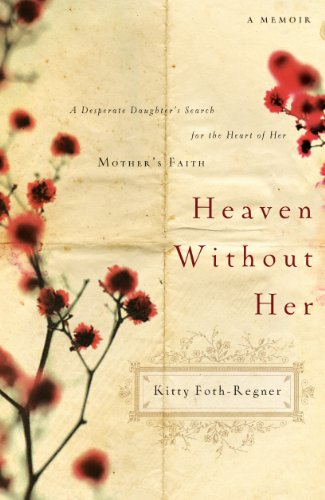
HeavenI first became aware of Heaven Without Her: A Desperate Daughter’s Search for the Heart of Her Mother’s Faith by Kitty Foth-Regner when Sherri reviewed it here. I commented that I was putting the book on my TBR list, and the author graciously contacted me and offered to send me both this book and another of hers, The Song of Sadie Sparrow.

This book is part memoir, part apologetics. Kitty grew up with a loving Christian mother, but she rejected the gospel. She felt God wasn’t real and Christianity would just get between her and her idea of fun. She became a feminist and an agnostic, developed a good writing business, had lots of like-minded friends and a significant other. Life seemed good.

Then her aging mother became sick and was not expected to live. Kitty couldn’t bear the thought that she might not see her mother ever again. To Kitty’s credit, she didn’t just mouth a false profession. She couldn’t agree to Christianity if she didn’t believe it was true. But she was willing to investigate it. So she dug, read, and studied not only Christianity but also other religions from every conceivable angle, such as the existence of God, creation vs. evolution, the veracity of the Bible, and more.

The book tells how she got “so lost” in the first place and how, point by point, God dealt with all her objections and brought her to Himself.

A few quotes:

The most dangerous lies are those that contain a healthy dose of truth.

It didn’t take me long to make the most important aspect of radical feminism my own–all the me-centered principle that made my ambitions, my feelings, my intellect, and my freedom my number one priorities.

It was time to quit wondering and take some action.

Later, I would read in Philippians 4 about “the peace of God, which surpasses all understanding.” It was like that: peace that I hadn’t felt since I was a little kid, before I knew the heartbreaks and fears and humiliations that can happen in this world. The sort of peace you feel when you know someone much bigger than you is in total control, loves you to pieces, and will take care of you always.

My friendship with several hyper-feminists were among the casualties of my conversion. Maybe I should have just kept my mouth shut. But I figured that a friend doesn’t let a friend live without hope; a friend shares the gospel.

Kitty ends the book with a list of recommending resources for anyone wanting to research the same questions and concerns that she did.

I’ve heard people criticize creation and apologetic ministries because they are not the gospel, and it’s only the gospel which “is the power of God for salvation to everyone who believes” (Romans 1:16, ESV). That’s true, but the seed of the gospel is the Word of God, according to the parable of the sower (Luke 8:4-15), and apologetics ministries pull out some weeds and rocks in the soil of people’s hearts and minds so the seed can better take root.

I’m thankful for Kitty’s sharing her testimony and the truths she learned in her book, and I can highly recommend it.

(Sharing with Semicolon‘s Saturday Review of Books, Literary Musing Monday, Carole’s Books You Loved)

Book Review: The Highly Sensitive Person

HSPThe first time I heard the term “highly sensitive person” as a personality designation, I felt it sounded like me. When I read the chapter on the highly sensitive in Reading People, I knew for sure that was me. On the self test I scored 25 out of 27. I wanted to learn more, so I looked up the book which started it all: The Highly Sensitive Person by Elaine N. Aron.

Actually, people have been writing about this personalty type since Jung, according to Aron, but she is the first to study and write about it in a major way.

A highly sensitive person is not someone who is extra touchy or prickly. The scientific name Aron coined is Sensory-Processing Sensitivity, not to be confused with Sensory Processing Disorder or Sensory Integration Disorder. SPS or HSP is not a disorder at all, but an innate personality characteristic summarized by the acronym DOES:

D is for depth of processing. Our fundamental characteristic is that we observe and reflect before we act. We process everything more, whether we are conscious of it or not. O is for being easily overstimulated, because if you are going to pay more attention to everything, you are bound to tire sooner. E is for giving emphasis to our emotional reactions and having strong empathy which among other things helps us notice and learn. S is for being sensitive to all the subtleties around us.

HSPs tend to be more aware of subtleties and process information more deeply. As a result they can be easily overstimulated and overwhelmed by things like bright lights, noise, too-busy schedules, too much social interaction. HS is not introversion, though many introverts are highly sensitive.  HSPs are also not neurotic by definition: one difference Aron found was that neurotic people tended to have a troubled childhood, which, combined with their sensitivity, made them more depressed or anxious.

Aron spends a lot of time discussing how higher sensitivity can be negatively perceived by others, especially when an HS companion gets overly aroused. Aron encourages what she calls reframing memories in light of this new information: when someone was impatient with you for being afraid or needing to leave, now you know you had good reason for your reaction.

She also emphasizes the good aspects of being highly sensitive: conscientiousness, being better able to “spot errors and avoid making errors,” “to concentrate deeply,” to process material deeply, being “deeply affected by other people’s moods and emotions, being “especially good at tasks requiring vigilance, accuracy, speed, and the detection of minor differences.”

She likens society to being divided into “warrior kings” and “royal advisors.” The warrior kings are aggressive, conquering, competing. They show initiative, expand territory, crush the competition. The “priest-judge-advisor class” provides balance and “is a more thoughtful group, often acting to check the impulses of the warrior-kings.”

HSPs tend to fill that advisor role. We are the writers, historians, philosophers, judges, artists, researchers, theologians, therapists, teachers, parents, and plain conscientious citizens. What we bring to any of these roles is a tendency to think about all the possible effects of an idea. Often we have to make ourselves unpopular by stopping the majority from rushing ahead. Thus, to perform our role well, we have to feel very good about ourselves. We have to ignore all the messages from the warriors that we are not as good as they are. The warriors have their bold style, which has its value. But we, too, have our style and our own important contribution to make.

Aron goes on to share ways to find balance between avoiding or dealing with over-stimulation yet not becoming a hermit to do so. She also discusses relationships, work, medication’s pluses and minuses, and different types of psychotherapy for those who might be interested in that route.

Personally, though I found much that was helpful, Aron’s style rubbed me the wrong way many times. For instance, she talks about picturing your highly sensitive personality as an infant and learning how to “reparent yourself.” Then she refers to the reader’s “infant/body self” so often the term began to have a fingernails-on-chalkboard effect on me. Some of her approaches are too New-Age-y for my tastes. For instance: “Perhaps the greatest maturity is our ability to conceive the whole universe as our container, our body as a microcosm of that universe, with no boundaries. That is more or less enlightenment.” She suggests an exercise in which the reader is instructed (in more detail) to curl up like a baby, breath from your diaphragm for three minutes, and then “become yourself as a baby.” Another is to imagine “your infant/body self” as a young baby and ask it what it needs. I guess some might find these exercises helpful, but they put me off. I also disagreed with the Jungian concept she describes as an inner helpmate or anima figure or spiritual guide. Discernment is needed in wading through the spiritual aspects of the book.

I disagreed with her about the nature of shyness as well. She says shyness is different from sensitivity, which I agree with. But then she goes on to say “Shyness is the fear others are not going to like us or approve of us. That makes it a response to a situation. It is a certain state, not an always-present trait.” I have been shy all my life, but my reactions weren’t related to fear of not being liked or approved of. When I panicked over being drawn into a conversation, it wasn’t because I feared others wouldn’t like what I had to say: it was because I couldn’t think of anything to say. Probably a lot of that had to do with an introvert’s penchant for being slower to process things. She prefers the term “social discomfort” to shyness, which I could go along with.

The edition I read was updated from the original with new research. Though I would have preferred a more straightforward style, I did benefit from the information and practical tips.

(Sharing with Semicolon‘s Saturday Review of Books)


Book Review: Gospel Meditations for Mothers

GM4Mothers Gospel Meditations for Mothers by Chris Anderson, Joe Tyrpak, Hannah Anderson, and others, was just published a few weeks ago, in time for Mother’s Day. Like the others in the Gospel Meditations series published by Church Works Media, this booklet contains 31 one-page devotionals relating to various aspects of its topic.

Topics covered include grace, to ourselves and other mothers; love; criticism and commendation; fear; discipline; trusting God for our loved ones. A sample of chapter titles:

How to Raise a Pharisee
Motherhood Is a Marathon
The Source of Your Strength
How to Clothe Yourself With Love
Show the Joys of Mundane Christianity

A couple of quotes that stood out to me:

You can be certain that every trial God puts in your domestic life is there to strengthen, purify, and mature you (Day 22).

Christ’s call to rest is a call to come away from other masters and submit to Him alone. It is a call to come away from following the expectations of other people and our own sense of performance. It is a call to be conformed to nothing but His perfect image, to allow His nature to mold and shape our own. So that as we follow Him, our souls–just like His–will be free from the weight, free from the strain, free from the feeling of being driven like a pack animal (Day 23).

I’ve read several in this series, and this is a great addition, both encouraging and convicting.

(Sharing with Semicolon‘s Saturday Review of Books, Literary Musing Monday, Carole’s Books You Loved)

Book Review: A Long Fatal Love Chase

Long Fatal Love ChaseLouisa May Alcott based her Little Women characters to a great degree on her own family. Just as Jo wrote both for a creative outlet and to support her family, so did Louisa. Louisa’s editor asked for a new novel to be published in installments in a magazine, and Louisa came up with A Long Fatal Love Chase. The novel was rejected, however, as being “too sensational.” Two years later Louisa published Little Women, and according to Wikipedia, stayed with children’s stories after that. A Long Fatal Love Chase was set aside and eventually discovered at a rare book dealer’s, bought, edited, and published by Kent Bicknell in 1995.

The story involves teenager Rosamond Vivian, who lives alone with an aloof grandfather. Tired of her boring, confined life and lack of love, she declares, Faust-like, “I often feel as if I’d gladly sell my soul to Satan for a year of freedom.” Right on cue, in walks her father’s old friend Phillip Tempest, who bears a striking resemblance to a portrait of Mephistopheles (why Rosamond’s grandfather has a portrait of Mephistopheles is not explained.)

Eventually Rosamond and Phillip fall in love and marry. She knows he has a past and is not a saint, but he has been nothing but kind to her. She feels love will conquer all. After while, however, she becomes aware of some of Phillip’s shady dealings. Unsettled, she becomes more wary. When she discovers that her marriage is a sham and Phillip already has a wife and son, she flees.

Thus the chase in the title ensues. Louisa wrote this not long after she had toured Europe as a paid companion to an invalid, and her experiences  there inform her novel. Rosamond puts on various disguises, travels to different places, receives help from a variety of people, but somehow Phillip and his spy, Batiste, find her every time until the tragic end alluded to in the title.

I was a little afraid of just how “sensational” this book might be, but it contains nothing explicit or lurid. Phillip is evil, but other classic villains are as bad or worse. Someone quoted on the Wikipedia page suggested perhaps in those times, a woman finding herself in a false marriage would hide away in shame even though the situation was no fault of her own, and the fact that Rosamond did not do that might have shocked some people.

Readers can tell this was originally written for magazine serialization, because every chapter ends with a cliffhanger. Alcott was quite good at writing that way and crafting enough sudden twists and turns to give one whiplash. A few lines border on silly (“She…looked at the vigorous figure before her with genuine womanly admiration for a manly man”[p. 13]. “Tempest…[enjoyed] her innocent companionship with the relish of a man eager for novelty and skillful in the art of playing on that delicate instrument, a woman’s heart” [p. 36].) But, overall, though this kind of novel isn’t my usual cup of tea, it was interesting to see this side of Alcott. The book was certainly exciting and suspenseful. And, though, it wasn’t written to have a moral, it has one nevertheless. Tempest’s love is destructive because it is obsessive and selfish, whereas that of someone Rosamond meets later is completely selfless, giving though he cannot receive her love in return. Though Rosamond is more independent than Little Women’s females, she is of the same character and fiber.

I was glad to win this book in a drawing for last year’s Mount TBR Challenge hosted by Bev at My Reader’s Block and save it for Tarissa’s Louisa May Alcott Reading Challenge this month.

(Sharing with Semicolon‘s Saturday Review of Books)

Book Review: The Mountain Between Us

MountainA snow storm and a broken de-icer strands thousands of travelers in the Salt Lake City airport. Dr. Ben Payne, on his way home from a medical conference, checks in with a charter pilot to see if they could beat the storm and get to Denver. Ben invites Ashley Knox, a fellow passenger he just met, to accompany them. Ashley’s on her way to her wedding rehearsal, so she’s eager to go.

But the pilot has a heart attack over the Uinta mountains. The plane crashes, the pilot dies, Ashley and Ben sustain several injuries. Her leg is severely broken; he has a couple of broken ribs and maybe a collapsed lung.

Thankfully Ben has hiking gear with him, brought along for a few excursions in-between conference meetings. His experience as a doctor and hiker and his athleticism from years of running give him an advantage, but he and Ashley have several things against them: their injuries, the remoteness of their location, the terrain, the cold, the fact that their pilot hadn’t filed a flight plan, and they had not let anyone know of their last-minute changes.

As they get well enough to travel, find food, and start off, Ben records messages to his wife, Rachel, on a voice recorder. Ben tells Ashley that he and Rachel are separated, but this recorder tradition started early in their relationship.  Through Ben’s recordings, both Ashley and readers learn of Ben and Rachel’s backstory. Ashley finds herself questioning whether she and her fiance have the kind of love that will last.

My thoughts:

I’m not usually one for plane crash stories. I don’t want them to come to mind when I have to fly. But I had heard good things about The Mountain Between Us by Charles Martin. It is a surviving disaster story, but even more than that, it’s about relationships. The fight to survive is suspenseful and intense, and the relationships between Ben and Rachel, and then Ben and Ashley (and even the pilot and his wife) are beautifully unfolded.

The story is marred for me, though, by some crudities (particularly a joke between Ben and Ashley) and some interaction between Ben and his wife that should have remained private.

Martin says in an afterward that he was inspired by Psalm 121:1-2: “I lift up my eyes to the hills. From where does my help come? My help comes from the Lord, who made heaven and earth.” But that’s not reflected in the story. I know that Christian stories are sometimes subtle: in Esther, for instance, God’s name is not mentioned nor are there any practices that acknowledge God beyond a time of prayer and fasting, yet God’s influence and leading are all throughout the book. Maybe that’s how Martin meant this book, but but it comes across as fairly secular. Perhaps he meant it for the general market.

So – mixed emotions. I loved the story itself. I could have done without the crude parts and private moments, and I would have liked the Christian undercurrent, if there is one, fleshed out more.

(Sharing with Semicolon‘s Saturday Review of Books)

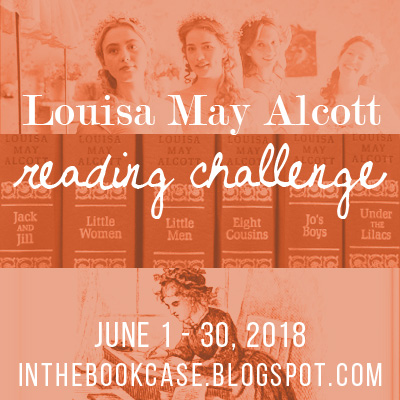
Louisa May Alcott Reading Challenge

LMA-button2018

Tarissa at In the Bookcase hosts the Louisa May Alcott Reading Challenge this month. You can find details and prize information here.

I’d like to read at least two books for the challenge.

  • A biography,  Invincible Louisa by Cornelia Meigs
  •  A Long Fatal Love Chase by Louisa. This was one of her “sensational novels” that she, like Jo in Little Women, wrote for quick money. It was recently rediscovered and printed. It will be interesting to see that side of Alcott.

I may also try to listen to Little Women again. I have read it several times and listened an audiobook of it at least once. I recently watched the new PBS remake, and I know they arranged some parts out of order, but for others I am not sure if I am remembering the book or the 1994 film. At any rate, I am hankering to go through the book again. I am making good time on my Back to the Classics challenge, so I think I have time for a detour. 🙂 But we’ll see.

What’s On Your Nightstand: May 2018

Nightstand82The folks at 5 Minutes For Books host What’s On Your Nightstand the last Tuesday of each month in which we can share about the books we have been reading and/or plan to read.

I enjoy this monthly opportunity to share what we’re reading.

Since last time I have completed:

Adam Bede by George Eliot, reviewed here. Excellent.

Anchor in the Storm by Sarah Sundin, WWII story and mystery, reviewed here. Very good.

The Illusionist’s Apprentice by Kristy Cambron, reviewed here. Excellent.

Drawing Near to the Heart of God: Encouragement for Your Lifetime Journey by Cynthia Heald, reviewed here. Good.

I’m currently reading:

Heaven Without Her: A Desperate Daughter’s Search for the Heart of Her Mother’s Faith by Kitty Foth-Regner

The Highly Sensitive Person by Elaine N. Aron. Mixed emotions about this one.

Villette by Charlotte Bronte

A Small Book About a Big Problem: Meditations on Anger, Patience, and Peace by Edward T. Welch

Gospel Meditations for Mothers by Chris Anderson, Joe Tyrpak, Hannah Anderson, and others

Up Next:

The Hunchback of Notre Dame by Victor Hugo

Christian Publishing 101 by Ann Byle

The Song of Sadie Sparrow by Kitty Foth-Regner

Overcoming Your Devotional Obstacles: 25 Keys to Having Memorable Devotions by John O’Malley.

Tarissa at In the Bookcase hosts the Louisa May Alcott Reading Challenge in June. I’d like to read a biography,  Invincible Louisa by Cornelia Meigs, and possibly A Long Fatal Love Chase by Louisa. The latter was one of her “sensational novels” that she, like Jo in Little Women, wrote for quick money. It was recently rediscovered and printed. It may be too sensational for me – we’ll see.

I also made a list of books I’d like to reread…someday.

Read anything interesting this month? Do you have big reading plans for the summer?

Book Review: The Illusionist’s Apprentice

Illusionist On New Year’s Eve in 1926, a medium in Massachusetts advertises that he will raise a man from the dead.  Though someone does rise from the newly unearthed coffin, he immediately falls down dead. The FBI treat the case as a homicide, and their investigation takes them to other vaudevillian performers, particularly Wren Lockhart. Wren is an illusionist who apprenticed under Harry Houdini. But interest in her goes beyond her stage work: the dead man had the name of Jennifer Charles in his vest pocket, Wren’s real name which she has tried to keep buried. FBI agent Elliot Matthews works with Wren to gain more information helpful to the case, but Wren reveals as little as possible, wary of bringing her past to light.

When Wren and Agent Matthews are chased and shot at in a car, the case expands from the one magic trick gone wrong on New Year’s Eve. Is someone after Wren to gain Houdini’s secrets? Or is someone wreaking revenge for the part Houdini and Wren played in debunking a medium’s claims? Or has someone uncovered Wren’s carefully buried secrets?

The Illusionist’s Apprentice by Kristy Cambron kept me on the edge of my seat with multiple twists and turns and the revelation of new information along the way. Wren’s history is told in flashbacks which jumped around to different parts of her life. They could have been confusing, but I made it a point to look at the date beginning every chapter to try to keep on track.

Besides the mystery and suspense elements, I loved Wren’s development through the story as she slowly learns to trust Matthews. I also enjoyed that there were several layers to the story. The faith element first shows up in Wren’s insistence that only one man ever raised anyone from the dead and that her profession wasn’t magic but illusion. After that her faith is more undercurrent than overt, but its expression becomes more vivid near the end.

One of my favorite quotes from the book:

There cannot be dark without the light that will overcome it. Whatever darkness there is, God’s light shines brighter. It has to. He’s the Hero in every story–especially this one.

Kristy’s first two books were set during WWII, the third one took place in a circus, and now this one centers around illusionists and vaudeville. Though I also enjoy authors who write in particular time eras or niches, I love that Kristy’s subject matter is unexpected and often largely unexplored until now.

(Sharing with Semicolon‘s Saturday Review of Books, Literary Musing Monday, Carole’s Books You Loved)