Book Review: A Slender Thread

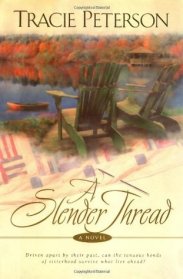
Slender ThreadIn A Slender Thread by Tracie Peterson, five sisters return home to Council Grove, Kansas, for the funeral of the mother who had abandoned them to pursue an acting career. They gather at the farmhouse of their grandmother, Mattie, who raised them and tried to instill in them a hope and faith in God. But each of the women has been affected in different ways by their mother’s desertion which causes conflict between them.

Ashley is married to a doctor, has two young boys, and is vying for Supermom status, trying to be everything her mother was not to her. Brook is a model who can’t let herself open her heart to the possibility of love. Connie feels alone because her two older and two younger sisters are close, and she has a different father, so she feels the odd woman out on many fronts. But she makes it worse by putting up walls that none of them can break through and making choices that she knows Mattie would be heartbroken over if she knew. Deirdre was the only planned child of her mother, conceived to try to heal her marriage. She’s the peacemaker but hides a secret obsession. Erica was the youngest, born barely 9 months after Deirdre, a gifted musician who puts her potential career above her love interest.

As the girls gather for the first time in years, tensions rise to the surface and harsh words break out on all sides. Mattie tries to point them to the love the have for each other, the “slender thread” that ties them together, and to God’s help and grace, but each one is too immersed in her own issues.

There’s a lot of bickering in this book. A lot. It’s meant to show that their issues go beyond the usual sibling rivalry, but they seem extraordinarily touchy and too willing to get offended by innocent remarks. Some of the same issues keep coming up over and over – which does happen when people are fixated on their past hurts without attempts to come to peace with them. But it did get old. The story seemed very slow in the first section when the girls were all together but the action picked up quite a bit when they all went back to their own lives and we saw them in their own setting. Their characters were developed quite a bit more then.

But I did appreciate the emphasis that we don’t have to be bound by a bad past or a parent who has failed us. We’ll forever be affected by them, but with grace and forgiveness and God’s help, we can put the past in perspective and forge new trails for ourselves and our families.

(Sharing at Semicolon‘s Saturday Review of Books)

Giveaway of Adam Blumer’s Book, The Tenth Plague

Tenth Plague

A few years ago I posted this review of Adam Blumer‘s The Tenth Plague along with an interview with him. At the time the book was only available in an e-book format, and it still is. But now — in fact, today — his publisher has released a paperback version. If you’d like to enter for a drawing to hold a real live copy of this book in your hands, leave a comment below (US addresses only, due to the expense of shipping). A week from today, April 12, I’ll draw from the names entered with random.org, and we’ll send one happy winner a copy!

Here’s a recap of the review and interview:

The-Tenth-PlagueIn The Tenth Plague by Adam Blumer, Marc and Jillian Thayer have just adopted a new baby boy, and a friend has invited them to  a Christian-themed resort for some rest and time together as a new family.

When they arrive, however, the retreat is in upheaval. A company planning a new Bible translation is having meetings at the resort, and a throng has arrived to protest. Someone rigged the water system to dispense what appears to be blood from the faucets. What seems an odd prank is soon discovered to be the first in a series of events based on the Biblical ten plagues of Egypt, some of them resulting in fatalities. Marc calls on a friend, a retired homicide detective, to help with the investigation as the plagues escalate.

Gillian, meanwhile, runs into someone who has hurt her deeply in the past. She thought she had put it all behind her, but the old anger and hurt rush back in like a flood,  and she wrestles with the need to extend forgiveness.

The Tenth Plague is a sequel to Fatal Illusions, Adam’s first book (which I reviewed here), but you don’t have to have read the first book to understand and enjoy the second. Both books are tremendously suspenseful and feature realistic, everyday Christian people trying to discern and apply God’s will in their circumstances. I enjoyed them both very much!

Here is an interview with Adam:

blumer_adam_portrait

What was your inspiration behind The Tenth Plague?

One day I was reading the book of Revelation and came across 22:18–19. “I warn everyone who hears the words of the prophecy of this book: if anyone adds to them, God will add to him the plagues described in this book, and if anyone takes away from the words of the book of this prophecy, God will take away his share in the tree of life and in the holy city, which are described in this book” (ESV). My mind began playing the “what if” game. Would God really bring a biblical plague on someone who tampered with His Word? I chatted with a few theologian friends, and the plot emerged from there.

How does this novel compare with your first novel, Fatal Illusions?

Though the plot, of course, is different, the two novels share a number of similarities. Both are set in Michigan’s Upper Peninsula, where I live. I like to write about average folks like Marc and Gillian Thayer, a pastor and his wife who face unexpected, even threatening, events. Of course, there’s another really bad killer who wants to do them harm, and their retired homicide detective friend, Chuck Riley, once again comes out of retirement to help them. I also like to weave in a historical event that somehow relates to the present day. In Fatal Illusions, it was the killer’s obsession with Houdini; in The Tenth Plague, an old mine disaster plays an important role. The past always plays an important role in the present—a running theme in my novels. Overall, I like to write about redemption: how biblical truth offers the answers to the complicated issues of life. Stories, like parables, present some of the best ways to illustrate biblical truths.

What was one of the most important lessons you learned during the writing of this novel?

The power of the collaborative process. I had a fairly strong first draft, but I was stuck. A novel editor provided a creative springboard and helped me see where my true story lay. Without her help, I doubt this story would have seen the light of day.

What part of writing this novel took the most work?

This novel required a ton of research. From an old mining tragedy to autism, from adoption law to anthrax, from pheromones to the Oklahoma City bombing, the research for this one required much more than I ever expected. I’m so thankful for technology and ease of access, thanks to the Internet. Without Google and so many resources at my fingertips, I’d probably still be researching this story.

So far, what has been your favorite work experience in life?

During one summer between years in high school, I worked at a library, a book lover’s paradise. Granted, a lot of the work involved stocking shelves, but being surrounded by so many fascinating books and interesting authors was pure heaven. I was born a die-hard book lover, and I’ll probably die one too.

Consider the qualities that make you unique. How do these qualities come out in your writing?

I love suspense fiction and history, so a blending of the two always seems to come out in my writing. In high school, I won awards in calligraphy; Gillian Thayer, my female lead, is into calligraphy in a big way (it’s her job). I’ve always been intrigued with how one’s past impacts his or her present and future. This is a recurring theme in my novels because it’s part of who I am. Now that I think about it, what I write is inseparable to some degree from who I am.

Introduce your plot summary and main characters. What is your favorite part of the story?

Water turns to blood. Flies and gnats attack the innocent. Marc and Gillian Thayer’s vacation resort becomes a grisly murder scene, with a killer using the ten plagues of Egypt as his playbook for revenge.

When their friend turns up dead, Marc and Gillian put their vacation on hold, enlist the help of a retired homicide detective, and take a closer look at the bizarre plagues as they escalate in intensity. Meanwhile, a stranger is after the Thayers’ newly adopted baby. Will they uncover the truth behind the bitter agenda before the tenth plague, the death of the firstborn son?

My favorite part is when the firstborn son is revealed and the novel culminates in the tenth plague. This is the most suspenseful and action-packed part of the story, with several key characters in jeopardy. I had a blast writing it.

One of the main themes of The Tenth Plague is confronting and dealing with your past. What can readers take away from this theme, especially in a novel that deals with religion and death?

Both the villain and my heroine, Gillian Thayer, grapple with heartbreaking real-life issues from their past. But how they respond shows two very different paths. My hope is that readers will see the stark contrast in the context of biblical truth presented in the story. The bottom line is that God is enough, and He offers the solution to every problem of life. This is another repeated theme in my stories. Thank you for the opportunity to talk about my latest project.

Some content used by permission of Kirkdale Press

Tenth Plague Forgiveness

(Sharing at Semicolon‘s Saturday Review of Books)

(Update: The giveaway is now closed. The winner is Faith! Congratulations!)

Book Review: Not In the Heart

Not-in-the-HeartIn Not In the Heart by Chris Fabry, Truman Wiley was once a promising reporter. However, downsizing cost him his job and a gambling addiction has resulted in estrangement from his family, the loss of his home, and some shady characters coming after him for a debt he owes. On top of everything else, his son is in the hospital and needs a new heart.

But an unexpected opportunity arises: a death row inmate wants him to write his story before his execution. The inmate’s wife is in the same Bible study as Truman’s wife, who has known about and prayed for Truman’s son’s condition for years. In return, the inmate wants to give Truman’s son his heart. He wants something good to come from his death. The public has mixed emotions and the governor needs some persuasion, but it looks like the heart donation will be approved.

As Truman begins to write the story, however, it begins to look like the inmate’s claims of innocence might actually be true. If he didn’t kill the murdered girl, who did? And if he’s innocent, what happens to Truman’s son?

I’ve never read a book by Fabry before and got this one on a Kindle sale because the story sounded interesting. His writing grabbed me from the start and the story kept up at a rapid pace all the way through. Some surprising twists and turns near the end led to quite an unexpected ending. In short, Fabry has a new fan. I loved some of his phrasing:

The trouble with my wife began when she needed Jesus and I needed a cat.

The woman of my dreams. The woman of my nightmares. Everything good and bad about my life. The “I do” that “I didn’t.”

Someone said, “Hey, Wanda,” and I deduced that this was Wanda. This is why I am such a good reporter.

I pulled out my phone as I hurried along and texted Abby, U OK? I had to stop while I texted because I am not a teenager.

A black pit bull barreled against the fence, jaws dripping with saliva, viciously barking like Old Yeller after the hydrophobia kicked in.

Ron pointed Helen’s gun at me. What kind of name is Ron for such a menacing figure?

Throughout most of the book, Truman’s view of faith is outside-looking-in. He doesn’t share his wife’s faith and pretty much disdains it. He doesn’t believe the inmate’s (Terrelle) profession of faith and dreads writing that part of the book, but he wants to handle it in a way that doesn’t offend “the faithful.” In my one minor criticism of the book, Truman’s own faith journey seemed a little rushed at the end – but then, everything was happening pretty fast at the end.

The point of view was unusual in this book. Most of the time it was from Truman’s point of view, written in the first person. But other chapters from the point of view of other characters are written in the third person.

One area I am somewhat on the fence about concerns his descriptions, mainly in a seedy club owned by one of the potential bad guys. Fabry is careful not to get overly descriptive, but some readers might feel he pushed the envelope a bit more than they’re comfortable with there.

But overall I loved the book and have already started on another by Fabry.

(Sharing at Semicolon‘s Saturday Review of Books)

Laudable Linkage

It’s been a little while since I have been able to share some noteworthy reads I’ve discovered the last few weeks online. Here is my latest accumulation:

Good Principle, Wrong Text. From my favorite in-real-life former Sunday School teacher. ” Every time we derive an interpretation and application of a text that is not native to the context — no matter how Biblical the concept itself may be — we are robbing that text, and ourselves in the process, of the meaning and applications that God intended when He gave it. The key is not to read any verse as a devotional island, isolated from its immediate and larger context.”

Getting Women Into the Word.

Love Serves: Showing Christ’s Love on Valentine’s Day. Ways a family can minister to others on that day in particular, but the ideas are good for any time.

4 Ways to Love Someone With Dementia or Alzheimer’s, Like God Loves Us.

To the Grown Daughter Who Has Failed to Love Her Mother Well.

In the Bleak Midwinter: When Your Heart Loses Its Song.

How Caring For Children Changes the World. Interesting consideration of the five women involved in saving the life of Moses.

Five Ways Christian Fiction Builds Faith.

Hillary, Bernie, Donald, and Me. Neat article by John Piper, not about these people’s politics, but about their and other people’s goals and accomplishments in their 60s and 70s. Encouraging as I am in the far side of my 50s.

And to end the day with a smile:

birth weight

Happy Saturday!

Book Review: The Bronte Plot

Bronte PlotIn The Bronte Plot by Katherine Reay, Lucy Alling loves working in an antique store, specializing in the books section. But in order to make her beloved books more special and valuable to customers, she incorporates several questionable practices. Her boss has no idea and would not approve if he did know.

When a handsome customer, James, comes in the store to find a gift for his grandmother, they hit it off and begin dating. But he soon finds that Lucy often embellishes the truth. She explains that her father was a con man, and she grew up with his stories. He loved classic stories, but he also made up many of his own. She hasn’t seen him in years. She “promised never to be like him and now…I suddenly hear myself and I am like him,” and her stories don’t sound quite so good when she recounts them to James, yet she feels compelled to make up stories even for things like getting seated at a restaurant without a reservation or getting a needed item for the store. Later when he finds out that she “embellished” the book he had bought for his grandmother, he breaks up with Lucy.

Oddly, however, James’s grandmother, Helen, who was quite taken with Lucy, has decided, against her family’s wishes, to take a trip to London and asks Lucy to go with her as a consultant. Lucy is not excited about the idea but eventually agrees, especially when she realizes there is a possibility they might be traveling near the place where she believes her father is.

As Helen and Lucy travel and each share their stories, Lucy realizes Helen has secrets of her own and a wrong in her past that she is trying to make right. Part of their travel takes them to antique stores, part to places of literary value, like the Bronte sisters’ home, and part to take care of the issue Helen needs to deal with.

As Lucy searches for her father, it almost seems that she feels doomed to follow in his steps since she shares his genes. But she learns that she can make her choices despite what he does, and determines to make things right with her boss and customers as much as she can, despite the risk to her reputation and job.

Reay’s specialty in all her books so far is weaving a plethora of literary references into her stories. I’m sadly not as familiar with the Bronte’s works except for Jane Eyre (one of my favorites), but I enjoyed getting to know more of their background and plan to read more of them in the future. Reay also quotes Dickens, Austen, Gaskell, and Lewis here (and possibly others I am not remembering), but she doesn’t just quote them – she incorporates something of their stories into her heroine’s story. One of my favorite quotes from this book, referencing Jane Eyre, is:

Lucy reached in her bag and pulled out the book, knowing exactly where to search. “I thank my Maker, that, in the midst of judgment, he has remembered mercy. I humbly entreat my Redeemer to give me strength to lead henceforth a purer life than I have done hitherto.” There it was. Mercy. Grace. And just as she’d told James, fiction conveyed change and truth and was loved and digested again and again because it reflected the worst, the best, and all the moments in between of the human experience (p. 267).

A couple of other favorite quotes:

All real lives hold controversy, trials, mistakes, and regrets. What matters is what you do next.

All the books have it . . . That time when you don’t know where you’ll be, but you can’t stay as you are. In life or in literature, that time rarely feels good (p. 31).

I thought all the characters were richly drawn, even the secondary characters like Dillon, their driver in England or Sid, Lucy’s boss. Looking through a few reviews here and there, I saw that many said they didn’t like Lucy. I think that’s because, though all characters should be flawed because no one is perfect, we’re hit with hers right off the bat. But I did like her as a person and sympathized with her in her journey.

It’s kind of ironic that reviews by non-Christians criticized the Christian element and reviews by Christians criticized that there was not much of a faith element. At first I felt the faith element was lacking because I didn’t recall Lucy making changes due to anything like repentance or a regard for having sinned against God, but I had forgotten the quote above referring to mercy and grace. As I went back and looked it up, in context she’s pondering her actions and thinks of Rochester in Jane Eyre: “Rochester couldn’t move–could never move–forward because he hadn’t gone back. He hadn’t laid down his sin and accepted that there was an absolute right” (p. 267). Then comes the quote from Jane about mercy and grace. So I did feel it was there, though perhaps a little more subtle than much Christian fiction. As I’ve mentioned in The Gospel and Christian Fiction and Why Read Christian Fiction?, it’s understandable that the nature of some stories would require more nuance (after all, the book of Esther does not mention God at all, but alert readers will see His hand there). But my only criticism of this book was that I did feel it was a little light in this department.

Nevertheless, all in all I enjoyed it very much. To me one sign of a great book is when you keep thinking of it and uncovering things about it long after turning the last page, and I definitely experienced that with this book.

If you’ve got half an hour, this interview with Katherine Reay was fun to listen to. I really enjoyed it, especially hearing the symbolism behind a scene that I hadn’t caught when I read it and some of the background information behind each of her books.

(Sharing at Semicolon‘s Saturday Review of Books)

Book Review: Searching For Eternity

Searching for EternitySearching for Eternity by Elizabeth Musser grabbed me right away, kept me engaged throughout the book, and made me not want it to end while at the same time eager to know what finally happened with the characters.

The story begins in the 1960s with nearly fourteen year old Emile de Bonnery finding that he and his mother have to suddenly leave France, where they have been staying with his grandmother in her 13th century chateau. Though Emile’s French father has been away “on business” often, this time it’s different. His American mother tells him that his father has found someone else and they must leave France immediately to go back to her native Atlanta. Emile protests, to no avail, and barely keeps control over his anger.

Emile feels that his father is a spy, that he’s merely on a mission, and may even be in trouble. Emile’s father, Jean-Baptiste, had been in the French resistance as a teenager during WWII, along with his parents. On each of Emile’s birthdays since he was five, his father has given him a gift of something he used in his resistance days – a book with pages cut away in which to store a switchblade, a thumbtack tin that once held a radio, etc., and told him the story behind that particular item as well as stories of his experiences. Emile knew that his father particularly hated Klaus Barbie, the “butcher of Lyon,” who was responsible for killing multitudes, including national hero Jean Moulin and Emile’s father’s father. Barbie had been condemned to death in absentia, and it was Emile’s theory that his father was hunting for Barbie. But no one agreed with him.

Meanwhile, he has to get used to life in America, especially to starting a new school. Being small for his age, new, and having an accent all seem to make him a target for the class bullies and friendless. Finally at lunch he sits near a girl named Eternity Jones, who, though somewhat aloof, at least doesn’t rebuff him. Gradually they become friends, and Emile eventually learns that Eternity comes from a broken home with a drunken, abusive mother. Eternity acts as protector for her two younger siblings. Wanting to extend help as well as friendship, Emile invites Eternity and her brother and sister to his grandmother’s home.

His grandmother and mother had been estranged for the 15 years his mother had been in France, and she and Emile showed up on her doorstep with no advance warning when they first left France. His mother had told him that her mother was controlling and they didn’t get along, but she welcomed them both with kindness, and her home radiated peace. His mother notes that her mother has changed in many ways. His mother and grandmother both try to make their home a safe haven for Eternity and her siblings.

There is so much in this book, it’s hard to know what to share. The rest of the book covers the next 23 years of Emile’s life and touches on racism, abuse, bullying, being a victim, faith, second chances, as well as what happens to Eternity and her family, Emile’s father, and even Klaus Barbie. It ended just as I hoped it would, but the author kept me guessing until nearly the last few pages.

Here are a few quotes from the book:

The wrong kind of love grabs and holds and chokes and demands and expects.

It’s a lot harder to hate a whole race of people, like the Negroes, or a type of person, like alcoholics, when you start getting to know individuals. Prejudice likes to make generalizations and stay far away. I wanted to get to know [Eternity’s mother] before I judged her too harshly.

Grandma had always said that suffering etched character into God’s people, making them stronger, better, holier, more useful to God and man. I had believed her for many years, but I did not see it on this night.

“I know it seems wrong and cruel. But this is what you must do. Let go. Give up the control, Emile. Be mad, grieve, accept that you cannot figure it out. Give up.”
“Giving up is weakness!”
“This time it will be strength.”
“How?”
“You must give up, not out of resignation, but out of trust. Trust that God knows and cares and will let you in on all the secrets you need to know in His time.”

There is more to life than looking for answers. Some answers you will never find–some you will. As long as the most important question is answered, the ‘not knowing’ of the others doesn’t seem so unbearable.

“The good thing about following Jesus is that His Word eventually seeps way down into your heart. And then, when you need to respond as He would, somehow that love blooms, watered by years of tears and tended by His Spirit. It blooms. Maybe not all at once, Emile. But eventually. He doesn’t waste your obedience. It counts. It works.” I said nothing, but I was listening, begging God to let her words–His words–penetrate my heart.

Victims could move on, but deep down they were still victims. Maybe there were parts of us that would never recover from the injuries of the past. And maybe that was all right, because we could still be useful in our maimed and injured state. ‘For when I am weak, then am I strong.’ I grabbed on to those words of the apostle Paul.

Elizabeth Musser’s being from Atlanta, being a missionary in France, and her teen boys being “third culture kids” all contribute to the realism in the book. The occasional mentions of eating at the Varsity in Atlanta have me questioning why I never went there the few years we lived in the area!

I don’t feel I have done this book justice at all, but I don’t want to say more about it and give too much away. So I’ll just say, it’s good. You should read it. It comes up occasionally on sale for the Kindle app. So far I have enjoyed all of Elizabeth Musser’s books, and I am eager to read more. And I am going to miss these characters!

(Sharing at Semicolon‘s Saturday Review of Books)

Book Review: A Prairie Collection

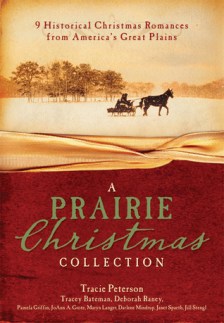
Prairie CollectionWhen I first began reading Christian fiction, a great many of its books were set in Western prairies. It also seemed that many of them contained one of three plot lines: a teacher from the East who came West, didn’t like it, and planned to go back home, until she fell in love; a snobby socialite, usually from Boston, who also didn’t like the rougher accommodations and culture of the West and planned to go back home; or a marriage of convenience, where two people who did not love each other and sometimes who had just barely met married each other, usually because one recently lost a spouse and for various reasons needed one, and they ended up coming to love each other by the end. Nothing wrong with any of that, but I just got burned out by it all and didn’t read anything prairie-ish or even Western for a very long time.

So with that background, and the fact that romances and short stories are not my favorites, either, I am not sure why I picked up A Prairie Christmas Collection: 9 Historical Christmas Romances from America’s Great Plains except that it was a good deal for the Kindle app, and I have enjoyed many of Tracie Peterson’s books and have been wanting to read Deborah Raney, two of the authors whose stories are included in this collection. The others are Tracey Bateman, Pamela Griffin, JoAnn, Grote, Maryn Langer, Darlene Mindrup, Janet Spaeth, and Jill Stengl, none of whom I had heard of before.

Sure enough, three stories contain a teacher coming from the East, a snobby Bostonian socialite, and a marriage of convenience. 🙂 But there is enough of a twist in each case that the stories aren’t cliche. Other stories include a widowed father and son moving into a new town and falling for a woman whose heart still belongs to her dead fiance; a woman who has lost everything and is greatly reduced in her circumstances coming to a new town to work as a maid; a woman determined to keep her family home after her mother’s death though her siblings and the railroad want her to sell; a tutor with a troubled background trying to make a new life and taking on a student not at all interested in his subject matter; the wife of a newly married young couple trying to make everything “just right” for her visiting mother-in-law; and a woman with a heart “colder than ice” coming to live with her estranged brother and taking on a job for the preacher. Some characters from the first story appear in the last, but I didn’t catch whether any of the other characters cross over into other stories.

One of the stories probably would have worked a little better as a novel, just because there was so much crammed into it, but overall, I really enjoyed the stories and each character’s journey of faith. They made for very pleasant Christmas and winter reading.

(Sharing at Semicolon‘s Saturday Review of Books)


Christmas afterglow and a few short reviews

We had a wonderful Christmas week and even some extended time with my oldest son – not only was he scheduled to be here a couple of days more than normal, but his flight out got canceled, so he was here for another night. I was thankful it was his first leg of the flight that was cancelled and not the second, so he could spend the time at home and not in an airport halfway there.

As you can imagine, little Timothy was the delight of this Christmas. At the last couple of family birthdays, he was really into this presents thing and was right in the middle of whosever presents they were, so I thought he’d suffer significant sensory overload with everybody getting presents. He happened to open a little kid-sized chair we had gotten for him first, and that worked out well, because he was delighted to sit in it the rest of the time. He loved opening his gifts but didn’t feel the need to help everyone else open theirs. His reactions were so cute. I wish I could upload a video without having to go through YouTube or Vimeo – his unwrapping of a stuffed dog was particularly sweet. Over the weekend we enjoyed tons of food, family time together, rewatching the first three Star Wars DVDs (and deciding we liked Star Trek better generally), playing Settlers of Catan, bowling, and visiting. And though it was all lovely, I think everyone is glad to be getting back to the routine today. I am personally reveling that there is no place I have to go today and nothing that has to get done besides laundry, dinner, and dishes, though I do hope to accomplish more than that.

Here is our yearly photo, in front of the house this time instead of in front of the tree:

Christmas 2015

We couldn’t get Timothy to smile, so we just said he was being very thoughtful. 🙂

In this transition week from the old year to the new, I’m going to have some posts later in the week about favorite books read this year and some of my favorite posts from the year. Before that, though, I have a few reviews I need to wrap up. I was actually hoping to have a couple more, but couldn’t quite get them finished yet.

Christmas LessonsChristmas Lessons by Patty Smith Hall is about a teacher named Claire who uses a cane as a result of contracting polio. She had broken off her engagement with Billy Warner some years earlier without giving him a reason: she had the absurd notion that her disability would hold him back in his coaching career. We’re not told until later in the book why she thought this. Suddenly Billy is back in town as the new coach at the school where she teaches, and the principal teams them together to work on a Christmas project. Of course, you can guess where the plot goes from there. It was just a touch predictable, and there were a few odd grammar issues (like “The old coach would have saw her” instead of “seen her), but overall it was a good, clean, Christian-based story.

365I picked up 365 Meditations for Grandmothers by Grandmothers from a clearance table long before I ever became a grandmother. I rediscovered it at the end of last year and, having a new first grandbaby, thought it would be a perfect time to read it.

It is authored by six different women, each penning two months’ worth of devotional thoughts about grandparenting. Each day’s selection includes a Bible verse, a couple of paragraphs, and a closing prayer.

Though there were a few good nuggets here and there, unfortunately, this is not a book I can recommend. My notes in the margins contain a number of question marks, “X” marks (meaning I thought something was wrong or off about a passage), and the phrase “wrong application.” The last is the biggest problem with this book. Sometimes what the devotional had to say was fine: even though it was a misapplication of what the quoted verse was saying, it was sometimes something that the Bible did say somewhere else. But sometimes it was totally wrong. Sometimes there were questions raised that didn’t need to be raised, like whether Paul was the author of 2 Timothy. Sometimes the gospel was clear; sometimes it was obscured or even contradicted; for example, one page says it is important to “help our grandchildren become like Jesus so that they will have a personal relationship with God” (p. 238) rather than showing them how to have a relationship with Jesus so that He can make them like Himself. Sometimes it’s just odd, like one devotional on Isaiah 55:10, about God’s Word being like the snow and rain that comes down from heaven and accomplishes God’s purpose, where the author goes on to say, “Can you imagine looking up into the sky and seeing God’s Word coming down from the sky? We can run into the fields like the birds and catch His Word as it falls from the sky” (p. 254). That paragraph earned a question mark beside it.

I was disappointed in the book early on but kept with it because, with six authors, I felt some parts of it would have to be better than others. I probably should not have: after the first few weeks I probably should have looked at representative excerpts from each of the others and then decided whether or not to keep it. If you know of a good devotional for grandmothers, let me know: sadly, this is not one of them.

All CreaturesFinally for today, I just finished listening to All Creatures Great and Small by James Herriot. I had enjoyed a few episodes of the old BBC series based on the books years ago but then had forgotten about them until Melanie mentioned them.

Herriot is a pen name for James Alfred Wight, and I was surprised to learn that the books are only semi-autobiographical. Maybe that was to protect the anonymity of the people he wrote about. But they are largely based on his experiences as vet in the Yorkshire area for 30 years, beginning in the 1930s.

In the books he starts out as an assistant for Sigfried Farnon, whom he describes as brilliant yet mercurial and extremely forgetful. Mostly he is very kind, though many frustrating yet comedic moments arise due to his forgetfulness. Soon Sigfried’s brother, Tristan, comes to live with them: he is an idle vet school dropout whom Sigfried keeps forgetting that he has kicked out. James’s vet skills are put to the test right away with farmers who often trust old folk remedies rather than veterinary science. In one of my favorite parts of the book, one farmer tells of putting onions in his horse’s rectum for some kind of cure, but his horse became “uneasy in the legs.” Sigfried told him he’d be uneasy in the legs, too, if someone had put onions in his rectum.

Another favorite passage is when James is invited to an elite social gathering hosted by a wealthy lady whose beloved and spoiled dog, Tricky Woo, had been treated by James. After the unfamiliar yet pleasant experiences of the evening, James is awakened in the middle of the night to come to one of the poorest farms in the district. As he contemplates the differences between the highs and lows of the night, he acknowledges that being a vet even in the most humble circumstances is where he is at home.

Sometimes his job has him nearly pulling his hair out in frustration and wondering why anyone would choose that profession, but most of the time he loves it and feels he has the best job in the world.

I enjoyed his descriptions of the Yorkshire area and people – warm, hospitable, honest, hardworking, almost a little stoic, and thrifty.

Along the way he meets a Helen Alderson, and although he hasn’t had time to think about dating much, something clicks with Helen despite two disastrous, yet humorously told, first dates.

The only flaws in the book are a fair amount of swearing and alcohol consumption, but overall it’s a funny, poignant, and heartwarming set 0f tales.

(This review will also be linked to Semicolon‘s Saturday Review of Books.)

Book Review: The Butterfly and the Violin

Butterfy and the ViolinIn The Butterfly and the Violin by Kristy Cambron, Sera James owns and manages an art gallery in Manhattan. For years she has been looking for a painting she saw as a child which held special meaning for her. She has finally found at least a copy of it, but hopes it will lead to finding the original. The owner, William Hanover, refuses to sell but wants to hire Sera because he also wants to find the original, but for very different reasons. They develop a relationship, but Sera is reluctant to open her heart again after having been left at the altar by her fiance two years ago. Unraveling the mystery of the painting at first brings them closer together but then suddenly brings a sharp division between them.

The painting portrays a young woman with piercing eyes, a shaved head, and a number tattooed on her wrist holding a violin. Cambron switches back and forth between the present day and Sera’s situation to the 1940s and the story of the woman in the painting, Adele von Braun, revealing more of Adele’s story in both narratives.

Adele’s father was a high-ranking official in the Third Reich, and she was a well-known violinist nicknamed “Austria’s sweetheart.” She loved a cellist named Vladimir, but her father would not sanction their relationship since Vladimir was only the son of a merchant. Adele kept seeing Vladimir in secret and eventually learned that he was part of a network that smuggled Jews out of the country to safety. Adele had hidden Jewish friends of her own that she secretly brought supplies to, but when she tried to help them escape, she was discovered, arrested, and sent to Auschwitz. There she became part of the prison orchestra, made to play every day as the prisoners were sent out to work, during executions, and occasionally at a Nazi social event. While she felt her spirit dying, her friend tried to help her see that there could be beauty and service to God even in such a place.

God is here. He sees. He knows what is happening in this place.

This, child, is our worship. To live and survive and play to God from the depths of our souls. This is the call that binds us. When we worship in the good times, it brings God joy. But worship in the midst of agony?…That is authentic adoration of our Creator.

One day we will be free. And we become free by living despite what they do to us. We live by working, and we work for God.

I had known that their were musicians among those in WWII prison camps who were made to play for the Nazis. And I knew that the Nazis had confiscated a lot of art during those years. But I hadn’t known that there were many paintings and other art by the prisoners themselves discovered after the camps were liberated – over 1,600 pieces in “partially destroyed warehouses and old barracks of Auschwitz,” according to the author’s note at the end. Those pieces still survive even now, though many of the artists are unknown. As one character muses in the story,

She told herself that to have something of worth in a world full of chaos was the very definition of beauty.  It felt like a spiritual liberation that couldn’t be silenced.  These prisoners, the ones who painted or wrote poetry or played in the orchestra – they refused to let that spirit die.  And this, she decided, is why the heart creates.

God plants the talent and it grows, sustained by a spirit-given strength to endure, even in the midst of darkness. It thrives in the valleys of life and ignores the peaks. It blooms like a flower when cradled by the warmth of the sun. It remains in a hidden stairwell in a concentration camp. It grows, fed in secret, in the heart of every artist.

I enjoyed both Sera’s and Adele’s stories and the themes of God’s presence in suffering and the need to create. This is Cambron’s first novel, and it has deservedly won many awards. My overactive internal editor stumbled over just a few minor places where I felt the writing was a little awkward, but I’m not even going to go into them because overall this was a gripping, fascinating, heart-breaking, yet beautiful story.

(This review will also be linked to Semicolon‘s Saturday Review of Books.)

Book Review: Through Waters Deep

Through-Waters-DeepThrough Waters Deep is the first in the the Waves of Freedom series by Sarah Sundin. All of Sarah’s books so far have been set in the WWII era, and this one is no exception. I love how she weaves historical detail into the story.

It’s the time when Europe is involved heavily in combat but America has yet to join the fray. Strong feelings among the isolationists, who don’t want the US to get involved, and the interventionists, who do, run high and cause conflicts, especially at the Navy shipyard in Boston where Mary Stirling is a secretary. Minor problems increase until some people begin to suspect that they are deliberate acts of sabotage, but is it an isolationist or an interventionist, or one trying to frame the other in order to get sympathy for his side? Mary’s work takes her all over the premises and into various offices, and she hears a lot of talk. She decides to make notes in shorthand (which no one would suspect) in case she overhears anything useful. But when she shows her notes to the FBI, they dismiss them as gossip and hearsay.

At a ship’s christening, Mary runs into an old high school friend, Jim Avery, now an ensign in the Navy. They are both changed from what they remember: they had been the quiet ones of their group and Jim had pined away for someone who was in love with someone else, so they had not really known each other well, but as Mary shows him around Boston, they each realize there is more to the other than they thought. When a definite and dangerous act of sabotage is found aboard Jim’s ship, tensions and suspicions escalate.

One underlying issue Mary has to deal with is that she has a strong aversion to being the object of attention. She wants to avoid being prideful and self-promoting, but it is more than humility. As the story unfolds we find the reason for her reluctance and panic, and she wrestles with what it means to “let your light shine” yet not put yourself forward, along with not missing opportunities God would have her take due to her wanting to stay in the background. I found this aspect of her character fascinating because I have wrestled with some of the same issues, and I have never seen this addressed anywhere except just a bit in C. S. Lewis’s Mere Christianity.

Jim describes himself as a “floater.” His two brothers who went into the Navy before him have ambitions to move up the ladder. Jim does not have that goal and just wants to float where the current of life takes him. He’s a hard worker and a caring person, yet has to realize his tendency to “float” looks like laziness and a lack of initiative. A good captain sees his potential and helps draw out his good points. That and the potential of missing opportunities in his relationship with Mary help him see that sometimes he needs to direct his steps, under God’s leadership and direction, rather than “floating.”

I’m not usually interested in romances just for the sake of romance, and Sarah’s books always go beyond just the romance to the deeper character issues as well as fleshing out what it might have been like to live in the setting. I love what Jim and Mary both had to learn and go through on their journey as well as the underlying mystery of the saboteur. Sarah does a great job conveying the feel of the times in the conversations and interactions of the various characters.

I loved this book, and I am looking forward to the next one in the series!

(This review will also be linked to Semicolon‘s Saturday Review of Books.)