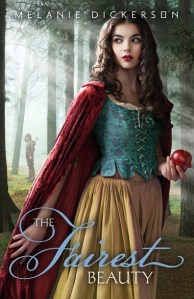
Book Review: The Fairest Beauty

FairestBeautyMelanie Dickerson writes Christian fiction retellings of fairy tales and sets them in medieval Germany. She says on her web site that she has “always loved fairy tales and been fascinated by the prospect of fleshing out traditional fairy tales and turning them into an in-depth romance. I was fascinated by the idea of taking a well-known fairy tale and making it real, with realistic characters and realistic reactions to their circumstances.” There are no magic wands or fairy godmothers in her stories, so the issues have to be worked out a bit more realistically. Having previously enjoyed The Merchant’s Daughter (based on Beauty and the Beast) and The Healer’s Apprentice (based on Sleeping Beauty), I snapped up The Fairest Beauty (based on Snow White and the Seven Dwarves) when it came up on sale for the Kindle app.

Sophie is a scullery maid for the wicked Duchess Ermengard, who throws her into the dungeon for things like rescuing the puppies that the duchess had ordered to be drowned. Sophie doesn’t see any way out of her situation, so she tries to make the best of it. Believing herself to be an orphan, the cook, Petra, is the closest person Sophie has to a mother, and another servant. Roslind, is her best friend. Somehow, despite her miserable upbringing, she is good and kind, and many love her (this is a fairy tale, after all. πŸ™‚ )

What she doesn’t know is that she is the daughter of the presumed-dead husband of the duchess, and the duchess is actually her step-mother, who treats her as she does because she is insanely jealous of her. Only two servants in the entire castle know who Sophie really is, and one of them has just escaped and traveled several days’ journey to Hagenheim Castle, the home of the man Sophie was betrothed to years ago, Valten. Unfortunately Valten is laid up with a broken leg and can’t leave immediately to investigate this claim that the girl he thought had died years ago is alive. His younger brother, Gabe, decides on his own to go and rescue Sophie. Though he sincerely feels that God would have him do so and that Sophie might be in danger, his motives are primarily to best his brother this one time and to be the hero.

Once he finds Sophie, he has to ascertain whether she really is the daughter of a duke and then try to convince her of that. Then they face several days’ journey back to Hagenheim, facing dangers from the henchmen the duchess has sent after them and wolves. Along the way they begin to fall for each other, each fighting it at first because they are both betrothed to others.

Since this is based on Snow White, we know how the story will end, but it was fun to see how Melanie worked out the details of the issues the couple faced as well as the classic fairy tale elements, like the poisoned apple and the seven dwarves (I’ll let you discover that for yourself. πŸ™‚ )

One thing I especially enjoyed in this book were the spiritual journeys. Sophie had to learn to trust and to let God heal her from the lies the duchess had been telling her all her life. Gabe had to realize that he had acted with wrong motives and that his impetuosity could put Sophie in danger physically and possibly hurt her reputation.

One little part I didn’t like was that, as they were becoming more aware of their interest in each other, there were mentions of Sophie noticing his muscles and being disconcerted when his shirt was off due to tending a wound. I don’t doubt that those things would happen in those situations, but I just don’t like to go there in books that I read. Thankfully, that was just a small part of the book.

I did also enjoy an unexpected tie-in with a couple of characters from A Healer’s Apprentice.

Overall I enjoyed this book quite a lot and look forward to a couple of others Melanie has written in this same vein.

(This review will also be linked toΒ Semicolonβ€˜s Saturday Review of Books.)

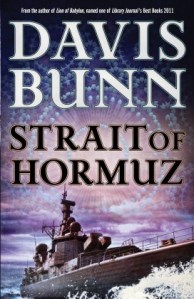
Book Review: Strait of Hormuz

Strait of HormuzStrait of Hormuz by Davis Bunn starts off with a bang and keeps up a steady pace through most of the story. Marc Royce was formerly an intelligence operative for the State Department, but was fired by his boss. Since then, however, his former boss has called him for a couple of missions in which he needs someone off the grid. In this case, there is possible evidence that Iran is up to something involving nuclear bombs. The money trail leads to an art gallery in Geneva, which explodes just after Marc enters it.

Marc is unexpectedly reunited with Kitra Korban, whom he had met and fallen in love with in Israel in Rare Earth. He’s had to break off the relationship: she wanted him to stay and help lead the kibbutz her family led, but his calling was elsewhere. She had been notified by a stranger that she needed to warn Marc that he was in danger, and thus she became embroiled in his latest mission. While they both long to see each other, they also feel awkward and helpless, knowing nothing can change between them.

The Strait of Hormuz is an actual location, a narrow passage from the Persian Gulf to the ocean. In the story, American and other officials want to stop a ship they think contains components of an Iranian bomb before it gets to the Strait, but doing so will be interpreted as an act of war. In Marc’s investigation he finds unanticipated allies and enemies and follows trails that lead nowhere until he finally realizes what the actual Iranian operation and target is. But will he be in time to prevent it? And what casualties might occur in the process?

Action, adventure, espionage, an international flavor, and Christian faith elements woven in a natural and realistic way are hallmarks of this book. The pace is tense, fast most times, but Bunn handles even the stillness or times of uncertainty well. It’s a hard book to lay aside.

Strait of Hormuz is the third in the Marc Royer series, Lion of Babylon being the first and Rare Earth the second. I don’t think you have to have read those books to understand this one – enough information is given to comprehend the connections here – but you would probably enjoy this more fully for having read those.

(This review will also be linked toΒ Semicolonβ€˜s Saturday Review of Books.)

Book Review: Taken

TakenWhen a kidnapped victim is released, we tend to think that’s the happy ending to their story, or at least to that chapter or ordeal. But Dee Henderson starts there in her newest novel, Taken. Shannon Bliss had been missing for eleven years, having been abducted at the age of 16. She escaped on her own and sought out private investigator Matthew Dane to help her take the next steps. He’s a former police officer, but he’s also the father of a kidnap victim: his daughter had been missing for a number of years, so Shannon feels Matthew can help her in a unique way that others could not.

I’ve always pictured recovered kidnapping victims as spending their first few days, after a medical check-up, giving their testimony to various officials. I don’t know how it works in real life, but in this book, Shannon shares the details of what happened in small bits at a time. One reason is that she can’t bring herself to lay it all out at once, but there are bigger reasons: the family who took her thinks she is dead, and her life might be in danger if they find out she’s alive, plus she is waiting on one friend who also had plans to escape, plus she has evidence that could put the whole family away if it’s shared at the right time and handled the right way. Her abductors were a large network of family members involved in a number of crimes, so Shannon wants to tread carefully in order to catch as many as possible, especially the most dangerous.

Matthew is friends with FBI Special Agent Paul Falcon (from Dee’s previous novel Full Disclosure) and is able to pass along information as Shannon shares it. His experience with his daughter’s kidnapping is helpful, but he has to learn that Shannon is older and copes in her own way. Still, he recognizes that she is still in survivor mode and that at some point the emotions will hit. For now, he helps her process things, acts as a buffer between her and the public and the police, and advises and protects her.

An added wrinkle is that her brother is running for governor and has mentioned his missing sister in his campaign. Deciding when to tell and meet with him and then when and how he should make the news public requires much thought.

Most of Dee’s books are edge-of-your-seat suspenseful. This was not that way, but I still enjoyed finding out Shannon’s story as it unfolded and seeing what happened afterward.

Of particular interest, and something Matthew is surprised at, is that her faith didn’t suffer through her ordeal. In quite an interesting conversation between them about free will, Shannon says,

β€œBut God decided to create a world where free will was more important than no one ever getting hurt. There must be something stunningly beautiful and remarkable about free will that only God can truly grasp, because God hates, literally abhors, evil, yet He created a world where evil could happen if people chose it. God sees something in free will and choice that’s worth tolerating the horrifying blackness that would appear if evil was chosen rather than good. I find that utterly remarkable” (pp. 107-108).

“God gave Adam and Eve that free will and choice. He gave them one warning: eat of any tree that is here, including the wonderful tree of life, but don’t eat from the tree of the knowledge of good and evil…I wish Adam and Eve had thought more about what knowledge meant. Eve saw it as a good thing, to know more. But how do you really know something? You experience it” (p. 108).

I disagreed when she said “God expected, fully intended, for Adam and Eve to obey what He had said,” since the Bible speaks of “the Lamb slain from the foundation of the world” (Revelation 13:8). That and other verses (besides verses about God’s omniscience) indicate that of course God knew what was going to happen. But I agree with her conclusion that man’s evil choices don’t make God evil, despite the fact that God could have stopped them, and that He gives grace and help in the midst of that pain of people’s wrong choices. “God has been acting honorably throughout history regrading what He wants. We’re the ones at fault. God is good. And I still really, truly like Him” (p. 109).

I’m always reluctant to get to the end of Dee’s books, because the characters feel like friends and I kind of miss them when the story is over. But in the last few, characters from some of her other books make appearances in the newer ones, so it’s neat to feel like you’re touching base with them again.

This was a book I made time for beyond my usual reading times, and I very much enjoyed it.

(This review will also be linked toΒ Semicolonβ€˜s Saturday Review of Books.)

Book Review: The Swan House

Swan HouseI picked up The Swan House by Elizabeth Musser when it came through as a Kindle deal because I liked her Words Unspoken so much (in fact, it was one of my top ten books from 2010.)

This story is told from the vantage point of 16-year-old Mary Swan Middleton, daughter of a wealthy Atlanta family in the 1960s. Tragedy strikes early in the book as her mother dies in an airplane accident along with a number of other Atlantans. The accident wounds her family and community deeply.

There are a number of threads in this book which Elizabeth weaves together nicely:

– Mary’s family and community dealing with their grief

– Mary’s (or Swan, as she’s called most often, or Swannee) quest to determine what happened to some missing paintings, one of them her mother’s, which were lost before they were to be debuted at the High Museum of Art

– Her black maid, Ella Mae, inviting her to come to her church to help with the weekly food distribution to the needy as a way to take her mind off her grief, where her eyes are opened to a whole different world and where she meets Miss Abigail, a white lady who has made it her mission to live and minister in the area.

– Her getting to know and becoming interested in a black teenage boy named Carl.

– The volatile racial tensions 0f the 1960s South and burgeoning civil rights movement

– Mary’s discovering clues that what was thought to be her mother’s artistic temperament might have been something deeper, something worse.

– Mary’s school life and activities, best friend Rachel, and budding interest in a boy named Robbie

– Mary’s spiritual development and crisis of faith.

In a sense it’s a coming-of-age story, but it’s so much more than that. It’s a book of rich depths. One of its themes is that there is often more going on behind the surface of a person’s life that we’re aware of.

Some of my favorite quotes from the book:

We were transported by that music in a ethereal way that later we would try to explain and couldn’t. But it was the first time I really felt what I had long understood: that something could be extremely beautiful and intensely painful at the same time.

She thought every church should be…a place where you could go without no makeup or fancy dress to hide behind and you could jus’ hug yore friends and cry and tell the Lawd how bad you’d messed up and ask Him to forgive ya and let ya git up and keep goin’.

It’s been through the hard times that I been able to he’p someone else. It’s been through believin’ that the Lawd somehow gonna git me through that the others done wanted to hear about my Jesus.

Guess I ain’t got no business tellin’ the good Lawd that He put me in the wrong place. He done shown me ’nuff times that He knows exactly what He is doing.

I mentioned in Why Read Christian Fiction that you would expect to find Christian conversations in Christian fiction but that some authors make it more subtle or only mention Christian truths in an offhand way so as not to be accused of being too heavy-handed with it. While some stories would call for subtlety, I am glad Elizabeth felt the freedom to have her characters have full-fledged conversations about what it means to really be a Christian and how Christianity should impact a life.

Elizabeth is a native Atlantan, and I enjoyed her afterword where she explained that many points of the story came from real life (even the airplane crash was a real one that impacted the Atlanta community). We lived just outside Atlanta for four years, and even though we didn’t go into the city that much, I felt like I was not only revisiting it but getting to know it better while reading this book.

I also enjoyed reading a little more about Elizabeth after reading this book. She and her family are missionaries in France, and she writes in a refurbished tool shed. She tells some of her writing journey here and photos of her writing place are here. I was exciting to see on Goodreads that this book “was named one of Amazon’s Top Christian Books of the Year and one of Georgia’s Top Ten Novels of the Past 100 Years.”

I enjoyed Words Unspoken so much, I am not sure why I waited so long to read another of Elizabeth’s books. But now that I have, I am looking forward to reading more of them.

(This review will also be linked toΒ Semicolonβ€˜s Saturday Review of Books.)

Book Review: To See the Moon Again

ToSeeTheMoonAgainTo See the Moon Again by Jamie Langston Turner begins with Julia, a widowed, middle-aged, introvertish teacher of Creative Writing at a university in South Carolina. Her tightly-controlled world has been shaken up a little by the award of a sabbatical, a paid year off from teaching, and she is not quite sure what to do with herself. But it is shaken up even more by a message on her answering machine: Carmen, a niece she has never met, daughter of her estranged brother, is in the state and planning to come to see her. While Julia hopes with everything in her that Carmen doesn’t come, of course, she does, and while Julia plans to send her off again as soon as possible, for various reasons she can’t.

Carmen is Julia’s opposite in many ways: she is free-spirited, open, gregarious, and a Christian. Julia thinks Carmen’s faith is naive and unrealistic. But as the two women get to know each other, we learn more of what makes each of them the way they are. Both have had a number of hard breaks and tragedies, both have actions in their pasts that they can’t forgive themselves for. Julia takes Carmen along on a trip which takes them both literally and figuratively to far different places than they had first imagined.

I identified with Julia and her introverted way of thinking quite a bit, but I can understand that some readers may not like her. Sometimes introverts can come across as standoffish, and Julia has other reasons as well for holding people at arm’s length. Although I like Julia, I haven’t liked many of Mrs. Turner’s main characters in other books, but as I got to know them, their background, what makes them tick, and came to understand them better, I could at least empathize and usually came to like them as well.

I like the way Mrs. Turner gradually reveals the depth of her characters. I like that the spiritual truth in the book comes not from an expert who has it all together, but from a young woman who is still dealing with issues herself. I also like that the ending isn’t tied up with a neat bow: things are left a little more open, but you know both characters are on their way to where they need to be. I have to admit to a little disappointment with the ending: without revealing anything, I had hoped it would go the way Julia was thinking it would. Yet I can see that the choices that were made were necessary to the growth of both Julia and Carmen.

Many of Mrs. Turner’s books have the aspect of an outsider looking in on someone else of faith, and that is an interesting and refreshing perspective. They also have grace and redemption as major themes. She’s often described as a different kind of Christian fiction author, and I would agree.

Since I spent 26 years of my adult life in South Carolina, fourteen of them in the town where Mrs. Turner lives, which is near the town many of her books are set in, I very much enjoyed that aspect of the book as well. I knew some of the places mentioned and knew the pattern of spring blooming that she described and could very much picture it. And some of the different types of Southerners were familiar as well.

Since Mrs. Turner is also a teacher of Creative Writing, there are often literary references in many of her books. This one contains a lot of mention of Flannery O’Connor, someone I have never read but now want to.

An interview with the author about this book is here. I think this is my favorite of her books, and I hope you’ll give it a try.

(This review will also be linked toΒ Semicolonβ€˜s Saturday Review of Books.)

Book Review: Lizzy and Jane

Lizzy and JaneKatherine Reay’s Dear Mr. Knightley was one of my favorite books read in 2014, so I was eager to read her next one, Lizzy and Jane.

Elizabeth is the chief chef in a New York restaurant, but something has been “off” in her cooking lately, and she can’t quite put her finger on the problem. The restaurant owner decides to bring in a celebrity chef to increase excitement, traffic, and sales. Discouraged, Elizabeth suddenly decides to go visit her sister, Jane, in Seattle.

She’s been avoiding Jane for a number of reasons. When their mother died from cancer, instead of coming together to comfort each other, the family withdrew and splintered. Now Jane is battling her own cancer, and Elizabeth didn’t feel she could face it until now. In the first few minutes after Elizabeth arrives at Jane’s house, it’s clear that there is more to the problems in their relationship than different ways of handling grief. Their attempts to reconnect are something like one step forward and two backward as they make attempts and then fall back into old patterns.

Jane’s appetite has been affected by her treatment, and Lizzy makes it her mission to experiment with different foods and combinations to come up with something Jane can eat, but at first it’s more about Elizabeth recapturing her spark and fire for cooking and needing a victory in that department than it really is about Jane.

Dear Mr. Knightley was replete with quotes and allusions to classic literature, specifically Jane Austen’s. This book doesn’t have quite as many, but it still has plenty. Elizabeth’s mother had loved all things Jane Austen and had especially loved having Elizabeth read Austen’s novels to her when she wasn’t feeling well: consequently, Elizabeth has been avoiding them in her grief. Yet Jane likes the same reading while receiving her chemo treatments, so Elizabeth rediscovers them by reading to Jane and learns to enjoy them again despite the connection with her mom’s illness. Apparently Elizabeth never forgets a food reference in the books she reads, and as she cooks for Jane and then another cancer patient, finding out what books they like is a part of discovering their tastes and preferences. It was fun to read food references from Dickens, Hemingway, Austen, and even The Wind in the Willows.

Though the girls were named after the main characters in Pride and Prejudice, Lizzie felt they

…portrayed too intimidating a relationship for me — always had. Lizzy and Jane Bennet understood each other, championed each other without fail, and possessed an unbreakable bond. Even Darcy could not find fault in their relationship or conduct — and he could find fault with most things. But Elinor and Marianne [from Sense and Sensibility]? They had more conflict, rubbed more, barked more…They felt more real, more flawed, and yet their bond was as strong, as enduring, and as beautiful (pp. 96-97).

The faith element in the book is not heavy-handed: Elizabeth had buried what she had known, like so many other things, after her mom’s death, but during this time she rediscovers and renews her faith.

There were a few thoughts or discoveries about food that spoke to me as well. Even though I was a Home Economics major, I was never into gourmet cooking, so a lot of the spices and pairings Elizabeth uses are totally foreign to me (cinnamon in tomato-based dishes? Chili powder in chocolate? Isn’t that backwards? πŸ™‚ ) In fact, my worst ever report card grade in college was in my Food Prep class (blush!) But somehow my family has survived my cooking for 35 years and even seems to like it pretty well most of the time. πŸ™‚ (My main problem wasn’t preparing food so much as it was not managing my time well and not getting assignments in on time.) A lot of times, actually, I wish cooking was not a main part of my job, but on the other hand I don’t think I’d really enjoy other people doing the cooking all the time. At any rate, these quotes reminded me that preparing food is not just about food:

[Mom] wasn’t a good cook; she was a loving cook (p. 110).

Great writers and my mom never used food as an object: instead it was a medium, a catalyst to mend hearts, to break down barriers, to build relationships. Mom’s cooking fed body and soul (p. 111).

“Mrs. Conner is sad and she hurts and it’s spring. The orange cake will not only show we care, it’ll bring sunshine and spring to her dinner tonight. She needs that.”
“It’s just a cake.”
“It’s never just a cake, Lizzy” (p. 111).

“You’re creating more than a meal; you’re creating sustenance and meeting needs that are way beyond nutritional” (p. 139).

It’s never about the food — it’s about what the food becomes, in the hands of the giver and the recipient (p. 172).

I really enjoyed the story, the food references, the literary allusions, and especially the characters. They’re flawed but realistic (even though most people I know don’t go at each other like they do: our family tends to retreat and get quiet when angry). I enjoyed how each of them grew in some way.

I did not like one reference to a symptom of Jane’s that wasn’t overt – I don’t know if everyone would even catch it – but it was a little TMI. Would a cancer patient experience it, and would two sisters talk about it in the privacy of their own home? Yes, but still…it was mentioned in a humorous way that wasn’t really necessary to the story and had me thinking, “Did she really just allude to what I think she alluded to?” Another blot in the book, in my opinion, was the use of a word that’s common today and a synonym for gutsy, but refers to male anatomy. Jarring and unnecessary. I mention these things not only because I feel strongly about them but also because I know many of you would want to be forewarned. By the world’s standards, they’re minor, but Christians are held to a higher standard. These have caused my bright, shiny, high regard for Reay to dim just a bit, and I so hope she’s not going further that direction in future books, but I think the story overall is a worthy one.

(This will also be linked toΒ Semicolonβ€˜s Saturday Review of Books.)

Book Review: Where Treetops Glisten

Where-Treetops-GlistenI wanted to read Where Treetops Glisten: Three Stories of Heartwarming Courage and Christmas Romance During World War II by Cara Putnam, Sarah Sundin, and Tricia Goyer since I first heard of it because I have thoroughly enjoyed all of Sarah Sundin‘s books. So far everything she has written has been set during WWII, and I enjoy the period backdrop as well as her well-drawn characters. I had never read Cara before and had read only one of Tricia’s books.

This book opens in the Turner home Lafayette, Indiana on Christmas Eve 1941. Abigail Turner’s boyfriend was killed in the bombing of Pearl Harbor and Meredith’s had broken her heart. For all of these reasons, no one was in much of a mood to celebrate Christmas. But Grandma Louise felt that celebrating Christ’s birth was especially necessary in such times, so she gets up early to start decorating.

The book then divides into three sections, each focusing on one of the Turner siblings during subsequent Christmas seasons and written by a different author. Each section is also headed by well known Christmas songs which debuted during the WWII era.

Almost a year after Pearl Harbor, Abigail is a college student and has decided that, for the duration of the war at least, her heart is closed to romance. There’s just no sense in getting involved with someone during uncertain times. She works part-time at the unique Glatz Candies (a real store, now known as McCord Candies), and on her way to catch the bus for work collides with a young man. He boards her bus as well, and she notices he has a limp plus seems to be under a heavy weight. She reaches out to see if she can be of help.

Pete Turner for years considered himself the black sheep of the family. His childhood bullying and prankish sense of humor hurt, angered, or aggravated every one subjected to it, until he finally gave his life to Christ. But old reputations are hard to escape, so he centers his life and work in a different town. On leave in Lafayette, he encounters a lost child and helps her home only to find that her widowed mother is the younger sister of a friend and the target of some of his worst bullying. She’s in need of some help, which he offers, but she has never forgiven him. Yet her daughter seems taken by him, and he seems to understand her daughter more than anyone else.

Meredith had met a young musician in college who was German born but seemed very Americanized. Just as their relationship was growing serious, she learns he has fled, and paraphernalia left behind indicates he was probably a spy. Hurt and betrayed, she joins the service as a nurse, and her unit is following the front lines to attend to the wounded. Christmas Day is also her birthday, and being so far from home weighs on her. But the last thing she expects is having to deal with her betrayal head on.

Grandma Louise’s influence is a running thread connecting all the stories, and an epilogue brings them all to a satisfying close.

At the end is a chat with the authors about their research and how they worked together on the project.

I very much enjoyed this book. The characters and situations were realistic and the element of faith was genuine. I enjoyed each character’s journey and what they learned along the way.

(This will also be linked toΒ Semicolonβ€˜s Saturday Review of Books.)


Book Review: The Last Bride

Last BrideThe Last Bride by Beverly Lewis is the fifth in her Home to Hickory Hollow series but can easily be read as a stand-alone novel. Tessie Ann Miller is the last of five daughters in her family and the only one still unmarried. She loves Marcus King, but her father disapproves of him. He wants to encourage Levi Smucker’s attentions to his daughter. Marcus and Tessie decide their best course of action is to marry secretly, have Tessie remain home with her parents, and then tell them the news when they feel the time is right.

As you can imagine, they set themselves up for a number of problems. I did guess one outcome of their situation, but another totally took me off guard. It happens fairly early in the story, so I can’t say too much about it without spoiling the suspense.

Woven in is a subplot involving Tessie’s sister, who was in a similar situation except that she did end up marrying the man her father preferred. But that situation did not go smoothly either, and she struggles to learn to live with and submit to someone she doesn’t truly love.

There is an undercurrent, if not a theme, on the problems caused by keeping secrets: at least four characters keep secrets from others, for varying lengths of time, but with negative consequences in each case. One of them is Tessie’s own father, who doesn’t reveal the reasons why he wanted his daughters not to marry certain men until the hardships caused by what appears to be his unreasonableness bruise his relationships.

Another undercurrent in the story is the fact that, since many people in the community are related in some degree to each other, there is a plethora of genetic diseases among their children.

One factor common to all the books in this series, besides the fact that they are set in Hickory Hollow, which I believe is the setting for Beverly’s first books, is the presence of Ella May Zook, an older lady whom they call the Wise Woman who gives kind and gentle but helpful advice to the main characters.

I always enjoy Beverly’s books. Hers is pretty much the only “Amish fiction” I read, and I started back before that became a popular genre. I enjoyed following along with what the characters were learning about their walk with God and each other.

(This will also be linked toΒ Semicolonβ€˜s Saturday Review of Books.)

Why Read? Why Read Fiction? Why Read Christian Fiction?

photo 1(1)

I have been reading Christian fiction for some 35 years or so, and for the most part have loved it. It has ministered to me in many ways. I always wince a bit when I hear someone β€œslam” it. Especially when they say β€œAll Christian fiction is…” whatever it is they don’t like about it. My snarky(and probably fleshly) inward response is β€œYou haven’t read all of it.” πŸ™‚

I’m probably not going to convince anyone who is dead set against it, and that’s fine. We can still be friends. πŸ™‚ But I wanted to share why I find it valuable, and to do that, it seems to me I need to start with reasons to read anything in the first place, and then reasons to read fiction, and then Christian fiction.

Why Read?

God chose to communicate to us through words. He created the world by speaking. His Son is called “the Word.” The Bible contains a number of different genres (poetry, history, letters, narrative, forensics).

To gain information

To learn – about other people’s experiences, other points of view, any of the many things we don’t know yet or know as much as there is to know

To understand how things work

To understand how others feel and develop empathy.

To gain perspective

To gain wisdom

To broaden horizons. There are places you’ll likely never go, experiences you’ll likely never have, except by reading about them. On the other hand, something you read may spark an interest in a new venture.

To understand your own culture better

To understand other cultures

To strengthen your views

To know you are not alone in your views.

To test your own beliefs against others

To understand others’ views

To improve reasoning skills

To find others who express thoughts you’ve had but couldn’t quite put into words

To improve concentration and focus

To improve vocabulary and communication skills

To relax

To be amused

To be challenged

To profitably pass time

To be surprised

To stave off boredom

To be inspired

To become a more well-rounded person

To become more creative

To immerse oneself in a subject. Randy Alcorn wrote at the end of Courageous that they wanted to write a full book after the movie partly so that people could spend 10 hours in a book thinking over the topics involved rather than just 2 hours of a film.

For enjoyment and pleasure

To understand cultural references so that when someone quotes Dickens or Frost or Shakespeare you have some idea who they’re talking about. If someone mentions β€œTwo roads diverged….,” knowing the poem and its subject enriches your understanding of what the person is referring to.

To have a point of contact with one’s fellow man or woman. A friend’s son was planning to go into a vocational job working with his hands and struggled with literature classes. She felt that her son’s time and mental powers would be better employed just reading and studying the Bible. But even the apostle Paul quoted poets and took time to understand other people’s culture as a way of understanding them as a people and having a point of reference from which to share the gospel (Titus 1:11-13, Acts 17:21-23).

To inspire β€œnoble action.”

“All literature, all philosophy, all history, all abounds with incentives to noble action which would be buried in black darkness were the light of the written word not flashed upon them.” – Cicero, Pro Archia

β€œI believe stories can broaden our empathy, helping us to love. They tell us we’re not alone. But they can also give us something to live up to, whetting our appetite for virtues we don’t yet have.” James D. Witmer, Stories That Lead By Example

To think. I found it interesting that a daughter of a friend teaching English and American culture in a Communist country said that parents there did not read books to their children for pleasure.

“Books are weapons in the war of ideas.” – U.S. Government Printing Office, Office of War Information, S. Broder (artist) 1942 World War II Poster. In totalitarian societies, books that disagree with national policy are banned.

β€œThe books that help you most are those which make you think the most. The hardest way of learning is that of easy reading; but a great book that comes from a great thinker is a ship of thought, deep freighted with truth and beauty.” Theodore Parker (1810 – 1860) (seen at Carrie’s)

To glean from the minds of great thinkers.

β€œThe reading of all good books is indeed like a conversation with the noblest men of past centuries who were the authors of them, nay a carefully studied conversation, in which they reveal to us none but the best of their thoughts.” Rene Descartes (1596 – 1650) (seen at Carrie’s).

To comprehend right and wrong

β€œThe great fairy tales and fantasy stories capture the meaning of morality through vivid depictions of the struggle between good and evil, where characters must make difficult choices between right and wrong, or heroes and villains contest the very fate of imaginary worlds.” Vigen Guroian, Tending the Heart of Virtue

To gain power. Thanks to Janet for this one. She shared that

β€œIn his autobiography, Frederick Douglass writes that his owner forbade his wife to teachΒ a slave to read on the grounds that it would β€˜forever unfit him to be a slave.’ β€˜I now understood what had been to me a most perplexing difficulty β€” to wit, the white man’s power to enslave the black man,’ writes Douglass. β€˜It was a grand achievement, and I prized it highly. From that moment I understood the pathway from slavery to freedom… I set out with high hope, and a fixed purpose, at whatever cost of trouble, to learn how to read.’”

Why Read Fiction?

You may agree with all the reasons listed so far for reading, but you want to read what’s β€œreal” and have no room for fiction in your life. Here are some things to think about regarding reading fiction. I believe all of the above reasons apply to fiction as well as non-fiction, but here are some that apply primarily to fiction:

God employed fiction in the Bible (Nathan to David, parables in the NT, story of the bramble in the OT, plus many others). We have to be careful not to fictionalize or label as myth what the Bible indicates as fact – as someone once said of Bible interpretation, “Where common sense makes good sense don’t seek any other sense.” Some people want to categorize much of the Old Testament as myth, and that is going way too far for too many reasons to go into here. But God does make use of stories.

God created imagination and stories employ it.

A story might provide conviction and instruction when we see ourselves in the story (Nathan to David in the story about a lamb, Aesop’s fables). A lecture or direct confrontation is not always the best approach. In It Takes a Pirate to Raise a Child by Daniel B. Coupland, he tells of a time when he was trying to get across to his young son why the way he was acting towards his sisters was wrong. The son did not comprehend or agree with what his father was saying until he said, “You’re acting like Edmund” in The Lion, the Witch, and the Wardrobe by C. S. Lewis. Then he “got it” and not only realized where he was wrong, but “The reference to Edmund hit my son in a very deep place in his heart, which only stories can reach.”

Fiction fleshes out truth. Sometimes during a sermon I am following along and understanding but find myself wondering what that truth looks like in real life. A story or illustration helps us know how to applyΒ truth or helps us understand the truth better.

Fiction appeals to our minds. Somehow most of us are wired to tune in to a story. I read one preacher who lamented that his listeners got drowsy while he exposited Scripture but perked up when he told a story. That doesn’t necessarily mean they are unspiritual and shallow. I have often fought sleepiness during a message I really wanted to hear but then found myself wide awake when the preacher began to tell a story. That’s not to say preachers should tell more stories than preach the Bible – we do need to discipline ourselves to hear sound doctrine. But it is not always due to laziness that are minds are attracted to stories.

Here are what greater minds than mine have said about fiction:

“The appeal of stories is universal, and all of us are incessant storytellers during the course of a typical day.” Justin Taylor, How Stories Work

β€œGood literature erects bridges between different peoples, and by having us enjoy, suffer, or feel surprise, unites us beneath the languages, beliefs, habits, customs, and prejudices that separate us. When the great white whale buries Captain Ahab in the sea, the hearts of readers take fright in exactly the same way in Tokyo, Lima, or Timbuctu.” ~Mario Vargas Llosa, Seen at Semicolon

β€œReading is to the mind what exercise is to the body. As by the one, health is preserved, strengthened and invigorated; by the other, virtue (which is the health of the mind) is kept alive, cherished and confirmed. But as exercise becomes tedious and painful when we make use of it only as the means of health, so reading is apt to grow uneasy and burdensome, when we apply ourselves to it only for our improvement in virtue. For this reason, the virtue which we gather from a fable, or an allegory, is like the health we get by hunting; as we are engaged in an agreeable pursuit that draws us on with pleasure, and makes us insensible of the fatigues that accompany it.” -Joseph Addison and Richard Steele, The Tatler No. 147

“Stories give children the opportunity to think about morals, lessons, and conflict resolution. With practice, children begin to search for the moral at the end of the story, and some will even structure their own stories around a specific message. Children who listen and tell many stories begin to recognize trends in human behavior. Their perspectives expand, and they become more critical, observant thinkers. They begin to consider in broader terms what it means to be helpful, mean, practical, hopeful, spiteful or considerate. Creating characters – which teaches that multiple perspectives exist at every moment – gives children invaluable tool for understanding others and for finding their way in the world.” (page 13)Β  Show Me a Story: 40 Craft Projects and Activities to Spark Children’s Storytelling, HT to Carrie.

β€œSome Christians view fiction as the opposite of truth. Β But sometimes it opens eyes to the truth more effectively than nonfiction.” – Randy Alcorn.

β€œIt is only a novel… or, in short, only some work in which the greatest powers of the mind are displayed, in which the most thorough knowledge of human nature, the happiest delineation of its varieties, the liveliest effusions of wit and humour, are conveyed to the world in the best-chosen language” ― Jane Austen, Northanger Abbey

“Fairy Tales are more than true; not because they tell us that dragons exist, but because they tell us that dragons can be beaten.” – G.K. Chesterton

β€œIt might be expected that such a book would unfit us for the harshness of reality and send us back into our daily lives unsettled and discontent. I do not find that it does so….Story, paradoxically enough, strengthens our relish for real life. This excursion into the preposterous [speaking here of The Wind in the Willows] sends us back with renewed pleasure to the actual” –C. S. Lewis, On Stories and Other Essays on Literature, p. 14

Since it is so likely [children] will meet cruel enemies, let them at least have heard of brave knights and heroic courage.C. S. Lewis, On Stories and Other Essays on Literature, p. 39

β€œThe value of myth is that it takes all the things we know and restores to them the rich significance which has been hidden by the β€˜veil of familiarity.’ The child enjoys his cold meat (otherwise dull to him) by pretending it is buffalo, just killed with his own bow and arrow. And the child is wise. The real meat comes back to him more savory for having been dipped in a story…If you are tired of the real landscape, look at it in a mirror. By putting bread, gold, horse, apple, or the very roads into a myth, we do not retreat from reality: we rediscover it. As long as the story lingers in our mind, the real things are more themselves. This book [LOTR] applies the treatment not only to bread and apple but to good and evil, to our endless perils, our anguish, and our joys. By dipping them in myth we see them more clearly.” – C. S. Lewis, On Stories and Other Essays on Literature, p. 90

Fairy Tales

Why Read Christian Fiction?

In addition to all of the above reasons for reading, which I believe can be applied to Christian fiction as well, here are some reasons particular to Christian fiction:

The missing element. Even the best of secular stories tends to leave God out of the picture and have the characters acting on their own initiative. Christian fiction shows how a Christian might act in dependence on God in some of these scenarios.

To see how Christians act in everyday life. I’ve mentioned here before that my mother was not, as far as I know, a Christian as I was growing up. In her later years she had some questions and concerns about it, but she did not want to discuss it. It was too sensitive, too personal for her to open up about it. I began sending her some of the Christian fiction I was reading. Not only did she enjoy the stories (Terri Blackstock and Dee Henderson were a couple of her favorites), but it helped her to see what Christianity in action looked like (we lived 1,000 miles away, so though we talked and wrote, we didn’t have that everyday life contact back when there was no texting or Facebook to keep in touch every day).

To display the gospel. I don’t think every Christian story has to include the plan of salvation or show a conversion, but if the gospel affects every aspect of our lives, that would be displayed in the stories in some way. I went into this further in an earlier post titled The Gospel and Christian Fiction. To repeat one thought from that post, while not every Christian story needs to explain the whole gospel, what it does share needs to be accurate. Because some have accused Christian fiction of being too β€œpreachy” (more on that later), the pendulum has swung the other way lately, and some authors have tried to make their message a little more subtle. That can be fine: some stories would call for the book’s message to be a little more explicit, some call for more subtlety. But in some cases subtlety has generated obscurity or even misleading statements. I would not have sent those kinds to my mom so as not to confuse her, though a mature Christian might benefit from them.

To learn spiritual truth.

To be helped in your own life by another’s example. Just one instance of this in my life: for several years of our married life, my husband had to travel quite a bit, and I was often discouraged about it. During one of those periods I was reading Janette Oke’s A Quiet Strength, and the young wife in the story was experiencing something similar with her husband having to be away much of the time to work. Even though our ages, life situations, time in history, and number of years married was different, I was still encouraged by what she found that encouraged herself.

It’s clean – or should be. There is a growing trend to use bad language or sexual scenes to be more β€œrealistic,” but I think explicitness in either vein is detrimental. I wrote about these elements in The Language of Christians and Sexuality in Christian Fiction, so I won’t reproduce those thoughts here.

Charges against Christian fiction:

Here are some complaints about Christian fiction that I have heard or read:

“It is predictable.” The person who is not a Christian becomes one or the problem a Christian has is solved or the lesson learned. But isn’t there a measure of predictability in every genre? Usually the guy and the girl get together in a romance, the detective figures out the mystery and “whodunnit,” the good guys win in the Western, the doctor helps save the patient, etc. (unless it is a series, and then a few lost cases are thrown in for realism). We expect a certain ending with most of the books we read, and the fun is in seeing how it is done and what unexpected twists and turns arise on the journey.

“It’s too preachy” or it is more of a sermon in the guise of a story. I’ve only found that occasionally. Of course authors, Christian or secular, usually do have some kind of truth they are trying to convey, but usually they try not to be blatant about it. Sometimes they are accused of being blatant when they are not: in C. S. Lewis’s book On Stories, he quotes Dorothy L. Sayers as saying, about the assumption that she wrote to β€œdo good”: β€œMy object was to tell that story to the best of my ability, within the medium at my disposal β€” in short, to make as good a work of art as I could. For a work of art that is not good and true in art is not good and true in any other respect” (p. 93). An author’s worldview is going to seep out into his story in some way. Lewis said that the Narnia stories were not intended as an allegory. They started with a couple of pictures in his mind, one of a faun, and some “supposings,” and developed from there.

I mentioned earlier that Christian fiction will show the everyday activity of Christians, so obviously there will possibly be prayer, reading and discussing Biblical truths, going to church, etc., in the story. But those elements should be woven in as naturally as possible and not just tossed in to label a character as Christian. One of the best at this is Jan Karon in her Mitford books, which are not even marketed as Christian fiction but convey a definite element of faith.

“The characters are too perfect.” I have rarely found this to be the case in the Christian fiction I have read. Most writers strive to make their characters realistically flawed.

“It’s poorly written.” I have only a handful of times found a Christian fiction book that I thought was truly terrible. There are some Christian novels that are mediocre, but, again, that could be said of any genre. I have found plenty of Christian fiction that has kept me glued to the page, instructed or inspired me, and some that had me looking up at the ceiling thinking, β€œI wish I could write like that.”

“As soon as someone becomes a Christian in the book, all of their problems are solved and they live happily ever after.” Again, I have rarely found that to be the case in the Christian fiction I have read, especially in recent years.

I think some of these charges might have been more true of some of the earliest Christian fiction, but most authors I have read over the last 25+ years have striven to make their characters and plots and realistic as possible.

If someone truly feels convicted that they should not read Christian fiction, of course one shouldn’t violate conscience. I have mentioned missionary Isobel Kuhn many times. For a time she came to a place of laying aside fiction because one time, after finishing a very exciting novel, she tried to read her Bible and couldn’t engage with what she was reading. She felt the Lord was telling her that trying to read the Bible after a novel was like trying to eat dinner after ice cream. She felt the fiction was stunting her taste for the Bible (I don’t know what kind of fiction it was). To that I would say, as parents the world over have, don’t eat your dessert before your main course. πŸ™‚ Make sure to put Bible reading before any other reading. Probably that same kind of thing would happen if trying to read the Bible just after an exciting ball game or social gathering or play: it takes a bit of time to “change gears.” But I wouldn’t argue with someone who felt this way: sometimes God does call us to put aside things that aren’t harmful in themselves in order to give first place to the best things. Later on when Isobel’s husband became a superintendent for their mission and had to travel frequently, and she was left alone in lonely mountain villages for long periods of time, she did come back to the classics for moments of respite and company. She felt like she was visiting with old friends, and because she was familiar with them, she didn’t have the temptation to neglect duties to stay glued to the book to see what happened.

I am not saying Christians should only read Christian books – not at all. One good post I’ve seen on that subject is Three Reasons to Diversify Your Reading.

I am also not endorsing all Christian fiction. Just as I wince when someone says they think it is all bad, I would also wince to hear someone say it is all good. We need to use discernment in everything we read. I have found some Christian fiction that I did feel was either poorly written or was off-base in something it said, but those have been the minority.

Conventional blogging wisdom would suggest that I divide this up into several posts – but personally I like having it all in one place even though it makes for too long a post. I hope you don’t mind. I also have a few more quotes I was going to share about books and reading, but I think I will save those for another time.

I’d love to hear your thoughts about reading fiction and Christian fiction.

“Every great story tells in some part The Great Story. Each truth revealed helps us make sense of our world. And through each tragedy, comedy, and fairy tale, the Truth is woven through the fabric of our being.” – Julie Silander, Threads

(Sharing with Booknificent Thursday)

Book Review: In Perfect Time

Perfect TimeIn Perfect Time by Sarah Sundin is the third in her Wings of the Nightingale series about three friends who were flight nurses during WWII (The first was With Every Letter, the second was On Distant Shores, both linked to my reviews).

They didn’t start out as friends: they had their differences. Kay Jobson was probably the hardest to get to know for the other girls. They were Christians and she was not. She liked to flirt, to have half a dozen boyfriends at a time, was decidedly unchristian, and liked to run around with other girls who felt the same way she did. But circumstances in the previous two books have led to something of a friendship between Kay, Mellie, and Georgie.

Someone in the book called Kay a floozy, and honestly, that’s what I thought of her in the other books. But I was convicted of being judgmental. She doesn’t get physical with her boyfriends – in fact, that’s one reason she keeps so many, so that none will get too serious. When he does, she drops him. Finding out her back story and mindset was eye-opening. Girls who are flirtatious and even promiscuous are souls Jesus died for with stories and heartaches of their own.

I won’t unfold her story here except to say that part of it involved a father who only preached condemnation and who condemned her about things that weren’t her fault and were beyond her ability to change. Her life now is all about control. Her view of Christians has been shaped by her father.

Guys seem to melt like around her, except for pilot Roger Cooper. He keeps his distance and is known not to date. He has his reasons, noble to him, as we soon discover. He is a Christian anyway, which Kay doesn’t like. But one encounter opens both of their eyes a bit to the other, with a glimpse that there may be more to the other than each had thought.

Roger is a great pilot, courageous, daring, thinking outside the box, but he is not good with details like filling out forms and being on time, and he loves to pull pranks on the other guys. His father told him he would never amount to anything, which becomes kind of a self-fulfilling prophecy.

Both Roger and Kay have to learn that other people’s expectations and misjudgments and even past failures don’t define us. When Kay learns that she is, in fact, redeemable, for the first time she begins to want to be redeemed. They also have to learn that though it is okay to dream, ultimately we have to give our dreams and desires over to God. If He fulfills them, it will be better than anything we could have done. If He redirects them, it will be better than going our own way would have been.

I loved Kay and Roger’s story on several levels. I will forewarn some that this book is perhaps a little more physical than Sarah’s others, but nothing is explicit. One of the characters wrestles with sexual temptation, but that is a common temptation, and I thought Sarah handled it well.

Though characters from the other two books are in this one, I think this one can be enjoyed alone (though I’d encourage you to read the others as well. πŸ™‚ )

(This will also be linked toΒ Semicolonβ€˜s Saturday Review of Books.)