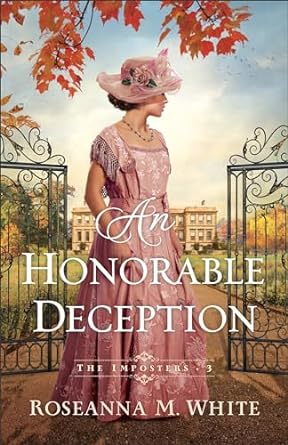
Review: An Honorable Deception

An Honorable Deception

An Honorable Deception is the third in Roseanna M. White’s Imposters series about an aristocratic English pair of siblings in the early 1900s whose father left them nearly penniless. One of the father’s extravagant expenditures was a circus, whose residents now make their home at the Fairfax tower and whose staff taught the siblings, Yates and Marigold, skills to help them in their venture as private investigators

Yates heads to the church of a friend, James, who allows him to conduct interviews with potential clients in the confessional booth. Yates poses as “Mr. A” with an accent, Scottish this time. A “Miss B” on the other side of the booth asks him to help find her ayah, Samira. Miss B had been raised in India when her father was a viceroy there. Samira was with the family until they moved back to England, and since then she has traveled back and forth in several similar situations. Miss B. and Samira have remained close and meet whenever Samira is in town. But Samira missed their scheduled meeting, and so did a friend who was supposed to give Miss B. some news.

As Mr. A. and Miss B talk, they hear banging doors and hurried footsteps. Before Yates can stop her, Miss B leaves the confessional, says, “You!” and is shot three times.

Yates is in danger of blowing his cover, but he has to help Miss. B. As he leaves the confessional, the men have gone, and he discovers Miss B. is none other than Alethia Barremore, daughter of one of London’s leading families.

James and Yates bring Alethia to the Fairfax’s London home for her safety, fearing her attackers would find her in a hospital. As she slowly recovers, they learn more of her story and start looking into her case.

Also with the Fairfax siblings is a longtime friend, Lavinia Hemming.Yates had loved Lavinia when they were teenagers, but she developed scarlet fever which damaged her heart, leaving her ill for several years. Then when Yates discovered he had no money, he knew her parents would never consent to him asking for her hand. And Lavinia herself seemed totally uninterested in him.

In one of the previous books, Lavinia discovered her mother was a traitor who threatened her life, her father’s and Yates’. Her mother was killed, leaving Lavinia to recover from the disillusionment of her deception. With her father away, Lavinia accompanies the Fairfax siblings to their Northumberland tower, where she accidentally learns that they are the Imposters. She recruits herself into the group to help.

Their investigation turns out to be involve more than a missing ayah as they uncover some of society’s seedier secrets.

I don’t want to spoil the story, but some readers would want to know the last half of the book shares details of child abuse and sex trafficking. However, nothing explicit is shown.

As almost always, I loved Roseanna’s story. Though dealing with a serious subject, there are moments of lively banter. And Lavinia and Alethia wrestle with several emotional issues in the wake of their parents’ sins.

A fun surprise in this book was the appearance of Barclay Pearce from Roseanna’s Shadows Over England series about a group of street kids who form their own family.

There’s an interview with Roseanna about this new book here. I assume this is the last of the Imposters books–Roseanna’s series all seem to form groups of three. If so, I’ll miss these characters.

(Sharing with Bookish Bliss Quarterly Link-Up)

Review: Across the Ages

Across the Ages

Across the Ages is the fourth in Gabrielle Meyer’s novels about time crossers: people who live in more than one timeline until their twenty-first birthdays, at which time they can choose which of their timelines to stay in and which to forfeit.

In all the previous books, the time crosser had a parent to tell them what was going on and share the rules. In this book, Caroline’s mother left her as a baby with her grandfather in South Carolina in 1727 and then fled, never to be heard from since.

Caroline goes to sleep in South Caroline and wakes up in Minnesota in 1927, where she is the dutiful daughter of a famous pastor. The next night, she goes to sleep in MN and wakes up in SC on a plantation with her grandfather, without having lost a day in-between.

When Caroline tried to tell either family about her strange existence as a child, they scolded her for making up stories. Her grandmother from her 1727 life had been burned at the stake as a witch. All Caroline can figure is that she’s under a curse from that grandmother.

When her grandfather in 1727 plans to force her into an arranged marriage with a man she doesn’t love, she decides to try to find her mother to get some answers. Caroline dresses as a boy and finds work on a ship to Nassau, the last known location of her mother. Everything goes well—until her boat is captured by pirates.

In 1927, Caroline’s brothers don’t live up to her father’s standards. One is a crooked cop, the other a crooked businessman. She tries to keep her brothers’ activities secret so as not to harm her father’s reputation. But she admits that living under public scrutiny is wearing. Her own search for answers leads her to places her parents wouldn’t want her to go.

Gabrielle Meyer keeps finding ways for new takes on this unique concept. This is the first book where the main character isn’t related to the main characters in the previous books. But I realized further in that there was a connection in this book with some of the side characters from the third book, For a Lifetime.

I listened to the audiobook, nicely read by Rachel Botchan, who has narrated all the books in this series. Thankfully, the audiobook included the author’s historical notes.We meet Ernest Hemingway and Charles Lindbergh as characters in this book, and several others are based on real people. Caroline’s preacher father is based on Billy Sunday, which I had guessed due to his having been a professional baseball player. However, I had not known that Sunday’s sons did not share his faith and dabbled in the things he preached against, like Caroline’s brothers did.

Some readers would want to know that there is mention of adultery and brothels with the corrupt brothers, but nothing explicit is shown.

Part of the history also included in this novel was the O’Connor agreement in St. Paul, MN, whereby criminals could stay in the city without being bothered as long as they checked in with the police, paid bribes, and did not commit crimes while there.

But besides the fascinating historical detail, I enjoyed Caroline’s personal journey, though it was painful for her in parts. She struggles to discern what true belief in God is, rather than just performing outwardly to her parents’ expectations. And she finds that she is not cursed, but blessed.

Although this book could be read alone, I’d recommend the whole series.

Review: The Secret Keepers of Old Depot Grocery

The Secret Keepers of Old Depot Grocery by Amanda Cox

In The Secret Keepers of Old Depot Grocery, a novel by by Amanda Cox, Sarah Ashby’s husband has just died. She returns to Brighton, TN, where she grew up and where her mother and grandmother still run the Old Depot Grocery Store which her grandfather began. All she wants to do is settle back in Brighton and help run the store she loves so much.

But her mother, Rosemary, doesn’t want Sarah to feel stuck in Brighton like she did. She keeps pushing her to move on and see the world.

And even if Sarah stayed, the old grocery isn’t doing well since the big new chain store opened nearby. Rosemary is pushing her mother, Glory Ann, to sell while they have interested buyers. Besides, Rosemary has urgent reasons to sell, reasons Sarah and Glory Ann know nothing about.

But the Old Depot was Glory Ann’s husband’s legacy, his way of ministering to the community. He never gave up. How can she?

The novel is told with a dual timeline, the second one in 1965 detailing Glory Ann’s life from her teen years. She was engaged to her blue-eyed farmer boy, Jimmy. But he was called up to fight in Viet Nam and was killed not long after. She didn’t have a chance to tell him that she carried the baby conceived from their one night of indiscretion.

Glory Ann’s father was a preacher who arranged for Glory Ann to marry Clarence, the son of an old-time friend. Clarence has been told the situation and is willing to marry Glory Ann. She resists, but her father says her sin will destroy his reputation and ministry as well as hers if it becomes known.

Glory Ann, Rosemary, and Sarah each have secrets that they think are protecting the others. Instead, misunderstandings and assumptions strain their relationships.

I love the way Amanda wove the different threads of this novel. As with her first novel, which I loved, The Edge of Belonging, the story has multiple layers: unplanned pregnancies, the nature of true love, the nature of everyday ministry, the damage secrets can cause and the freedom truth brings, PTSD. (Her first novel had a character with PTSD, too, making me wonder f someone in her family did.)

I listened to the audiobook, which was free from Audible’s Plus Catalog and read by Stephanie Cozart. The narration was well-done except the fake Southern accents were a little overwrought and grating to me. I think I would have liked this better in print.

But I did love the story and highly recommend it.

Review: The Edge of Belonging

The Edge of Belonging by Amanda Cox opens with a homeless man, Harvey James, finding a newborn baby abandoned near his camp. He cleans her up and decides to look for a nice house with toys in the yard. A family with children would know what she needed. But none of the places he sees seem suitable.

He names her Ivy for the way she wound her way around his heart so quickly.

When he stumbles upon a pantry at a church with baby supplies, he begins to wonder if he could take care of her after all. At least for a while.

Twenty-four years later, Ivy is engaged and working her dream job as a counselor in a school when she learns that her grandmother has passed away. None of her family is related by blood, but their bond is strong as if they were. She goes home for the funeral, but her fiance’s selfishness in not wanting her to go makes her realize how controlling and emotionally abusive he has been.

She receives a letter her grandmother sent before her death, asking Ivy to take care of some of her things and telling her about a journal detailing her origin.

Ivy had always been told she had been left on her adopted parents’ doorstep as a baby, and they took her in. But her grandmother indicates there was more to the story.

After breaking up with her fiance and losing her job, Ivy travels back to her grandmother’s house. But the journal is missing. Her parents and uncle won’t answer any questions about her birth, saying the past is better left behind. But Ivy feels she needs to know where she came from to determine where she should go next. She begins to piece together clues found in her grandmother’s belongings.

The story switches back and forth from the events after her birth in 1994 and the present day, with the people and circumstances in Ivy’s and Harvey’s lives slowly revealed.

I loved this book. Some of the themes involve the nature of family, healing of wounded souls, the nature of sacrificial love, reaching out to help others even when they might reject it. The book also touches on homelessness, PTSD, depression, infertility, the foster care system, sex trafficking, and more. Everyone has a story, and that’s true of all of the main characters here.

Although I enjoyed Ivy’s journey, Harvey is my favorite character. At the beginning, he’s so skittish he can barely hold a conversation. He’s been shuffled aside so many times, he’s closed off to everyone. But his love for Ivy pushes him to extend himself far beyond his comfort zone.

Ivy’s Grandma Pearl is another favorite, but I can’t tell you too much about her without spoiling the story. Though both sides of the dual timeline focus on Ivy, Pearl is in many ways the hub of the wheel that connects all the characters. She says of herself, “If the story of my life could say one thing, I’d hope it would show the importance of venturing into the highways and the hedges to let invisible people know they’re seen and loved. To invite them in.”

A couple of other sentences that stood out to me:

I’m starting to see that when I let go of my grip on my pain, I make space for new things. Things that bless me in a way I never would have imagined. I’m getting there little by little—learning how to release my disappointments and embrace the gifts I have (pp. 295-296).

It’s not about my pain versus your pain. It’s about sharing in the human experience and knowing what it is to hurt. It takes courage—stepping forward and healing when it’s so tempting, so safe, to stay and worship the altars we’ve built to our pain (p. 297).

I started out listening to the audiobook, nicely read by Leah Horowitz, which was free from Audible’s Plus Catalog. But Audible rotates titles in and out of their free offerings, and this book rotated out about a day before I could finish it, so I lost the quotes I had marked in the early part of the book. Thankfully, our library had a copy, so I could finish the book.

This book was Amanda’s debut novel in 2020. I’m looking forward to reading the books she has written since then.

Review: Tending Roses

In Tending Roses by Lisa Wingate, Kate Bowman drives with her husband and baby son to her grandmother’s Missouri farm a few weeks before Christmas. But this will be no idyllic holiday season.

Kate’s grandmother “had a talent for stirring up unpleasantness, she was an expert on every subject, and she felt the need to control everyone” (p. 16). She acted like a martyr when she didn’t get her way. She was so fussy about her house, Kate often felt she loved it more than her.

Kate’s grandmother has become forgetful and nearly burned the farmhouse down. Kate’s father and aunt are coming for Christmas and planning to move Grandma Rose into a nursing home.

All the family has not been together and has rarely spoken to each other since Kate’s mother died.

So this holiday family reunion has all the makings of a potential war.

Kate and her husband have been elected to go to the farm early, under the guise of an extended visit, to help keep an eye on Grandma and prevent any other fires or disasters til the rest of the family comes. Kare is still on maternity leave due to her son’s heart condition, and her husband works remotely, so they are the perfect candidates.

But worries over the baby’s health, the piles of medical bills, and her assistant taking over her job have Kare distracted.

At first the visit goes about as well as Kate expected. But one day she finds her grandmother’s journal and discovers the hopes, dreams, and trials she experienced as a younger woman. That and getting to know her on an everyday level have Kate questioning her own future as well as the family’s decision about Grandma’s.

There’s naturally a lot of tension at first in the book with all the personality clashes and problems. But I loved the story arc and the slow understanding that developed between Kate and her grandmother.

A secondary story line involves Dell, an impoverished child living nearby in a shack with her ailing grandmother. “Poverty and ignorance were characters we saw on TV, or sometimes passed on the highway while traveling to some vacation hideaway. They were not our neighbors. They did not have faces with soft brown eyes and down-turned mouths that never smiled” (p. 83).

A few sentences that stood out to me:

I felt a little like a wishbone in a tug-of-war (p. 146).

Grandma sensed World War III coming on and stepped in like Switzerland (p. 175).

That’s the problem with people. We’ll starve to death looking over the fence when we’re knee-deep in grass where we are (p. 206).

Years have mellowed my joy in Christmas, as in all things. The packages, the tree, the fire, all carry memories to me—reminders that I am the last. Looking at them, I relive, remember, and regret. And an ache blossoms in my breast that I am no longer young (p. 232).

This had been the hardest year of my life, when all the colors ran outside the lines I had drawn, but also the year when I finally discovered myself (pp. 272-273).

This story is more than a reminder to “stop and smell the roses.” It weaves together themes of family, forgiveness, faith, materialism versus contentment, aging, caring for each other, especially the elderly.

This book is the first in a series of five. I’m looking forward to the rest of the series.

Review: Written on the Wind

Written on the Wind by Elizabeth Camden

In Written on the Wind by Elizabeth Camden, Natalia Blackstone has an unusual position for a woman in 1900. Her father owns a major bank in New York. Natalia rose through the ranks until she became one of his main analysts. Because her mother was Russian and Natalia speaks Russian fluently, she heads the analysis and funding for the Trans-Siberian Railway project.

She has communicated so often with the man in charge of the project, Count Dimitri Sokolov, that the two have become friends. Their correspondence veers into music, literature, and a number of other interests.

Lately, however, Natalia hasn’t heard from Dimitri. When she inquires about him, she is only told that he is no longer on the project.

Unknown to Natalia, Dimitri had been ordered to take part in an appalling crime. When he refused, he was arrested, stripped of his title and lands, and exiled to a Siberian penal colony. His only hope is to escape and tell the truth about what happened. But the incident will reflect poorly on the czar, so Dimitri must tread carefully. Without cash and contacts, he plans an impossible journey to get to Natalia, the only trustworthy person able to help him.

I very much enjoyed that the plot, setting, and characters were all much different than anything I have read before.

The only other book I have read from this author, The Rose of Winslow Street, had characters from Romania. With that and this book having Russian characters, I wondered if the author had a Russian heritage or a special interest in that region. The audiobook had an end note with details about the Trans-Siberian Railway, but nothing about the author personally.

Unfortunately, the narrator of the audiobook had an annoying way of over-enunciating. Plus she emphasized minor words in sentences, like propositions. (“He navigated THROUGH mirrored hallways”; “AFTER arriving IN New York . . .,” etc.). She made a faint attempt at the accent of an Irish character but none with any of the Russians. I am going to avoid this narrator in the future.

I didn’t realize, when I started the book, that it was the middle volume in a series. But it read well as a stand-alone. I looked through my Kindle library and saw I had the first book in the series on hand, so I’ll look into that one some time.

Review: Hope Between the Pages

Hope Between the Pages by Pepper Basham

Hope Between the Pages is a split-time novel by Pepper Basham.

In 1915, Sadie Blackwell is the resident library servant in charge of the books in the Biltmore House in Asheville, NC. A book-lover herself, Sadie enjoyed keeping the library tidy, leaving books guests might like on a library table, and reshelving the books once guests were done with them.

Just a year after George Vanderbilt’s passing, Sadie continued in the position her mother held before her.

As a servant, Sadie was supposed to be “invisible,” vacating the room when guests came in. But one day, she couldn’t get to the door in time and hid. She overheard a British father and son, the Camdens, talking with Mrs. Vanderbilt about books. The son, Oliver, appeared to love books as much as Sadie did. Based on his remarks, she later pulled some books she thought he might like. He responded with a note for the “Library Fairy” whose selections matched his tastes so well.

Not content with a thank you note, Oliver wanted to meet this Library Fairy. She found it difficult to remain invisible from such a pursuit.

In present day Asheville, Clara Blackwell owns a bookstore in Biltmore village, inherited from her father, who recently died. Though she loves her work, the bookstore is faltering a bit since the new big chain bookstore opened nearby. And her uncle Julian, her father’s half-brother, is making a nuisance of himself, trying to encourage Clara to sell. On top of all that, Clara is informed by her lawyer that he does not have a deed for the bookstore on file. If she can’t find the deed, Clara may lose the bookstore anyway.

In searching for the deed, Clara finds a box of her grandmother’s with a couple of notes addressed to a “Library Fairy.” The notes led to a series of discoveries about Sadies’s life previously unknown to the family.

Both women’s journeys take them beyond their predictable environments to step out on faith.

The Biltmore House library is my favorite room in one of my favorite places. I’ve wished many times that I could go beyond the cordoned-off path on one side of the library and walk into the room. I wouldn’t disturb any of the books, but I’d like to scan the titles up close, sit in one of the chairs, and soak up the ambience. However, I imagine if all of us who wanted to did that, we’d probably wear out the furniture and carpet. So you can imagine my delight to find so much of the book connected to Biltmore’s library!

The scenes in the rest of the house and the imagined conversations with Mrs. Vanderbilt were fun as well.

And with a librarian and bookstore owner as main characters, the book contained many literary references.

But beyond the bookishness of the stories, I loved the characters and their arcs. Besides the theme of stepping out of faith, being willing to leave the familiar behind, another undercurrent was being seen beyond the surface to what we really are underneath.

A few of my favorite quotes:

Few people are as they appear at first, and it behooves the heart of a Christian to see with gracious eyes our fellow humans, whether of high-bred means or low. After all, I’d been a servant, or the daughter of a servant, my entire life, and certainly hoped, if given the chance, people would see me for more than a quiet worker with nothing of interest to say. I had plenty to say—too much, really, for my occupation (p. 42).

God was there. And here. And all the places in between. Couldn’t I trust Him with the horizon as I trusted this ship to carry me . . ? (p. 147).

I’d lived a quiet life as long as I could remember, so solitude didn’t frighten me. In fact, I slipped it on like a pair of well-loved shoes (p. 164).

Maybe the definition of romance wasn’t some generic ideal dispersed among the romance-reading masses. Perhaps, in real life, romance corresponded to the intimate and individual needs of the two hearts. Unique. A handcrafted, heavenly match (p. 219).

Keep to your Bible and to your fairy tales, sweet girl. One is for your soul and the other is for your daydreams. Both will help you through this, and in both you’ll find your story (pp. 245-246).

My father always told me to never outgrow my belief in faith and fairy tales, but fear has a way of darkening one’s vision, and so I’d lost of the beauty God displayed through magical stories. Not so much the glass slippers or the poisoned apples, but the deeper truths. The light overcoming darkness. The rewards of perseverance. The beauty that can come through trials of thorns or battles or even sleeping death. I’d forgotten that imagination gives me so much more than the ability to fall into the world of a book. It motivates my dreams, inspires remarkable love, and helps me see beyond this world to a greater one (pp. 249-250).

I’d never considered how some of our greatest losses lead us to choices that God uses for bigger things than we could have ever imagined. Sometimes brokenness and heartache force us into self-seclusion and fear, and sometimes they can propel us into something amazing, if we let them (pp. 251-252).

I think many people would love this book even if they weren’t so much interested in the Biltmore House and classic literature.

This book is one in a Doors to the Past series. Each is written by a different author and involves a historic American landmark. I think each may be a split-time novel as well. This is the only book I’ve read in the series.

This is also the first book of Pepper’s that I have read, but it won’t be the last, especially knowing she lives in and writes about the Blue Ridge Mountains area of North Carolina.

Review: When We Were Young and Brave

When We Were Young and Brave

The day after Japan attacked Pearl Harbor, the Japanese invaded the Chefoo school for missionary children in what is now known as Yantai in northern China. They allowed the school to operate and keep to its schedule, though they rationed food and policed activities. Almost a year later, the Japanese took over the school buildings completely and sent the staff and students to an abandoned missionary outpost known as Temple Hill, keeping them under Japanese guard. In September 1943, the staff and student were transported to an interment camp known as Weihsien with 1,500 other people from various walks of life. They remained Weihsien until it was liberated by Americans in 1945.

Hudson Taylor, founder of the China Inland Mission, had founded the Chefoo school in 1881 for the children of CIM missionaries. A few children of other Europeans also attended the school.

I had read of the Chefoo school and its capture in various missionary biographies and in David Michell’s memoir of his time as a Chefoo student in A Boy’s War. So I was interested to learn that Hazel Gaynor wrote a fictional account of the school’s interment in When We Were Young and Brave.

Gaynor’s characters are fictional. She focuses mainly on a ten-year-old girl named Nancy, nicknamed Plum, and and two of her friends as well as one teacher, Elspeth Kent and her friend. The chapters switch back and forth between the point of view of Nancy and Elspeth, so we get both the adult’s and child’s view of events. One of Nancy’s friends, Joan, aka Mouse, gets one chapter late in the book.

The story begins with the everyday workings of the school with the Japanese occupying the surrounding area. The Chefoo school was fairly self-sufficient, so they didn’t fear the Japanese, though they disliked the tension of having them nearby.

Everything changed, however, when Japan declared war on Great Britain. Now everyone at Chefoo school was the enemy.

Thankfully, many students were away for Christmas break at the time of the Japanese occupation. Those at the school over the holidays were unable to be with their parents due to lack of safety to travel.

As the years wore on, the strain became harder to bear with lack of proper food and the increasing fear of the Japanese guards.

The school staff tried to keep everyone’s spirits up by maintaining classes and Girl Guides (similar to Girl Scouts in the USA). But they all faced various hardships.

The book opens and closes with the adult Nancy, thirty years after liberation, reflecting on her experiences.

The book is well-written. The characters are relatable and well-developed. As a reader, I felt the weight of what they were going through.

A few quotes stood out to me:

Our war wasn’t one of battles and bombs. Ours was a war of everyday struggles, of hope versus despair, of courage against fear, strength over frailty (p. 198).

In the most peculiar circumstances imaginable, their interment had insured that they were capable beyond their years (p. 243).

War and interment are part of their lives now, part of their story, part of who they are. . . . I actually think life is meant to have its share of difficultly and struggle. That’s when we find out who we really are, what we’re really made of, not when everything’s going along all jolly and straightforward and terribly nice. We come alive in the dramatic bits, don’t we; in moments that make us gasp and cry (p. 285).

But a few factors marred my enjoyment of the book.

First, Gaynor often refers to the children as “privileged.” Since most of them were missionary children, this was not a posh, expensive boarding school for the higher classes. There was probably some sense in which the children were more privileged than some of the Chinese nationals, who had been fighting Japan for a while already. But it wasn’t necessary to infuse the same sensibilities as one would have for a standard elite British boarding school.

Secondly, the school was established as a Christian school. According to David Michell, the school still provided “a truly Christian education for body, mind, and spirit” when he was there. But there is little mention of Christianity in Gaynor’s book. When Elspeth only took two books with her when they left Chefoo, she chose her Girl Guide Handbook and the Buddhist scriptures a Chinese servant had given her, not a Bible. She mentions struggling all her life to believe in God and says a budding sunflower gave her “more strength and hope that any prayer ever had” (p. 118). The teachers’ encouragement is the British stiff upper lip, “Keep calm and carry on” variety rather than anything of a spiritual nature.

Then, Elspeth feels that the children’s parents put their mission above their children by sending them away to school. That was not usually the case. Though teaching at home predates institutional learning, home schooling was not the industry then that it is now. Parents might have been able to teach their children at home on the mission field for their early years, but likely would not have had the material to do so as they got older. Plus, the children would not have had the credentials to go to college. Thankfully, these days, many mission boards work with parents to teach their children at home.

Additionally, some of the missionaries worked in remote areas with very few other Christians. Isobel Kuhn wrote that the tribe they worked with didn’t worship idols: they worshiped demons. When her son got old enough that she couldn’t keep him at her side all day, she feared what he would be exposed to as he interacted with people on the village. For many parents, sending their children away to school was for their protection.

Gaynor wrote that she drew from some of the internees’ own accounts at Weihsien Paintings and the Chefoo School Archives in London as well as other books. But all her characters were invented (except Olympic runner Eric Liddell, who was a missionary to China, and was interred at the camp. He died there of a brain tumor). Her characters and their interactions largely came from imagining what her own children might do in this situation, what she would have felt like as a parent at the time, and her grandmother’s war-time experiences. So I struggled a bit with not knowing was was real in the book and what came from the author’s imagination.

At some point, I set aside what I knew of the school and just read the book for what it was: a fictionalized account of people enduring and overcoming great, sustained hardships. I enjoyed it much more after that. But it spurred me to get David Michell’s book to reacquaint myself with the real story.

Review: A Month of Summer

In Lisa Wingate’s novel, A Month of Summer, Rebecca Macklin lives in LA, has a legal practice with her husband, and runs her 9-year-old gymnast daughter to practices and meets.

Then Rebecca receives a devastating phone call. She has not seen her father in over thirty years. She was supposed to spend a month of every summer with him and his new family as part of the custody arrangement of her parents’ divorce when she was twelve. But she refused to go. Her father honored her wishes.

Her stepmother has written over the last couple of years that Rebecca’s father developed dementia and urged her to make peace before it was too late. But Rebecca ignored her. Why bother making contact with him now?

But a phone call from Dallas puts Rebecca in a tough spot. Her step-mother has had a stroke. Her developmentally disabled step-brother was roaming town alone, having gotten on a bus without being able to figure out how to find his way home. Her father was totally confused. The police found Rebecca’s name on a contact list. If she didn’t come to take care of her father and step-brother, Social Services was going to get involved.

Reluctantly, Rebecca makes plans to go. But on the day she leaves, she sees her husband at an outdoor cafe holding hands with one of his clients. Is this why he has been working late? Without time to confront him, she boards her flight, with all the problems of her life weighing her down.

But when she arrives in Dallas, things are worse than she imagined. A housekeeper who was supposed to keep things in order has disappeared. Dirty dishes and molded food are everywhere as is dirty laundry. Wet laundry has mildewed in the washer. And money is missing from her father’s accounts.

The point of view shifts back and forth from Rebecca and her step-mother, Hanna Beth. Hanna Beth is cognizant, but can’t express herself or control her movements. When she learns that Rebecca has come, now of all times, she wonders what will happen. Will Rebecca ship her father and step-brother off to institutions before Hanna Beth can recover enough to go back home?

As each woman painfully peels back layers of the last several years, they learn things aren’t always as they appear.

I saw one reviewer call this a light and easy read. I didn’t think so, myself. It was a good read, but felt very heavy sometimes, except for the knowledge (or at least the hope) that things would work out somehow in the end.

There’s a delightful cast of side characters in the book: a sweet older woman Rebecca meets on the flight who she runs into again later, a talkative older man in Hanna Beth’s nursing center, a stern German physical therapist, a sweet aide with two boys, a nurse from Ghana. I loved one teasing line from the nurse who was trying to get the older man back to his room: “Old rooster, he loud on the fence, quiet in the stew.”

This book is the first in Lisa’s Blue Sky Hill series about a neighborhood in Dallas. I had read the second book in the series, The Summer Kitchen, as well as the fourth, Dandelion Summer. But there were so many years between each read, I could not remember if any of these characters showed up in the later books. I probably would have caught more of the connections if I had read them in order and closer together, but each book does hold up well as a stand-alone.

Review: Mildred Budge in Cloverdale

Mildred Budge in Cloverdale

Mildred Budge in Cloverdale by Daphne Simpkins is the first of several books about retired schoolteacher Mildred Budge. Mildred retired a little on the early side, but we’re not told why until a few chapters in.

Mildred is finding retired life anything but peaceful. Her best friend, Fran, has set them up in booth for the Emporium to sell off some of their used furniture. A young couple across the street wants her help with their son, who doesn’t talk. And Sam at church wants her to host a young couple coming for the missionary conference.

Mildred is somewhat set in her ways, but is pressured to take the young couple in. She finds herself actually enjoying them and joins in with some of their activities.

But trouble comes when suspicious “serial widow” Liz makes moves towards Fran’s boyfriend and when Mildred is betrayed by someone she tried to help.

I liked that Mildred loosened up a bit over the course of the book and had a heart to help people.

But I’m sorry to say I did not care for this book very much. The author’s writing and style of humor didn’t gel with me. Plus there were many statements about what “church ladies” do and think (as if they all think and do the same) that rubbed me the wrong way–although those statements may have been meant as humorous. Also, a lot of lines of dialogue sounded stilted because of several paragraphs of extraneous information between each speaker’s lines.

Some of the spiritual content was a little wonky, like this: “Salvation is an old-timey word that simply means you don’t have to live out this life alone. You are not created to live like that” (p. 55, Kindle version). This was from a preacher at a funeral service. Salvation isn’t that old-timey a word, and it’s much more than not living alone. Later, when a young woman says she might be interested in having Jesus in her life, Mildred “felt an urgency” to ask her just to say His name. But the conversation (and any explanation) never went further. In the excerpt from the next book at the end, one man says a pastoral candidate at the church “preached grace, which means he wasn’t willing to preach Jesus front and center”—which doesn’t make sense.

I found very few negative reviews on Amazon or Goodreads for this book, so lots of other people liked it. I got it when Paula mentioned enjoying it. At that time, it was free for both the Kindle and Audible versions, so I got both. However, the Audible version was narrated by a “Virtual Voice,” which was not very good. It sounded human rather than robotic and had a bit of conversational flow to it, but it did not do inflections well and stumbled over words like “Tsk.”

Have you read Mildred Budge books? Have you ever disliked a book other people loved?