
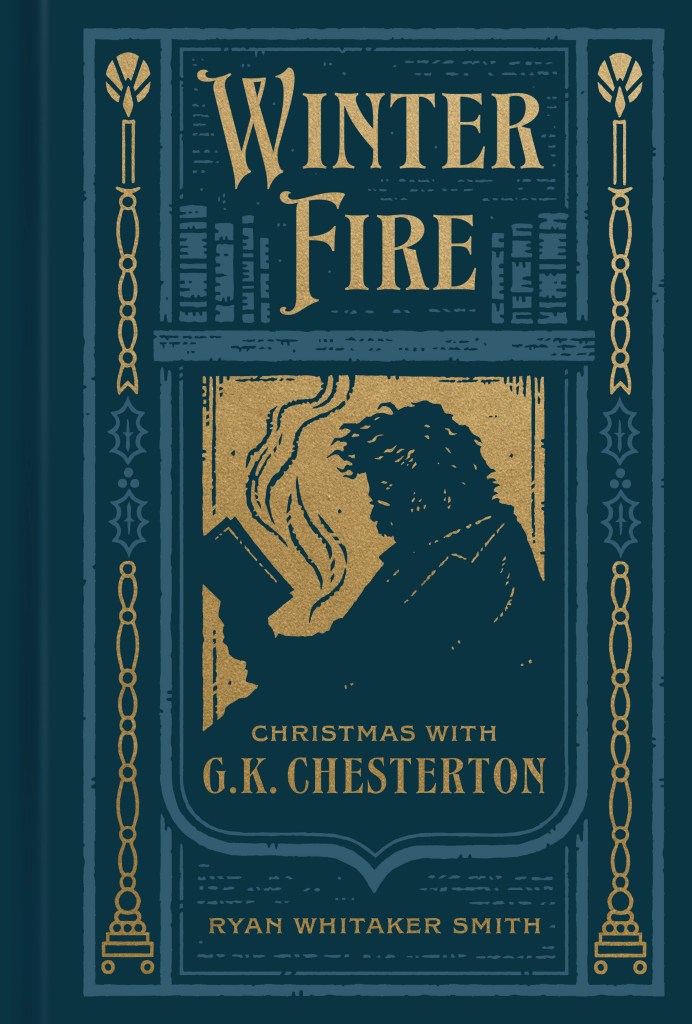
I’ve not read G. K. Chesterton except for one novel, The Man Who Was Thursday, and a few pithy quotes. The quotes were enough to entice me to read more. So I was excited to see Winter Fire: Christmas with G. K. Chesterton by Ryan Whitaker Smith.
When I looked at the sample of the book at Amazon, however, I was disappointed that the book seemed to be less of Chesterton and more on Smith commenting on Chesterton. I eventually decided to get the book anyway, and I am glad I did.
Smith says that reading Chesterton is an “acquired taste,” and I agree. I would not have gotten nearly so much out of Chesterton’s quotes here without Smith drawing out the meaning.
If you’re not familiar with Chesterton, Wikipedia says he “wrote around 80 books, several hundred poems, some 200 short stories, 4,000 essays (mostly newspaper columns), and several plays. He was a literary and social critic, historian, playwright, novelist, and Catholic theologian and apologist, debater, and mystery writer.” He was a columnist for several newspapers and even wrote some Encyclopedia Britannica entries (including the one for Charles Dickens). He might be known best for his Father Brown stories about a priest who also does detective work.
He was baptized into the Church of England as a child, dabbled in the occult, then came back to the Anglican church as an adult, and later converted to Catholicism. I am curious how and why he embraced Catholicism but haven’t read enough to know his thinking. But “Christian themes and symbolism appear in much of his writing.”
Smith says Chesterton wrote prolifically about Christmas, much more than could be included in this book.
Winter Fire contains thirty days of readings, with Smith expanding on, explaining, and giving the cultural background to quotes about Christmas from some of Chesterton’s essays. After each reading is a Bible verse and questions for thought.
Then there are a variety of Chesterton’s other writings: several poems, a few essays, and a couple of short stories. Finally, Smith included recipes and games prevalent at the time Chesterton lived (1874-1936). The weirdest game, called Snapdragon, involved raisins doused in brandy, then set on fire. Then children tried to reach into the fire quickly and grab a raisin.
One of the readings here inspired a blog post, A Christmas Boomerang, and I have another post or two in mind based on thoughts read here.
Smith says the title of this book “is taken from a quote featured in the reading for Day 13: ‘Christ is not merely a summer sun of the prosperous but a winter fire for the unfortunate.’ The image of a fire burning amid the frosts of winter seemed a fitting image to draw from for a book that not only celebrates the comfort, joy, and revelry of Christmas, but the mercy of God who has called us to His everlasting feast” (p. 12). He writes that “The purpose of our journey is not so much to dwell in ‘the place from which Christmas came,’ but to allow that place to dwell in us, to return to our own country with christened eyes, to look upon our everyday surroundings with a baptized imagination” (p. 17).
I have scores of quotes marked, but I’ll try to share just a few:
In the majestic march of Progress, we have first vulgarised Christmas and then denounced it as vulgar. Christmas has become too commercial; so many of these thinkers would destroy the Christmas that has been spoiled, and preserve the commercialism that has spoiled it” (Chesterton, p. 32).
I have never understood what people mean by domesticity being tame; it seems to me one of the wildest of adventures (Chesterton, p. 45).
Omnipotence and impotence, or divinity and infancy, do definitely make a sort of epigram which a million repetitions cannot turn into a platitude. It is not unreasonable to call it unique. Bethlehem is emphatically a place where extremes meet. (Chesterton, p. 84).
Christmas did not merely borrow certain traditions from paganism; it survived paganism. It was a stronger thing than all the pagan world could offer. It was fiercer than its creeds, more potent than its rituals (Smith, p. 116).
The land endures the harshness of winter in order to be reborn in the vigor of spring. Everywhere we look, nature is rehearsing resurrection, preparing for the day when all things will be made new, when measurable time gives way to immeasurable eternity (Smith, p. 128).
These are a couple of stanzas from Chesterton’s poem “The House of Christmas”:
A Child in a foul stable,
Where the beasts feed and foam;
Only where He was homeless
Are you and I at home;
We have hands that fashion and heads that know
But our hearts we lost—how long ago!
In a place no chart nor ship can show
Under the sky’s dome.
To an open house in the evening
Home shall men come,
To an older place than Eden
And a taller town than Rome.
To the end of the way of the wandering star,
To the things that cannot be and that are,
To the place where God was homeless
And all men are at home.
The book cover, texture, and illustrations have a lovely old-fashioned feel to them.
Chesterton uses a lot of irony, and often. as Smith says, is “saying several things at once” (p. 11). I have question marks at a couple of places in the book. But I was inspired, taught, and encouraged by much that I read, and I am sure I’ll read this again in future Advent seasons.
(Sharing with Bookish Bliss Quarterly Link-Up)






 Stray Thoughts