Book Review: The Yearling

YearlingThe Yearling by Marjorie Kinnan Rawlings is the story of twelve year old Jody Baxter, who lives with his family in a backwoods area of Florida known as “the scrub” in the years after the Civil War. His parents, Ezra (nicknamed Penny because of his small stature) and Ory, have previously lost six children in infancy. This and the fact that he had a hard upbringing himself makes Penny want to let Jody be a child for as long as he can and makes him even more dear. But Ory, though not totally lacking in affection, is somewhat detached from Jody, and has hardened somewhat after all the losses and hardscrabble existence. She says, “Seems like bein’ hard is the only way I kin stand it.”

Though “friendliness and mutual help in time of trouble” was more available in towns, Penny wanted the peace of the scrub:

He had perhaps been bruised too often. The peace of the vast aloof scrub had drawn him with the beneficence of its silence. Something in him was raw and tender. The touch of men was hurtful upon it, but the touch of the pines was healing. Making a living came harder there, distances were troublesome in the buying of supplies and the marketing of crops. But the clearing was peculiarly his own. The wild animals seemed less predatory to him than people he had known. The forays of bear and wolf and wild-cat and panther on stock were understandable, which was more than he could say of human cruelties.

Jody begins as a good-hearted but immature boy, off rambling in the forest when he should be hoeing the corn. He wants a pet, but his Ma is against it: it’s hard enough to keep the family fed. Although Penny wants Jody to be carefree as long as possible, he takes Jody on various forays like hunting, trading, planting, etc., teaching him and imparting wisdom along the way. When Penny wants to take Jody trading with their nearest neighbors (four miles away), the rowdy Forresters, he and Ma argue:

“Jody has got to mix with men and learn the ways o’ men,” Penny said.

“The Forresters’ is a fine place to begin. Do he learn from them, he’ll learn to have a heart as black as midnight.”

“He might learn from them, not to.”

The Baxters face perils from bears, particularly a smart, sneaky one nicknamed Ol’ Slewfoot because he’s missing a toe, panthers, wolves, catastrophic weather, and snakes, but there are also visits with friends and Christmas parties and fun times as well.

At one point when a doe is killed during an emergency, Jody discovers she had a fawn. When he pleads with Penny to take it home since they were responsible for its mother’s death, Penny relents. Jody and the fawn, named Flag by a friend, become fast friends. But of course, as Flag gets older, he becomes harder to handle and a menace to the family’s crops.

The title would suggest the story is about the fawn, as it starts becoming a problem when it becomes a yearling. But several times in the book Jody is called a yearling, and the book is something of a coming of age story. Though the main storyline is about his transformation from a boy to a responsible youth, there are so many facets to the book: Penny’s understanding of and relationship with Jody, his wisdom and decency, how different people respond to the trials of life, how people existed in such a place and time. There is a wealth of knowledge about animal ways and how all their parts were used (who knew panther oil was good for rheumatism?)

Marjorie Kinnan Rawlings won a Pulitzer prize in 1939 for this book, deservedly so, and it’s the work she is most known for. As I was reading I mused that she had to be from this area, because her knowledge flowed so naturally it couldn’t have come just from research into it, and I was was delighted to find I was right: I found this interesting article about the area where Rawlings lived  in central Florida and where the movie based on the book was filmed. According to Wikipedia, her editor rejected several things she sent him and told her to “write about what she knew from her own life”; that advice led to The Yearling.

It has to be masterful writing that can include accented dialogue along with beautiful prose, almost poetic in places. Here are a few favorite spots:

He edged closer to his father’s bones and sinews. Penny slipped an arm around him and he lay close against the lank thigh. His father was the core of safety. His father swam the swift creek to fetch back his wounded dog. The clearing was safe, and his father fought for it, and for his own. A sense of snugness came over him and he dropped asleep (Chapter 4).

She clasped two fingers over her nose in a gesture of malodorous disgust (Chapter 11).

[After Jody threw a potato at the girl above], “Well, son, you cain’t go thru life chunkin’ things at all the ugly women you meet” (Chapter 11).

Grandma Hutto’s flower garden was a bright patchwork quilt thrown down inside the pickets (Chapter 11).

She drew gallantry from men as the sun drew water. Her pertness enchanted them. Young men went away from her with a feeling of bravado. Old men were enslaved by her silver curls. Something about her was forever female and made all men virile (Chapter 11).

A tenderness filled Jody that was half pain, half sweetness. In his agony, his father was concerned for him (Chapter 14).

At the house, Ma Baxter received the news stolidly. She had shed her tears and wailed her laments when the crops were ruined. As the going of too many of her children had wrung her dry of feeling, now the passing of the game was only another unprotested incident (Chapter 21).

“You got to learn takin’ keer o’ rations comes first of all–first after gittin’ ’em” (Chapter 22).

Ma Baxter rocked complacently. They were all pleased whenever she made a joke. Her good nature made the same difference in the house as the hearth-fire had made in the chill of the evening (Chapter 23).

Jody chewed on his licorice stick. The rich black juice filled his mouth and the talk filled another hunger, back of his palate, that was seldom satisfied (Chapter 25).

“You’ve seed how things goes in the world o’ men. You’ve knowed men to be low-down and mean. You’ve seed ol’ Death at his tricks. You’ve messed around with ol’ Starvation. Ever’ man wants life to be a fine thing, and a easy. ‘Tis fine, boy, powerful fine, but ’tain’t easy. Life knocks a man down and he gits up and it knocks him down agin. I’ve been uneasy all my life….I’ve wanted life to be easy for you. Easier’n ’twas for me. A man’s heart aches, seein’ his young uns face the world. Knowin’ they got to git their guts tore out, the way his was tore. I wanted to spare you, long as I could. I wanted you to frolic with your yearlin’. I knowed the lonesomeness he eased for you. But ever’ man’s lonesome. What’s he to do then? What’s he to do when he gits knocked down? Why, take it for his share and go on” (Chapter 33).

I think that last quote is one that resonated with me the most. We want to shield our children from hard things: even just telling them “No” when they’re toddlers can break our hearts. But we can’t. Hard times will come, and we hope that they’ll be resilient and keep hope and faith alive and let the hard times mature them without hardening them.

I had seen the film with Gregory Peck and Jane Wyman years ago and loved it and wanted to read the book someday, but just didn’t think of it when making reading plans for the year. When I finally thought about it a few weeks ago, I almost waited to include as a classics read for next year, but then decided I didn’t want to wait. And I am so glad I went ahead. I love this book. I’d like to see the movie again now as well.

For those who would want to know about objectionable elements, there is a smattering of “hells” and “damns” (usually from the Forresters), mentions of whiskey (also usually by the Forresters and sometimes the doctor, who took to drink after his wife died). There is an odd scene when Jody is spending the night with the Forresters, and they wake up in the night due to a commotion outside. He’s shocked to find that they are all naked, and then instead of going back to bed, they start playing music – still naked. I guess that’s to show just how untamed and unconventional they are. Because of these things I don’t think it is exactly a children’s book (at least not without some editing and/or discussions): young adults, maybe. But I enjoyed it as an adult while not condoning those aspects.

The book is not from a Christian standpoint, but as a Christian I like to see what aspects of faith and perceptions of God are in a story. There was an odd exchange about something the doctor said:

Buck said, “That Doc, he’d crack him a joke right in the Lord’s face.”

Penny said, “That’s why he’s a good doctor.”

“How come?”

“Well, he gits to fool the Lord now and agin.”

The one character depicted as a Christian, Penny’s father, was characterized unfortunately as “stern as the Old Testament God.” (It’s a common misconception that God in the Old Testament is aloof and stern but Jesus is kind and compassionate. But they are one, and there are many references to God’s love, mercy and compassion in the OT and His sternness in the NT.) There is a general respect for God’s providence and an occasional lament at what is seen as His hardness, but not really a closeness to Him. Penny’s prayer at a crippled boy’s burying are particularly sweet. I wish the characters could have known that “The eternal God is thy refuge, and underneath are the everlasting arms” (Deuteronomy 33:27) and “God is our refuge and strength, a very present help in trouble.” (Psalm 46:1).

As I was poking around looking at reviews and articles about The Yearling after I finished it, I discovered this song by Andrew Peterson called “The Ballad of Jody Baxter” based on the book (which made me teary). You can find the text online at Project Gutenberg Australia which includes some beautiful illustrations by N. C. Wyeth. I enjoyed listening to the audiobook very ably narrated by Tom Stechschulte and reread some passages online.

(This review will also be linked to Semicolon‘s Saturday Review of Books.)

Back to the Classics 2015 Wrap-Up Post

backtotheclassics2015BUTTON

The Back to the Classics Challenge 2015 requires a wrap-up post (at least to be eligible for prizes, but it’s nice, too, to look back over the fruit of one’s labors.) So these are the classics I’ve read for this challenge this year. Each links back to my review of the book.

1.  A 19th Century Classic — any book published between 1800 and 1899: Little Dorrit by Charles Dickens (Finished 7/22/15)

2.  A 20th Century Classic — any book published between 1900 and 1965: The Masqueraders by Georgette Heyer, 1928 (Finished 1/19/15)

3.  A Classic by a Woman Author: Emily Climbs by L. M. Montgomery, second in the Emily of New Moon series. (Finished 2/4/15)

4.  A Classic in Translation. a book written originally in a language not your own: Quo Vadis: A Narrative of the Time of Nero by Henryk Sienkiewicz (Finished 9/19/15)

5.  A Very Long Classic Novel — a single work of 500 pages or longer: War and Peace by Leo Tolstoy (Finished 4/20/15)

6.  A Classic Novella — any work shorter than 250 pages: The Little Prince by Antoine de Saint-Exupéry (Finished 6/22/15)

7.  A Classic with a Person’s Name in the Title: The Case-Book of Sherlock Holmes by Sir Arthur Conan Doyle (Finished 5/20/15).

8.  A Humorous or Satirical Classic. The Screwtape Letters by C. S. Lewis. Serious subject, but written in a satirical form. (Finished 9/26/15).

9.  A Forgotten Classic or lesser-known classic: The Dead Secret by Wilkie Collins.  (Finished 11/7/15).

10.  A Nonfiction Classic: The Problem of Pain by C. S. Lewis. (Finished 9/19/15)

11.  A Classic Children’s Book: By the Shores of Silver Lake by Laura Ingalls Wilder, 5th in her Little House series. (Finished 2/18/15)

12.  A Classic Play: Pygmalion by George Bernard Shaw. (Finished 7/30/15)

I am happy to have completed all the categories! That makes me eligible for three entries into Karen’s drawing.

I tried a few new authors and enjoyed meeting up again with some who were already known and loved, to try some of their other works.

As I said at the start of this challenge, I didn’t grow up reading a lot of classics, and I’ve been making a deliberate effort to include them in the past several years. Thanks to Karen at Books and Chocolate for encouraging that endeavor in such a clever and interesting way!

Book Review: The Screwtape Letters

ScrewtapeThe idea for what would become The Screwtape Letters first came to C. S. Lewis in 1940, and, when they were completed, they first appeared one at a time in a weekly Anglican publication called The Guardian. The public response prompted publishers to make it into a book as soon as possible. It was first published in England in 1942 and in the USA shortly thereafter.

Lewis thought it might be both “entertaining and useful” to write a series of letters from an older devil to a younger apprentice in his work of tempting and tripping up a new “patient.” The type of approach, presenting “a negative point of view to lift up the positive,” was unusual for Lewis, but he felt it “would give a fresh, even comical perspective on the subject and might attract readers who might not normally think about such things.” Why a comical approach for such a serious subject, one that ended up being very difficult and unpleasant for Lewis to write about?” Partly to “[lure] the ordinary reader into a serious self-knowledge under pretense of being a kind of joke”* (McCusker’s preface) and because “humor involves a sense of proportion and a power of seeing yourself from the outside” (Lewis’s 1961 preface).

In his preface to the original edition, Lewis notes that “There are two equal and opposite errors into which our race can fall about the devils. One is to disbelieve in their existence. The other is to believe, and to feel an excessive and unhealthy interest in them. They themselves are equally pleased by both errors and hail a materialist or a magician with the same delight.” In the same preface he “[advises the reader] to remember that the devil is a liar. Not everything that Screwtape says should be assumed to be true even from his own angle.” He writes in the preface to the 1961 edition that “Satan, the leader or dictator of the devils, is the opposite, not of God, but of Michael,” an archangel, and “God has no opposite.”

At first it is a little hard to get used to the reverse thinking of the letters: Screwtape refers to God as “the Enemy,” to the devil as “Our Father Below,” to his position in the “Lowerachy” of hell, etc. It takes frequent mental adjustments throughout the book, and I can see at least partly how it could seem so oppressive for Lewis to try to express what a devil’s thoughts might be.

Screwtape’s nephew, Wormwood, is his apprentice and correspondent, and Wormwood, seems to want to come at the patient with a full-fledged attack and arguments. Screwtape counsels him that argument is not the answer, because by arguing, “you awake the patient’s reason, and once it is awake, who can foresee the result?” (Letter 1). Likewise, Wormwood wants to be able to “report spectacular wickedness. But do remember, the only thing that matters is the extent to which you separate the man from the Enemy. It does not matter how small the sins are provided their cumulative effect is to edge the man away from the Light and out into the Nothing…Indeed the safest road to Hell is the gradual one—the gentle slope, soft underfoot, without sudden turnings, without milestones, without signposts” (Letter 12). Thus, distracting someone on the verge of a spiritual crisis with thoughts about lunch proves quite effective.

When Wormwood’s patient becomes a Christian, Screwtape threatens “the usual penalties” but admits there is still plenty they can do, such as to “work hard, then, on the disappointment or anticlimax” that occurs a few weeks after his conversion, for “If once they get through this initial dryness successfully, they become much less dependent on emotion and therefore much harder to tempt.” Wormwood can also point out the flaws in the patient’s church and fellow churchmen, “[keeping] out of his mind the question ‘If I, being what I am, can consider that I am in some sense a Christian, why should the vices of those people in the next pew prove that their religion is mere hypocrisy and convention?'” (Letter 2).  He offers a few more suggestions, among them:

Whenever they are attending to the Enemy Himself we are defeated, but there are ways of preventing them from doing so. The simplest is to turn their gaze away from Him toward themselves. Keep them watching their own minds and trying to produce feelings there by the action of their own wills. (Letter 4).

[The Enemy] wants men to be concerned with what they do; our business is to keep them thinking about what will happen to them (Letter 5).

Provided that meetings, pamphlets, policies, movements, causes, and crusades, matter more to him than prayers and sacraments and charity, he is ours–and the more “religious” (on those terms) the more securely ours. I could show you a pretty cageful down here (Letter 7).

Never forget that when we are dealing with any pleasure in its healthy and normal and satisfying form, we are, in a sense, on the Enemy’s ground. I know we have won many a soul through pleasure. All the same, it is His invention, not ours. He made the pleasures: all our research so far has not enabled us to produce one. All we can do is to encourage the human to take the pleasure which our Enemy has produced, at times, or in ways, or in degrees, which He has forbidden. Hence we always try to work away from the natural condition of any pleasure to that in which it is least natural, least redolent of its Maker, and least pleasurable. An ever increasing craving for an ever diminishing pleasure is the formula (Letter 9).

A moderated religion is as good for us as no religion at all–and more amusing (Letter 9).

But flippancy is the best of all. In the first place it is very economical…If prolonged, the habit of Flippancy builds up around a man the finest armour plating against the Enemy that I know, and it is quite free from the dangers inherent in the other sources of laughter. It is a thousand miles away from joy; it deadens, instead of sharpening, the intellect; and it excites no affection between those who practise it (Letter 11).

Your patient has become humble; have you drawn his attention to the fact? (Letter 14).

Tortured fear and stupid confidence are both desirable states of mind (Letter 15).

The search for a “suitable” church makes the man a critic where the Enemy wants him to be a pupil (Letter 16).

Now you will have noticed that nothing throws him into a passion so easily as to find a tract of time which he reckoned on having at his own disposal unexpectedly taken from him…They anger him because he regards his time as his own and feels that it is being stolen. You must therefore zealously guard in his mind the curious assumption ‘My time is my own.’ (Letter 21) (Ouch! This one hit particularly home for me.)

That’s probably more than enough, but there is so much more. When the patient does begin to feel as if he has done something wrong, Screwtape advises trying to help him avoid “the explicit repentance of a definite, fully recognized, sin,” but rather to encourage a “vague, though uneasy feeling that he hasn’t been doing very well” (Letter 12). If the patient gets to the place of proclaiming “No more lavish promises of perpetual virtue…not even the expectation of an endowment of ‘grace’ for life, but only a hope for the daily and hourly pittance to meet the daily and hourly temptation! This is very bad” Letter 14).

The particular edition I read also included “Screwtape Proposes a Toast,” originally an article in the Saturday Evening Post in 1959. It’s written as Screwtape giving an after-dinner speech in hell at the annual dinner for new graduates of the Tempter’s Training College for Young Devils. Though it contains some general advice from Screwtape, a great deal of it involves politics and education and “devilish” tends on those fronts.

Lewis said in his preface to the 1961 edition that “Some have paid me an undeserved compliment by supposing that my Letters were the ripe fruit of many years’ study in moral and ascetic theology. They forgot that there is an equally reliable, though less creditable, way of learning how temptation works. ‘My heart’—I need no other’s—’showeth me the wickedness of the ungodly.’ ” Thus this isn’t an exhaustive study of every way we can be tempted. I was a little surprised at a few obvious things he didn’t cover (like trying to keep people away from Bible reading). Maybe he felt those were obvious enough that they didn’t need to be dealt with. He doesn’t really discuss spiritual warfare, either, or show how a “patient” can resist temptation except in a few passing observations. His main purpose was to show how Satan can so easily get us off course, sometimes by the merest step away from the way God intended things.

I won’t give away what ultimately happens to the patient or Wormwood, but I did enjoy this peek into the devices of the devil. As I said when I introduced this book for Carrie‘s Reading to Know Classics Book Club for this month, II Corinthians 2:11 was a motivating factor in reading this book: “Lest Satan should get an advantage of us: for we are not ignorant of his devices.”

There were a few little places where I didn’t agree with Lewis, most notably a mention of Limbo in Screwtape’s toast, a place for “creatures suitable neither for Heaven nor for Hell.” McCusker quotes a letter from Lewis in which he describes it as a place for the “virtuous unbeliever,” where it’s pleasant except for a “faint melancholy because you’ll all know that you missed the bus.” I don’t know where he got such an idea (it’s noted he explored it further in The Pilgrim’s Regress, which I have not read), but it is not a Biblical concept. McCusker also has a note from a chapter in Letters to Malcolm on a sentence where Screwtape mentions a “final cleansing” before death for humans that Lewis also believed in Purgatory, not as a Catholic doctrine so much as just a need for a final cleansing from whatever sin we were stained with when we get to heaven. I thought that was odd as well. When we repent and believe on Christ, all our sins, past, present, and future, are forgiven, and we’re seen through the righteousness of Christ, not our own. But otherwise, I thought he showed amazing insight and a great deal of cleverness in writing about such concepts in such a way.

The particular version I read was the e-book The Screwtape Letters: Annotated Edition by C. S. Lewis with preface and annotations by Paul McCusker. I found it on a great sale a few months before reading it. His preface and annotations were very helpful: the annotations included definitions of obscure words and explanations of some unfamiliar references as well as cross-references to some of Lewis’s other writings that expand on concepts mentioned here. Sometimes I wrestled with whether to chase down the references or just read the story, but most times it was rewarding to get that additional insight. I was grateful McCusker included both the preface to the original version and the 1961 version here as well.

Carrie will have a wrap-up post for discussion of this book tomorrow. If you’ve read it with her book club, you can link up your post there. I am looking forward to seeing what others thought of this book. It was my first time to read it, but I can tell it’s going to be one I come back to often.

By the way, Carrie shared in her review a clip of a play made from this book. I agree with her that it works better as a book than a play!
_________________________________
*It is difficult to put page numbers for quotes from an e-book, because they might vary on different devices or with different size fonts, so I just put what section or letter the reference is from.

Reading to Know - Book Club

(This review will also be linked to Semicolon‘s Saturday Review of Books.)

Book Review: Quo Vadis

Quo VadisWhen I posted my reading plans for the year, a friend suggested that Henryk Sienkiewicz’s With Fire and Sword: An Historical Novel of Poland and Russia would fill the Forgotten, Long, or Translated classic categories of the Back to the Classics Challenge. I was looking over descriptions and reviews of the book and decided to look into for next year’s challenge, but noticed along the way that Sienkiewicz had also written Quo Vadis: A Narrative of the Time of Nero. That’s a title I have heard of for years but never read, and I was looking to replace the classic I had originally chosen for a translated one, so I started listening to this via audiobook. Then I got the free Kindle version to reread or look more closely into various sections.

The Latin phrase quo vadis means “Where are you going?” and is usually connected with a legend that says Peter was fleeing from Roman persecution when, outside the city, he saw Jesus with His cross coming into the city. When Peter asked where He was going, Jesus supposedly replied, “I am going to Rome to be crucified again.” I had thought perhaps the title might be a metaphor for the various characters, especially Marcus Vinicius, and it may be, but the author includes the legend as a scene near the end of the book as well.

Vinicius is a Roman tribune who falls in love with a beautiful young woman who is the ward of a general. Her name is Callina, though she goes by Ligea throughout most of the book because her people were known as Ligeans. They were conquered by Rome, and technically she is a hostage. Somehow she came to the house of Aulus Plautius and his wife, Pomponia Graecina, but she has become like a daughter to them. Marcus’s attraction at first is primarily lustful: she’s beautiful and he desires her, so his uncle, the influential Petronius, suggests that, since she is a hostage, they can have Caesar take her from her home, bring her to the palace, and then give her to Marcus. Marcus doesn’t understand why this does not go over well with Ligea (duh), but while at the palace where they participate in a feast which turns into a drunken orgy, Marcus realizes that one of the things he loves about Ligea is that she’s not like other women, and to either take her by force or subject her to such an atmosphere would not only violate her personally but would change everything he loves about her.

At one time Ligea drew a fish in the sand, but Marcus did not know it had any special meaning. Ligea escapes the palace with her servant and the help of a number of other Christians. In trying to find her, Marcus learns that the fish is symbolic of Christianity. He and Petronius are surprised that Ligea is a Christian, as there are a number of odd rumors going around about Christians, such as that they poison wells and fountains, worship an ass’s head, murder babies, and “give themselves up to dissoluteness.” But since Ligea and the one or two other professing Christians they know are not like that, then the rumors, they reason, must be wrong. Marcus doesn’t care, as he is willing to set up an altar to Christ and add Him to the other gods he worships, if he can only find Ligea and make her his.

Marcus does find the Christian community, and as he spends time with them, he realizes that being a Christian is not just a side religion for them, but rather affects everything they do. Furthermore, it is an obstacle between himself and Ligea, because, though he senses she loves him, she could not be his mistress, because it would violate her religion, and she could not marry him because he is not a believer. Thus he is in an agony.

The context of their story plays out in the backdrop of the Roman civilization of the time. Though many covet the favor of Nero’s court, it’s an uncertain place to be, as Nero’s favor can change on a whim or the merest displeasure. When Marcus reminds Petronius that he is “playing with death” by his verbal jousts, Petronius replies that “That is my arena, and the feeling that I am the best gladiator in it amuses me.” The excess, frivolity, self-gratification, depravity, and cruelty of the Romans, particularly the patrician class, is contrasted with the poverty, simplicity, sincerity, and goodness of the Christians. Many of the major characters come to their own fork in the road and have to decide which way they are going.

And all at once he saw before him a precipice, as it were without bottom. He was a patrician, a military tribune, a powerful man; but above every power of that world to which he belonged was a madman whose will and malignity it was impossible to foresee. Only such people as the Christians might cease to reckon with Nero or fear him, people for whom this whole world, with its separations and sufferings, was as nothing; people for whom death itself was as nothing. All others had to tremble before him. The terrors of the time in which they lived showed themselves to Vinicius in all their monstrous extent. He could not return Lygia to Aulus and Pomponia, then, through fear that the monster would remember her, and turn on her his anger; for the very same reason, if he should take her as wife, he might expose her, himself, and Aulus. A moment of ill-humor was enough to ruin all. Vinicius felt, for the first time in life, that either the world must change and be transformed, or life would become impossible altogether. He understood also this, which a moment before had been dark to him, that in such times only Christians could be happy.

The author has Nero and Peter coming face to face at one point, which probably did not really happen, but of the meeting he says:

For a while those two men looked at each other. It occurred to no one in that brilliant retinue, and to no one in that immense throng, that at that moment two powers of the earth were looking at each other, one of which would vanish quickly as a bloody dream, and the other, dressed in simple garments, would seize in eternal possession the world and the city.

Even Petronius, though not at all tempted by the Christian religion, acknowledges “that a society resting on superior force, on cruelty of which even barbarians had no conception, on crimes and mad profligacy, could not endure. Rome ruled the world, but was also its ulcer.”

There is a definite Catholic flavor to much of the Christianity in the book, perhaps most noticeable when the author has Peter saying that God will build His capital in Rome rather than Jerusalem (not something the Bible ever intimates) and calls Peter the “vice-regent” of Christ. But there is also a surprising amount of truth in a lot of the characters’ grappling with what Christianity would mean to them. The author portrays many of the Romans as not really believing in the gods, much less loving them, though they felt compelled to placate them with offerings for good measure. But the Christians had “found a God whom they could love, they had found that which the society of the time could not give any one –happiness and love.”

“What kind of God is this, what kind of religion is this, and what kind of people are these?” All that he had just heard could not find place in his head simply. For him all was an unheard-of medley of ideas. He felt that if he wished, for example, to follow that teaching, he would have to place on a burning pile all his thoughts, habits, and character, his whole nature up to that moment, burn them into ashes, and then fill himself with a life altogether different, and an entirely new soul.

Since the book was written in 1895 and translated in 1896, of course it reads like an older work – more telling than showing, a little dragged out in places. Peter and Paul are highly idealized. I had to smile at a description of Marcus’s handsomeness remarking about his “brows joining above the nose.” Perhaps a unibrow was considered handsome then. 🙂 But the descriptive passages of the famous Roman fire and the persecutions in the arena were quite well done. Of course, given the setting, we know that someone among the main characters will end up in the arena, but it didn’t happen in any of the ways I had thought it might, and there is quite a bit of intrigue about whether that person can be saved before their time in the arena comes.

The author is said to have done quite extensive research before starting this book, and he weaves historical details in fairly seamlessly. I am not well versed in that segment of history, so I am not sure how much is factual and how much is fictional except that he did include some actual historical figures, though of course their conversations are fictional.

I have to commend him, too, that some of the scenes portraying the profligacy of the people left one feeling disgusted and sick at their actions without the descriptions getting too gratuitous. I wish modern authors would take a note from this. He does include a few details I would prefer to have been left out (too many mentions of “heaving bosoms”), but considering what could have been said about what was going on, particularly at Nero’s feast, he showed much restraint. I’ve often said “less is more” with these kinds of details, and this book illustrates that.

The book left me with several thoughts to ponder, among them: the cost of following Christ, something we don’t take into account in our day in many places in the world; the thought that whatever persecution or disfavor we think Christians are facing now, we really haven’t seen anything yet in most places; the testimony of the Christians that belied the rumors about them (“For so is the will of God, that with well doing ye may put to silence the ignorance of foolish men” – I Peter 2:15); the thought in an above quote, that in such times only Christians could be truly happy, for this world is not the end for them.

I listened to the audiobook narrated by Frederick Davidson, and honestly, it was hard to follow at first. That’s one reason I got the Kindle version as well. I am not sure if it was due to the opening of the book itself or the narrator’s voice. He did some characters very well, particularly Petronius, Chilo (a wily investigator employed by Marcus), and Nero, but other times he spoke in a monotone. Once I got well into the book and invested in the characters, however, the less his narration bothered me.

There are a number of film versions, notable a 1951 film starring Deborah Kerr and Robert Taylor, that I would like to see but haven’t yet. It would be interesting to see how they condense the 22 hours of the book to the 2 hours or so of a movie. I was very surprised it was not on Netflix.

Though it was not a flawless book, overall it was a good read and I enjoyed it.

(This review will also be linked to Semicolon‘s Saturday Review of Books.)
Join Us in Reading The Screwtape Letters in September

I have been honored that Carrie has asked me to choose a book for her Reading to Know Classics Book Club for the past few years. Normally I choose a book I know, love, have reread multiple times, and am eager to share with others.

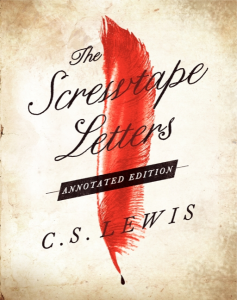
screwtape-lettersThis year, however, I chose a book I have never read before: The Screwtape Letters by C. S. Lewis. It is a series of letters that a senior demon writes to a junior demon-in-training in how to win a man to their side. I enjoy reading Lewis, but I have avoided this book. Years ago when I first became a Christian, there was an emphasis on spiritual warfare that was honestly a little wonky in places. I read some of that kind of thing at the time, but later on avoided it except for when I would come across it in my Bible reading or hear it preached in church. I was always a little afraid of the devil. I knew he was greater and stronger than I was. I also knew that Jesus in me was greater than him, but I’d still rather keep my distance. I had this subconscious naive notion that if I left the devil alone, I wouldn’t attract his attention and he wouldn’t bother me as much. Some friends and I discussed once that our flesh gave us so much trouble that the devil didn’t really have to do too much with us. Both are mistaken and unbiblical views. On the opposite extreme, I have also known people who give the devil too much credit and see him behind every problem or issue. It’s good to be balanced and Biblically-based in this area.

After reading some other Lewis books last year, I looked up some excerpts from this book online and felt that it was finally time to read it. The verse that keeps coming to mind is II Corinthians 2:11: “Lest Satan should get an advantage of us: for we are not ignorant of his devices.” It doesn’t pay to be ignorant of his ways. From what I have seen so far, Lewis handles this whole topic with irony and humor in some places but with convicting accuracy. I am looking forward to finally delving into this one because it is a classic I have neglected, because it is Lewis, and because I think it will be spiritually helpful.

Part of the enjoyment of a reading club, online or in person, is discussing the book with others who are also reading it. Carrie has a post here where you can let her know if you’ll be joining in, and at the end of the month she’ll have another post where we can share our thoughts or the links to our blog posts about the book. I think it is highly likely your library will have a copy, or you can find it in almost any form online (paperback, e-book, audiobook). Project Gutenberg Canada has a free online version here. I happened upon a good sale on the annotated e-book version last year – I’ll have to see if the extra notes are helpful or distracting. Whatever way you’d most enjoy reading it, I hope you’ll join us!

Reading to Know - Book Club

Book Review: Little Dorrit

Little DorritLike many Dickens’ novels, Little Dorrit starts off kind of slow with different scenes, characters, and conversations that don’t seem connected. But if you’ve read much Dickens, you know everything is connected in his books and trust it will all make sense in time, and it does.

One of the early scenes involves a group of people in quarantine after a trip from China to England. One of them, Arthur Clennam, has been living and working with his father for several years. His father has died, and Arthur is returning home. He goes to visit his mother and to tell her he does not want to continue in the family business. He also says he has reason to suspect that his father has perhaps wronged someone without having a chance to make it right, and asks if she would know whom, so that Arthur can do this kindness for his father. His mother and her butler-turned-business-partner Mr. Flintwich takes great offense at the suggestion.

Arthur is in his 40s and his home has never been a happy one. His parents have never gotten along, and his mother is rigidly and unmercifully religious, seeing everything that happens in terms of God’s punishment.

Arthur notices what he thinks is a young girl doing needlework at his mother’s house, but when he looks at her more closely, he sees that, though she is small, she is actually a young woman. He notices that his mother treats her with a modicum of kindness, unlike how she treats everyone else, and wonders if perhaps this girl or her family are ones that his family or their business has wronged. He follows her as she leaves to try to find out more about her.

He discovers that her father has been in Marshalsea debtor’s prison for some 23 or so years. The girl, known to everyone as Little Dorrit, was born there. Evidently prison at this time, at least this prison, allowed inmates’ families to live with them and come and go. Little Dorrit’s (her given name is Amy) mother died years ago. She has an older sister who has learned how to dance and works in that way, and an older ne’er-do-well brother. Her father has the distinction of having lived in the prison the longest of anyone there and is regarded as “the Father of the Marshalsea.” What is odd about all the family except Amy is that they put on airs (later Amy’s sister remonstrates with her about embarrassing the family and their position by walking home with an old pauper).

Arthur tries to discover the details of Mr. Dorrit’s case to see if there is anything he can do to help the family. He goes to the Circumlocution Office – Dickens’ satirical treatment of the epitome of bureaucracy and red tape – and gets nowhere.

Book I of the novel is called Poverty; Book II is Riches, which tells you that the Dorrit family’s fortune changes, but not their character.

Amy has fallen in love with Arthur, but Arthur, although he comes to care for her deeply, calls her “my child” and seems to see himself as a father figure. Meanwhile, he is in love with a girl named Pet, whom he met on the trip from China, along with her family, the Meagles. He has become friends with her family and visits them often. But she loves someone else.

Along with these threads, there are a few more: two prisoners seen in the opening chapter show up in different perspectives later in the book; a Miss Wade who was also on that first ship from China is a bitter woman whose path crosses that of the Meagles, Arthur, and one of the prisoner’s many times; there are several businessmen who play key roles, some good and some bad; there are a couple of Society women who do the same; there is a convoluted mystery involving Arthur’s mother, her butler, one of the prisoners, and Little Dorrit.

At 800+ pages, there is a lot to this novel. It was originally published in monthly installments over two years in the 1850s. Dickens’ own father had been a Marshalsea prisoner. Most of his novels deal with some sort of social injustice, and this one touches on the plight of the poor, governmental inefficiency, and the falseness of high society. He says in the preface that the major investment failure in the book that affects many is based on an actual bank failure.

It’s a little hard to sum up in one sentence what the book is about, but, going by the title character, I’d say it probably has to do with a character who stays good and kind whether her circumstances are good or bad, whether people treat her well or poorly. When her father’s fortune changes, she “lay her face against his, encircled him in the hour of his prosperity with her arms, as she had in the long years of his adversity encircled him with her love and toil and truth; and poured out her full heart in gratitude, hope, joy, blissful ecstasy, and all for him.” She reminds me a lot of Nell in The Old Curiosity Shop, caring for a fairly foolish parent (or grandparent in Nell’s case), except she is older and wiser and comes to a better end. That is one gratifying thing about this novel: the good characters win out in the end, even though some of them go through some low spots and trials, and most of the bad ones get their just desserts.

Even though Dickens deals with serious issues, he sprinkles quite a bit of humor throughout the book. In one of the sections dealing with a high society dinner, and having commented often on the highly powdered wigs of the footmen, he says that at the dinner “There was so much Powder…that it flavoured the dinner. Pulverous particles got into the dishes, and Society’s meats had a seasoning of first-rate footmen.” In telling about a Mr. Pancks, who is sort of the man who gets things done behind the respected figurehead of his business, he describes him as a tugboat who pulls the big ship where it needs to go, and uses phrases harkening back to that metaphor almost every time he mentions him, like, “Pancks opened the door for him, towed him in, and retired to his own moorings in the corner” and “On taking his leave, Pancks, when he had shaken hands with Clennam, worked completely round him before he steamed out the door.” The family in charge of the Circumlocution Office are slyly named Barnacle.

There are also some very tender, poignant moments, as when Arthur, after accepting that Pet loves someone else, tells Amy that he’s too old now to think about love, and Amy doesn’t want to show her feelings toward him but is dying inside. Arthur had decided early on that it would be best not to fall in love with Pet, and there are several statements along the lines that, “It’s a good thing he made that pact not to fall in love with her,” but he actually had. Later, after Pet tells him she’s going to marry another and he’s alone again, he takes the flowers she had picked and given him and gently tosses them in the river, where his hopes and dreams float away with them. And another young man, coming to grips with a great disappointment, “the heart that was under the waistcoat…swelled to the size of a gentleman, and the poor common little fellow, having no room to hold it, burst into tears.”

A favorite moment late in the book is a confrontation between Arthur’s mother and Little Dorrit, in which the latter tries to convince Mrs. Clennam that she doesn’t have to punish herself for her wrongdoing:

“Even if my own wrong had prevailed with me, and my own vengeance had moved me, could I have found no justification? None in the old days when the innocent perished with the guilty, a thousand to one? When the wrath of the hater of the unrighteous was not slaked even in blood, and yet found favour?”

“O, Mrs Clennam, Mrs Clennam,” said Little Dorrit, “angry feelings and unforgiving deeds are no comfort and no guide to you and me. My life has been passed in this poor prison, and my teaching has been very defective; but let me implore you to remember later and better days. Be guided only by the healer of the sick, the raiser of the dead, the friend of all who were afflicted and forlorn, the patient Master who shed tears of compassion for our infirmities. We cannot but be right if we put all the rest away, and do everything in remembrance of Him. There is no vengeance and no infliction of suffering in His life, I am sure. There can be no confusion in following Him, and seeking for no other footsteps, I am certain.”

I mostly listened to the audio version wonderfully read by Simon Vance, but near the end I switched back and forth with the Kindle version, both because I was getting eager and impatient to see how everything came out, and I could read at times that I couldn’t listen. I’ve been trying to read some Dickens work that I was not familiar with, so I’m glad to have completed Little Dorrit in that vein. Though I can’t say this is one of my favorites of his, I did enjoy it, and Amy and Arthur are among my favorites of his characters. There was a BBC miniseries made of it in 2009 (starring Matthew McFadyen, who played Mr. Darcy in the Kiera Knightly version of Pride and Prejudice, as Arthur) that I would love to see some time, but as it is several hours long, I’d probably have to break it up into segments as it originally aired. Here’s a trailer for that series:

Have you read Little Dorrit? What did you think?

(This review will also be linked to Semicolon‘s Saturday Review of Books.)

Book Review: The Little Prince

the-little-prince.jpegThe Little Prince by Antoine de Saint-Exupéry was chosen by Amy for Carrie‘s Reading to Know Classics Book Club for June, and, at 85 pages, also happened to fit the novella or short classic category for my Back to the Classics Challenge. I read the 70th anniversary edition, which, thankfully, my library had, and which also includes a CD of the story read by Viggo Mortenson (Aragorn in the LOTR films). I listened a bit to one CD just to see what it was like, but this is a book you definitely want to read rather than listen to because of the illustrations.

On the surface, the story opens with the narrator reminiscing that as a child, when he drew a picture of a boa constrictor digesting an elephant, grown-ups could only see it as a hat and advised him to stop drawing and concentrate on school subjects. “That is why I abandoned, at the age of six, a magnificent career as an artist. I had been discouraged by the failure of my drawing…Grown-ups never understand anything by themselves, and it is exhausting for children to have to provide explanations over and over again” (p. 2). As an adult he still showed people his drawing, but if they said they only saw a hat, he “would put myself on his level and talk about bridge and golf and politics and neckties” (p. 3).

So he felt pretty lonely and misunderstood until he crash-landed his plane in the Sahara Desert and met, in the middle of the isolation, a little prince. He had a hard time at first learning anything about the prince because he didn’t answer direct questions. The narrator had to pick up clues from things he said in passing, and in that way he learned that the prince was from an extremely small planet (the size of a house). But best of all, the prince understood his drawings.

Over the next eight days – the length of time the narrator’s water supply lasted while he tried to fix his plane – he learned more about the prince’s planet, travels to different planets and the odd people he met there, and his first excursions on Earth.

One gets the definite sense while reading that this story means more than the adventures of a little prince on his travels, yet the meaning isn’t entirely plain. I didn’t feel too bad about not being to make it out when I saw on SparkNotes and Wikipedia that there are differences of opinion among those who have read and studied the book since it was published 70 years ago. Some see in it elements of WWII, since it was written during that time, the dangerous baobob trees of the prince’s planet, which can “overgrow the whole planet. It’s roots pierce right through. And if the planet is too small, and if there are too many baobobs, they make it burst into pieces” (p. 15) representing Naziism. But some dispute that. There is more agreement that the vain rose that the prince cared for on his planet represents Saint-Exupéry’s wife. Some see it as “an allegory of Saint-Exupéry’s own life—his search for childhood certainties and interior peace, his mysticism, his belief in human courage and brotherhood…. but also an allusion to the tortured nature of their relationship” (Wikipedia). Some see it as “metaphor of the process of introspection itself, wherein two halves of the same person meet and learn from each other,” the narrator and the prince both representing aspects of Saint-Exupéry (SparkNotes). It adds to the mystique of the story that Saint-Exupéry was a pilot and did indeed crash-land in the desert once, and went missing while on a mission in his plane.

Whatever it means or represents, there are a few themes that come to the forefront. One is that “One sees clearly only with the heart. Anything essential is invisible to the eyes,” as a fox tells the prince. Another major theme is the problem of limited viewpoints. First there are the adults not understanding the narrator’s drawings, then one planet the prince visits is inhabited only by a king who only sees others as subjects to be ruled and acts toward them accordingly, and on another planet there is only a vain man who only sees others as admirers of himself, and so on. When the prince comes to Earth and lands in the desert and sees no other people, he asks a flower where they are. In her life she had only seen a few pass by, so she thought that’s all there were and that “The wind blows them away. They have no roots, which hampers them a good deal” (p. 52).

But to me the crux of the book is in the concept of “taming.” When the fox tells the prince he isn’t tamed, and the prince asks what “tamed” means, the fox replies:

“It is an act too often neglected,” said the fox. “It means to establish ties.”

“To establish ties?”

“Just that,” said the fox. “To me, you are still nothing more than a little boy who is just like a hundred thousand other little boys. And I have no need of you. And you, on your part, have no need of me. To you I am nothing more than a fox like a hundred thousand other foxes. But if you tame me, then we shall need each other. To me, you will be unique in all the world. To you, I shall be unique in all the world….”(p. 59).

He goes on to say that, “If you tame me, my life will be filled with sunshine. I’ll know the sound of footsteps that will be different from all the rest…If you come at four in the afternoon, I’ll begin to be happy by three” (pp. 60-61), and that from now on a wheat field, which means nothing to a fox since he doesn’t eat wheat, will remind him of the prince since his hair is the same color, “And I’ll love the sound of the wind in the wheat…” (p. 60). The fox also says, “It’s the time that you spent on your rose that makes your rose so important. . . . People have forgotten this truth, but you mustn’t forget it. You become responsible for what you’ve tamed. You’re responsible for your rose” (p. 64). The prince had thought his only rose was special until he comes across thousands of them on Earth. But the time and care he spent on it was what made it unique and special. So I think probably the biggest takeaway is that relationships (“creating ties”) are worth both the investment of time and care and then the pain when those with ties are apart, as the narrator himself discovers at the end. When the prince has to leave the fox, and the fox is sad, the prince tells him it’s his own fault for wanting to be tamed. When the fox admits he will weep when the prince goes, the prince asserts the fox got nothing out of being tamed. The fox replies, “I get something because of the color of the wheat” (p. 61). That statement in context is so poignant it almost makes me teary.

What I first thought of as an odd little tale that I couldn’t quite make sense of, now, after a couple of days of pondering, seems a very sweet and touching story about love and relationships. I love books that do that – make you think and unfold themselves long after the last page is turned.

(This review will also be linked to Semicolon‘s Saturday Review of Books.)

Book Review: The Case-Book of Sherlock Holmes

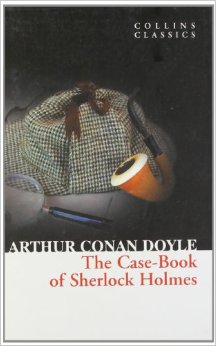
Case Book of SHThe Case-Book of Sherlock Holmes is the last of the Holmes stories by Sir Arthur Conan Doyle. It opens with a preface from Doyle himself, rather than Watson, saying that “I fear that Mr. Sherlock Holmes may become like one of those popular tenors who, having outlived their time, are still tempted to make repeated farewell bows to their indulgent audiences. This must cease and he must go the way of all flesh, material or imaginary.” He says that he “had fully determined at the conclusion of The Memoirs to bring Holmes to an end, as I felt that my literary energies should not be directed too much into one channel,” but he later revived him (reportedly due to public demand, though he doesn’t say so here). He goes on to note:

I have never regretted it, for I have not in actual practice found that these lighter sketches have prevented me from exploring and finding my limitations in such varied branches of literature as history, poetry, historical novels, psychic research, and the drama. Had Holmes never existed I could not have done more, though he may perhaps have stood a little in the way of the recognition of my more serious literary work.

The Wikipedia article on Doyle states that he “wrote seven historical novels, which he and many critics regarded as his best work,” as well as other pieces, but he’s best known for Sherlock Holmes.

A couple of variations in this volume are two stories written as by Holmes himself rather than Watson and one written from a third person point of view. One of the two stories by Holmes occurred when he criticized Watson’s style of storytelling, and Watson told him he should give it a try; the second occurred after Holmes had retired and was no longer in touch with Watson when he came upon an unexpected case.

Twelve stories are included in this book, with some editions arranging them in different orders. The very last Holmes story written was “The Adventure of Shoscombe Old Place” in 1927.

The stories include a variety of cases brought to Holmes’ attention in a variety of ways, most often by someone connected with the case. The include a woman seen only in a veil, a mother accused of vampirism, a missing diamond, the theft of papers from a dead son’s trunk, a man searching for two other men with an unusual last name, a jealous wife, an unusual sea creature, a missing soldier, and a wax effigy of Holmes. In one of them, Holmes says, “In all my chronicles the reader will find no case which brought me so completely to the limit of my powers. Even my imagination could conceive no solution to the mystery.”

They occur in a variety of times as well: some when Watson was rooming with Holmes, some when he was not, one after Holmes retirement.

A few sentences stood out to me concerning Holmes’ regard for Watson. In “The Case of the Blanched Soldier,” one of the stories written from Holmes point of view rather than Watson’s, he says, “Speaking of my old friend and biographer, I would take this opportunity to remark that if I burden myself with a companion in my various little inquiries it is not done out of sentiment or caprice, but it is that Watson has some remarkable characteristics of his own to which in his modesty he has given small attention amid his exaggerated estimates of my own performances.” He says in this same story, “The good Watson had at that time deserted me for a wife, the only selfish action which I can recall in our association. I was alone.” In “The Adventure of the Mazarin Stone,” the one written in the third person, it’s said that, “Watson was always the man of action, and he rose to the occasion.” In one story in which Watson was wounded, Holmes cried out, “You’re not hurt, Watson? For God’s sake, say that you are not hurt!” Watson thought to himself, “It was worth a wound–it was worth many wounds–to know the depth of loyalty and love which lay behind that cold mask. The clear, hard eyes were dimmed for a moment, and the firm lips were shaking. For the one and only time I caught a glimpse of a great heart as well as of a great brain. All my years of humble but single-minded service culminated in that moment of revelation.”

After receiving a note from Holmes in one case which simply read, “Come at once if convenient–if inconvenient come all the same. S.H.,” Watson muses:

The relations between us in those latter days were peculiar. He was a man of habits, narrow and concentrated habits, and I had become one of them. As an institution I was like the violin, the shag tobacco, the old black pipe, the index books, and others perhaps less excusable. When it was a case of active work and a comrade was needed upon whose nerve he could place some reliance, my role was obvious. But apart from this I had uses. I was a whetstone for his mind. I stimulated him. He liked to think aloud in my presence. His remarks could hardly be said to be made to me–many of them would have been as appropriately addressed to his bedstead–but none the less, having formed the habit, it had become in some way helpful that I should register and interject. If I irritated him by a certain methodical slowness in my mentality, that irritation served only to make his own flame-like intuitions and impressions flash up the more vividly and swiftly. Such was my humble role in our alliance.

Other interesting features in this story: in one Holmes refused to eat, and when Watson asked why, he replied, “Because the faculties become refined when you starve them. Why, surely, as a doctor, my dear Watson, you must admit that what your digestion gains in the way of blood supply is so much lost to the brain. I am a brain, Watson. The rest of me is a mere appendix. Therefore, it is the brain I must consider.” I don’t think that’s the wisest course of action for most people, but it is interesting that he thought of himself primarily in terms of his brain. That appears to be a factor in his suppression of emotion and lack of relationships as well. Holmes says in one story: “Women have seldom been an attraction to me, for my brain has always governed my heart, but I could not look upon her perfect clear-cut face, with all the soft freshness of the downlands in her delicate colouring, without realizing that no young man would cross her path unscathed.”

Another observation I thought unusual for Holmes occurred when a man was taking a potion to seem to become more youthful: “There is danger there–a very real danger to humanity. Consider, Watson, that the material, the sensual, the worldly would all prolong their worthless lives. The spiritual would not avoid the call to something higher. It would be the survival of the least fit. What sort of cesspool may not our poor world become?”

One sentence that struck me as particularly clever: “When his castle in the air fell down, it buried him beneath the ruins.”

It’s been fun to read of the “real”…or at least, the original Sherlock Holmes. One of my main curiosities was whether he was really as rude as some modern conceptions of him make him out to be. I was happy to find he wasn’t. He was eccentric in some ways and could be egoistical, but he knew how to interact with people when he needed to and could even be kind and comforting when needed. He was a classic introvert and only had a very few close friends. I was surprised to find that his nemesis, Moriarty, only appeared in two books, with just a mention in one of them. I was also pleased to find that Watson was not a doddering old man, but was vibrant, described as “fleet of foot” in one story, and that Holmes valued him for his medical skills as well as his skills with a revolver, besides his being a good sounding board.

I was concerned, before reading the stories, about his rumored drug addiction, but it wasn’t enough to be an addiction, only appeared in a couple of books, and Watson talked him out of using drugs any more. I was also concerned because I had heard there were instances of spiritism in the book, but I did not find any. I did just read yesterday that Doyle was heavily involved in such, but Holmes, although he was not a religious man, did use various Biblical phrases and did not participate in anything like spiritism. There were a couple of cases where there were evidences of voodoo or something similar, but those involved were always portrayed as being from some island or another.

Here are my reviews of the other Holmes books:

A Study in Scarlet (novel)
The Sign of the Four (novel)
The Adventures of Sherlock Holmes (short stories)
The Memoirs of Sherlock Holmes (short stories)
The Hound of the Baskervilles (novel)
The Return of Sherlock Holmes (short stories)
His Last Bow: Some Reminiscences of Sherlock Holmes (short stories)
The Valley of Fear (novel)

I listened to the first books read by various narrators, and the last ones read by Simon Vance in this collection, who once again did a wonderful job. This edition of all the Holmes stories together came through on a good sale, so I got it, but it was maddening that the divisions weren’t according to the books. They are just run together one after the other, which is fine if you’re listening to them that way, but it’s hard to find a particular book. Thankfully one listener posted a table of contents which shows where the various books begin and end.

I don’t feel all warm and fuzzy toward these stories as I do some other books, so I don’t know that I’d reread or relisten to them, at least not any time soon. But they were fun while they lasted! And Holmes is such an iconic figure with so many cultural references to him, it’s nice to be familiar with him now.

(This review will also be linked to Semicolon‘s Saturday Review of Books.)

Book Review: The Valley of Fear

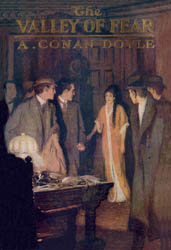
Valley_of_fearThe Valley of Fear is the fourth of Sir Arthur Conan Doyle’s full-length Sherlock Holmes novels. Like most of his other stories, it first appeared serialized in a magazine, this time in The Strand.

The book opens with Holmes and Watson trying to decipher a message from an informant concerning Professor Moriarty. The only other time Moriarty has been mentioned was in the last chapter of The Memoirs of Sherlock Holmes, in which he died. So this story predates that one, but there is a bit of a disconnect in that Watson didn’t know who Moriarty was in Memoirs, and if the events in The Valley of Fear occurred in the timeline before that book, Watson would surely have known the name. But as far as I know that’s the only major slip up in Doyle’s narratives, so we can forgive him: he may have even been aware of the problem and decided to write this story as is anyway.

At any rate, Holmes and Watson are interrupted by the arrival of a Scotland Yard Inspector MacDonald asking Holmes to assist on a case and then being stunned to learn that the message Holmes had just deciphered concerned the very man who had been killed. The victim had been shot in the face with an American sawed-off shotgun. There are a number of odd incidents and clues that do not add up. Holmes fixates on one that the others do not think is important, and, of course, solves the mystery.

The second part of the book is the back-story of what happened leading up to these events and is written in a completely different style, much like the story within a story in A Study in Scarlet. At first nothing seems related at all, but the reader assumes that some of the characters are going by different names than what they’re known as in the first part. In this story, a young John McMurdo is fleeing from the law in Chicago and comes to a Vermissa Valley to start anew. He’s part of an organization called The Eminent Order of Freemen, which primarily engages in charitable works in Chicago. But in Vermissa Valley, it’s a tightly run gang of thieves, murderers, and extortioners called the Scowrers who have the area under their thumb so much that it is nicknamed the Valley of Fear. McMurdo has no choice but to become involved with the gang, even though his landlord kicks him out over it and refuses to let him see his daughter any more.

Events unfold with the Scowrers for several chapters until they learn that a Pinkerton detective is undercover in the area, and their focus turns to finding and dealing with him.

An epilogue ties up the loose ends of the story and brings it back to Moriarty’s involvement.

Though I eventually guessed who McMurdo was (and rereading the first few pages, I saw several clues which caused me to realize I should have guessed it much sooner), I was totally surprised by the twist in the second story. Though some of the first story gets a little boring with the deciphering and then the arguing over which clues mean what, the last couple of chapters were the most exciting of any of Doyle’s work that I have read so far.

After looking around Wikipedia a bit, I saw that the story was based on the real life Molly Maguires in PA and their encounter with Pinkerton Agency detective James McParland. I had heard the term Molly Maguires before but had no recollection of what it meant until reading about it just now.

I listened to the audiobook read by Simon Vance, who did a wonderful job not only with the various English accents and voices in the story, but also with American, Scottish, and Irish accents as well. I also read parts of the story online at Project Gutenberg.

(This review will also be linked to Semicolon‘s Saturday Review of Books.)

Book Review: His Last Bow: Some Reminiscences of Sherlock Holmes

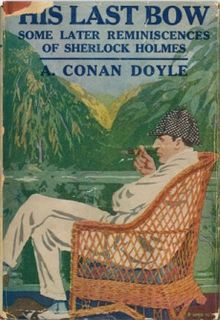
HisLastBowHis Last Bow: Some Reminiscences of Sherlock Holmes by Sir Arthur Conan Doyle is another collection of his Sherlock Holmes short stories, most originally published in magazines. One story, “The Cardboard Box,” was originally in another volume and added to this one in later printings.

The book opens with a preface from Dr. Watson saying that Holmes was retired and doing well except for occasional bouts of rheumatism. He had refused many offers to take up cases until called into service by his government on the eve of war with Germany. Watson states that the last story in this collection contains the details of that incident, and the other stories are some that he has had on hand for some time but not used in his other collections, but added them here to supplement the last story.

There are eight stories all together, covering various time periods (some when Watson was married, some when he was rooming with Holmes. Most contain trademarks of the other Holmes stories. A few are different, however.

In “The Adventure of Wisteria Lodge” (sometimes published as two stories, “The Singular Experience of Mr. John Scott Eccles” and “The Tiger of San Pedro”), the inspector on this case, Inspector Baynes, is the only police official that Holmes has thought well of and thought almost as competent as himself. He had learned to work with Lestrade and Grayson and others, though he usually figured out the case long before they did. But Baynes he admired and predicted he would go far in his profession.

Some of the other cases involve assumed identities, stolen naval plans, a woman receiving severed ears in the mail, an incident that kills one sister and drives two brothers mad, a kidnapped woman, and Holmes’ seemingly fatal illness.

The last story, “His Last Bow,” is different in a few ways. It opens with someone other than Holmes or Watson, is told in the third rather than the first person, and is a spy story more than a detective story. It’s set after Holmes has retired but has been asked to help his government, and when it’s over, he and Watson reminisce as if they haven’t seen each other in a while and are catching up. I wonder if Doyle wasn’t planning to write more Holmes stories after this. There is one Holmes novel whose writing overlaps the time period when these stories were published, and one more collection of stories after this one. If all the stories were laid our chronologically, this one would be the last in the time frame though it’s not the last one written. It was published during WWI, and this quote was probably meant to encourage Doyle’s fellow countrymen:

“There’s an east wind coming, Watson.”

“I think not, Holmes. It is very warm.”

“Good old Watson! You are the one fixed point in a changing age. There’s an east wind coming all the same, such a wind as never blew on England yet. It will be cold and bitter, Watson, and a good many of us may wither before its blast. But it’s God’s own wind none the less, and a cleaner, better, stronger land will lie in the sunshine when the storm has cleared.”

In many of the stories, Holmes makes reference to Watson’s writings and even offers suggestions about what to include, even though he doesn’t like the way Watson tells the stories.

I found further evidence that Holmes was neither always rude nor antisocial or even autistic, as some modern portrayals seen to suggest. When interrupted from a project when asked to take on a case he is not interested in at first, Watson notes that  “Holmes was accessible upon the side of flattery, and also, to do him justice, upon the side of kindliness. The two forces made him lay down his gum-brush with a sigh of resignation and push back his chair.” In another case,

Holmes leaned forward and laid his long, thin fingers upon the woman’s shoulder. He had an almost hypnotic power of soothing when he wished. The scared look faded from her eyes, and her agitated features smoothed into their usual commonplace. She sat down in the chair which he had indicated.

In another place he said, “[The landlady] was fond of him, too, for he had a remarkable gentleness and courtesy in his dealings with women. He disliked and distrusted the sex, but he was always a chivalrous opponent.”

Watson does admit, though, in another case that, “It was one of my friend’s most obvious weaknesses that he was impatient with less alert intelligences than his own,” in this case Lestrade’s.

Holmes also doesn’t misuse Watson, as some modern depictions portray. In one case here he sends Watson on a mission when he can’t leave the case he is currently involved with, and when he does catch up with Watson, he exclaims,

“I cannot at the moment recall any possible blunder which you have omitted. The total effect of your proceeding has been to give the alarm everywhere and yet to discover nothing.”

“Perhaps you would have done no better,” I answered bitterly.

“There is no ‘perhaps’ about it. I HAVE done better. Here is the Hon. Philip Green, who is a fellow-lodger with you in this hotel, and we may find him the starting-point for a more successful investigation.”

The only time that he seems genuinely rude was when he was ill but did not want Watson to examine him, saying, “After all, you are only a general practitioner with very limited experience and mediocre qualifications. It is painful to have to say these things, but you leave me no choice.” Watson “was bitterly hurt.” But later Holmes discloses that he did not want Watson near him because he was on a case to try and catch someone, and Watson’s “astute judgment” would determine on a close examination that Holmes was well, and Holmes needed him to believe in the urgency of the situation in order to convince the man Holmes wanted to come. He assures Watson of his high “respect for your medical talents.”

In one unguarded moment after Watson saves both their lives, Holmes declares,

“Upon my word, Watson!” said Holmes at last with an unsteady voice, “I owe you both my thanks and an apology. It was an unjustifiable experiment even for one’s self, and doubly so for a friend. I am really very sorry.”

“You know,” I answered with some emotion, for I have never seen so much of Holmes’s heart before, “that it is my greatest joy and privilege to help you.”

He relapsed at once into the half-humorous, half-cynical vein which was his habitual attitude to those about him.

There was one other glimpse in Holmes’ heart when, in a case where someone avenged the death of his loved one, Holmes said, “I have never loved, Watson, but if I did and if the woman I loved had met such an end, I might act even as [he] has done.” That also seems further proof of something I asserted in an earlier book, that Irene Adler was not the love interest many thought her to be, but rather just a woman he admired for being one of the few people to ever outsmart him.

I listened to the audiobook read by Simon Vance, who did a great job with the different accents and inflections. Overall I enjoyed these continuing adventures of Holmes and Watson and and discovering more of their personalities. I look forward to the last two books.

(This review will also be linked to Semicolon‘s Saturday Review of Books.)