Mount TBR Reading Challenge Wrap-up

Mount TBR 2016The Mount TBR Reading Challenge had the goal to read books that we already had on hand prior to 2016. For this challenge I completed (the first 12 are from my original list; the rest I added throughout the year in more or less the order I finished them.):

  1. True Woman 201: Interior Design by Mary Kassian and Nancy Leigh DeMoss (Finished 4/16/16)
  2. The Renewing of the Mind Project by Barb Raveling (2015) (Finished 5/23/16)
  3. Beyond Stateliest Marble: The Passionate Femininity of Anne Bradstreet by Douglas Wilson (2001) (Finished 5/1/16)
  4. Ten Fingers For God: The Life and Work of Dr. Paul Brand by Dorothy Clarke Wilson (Finished 8/26/16)
  5. What Are You Afraid Of? Facing Down Your Fears With Faith by David Jeremiah (Finished 2/22/16)
  6. Home to Chicory Lane by Deborah Raney (Finished 9/18/16)
  7. The Bronte Plot by Katherine Reay (Finished 2/2/16)
  8. Pride, Prejudice, and Cheese Grits by Mary Jane Hathaway (2014) (Finished 5/24/16)
  9. Searching for Eternity by Elizabeth Musser (Finished 1/16/16)
  10. Pioneer Girl: The Annotated Autobiography by Laura Ingalls Wilder and Pamela Smith Hill (Finished 7/11/16)
  11. Our Mutual Friend by Charles Dickens (Finished 2/22/16)
  12. A Connecticut Yankee in King Arthur’s Court by Mark Twain (Finished 3/8/16)
  13. Big Love: The Practice of Loving Beyond Your Limits by Kara Tippetts (Finished 2/14/16)
  14. Gilead by Marilynne Robinson (Finished 1/13/16)
  15. SEAL of God by Chad Williams and David Thomas (Finished 1/24/16)
  16. Not In the Heart by Chris Fabry (Finished 3/26/16)
  17. A Slender Thread by Tracie Peterson (Finished 4/6/16)
  18. The Reunion by Dan Walsh (Finished 4/10/16)
  19. What Follows After by Dan Walsh (Finished 4/23/16)
  20. The Hardest Peace: Expecting Grace in the Midst of Life’s Hard by Kara Tippetts (Finished 4/30/16)
  21. One Perfect Spring by Irene Hannon (Finished 5/11/16)
  22. Don’t Let the Goats Eat the Loquat Trees: The Adventures of an American Surgeon in Nepal by Thomas Hale (Finished 6/13/16)
  23. Chateau of Secrets by Melanie Dobson (Finished 6/18/16)
  24. Eight Twenty Eight: When Love Didn’t Give Up by Ian and Larissa Murphy (Finished 6/28/16)
  25. Thin Places: A Memoir by Mary DeMuth (Finished 7/12/16)
  26. The Methusaleh Project by Rick Barry (Finished 7/16/16)
  27. C. S. Lewis’ Letters to Children, edited by Lyle W. Dorsett and Marjorie Lamp Mead (Finished 7/23/16)
  28. I’m No Angel: From Victoria’s Secret Model to Role Model by Kylie Bisutti (Finished 9/6/16)
  29. Be Faithful (1 & 2 Timothy, Titus, Philemon): It’s Always Too Soon to Quit! by Warren Wiersbe
  30. Be Mature (James): Growing Up in Christ by Warren Wiersbe
  31. Be Hopeful (1 Peter): How to Make the Best Times Out of Your Worst Times by Warren Wiersbe
  32. Be Real (I John): Turning From Hypocrisy to Truth by Warren Wiersbe, not reviewed. (Not sure of the finish date for the above four – sometime in August or September)
  33. Give Them Grace: Dazzling Your Kids With the Love of Jesus by Elyse M. Fitzpatrick and Jessica Thompson (Finished 10/1/16)
  34. Knowable Word: Helping Ordinary People Learn to Study the Bible by Peter Krol
  35. Radical Womanhood: Feminine Faith in a Feminist World by Carolyn McCulley (Finished 11/20/16)
  36. The Princess Spy by Melanie Dickerson (Finished 11/15/16)
  37. The Messenger by Siri Mitchell (Finished 12/7/16)
  38. The Christmas Violin by Buffy Andrews (Finished 12/13/16)

The different levels of the challenge are represented by different mountains. I had originally planned to read at least 12 for “Pike’s Peak.” I’m happy I got to the third level, Mt. Vancouver!

Bev also added a fun activity linking the books from our list with familiar proverbs. Mine are:

A stitch in time…with A Slender Thread.
Don’t count your chickens…and Don’t Let the Goats Eat the Loquat Trees.
All good things must come…Home to Chicory Lane.
When in Rome…[see] Our Mutual Friend
A picture is worth…Eight Twenty Eight.
When the going gets tough, the tough get…The Hardest Peace
.
Two wrongs don’t make…One Perfect Spring.
The pen is mightier than…The Messenger.
The squeaky wheel gets…What Follows After.
Hope for the best, but prepare for…Thin Places.
All that glitters is not…Beyond Stateliest Marble.
Birds of a feather…[attend] The Reunion.

I enjoyed getting to so many of my books on hand (or in my Kindle app) yet allowing for some new reads along the way, too.

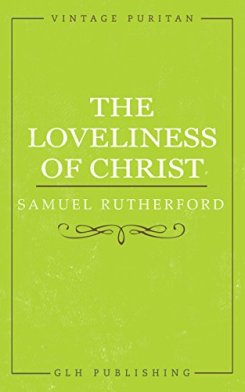
Book Review: The Loveliness of Christ

loveliness-of-christPuritan Samuel Rutherford’s writings were the inspiration for one of my favorite hymns (“The Sands of Time Are Sinking“) and he’s the author of one of my favorite quotes, but I had never read anything else from him. So when The Loveliness of Christ came through on a 99 cent Kindle sale last week, I decided to give it a try.

I was disappointed that the selections weren’t essays or letters (except for a few letters at the very end): rather, the book is mainly a selection of quotes gleaned from Rutherford’s letters. The writing is a little hard to understand in places, but there are some gold nuggets here.

After a brief biography of Rutherford, the quotes are listed. I am not sure if they are in random of chronological order: except for the full-length letters at the end, we don’t know to whom or when they were written.

Here are some that most spoke to me:

You will not get leave to steal quietly to heaven, in Christ’s company, without a conflict and a cross.

Christ’s cross is such a burden as sails are to a ship or wings are to a bird.

Let our Lord’s sweet hand square us and hammer us, and strike off the knots of pride, self-love and world-worship and infidelity, that He may make us stones and pillars in his Father’s house.

The devil is but God’s master fencer, to teach us to handle our weapons.

They are not lost to you that are laid up in Christ’s treasury in heaven. At the resurrection ye shall meet with them: there they are, sent before but not sent away. Your Lord loveth you, who is homely to take and give, borrow and lend.

O, what I owe to the file, to the hammer, to the furnace of my Lord Jesus!

Why should I start at the plow of my Lord, that maketh deep furrows on my soul? I know He is no idle husbandman, He purposeth a crop.

How sweet a thing were it for us to learn to make our burdens light by framing our hearts to the burden, and making our Lord’s will a law.

Our fair morning is at hand, the day-star is near the rising, and we are not many miles from home. What does it matter if we are mistreated in the smoky inns of this miserable life? We are not to stay here, and we will be dearly welcomed by Him to whom we go.

When we shall come home and enter to the possession of our Brother’s fair kingdom, and when our heads shall find the weight of the eternal crown of glory, and when we shall look back to pains and sufferings; then shall we see life and sorrow to be less than one step or stride from a prison to glory; and that our little inch of time – suffering is not worthy of our first night’s welcome home to heaven.

Let not the Lord’s dealings seems harsh, rough, or unfatherly, because it is unpleasant. When the Lord’s blessed will bloweth cross your desires, it is best in humility to strike sail to him and to be willing to be laid any way our Lord pleaseth: it is a point of denial of yourself, to be as if ye had not a will, but had made a free disposition of it to God, and had sold it over to him; and to make of his will for your own is both true holiness, and your ease and peace.

Welcome, welcome, Jesus, what way soever Thou come, if we can get a sight of Thee! And sure I am, it is better to be sick, providing Christ come to the bedside and draw by the curtains, and say, “Courage, I am Thy salvation,” than to enjoy health, being lusty and strong, and never to be visited of God.

Faith liveth and spendeth upon our Captain’s charges, who is able to pay for all.

Glorify the Lord in your sufferings, and take his banner of love, and spread it over you. Others will follow you, if they see you strong in the Lord; their courage shall take life from your Christian carriage.

Ye may yourself ebb and flow, rise and fall, wax and wane; but your Lord is this day as he was yesterday; and it is your comfort that your salvation is not rolled upon wheels of your own making, neither have ye to do with a Christ of your own shaping.

If Christ Jesus be the period, the end and lodging-home, at the end of your journey, there is no fear, ye go to a friend…ye may look death in the face with joy.

My Lord Jesus hath fully recompensed my sadness with His joys, my losses with His own presence. I find it a sweet an a rich thing to exchange my sorrows with Christ’s joys, my afflictions with that sweet peace I have with Himself.

The favorite quote I mentioned at the beginning was here only in part: I had seen it in one of Amy Carmichael’s writings as having been a comfort to her when one of the children at her compound died. It was written by Rutherford to someone who had lost a child. The larger quote is “Ye have lost a child: nay she is not lost to you who is found to Christ. She is not sent away, but only sent before, like unto a star, which going out of our sight doth not die and vanish, but shineth in another hemisphere. We see her not, yet she doth shine in another country. If her glass was but a short hour, what she wanteth of time that she hath gotten of eternity; and ye have to rejoice that ye have now some plenishing up in heaven.”

As a collection of quotes, some quite thought-provoking and others requiring thought to process, it seemed to work best to read a few a day rather than trying to take in a lot at one sitting. Even doing that, though, it only took about a week to read.

As you can see from the sampling of quotes here, some of the themes of Rutherford’s writing include the goodness of God in the face of any circumstances, His ability to use those circumstances to shape us, the joy of Christ in this life but especially in the life to come.

I’m glad I spent time with this little book and I’m sure I will again in the future. I’m even inspired to go on to the fuller Letters of Samuel Rutherford some day.

Genre: Christian non-fiction
Potenti
al objectionable elements: None
My rating: 10 out of 10

(Sharing with Semicolon‘s Saturday Review of Books and Carol‘s Books You Loved )

Books you loved 4


Save

Save

Save

Save

Book Review: Great British Short Stories: A Vintage Collection of Classic Tales

Classic short storiesI’m not a big fan of short stories, so when I saw a book of short stories listed as one of the options for the Back to the Classics Challenge, I perused a few sources, didn’t see anything that interested me, and decided I’d skip that one. But then I finished all the other options for the challenge and didn’t want to leave that one undone. I finally found an audiobook of Great British Short Stories: A Vintage Collection of Classic Tales, with tales from familiar names like Charles Dickens, Elizabeth Gaskell, Arthur Conan Doyle, and Robert Louis Stevenson as well as unfamiliar ones like Barry Pain, James McGovan, and William J. Locke.

There are ten stories in all:

“The Dog” by Arnold Bennett: A man from one class of a family takes out a girl from another class, and, as luck would have it, they have an accident in a very public place, causing trouble in both families. The title and description of the man man throughout as a dog confused me – I wasn’t sure what that meant at the time and whether it was good or bad. The young man seems to think it’s good; the story itself seems to indicate otherwise.

“Not On The Passenger List” by Barry Pain: A widow on a ship to meet the man she is going to marry keeps seeing her dead jealous former husband on the ship.

“The Old Man’s Tale About The Queer Client” by Charles Dickens: The wife and son of a  man in debtor’s prison die, and he vows revenge on the man responsible for putting him there and contributing to their deaths. Not my favorite from Dickens, who didn’t end this on a note of hope and optimism as he usually does, but I was surprised by the twist in who the responsible party was.

“The Half Brothers” by Elizabeth Gaskell: A man marries a widow with a small son; they have another son; the wife dies shortly thereafter; the man blames his step-son. Though the story ends in a tragedy, it brings resolution. A little predictable, at least by today’s standards, but nicely told.

“The Veiled Portrait” by James McGovan: A physician treating an older woman asks to see the painting that she has veiled in her room. It’s a portrait of her wayward son when he was an innocent child. The doctor, who really wanted to be an artist but couldn’t make a living at it, wants to borrow the painting and copy it, or at least make a sketch of it, but she refuses all requests concerning it. He happens to hear of a skilled thief and decides to have him steal the portrait long enough for him to copy and then return it, but things go in a very unexpected way. This was one of my favorite stories in the book.

“Markheim” by  Robert Louis Stevenson: The title character kills a man in order to get to money he has hidden in his business and then is unexpectedly confronted by what he thinks is a demon offering to help him. Shocked, thinking he hasn’t fallen that far, he refuses its help and promises this will be the last bad thing he ever does. Though the first part of the story took much longer than needed to tell, what’s interesting in this one is the moral argument: the being shoots down all of Markheim’s arguments, resolutions, self-deceptions one by one. But there is a surprising twist at the end.

“The Bottle Imp” by Robert Louis Stevenson: A man tries to sell a bottle containing, not a genie, but an imp. The imp will help it’s owner in any way requested, with two caveats: if the bottle isn’t sold before the owner dies, the owner will go to hell, and it must be sold for less than it was bought for.

“The Adventures Of The Kind Mr. Smith” by  William J. Locke: A case of mistaken identity lands an ex-French teacher in the middle of a plan to commit fraud. He keeps up pretenses until the person he is supposed to be shows up. But from there on out, the plot takes continuous surprising turns. Loved this one!

“The Man Of Mystery” by Barry Pain: a butler who keeps his own confidences is dismissed by his employer, until she realizes she wrongly accused him and tries to rectify the situation. Would have liked this one except for someone getting away with and profiting from doing wrong.

“The Brazilian Cat” by Sir Arthur Conan Doyle: A man in financial straits seeks out the help of a cousin who is married to an unfriendly Brazilian woman and keeps a large puma-like Brazilian cat. This was the first non-Sherlock Holmes story I’ve read by Doyle, and it was easily the most suspenseful and exciting in the book.

So, though I am still not likely to seek out short stories in general, this was not an unpleasant excursion. I listened to the audiobook, though there is a print version that can be found through used book sellers. The narrator’s voice and style was a little grating at first, but before long I got used to it and it didn’t bother me any more.

(Sharing at Semicolon‘s Saturday Review of Books)

Save

Save

Save

Book Review: Gulliver’s Travels

GulliverOne of the categories for the Back to the Classics challenge was a banned or censored book. After perusing several banned book lists, I thought I’d have to skip this category, because what few books I found interesting on the lists were ones I had already read. Then I spied Gulliver’s Travels on a couple of lists. I had heard of it, of course, but had never read it, so I decided to give it a try.

The full original title in 1726 was Travels into Several Remote Nations of the World. In Four Parts. By Lemuel Gulliver, First a Surgeon, and then a Captain of Several Ships. I’m thankful it was eventually shortened. 🙂 It was written by Jonathan Swift, an Irish Anglican clergyman, politician, and writer best known for his scathing satire.

I knew about Gulliver’s waking up on an island and finding himself tied down by 6-inch people called the Lilliputians, but I hadn’t known of his other travels. The book opens with a very short account of his background, and then launches into his first voyage as a ship’s surgeon. The book is divided into four parts:

Part 1: Lilliput. Gulliver’s boat is shipwrecked and he appears to be the lone survivor. He washes up on an island and wakes up realizing that he can’t move. Swift’s writing is nice here in that he gradually makes us aware through Gulliver’s eyes of what has happened, with the realization that his every limb and even his hair is tied down, to noticing a little person making his way up his body to speak to him. Gulliver and the Lilliputians can’t understand each other, but they are able to make signs to one another, and they eventually take him to their king. Gulliver has a facility for languages, thankfully, and soon can communicate easily. Once he assures the king that he will be loyal to him and careful of his subjects, he’s given free reign to go about the land. In a war with the Lilliputian’s enemies in Blefuscu, Gulliver saves the day by single-handedly capturing their fleet. The Lilliputian king wants Gulliver to help him subdue all his enemies, but Gulliver will not be persuaded to enslave a free people. The king says he understands, but things are not quite the same between them afterward. Then when the queen’s house catches fire, and  people are passing along these pitiful thimble-sized buckets of water to Gulliver to pour on the flames, he realizes he has a better way: he needs to urinate and voluminously does so on the queen’s house, putting out the fire, but seriously offending her. A friend at court alerts Gulliver that plans are being made to put out his eyes and starve him, so he escapes to Blefescu and eventually find an abandoned boat in his size and returns home.

Part 2: Brobdingnag. After a short while at home, Gulliver sets out on another voyage, wherein storms blow his ship off course, and they stop at an island to search for fresh water. Suddenly Gulliver notices that his boat is quickly making out for sea without him, and then notices there is a giant twelve times the size of an ordinary human wading out into the sea after the ship. Gulliver runs the other way and finds himself in a field, where one of the workers notices him and at first thinks he is a bug or animal. He is taken to a farmer and goes through the same method of first signing, then pointing to objects and asking their names, to eventually being able to communicate quite well. The farmer decides to charge to “show” Gulliver several times a day to people for a fee, exhausting him. Eventually he is given an audience with the queen, who buys him from the farmer. The queen treats him well but views him almost as a doll. He encounters problems with flies, rats, and even a monkey. When Gulliver complains of anything, he’s not taken seriously. The king discusses the politics and history of England with Gulliver but belittles them, saying, “I cannot but conclude that the Bulk of your Natives, to be the most pernicious Race of little odious Vermin that Nature ever suffered to crawl upon the Surface of the Earth.”  A search is made for a woman of Gulliver’s size for him to mate with, but he is thankful that none is found, for he would not want to produce a family just to be shown like circus animals. There seems to be no escape for him. But one day a servant takes him in a little box that the queen had made for him to the seashore, where a bird snatches up the box by the clasp on top. When the bird is attacked by other birds, it drops the box into the sea, where it floats until it is found by a ship of men Gulliver’s own size, and he is returned home.

Part 3: Laputa, Balnibarbi, Luggnagg,and Glubbdubdrib. Gulliver’s wife does not want him to sail again, but his love of travel and desire to see the world sets him out once more. This time pirates attack his ship, and he maroons an another island. He notices something in the sky and realizes it is a floating island. He gets the attention of the people on it, and they lower a chair to bring him up. The people are his own size, but their “heads were all reclined, either to the right, or the left; one of their eyes turned inward, and the other directly up.” They were all so absorbed in their own thoughts that they had to hire “flappers” to bop their ears when they needed to listen and their chins when they needed to answer. It took Gulliver a while to convince them he didn’t need that aid. The island was called Laputa, and the king lived there, ruling over the land of Balnibarbi below. The island moves by a magnetic lodestone, and one of the ways the king exerts pressure on his subjects is by centering the floating island above an area so that it receives neither sun nor rain until the people acquiesce. When Gulliver asks to visit the land below, he finds academies and labs full of ludicrous experiments, such as “an operation to reduce human excrement to its original food,” “a new method for building houses, by beginning at the roof, and working downward to the foundation,” using spider webs instead of silkworms, a method of language reduced to nouns and using objects instead of words. Yet in practical matters, their clothes weren’t measured to fit, their buildings were were not built well, their fields were barren (and one man who worked his fields in the ‘ancient’ manner and had them lush and green was looked down upon.) He eventually finds a voyage back home.

Part 4: The Country of the Houyhnhnms. Gulliver sets sail once again, this time as the captain of a vessel. Several of his men die en route, so he hires men from islands he comes across on the way. But the new hires had been buccaneers and soon persuaded his men to mutiny against him and leave him on the first bit of land they came to. As Gulliver tries to find people on the island to trade with for supplies, he discovers some hideous creatures with long hair on their heads and chest and claw-like nails. They block his path, and he swings his sword to try to fend them off without cutting them. He races to a tree, but they climb up it and defecate on him. Suddenly they all run away, and Gulliver sees a horse on the path, looking at him with wonder. Another horse comes along, and they seem to be conversing. Soon he discovers that horses called Houyhnhnms are the ruling animals here. He is startled and horrified to discover that the creatures he first encountered, called Yahoos, are actually human. The Houyhnhnms think he is  Yahoo as well, but agree that he has more reason than the others do. One takes him into his home. Gulliver admires the virtues and reasonableness of the Houyhnhnms so well that he is ashamed to be a lowly Yahoo. The Houyhnhnms are something like Vulcans: big on reason but short on emotion. When Gulliver is grieved at being expelled from the area because it’s not seemly for a Houyhnhnm to have a Yahoo in his home, and finds passage back to England, he can’t stand the sight and smell of other humans, associating them with Yahoos, even though they show great kindness, like the captain who finds and provides for him. He is repulsed by his wife and children, but buys a couple of horses and converses with them several hours a day.

Many points in this book would have been so recognized at the time that it was published anonymously and Swift’s publisher edited out some of the most offensive sections. In a later edition, Swift added a fictional letter as if from Gulliver to his cousin fussing about the alterations, saying. “I do hardly know mine own work.” Wikipedia, SparkNotes, Shmoop, and CliffsNotes all had good information about what the satire referred to, though they disagreed in a couple of particulars. Cliifsnotes was the most extensive, and their Philosophical and Political Background and Essay on Swift’s Satire and Gulliver as a Dramatis Persona were quite enlightening. Shmoop’s character list and analysis gave a fairly succinct explanation of who or what the different characters represented.

But Swift satirizes several things in this book that one can easily pick up on without knowing the references. Travel books, for one: he mentions several times that he is telling the “truth,” not like so many other travelogues that exaggerate and make up stories. He pokes fun at the fact that every government thinks it is the best form, at academia that is so wrapped up in the theoretical that it is impractical, at the bluster and self-importance of people like the Lilliputians, who could have been easily crushed if Gulliver had had a mind to, the arrogant exaltation of reason that lacks empathy and emotion, the tendency of “big government” to be so far removed from the needs of the “little people.” The silly rope dances that people who wanted to advance in the kingdom had to do easily makes fun of the hoops similar officials have to jump through that have little to do with skill. The conflicts between the Big Endians and Little Endians over the right way to break an egg and those who prefer high heels or low heels satirizes how ridiculous some conflicts between factions can be (as well as an heir to the crown who hobbles because he wears one big heel and one low heel to please both sides). And, finally, he satirizes man’s faults and foibles in general.

I can understand why the book has been censored, aside from the political views of its day. There’s quite a lot about bodily functions in addition to Gulliver’s urinating on the queen’s quarters to put out a fire. There are also some parts that would be considered risqué.

Excepting one particular section, I enjoyed the book and am glad to know some of these cultural references. I hadn’t realized that the term yahoo as “an uncultivated or boorish person” originated here.

I enjoyed the audiobook narrated by David Hyde Pierce, who did an excellent job. I especially liked how he pronounced Houyhnhnm and some of the Houyhnhnm words with a little whinny in his voice. I also reread some sections more closely in the Gutenberg version online.

(Sharing at Semicolon‘s Saturday Review of Books)

Save

Book Review: The Wind in the Willows

I never read The Wind in the Willows by Kenneth Grahame as I was growing up: I don’t think I had even heard of it. I didn’t read it to my children, but we did watch a video of it which I thoroughly could not stand. It mainly focused on Toad’s misadventures with his car, and Toad just irritated me to no end.

But reading some of C. S. Lewis’s books over the last couple of years, particularly On Stories, I saw that he mentioned it quite a lot, and some of his comments spurred me to give it a try.

It begins with Mole getting exasperated by his spring cleaning and escaping out into the forest, running about to his heart’s content, until he comes to a river, which he has never seen before. Delighted by the sight, he notices the Water Rat, who invites him into his boat for a ride. Mole has never been in a boat and is thrilled. He ends up not only having a picnic with Rat, but going to stay at his house for a time and meeting Otter, Badger, and eventually Toad.

Otter is more of a secondary character, but Mole, Rat, Badger and Toad become fast friends. Badger is introverted and doesn’t come into society much, but is friendly when he does. He was an old friend of Toad’s father and is very wise. Rat loves his boat, believes “there is nothing – absolutely nothing – half so much worth doing as simply messing about in boats,” and likes to write poetry and songs. Mole is an all-around good fellow but gets into trouble by extending himself past his experience and ability a couple of times, until near the end, when his doing so saves the day. Toad is rich, pompous, conceited, undisciplined, and goes full-bore into whatever his current interests are (and I still don’t like him very much. 🙂 ) When he discovers motor cars, he’s almost a lost cause.

There are almost two stories intertwined in the book: the raucous Toad’s pursuit of cars, wrecks, theft of one, imprisonment, disguise, escape, wild journey back home, and defense of his home from the weasels and stoats who overtook it while he was away, and then the quieter, gentler, homier experiences of the other animals. I like the second much better, but I understand that a book especially for children needs some action.

If I had to try to sum up what the book was about overall, the theme that comes to me is friendship. Each of the friends extends himself for the others at various points (except Toad, unless you want to count his final trying to rein himself in after several false repentances as an effort for his friends’ sake). They often inconvenience themselves greatly for each other, are kind to his others’ foibles, encourage and look out for each other.

There is one odd little section where Mole and Rat are helping to search for Otter’s lost little one and come upon the god Pan playing his pipes and watching over the little Otter. There reaction personifies reverence:

Then suddenly the Mole felt a great Awe fall upon him, an awe that turned his muscles to water, bowed his head, and rooted his feet to the ground. It was no panic terror—indeed he felt wonderfully at peace and happy—but it was an awe that smote and held him and, without seeing, he knew it could only mean that some august Presence was very, very near. With difficulty he turned to look for his friend and saw him at his side cowed, stricken, and trembling violently…

Perhaps he would never have dared to raise his eyes, but that, though the piping was now hushed, the call and the summons seemed still dominant and imperious. He might not refuse, were Death himself waiting to strike him instantly, once he had looked with mortal eye on things rightly kept hidden. Trembling he obeyed, and raised his humble head; and then, in that utter clearness of the imminent dawn, while Nature, flushed with fullness of incredible colour, seemed to hold her breath for the event, he looked in the very eyes of the Friend and Helper; saw the backward sweep of the curved horns, gleaming in the growing daylight; saw the stern, hooked nose between the kindly eyes that were looking down on them humourously…

‘Rat!’ he found breath to whisper, shaking. ‘Are you afraid?’

‘Afraid?’ murmured the Rat, his eyes shining with unutterable love. ‘Afraid! Of HIM? O, never, never! And yet—and yet—O, Mole, I am afraid!’

Then the two animals, crouching to the earth, bowed their heads and did worship.

I was curious to know what Grahame might have meant by it, especially since one of his previous books is titled Pagan Papers. I found a variety of opinions about it: one professing pagan fully embraced it as pagan worship and called Pan his favorite god; one thought it was a representation of Christ, as Aslan was in the Narnia books (and was taken to task in the comments); one thought it was a personification of nature. I still don’t know Grahame’s intention, though. I know C. S. Lewis used the mythic gods as something almost like superheroes, maybe just above or below the angels but definitely above man, yet in service to the one true God. I did read that some newer editions leave out this section, and I wasn’t the only reader that thought it was anomalous. But one of the posts I read – I forget which one – pointed out that though Pan made an appearance in person, his influence was all throughout the book. And when I went back and reread the first few pages, I thought that might be true: the way nature is spoken of is the same there as it is in the section with Pan. So I am a little wary: if I was reading this to my children, we’d have to have a discussion about it.

I went back and skimmed through the couple of books by C. S. Lewis looking for one quote in particular that most influenced me to read the book, and, frustratingly, I could not find it. If my memory is correct, I thought it had to do with dealing with ridiculous people (Toad in this case), and it helped me in regarding a ridiculous person or two in my acquaintance. But here are a few other quotes from Lewis about Wind in the Willows:

Does anyone believe that Kenneth Grahame made an arbitrary choice when he gave his principal character the form of a toad, or that a stag, a pigeon, a lion would have done as well? The choice is based on the fact that the real toad’s face has a grotesque resemblance to a certain kind of human face–a rather apoplectic face with a fatuous grin on it. This is, no doubt, an accident in the sense that all the lines which suggest the resemblance are really there for quite different biological reasons. The ludicrous quasi-human expression is therefore changeless: the toad cannot stop grinning because its ‘grin’ is not really a grin at all. Looking at the creature we thus see, isolated and fixed, an aspect of human vanity in its funniest and most pardonable form; following that hint Grahame creates Mr. Toad–an ultra-Jonsonian ‘humour’ (On Stories, p. 13).

It might be expected that such a book would unfit us for the harshness of reality and send us back to our daily lives unsettled and discontented. I do not find that it does so. The happiness which it presents to us is in fact full of the simplest and most attainable things–food, sleep, exercise, friendship, the face of nature, even (in a sense) religion. That ‘simple but sustaining meal’ of ‘bacon and broad beans and a macaroni pudding’ which Rat gave to his friends has, I doubt not, helped down many a real nursery dinner. And in the same way the whole story, paradoxically enough, strengthens our relish for real life. This excursion into the preposterous sends us back with renewed pleasure to the actual (On Stories, p. 14. Incidentally, the paragraph just after this one contains the quote, “No book is really worth reading at the age of ten which is not equally (and often far more) worth reading at the age of fifty–except, of course, books of information.”)

The Hobbit escapes the danger of degenerating into mere plot and excitement by a very curious shift of tone. As the humour and homeliness of the early chapters, the sheer ‘Hobbitry’, dies away we pass insensibly into the world of epic. It is as if the battle of Toad Hall had become a serious heimsókn and Badger had begun to talk like Njal (On Stories, p. 18).

I never met The Wind in the Willows or the Bastable books till I was in my late twenties, and I do not think I have enjoyed them any the less on that account. I am almost inclined to set it up as a canon that a children’s story which is enjoyed only by children is a bad children’s story. The good ones last (On Stories, essay “On Three Ways of Writing For Children,” p. 33).

Consider Mr Badger… that extraordinary amalgam of high rank, coarse manners, gruffness, shyness and goodness. The child who has once met Mr Badger has ever afterwards, in its bones, a knowledge of humanity and of English social history which it could not get in any other way (On Stories, “On Three Ways of Writing For Children,” (p. 37).

If you subtract any one member, you have not simply reduced the family in number; you have inflicted an injury on its structure. Its unity is a unity of unlikes, almost of incommensurables…A dim perception of the richness inherent in this kind of unity is one reason why we enjoy a book like The Wind in the Willows; a trio such as Rat, Mole, and Badger symbolises the extreme differentiation of persons in harmonious union, which we know intuitively to be our true refuge both from solitude and from the collective (The Weight of Glory, essay “Membership,” p. 165).

That last one may have been the one I was searching for initially, because I remembered it had to do with unity among different kinds of people. But I had thought the quote I had in mind mentioned Toad specifically and had the word “ridiculous” in it, so maybe not.

I’ve been giving Toad a hard time, but some people do find him lovable and funny despite his foibles.

Now, for a few favorite quotes from the book itself:

He thought his happiness was complete when, as he meandered aimlessly along, suddenly he stood by the edge of a full-fed river. Never in his life had he seen a river before—this sleek, sinuous, full-bodied animal, chasing and chuckling, gripping things with a gurgle and leaving them with a laugh, to fling itself on fresh playmates that shook themselves free, and were caught and held again. All was a-shake and a-shiver—glints and gleams and sparkles, rustle and swirl, chatter and bubble.

They braced themselves for the last long stretch, the home stretch, the stretch that we know is bound to end, some time, in the rattle of the door-latch, the sudden firelight, and the sight of familiar things greeting us as long-absent travellers from far over-sea…

We others, who have long lost the more subtle of the physical senses, have not even proper terms to express an animal’s inter-communications with his surroundings, living or otherwise, and have only the word ‘smell,’ for instance, to include the whole range of delicate thrills which murmur in the nose of the animal night and day, summoning, warning, inciting, repelling. It was one of these mysterious fairy calls from out the void that suddenly reached Mole in the darkness, making him tingle through and through with its very familiar appeal, even while yet he could not clearly remember what it was. He stopped dead in his tracks, his nose searching hither and thither in its efforts to recapture the fine filament, the telegraphic current, that had so strongly moved him. A moment, and he had caught it again; and with it this time came recollection in fullest flood.

Home! That was what they meant, those caressing appeals, those soft touches wafted through the air, those invisible little hands pulling and tugging, all one way! Why, it must be quite close by him at that moment, his old home that he had hurriedly forsaken and never sought again, that day when he first found the river! And now it was sending out its scouts and its messengers to capture him and bring him in. Since his escape on that bright morning he had hardly given it a thought, so absorbed had he been in his new life, in all its pleasures, its surprises, its fresh and captivating experiences. Now, with a rush of old memories, how clearly it stood up before him, in the darkness! Shabby indeed, and small and poorly furnished, and yet his, the home he had made for himself, the home he had been so happy to get back to after his day’s work. And the home had been happy with him, too, evidently, and was missing him, and wanted him back, and was telling him so, through his nose, sorrowfully, reproachfully, but with no bitterness or anger; only with plaintive reminder that it was there, and wanted him.

The smell of that buttered toast simply spoke to Toad, and with no uncertain voice; talked of warm kitchens, of breakfasts on bright frosty mornings, of cozy parlour firesides on winter evenings, when one’s ramble was over and slippered feet were propped on the fender; of the purring of contented cats, and the twitter of sleepy canaries.

Take the Adventure, heed the call, now ere the irrevocable moment passes!’ ‘Tis but a banging of the door behind you, a blithesome step forward, and you are out of the old life and into the new! Then some day, some day long hence, jog home here if you will, when the cup has been drained and the play has been played, and sit down by your quiet river with a store of goodly memories for company.

Another theme in the book seems to be the contrast between going on adventures – usually fun and enlightening – and coming home, even more delightful.

I did not find a lot of biographical information about Grahame online or in the sketches in the books I looked at, but they all said this book grew out of stories he used to tell to his only son, Alastair. The son seemed to have a number of problems, and Toad was based on his personality. Sadly, Alastair took his own life as a young adult.

I listened to an audiobook version, and sampled several narrations before choosing the one I initially did. Unfortunately I had not listened far enough to catch the character voices, and that narrator’s voice for Mole was like fingernails on a chalkboard. Thankfully Audible allows returns, so I exchanged that one for this one narrated by Michael Hordern, and found it much more cozy and not at all grating.

WillowsAnd though I very much enjoyed the audiobook, I felt this book might best be enjoyed in a full-color illustrated version. I tried this Kindle one, but the pictures were very small. The only copy I could find in our nearby branch library just had line drawings by Ernest Shepard rather than color illustrations, but after I got over their not being in color, the drawings did enhance the story a lot. I had not thought of Toad as comical (though he is supposed to be) until seeing Shepherd’s illustrations, especially of Toad’s disguise as a washerwoman. Shepard includes a nice introduction about showing his drawings to Grahame.

IMG_1714

I hope you’ll forgive the length of this review. It’s more than a review, really: I like to try to note my thoughts and reactions for my own benefit and memory rather than just writing a shorter and more focused review like you’d find on Amazon or Goodreads, but that means some of it might be extraneous to my readers.

Except for the odd bit about Pan, I thoroughly enjoyed the book and understand why it is a classic. I am glad I finally read it and imagine I will turn to it again some time.

(Sharing at Semicolon‘s Saturday Review of Books)

Save

Book Review: Robinson Crusoe

CrusoeI tried to read Robinson Crusoe by Daniel Defoe some years ago, but, even though I know to be patient with older classics, I was bored to tears and never finished it. When I listened to The Moonstone recently, one of the characters in it referred to Robinson Crusoe quite a bit, and I thought, that’s it, I have got to finally read this thing. 🙂 I did not find it hard at all to get into this time. I think listening to an audiobook, read by David Warner’s easy-on-the-ears voice, helped immensely. I read parts in the online version on Project Gutenberg.

All I knew about the story was that Crusoe went off to sea in rebellion to his father’s wishes and somehow landed on a deserted island – deserted, he thought, until he had been there alone for some years and then was startled one day to find a single footprint that he knew wasn’t his, and that later he finds a black man whom he names Friday who becomes his servant. I didn’t realize that there were other adventures, both before and after his time on the island. In fact, the original (and very long) title to this book was The Life and Strange Surprizing Adventures of Robinson Crusoe, Of York, Mariner: Who lived Eight and Twenty Years, all alone in an un-inhabited Island on the Coast of America, near the Mouth of the Great River of Oroonoque; Having been cast on Shore by Shipwreck, wherein all the Men perished but himself. With An Account how he was at last as strangely deliver’d by Pyrates. Quite a mouthful! These days it’s usually shortened to The Life and Adventures of Robinson Crusoe or just Robinson Crusoe.

Wikipedia says this book, published in 1719, “is often credited as marking the beginning of realistic fiction as a literary genre,” and Sparknotes comments, “His focus on the actual conditions of everyday life and avoidance of the courtly and the heroic made Defoe a revolutionary in English literature and helped define the new genre of the novel. Stylistically, Defoe was a great innovator. Dispensing with the ornate style associated with the upper classes, Defoe used the simple, direct, fact-based style of the middle classes, which became the new standard for the English novel.”

The story opens with a bit of background of Crusoe’s family. “Being the third son of the family and not bred to any trade, my head began to be filled very early with rambling thoughts.” His father wanted him to go into law, but Robinson “would be satisfied with nothing but going to sea.” His father earnestly admonished him that he had an opportunity for a comfortable life that had none of the problems of the very poor or very rich, and that he feared that if Robin persisted in his plans, it would come to no good end. Robin listened and waited a year, but in all that time could not make himself settle down to a profession. When he was nineteen, an opportunity arose for him to go out on a friend’s father’s ship, and “I consulted neither father nor mother any more, nor so much as sent them word of it; but leaving them to hear of it as they might, without asking God’s blessing or my father’s, without any consideration of circumstances or consequences,” he went.

His first journey is beset by storms and seasickness; his second journey ends with the ship being overtaken by pirates and his being made a slave.  After a while he escapes with a young boy named Xury, whom he makes his servant. They are rescued by the captain of a Portuguese ship, which takes him to Brazil. He sells Xury to the captain, obtains a plantation, and gets on fairly well for a number of years. Then he goes out to sea again with some others to obtain slaves, and that ship wrecks in a storm and Robinson lands, alone, on the island where he will spend the bulk of his life.

A great part of the story is taken up with his management on the island. He’s greatly afraid at first until he explores enough to find that he is alone and there doesn’t seem to be any kind of dangerous creatures. He fashions a raft and gets as much as he can off the ship before it’s broken to bits. Then he sets about making a shelter and planning how to ration his supplies and supplement them with what he can find on the island.

He calls it the “Island of Despair.” Many times he feels bad about his situation and prays to God for help, but he’s not really repentant yet. He’s like the stony ground in the parable of the sower in which something seems to be growing at first, but as the bedrock beneath has never been broken up, spiritual life doesn’t really take root. It’s not until some time later when he is very sick with ague that he comes to the end of himself and truly repents and turns to God. The book is surprisingly frank and orthodox about spiritual issues (surprising in the sense that a book this close to Biblical truth, and, in fact, somewhat didactic at times spiritually, has been so popular for hundreds of years. I’m glad – just surprised. Even the Sparknotes and Shmoop commentaries handle this aspect with being derogatory). When he gets discouraged, he makes up a list of the bad and the good: I’m alone on a desert island/at least I’m alive; I don’t have clothes/but I’m in a hot climate where I don’t need them, etc., and thus he is encouraged.

As first Robinson is in bare survival mode, but after a while his skills and possessions increase. He knows he must make provision for when his supplies from the ship run out. He throws out some leftover seed from a bag and is surprised when corn and barley grow from what he thought was just dust and feed remains, and he thanks Providence. He finds some birds which are good to eat, as well as turtles (which he cuts open to gather their eggs). He is pretty ingenious: one thing he lacked was any kind of iron. Once when cooking something in an earthenware pot he made, a piece of it broke off in the fire and became hardened. He began to try ways of heating his clay creations to make hardened, watertight vessels. Much of this and the rest of his work was trial and error, and many things took a great deal of time. Much of the middle section of the book is his dealing with these kinds of things and musing to himself.

He learns to be pretty content expect for the lack of companionship and sometimes feels like “my majesty the prince and lord of the whole island.” He even makes different areas to live, calling one his castle and another his “country house.”

But the pivotal moment comes when, after years on the island alone, he unexpectedly finds a man’s footprint in the sand. Further investigation leads to a site where cannibals have had a disgusting feast. Robinson determines to prepare for the next time they come to the island and kill them all, but then he wrestles with his conscience about whether that would be the right thing since they don’t know they are doing wrong. When they do come again, one of their prisoners breaks away. Robinson rescues him, names him Friday (that being the day of the week he found him), and makes him his servant.

This is one area that would offend modern sensibilities: Crusoe’s making Xury and servant and then selling him, and then making Friday a servant. Friday seems happy to be a servant in exchange for his life having been saved, but it seems arrogant and ungracious for one person to enslave another. It was the way of the world then, but Sparknotes makes this interesting analysis from Chapters 24-27:

The affectionate and loyal bond between Crusoe and Friday is a remarkable feature of this early novel. Indeed, it is striking that this tender friendship is depicted in an age when Europeans were engaged in the large-scale devastation of nonwhite populations across the globe. Even to represent a Native American with the individual characterization that Defoe gives Friday, much less as an individual with admirable traits, was an unprecedented move in English literature. But, in accordance with the Eurocentric attitude of the time, Defoe ensures that Friday is not Crusoe’s equal in the novel. He is clearly a servant and an inferior in rank, power, and respect. Nevertheless, when Crusoe describes his own “singular satisfaction in the fellow himself,” and says, “I began really to love the creature,” his emotional attachment seems sincere, even if we object to Crusoe’s treatment of Friday as a creature rather than a human being.

Robinson begins to teach Friday about God and Christianity, which Friday readily seems to accept.

What happens to Crusoe and Friday, what other visitors come to the island, and their other adventures off the island, I’ll leave for you to discover.

I’m glad to finally know the story of Robinson Crusoe. Have you read it? What did you think?

(Sharing at Semicolon‘s Saturday Review of Books)


Book Review: The Moonstone

MoonstoneThe Moonstone by Wilkie Collins opens with a copy of a family paper from an unnamed source. The writer and his cousin, John Herncastle, were soldiers in the English battle for Seringapatam, India, in 1799.  The night before, stories were told by the men in the camp about various treasures to be found there, especially one called the moonstone, a large yellow diamond in the forehead of a statue of a moon god. The narrative tells of the history and legend of the stone, including three Brahmins who were supposed to keep it under constant watch and “certain disaster to the presumptuous mortal who laid hands on the sacred gem, and to all of his house and name who received it after him.” After the battle, the narrator and his cousin were charged with keeping the men from looting, but the narrator came across his cousin in a room with the diamond in his hand and two dead and one dying Indian at his feet. Though the narrator knew his cousin had stolen the diamond and killed the men, he could not prove it since he had not actually seen it done, so he didn’t bring it to the authorities. He did, however, turn his back on his cousin and has written this narrative to explain to the family why he has done so. The family in turn turned their back on John. The narrator concludes, “Although I attach no sort of credit to the fantastic Indian legend of the gem, I must acknowledge, before I conclude, that I am influenced by a certain superstition of my own in this matter. It is my conviction, or my delusion, no matter which, that crime brings its own fatality with it. I am not only persuaded of Herncastle’s guilt; I am even fanciful enough to believe that he will live to regret it, if he keeps the Diamond; and that others will live to regret taking it from him, if he gives the Diamond away.  ”

Fast forward 50 years or so, and John Herncastle tries to visit his sister and her daughter. His sister refuses to see him. He retreats, but leaves the diamond to his sister’s daughter, Rachel, in his will. Rachel’s birthday is coming up, and her cousin Franklin Blake has been assigned to bring the diamond to her for the occasion. Knowing the diamond’s history, he is unsure whether giving it to Rachel is the best thing to do, but after consulting with longtime friend and family butler, Gabriel Betteredge, they conclude that giving it to her is the only thing that can be done.

So Franklin gives her the diamond and fastens a little setting so she can wear it on her blouse. And who should crash the party but three traveling Indian jugglers, who can’t escape seeing the diamond.

The next morning, it’s discovered that the diamond is missing, stolen out of Rachel’s room. The Indians are the first suspected, but they have an alibi. Rachel is strangely uncommunicative about the incident.

The story continues from there with various people being suspected and cleared, various family secrets coming forth, and finally the mystery revealed.

The Moonstone is considered by many to be the first detective novel written (Poe wrote mysteries, but they were short stories) and contains many elements that soon became standards of the genre: bumbling local police, a famous detective with eccentricities, false leads, , the “least likely” suspect being the perpetrator, a plot twist, and the detective summing everything up and filling in the missing pieces at the end. The detective is oddly missing in the middle of the novel, but Franklin Blake pursues the mystery, and even Gabriel Betteredge confesses to getting “detective fever.”

The story is written as a series of accounts requested by Blake from various people of what they saw and experienced, so in a sense the reader gets to consider the evidence and play detective along the way.

I thought the story dragged a bit in the middle, when the accounts there seemed to have little to do with the diamond theft: later, however, the reason for those seemingly unrelated details comes to the forefront. Like Dickens, with whom Collins was friends and for whose magazine he wrote, there are no extraneous details or characters: everything fits into the plot, though it doesn’t always make sense until the end. The latter third of the book really picked up the action and I found it hard to put down at that point. The story was originally published monthly in Dickens’ magazine, and at the end of many chapters I thought Collins showed great skill in ending the chapter on a note that would makes readers breathless until the next installment. I was glad I didn’t have to wait a month between chapters! I also thought Collins shone in having characters reveal details about themselves unawares and seemingly contradicting what they meant to reveal about themselves..

The Moonstone and The Woman in White are considered the best of Collins’ novels. I had read the latter a couple of years ago and consequently wanted to read more of Collins, but shied away from this one because I wasn’t sure how much superstition about the stone would play a part in it. But that turned out to be a very minor part of the story, mainly contained in the first section about its history. As the first narrator said, ” crime brings its own fatality,” and the book mainly deals with the crimes along the way of the moonstone’s history.

Though I normally enjoy reading analysis in Sparknotes, I thought they were a little off in a couple of places concerning this book. Here they say the story is “a novel in which women don’t speak often and therefore do not have a distinctive presence.” But the women spoke quite often – one of the major narrators is a woman. And they assert that the moonstone is symbolic of Rachel’s femininity and virginity and the theft of it from her room symbolic of her “deflowering.” But I saw no reason to associate it as such, especially as she is not “deflowered” in the incident.

I enjoyed listening to the audiobook narrated by several and the perusing parts of the text at Project Gutenberg.

(Sharing at Semicolon‘s Saturday Review of Books)

What’s On Your Nightstand: March 2016

What's On Your NightstandThe folks at 5 Minutes For Books host What’s On Your Nightstand? the last Tuesday of each month in which we can share about the books we have been reading and/or plan to read.

It’s been another busy month, but I’m thankful for the mini-breaks that reading provides.

Since last time I have completed:

Our Mutual Friend by Charles Dickens, audiobook, reviewed here.

Sweet Grace: How I Lost 250 Pounds And Stopped Trying To Earn God’s Favor by Teresa Shields Parker, recommended by Melanie, reviewed here.

Not In the Heart by Chris Fabry, reviewed here. Excellent!

Narrative of the Life of Frederick Douglass, reviewed here.

The Sword in the Stone by T. H. White, audiobook, reviewed here.

A Connecticut Yankee in King Arthur’s Court by Mark Twain, audiobook, reviewed here.

Around the World in 80 Days by Jules Verne, audiobook, reviewed here.

The Old Man and the Sea by Ernest Hemingway, audiobook, reviewed here.

What Are You Afraid Of: Facing Down Your Fears With Faith by David Jeremiah was finished and mentioned at the last Nightstand, but I had not reviewed it yet. That review is here. I think this will be a favorite of the year.

Every Waking Moment by Chris Fabry. Just finished it this weekend – review coming soon, hopefully.

Though that looks like a lot, a couple of them were mostly read in Feb. and just finished up this month, the last Nightstand was almost a week before Feb. ended  (giving us an extra week in this Nightstand’s reading), and five of these were fairly short audiobooks.

I’m currently reading:

True Woman 201: Interior Design by Mary Kassian and Nancy Leigh DeMoss.. Enjoying very much.

Beyond Stateliest Marble: The Passionate Femininity of Anne Bradstreet by Douglas Wilson

The Moonstone by Wilkie Collins, audiobook.

Pioneer Girl: The Annotated Autobiography by Laura Ingalls Wilder and Pamela Smith Hill. I probably should not include this because I don’t know if I have actually looked at it this month. :-/ As I’ve said before, it’s a big book that doesn’t really fit in the places where I keep books I am reading, so I keep forgetting to pick it up. I started it in Feb. and need to make a determined effort to finish it.

Up Next:

Pride, Prejudice, and Cheese Grits by Mary Jane Hathaway

The Renewing of the Mind Project by Barb Raveling, recommended by Kim.

After these, I still have some Christmas presents and my reading lists for the year to choose from.

What are you reading now?

Book Review: The Old Man and the Sea

Old Man and the SeaThe Old Man and the Sea is a short novel by Ernest Hemingway published in 1951. The last of his major works published during his lifetime, it earned him a Pulitzer Prize and contributed to his winning the Nobel Prize in Literature.

The old man is named Santiago but is usually just called the old man. He’s an aging fisherman in Cuba who, at the story’s beginning, has gone 84 days without catching a fish. A boy, Manolin (usually just called the boy), had been assisting him, but after forty days without a catch, his parents make him quit to work with another boat and tell him the old man is the worst form of unlucky. But the boy still cares for him and helps him out as he can.

As the old man wraps up his tasks for the day and prepares for the next, we see a little of his home and lifestyle. He lives alone with very little interaction with others except the boy. His wife has died and he has taken her picture down because it makes him too lonely. He lives in pretty abject poverty (offering the boy some of his dinner of fish and rice which the boy knows is nonexistent, tattered and patched sails, sleeping on newspapers). His one great interest besides fishing is American baseball with Joe DiMaggio being his favorite (partly because DiMaggio’s father was a fisherman). The old man and the boy discuss baseball while they eat a dinner donated by the local cafe owner. Santiago muses that he must do something nice for the cafe owner when he can.

The old man determines the next morning to go out further into the sea than fishermen usually do. He notices a bird circling the water and decides to follow it. He caches a tuna that he saves to use as bait. He’s precise in his actions and obviously skilled by many years at sea, knowledgeable about the characteristics and habits of many sea creatures.

Finally his deepest line tugs. The old man can tell it is a big fish and is confident that it is probably a marlin. He manages the line to keep it from breaking yet tries to hold it firmly enough that the fish is actually hooked. It’s too big to haul in, however, and he realizes that the fish is pulling him out to sea. At one point he sees enough of it to tell it is two feet longer than his skiff. He pulls the line over his shoulders to distribute the weight of it, but his hands still cramp and bleed from the line. He lets the fish pull his boat until it can get close enough for him to harpoon it. But he is pulled even further out to sea and can no longer see land.

Since this is such a short novel, telling more of the story would reveal the rest of the plot, so I’ll leave it there. But as you can imagine, the man has to deal not only with the fish but his own age, injuries, need for food and rest, and eventually sharks. The reader is given a window to his thoughts about life, baseball, nature, etc.

I chose this book for the Back to the Classics Challenge as a reread of a classic I had read in high school. I do remember the story from then, but I don’t think I had appreciated Hemingway’s sparse, clear writing at the time. I believe this is the only book of his that I have read, but rereading it has made me want to explore some of his other work.

I read some of the analysis of the story at Sparknotes and Shmoop, and both offer some interesting theories about symbolism in the book, but a quote I read from Hemingway (which didn’t name the source) said there is no symbolism in it (“There isn’t any symbolism. The sea is the sea. The old man is an old man. The boy is a boy and the fish is a fish.”) But I think the story does show the dignity, endurance, and triumph of the spirit  of the old man through the ordeal he faces.

Here are just a few quotes that stood out to me:

“Now is no time to think of what you do not have. Think of what you can do  with that there is.”

“I may not be as strong as I think, but I know many tricks and I have resolution.”

“You did not kill the fish only to keep alive and to sell for food, he thought. You killed him for pride and because you are a fisherman. You loved him when he was alive and you loved him after. If you love him, it is not a sin to kill him. Or is it more?”

“Only I have no luck any more. But who knows? Maybe today. Every day is a new day. It is better to be lucky. But I would rather be exact. Then when luck comes you are ready.”

“Fish,” the old man said. “Fish, you are going to have to die anyway. Do you have to kill me too?”

I listened to the audiobook read quite nicely by Donald Sutherland.

(Sharing at Semicolon‘s Saturday Review of Books)

Book Review: The Sword in the Stone

Sword in the StoneThe Sword in the Stone by T. H. White tells the story of the boyhood of King Arthur. He has no idea he is descended from royal blood. He’s growing up in the family of Sir Ector in his castle near the Sauvage Forest in England. Arthur is known then as “The Wart” and knows he is not a “proper son,” but we’re not told yet where he came from and how he got there. Sir Ector’s son, Kay, is about the Wart’s age, and they take lessons together in everything from History to jousting and hawking. Kay’s destiny is to become a knight: the best that The Wart can hope for is to become Kay’s squire.

When Sir Ector decides the boys need a tutor, the Wart happens upon Merlin. Merlin is a magician who is moving through time backwards, which often confuses him as to whether something is about to happen or has already happened. He is an able tutor, but he gives more time to the Wart, telling him it’s best to learn from experience and therefore turning him into various creatures, like a fish, a snake, an ant, a bird, and a badger, and sending him into each creatures environment to interact with others.

The Wart feels bad that Kay doesn’t get any adventures and wants Merlin to turn him into something, but Merlin insists he can’t use that magic for Kay. But he does send them off on a trail in the forest which leads them to Robin Hood’s camp and an expedition to save prisoners from the fairy queen, Morgan la Fey.

The word that seems to stand out to me to describe the Wart as a boy is decent. It’s not that he’s brave because bravery is a good trait in itself, but in doing the right thing he has to exercise bravery, such as when he and Kay take their father’s prize hawk into the woods to hunt rabbits, and Kay mishandles the hawk, resulting in its flying into a tree and not coming back to them. Kay goes home, but the Wart stays all night alone in the forest to keep an eye on the hawk so they don’t lose it. He’s also thoughtful, merciful, humble, and kind.

The musical Camelot is based on White’s version of Arthur’s story, and once I saw an interview with Richard Harris, who played Arthur in the film version, in which he said that he played him as someone who has greatness thrust upon him, but Richard Burton, who played Arthur on stage, played him as someone born to greatness. I can see both elements here. He is born to greatness, but he doesn’t know it yet. But events like the climatic removing the sword from the stone are done, not with the desire to overcome the challenge and prove himself king, but to help someone. He discovers only later that the sword would only come out for the person destined to be king (having missed the conversation in which everyone else talks about it) and at first feels quite uncomfortable with Sir Ector and Kay treating him like a king.

The Wart’s various experiences with animals were not just to teach him about nature. According to various sources, they also served to teach him about various governments. The pike, for instance, who was the king of that particular body of water in which the Wart was learning to be a fish, had absolute power but was deceptive and cruel. A colony of ants, on the other hand, acted like mindless automatons working for the greater good, which some suggest is meant to portray Communism (oddly, the ants aren’t included in the version I listened to, but I saw them mentioned in other sources). Perhaps what he learns about governing from each of them is brought out in the later books, but in this one, the various lessons he learns from them come back to him as he tries to pull the sword out of the stone. For instance, when he was trying to learn to swim as a fish with fins instead of arms and a tail instead of legs, Merlin kept telling him to “put his back into it.” That as well as bits from his other experiences came back to him in that moment.

The Sword in the Stone by T. H. White was originally published in 1938 but eventually it was combined with other books about the legend of King Arthur in The Once and Future King in 1958. It underwent quite a bit of revision by the time the 1958 version was published, incorporating some material that White had wanted to include in a fifth book in the series. According to Wikipedia, stand-alone publications of the novel tend to use the first version while publications of all four books into The Once and Future King used the revised. According to the PDF accompanying the audiobook I listened to, this version uses elements of both.

This book reads like a fairy tale or a boy’s adventure story, but it’s not technically aimed at children. There are comic moments along with the adventures and lessons as well. It was the basis for the Disney movie by the same name, but, as usually happens, much was changed in the cartoon version. I understand that the rest of the legend gets darker as it progresses in the other books. I haven’t decided yet whether to read them.

As far as potential objectionable elements go, there’s the whole issue of Merlin being a wizard, the Wart being turned into other creatures, and a fight with a witch. If you allow fairy tales, these shouldn’t be a problem: when my kids were young, I avoided stories with witches, but at some point when they were older decided that fairy tale witches were different from the real thing and operated more as the antagonist in stories. But if you have a problem with that or think your children shouldn’t be exposed to that yet, then you’d want to avoid this book. There is also a good deal about evolution and a good bit of violence, though it’s not gratuitous nor overly descriptive. The one brief part I didn’t like was the flippant portrayal of God in one legend.

But when it comes to the adventures themselves and Arthur’s growth into the man and king he eventually became, I enjoyed the story quite a lot.This book ends not long after Arthur’s coronation, and I assume the next one picks up some time after that.

(Sharing at Semicolon‘s Saturday Review of Books)