Review: Be Complete (Colossians)

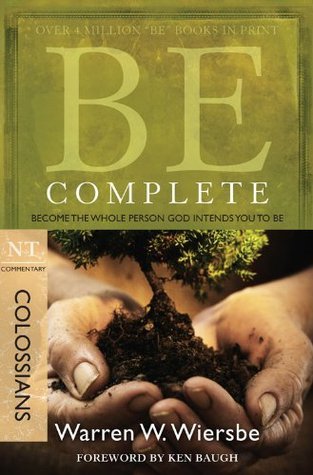
Be Complete (Colossians): Become the Whole Person God Intends You to Be by Warren Woersbe

I think most of Warren Wiersbe’s “Be” commentaries are about the same size. So a commentary on Isaiah, which has sixty-six chapters, discusses large portions at a time.

The book of Colossians just has four chapters. So Be Complete (Colossians): Become the Whole Person God Intends You to Be covers just a few verses of Colossians in each of its twelve chapters.

Since Colossians is so densely packed, and the ESV Study Bible had a lot of notes on it as well, plus Wiersbe’s book had more detail, I decided to slow down my usual pace of reading and take time to soak in what was written.

Wiersbe calls Colossians “one of the most profound letters Paul ever wrote.”

The church in Colossae was not one that Paul started; in fact, he had never been to that city. But Paul had been in nearby Ephesus for three years, from which the Bible says “‘all they which dwelt in Asia heard the word of the Lord Jesus, both Jews and Greeks'” ‘ (Acts 19:10). This would include people in Colossae, Laodicea, and Hierapolis.” A Colossian named Epaphras seems to have heard Paul preach in Ephesus and then brought the gospel back to Colossae.

At the time Colossians was written, Paul was in prison. Epaphras was with him and evidently shared that a dangerous teaching was making the rounds in Colossae. So Paul wrote to help these believers. Wiersbe believed the false teaching was Gnosticism; the ESV Study Bible notes say that “an improved understanding of Gnosticism” due to more information having been discovered about it has led scholars to think Gnosticism was not the problem, but they don’t know exactly what false teaching was being promoted. Nevertheless, there’s much we can learn from Colossians even without knowing exactly what teaching was being combated.

Paul begins the book with greetings and thankfulness for the Colossians faith. Then he shares what he prays for them, one of my favorite prayers in the Bible:

And so, from the day we heard, we have not ceased to pray for you, asking that you may be filled with the knowledge of his will in all spiritual wisdom and understanding, so as to walk in a manner worthy of the Lord, fully pleasing to him: bearing fruit in every good work and increasing in the knowledge of God; being strengthened with all power, according to his glorious might, for all endurance and patience with joy; giving thanks to the Father, who has qualified you to share in the inheritance of the saints in light. He has delivered us from the domain of darkness and transferred us to the kingdom of his beloved Son, in whom we have redemption, the forgiveness of sins.

I have prayed this often for myself and loved ones.

Paul then writes about the preeminence of Christ, “the image of the invisible God,” the one who created everything and holds it all together, the head of the church. “In him all the fullness of God was pleased to dwell, and through him to reconcile to himself all things, whether on earth or in heaven, making peace by the blood of his cross” (1:19-20).

And, amazingly, “you, who once were alienated and hostile in mind, doing evil deeds, he has now reconciled in his body of flesh by his death, in order to present you holy and blameless and above reproach before him” (1:21-22).

Paul says his stewardship was “to make the word of God fully known, the mystery hidden for ages and generations but now revealed to his saints. To them God chose to make known how great among the Gentiles are the riches of the glory of this mystery, which is Christ in you, the hope of glory. Him we proclaim, warning everyone and teaching everyone with all wisdom, that we may present everyone mature in Christ. For this I toil, struggling with all his energy that he powerfully works within me” (1:25-29). In the Bible, a mystery wasn’t something to figure out from clues: it was something that was not previously revealed but now is.

Paul warns them to “See to it that no one takes you captive by philosophy and empty deceit” or “delude(s) you with plausible arguments” (2:8, 4).

Paul goes on to exalt Christ as the one “in whom are hidden all the treasures of wisdom and knowledge” (Colossians 2:3). As we received Him, we’re to “walk in him, rooted and built up in him and established in the faith, just as you were taught, abounding in thanksgiving (2:6-7).

After sharing the gospel, Paul gives practical instruction for how the gospel affects our lives, families, and workplaces. There are certain behaviors we’re to put off, others we’re to put on. We’re to “seek the things that are above, where Christ is, seated at the right hand of God. Set your minds on things that are above, not on things that are on earth” (3:1-2).

Paul wraps up his teaching by encouraging believers to pray, give thanks, and “Walk in wisdom toward outsiders, making the best use of the time. Let your speech always be gracious, seasoned with salt, so that you may know how you ought to answer each person” (4:5-6).

I can get so caught up in the affairs of this life, I need the reminder to “set my mind on things above” and exalt Christ above all.

A few more quotes from the book that stood out to me:

The gospel message does not center in a philosophy, a doctrine, or a religious system. It centers in Jesus Christ, the Son of God (p. 30, Kindle version).

Uniformity is the result of compulsion from the outside; unity is the result of compassion from the inside (p. 37).

Satan is so deceptive! He likes to borrow Christian vocabulary, but he does not use the Christian dictionary (p. 43).

The false teachers in Colossae, like the false teachers of our own day, would not deny the importance of Jesus Christ. They would simply dethrone Him, giving Him prominence but not preeminence. In their philosophy, Jesus Christ was but one of many “emanations” that proceeded from God and through which men could reach God. It was this claim that Paul refuted in this section (p. 57).

In the New Testament, saints are not dead people who during their lives performed miracles and never sinned. New Testament saints were living people who had trusted Jesus Christ. Paul wrote this letter to living saints (Col. 1:2), (p. 73).

Prayer is not our trying to change God’s mind. It is learning what is the mind of God and asking accordingly (1 John 5:14-15) (p. 81).

It does little good if Christians declare and defend the truth, but fail to demonstrate it in their lives (p. 113).

Paul did not ask for the prison doors to be opened, but that doors of ministry might be opened (1 Cor. 16: 9; Acts 14: 27). It was more important to Paul that he be a faithful minister than a free man. It is worth noting that in all of Paul’s prison prayers, his concern was not for personal safety or material help, but for spiritual character and blessing (p. 154).

I like how Wiersbe closed his commentary on Colossians:

As we come to the close of our study of this remarkable letter, we must remind ourselves that we are complete in Jesus Christ. We should beware of any teaching that claims to give us “something more” than we already have in Christ. All of God’s fullness is in Him, and He has perfectly equipped us for the life that God wants us to live. We do not live and grow by addition, but by appropriation (p. 173).
Be Committed: Commentary on Ruth and Esther

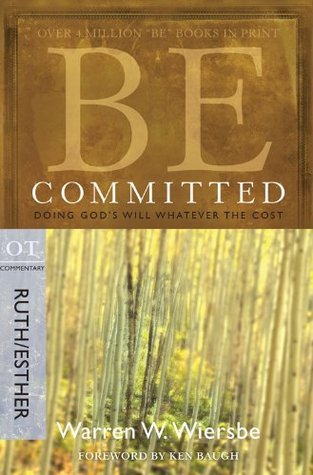
The books of Ruth and Esther are the only ones in the Bible named for women. The two women lived in different times and came from very different backgrounds. So why did Warren Wiersbe group them together in his commentary, Be Committed (Ruth and Esther): Doing God’s Will Whatever the Cost? He says:

Why do we bring these two women together in this study? Because, in spite of their different backgrounds and experiences, both Ruth and Esther were committed to do the will of God. Ruth’s reply to Naomi (Ruth 1: 16–17) is one of the great confessions of faith found in Scripture, and Esther’s reply to Mordecai (Est. 4: 16) reveals a woman willing to lay down her life to save her people. Ruth and Esther both summon Christians today to be committed to Jesus Christ and to do His will at any cost (pp. 15-16).

And then Dr. Wiersbe says something he has repeated in many of his commentaries: “Faith is not believing in spite of evidence but obeying in spite of consequence” (p. 16).

Ruth lived during the time of the judges, before Israel had kings. She was from Moab, people who were enemies to Israel. But her in-laws had come to Moab from Israel during a time of famine. Ruth had married one of their sons, but over time her father-in-law, husband, and brother-in-law all died. Ruth had come to believe in Naomi and Israel’s God, and she traveled with her mother-in-law, a bitter and broken, Naomi back to Israel.

The only recourse the women had for food was for Ruth to glean in someone else’s fields. The law at that time told farmers not to harvest every single piece of produce they grew, but to leave some for the poor. Ruth “happened” upon the fields of kind Boaz (one of my favorite OT people), who told his workers to leave some extra on purpose for her.

Near relations had the right to redeem the land of their deceased relatives, but part of the deal was marrying the widow. The nearest relation to Ruth’s husband was not willing to do this. But Boaz was the next nearest relation, and he was willing. Thus Ruth and Naomi were taken care of, and Naomi’s joy returned with the birth of her grandson–who became the grandfather of King David.

There’s much that could be said about this wonderful book. One point Wiersbe makes is this:

It is encouraging to see the changes that have taken place in Naomi because of what Ruth did. God used Ruth to turn Naomi’s bitterness into gratitude, her unbelief into faith, and her despair into hope. One person trusting the Lord and obeying His will can change a situation from defeat to victory (p. 43).

Esther lived hundreds of years after Ruth. Israel went through several kings, most of whom did not follow God. After much warning and preaching, with little response, God sent His people into exile in Babylon, which was later conquered by Persia. After 70 years, many Israelites were permitted to go back to their land. But Esther and her cousin, Mordecai, were among many Jews still in Persia.

Mordecai raised Esther because her parents had died. The pagan king, Ahasuerus, dismissed his wife for reasons found in Esther 1. His advisors encouraged him to gather the virgins of the land and . . try them out, and then choose from among them a new bride. Esther was one of the young women, and she happened to be chosen as the new queen.

Neither Esther nor Mordecai were known to be Jews at first. Wiersbe talks about the possibility that this may have meant they were not living according to God’s laws, because even the dietary laws would have separated them from other people in the land. We don’t know if this means they weren’t being faithful or if there were other reasons their nationality was not known. There also would have been problems with Esther, as a Jew, marrying a Gentile, and of course with her sleeping with the king before they were married (though she may not have had a choice about that).

At any rate, one person knew Mordecai was a Jew: Haman. Haman was a high official and hated that Mordecai would not bow to him like everyone else did. He was so angry, he plotted to kill not only Mordecai, but all the Jews. When he proposed this to the king, oddly, the king agreed without much discussion.

One interesting thing about the book of Esther is that God’s name is not mentioned once. But His fingerprints are all over the book. The suspense and irony of how God delivered the Jews from destruction is one of the most exciting stories in the Bible.

The highlight of the book is when Esther goes before the king to petition his protection for her people. According to the law of the land, if she came uninvited to see him, and he refused her, she could have been killed. But after fasting and praying for three days and asking others to do the same, she determined to go. Her “if I perish, I perish” (Esther 4:16) has rung through the centuries as an example of doing what’s right and what’s best for others despite what happens to us.

Both of these books show God’s guiding hand in the lives of His people, individually and as a nation. One encouragement to me was that God did this despite and even through a pagan king and an enemy to His people.

Finally, there is a powerful personal message in the book of Esther; for Esther, like Ruth, is a beautiful example of a woman committed to God. Ruth’s “Whither thou goest, I will go” (Ruth 1: 16 KJV) is paralleled by Esther’s “And if I perish, I perish” (Est. 4: 16 KJV). Both women yielded themselves to the Lord and were used by God to accomplish great things. Ruth became a part of God’s wonderful plan for Israel to bring the Savior into the world, and Esther helped save the nation of Israel so that the Savior could be born (p. 79).

We must never think that the days of great opportunities are all past. Today, God gives to His people many exciting opportunities to “make up the hedge, and stand in the gap” (Ezek. 22: 30 KJV), if only we will commit ourselves to Him. Not only in your church, but also in your home, your neighborhood, your place of employment, your school, even your sickroom, God can use you to influence others and accomplish His purposes, if only you are fully committed to Him (p. 80).

Be Transformed

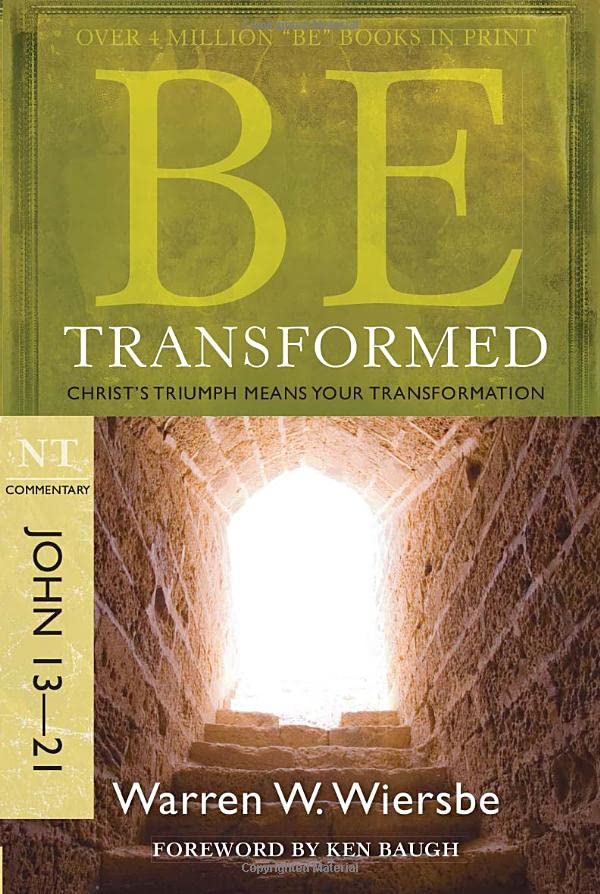
Warren Wiersbe divided his commentary on the gospel of John into two books. The first was Be Alive (John 1-12): Get to Know the Living Savior. The second is Be Transformed (John 13-21): Christ’s Triumph Means Your Transformation. The first twelve chapters of John “focus on our Lord’s public ministry, especially the signs (miracles) that Jesus performed and the messages that grew from them” (Location 150, Kindle version). Chapters 13-21 share more of the private ministry of Jesus with His closest disciples, “preparing them for their future service when the Holy Spirit would come and empower them” (Location 150). Chapter 13 opens with the Passover meal the night before Jesus was betrayed where He washes the disciples’ feet and institutes what we call the Lord’s supper (communion). The rest of John details Jesus private discourse with the disciples that night, His betrayal, arrest, crucifixion, and resurrection.

John shares his purpose statement in John 20:31: “these are written so that you may believe that Jesus is the Christ, the Son of God, and that by believing you may have life in his name.” “The basic theme of John’s gospel is that Jesus Christ of Nazareth is the very Son of God, and all who believe in Him receive eternal life (20: 30–31). John’s subject is the deity of Christ. John’s object is to lead people into the life—eternal life, abundant life—that only Christ can give. John is both a theologian and an evangelist” (Location 150).

John attests to Jesus deity not only through His many signs, or miracles, but through other witnesses, through Jesus’ “I am” statements, through His fulfillment of the Old Testament festivals and prophecies about Himself.

John said throughout the first part of his book that Jesus’ “hour” had not yet come. Then in John 12:23, at this transition between public and private ministry and the week leading up to the cross, Jesus said, “The hour has come for the Son of Man to be glorified.” Jesus says a little later, in verse 27, ““Now is my soul troubled. And what shall I say? ‘Father, save me from this hour’? But for this purpose I have come to this hour.”

As I mentioned in Let Not Your Hearts Be Troubled, Wiersbe points out that Jesus comforted and reassured the disciples that though He was about to leave the earth, they had the Father’s love and care, the peace Jesus gave them, the comfort and ministry of the Holy Spirit within them, access in prayer, and a home in heaven to look forward to.

He then teaches them to abide in Him, as a branch abides in the vine (John 15). “The key word is abide; it is used eleven times in John 15: 1–11 (‘continue’ in John 15: 9 and ‘remain’ in John 15: 11). What does it mean to ‘abide’? It means to keep in fellowship with Christ so that His life can work in and through us to produce fruit. This certainly involves the Word of God and the confession of sin so that nothing hinders our communion with Him (John 15: 3). It also involves obeying Him because we love Him (John 15: 9–10)” (Location 777). “This abiding relationship is natural to the branch and the vine, but it must be cultivated in the Christian life. It is not automatic. Abiding in Christ demands worship, meditation on God’s Word, prayer, sacrifice, and service—but what a joyful experience it is!” (Locaion786).

Jesus tells them more of the work the Holy Spirit will do in their lives (John 16) and then offers up His wonderful “high priestly prayer” to the Father for us (John 17).

Then John tells of Jesus’ betrayal by Judas, His encounter with Pilate, His crucifixion, burial, resurrection, appearances to Mary and the disciples..

A few other quotes from Wiersbe’s commentary:

To “keep” His commandments means to value them, treasure them, guard them, and do them. “I have esteemed the words of his mouth more than my necessary food” (Job 23: 12) (Location 559).

Our English word comfort comes from two Latin words meaning “with strength.” We usually think of “comfort” as soothing someone, consoling him or her, and to some extent this is true. But true comfort strengthens us to face life bravely and keep on going. It does not rob us of responsibility or make it easy for us to give up. Some translations call the Holy Spirit “the Encourager,” and this is a good choice of words. Parakl ∑ tos is translated “Advocate” in 1 John 2: 1. An “advocate” is one who represents you at court and stands at your side to plead your case (Location 587).

Shalom—peace—is a precious word to the Jewish people. It means much more than just the absence of war or distress. Shalom means wholeness, completeness, health, security, even prosperity in the best sense. When you are enjoying God’s peace, there is joy and contentment. But God’s peace is not like the “peace” that the world offers (Location 662).

We do not study the Word of God in order to “argue religion” with people, or to show off our grasp of spiritual things. We study the Word to see Jesus Christ, to know God better, and to glorify Him in our lives (Location 1133).

“Be of good cheer!” is one of our Lord’s repeated statements of encouragement. Literally it means, “Cheer up!” There is the “good cheer” of His pardon (Matt. 9: 1–8), His power (Matt. 9: 18–22), and His presence (Matt. 14: 22–27). Here in John 16: 33, He announces the “good cheer” of His victory over the world. We are overcomers because He has first overcome for us (Location 1318).

Human history began in a garden (Gen. 2: 8ff.), and the first sin of man was committed in that garden. The first Adam disobeyed God and was cast out of the garden, but the Last Adam (1 Cor. 15: 45) was obedient as He went into the garden of Gethsemane. In a garden, the first Adam brought sin and death to mankind, but Jesus, by His obedience, brought righteousness and life to all who will trust Him. He was “obedient unto death, even the death of the cross” (Phil. 2: 8). History will one day end in another garden, the heavenly city that John describes in Revelation 21 and 22. In that garden, there will be no more death and no more curse. The river of the water of life will flow ceaselessly, and the tree of life will produce bountiful fruit. Eden was the garden of disobedience and sin; Gethsemane was the garden of obedience and submission; and heaven shall be the eternal garden of delight and satisfaction, to the glory of God (Location 1629).

It is a sad thing when well-meaning but ignorant Christians take up the sword to “defend” the Lord Jesus Christ. Peter hurt Malchus [the high priest’s servant whose ear Peter cut off), something no believer should do. Peter hurt the testimony of Christ and gave the false impression that His disciples hate their enemies and try to destroy them. (Note our Lord’s reply to Pilate in John 18:36.) (Location 1713).

The cup He prepares will never contain anything that will harm us. We may suffer pain and heartbreak, but He will eventually transform that suffering into glory (Location 1737).

God does not reveal new truth to us if we fail to act on the truth we already know (Location 2005).

I enjoyed spending time in December thinking of Jesus birth in the context of the rest of His life and ministry and teaching in John. Dr. Wiersbe, as always, was a helpful companion.

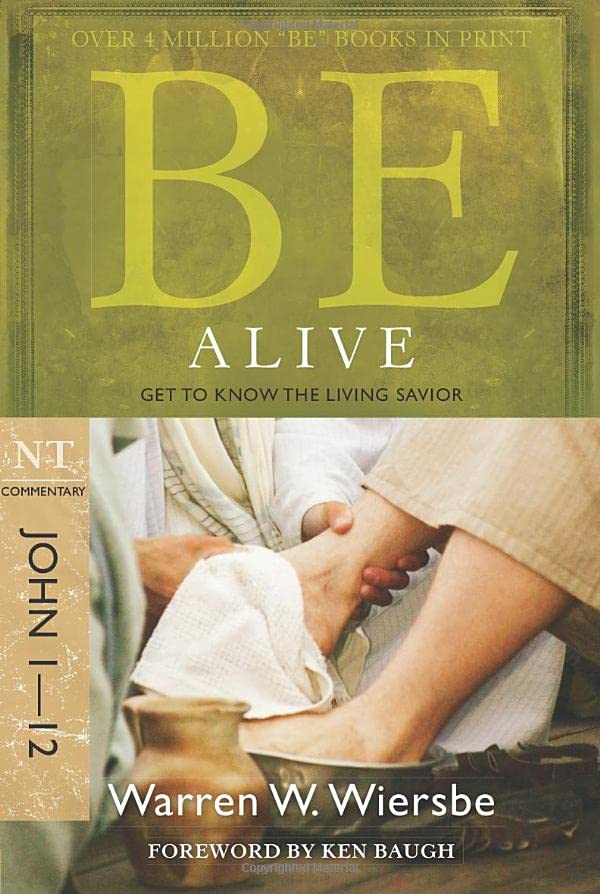
Be Alive: Get to Know the Living Savior

I veered from my Bible reading plan because I wanted to be in one of the gospels over December, and because the plan had not taken me through John in the last few years.

Warren Wiersbe divided his commentary on John into two books, the first being Be Alive (John 1-12): Get to Know the Living Savior.

Each of the four gospels presents Jesus from a different aspect. John’s gospel portrays Jesus as the Son of God.

John shares different titles for Jesus: the eternal, incarnate Word of God (“Much as our words reveal to others our hearts and minds, so Jesus Christ is God’s ‘Word’ to reveal His heart and mind to us”–p. 20); the light of the world; the eternal Son of God; the lamb of God; the Messiah, long promised and prophesied in the Old Testament; the king of Israel; the Son of Man; the good shepherd, the water and bread of life, the door.

When John shares some of the miracles Jesus did, he “seeks to share the inner meaning—the inner significance—of our Lord’s works, so that each miracle is a ‘sermon in action” (p. 38). “Our Lord’s miracles were testimonies (John 5: 36), giving evidence of His divine sonship; but they were also tests, exposing the hearts of the people (John 12: 37ff.). The same events that opened some eyes only made other eyes that much more blind (John 9: 39–41)” (p. 44).

One theme through John’s gospel is Jesus’ “hour.” Throughout, Jesus says His hour was not yet come. Then it was at hand, then it finally culminated in His death for us.

Another theme is that Jesus loves and came to die for the world, not just the Jews.

One of John’s major themes is that Jesus is the Savior of the world, not simply the Redeemer of Israel. He is the Lamb of God who takes away the sin of the world (John 1: 29). “For God so loved the world” (John 3: 16). The Samaritans rightly identified Him as “the Savior of the world” (John 4: 42). He gave His life for the world, and He gives life to the world (John 6: 33). He is the Light of the World (John 8: 12). The universal emphasis of John’s gospel is too obvious to miss. Jesus will bring the “other sheep” who are outside the Jewish fold (John 10: 16; and see 11: 51–52) (p. 190).

The crowds at first flocked to Jesus for His teaching and His provision. They hoped He would throw off Roman oppression and set up His kingdom. Some believed and became loving followers of Christ. Many began to fall away when He spoke of the cost of discipleship and when it became clear that He was not the type of Messiah they had envisioned.

The Pharisees were supposed to be experts in the law of God, but they missed the Savior portrayed in the law.

When a person starts to resist the light, something begins to change within him, and he comes to the place where he cannot believe. There is “judicial blindness” that God permits to come over the eyes of people who do not take the truth seriously. (The quotation of Isa. 6: 9–10 is found in a number of places in the New Testament. See Matt. 13: 14–15; Mark 4: 12; Luke 8: 10; Acts 28: 25–27; Rom. 11: 8.) It is a serious thing to treat God’s truth lightly, for a person could well miss his opportunity to be saved. “Seek ye the LORD while he may be found, call ye upon him while he is near” (Isa. 55: 6)” (p. 194).

John’s gospel is a full and rich portrayal of Christ. There is so much in it, I am not surprised Wiersbe took two books to cover it. I look forward to the next one.