

If we look through the Ten Commandments, most of us breathe a sigh of relief when we come to the sixth one: “You shall not murder.” At least that’s one thing we haven’t done.
However, Jesus takes the issue beyond outward action to the heart. He said, “You have heard that it was said to those of old, ‘You shall not murder; and whoever murders will be liable to judgment.’ But I say to you that everyone who is angry with his brother will be liable to judgment; whoever insults his brother will be liable to the council; and whoever says, ‘You fool!’ will be liable to the hell of fire” (Matthew 5:21-22).
Some translations show the middle of verse 22 saying “And whoever says to his brother, ‘Raca!’ shall be in danger of the council” (NKJV). According to the Berean Study Bible notes here, “‘Raca’ is an Aramaic term of contempt, roughly equivalent to calling someone ’empty-headed’ or ‘worthless.'” Other translations use the word “idiot.”
The notes go on to say, “Calling someone a ‘fool’ implies moral and spiritual deficiency, not just intellectual lack. In biblical terms, a fool is someone who rejects God and His wisdom (Psalm 14:1). This phrase highlights the destructive power of words and the importance of speaking with love and respect.”
We can understand how lust is the first step toward sexual sin, as Jesus said earlier in Matthew: “You have heard that it was said, ‘You shall not commit adultery.’ But I say to you that everyone who looks at a woman with lustful intent has already committed adultery with her in his heart” (Matthew 5:27-28).
But how are anger and name-calling precursors to murder?
They both dehumanize other people and cheapen their worth. Jen Wilkin describes the progression in her book on the Ten Commandments, Ten Words to Live By: “First, I am angry with you in response to a hurt. Next, I begin to question your character with an insult. Then, I begin to question your worth as a person. As anger degrades into contempt, the personhood of another is devalued” (p. 93).
I’ve often wondered at the atrocities humans have committed against each other during the days of slavery or the Holocaust or in prisoner of war camps. Some people thought of slaves or Jews or enemies as something less than human, and that was the first step to treating them horribly.
Even now, online battles reveal a shocking wish for harm towards others who disagree with opposing politics or views. Seven years ago, author and teacher Karen Swallow Prior was hit by a bus and had a long recovery. Recently, she shared a post on X where someone said he wished that bus had better aim. Like her or not, disagree or agree with her, wishing for her demise is appalling.
But these kinds of things are common online. Harm is wished towards people of differing opinions. Cancel culture is a smaller version of wanting to wipe out, to remove from public view, those we disagree with.
A few years ago, I was in a WalMart when I first realized that Covid was going to be a major issue. I had heard of it, but we’d been warned about viruses before (like H1N1), which didn’t have a great effect on our everyday lives. We figured this new virus would be the same.
But that day in WalMart, shelves were empty of disinfecting wipes, antibacterial soap, and toilet paper, among other things. I had never seen anything like this. I was rattled, wondering what was going on, how big this thing was going to be, and where I was going to find what I needed.
In my preoccupied state, I turned in front of another cart to get something from a shelf. It was the equivalent of cutting someone off in traffic. I wasn’t being malicious: I just wasn’t thinking clearly. But I was definitely in the wrong. I couldn’t seem to form the thoughts or words to apologize.
The person I offended pulled his mask down, looked straight in my eyes, and said to his companion, “I hope she gets the Coronavirus. I hope she dies from it.”
I watched him pass by with my mouth gaping open. I couldn’t believe he said that. I was even more rattled.
Genesis 1 tells us God created people in His image or likeness. Everyone has worth because God made them, even though that image is marred because of sin.
When we become believers, we “put on the new self, created after the likeness of God in true righteousness and holiness” (Ephesians 4:24). We start to look and act more like our Father. The more we behold Him and walk with Him, the more we’ll look like Him. Therefore we take care to “Be angry and do not sin; do not let the sun go down on your anger, and give no opportunity to the devil” (Ephesians 4:24-27).
We don’t keep the sixth commandment just by avoiding murder. We value others as God’s creation.
Jen Wilkin continues:
Because we are accepted in the beloved, we will not be content to simply be not-murderers, or not-contemptuous, or not-angry. We will not merely refrain from taking life—we will run toward giving it. Let us read in the sixth word’s prohibition of murder the exhortation to take every care to preserve life. Let us run to be life-protectors and esteem-givers and peacemakers.
To do so will require that we take stock of how we might be participating in the anger-worship of our cultural moment. It will require that we strive to preserve life in a culture that believes entire categories of image bearers are worthy of our contempt or our disregard—the unborn, the elderly, the physically or mentally challenged, the poor, the powerless, the foreigner. And in a world defined by living at odds with others, it will require that we strive to live at peace with others, as far as it is possible with us. It will ask us to be our brothers’ keepers, even as Christ has been ours (p. 96).
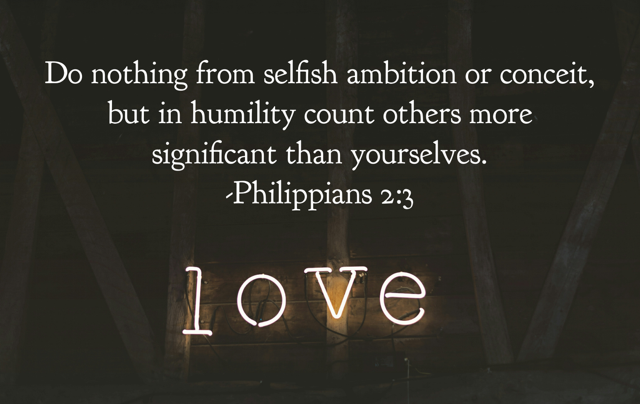
Paul writes in Philippians 2: “Do nothing out of selfish ambition or conceit, but in humility consider others as more important than yourselves. Everyone should look not to his own interests, but rather to the interests of others” (verses 3-4, CSB).
He points us to Jesus’ example: “Adopt the same attitude as that of Christ Jesus, who, existing in the form of God, did not consider equality with God as something to be exploited. Instead he emptied himself by assuming the form of a servant, taking on the likeness of humanity. And when he had come as a man, he humbled himself by becoming obedient to the point of death —even to death on a cross” (verses 5-8, CSB).
If anyone had a right to be angry with others, Jesus did. But He became as a servant and humbled Himself, even to the point of death, for people who, at best, did not understand Him, and, at worst, plotted to do away with Him.
We can’t have the attitude Jesus did in ourselves. We need His grace. We need to look long at Him so that we might become more like Him, showing love instead of contempt.
(I often link up with some of these bloggers.)

 Stray Thoughts