
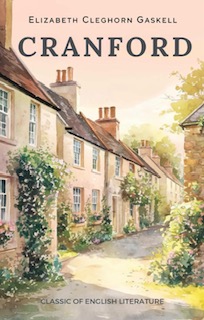
Cranford was originally written as a series of vignettes by Elizabeth Gaskell in Charles Dickens’ magazine, Household Words. She started out with just two, but he encouraged her to write more. Afterward, with a little alteration, the pieces were formed into a book.
As such, there’s not an overarching plot through the book. The stories take place in a fictional small town whose residents are mostly older single women living in genteel poverty. They live by a strict code–“calling” is only for three hours a day and only for fifteen minutes. They are constantly evaluating situations by class–how to dress for this person’s get-together, whether it was right for that person to marry this one, and so forth.
The two main characters are sisters, Deborah and Matty Jenkyns, daughters of the former rector. Deborah is older and very strict in her views of what is acceptable and what is not. Yet she surprises others by breaking protocol sometimes in her compassion for others. She leads the way in new thinking that class is not always the basis for one’s actions.
When she passes away early on in the book, the more timid Matty has to come into her own.
The stories are told through a Miss Smith, who comes to visit often. This is what I would call a quiet book. The characters experience ups and downs, joys and sorrows. Gentle humor is sprinkled throughout.
When a man with two daughters moves into the neighborhood, the dynamics of society are shaken up a bit, especially as he doesn’t know that things like one’s financial situation are not discussed in public. A series of robberies take place just as a magician comes to town, making him a suspect. Matty comes across a former suitor she’d had to turn down decades ago.
This Kindle version of the book has a couple of interesting appendices, one on the historical context of the book, and one on Gaskell’s life. Many of the stories are based on Gaskell’s memories of living in Knutsford (including one tale of a cow dressed in flannel. She told someone she scaled down some descriptions a bit, thinking no one would believe the full version). The former article says, “The tale of Cranford, then, is the tale of England in miniature: a society caught in a moment of profound transition, learning to reconcile its cherished traditions with the irresistible tide of a new and unfamiliar age.” It also says Gaskell captured the “quiet comedies and secret sorrows of her characters.”
Gaskell’s family were Unitarians, and she married a Unitarian minister. The article describes them as “Dissenters,” though I had not associated that word with Unitarianism. The article says, “This progressive faith emphasized reason, social responsibility, and individual conscience over rigid doctrine” and “shaped her entire worldview. It instilled in her a powerful sense of moral duty and a deep-seated empathy for those on the margins of society.” I would not agree with many religious aspects of Unitarianism (they deny the doctrine of the Trinity, for one thing), but that does not come up much in the book. The emphasis here is more on “social responsibility.”
I first read Cranford about fifteen years ago, and thought it merely “pleasant.” But then I started watching the BBC series, which combines stories from this book as well as My Lady Ludlow and Mr. Harrison’s Confessions. That renewed my interest in the characters, so I went through the book again, this time via audiobook superbly read by Prunella Scales.
Though I like others of Gaskell’s books better, I liked this one much more than I did on my first reading.

