Women of the Word

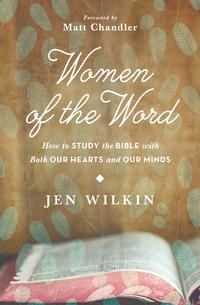
WOTWIf you could only read one book about studying the Bible, I would recommend Women of the Word by Jen Wilkin.

I read it four years ago, but wanted to read it again. I should probably reread it every few years.

Jen opens with some of the mistaken approaches she took to reading the Word of God at first. One was reading it as if it were a book about her and to help her. Though the Bible does help us, it is a book about God. Another “turnaround” for her was the realization that the Bible should speak to the mind as well as, and even before, the heart.

If we want to feel a deeper love for God, we must learn to see him more clearly for who he is. If we want to feel deeply about God, we must learn to think deeply about God (p. 33).

We must love God with our minds, allowing our intellect to inform our emotions, rather than the other way around (p. 34).

Jen’s great passion is promoting Bible literacy, which she says “occurs when a person has access to a Bible in a language she understands and is steadily moving toward knowledge and understanding of the text” (pp. 36-37). She emphasizes the steady movement: we won’t some day “arrive” at complete Bible knowledge, but we should be ever growing.

But “we may develop habits of engaging the text that at best do nothing to increase literacy and at worse actually work against it” (p. 37). She discusses several of those wrong habits, like the Xanax approach (which “treats the Bible as if it exists to make us feel better,” p. 39), the Magic 8 ball approach, and several others.

Then she shares Five P’s of Sound Study: purpose, perspective, patience, process, and prayer, explaining, illustrating, and giving example of each. Within “process” she discusses comprehension, interpretation, and application, and she stresses reading in context and in consideration of the genre of each book.

Throughout the book Jen emphasizes that Bible study and literacy is not an end in itself: it is a means of knowing God for who He is, getting to know Him better and being changed to become more like Him.

Our study of the Bible is beneficial only insofar as it increases our love for the God it proclaims. Bible study is a means to an end, not an end in and of itself. It is a means to love God more, and to live differently because we have learned to behold him better. And it is a means to become what we behold. The reciprocal love of God is a love that transforms (p. 148).

She includes an excellent chapter expressing the great need for women to teach women and sharing helps for those who would go on to lead Bible studies. I especially appreciated the admonition to avoid “ricocheting around the entire Bible…Good teaching will necessarily involve the use of cross-references, but not at the expense of the primary text” (p. 139) and to avoid “feminizing the text” (p. 140) as well as the rest of the advice in this chapter.

I am glad I read this again, and I am happy to recommend it again.

(Sharing with Semicolon‘s Saturday Review of Books,
Literary Musing Monday,
Carole’s Book’s You Loved)

Book Review: Overcoming Your Devotional Obstacles

If you’ve ever tried to develop a habit of Bible reading and prayer time (often called devotions or quiet time), you know it doesn’t take very long at all to run into some obstacles. The first one is usually making time: busy schedules crowd out quiet time or urgent needs come up in the midst of it. Then when we do get a few minutes, we’re easily distracted. If we can rein in our attention and focus, we don’t always understand what we read or know how to apply it to our everyday lives. And if we do understand, we forget what we’ve read within minutes. We see cozy Instagram photos of people with their open Bibles and steaming mugs of coffee and wonder why our devotional time seems to far so fall below the picture-perfect time others experience.

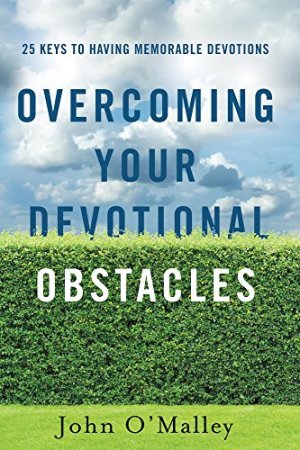
Devotional ObstaclesJohn O’Malley tackles these issues in Overcoming Your Devotional Obstacles: 25 Keys to Having Memorable Devotions. I appreciate that he deliberately chose a positive, encouraging title rather one with a negative cast, like Seven Reasons I Fail in My Devotions. His purpose, he writes, is not assigning fault or blame, but rather “putting tools in your hand to help you go from defeated to victorious in your time alone with God.”

The author emphasizes that our relationship with God is based on grace, not performance. Our devotional time is not meant to try to impress Him (or anyone else). Devotions are not a work to gain favor with God; they’re a means of communicating with Him. But there are ways to improve our understanding of His communication to us.

Our Quiet Time with Him is more about discovering His presence than finding the perfect Bible reading plan or study method. If we complete a Bible reading plan and did not discover His presence, we may have checked off the box for the day on our daily Bible reading plan, but we missed Him.

When we do not spend time with God, we deplete ourselves. We deplete our peace, joy, and strength. When limiting our access to time with God, we tend to lean on our own understanding; we are filled with doubts, and we consult our own heart instead of the mind of God (Proverbs 3: 5-6).

Jesus said that His sheep know, hear, and follow His voice. Your time with the Lord is about listening. God’s Word is the answer to every human need. Read not to accomplish book or chapter count. Read and listen.

If it takes you five years to read through the Bible, you are not less of a Christian. Read it at a pace that you can comprehend it and receive something from it.

The author discusses each of the obstacles mentioned above: finding time for devotions, battling distractions, improving comprehension, discerning how to apply what we read, understanding cultural differences, and retaining what we read.

I loved the author’s description of application as “the intersection of Bible learning and Bible living.”

I particularly liked his illustration about understanding and learning from the different culture that the Bible was written in. He likens it to taking a friend to a family reunion. The friend won’t know the histories, background stories, and quirks of all the family members, so you’ll likely have to explain some references along the way. “Culture is the system of beliefs, values, and ideas of a people in a certain time period.” However, “God and His Word are transcultural.” The author suggests some resources for finding out more about the cultural aspects, but above all other resources, he reminds that the Holy Spirit indwells believers and teaches us from God’s Word.

I also appreciated the tips for retaining what we read, something I don’t remember seeing in other books about devotions. One tip was to write down on a 3×5 card three key points from the verses read and then read and think about the verse and those points several times throughout the day.

The author advocates a lot of 3×5 cards, however. I counted at least four that he recommended filling out: one for a verse to meditate on; one for recording the time spent and main truth learned; one for writing down several statements about why we read the Bible; and one to write down your expectations for what God will do through His Word. He notes that one can use a journal, electronic device, etc.

The author includes some Bible study plans, lists of resources, and work sheets.

My only point of disagreement in the book was with the author’s statement that “Applying Scripture to your life is what brings the Word of God to life.” I know what he means: we don’t benefit and really learn it unless we apply it. But I always wince when I see someone speak of “making the Bible come alive.” God’s Word IS alive (“For the word of God is living and active, sharper than any two-edged sword, piercing to the division of soul and of spirit, of joints and of marrow, and discerning the thoughts and intentions of the heart” – Hebrews 4:12, ESV; “The words that I have spoken to you are spirit and life” – John 6:63b, ESV). We’re the ones who need to be brought to life. But I know the author believes these truths, so the disagreement was with the wording.

This book is immensely practical and to the point with little to no fluff. It is an excellent resource for anyone who is trying to establish a devotional time or who has run into any of these obstacles in their own quiet time.

(Sharing with Semicolon‘s Saturday Review of Books, Literary Musing Monday, Carole’s Books You Loved)

Laudable Linkage

img_0021

Here’s another round of notable reads found recently:

How to Avoid Becoming (Heavenly) Hangry on Vacation.

What Your Child Needs More Than Self-esteem, HT to Story Warren.

A Parent’s Guide to the 5 Skeptics Who Want to Shame Your Kids for Being Christian, HT to Challies.

When You Don’t Enjoy the Little Years. Even though you love your little ones dearly, some days are hard.

Can I Trust God With My Child’s Suffering? HT to True Woman.

How to Bring the (Whole) Bible to Life for Kids, HT to True Woman. Though I chafe at the phrasing of the title (the Bible IS living – John 6:63), I know what the author meant, and there are some great ideas here.

When the Content Police Came for the Babylon Bee, HT to Challies.

Hope for People With Food Allergies, HT to True Woman.

The Real Story of Christopher Robin, HT to Glynn. Sad, but I hope on some level the family retained some joy that the Pooh stories were such a dear part of many people’s childhoods.

Several people have asked me if I’ve heard of the recent ruling to remove Laura Ingalls Wilder’s name from a literary award. I’m not surprised, especially in today’s climate. There were characterizations and incidents in the books that we cringe at today. But I hope this does not lead to a pulling of her books from shelves or reading lists. We encounter what we would consider wrong attitudes in a number of older books, even classics. If we tossed books that had anything in them we disagreed with – well, we wouldn’t have much left. It takes long years to change cultural thinking. The better way, I believe, is to realize that every person and every generation is a mixture of good and bad and to educate about both sides. A couple of good articles I’ve seen on this are Scrubbing Laura Ingalls Wilder is a Dangerous Step Toward Ignorance (HT to Melanie) and How to really Read Racist Books to Your Kids, (HT to 19th Century Classic Children’s Books You Might Have Overlooked, which I found through Story Warren). I wouldn’t agree with every point in the latter (mainly the evolutionary lens), but both articles make good points.

I usually like to close these posts with a funny or thoughtful picture or meme – but I don’t have one handy and need to get on to today’s tasks, so I’ll wish you a Happy Saturday!

Laudable Linkage

IMG_0195

Here are noteworthy reads discovered this last week:

Reaching for the Light. A mom’s struggle to spend time with the Lord and four kids.

Why I Took My Six-year-old Son on an Overnight Trip. Thoughts on Scripture’s instruction, “Son, give me your heart.”

The Hardest Part of Mothering.

Youth Group or Frat House? HT to Out of the Ordinary. Wisdom about youth group activities that humiliate.

In Defense of Preachy Children’s Books. HT to Story Warren. “Kids want to be entertained and delighted. The first thing you can do is erase the words moral, teach, message, and lesson out of your vocabulary…keep authoritative figures, like parents, teachers, or older siblings, in the background. Lastly, never let the adults in the story tell what the main character should do. Remember, it is a sin to preach in fiction.” The author counters this advice with examples from beloved children’s classics, and I agree with her. There was something in me that rose up to meet and welcome moral instruction in stories. It can be overdone, of course. And there are times to let readers realize what the story is about rather than telling them directly. But, “Rather than detracting or distracting from the story, were these passages giving me the names of the lovely ideals I sensed in the characters I admired? Were they revealing to me an eternal, universal world of Courage, Sacrifice, Hope, Joy, Love that, unlike the long-ago and fairytale story-lands I longed to enter, was near at hand for me to dwell in? Could this be why didacticism, properly woven into story, does not ruin but elevates it?”

100 Summer Crafts and Activities for Kids, HT to Story Warren.

And a thought for the day, HT to Jody Hedlund re writing, but applicable to many areas:

Laudable Linkage

IMG_0195

Here’s my latest round-up of good reading on the web:

You Don’t Love the Church.

What Does It Mean to Abide in Christ, HT to Challies.

The Long Drive Home. I can identify.

Studying God’s Word When You’re Tired and Busy, HT to Challies.

Three important differences between flattery and encouragement, HT to Challies.

False Friends and Dead Words, HT to Challies, on words in the KJV which mean something different now than they did then and how that causes confusion.

The Little Known Story of Olympian Eric Liddell’s Final Years.

Scott Hamilton Was Demoted As an Olympic Broadcaster. Don’t Feel Sorry For Him. Scott is my all-time favorite ice skater. I enjoyed his testimony here:

Happy Saturday!


Laudable Linkage

IMG_0195

I’ve come across a lot of good reading already in 2018! Here is some that stood out to me in various ways:

How an Old Man Helped Save My Faith, HT to Challies.

I Couldn’t Call God “Father,” HT to Challies. A sweet testimony of an Iranian woman’s journey to Christian faith.

Show Me Your Endurance. “While church leaders dismissed my friend as unpolished and uneducated, I realized her experience was a part of my discipleship journey in ways that information acquisition and discipleship habits alone were not. I saw in her life what my own could look like as I trusted God to be there for my child and for me.”

These Hibernation Days, HT to True Woman. “Winter is a fallen seed, before it has sprouted again. It is God’s gift to us, to teach us of the value of rest, quiet, hiddenness, and death.”

Harsh Light, HT to Story Warren.

A few with the new year in mind:

Bible Reading Schedules. A couple of these I have seen before, a couple were new to me.

Preventing Spiritual Scurvy this Year: The Micronutrient Bible Reading Plan, HT to Challies.

Beginning of the Year Check-in Questions for Christians, HT to Challies. “Don’t leave your spiritual growth up to spontaneity. Make a plan. Now that we’re in 2018, here are some questions to ask as you formulate ways to grow.”

A Launch-Yourself-Forward Worksheet. If your resolutions or “one word” choices fizzle out sooner rather than later, this worksheet might help you implement those changes.

How (Not) to Read Next Year, HT to Bobbi.

They are our children, after all. When everything does not turn out all right in our children’s lives.

Clearing to Neutral: The One Habit That Stops You From Procrastinating, HT to Lisa.

What Sugar Does to Your Brain, HT to Challies. Not good news after the excess sweets throughout December.

And finally, many of us are in a very cold weather system right now. We haven’t had snow here except for about an hour one day. I hope those of you “snowed in” get some sunshine and warmer temperatures soon. Meanwhile…

Happy Saturday!

Laudable Linkage

img_0021

I have kind of a longish list today, but found all of these noteworthy or thought-provoking in some way. Hope you find something you like!

Where Is God in a Mass Shooting? HT to True Woman.

Letter to a Church Member (Or a Letter to Myself). “Your church is here, not to give you a good self-image, but to give you a true self-image.”

Exegesis Without Embarrassment, HT to Challies. The first of a series dealing with why God would command the destruction of the Canaanites.

Ten Things You Should Know About Temptation, HT to Challies.

God Is With You in Your Panic Attack.

Let’s Get Real About Women’s Discipleship, HT toChallies. “If Instagram is any clue, most Christian women think discipleship is limited to hosting thoughtfully curated Bible studies in tasteful homes where shrieking children and dirty dishes don’t exist. This glossy ideal sits like a yoke on many women’s shoulders rather than spurring them onward in Christ’s Great Commission.”

The Holiness of Small Things.

Worship Isn’t About Feelings, HT to Challies. “Sometimes I serve my neighbor out of obedience to Christ, and love for Christ follows. Sometimes I am filled with love for Christ, such that I look for an opportunity serve my neighbor.

When You Don’t Need God’s Guidance, HT to True Woman. “We don’t need to seek guidance where guidance has already been revealed in Scripture. How easy it is to convince ourselves we’re “confused” about what we should do when we’re reluctant to do what we know is right. It helps us feel better to label questions of morality “complicated” when they require us to pick up a cross or suffer rejection. The serpent’s ancient whisper—Did God really say?—trips off the tongue when God’s commands are costly.”

Heroes, Hagiography, and Villainy. I’ve been thinking for some time now about writing a post concerning flawed heroes. This says some of the things I have been thinking.

Four Reasons to Read Slowly. “The Information Age isn’t slowing us down, but subtly and constantly pressuring us to speed up. As we browse, surf, and scroll, we’re training ourselves to quickly see new facts and then look for the next figures, rather than feel the weight of what we read.”

Advice for Reading the Bible when a learning disability makes it hard.

Benny Hinn Is My Uncle, But Prosperity Preaching Isn’t For Me.

Theological imagination.

I Stopped Praising My Kids for a Week: This Is What I Learned, HT to Story Warren.

Some years ago I was wandering around the local library’s video collection looking for something to watch and saw the 10th anniversary production of Les Miserables. I decided to get it and see what all the fuss was about – and that started a love affair with the musical and then the book. Since the particular singers there were the first I heard, and though I have seen some wonderful clips of a variety of singers singing some of the songs, this cast will always embody the characters for me. Recently I stumbled across this video of Philip Quast, who played Inspector Javert, telling how he approached one of the solos. I had no idea such thought and intention was involved behind every word. In the song he’s discussing, Javert has just had an encounter with ValJean, the man he has been trailing all his adult life. ValJean has just carried a wounded Marius through the sewer system when he runs into Javert and begs Javert to let him see Marius to safety. Previously ValJean had held Javert’s life in his hands, and let him go. Javert can’t compute this: he upholds righteousness and The Law, and in his mind, once you’ve fallen, there is no mercy or grace. “Once a con, always a con” is his mindset. So how can it be that this man no longer acts like a con and even shows mercy and compassion?  I’ll post the video of this song from the musical after this interview:

A couple of other things I love about this: Javert’s previous solo was about the comfort he found in the stars as “sentinels” of God’s order in the world. But here, “the stars are black and cold.” Also, there is so much parallelism between this song and Valjeans’s soliloquy when when the bishop shows him an undeserved kindness: the same tune there and here, similar phrasing about “allowing this man” to have an influence, an offer of freedom, “I am reaching, but I fall…,” escaping the world of Jean ValJean, but in two different ways. Although ValJean had to wrestle with it, he accepted the bishop’s grace. Javert either thought he didn’t need it, since he was always in the right in his own eyes, or he couldn’t accept it from this man. When his entire worldview was turned on its ear, instead of adjusting, he could only escape. Grace accepted saves and changes a person. Grace rejected leaves one out in the cold darkness.


Save

Word Studies in the Bible

IMG_0377

Generally it’s better to read a book of the Bible from start to finish, in one or consecutive sittings. You get the whole context then, the way the passage fits within the rest of the book, etc., and you get it the way it was originally intended to be read. But sometimes a topical or word or phrase study can be beneficial, too, either as a break from just reading, or because you have found something you want to study out a bit further.

We have to be careful with word or topical studies that we don’t string together a bunch of unrelated verses out of context. But if we take context into account, sometimes these studies can be real eye-openers. I’ll share a few of my own later.

The place to begin is a concordance. You probably have a small concordance in the back of your Bible, and that can be a good starting place. But you’re probably going to want to invest in a Strong’s Exhaustive Concordance, or, if you have a computer, learn to work with some online programs. There are several Bible computer programs you could buy, but for just a basic study like this, free online resources like BibleGateway.com, BibleStudyTools.com, or blueletterbible.org are all fine.

Say you wanted to look up verses about God’s love. You look up “love” in the concordance, and there are tons of verses with that word in it. You go through them and find the ones that deal with God’s love rather than the love of people for each other, and either write them out, or, with a computer you can just “copy and paste” them into your word processing program. As you do this, you’ll find characteristics of God’s love (it is eternal, merciful, etc.), and you might want to organize the verses into categories. Even doing this you won’t find all the verses about God’s love, because some verses that may talk about it may not have the word “love” in the verse, and so won’t show up in that category in the concordance. So if you want to be really thorough, as you study those verses you can look up the cross references or look up the verses just before and after the ones you find in the concordance (that is a good practice anyway to make sure you are taking the verses in context).

If you wanted to take it a step further, you could look up the original Greek or Hebrew words. The Strong’s Concordance will have a number assigned to each word, and you can then look up words by that number. I believe Strong’s numbers are only available for the KJV and NIV. In BibleStudyTools.com, for instance, if you look up John 3:16, then you can click on the “Settings” icon and click on the Strong’s numbers. All the words with a Strong’s number will turn blue, and you can click on any of them to see the definition. If you click on “loved,” you’d be taken to a page which shows you the Greek word there is “agapao,” and you’ll also see the word origin, part of speech, definition, other places in the Bible where this word is used, and other ways the word is translated. You can even listen to what the pronunciation sounds like.

Once in a Child Care class in college, we had to do a study on what the Bible says about child discipline. For that kind of a study, you might go to verses you are already familiar with first, then look up the cross references listed beside them, then look up pertinent words in the concordance, like “rod,” “discipline,” “train,”, “child,” “son,” etc. Then you might go from the actual verses telling about child discipline to examples in Scripture of parents disciplining their children in good or bad ways or examples of how God disciplines us.

When you go back to your regular reading, you’ll likely find other verses that would fit in to your study, and your study will likely heighten what you get out of that passage as you read it again.

I’ve done studies on particular problem areas I’ve wrestled with, like anger, pride, anxiety, gluttony, that have been very helpful.  One pitfall is that it be can be very easy to look these verses up and get them all neatly categorized and organized….and then file them away without really going back to read and study them to see what they teach. But they can be a handy and helpful study guide.

Once I did a study on the words “in Christ” or “in Him.” I had noticed a few verses that detailed some things that we have in Christ and wanted to study it out further. It was a very rich study! Here are just a few of those verses:

Romans 3:24   Being justified freely by his grace through the redemption that is in Christ Jesus.

 Romans 8:1  There is therefore now no condemnation to them which are in Christ Jesus, who walk not after the flesh, but after the Spirit.

Romans 8:38– 98   For I am persuaded, that neither death, nor life, nor angels, nor principalities, nor powers, nor things present, nor things to come, Nor height, nor depth, nor any other creature, shall be able to separate us from the love of God, which is in Christ Jesus our Lord.

 1 Corinthians 1:30   But of him are ye in Christ Jesus, who of God is made unto us wisdom, and righteousness, and sanctification, and redemption.

 1 Corinthians 15:22   For as in Adam all die, even so in Christ shall all be made alive.

 2 Corinthians 2:14   Now thanks be unto God, which always causeth us to triumph in Christ, and maketh manifest the savour of his knowledge by us in every place.

John 1:4   In him was life; and the life was the light of men.

 Colossians 2:10   And ye are complete in him, which is the head of all principality and power.

Another time, to try to fight against my desire for my own way so much of the time, I did a study looking up verses like “own way,” “own understanding,” “own thoughts,” “own sight,” “own eyes,” etc. I ended up with four pages of very convicting notes! Here are just a few:

Isaiah 53:6 All we like sheep have gone astray; we have turned every one to his own way; and the LORD hath laid on him the iniquity of us all.

Proverbs 14:14a The backslider in heart shall be filled with his own ways

Proverbs 21:2 Every way of a man is right in his own eyes: but the LORD pondereth the hearts.

Romans 10:3  For they being ignorant of God’s righteousness, and going about to establish their own righteousness, have not submitted themselves unto the righteousness of God.

Proverbs 1:31 Therefore shall they eat of the fruit of their own way, and be filled with their own devices.

Proverbs  3:5 Trust in the LORD with all thine heart; and lean not unto thine own understanding.

Proverbs  3:7 Be not wise in thine own eyes: fear the LORD, and depart from evil.

Philippians 3:9   And be found in him, not having mine own righteousness, which is of the law, but that which is through the faith of Christ, the righteousness which is of God by faith.

One of the most impactful word studies I did was on the phrase “God is able.” I saw a few verses with that phrase in the March 8 evening reading of Daily Light on the Daily Path, and decided to look up more.  Some of those:

II Chronicles 25:9: And Amaziah said to the man of God, But what shall we do for the hundred talents which I have given to the army of Israel? And the man of God answered, The LORD is able to give thee much more than this. (See II Chronicles 25:1-9 for the bigger picture.)

Daniel 3:17: If it be so, our God whom we serve is able to deliver us from the burning fiery furnace, and he will deliver us out of thine hand, O king.

Daniel 4:37: Now I Nebuchadnezzar praise and extol and honour the King of heaven, all whose works are truth, and his ways judgment: and those that walk in pride he is able to abase.

Matthew 10:28: And fear not them which kill the body, but are not able to kill the soul: but rather fear him which is able to destroy both soul and body in hell.

Acts 20:32: And now, brethren, I commend you to God, and to the word of his grace, which is able to build you up, and to give you an inheritance among all them which are sanctified.

Romans 4:21: And being fully persuaded that, what he had promised, he was able also to perform.

Romans 14:4: Who art thou that judgest another man’s servant? to his own master he standeth or falleth. Yea, he shall be holden up: for God is able to make him stand.

2 Corinthians 9:8: And God is able to make all grace abound toward you; that ye, always having all sufficiency in all things, may abound to every good work…

Ephesians 3:20-21: Now unto him that is able to do exceeding abundantly above all that we ask or think, according to the power that worketh in us Unto him be glory in the church by Christ Jesus throughout all ages, world without end. Amen.

Philippians 3:21: Who shall change our vile body, that it may be fashioned like unto his glorious body, according to the working whereby he is able even to subdue all things unto himself.

2 Timothy 1:12: For the which cause I also suffer these things: nevertheless I am not ashamed: for I know whom I have believed, and am persuaded that he is able to keep that which I have committed unto him against that day.

Hebrews 2:18: For in that he himself hath suffered being tempted, he is able to succour them that are tempted.

Hebrews 7:25: Wherefore he is able also to save them to the uttermost that come unto God by him, seeing he ever liveth to make intercession for them.

James 4:12: There is one lawgiver, who is able to save and to destroy: who art thou that judgest another?

Jude 1:24: Now unto him that is able to keep you from falling, and to present you faultless before the presence of his glory with exceeding joy….

Matthew 9: 28, 29: Believe ye that I am able to do this? . . . Yea Lord. . . . According to your faith be it unto you.

What a great boost to faith, and how much we have to praise our God for!

Have you ever done a word or topical study in the Bible that impacted you? If not, I hope you’ll give a word or topical study a try!

(Sharing with Inspire Me Monday, Literary Musing Monday, Glimpses, Soul Survival)

Book Review: Taking God At His Word

Taking God at His WordTaking God At His Word: Why the Bible Is Knowable, Necessary, and Enough, and What That Means for You and Me by Kevin DeYoung discusses…well, exactly what the subtitle says it does, “unpacking what the Bible says about the Bible.”

He begins with Psalm 119, the longest chapter in the Bible, an acrostic “love song” about God’s Word in language that would seem excessively emotional by many today, even many who read and love the Bible. He wants Psalm 119 to be the goal, the application, that the rest of the book leads to rather than a “ho hum” or skeptical reaction.

I want to convince you (and make sure I’m convinced myself) that the Bible makes no mistakes, can be understood, cannot be overturned, and is the most important word in your life, the most relevant thing you can read each day.

He then goes on to discuss what we should believe about the Word of God – it says what is true, it demands what is right, it provides what is good – and what we should feel about the Word of God – delight in it, desire it, depend on it. He then discusses what we should do with the Word of God (with supporting points for each section).

He discusses the “feeling as though God speaking to us through the Scriptures is an inferior, less exciting, less edifying means of communication. We can’t help but conclude, ‘Yes, the Bible is important, but oh, what a treasure it would be if I could experience God really speaking to me! If only I could hear from the sure and infallible voice of God'” and assures us that that’s exactly what we do have in the Bible.

He devotes a chapter each to God’s Word being enough, clear, final, and necessary, concluding with “Christ’s Unbreakable Bible,” which shows what Jesus believed about and how He responded to the OT Scriptures, and “Stick With the Scriptures.”

A few more quotes:

The authority of God’s Word resides in the written text–the words, the sentences, the paragraphs–of Scripture, not merely in our existential experience of the truth in our hearts.

The goal of revelation is not information only, but affection, worship, and obedience. Christ in us will be realized only as we drink deeply of the Bible, which is God’s word outside of us.

To deny, disregard, edit, alter, reject, or rule out anything in God’s Word is to commit the sin of unbelief.

Just because God cannot be known exhaustively, that does not mean he cannot be known at all.

We should not abandon faith in anything God has taught us merely because we cannot solve all the problems which it raises. Our own intellectual competence is not the test and measure of divine truth. It is not for us to stop believing because we lack understanding, but to believe in order that we may understand (This is a quote from J. I. Packer’s book “Fundamentalism” and the Word of God).

There is an objective standard of truth which supersedes private impressions or experience.

But, someone may ask, doesn’t Jesus sometimes argue that the Old Testament was wrong? Doesn’t he actually correct the Scriptures on a few occasions? It may look that way, but upon closer inspection we see that Christ never corrects a verse of Scripture when rightly interpreted and applied. For example, the claim is made that Jesus relaxed the requirements of the Sabbath, thus violating his own principle and tweaking Scripture to be less rigid. But actually Jesus appealed to Scripture—to the story of David and his men eating the bread of the Presence—to show that the Pharisees were imposing standards which violated the teaching of Scripture (Mark 2: 23–28)…Jesus is not correcting Scripture itself, but the misapplication of it.

Scripture doesn’t tell us everything we may want to know about everything. But it tells us everything we need to know about the most important things.

The author covers a lot of ground in a short book (146 pages) in a way that is thorough, engaging, clear, learned but not full of academese, easily accessible, I believe, for non-Christians, new Christians, or experienced Christians. I enjoy Keven’s writing, and though in other posts and books of his I may not agree with every little point, I don’t recall anything I objected to in this book. Highly recommended.

(Sharing with Semicolon‘s Saturday Review of Books, Carole’s Books You Loved, Literary Musing Monday)


Save

Save

Laudable Linkage and a Question

IMG_0195

It’s been a little while since I have been able to share interesting reads found online lately, so I have a longish list. But first I have a question.

I used to save all my links on Del.icio.us.com, but they’ve not been up to par for some time now – being bought by various companies, relocating, changing their url. etc., and now they’re “read only” – I can’t add new links to them. I liked that the tags were searchable: if I wanted to look up a link I had saved about the Bible, I could search for “Bible” and find all my links on that subject. Lately I have been saving new links to a draft in my gmail account since I always have that open, but sometimes either the draft itself or the content disappears (maybe when it gets too long?) So my question, or actually two questions are: Is there anything else like Delicious out there, and is there an easy way to import the links I already have over to something else? It would take ages to place all those years of links individually, so I probably just would not do that and hope the read-only version of Delicious stays up, or maybe I’d just do it for a couple of the most important categories. I’d love hearing any suggestions!

Ok, on to the most recent rewarding reads:

Hermeneutics for Parenting: Study the Word, HT to Story Warren. Though this is in the context of teaching one’s children, when it gets to the part about Bible study, it’s good basic, concise Bible study truth for anyone.

The Rise of Digital Technologies and the Decline of Reading. This is not an “abandon all technology, books are better post.” Some good tips for finding balance and adapting.

Empty Tables: Singleness and Barrenness. “I had to learn my purpose could not be put on hold until I was married. In the same way, I have to learn I am not less than, being withheld from, incomplete, or unable to learn what God has for me to learn in barrenness.”

Do I Want My Children to Be Careful or Take Risks? HT to Story Warren. This is a hard one to balance. I think I erred on the side of carefulness probably too much, but I can see the need to encourage and allow for some degree of risk-taking as well.

Millennial Motherhood: Three Traps For Young Moms.

An Ode to ‘Women of a Certain Age.’ Loved this, especially after just recently passing a “milestone” birthday. I have a lot of living left to do!

5 Practical Steps For Seeking Wisdom through Mentorship, HT to Challies.

Charlottesville, Confederate Memorials, and Southern Culture. A difficult subject, one I certainly don’t have all the answers for, but this sounds like a reasonable approach.

4 Reasons You Shouldn’t Be Colorblind, HT to Lisa.

Sorry, Nobody Wants Your Parents’ Stuff, Advice for Boomers Desperate to Unload Family Heirlooms, HT to Button Floozies. Also linked to the latter was this place which takes old sewing notions and the like: I don’t like the name of the place but I love the idea!

10 Elements of a Light and Bright Space, HT to Linda. This is exactly my style, except for the open shelving (too much to dust!)

Lessons from the Otter on Doing Hard Things, HT to Jessica. Randy Alcorn draws some observations from an otter afraid to go into the water and then finding it’s “what he was made for.” I’ll include the video below. I love this because this is so me! “Sometimes we need to just get our shrieks out of the way as God lowers us toward the water, finally just jump in that water, and discover the wonderful things God has for us!”

Happy Saturday!

(As always, linking to a particular site does not include 100% endorsement of that site.)

Save