God’s Grace for This Moment

God's grace for this moment

As we were preparing for bed one night last week, my husband shared a concern on his heart for our country, especially in regard to the next election.

I’m thankful for a husband who keeps informed and understands more about these things than I do. I’m afraid I am not nearly as interested in politics as my husband is. It’s not that I stick my head in the sand and ignore what’s going on. I believe in being informed, voting, and using our voice, especially since we have a voice and vote in this country. But sometimes it seems nearly impossible to know what’s really happening behind closed doors and what news services are trustworthy.

The country’s and the world’s problems are too big for me. There’s not much I can do about any of them besides pray. And though I acknowledge that praying is the main and best thing I can do, I get overwhelmed, frustrated, and burdened if I think too much about the needs of the world. I have enough to do with the things I have responsibility for.

As I continued my nightly routine, I began to think of some of those responsibilities closer to home. We had a few more events than usual on the calendar. At this stage of life, having a busy calendar stresses me even when I look forward to the events.

Before I go to bed, I like to read the evening selection from Daily Light on the Daily Path. At that time of night, I don’t dive deep, pull out commentaries, or look up definitions like I might during my main Bible reading in the mornings. I mainly read a few verses of truth at night to settle my mind and close my day.

This night, however, I had trouble focusing even for those few minutes. It’s not that I was worried or stressed at the moment because of national or personal needs. But my thoughts pinballed at high speed between all the different concerns on my mind.

I told myself I needed to shut everything else down and just focus at this very moment on the words of truth before me. I think I prayed that, but I don’t remember for sure.

As God helped me concentrate, these are some of the verses I read:

My God shall supply all your need according to his riches in glory by Christ Jesus (Philippians 4:19).

God is able to make all grace abound toward you; that ye, always having all sufficiency in all things, may abound to every good work (2 Corinthians 9:8).

We have this treasure in earthen vessels, that the excellency of the power may be of God, and not of us (2 Corinthians 4:7).

Instantly, my mind, heart, and soul were at rest. All of these verses were familiar to me, but I needed them once again. Whatever is ahead, on a personal, national, or global level, God’s grace is sufficient.

Decades ago when we took a childbirth class during my first pregnancy, our instructor had a couple from one of her previous classes come back and share their experiences. I remember the new mom saying that during labor, if she thought, “How many hours will I have to do this?” she felt defeated and tired. But if she took each contraction as it came and used the techniques she had been taught, she coped better.

All we have to do is trust God and walk with Him in this very moment. That’s what a walk is, after all—a series of steps. We don’t have grace for what’s ahead, because we don’t need it yet. As we rely on Him step by step, He’ll carry us through whatever we have to face.

When life seems too much, just focus on this moment and rely on your heavenly Father. God’s grace is available every step.

Day by day, and with each passing moment,
Strength I find to meet my trials here;
Trusting in my Father’s wise bestowment,
I’ve no cause for worry or for fear.
He, whose heart is kind beyond all measure,
Gives unto each day what He deems best,
Lovingly, its part of pain and pleasure,
Mingling toil with peace and rest.

Every day the Lord Himself is near me,
With a special mercy for each hour;
All my cares He fain would bear and cheer me,
He whose name is Counsellor and Pow’r.
The protection of His child and treasure
Is a charge that on Himself He laid;
“As thy days, thy strength shall be in measure,”
This the pledge to me He made.

Help me then, in every tribulation,
So to trust Thy promises, O Lord,
That I lose not faith’s sweet consolation,
Offered me within Thy holy Word.
Help me, Lord, when toil and trouble meeting,
E’er to take, as from a father’s hand,
One by one, the days, the moments fleeting,
Till I reach the promised land.

Lina Sandell Berg, 1865

2 Corinthians 9:8: And God is able to make all grace abound to you, so that having all sufficiency[a] in all things at all times, you may abound in every good work.

(I often link up with some of these bloggers.)

Updated to add: I wrote this a week ago without thought of Hurricane Helene. If anything would overwhelm, what I’ve seen and heard of Helene’s effects would. My heart goes out to those who are suffering in the hurricane’s wake, and I pray they find God’s presence, comfort, and provision sufficient for all their needs.

Laudable Linkage

Laudable Linkage

I have several good reads to share today:

Hope In Hindsight: Navigating Unexpected Journeys, HT to the Story Warren. “Just as Stephen looked to the stories of Scripture to remind him of who God is and what he has done, we can do the same when we face uncertainty in our futures. When plans are interrupted, when hardship comes, and when we’re confronted with the reality of sin and death in a fallen world, we can look to the story of Scripture and the story of our life and see the goodness of God woven throughout.”

Maybe You Don’t Need a Therapist, HT to Challies. “I’ve found that for a growing number of people there is an assumption that to be a human is to need therapy. We’re all maladjusted, and the purpose of therapy is to adjust us so that we’re high-functioning members of society, living flourishing, mentally healthy lives. In this model, therapy is something like a weekly medicine we all need to mentally survive a hostile world.” But such an approach raises concerns, which the author discusses.

When Spiritual Disciplines Took Over My Life, HT to Challies. “Scrupulosity can be jaw-droppingly deceptive. Spiritual disciplines are essential for growth, and we want to encourage one another to practice them. But there’s a difference between healthy spiritual practice and someone who’s struggling with OCD. Since the outward behaviors may be the same, we need to look below the surface to identify scrupulosity.”

On Biblical Mandates and Cultural Expectations, Part 3. “Once we’ve invested the time and effort it takes to be informed about what the Scripture says, and what the law requires, and what the culture expects, we need to get down to the business of making decisions about how we respond to specific demands from those authorities.”

The Rise of Hyperpleasures, HT to Redeeming Productivity. “If humans experience pain and pleasure on a 1-10 scale, then hyperpleasures are those activities which take us ‘off the scale,’ so to speak. They give us experiences that make us feel like a 20, 30, 100, 1,000, and so on. The particular number is arbitrary, of course, but the principle remains — these are pleasures that go far beyond the ordinary range of enjoyment, principally by removing those discomforts we experience in our ordinary pleasures.”

It Takes Years to Grow, HT to Challies. “We think transformation will be quick, and sometimes it is. But generally speaking, God isn’t in a rush. There’s a certain kind of holiness and beauty that develops only after decades of walking with God. You can’t microwave it. But when you see it, it’s a beautiful thing.”

Mom and Dad: Show Your Need, HT to Challies. ““I have one regret of how I parented . . . I wish I would’ve shown my kids my need for Christ more. I worked so hard to show them my godliness that I didn’t show them my need. I should have been more transparent. I should have shown them just how much I needed Jesus.”

To Everything in Motherhood, There Is a Season. “It would have been impossible for me to explain my grief in that moment. I was missing something. Not people necessarily, but a time of life with those people. . . Yet, each new season brings new joys.”

People Who Were Bookworms As Children Often Display These Seven Unique Traits, HT to Linda. “Many of us were those so-called bookworms as kids, and it’s fascinating to see how this early love for reading has shaped us into the adults we are today. You see, spending all that time with our heads buried in books did more than just help us ace our English tests. It subtly carved out traits within us that are not only unique but pretty advantageous, too.”

Do Quests, Not Goals, HT to Redeeming Productivity. “The conventional term for this sort of personal campaign is a ‘short-term goal.’ But I suggested to OBW participants that they drop the G-word in favor of something more fanciful: the quest. If that sounds a bit whimsical, hear me out. Whereas ‘goal’ has become a tired and bloodless descriptor for the (supposed) intention to do something great, the word quest instills the right mentality for achieving a real-life personal victory.” I’ve never thought of a “goal” as tired and dull, but the quest mentality does have some good points.

This is a good time for my occasional reminder that linking to a site doesn’t mean 100% endorsement of everything on that site.

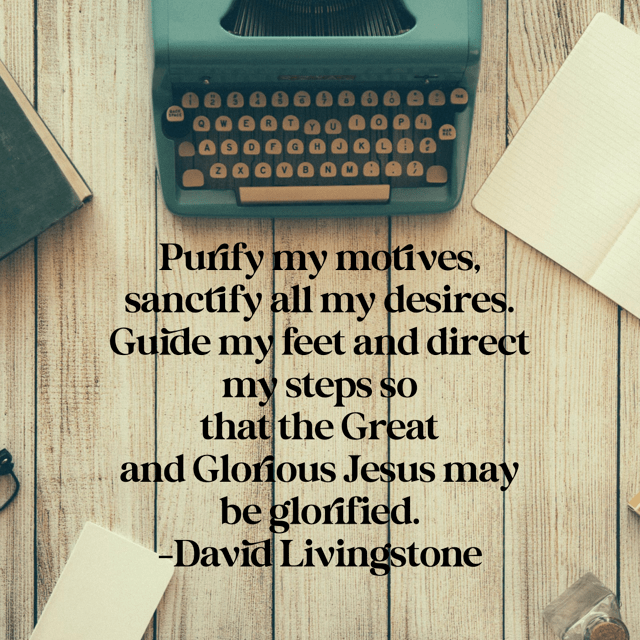
Any theology that minimizes God’s holiness and tolerates people’s deliberate sinfulness
is a false theology. — Warren W. Wiersbe,
from Be Decisive (Jeremiah): Taking a Stand for the Truth

Laudable Linkage

Laudable Linkage

I have just a short list to share with you today:

The Living and Abiding Word of God, HT to Challies. “A farmer doesn’t cause seeds to grow but faithfully plants and waters them. Despite his careful tending, the seeds he sows sometimes lay dormant for a long time—which is Peter’s point. It’s not our cleverly devised arguments or our life’s example that brings about new life but the powerful life-producing work of God’s imperishable and never-fading Word.”

Look Up In Faith, HT to the Story Warren. “On my way to school, I drove with my eyes fixed on the road, praying I would be ready to meet my twenty-six early morning students in just a few minutes. And then I saw it, a pinkish orange hue highlighting a sky full of cotton puffs. I couldn’t believe it. How many years had I been making this drive and I just now noticed? If I’m honest, I’ve always had a hard time looking up.”

Does the Bible Blame Women for Rape? HT to Challies. Wendy Alsup thinks through a difficult passage in Deuteronomy.

Why Is Proverbs So Negative About Women? “So a fairly new believer asked me a simple question afterward. ‘Why is the Bible so hard on women?’ I am glad she felt the freedom to ask the question. I would much rather get it out in the open than have women wonder silently. Let’s tackle the question for a moment.”

How to Identify a Great Deacon, HT to Challies. Churches have different ways of choosing deacons: some appoint them, others have the congregation vote on them. If you’re in the position of nominating or voting on deacons, this article has great points to consider.

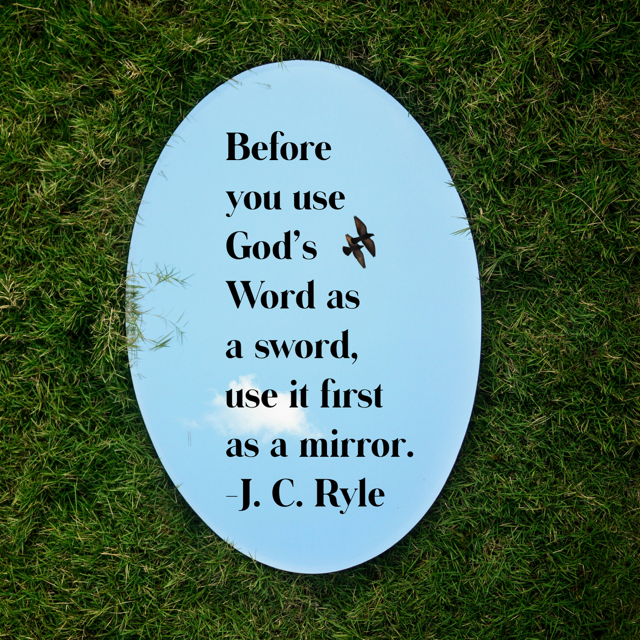
J. C. Ryle quote

Before you use God’s Word as a sword, use it first as a mirror.
J. C. Ryle

Laudable Linkage

It’s been a super-busy week, so I have just a few links for you. But I think they’re good ones.

Why We Follow Some Old Testament Laws But Not Others, HT to Challies. “Critics accuse Christians of conveniently picking and choosing from Old Testament laws. We’re quick to ‘clobber’ gay people with verses from Leviticus, they say, yet we don’t keep kosher ourselves. The complaint, though, is based on a misunderstanding about the Mosaic Covenant that even Christians fall prey to.”

Where Is Your Faith?” HT to Challies. “How do you cling to belief amidst such turmoil of the heart? How do you survive the death of a child? I can tell you, it is not what happens in that moment of complete darkness or even in the months and years that follow. Survival is forged in the pew every Sunday. It is built on the truths of Scripture that you fill your mind with day by day. It comes through knowing Who God is.”

We’re Missing It. “He wants time to love us that way and it can’t happen if He is a ‘to do’ list item, or in sound bites only throughout our day, or only while we grab coffee on our way out the door.”

Well-Worn Boots. Lessons from a pair of faithful old work boots.

Laudable Linkage

Here are some of the posts that resonated with me this week:

Did You Know You Might Be Someone’s Blessing in Disguise? “I don’t remember that nurse’s name, but God does. She never knew how her warmth, genuineness, and kindness blessed us that day. But God does.”

Counseling Your Child About Salvation. When my kids were young, I was greatly concerned with how to know they were ready to be saved rather than just praying a prayer to please parents or fit in. This article has some wise advice.

Something to Eat, HT to Challies. “Too often, when someone first believes in Jesus – especially someone famous – we rush to push them on stage, or sign a book deal, asking them to tell their stories while they still have an empty stomach. They have been raised to new life, but they still need something to eat.”

Judge Not, HT to Challies. “Matthew 7:1 is one of the most needed and one of the most abused statements in the Bible. . . .Yet just because people can misuse a verse does not give us a reason to throw out that verse. The fact is that Matthew 7:1 is a necessary corrective that many Christians need to hear. If we can first clear away the false claims, we will be in a position to let Matthew 7:1 shape us as Jesus intended.”

The American Dream Couldn’t Save My Marriage, HT to Challies. “I am grateful to this country which granted me asylum and opened the door for my permanent residence status. I received many opportunities through which I was able to continue my education, find a better job, and travel freely without fear. When I purchased my first home, I felt I had accomplished the American dream. This and lots of other things ended up going right for me before I had to realize how wrong I had been.”

On Losing Consciousness in Public, HT to Challies. Though I don’t have Seth Lewis’ health problems, my own have frustrated me due to their seeming waste of time and hindrance of doing the things I need and want to do. “My body betrayed me and flipped the power switch without my permission. When something like that happens, I am forced to remember two realities: that I am not in control, and that I am not as strong as I think I am.” But instead of being distressed by those truths, I can trust “there’s no need for despair over weakness because God is still in control and still strong enough to keep his promises for his children.”

What to Remember When God Feels Distant. “Often, it is in seasons of struggle and weariness that we find God’s peace to be most sustaining, His comfort most reassuring, His presence most stabilizing. Maybe we have to come to the end of ourselves to realize He truly is the only Source of everything we need?”

When Church Leadership Goes Wrong. “But it is my conviction, and Honeysett’s, that the majority of leaders who eventually go wrong set out with good desires and noble motives. Their good intentions were not enough to protect them from eventually abusing their power and misusing their authority. Some of them may have even behaved in abusive ways without knowing they were doing so. Yet ‘lack of intention doesn’t remove culpability. The heart is deceitful, and we are never fully aware of our own motives.'”

Being Senior. “In any other context but aging, the word senior is very positive.”

Laudable Linkage

Here are some of the good reads I’ve discovered recently. Maybe some will pique your interest, too.

On the Fence, HT to Challies. “The midst of a car accident is not the best time to consider whether or not Jesus is who He says He is. Although it’s better than never considering the Jesus question, it’s still not the optimal time.”

War. “Some think that mankind can be educated to the point where he will never desire to resort to brutal force in the settlement of problems. That theory is certainly proven wrong in this case. There are three questions that many people ask concerning wars. Why do wars occur, why does God permit them to take place and will we see peace in our generation?”

Are You Getting in the Way of God’s Work? HT to Challies. “Being an instrument of God means that we live in a paradox. On one hand, God does significant things through us to advance his kingdom, and on the other, we are acutely aware of how much better things could go if we weren’t constantly tripping over our own feet.”

On What You Put in Your Head: Toto, We’re Not in Eden Anymore. “While there’s great joy in romping through fields of wildflowers, we know that the pastoral scenes in novels and movies aren’t really accurate. There are ants at the picnic and snakes in the woods. The world is a broken place; it’s really not a good idea to follow my recommendation in the previous post—’learn all you can about everything you can’—without putting some sensible limitations in place. We’re not in Eden anymore. How do we decide which trees in the garden to sample?”

Showing Mercy in a Feeding Frenzy. “They could almost have been us—people who so often delight to tear one another apart, to focus on flaws more than virtues, to be critical rather than encouraging, harsh rather than tender, vindictive rather than merciful. I recently found myself studying the Parable of the Good Samaritan and marveling at its example of mercy.”

The Disproportional Response, HT to Challies. “There’s something deeply disturbing about our cultural moment when it comes to how we respond to being hurt, offended or disagreed with. It’s no longer enough to cut down the poppies, now we have to scorch the earth they were planted in too. When it comes to our churches, this should give us pause and prompt us to deep, and maybe even painful reflection. Are our churches places where loving one another, bearing with one another and exercising costly forgiveness are still the kinds of things that mark us out from the surrounding culture?”

Does My Son Know You? HT to Challies. A moving article about a sports writer’s journey with cancer and his father’s early death from Parkinson’s.

How Can I Expect My Children to Honor Me Since I Am a Sinner, Too? HT to Challies. “I was recently asked this question at a conference. Have you ever wondered the same thing? Certainly, as parents, we blow it. Can we still ask our children to honor us?”

The Lord’s Prayer for Writers, Part 1. Though this is written for writers, it’s a good study of the first part of what we call “the Lord’s prayer” for anyone.

A Right Big Mess Was Made By All, or, The Transformative Powers of Mud. “Today I am challenged by this memory; I have been daily cursing the mud and dirt dragged into our home by my children as they try to find rays of sun and active pastimes in our backyard. I’ve resented what the dirt represents: carelessness on the part of my children. Work for me. But writing out this fantastic and hilarious and ridiculous memory has taken me back, and I hope transformed me a bit, again.”

Finally, going along somewhat with the previous article, this is a sweet video about a boy’s adventures with his grandfather and a red wagon:

Happy Saturday!

Laudable Linkage

IMG_0195

Welcome to my almost weekly list of good reads found around the Web.

This Dying Young Woman Has a Message for Us, HT to Challies. “Brooklyn may face dark moments, but they are never so dark that the light of Christ does not breakthrough. Along with telling her story, she wants to speak directly to us, and even when she wants to tell us hard truths, her sense of humor steps in to help us swallow the medicine. ‘I’m sick. Soon to die. But so are you. I’m just doing it faster.'” Brooklyn did pass away March 1.

Truth in Small Bites Is Truth Nonetheless. “When life takes a turn, most of us tend to push Bible reading aside until our circumstances return to normal. If you’re not able to sit down at your kitchen table for a quiet hour of in-depth study, you don’t even crack open God’s Word. Somewhere along the way, you’ve told yourself that if you’re not able to feast, you shouldn’t eat at all, not realizing that a handful of almonds in the middle of the night is far better than allowing your soul to starve.

Sexual Sin Is Not Inevitable, HT to Challies. “God never commands us to do anything without providing the resources to obey by the power of the Holy Spirit.”

Death, Miracles, and Tears from a missionary in Cameroon, HT to Challies. “About three years ago I took a girl in our village named Mami to get an ultrasound. At the clinic I met her boyfriend named Koo who was visibly concerned about her pregnancy. So much so that he made a deal with God: if his baby survived, he would dedicate his life to the Lord.”

The Friend Who Sharpens Me, HT to Challies. “While it’s great to have friends we agree with theologically and mentors who can teach us more about the historical faith we hold to, I’m learning that it’s important to make friends with those I disagree with. It’s important to learn from those with a different viewpoint than me.”

Tell Me a Story? “There are many nights when both Dan and I draw a complete blank. Four sets of eyes stare at us longingly as we frantically rake our minds for something to say, only to come up as empty as one of Pooh’s honey jars. Over the years we have developed a strategy for handling situations like this. It’s easy to implement, and it has never failed.”

This is a good reason to get those dust bunnies when they’re small and few. 🙂

Happy Saturday!

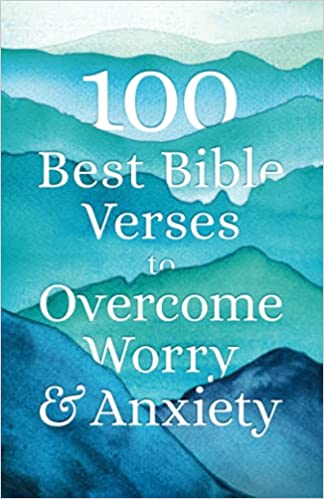
100 Best Bible Verses to Overcome Worry and Anxiety

100 Best Bible Verses to Overcome Worry and Anxiety is compiled from writings of several authors and published with Bethany House.

Each two- to three-page spread begins with a Bible verse. The author then adds a brief paragraph about the context the verse was set in. Then several paragraphs about the meaning of the verse and one or two of application are included. Then a few references are listed for additional reading.

When I first saw this book reviewed at Joanne’s, I thought it was a great idea. I’ve mentioned before that anxiety is probably not something that can be conquered by answering an altar call or sitting down for one massive Bible study. Rather, battling anxiety is a matter of continually feeding our souls truth. This book is a wonderful way to keep God’s provision, protection, and promises continually before us in small but substantial doses.

I very much appreciated that the writers delved into the context of the verses before explaining the meaning and applying them. The context enriches our understanding of the passage and keeps us from spinning our own take on a single sentence.

I’ve repeatedly heard that there are 365 Bible verses that say, “Fear not.” That declaration is often followed by the quip, “One for every day of the year.” I had thought this would be a collection of those verses. It’s not (though such a collection would be a great idea for a devotional book). I was surprised at some of the verses used, as they didn’t seem to directly relate to anxiety or worry. But I came to understand they were foundational verses about God’s character or promises. The more we know Him, the less reason we have to be anxious about anything.

Here are just a few of the quotes I marked in this book:

[On John 16:33] It’s a strange way to promise peace—Jesus starts by telling his disciples that they are about to go through a time of sorrow and fear. How is that peaceful? they might have wondered, especially after Good Friday, when their teacher was killed, and it seemed like the world had won.

Still, Jesus’ words, “Take heart!” are a command in the original language, not just an inspirational phrase but something God wanted them—and us—to actively do. It could be phrased “Choose hope!” or “Be encouraged!” (p. 39).

Some seasons, taking heart might be among the hardest of God’s commands to follow. Until we remember the rest of the verse: “I have overcome the world” (p. 40).

[On 2 Timothy 1:7] Fear is a tool of the enemy that exists to keep us from advancing the kingdom of God. It distracts us from trusting him, and instead tempts us to protect ourselves and rely on our own abilities” (p. 51).

In verses 7 and 8 [of Joshua 1], God connects being strong and courageous to faithfully following his Word. Not believing in God’s Word nor taking it seriously had been the sin that forced the Israelites to wander in the wilderness for forty years (p. 62).

[On Lamentations 3:57] His response will always be, “Do not fear.” Not condemnation for being afraid, but telling us there is no need for it. He is holding on to us tightly, a good Father whose perfect love casts out fear . . . if we just ask (p. 65).

[On Genesis 50:20] [Joseph] endured some of the most difficult circumstances and betrayals and still honored the Lord in the midst of them. He refused to see his journey as one setback after another, but instead chose to believe that God was writing a much bigger story (p. 78).

Allow your confidence to be informed by your faith, not your circumstance (p. 79).

[On Psalm 61:2] We don’t need to strive so hard to be self-sufficient when the chaos threatens to overwhelm us, but we can rest in the truth that God is infinitely more capable than we are (p. 121).

[On Psalm 23:4] Dark valleys don’t stay dark. The beauty of a valley is that it dips down but then rises back up. Valleys aren’t endless stretches of defeat, but stretches we walk through and rise from. What a beautiful promise. We are not alone in our valleys. Even as we “walk through,” we don’t need to sprint through in a panic; we will walk through our valley with Jesus by our side and emerge safely, made stronger by the experience (p. 125).

This book doesn’t just try to make readers feel better. It continually points the reader back to God’s character and His Word. Thus, it is an excellent resource when worries or fears try to pull our gaze away from Him.

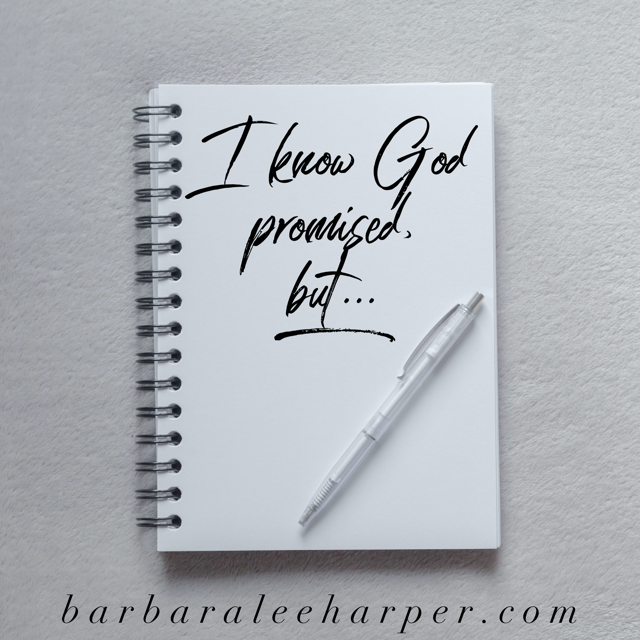
I know God promised, but…

I know God said He’s always with me, but I just feel so alone.

I know God said He would enable me, but I just don’t think I can do it.

I know God said He would take care of me, but I fear what might happen.

I know God wants me to witness, but I just don’t think anyone wants to hear the gospel.

It’s possible to have the promises of God but still not move forward in our Christian lives.

How can that be?

According to one commentator, the difference between Israel’s failure to enter the promised land in Numbers and their success in Joshua was a matter of reckoning.

In the American South, the word “reckon” is sometimes used to mean “suppose.”

“I reckon it’s about time to go to bed.”

“Do you reckon it will rain tomorrow?”

But one American dictionary definition for reckon is “to count, depend, or rely, as in expectation (often followed by on).”

And the Greek word rendered reckon in the KJV lists counting as one definition, but also includes words like “consider, take into account, weigh, meditate on, suppose, deem, judge, determine, purpose, decide.”

In both Numbers and Joshua. God had promised to give Israel the land. But in the first case, they didn’t believe God and failed to obey. They spent the next forty years in the wilderness while all the adults except Joshua and Caleb—the only ones who did believe God—died off.

Hebrews refers of this period: “Let us therefore fear, lest, a promise being left us of entering into his rest, any of you should seem to come short of it. For unto us was the gospel preached, as well as unto them: but the word preached did not profit them, not being mixed with faith in them that heard it. (Hebrews 4:1-2, KJV)

Then in Joshua 6, “the Lord said to Joshua, ‘See, I have given Jericho into your hand, with its king and mighty men of valor.'” God told Joshua this before the battle even began. Joshua counted on this promise as well as the one God had given him in chapter 1:

This Book of the Law shall not depart from your mouth, but you shall meditate on it day and night, so that you may be careful to do according to all that is written in it. For then you will make your way prosperous, and then you will have good success. Have I not commanded you? Be strong and courageous. Do not be frightened, and do not be dismayed, for the Lord your God is with you wherever you go (Joshua 1:8-9).

Warren Wiersbe, in his commentary Be Strong (Joshua): Putting God’s Power to Work, says this:

Victorious Christians are people who know the promises of God, because they spend time meditating on God’s Word (1: 8); they believe the promises of God because the Word of God generates faith in their hearts (Rom. 10: 17); and they reckon on these promises and obey what God tells them to do. To “reckon” means to count as true in your life what God says about you in His Word. . . .

Christ has conquered the world, the flesh, and the Devil; and if we reckon on this truth, we can conquer through Him. It’s possible to believe a promise and still not reckon on it and obey the Lord. Believing a promise is like accepting a check, but reckoning is like endorsing the check and cashing it (p. 88-89, Kindle version).

If we say, “I know God said, but….” we’re not relying, or reckoning, on His promise. We’re looking at circumstances or our abilities or feelings instead, none of which are reliable.

But reading and meditating on God’s Word leads to faith in God’s Word, which leads to relying on God’s Word, which leads to obedience.

Relying on God’s promises doesn’t give us grounds for presumption. Israel got into trouble in the next few chapters of Joshua because they went forward presumptuously (in the case of Ai) and didn’t ask counsel of the Lord (in the case of the Gibeonites).

Relying on God doesn’t mean we follow a formula. We’re prone to seek three easy steps to handle any problem. God’s instructions for battling Jericho and Ai and other cities were very different.

We need to humbly seek God’s will and stay in His Word so He can guide us, show us sin in our lives that we need to confess to Him, and show us His promises to help us overcome for Him. But as we rely on His truth,

Then in fellowship sweet we will sit at His feet.
Or we’ll walk by His side in the way.
What He says we will do, where He sends we will go;
Never fear, only trust and obey.

(John H. Sammis)

(I often link up with some of these bloggers.)

Interestingly, Adrian Rogers’ Love Worth Finding radio program touched
on “reckoning” today (Monday) in a sermon titled “How to Live in Victory.”

Faith, not Genes, Determines our Standing Before God

If you’ve ever read the books of Numbers, you might remember one of the most dramatic sections occurs with the rebellion of Korah.

The congregation had just received the devastating news that, in response to their failure to believe God and enter the promised land, all the rebellious adults (who had been rebelling and complaining since they left Egypt) were going to die in the wilderness over the next forty years (Numbers 13-14). God was going to give the land to their children instead of them.

After this, God gave them instructions about sacrifices that they were to implement, not in the wilderness, but when they came into the promised land. Why would God give them such instructions now, when they just found out they weren’t going to get to the land for forty years? The ESV Study Bible notes point out that some of the materials mentioned wouldn’t be available in the wilderness. But, more importantly, the notes say this instruction about future temple worship coming on the heels of such severe judgement was a reassurance that yes, the children of Israel were still God’s people and would eventually get to the promised land.

But Korah and Dathan and Abiram, along with the other challengers, had this complaint against Moses and Aaron:

You have gone too far! For all in the congregation are holy, every one of them, and the Lord is among them. Why then do you exalt yourselves above the assembly of the Lord? (Numbers 16:3b).

The ESV Study Bible notes say that Korah “[emphasized] one truth to the exclusion of others (which is what heretics and founders of cults commonly do).” In Exodus 19:4-6b, God had told the people if they obeyed Him and kept His covenant, they would be His “treasured possession among all peoples, for all the earth is mine; and you shall be to me a kingdom of priests and a holy nation.”

But, though they were a kingdom of priests and a holy nation, God had set apart certain people to minister specifically in the tabernacle. Korah was a Levite who had certain duties that he should have considered a privilege.

Is it too small a thing for you that the God of Israel has separated you from the congregation of Israel, to bring you near to himself, to do service in the tabernacle of the Lord and to stand before the congregation to minister to them, and that he has brought you near him, and all your brothers the sons of Levi with you? And would you seek the priesthood also? (Numbers 16:9-10)

This time, “You have gone too far, sons of Levi!” Moses said Korah’s argument was against the Lord (Numbers 16:7, 11).

After a demonstration to illustrate God’s choice of leadership, He caused the earth to “open its mouth and swallow them up” (verses 28-35). Thus the first wave of deaths of the rebellious, unbelieving adults were swept into eternity.

I had always thought that Korah’s wife and children had died in this judgment, too, since verse 32 says, “their households and all the people who belonged to Korah and all their goods” were swallowed up. That always bothered me. But I trust “the Judge of all the earth” to “do right” (Genesis 18:25). I figured either He knew they were rebellious, too, or else He felt it best to take them on to heaven instead of having to live with the aftermath of Korah’s judgement.

But Warren Wiersbe pointed out in his book, Be Counted (Numbers): Living a Life That Counts for God, that Numbers 26:9-11 mentions this incident and says in verse 11 “But the sons of Korah did not die.”

Korah’s descendants ministered in the tabernacle in the time of Chronicles.

Some “were in charge of the work of the service, keepers of the thresholds of the tent, as their fathers had been in charge of the camp of the Lord, keepers of the entrance” (1 Chronicles 9:19; 26:19).

Some made cakes and the showbread for the temple (1 Chronicles 9:31-32).

Some were among David’s mighty men (1 Chronicles 12:11-6).

Some of them “stood up to praise the Lord, the God of Israel, with a very loud voice” when God answered Jehoshaphat’s prayer (2 Chronicles 20:18-19).

And some of them wrote psalms. Eleven of them: Psalms 42; 44—49; 84—85; 87—88.

The people whose ancestors weren’t content with their Levitical role and coveted the priesthood could now say, “I would rather be a doorkeeper in the house of my God than dwell in the tents of wickedness” (Psalm 84:10b).

I had noticed the sons of Korah listed with the psalms, but for some reason never connected them with that Korah. That’s one good reason to keep reading the Bible no matter how often you’ve read it or how familiar it is. You keep finding truths and connections you missed before.

In Keep a Quiet Heart, Elisabeth Elliot shares an excerpt from a book titled Fathers and Sons written by Phillip Howard, her grandfather:

Do you remember that encouraging word of Thomas Fuller’s, a chaplain of Oliver Cromwell’s time? It’s a good passage for a father in all humility and gratitude to tuck away in his memory treasures:

“’Lord, I find the genealogy of my Savior strangely checkered with four remarkable changes in four immediate generations.

Rehoboam begat Abijah; that is, a bad father begat a bad son.
Abijah begat Asa; that is, a bad father begat a good son.
Asa begat Jehoshaphat; that is, a good father begat a good son.
Jehoshaphat begat Joram; that is, a good father begat a bad son.

I see, Lord, from hence that my father’s piety cannot be entailed; that is bad news for me. But I see also that actual impiety is not always hereditary; that is good news for my son.”

It’s such a blessing to know that our genetics don’t have any influence in our standing before God. If we’re privileged to come from a long line of faithful believers, their righteousness doesn’t count for us. We have to believe on the Lord and repent of our sins personally to become part of the family of God. And if we come from people who didn’t know God or who were outright rebels, by God’s grace, we can change courses. We can say with the sons of Korah, “O Lord of hosts, blessed is the one who trusts in you!” (Psalm 84:12).

(I often link up with some of these bloggers)