What God’s Sovereignty Does Not Mean

What God's Sovereignty Does not Mean

As Christians, we believe in God’s sovereignty, the fact that He is the Creator and supreme ruler of all. God’s rule is all over the Bible, but here are just a few verses about it:

Our God is in the heavens; he does all that he pleases (Psalm 115:3).

Let the heavens be glad, and let the earth rejoice, and let them say among the nations, “The Lord reigns!” (1 Chronicles 16:31).

The Lord has established his throne in the heavens, and his kingdom rules over all (Psalm 103:19).

Many are the plans in the mind of a man, but it is the purpose of the Lord that will stand (Proverbs 19:21).

The heart of man plans his way, but the Lord establishes his steps (Proverbs 16:9).

I am the Lord, and there is no other, besides me there is no God; I equip you, though you do not know me, that people may know, from the rising of the sun and from the west, that there is none besides me; I am the Lord, and there is no other. I form light and create darkness; I make well-being and create calamity; I am the Lord, who does all these things (Isaiah 45:5-7).

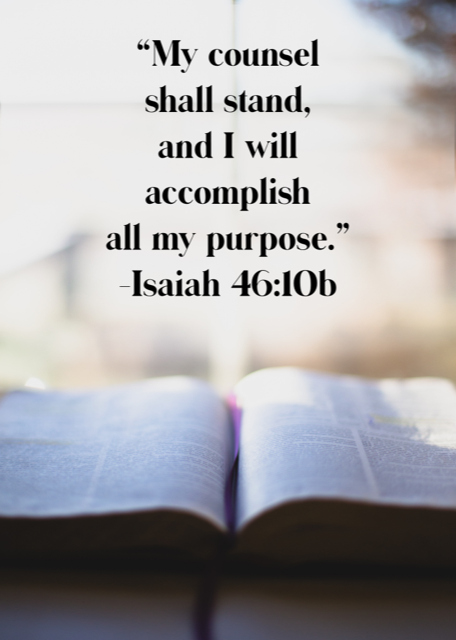
For I am God, and there is no other; I am God, and there is none like me, declaring the end from the beginning and from ancient times things not yet done, saying, ‘My counsel shall stand, and I will accomplish all my purpose (Isaiah 46:9b-10).

But then we wonder, if God is sovereignly ruling and reigning from heaven, why do such atrocities like murder and rape occur? Why do hurricanes and tornadoes and fires decimate cities and take so many lives? 

The good world that God created has been broken since sin entered. “The whole creation has been groaning together, waiting for its redemption” (Romans 8:22).

Jesus died for the sins of the world, that whoever believes in Him can receive forgiveness.  Someday, after Jesus returns, sin will be defeated and everything will be made right. Until then, He gives grace to help in time of need (Hebrews 4:16). He even redeems our circumstances, working all things together for good to them that love God (Romans 8:28).

People have argued for centuries over what God allows vs. what He ordains and how His sovereignty and our responsibility work together. Those are subjects too big for this blog post, and there are people much more qualified than I am to write about them.

But through years of talking with other Christians and reading Christian writing, it seems to me there are some things God’s sovereignty does not mean.

God’s sovereignty does not mean:

Passivity.

When William Wilberforce was confronted with the horrors of slavery, he didn’t sit back and say, “Well, it must be God’s will.” He fought slavery his whole life. Others who joined him saw slavery as the ultimate in not loving our fellow humans as God taught us to.

When Elisha stayed with the Shunammite woman in 1 Kings 4, he wanted to make some return to her for her hospitality. When he found she was childless, he foretold that she would have a son. When the son died, he raised him up. In neither case did he say, “Well, God allowed it, so I can’t do anything about it.”

Sometimes God brings people’s needs to our attention for the very purpose that He might use us to meet them. We can’t do what Elijah did, but we can help as God enables.

Fatalism

Some years ago when a national election hadn’t gone the way most Christians preferred, I wrote a post saying all was not lost because we still had a voice in America. We could stay informed, vote our consciences, write to our officials, let our views be known on issues, etc. Someone commented that because God was sovereign, fate was sealed and nothing we did would change anything. I responded that we have several instances in the Bible of people influencing officials: Joseph, Daniel, Esther, John the Baptist. This reader kept arguing, and  I finally had to ask him to stop.

God knows what is going to happen, and it’s true our actions won’t change something He has ordained. Yet it is also true that somehow, He works through our actions as He leads us. 

Lack of regret.

Though David was forgiven for his sin with Bathsheba and her husband, and God used his heartbroken expression of repentance in Psalm 51 in countless lives since then, I have no doubt that he regretted his actions, especially as the consequences played out in his family. I’m sure Peter regretted denying the Lord Jesus. We all have regrets–actions and words we wish we could take back, opportunities missed, and so forth.God forgives and redeems our regrets, but we wish we would have done right in the first place. 

Stoicism.

When a fellow Christian is troubled over something God has brought into his or her life or some good thing He has not given, we can get a little impatient, thinking, “You just need to accept that this is God’s will and move on.” And maybe, ultimately, acceptance of God’s will is needed. But often acceptance is not a one-time event. Sometimes we have to wrestle our desires or emotions into submission. And though God allows circumstances for a reason, He also calls us to come alongside, encourage, help others gain perspective, and help bear their burdens.

I think in situations like school shootings or major disasters, Christians can jump immediately to God’s sovereignty in their efforts to find meaning and hope. But there are times to just weep with those who weep over the effects of living in a fallen world. Yes, ultimately we find comfort in His care and purpose. But He knows this world will have its share of sorrow and calls us to comfort each other. Our ultimate comfort comes from the promise that, in His kingdom to come, there will be no more sorrow, death, crying, or pain.

Nonchalance

I’ve known some people with the attitude that it doesn’t matter what choices they make in life, because God will guide them to the right choice. God promises to lead us in the way we should go, but He tells us to seek His will, pray, be careful, walk wisely, be diligent, and so many other things. Scripture shows people praying for God’s direction: Abraham’s servant, Jehoshaphat. Even Jesus spent the night in prayer before naming His disciples.

That there is no need for prayer.

Another mystery in the Bible is why we’re to pray when God knows the need and knows what He will do about it. One reason God calls us to pray is for our fellowship and our growth and submission to His will. And though He can and does act apart from our prayers, there are things we won’t have if we don’t pray. “You do not have, because you do not ask” (James 4:2b).

That there is no need for self-examination

Some years ago, a missionary letter told of many details and preparations involved in special meetings at his church. Visitors came, but no one visibly responded. One of the Christians asked why. The missionary replied that the unsaved people who came were not elect.

I was stunned. I think the better response would have been that sometimes we plant the seed of the gospel and sometimes we water it (1 Corinthians 3:6). Maybe people didn’t respond to the gospel then, but they heard it. And maybe some did respond in their hearts even though they did not come forward at the invitation.

But it still concerned me that a lack of response was deemed God’s “fault,” with no examination about whether the Christians there could have done anything differently. Did people welcome the visitors? Were they friendly? Was the gospel explained clearly? Were there distractions like heat, cold, bugs (in open air meetings), etc.? Yes, God is the one that brings the gospel to fruition in a life, and the Holy Spirit can work in spite of hindrances. But we can also do everything in our power to have as few hindrances as possible.

When missionary Amy Carmichael was once sharing the gospel with someone, the woman seemed to be listening, until she noticed Amy’s fur gloves. Such gloves were not common in her country, and she got distracted examining them. Amy never wore the gloves again. 

That we can’t make wrong decisions.

There’s an odd story in 2 Kings 13 where Elisha told the king to take his arrows and strike the ground with them.

And he struck three times and stopped. Then the man of God was angry with him and said, “You should have struck five or six times; then you would have struck down Syria until you had made an end of it, but now you will strike down Syria only three times” (2 Kings 13:18-19).

The Israelites had been promised a land for their people. But when the time came to go in and take the land, most of the people balked and refused. Instead of relying on God’s promised help, they held back in fear. So God sent them into the wilderness for forty years.

When Mordecai warned Esther about Haman’s wicked scheme to kill the Jews, he asked her to go speak to the king about it. The problem was that Esther would be risking her life by going to the king uninvited. He might welcome her, but if he didn’t, he could have her killed. Mordecai responded:

Do not think to yourself that in the king’s palace you will escape any more than all the other Jews. For if you keep silent at this time, relief and deliverance will rise for the Jews from another place, but you and your father’s house will perish. And who knows whether you have not come to the kingdom for such a time as this? (Esther 4:13-14).

Of course, in each case, God knew what people would do and what He would do in response. The Bible doesn’t teach open theism, the concept that God doesn’t know what’s going to happen or that He’s waiting to see what we’ll do before He acts. But humanly speaking, we can make wrong decisions. The Bible is replete with warnings about following God’s revealed will.

That we don’t need to plan

We trust God to take care of us, but we also seek wisdom for life decisions. God often works to take care of us through the counsel of others. In speaking of counting the cost of discipleship, Jesus said, “For which of you, desiring to build a tower, does not first sit down and count the cost, whether he has enough to complete it?” (Luke 14:28).

Proverbs 24:27 says “Prepare your work outside; get everything ready for yourself in the field, and after that build your house.” 

I knew someone who didn’t want to schedule her time because she wanted to be open to God’s leading throughout the day.  But God can work through schedules as well as through interruptions. 

God’s sovereignty doesn’t negate our responsibility to seek His will and guidance and make wise choices based on His Word. We can take comfort in the fact that God knows everything going on in our lives and nothing can happen unless He allows it. If He allows it, He promises His grace and help to deal with it. 

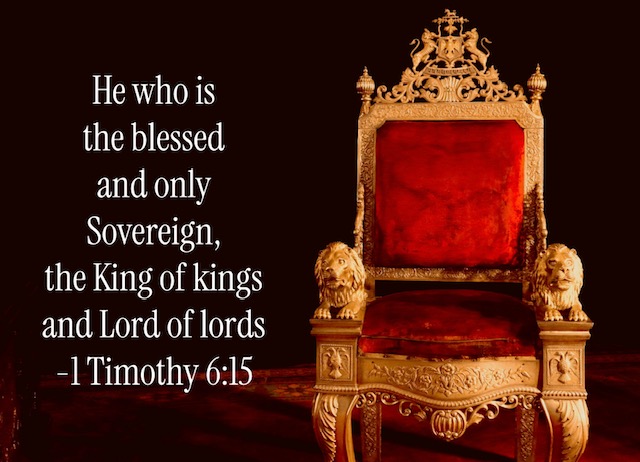
1 Timothy 6:15

(I often link up with some of these bloggers.)

When Everything Goes Wrong

When everything goes wrong.

It must have seemed to the disciples like everything was going wrong.

In less than twenty-four hours, everything they had worked for the past three years seemed to unravel:

  • A “great crowd with swords and clubs” came to find Jesus in the garden of Gethsemane (Matthew 26:47).
  • Judas, one of the twelve disciples, betrayed Jesus.
  • Peter, thinking to defend Jesus, wielded his sword and cut off a man’s ear. But Jesus told him to put his sword away.
  • Jesus was wrongly arrested.
  • People lied about Jesus at His trial.
  • Jesus was falsely accused of blasphemy.
  • The Jews spit at, slapped, beat, and mocked Jesus.
  • Peter, who promised to stay with Jesus always, denied knowing Him.
  • Judas killed himself.
  • Jesus was taken to Pilate, who offered to make Jesus the prisoner he annually released for the crowd. But the crowd chose Barabbas instead.
  • Pilate had Jesus scourged and delivered Him to be crucified.
  • The Roman soldiers mocked, spit on, and beat Jesus.
  • Jesus was crucified between two thieves.
  • Jesus was mocked by the crowd.
  • Jesus died.
  • Earthquakes split rocks and opened tombs.

I can only imagine the disciples’ dismay and confusion for the three days between the crucifixion and resurrection. Jesus told them He was going to be put to death and rise again, but somehow they didn’t get it. At least, however they thought it was all going to work, they were clearly surprised and unprepared.

Their leader, their Messiah, had been cruelly treated and killed. How did it all happen, and so quickly? What was going to happen to them now? What should they do?

As they were soon to discover, God’s perfect will was being worked out. God didn’t just work in spite of all that had occurred, but through it all.

God’s fingerprints were all over this day. Does that mean He made people sin? No, but He knew what they would do.

At least 27 Old Testament prophecies were fulfilled by Christ in that one day, not to mention so many that were fulfilled over His lifetime. .

The Pharisees had not wanted to arrest Christ during the Passover “lest there be an uproar among the people (Matthew 26:3-4). But that’s exactly when it happened, so that Jesus, the Lamb of God, could fulfill what the Passover lamb represented.

When Pilate said, “Do you not know that I have authority to release you and authority to crucify you?” Jesus answered him, “You would have no authority over me at all unless it had been given you from above” (John 19:10).

Jesus “yielded up His spirit” (Matthew 27:50). He died when He had fulfilled everything and when He was ready. He died on His terms, not Pilates’ or the Pharisees’ or the soldiers’.

On this worst of days, when everything seemed to be going wrong, God was working to accomplish the means of our salvation. Though it must have seemed to the disciples that everything was spinning out of control, God’s perfect will was being accomplished.

Others in Scripture had times when everything seemed to be going wrong.

  • Job lost his possessions, his livelihood, his ten children, and then his health.
  • Abraham and Sarah were promised a son, but nothing happened for decades.
  • Joseph was the favored son, but was sold by his brothers into slavery, falsely accused, and thrown into prison. Those whom he asked to say a good word for him forgot.
  • David was anointed king, but spent years running for his life and hiding in caves before he was crowned.
  • The Jews were on the verge of being exterminated by a wicked enemy in the book of Esther. Esther was unsure whether her husband, a pagan king, would listen to her plea to save her people. Though God is not named in the book, His hand is obvious throughout.

We see their situations resolved by God’s provision and leading in just a few pages. But we need to remember they lived with questions and bewilderment for a long time, even for many years in some cases.

Olympic runner and missionary Eric Liddell said, “Circumstances may appear to wreck our lives and God’s plans, but God is not helpless among the ruins. God’s love is still working. He comes in and takes the calamity and uses it victoriously, working out His wonderful plan of love.”

When things seem to be falling apart, when God’s answer doesn’t seem to be coming, when we’re confused, when we have no idea how the current circumstances will ever work out, we can go to God. He doesn’t always let us know His plans or reasons. But He promises He loves us and He is in control. He has a purpose for everything He allows. Many verses reassure us of these things. Here are just a few:

  • “Remember the former things of old; for I am God, and there is no other; I am God, and there is none like me, declaring the end from the beginning and from ancient times things not yet done,
    saying, ‘My counsel shall stand, and I will accomplish all my purpose” (Isaiah 46:9-10).
  • “The LORD has established his throne in the heavens, and his kingdom rules over all” (Psalm 103:19).
  • “Then Job answered the Lord and said: ‘I know that you can do all things, and that no purpose of yours can be thwarted'” (Job 42:1-2).
  • “Many are the plans in the mind of a man, but it is the purpose of the LORD that will stand” (Proverbs 19:21).
  • “Our God is in the heavens; he does all that he pleases” (Psalm 115:3).
  • “The Most High rules the kingdom of men” (Daniel 4:25b).
  • “And we know that for those who love God all things work together for good, for those who are called according to his purpose” (Romans 8:28).

Throughout the Bible, we see people laying their hearts, confusion, and questions out before the Lord, often in anguish. After reminding themselves of the truth they knew about God’s character, wisdom, love and power, they came to a place of trust, submission, hope, and joy. They received His grace and help to carry on and wait for God’s answer.

We can, too.

God's counsel shall stand.

(I often link up with some of these bloggers.)

Laudable Linkage

Here are some of the posts that especially resonated with me this week:

If God Would Outsource His Sovereignty. “I want you to imagine that, at least for a time, the Lord would see fit to involve us in selecting the providences we would receive from his hand. I want you to imagine that through one of his deputies—an angel perhaps—he would approach us to ask how we would prefer to serve him.”

Struggling with the Struggle. “The main feeling that is overwhelming me right now is guilt. After all, shouldn’t I be overjoyed that God is teaching me intense lessons right now? And then I judge myself harshly for thinking that hard times are actually hard and not much fun.”

There Is Something Better Than Never Suffering, HT to Challies. “To suffer, with Christ, is a vastly superior to a life of comfort without him. And if he has saved you through his death, manifesting all his divine power in his own human weakness unto death, do you not think he can be your power in your suffering?”

It All Holds True, HT to Challies. “We want to shield our kids from pain. We want them to learn perseverance and endurance and real, personal faith without having to go through anything hard. That’s not quite how it works in the Christian life. Perseverance is cultivated in adversity.”

He Is Not an It: Understanding the Person of the Holy Spirit. “The Holy Spirit is not a force, feeling, or phenomenon. He is not a ghost or an “it.” He is a Person that we should know and love.”

On Being the Main Character in Your Own Sermon. I can identify with this, even though I am not a preacher. “I pray for the humility to go unseen, unacknowledged, and unremembered, so long as Christ is seen, acknowledged, and remembered. In fact, I pray that Christ would be so present and so visible that people would fail to think of me at all.”

Where Do You Get That From the Text? HT to Knowable Word. “This matters because not every comment in every bible study is of equal worth. Not every application of scripture is a valid application of scripture.”

Why Read If You Forget Most Everything Anyway? HT to Challies. “If you can’t remember most of what you read, why even bother? Aren’t there better ways to use your time?”

God's Word is a treasure

When It Looks Like Evil Is Winning

Sometimes when I am dismayed over the state of the world or a personal problem, I am tempted to think, “God, why aren’t you winning? You’re stronger than evil. You’re bigger than this problem. Why isn’t all of this taken care of? It would be nothing to You to right these things.”

The psalmists wrestled with this question in a slightly different way. In Psalm 73, Asaph struggled with not only the presence of the wicked, but the fact that they prospered. He even came to the point of thinking that his efforts to live purely had been in vain. Job’s friends’ asserted that God blesses the righteous and punishes the wicked, and therefore Job must have done something wrong to be experiencing so much trouble. One of Job’s arguments against their theory was that the wicked often prosper in this life.

But nothing in Job’s circumstances indicated that God wasn’t “winning,” that He was absent, didn’t care, or had lost control of the situation. God was with Job all along, even though Job couldn’t sense His presence. God displayed mercy and compassion to Job, even though it looked different from what we might expect. All of the physical, material blessings that God restored to Job at the end of the book are items that he once again lost at the end of his life. But through the first loss of them, God taught him eternal truths and drew Job closer to Himself. Job’s relationship with God and the spiritual truths he learned would affect the rest of his life. Though it might have looked like Satan was winning, God was working out His purposes.

I love the Psalms for their honest emotion. Whether the psalmists faced personal danger or lamented the seeming triumph of evil in the world, they brought their own thoughts and those of their listeners back to the truth they knew about God. Psalm 10 (ESV) starts out, “Why, O Lord, do you stand far away? Why do you hide yourself in times of trouble?” But the psalmist reminded himself, “But you do see, for you note mischief and vexation, that you may take it into your hands; to you the helpless commits himself; you have been the helper of the fatherless.” He concludes back on solid ground:

 The Lord is king forever and ever;
    the nations perish from his land.
O Lord, you hear the desire of the afflicted;
    you will strengthen their heart; you will incline your ear
to do justice to the fatherless and the oppressed,
    so that man who is of the earth may strike terror no more.

When God seems far away, we remind ourselves of the truth we know about Him from His Word. He sees what is going on. He loves us. He will deal justly. He might be waiting to answer for a number of reasons. We ask Him to search us and show us anything that might be hindering His answer to our prayers. And we rest in His wisdom, love, righteousness, and strength.

Trusting that God has control of the situation doesn’t mean inaction on our part. Only God can take care of all the needs of the world, but He often works through people. A needy world is a call to pray and then to look for ways to help those in need. William Wilberforce and Hannah More not only prayed against the evil of slavery but fought against it. We may not be able to solve world pproblem, but we can help those within our sphere of influence.

In the May 19 selection of Spectacle of Glory by Joni Eareckson Tada, she wrote:

On the whole, the good that we are able to tally in this life doesn’t seem to outweigh the bad that we observe. We keep praying, but we don’t see some of the answers closest to our hearts. Only heaven will reveal a clear picture of how the sweet fragrance of our faith in Jesus, even in times of grief and loss, influenced the lives of those around us. Only eternity will show how our fainthearted prayers changed the destinies of people on our prayer list. Great faith believes in God even when He plays His hand close to the vest, not showing all His cards. God wants to increase your “measure of faith.” He does this whenever He conceals a matter and you trust Him nevertheless (p. 156).

The Bible tells us the world will get worse before the end. “But as for you, continue in what you have learned and have firmly believed, knowing from whom you learned it and how from childhood you have been acquainted with the sacred writings, which are able to make you wise for salvation through faith in Christ Jesus” (2 Timothy 3: 14-15).

God not only wins in the end. He is winning now. He’s working out His purposes even now.

Ye fearful saints fresh courage take,
The clouds ye so much dread
Are big with mercy, and shall break
In blessings on your head.

His purposes will ripen fast,
Unfolding ev’ry hour;
The bud may have a bitter taste,
But sweet will be the flow’r.

Blind unbelief is sure to err,
And scan his work in vain;
God is his own interpreter,
And he will make it plain.

(From “God Moves in a Mysterious Way” by William Cowper, 1773)

Revised from the archives. I had another post in mind for today, but then was inclined to this one.

(Sharing with Hearth and Soul, Sunday Scripture Blessings, Selah, Scripture and a Snapshot, Inspire Me Monday, Senior Salon, Remember Me Monday, Tell His Story, Legacy Link-Up, InstaEncouragements, Recharge Wednesday, Let’s Have Coffee, Share a Link Wednesday, Heart Encouragement, Grace and Truth, Faith on Fire, Blogger Voices Network)

God’s Efficiency

God's plans are bestDuring my college years, students often ran short of cash. Credit cards were not as ubiquitous, Apple Pay had not been invented yet (Apple either, for that matter), and students in general did not have as much discretionary funds as they seem to today.

One situation stood out to me. The details are fuzzy after a few decades, but it seemed like a student needed laundry money. She hadn’t asked for help, but someone became aware and passed the need along. The information traveled through a handful of people before someone was found who had a little extra cash to give to the cause.

But what I remember most from the experience was wondering why God didn’t somehow make the need known to the one person who could help instead of having so many involved. Humanly speaking, it seemed like that would be more efficient. All I could conclude at the time was that those who knew the situation were also in on the blessing.

That may have been the first time I realized that God’s idea of efficiency is not the same as ours. You’ve probably heard the phrase “God is never late, but He is seldom early.” I’ve known many people waiting on funds for camp or mission trips or other needs who could testify to that, with the remaining money coming in at seemingly the last minute.

Another area where God’s way of doing things puzzles me involves time and interruptions. I get frustrated when I try to plan my schedule efficiently in order accomplish what I think He wants me to do, and then an interruption, delay, or snafu occurs. Didn’t He know those things were going to happen? Couldn’t He have directed my planning so as to avoid them? Sure. Then why didn’t He? I don’t know all the reasons, but perhaps one is to teach me the longsuffering I pray for. You can’t learn longsuffering with suffering long. You can’t learn patience without being put in a situation where patience is required.

Perhaps some delays are for our safety. Maybe not getting on the road on time despite all our best efforts kept us from an accident. An interesting, often overlooked passage occurs in Exodus 13, where the Israelites have just left Egypt. Verse 17 says, “ When Pharaoh let the people go, God did not lead them by way of the land of the Philistines, although that was near. For God said, ‘Lest the people change their minds when they see war and return to Egypt.'” So He took them the long way around—to the Red Sea. He knew the nearer way would have been too much for them. But that means He also knew that they should have been able to trust Him for what they would face when caught between Pharaoh’s army and the sea.

Probably another reason He allows interruptions is to remind us that people are more important than our tasks and plans.

Then there are other times we marvel at the series of seeming coincidences that can only point to God’s sovereign rule. When Rosalind Goforth narrowly escaped the Boxer rebellion in China, she hadn’t had time to pack clothes. Dear ladies nearby offered to sew for the family. They got everyone outfitted but the baby by the time the Goforths boarded their ship. Rosalind was exhausted and just could not sew another stitch. Then she got word that a package had been delivered for her: someone had sent her the clothes of her baby son who had passed away. None of these women knew the need, but God arranged their help and gifts at just the perfect time.

We rejoice in situations like that because we see how it ll worked out so marvelously. But we need to trust that God is also working things out when we can’t see it, or when it’s not happening like we thought it would.

Many are the plans in the mind of a man, but it is the purpose of the Lord that will stand. Proverbs 19:21.

 We’ve heard Romans 8:28 so much that we’ve become numb to it. But we need to remind ourselves it is not a cliche: it’s a blessed truth:

And we know that for those who love God all things work together for good, for those who are called according to his purpose.

All things.

Even delays, disappointments, detours?

All things.

The gospels show Jesus being interrupted frequently. Yet He never lashed out at the interrupter. He was busy, but never frantic. He didn’t do everything that could have been done—there were still sick, blind, lame, needy people in Israel. But He could say, “I glorified you on earth, having accomplished the work that you gave me to do” (John 17:4).

You’ve heard the phrase “God moves in mysterious ways.” Did you know that line came from a hymn by William Cowper? It goes like this:

God moves in a mysterious way
His wonders to perform;
He plants his footsteps in the sea,
And rides upon the storm.

Deep in unfathomable mines
Of never-failing skill
He treasures up his bright designs,
And works his sov’reign will.

Ye fearful saints, fresh courage take;
The clouds ye so much dread
Are big with mercy, and shall break
In blessings on your head.

Judge not the Lord by feeble sense,
But trust him for his grace;
Behind a frowning providence
He hides a smiling face.

His purposes will ripen fast,
Unfolding ev’ry hour;
The bud may have a bitter taste,
But sweet will be the flow’r.

Blind unbelief is sure to err,
And scan his work in vain;
God is his own interpreter,
And he will make it plain.

God’s idea of efficiency may be different from ours, but His efficiency for what He wants to accomplish in our hearts and lives is perfectly and lovingly planned and carried out.

(Sharing with Inspire Me Monday, Senior Salon, Purposeful Faith,
InstaEncouragament, Recharge Wednesday, Let’s Have Coffee,
Heart Encouragement, Grace and Truth, Blogger Voices Network)

Laudable Linkage

Here’s my latest collection of good reads online:

Seeing God’s Sovereignty in Our Suffering. “But in seasons of suffering, we have hope. Our hope is not some kind of wishful thinking that things will magically get better. Our hope is rooted in the bedrock, Bible-based truth that our God is sovereign and is orchestrating all of the events in our lives to accomplish His wise, good, and gracious purposes. ”

Calming the Soul in a Culture of Fear. How to combat fear arising from headlines and media.

Are You Storm-Tossed And Weary?, HT to Challies. “I just want them home safe—God wants to conform them to the image of his Son. I want them to be shielded from harm—he wants them to be holy. So, in prayer, I lay them at his feet, entrusting them to his care, and asking for wisdom for them and myself.”

That Discomfort You’re Feeling Is Grief, HT to Linda.

4 Things You Can Do For Your Mental Health During the Covid-19 Virus, HT to Linda

How Do I Overcome Comparison? The True Woman blog of the Revive Our Hearts ministry is doing a series called “Ask an Older Woman.” This is the second in the series, with some good advice.

How Do We Do Church Now? We Can Start With Prayer. Several things to pray for in connection with the coronavirus and it’s affect on us.

How the World Worshipped on One of the Most Unusual Sundays in Church History. This was neat: pictures from across the globe of people doing church remotely.

Ferdi, HT to Challies. While most of us appreciate the technology that allows up to “do church” to some degree virtually, we realize its limitations. But for some, this is the first time they get to meet with other believers.

What Will We Teach Our Kids About Trusting God? “Will we trust Him with the path ahead? Will we teach our children to trust even when things get dark? Or are we offering them a faith that is contingent on whether God does what seems right to them?”

The Gospel Is Worth the Embarrassment. There’s one odd sentence here I am not sure I agree with, but overall this is a good reminder that Jesus bore embarrassment for us. For whatever reason we feel a bit embarrassed to share His truth sometimes, it’s worth it.

I’ve mentioned Ron Hamilton several times on the blog. My kids grew up listening to Patch the Pirate, and I know and love several of the songs the Hamiltons have written and performed for years. Ron and his wife, and Shelly, were grad assistants when I was a college freshman. They were active in music ministry, so they were well known. A few years after they married, Ron lost an eye to cancer. That experience resulted in one of his most well-known songs, “Rejoice in the Lord,” his Patch the Pirate ministry to children (portions can be heard on BBN Radio on Saturday mornings), and his Majesty Music ministry for forty years. Ron and Shelly also experienced the mental illness and suicide of their son, Ron’s early-onset dementia, and Shelly’s auto-immune disease. I just watched these two videos with Shelly and was blessed to hear more of the story of God’s grace in their lives and news about how they are doing now. The videos are a bit longer than what I usually share here, but I thought some of you might be interested whether you were familiar with them before or not.

Hope you have a good Saturday.

Laudable Linkage

Here’s my latest collection of thought-provoking posts:

Do Christians, Jews, and Muslims Worship the Same God? HT to Challies.

When You’re Tempted to Hate People, Part 10. Aspects of God’s forgiveness that we don’t often think about: He knows whether our repentance is sincere and He knows we’re going to fall again in the same way, yet still forgives.

For Childhood Fears, Bible Memory is Not Enough. “Did you notice how God doesn’t just speak to the mind, but also to the imagination?”

Exactly Where I Need to be When I Need to Be There. “Recently the Lord took a frustrating situation that tested my patience and reminded me my timing and priorities are different than His and that He often places me exactly where I need to be when I need to be there.”

The Importance Of Doing What Anyone Could Do, HT to Challies. “It’s a good thing for all of us that people have developed these skills. It’s also true that the world is always in need of the non-specialised abilities that all of us are capable of using: Love. Friendship. Shared time. A listening ear. A hard day’s work. Loyalty. Respect.”

Embodying Masculinity in a World that Rejects It.

A Writer’s Evening Prayer.

Getting Your Digital Accounts Ready in Case of Death, HT to Challies.

101 Fun Fall Activities for Kids, HT to the Story Warren.

Finally, someone posted this on Facebook. I couldn’t figure out who originally made it to give them credit, but it made me smile.

Happy Saturday!

When Your World Is Shaken

Has your world ever been shaken? Has you ever experienced the rug being pulled from under you and everything going topsy-turvy? An unexpected serious diagnosis, a betrayal, a financial failure, a massive, destructive storm?

My own world was shaken once when I was 15. My parents divorced and we moved from a very small town to a humongous city. On one hand, my parent’s breakup was not a surprise: circumstances had been leading to that conclusion for a long time. But it was still a shock to the system when it happened. On top of family issues, I had to process the loss of friends, familiar neighborhoods, and school and face the culture shock of a totally different area, new school, etc.

Another shaking occurred in my thirties. One morning my left hand felt a little funny, like I had slept on it wrong. Within three hours, my left arm, both legs, and my lower torso were numb, I couldn’t walk on my own, and I was having trouble going to the bathroom. I thought I was having a stroke. After eight days and multitudes of tests, I was diagnosed with transverse myelitis. Would it get better . . . or worse? Would I walk again? How could I live in my split-level house when I couldn’t get up the stairs? How could I take care of my 2-year-old? No one could tell me.

I don’t remember when I first read C. H. Spurgeon’s Morning and Evening, but his meditation on the evening of June 22. was eye-opening for me. The verse for that evening was Hebrews 12:27: “This phrase, ‘Yet once more,’ indicates the removal of things that are shaken—that is, things that have been made—in order that the things that cannot be shaken may remain.” Even though that passage is talking about the ultimate “shaking” at the end of the age, we can apply some its truths to our comparatively smaller shakings.

Spurgeon says:

We have many things in our possession at the present moment which can be shaken, and it ill becomes a Christian man to set much store by them, for there is nothing stable beneath these rolling skies; change is written upon all things. Yet, we have certain “things which cannot be shaken,” and I invite you this evening to think of them, that if the things which can be shaken should all be taken away, you may derive real comfort from the things that cannot be shaken, which will remain.

What are some things that cannot be shaken? These truths are all through Scripture, but I’ll share a representative verse or two for each.

  • God’s sovereignty. Nothing that happens to us is a surprise to God. Well, then, why didn’t He prevent this calamity? That’s a question for another post. But He has a purpose in what He allows.

I am God, and there is no other; I am God, and there is none like me, declaring the end from the beginning, And from ancient times things which have not been done, Saying, ‘My purpose will be established, And I will accomplish all My good pleasure'” (Isaiah 46:9-10).

“The LORD is constantly watching everyone, and he gives strength to those who faithfully obey him” (2 Chronicles 16:9a, CEV).

“Are not two sparrows sold for a penny? Yet not one of them will fall to the ground outside your Father’s care” (Matthew 10:29, NIV).

God’s power, might, and knowledge are all still in force though circumstances are in an upheaval.

  • God’s presence. One of the first things people ask in a crisis is, “Where is God?” He’s there.

“Be strong and courageous. Do not fear or be in dread of them, for it is the LORD your God who goes with you. He will not leave you or forsake you” (Deuteronomy 31:6).

 Keep your life free from love of money, and be content with what you have, for he has said, “I will never leave you nor forsake you” (Hebrews 13:5).

  • God’s love. We might not understand how the turmoil we’re facing fits with God’s love, but we can rest in the fact that His love never leaves us.

 For I am sure that neither death nor life, nor angels nor rulers, nor things present nor things to come, nor powers, nor height nor depth, nor anything else in all creation, will be able to separate us from the love of God in Christ Jesus our Lord” (Romans 8:38-39).

  • Our salvation. Tumultuous circumstances do not indicate that my salvation is in question.

I give them eternal life, and they will never perish, and no one will snatch them out of my hand. My Father, who has given them to me, is greater than all, and no one is able to snatch them out of the Father’s hand” (John 10:28-29).

  • Our home in heaven. Spurgeon concludes his devotion on this topic this way: “Our country is Immanuel’s land, our hope is above the sky, and therefore, calm as the summer’s ocean; we will see the wreck of everything earthborn, and yet rejoice in the God of our salvation.” Sometimes trials remind us of this very thing: we seek “a better country, that is, a heavenly one.” This world is just a temporary dwelling, a tent.

If then you have been raised with Christ, seek the things that are above, where Christ is, seated at the right hand of God. Set your minds on things that are above, not on things that are on earth. For you have died, and your life is hidden with Christ in God. When Christ who is your life appears, then you also will appear with him in glory.” (Colossians 3:1-3).

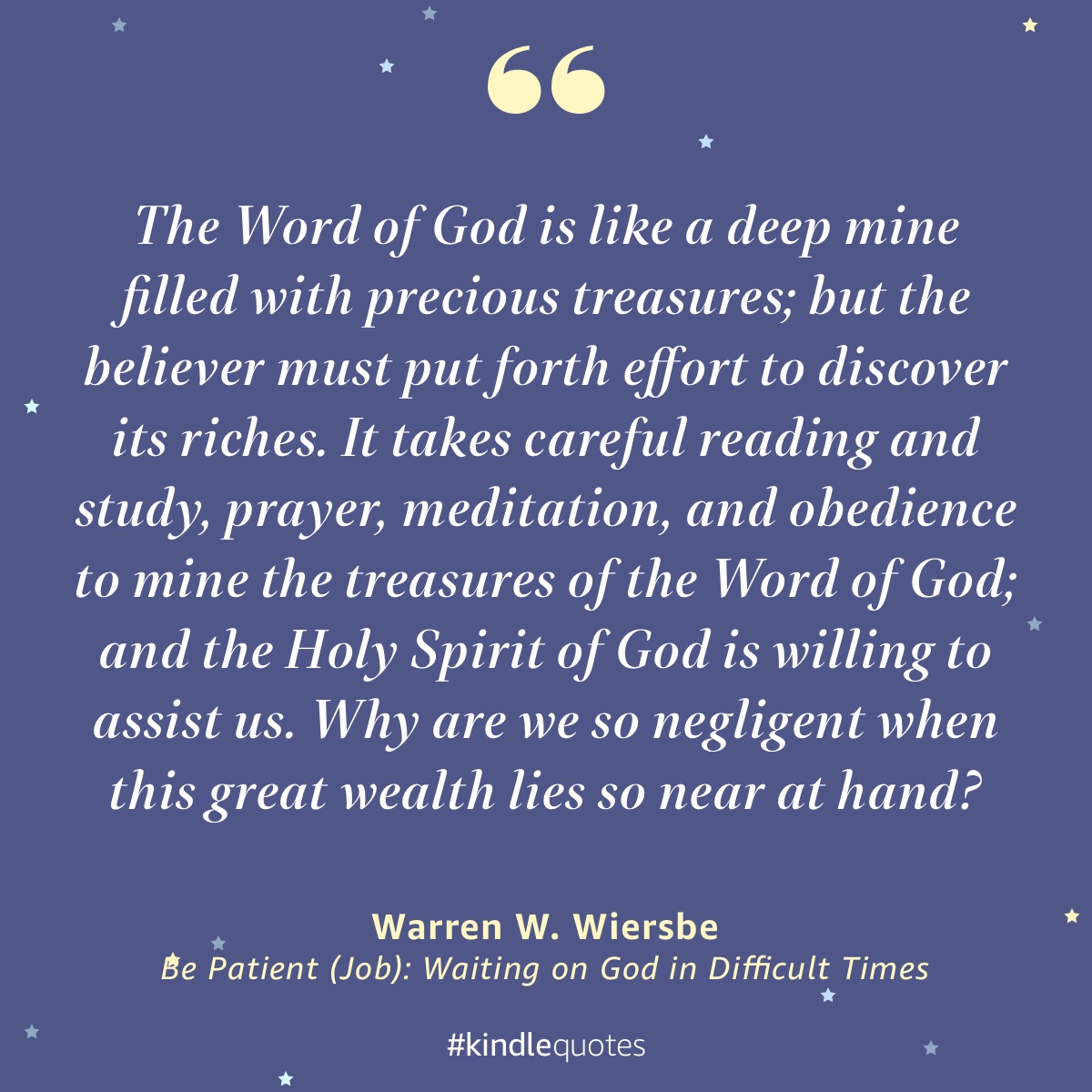
This is one reason it’s so important that we mine the bedrock truth from the Bible. So often we seek affirmation or warm fuzzy spiritual feelings. But nice feelings will evaporate in hard times. We need to know God’s character and Word are true no matter how we feel and how circumstances seem.

If you’re familiar with Elisabeth Elliot, you know that her world was shaken in a major way a few times. Her first husband was killed by the Indians he was trying to reach with the gospel. Her specialty on the mission field was translation, and years of painstaking work was lost in an instant. Her second husband died of cancer. A recently published book, Suffering Is Never for Nothing, is transcribed from her sessions at a conference. In the third chapter she says:

We are not adrift in chaos. To me that is the most fortifying, the most stabilizing, the most peace-giving thing that I know about anything in the universe. Every time that things have seemingly fallen apart in my life, I have gone back to those things that do not change. Nothing in the universe can ever change those facts. He loves me. I am not at the mercy of chance (p. 43).

Sometimes it’s not the big things that shake us up. It’s the little accumulated everyday frustrations. I never read the book If God Loves Me, Why Can’t I Get My Locker Open, so I don’t know if it’s good. But I’ve had similar thoughts! I love God and I am trying to serve Him here, so why am I stuck in traffic/is my computer not working/is what I need unavailable. Elizabeth wrote in another book of the frustration of spending an inordinate amount of time in the jungle on a stove that wasn’t working. Couldn’t God “make” it function so she could get back to the more important translation work? He could, and sometimes He does. But we live in a fallen world, and He doesn’t take away all the effects of that yet. She wrote in A Lamp For My Feet:

Whatever the enemy of our souls can do to instill doubt about the real purpose of the Father of our souls, he will certainly try to do. “Hath God said?” was his question to Eve, and she trusted him, the enemy, and doubted God. Each time the suspicion arises that God is really “out to get us,” that He is bent on making us miserable or thwarting any good we might seek, we are calling Him a liar. His secret purpose has been revealed to us, and it is to bring us finally, not to ruin, but to glory. That is precisely what the Bible tells us: “His secret purpose framed from the very beginning [is] to bring us to our full glory” (1 Cor 2:7 NEB).

I know of no more steadying hope on which to focus my mind when circumstances tempt me to wonder why God doesn’t “do something.” He is always doing something–the very best thing, the thing we ourselves would certainly choose if we knew the end from the beginning. He is at work to bring us to our full glory.

Sufferings and trials have a way of clarifying for us what’s most important. As the things which can be shaken fall away, the things which cannot be shaken come more clearly into focus. Many of the psalmists go through this process: they come to God shaken by a problem: an enemy is after them, they’re troubled by the prospering of the wicked, etc. But as they pray and remind themselves of the truths they know, they’re brought back to a place of peace.

As Samuel Rutherford said, “Believe God’s word and power more than you believe your own feelings and experiences. Your Rock is Christ, and it is not the Rock which ebbs and flows, but your sea.”

God is our refuge and strength,
    a very present help in trouble.
Therefore we will not fear though the earth gives way,
    though the mountains be moved into the heart of the sea,
    though its waters roar and foam,
    though the mountains tremble at its swelling. Selah

There is a river whose streams make glad the city of God,
    the holy habitation of the Most High.
God is in the midst of her; she shall not be moved;
    God will help her when morning dawns.

“Be still, and know that I am God.
    I will be exalted among the nations,
    I will be exalted in the earth!”
The Lord of hosts is with us;
    the God of Jacob is our fortress.

Psalm 46:1-5, 10-11

(Sharing with Tell His Story, Purposeful Faith, Welcome Heart, Share a Link Wednesdays, Faith on Fire, Grace and Truth, Inspire Me Monday)