
Laudable Linkage

Laudable Linkage

I have quite a long list of links that piqued my interest to share this week. I hope you’ll find some useful reading here.

Occasionally I like to repeat the reminder that links don’t imply 100% endorsement of everything on a site.

What Does Trouble Do? “To live is to experience trouble. There is no path through this life that does not lead through at least some kind of difficulty, sorrow, or trial—and often through a cornucopia of them. This being the case, we rightly wonder: What does trouble do? Though we may not see an answer in the immediate circumstances of our lives, we can begin to put one together as we look at the lives of other believers.”

On Mother’s Day, Rinse and Repeat with Truth. This is one of my favorites from Michele–good not just for moms and not just on Mother’s Day. “As mothers, as women, as grace-dependent creatures, we rely on the cleansing properties of God’s Word as it removes the gunk, as it scrubs away the Slime that the culture leaves in our thoughts and our habits. And since we are constantly swimming in lies, we constantly need the truth before our eyes, in our ears, and in our minds to counteract the Slime.”

Tell the Truth About Children, HT to Challies. I’ve been considering writing a post about the worth of children. This author does an admirable job. “Perhaps we zealously undertake the rescue mission of motherhood while our hearts still cling to the names the world reserves for children: Chaos. Burdens. Busyness. Craziness. But God bestows on them different names: Heritage. Power. Blessings. Gifts. Our children do not need to ‘grow up’ to earn given titles. Rather, mothers’ hearts need to hear afresh God’s words about children.”

When Prayer Starts With Panic, HT to Challies. “Notice what Paul actually says. He does not say, ‘don’t feel anxious and then pray,’ but rather, ‘in everything, by prayer and supplication… let your requests be made known.’ It’s a call to bring our panic into conversation with God, while it’s still happening. And he even includes thanksgiving, not as a command to pretend, but as a practice to remind ourselves that God’s character remains steady—even when everything else feels fragile.”

When Christ Is En Vogue, Christians Beware, HT to Challies. “I want to have the perspective of Paul, that ‘whether in pretense or in truth, Christ is proclaimed, and in that I rejoice. Yes, and I will rejoice’ (Phil 1:18). But with this widespread cultural acceptance comes a level of danger. I want to give three warnings about the dangers of Christian popularity.”

Sharpen Your Sword for Victory in Spiritual Battles. “Sometimes we use fleshly methods to deal with spiritual matters, like lashing out when people mistreat us. Situations never end well when we utilize worldly ways. But when we use the Sword of the Spirit—which is the Word of God—we invite the Lord to intervene in our circumstances, and the outcome is different. Do you know how to sharpen your sword? It’s crucial we understand how to skillfully use and maintain the Sword of the Spirit.”

Wounded Intercession: Turning Pain Into Prayer. HT to The Story Warren. “What we see in these examples is something deeper than mere forgiveness. It’s wounded intercession: taking the wounds inflicted on us by others and turning the pain into prayer.”

On Silence During Chaos. This post is the fifth in a series by Dan Olinger about caution with how we express ourselves over political issues or news in public forums.

17 Gospel Encouragements to Overcome Barriers to Biblical Hospitality. “Hospitality is a beautiful calling, but sometimes the reality of our lives looks very different from the picture we have in our minds. We might feel like our circumstances create barriers to offering the kind of welcome we long to extend. What if biblical hospitality is simply about welcoming others as Christ has welcomed us? Many barriers to hospitality can be overcome by embracing the gospel and looking to Jesus as our example.”

How Moms Can Care for Women Experiencing Infertility, HT to Challies. “The weight of infertility is heavy, and those experiencing it need all kinds of women in the body of Christ to help carry their burden (Gal. 6:2). If you’re a mother who hasn’t experienced infertility, you can still minister to women navigating it. There are no magical words to say, but in my experience, some attitudes and actions can be a soothing salve to a wounded heart.”

Why Boys No Books? Though the topic of this post is why boys don’t read, I was especially interested in a discussion there about an essay C. S. Lewis wrote on chivalry. He says men are mostly divided into the warrior/jock type (which he calls “stern”) or the nerd/artist type (which he calls “meek”). But every now and then comes a man who is a blending of the two, which he calls a “knight,” which this author says is “A Davidic kind of man with gentle hands that can deftly strum a harp, or chop off Goliath’s head.” He then discusses how reading can help point boys to this ideal.

More Than Skin Deep, HT to Linda. “We’re urged to focus our finite energy on fixing our external appearance, as though that will bring us some sort of deep and lasting life satisfaction. Unfortunately, spending too much precious life energy on the externals is … exhausting. And although I enjoy feeling reasonably put together as occasion warrants, I really don’t want to spend my remaining lifetime on a fruitless quest to look like the me of thirty years ago.”

Job’s Friends Versus Bob’s Friends. I mentioned a few weeks ago this podcast called Dead Man Talking by Bob Roberts, someone from one of our former churches. He has stage 4 liver cancer and wanted not to “waste” it, so he and four friends from college days meet to discuss various facets of what he is learning and going through. Someone suggested the subject of Job’s friends compared to Bob’s as a joke, but a valuable discussion grew from there. I linked to the YouTube version, but the podcast is also on Spotify and Apple podcasts.
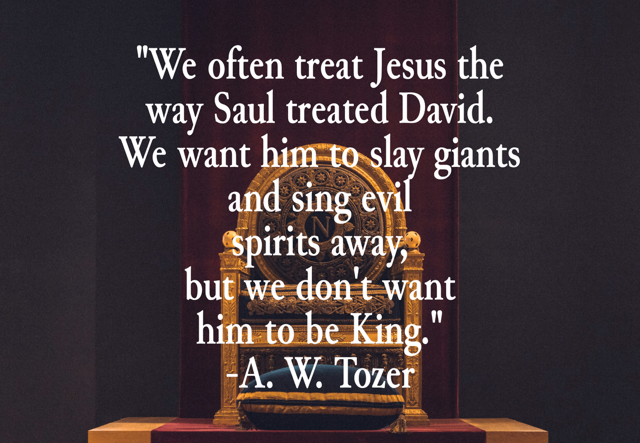
“We often treat Jesus the way Saul treated David. We want him to slay giants and sing evil spirits away, but we don’t want him to be King.” – A.W. Tozer

You Can Throw Your Weight on God’s Testimony

You can throw your weight on God's testimony.

Often I’ll turn the radio on while I make my breakfast, and usually Dr. Stephen Davey’s program, Wisdom for the Heart, is on at that time.

One day last week, Dr. Davey was speaking from Psalm 19. It’s a familiar passage to many of us. It starts with “The heavens declare the glory of God, and the sky above [firmament in the KJV] proclaims his handiwork,” and then goes on to develop that theme for the next several verses.

The last half of the psalm talks about how God’s character is seen through His Word. Verse 7 starts off another familiar passage: “The law of the Lord is perfect, reviving the soul. . . ” Perhaps you remember, as I do, a song made of these words.

The passage is so familiar, in fact, that it’s easy to zip right through it without stopping to take it in.

But Dr. Davey pointed out something that stopped me in my tracks.

The latter half of verse 7 says, “The testimony of the LORD is sure, making wise the simple.”

Dr. Davey said:

This is legal language; whenever someone is called into court by the prosecution or defense, they give their testimony.  They testify to what they know – what they’ve seen – what they’ve heard.

David writes in legal terminology – God is testifying . . . and whatever and whenever He does, David writes here, The testimony of the Lord is sure.

In other words, you can count on it.  One author* wrote, “You can throw your weight on God’s testimony and it will hold up.”

You can throw your whole weight on God’s testimony.

Does that impact you like it does me?

It’s not that this truth was new to me. But hearing it put that way brought my understanding to a whole new level.

God’s Word is sure. It’s trustworthy. We can stake the whole weight of our souls on it.

BibleStudyTools.org says the Hebrew word translated “sure” here means “to support, confirm, be faithful; made firm, sure, lasting; verified; reliable, faithful, trusty .”

What God tells us about Himself, the world, and ourselves is dependable.

His promises won’t break when we lean on them. That doesn’t mean all our prayers will be answered just the way we hoped, or that life will have a fairy-tale ending. But when He tells us who He is and that He will be with us and take care of us, we can rely on His Word without worry.

I did not grow up in areas where ponds freeze over. But I am familiar with the concept of testing the ice to make sure it’s solid before walking or skating on it. And I have stepped on a bridge, fallen log, or even a piece of flooring and felt it give, wondering if it would hold my weight.

But we’ll never have that experience with God’s Word. It is sure.

Is there a passage you’re staking your soul on today?

Psalm 19:7: The testimony of the LORD is sure.

* Donald Williams, Mastering the Old Testament: Psalms 1-72 (Word Publishing, 1986), p. 153), quoted in Psalm 19:7-9) God’s Inspired Little Book by Stephen Davey on the Wisdom for the Heart Radio Broadcast, 1/22/2024.

(I often link up with some of these bloggers.)

Giving and Receiving God’s Word

I was surprised recently to read of someone offering their support and sympathy but promising not to share Bible verses.

My first thought was, “Isn’t the Bible our main source of comfort?” Human comfort helps, but it only goes so far.

I think I know what the person meant, though. Sometimes it’s easy to pat someone on the back, quote Romans 8:28, and go on our merry way. That’s like the spiritual version of what James says about physical needs: “If a brother or sister is poorly clothed and lacking in daily food, and one of you says to them, ‘Go in peace, be warmed and filled,’ without giving them the things needed for the body, what good is that?” (James 2:15-16). We’re instructed to be quick to hear and slow to speak, to weep with those who weep, to suffer with others in the body of Christ who suffer. We’re to “Remember those who are in prison, as though in prison with them, and those who are mistreated, since you also are in the body” (Hebrews 13:3). We need to enter in to someone else’s pain rather than just offer them a bandage.

We also need to discern whether others are ready to hear. God had Elijah eat and sleep before talking with him. Nathan told David a story before confronting him with his gross sin. Jesus once told the disciples, “I still have many things to say to you, but you cannot bear them now.”

Once one of my coworkers suffered a miscarriage. This young woman was not a Christian. She told our manager that she didn’t want anyone to say anything about her situation when she returned to work. But one of the other ladies, a Christian, made it a point to speak to her about her miscarriage on her first day back. I don’t know what was said or how it was received. But it seemed unwise not to give this woman the time she asked for.

Someone has said that Job’s friends did more for him when they sat in silence than when they began to advise him. Sometimes a sorrow is so deep or so new, we should just express sympathy and share our presence and support. Pat answers and cliches don’t help.

Sometimes, too, when the person we want to comfort is a mature Christian, we can’t tell them anything they don’t already know. They know how to seek the Scriptures and lay their hearts bare before the Lord. That doesn’t mean we should never say anything comforting to them from the Word, but we just need to be led by the Spirit and not by our need to “say something” or “fix” the situation.

We need wisdom, grace, discernment, and the Holy Spirit’s leading when we share God’s Word with people. Job’s friends were sure that Job was suffering because he sinned. Since God said Job had not sinned, all his friends’ counsel was misapplied. In fact, Job called them miserable comforters.

But I have known what is it, as I am sure you have, to have someone share “a word spoken in due season.” When my mother passed away, someone shared in a card the verse that shaped my prayers for that time: “Let, I pray thee, thy merciful kindness be for my comfort, according to thy word unto thy servant” (Psalm 119:76, KJV). Often someone has shared a verse or sometimes just a thought or principle from the Bible at just the right time for whatever I was dealing with at the moment. That’s the kind of comforter and encourager I want to be. That can only come from walking closely with the Lord and spending time in God’s Word so the Holy Spirit can bring to mind what He wants us to share.

On the other side of this coin, though, as one receiving comfort or instruction, aren’t there times we just don’t want to hear it? Sometimes that’s because it’s coming from someone who hasn’t taken the time to really listen and enter in to the situation. But sometimes it’s due to other causes.

Sometimes we don’t want to hear because of our flesh. When you’re reaching for your third donut, you don’t want to hear about self-control. When you want to lash out at someone, you don’t want to hear verses about forbearing and forgiving. I’ve often prayed that God would help me look for the way to escape temptation that He promised rather than looking for an excuse to indulge.

Sometimes we don’t want to give up our pain because we want the person who caused it to suffer. Sometimes we might even be mad at God for what He allowed.

Sometimes we might not want to hear truth because we’re feeling a little dull or distracted spiritually.

The times when we least want to hear God’s Word are the times we most need it. A verse I like to pray in those times is Psalm 119:36: “Incline my heart to your testimonies.”

The Holy Spirit uses the Word of God to revive us.

  • Jesus said, “It is the Spirit who gives life; the flesh is no help at all. The words that I have spoken to you are spirit and life” (John 6:63).
  • “This is my comfort in my affliction, that your promise gives me life” (Psalm 119:50).
  • “I will never forget your precepts, for by them you have given me life.” (Psalm 119:93).

We’re still responsible for the truth we hear and read, even if the person sharing it isn’t doing so in the best way or time. Sometimes we just have to extend grace and ask God to minister to our hearts.

May God give us eager “ears to hear” His Word and make us gracious and sensitive encouragers.

. (I often link up with some of these bloggers)