Ways to Pray for the Lost

Ways to pray for the lost

One of our former pastors who is now with the Lord used to encourage us to pray Scripturally rather than falling into “Christian cliches.”

One evening he especially challenged us regarding praying for people who don’t know the Lord. It’s not cliche to pray “Please save so-and-so.” Paul said of his countrymen, “Brothers, my heart’s desire and prayer to God for them is that they may be saved” (Romans 10:1).

But, if you’re like me, praying the same way repeatedly can seem rote after a while. Petitions based on Scripture not only refresh our prayers but also give us confidence that we’re praying according to God’s will.

The discussion that night sparked a brief search which turned up a few verses of praying for the lost. Since then, I’ve added others as well as some passages that aren’t prayers in themselves but can be turned into prayer.

We don’t necessarily need to mention all these things every time we pray for our non-Christians friends and loved ones, but considering one or two of these at a time can help us pray more fervently and effectively.

We can pray that:

They hear or read God’s Word. Romans 10:17 tells us “Faith comes from hearing, and hearing through the word of Christ.” There are so many ways now to encounter the gospel–in one’s own Bible, on apps, via audio, and so many more options.

Someone tells them of Jesus. In a sense, books, blogs, social media posts, tracts, etc, involve someone telling the hearers or readers about Him. I’ve heard testimonies of people who believed on the Lord alone in their rooms after reading the Bible. But for many, a personal example is needed.

When Jesus had compassion on a crowd “because they were harassed and helpless, like sheep without a shepherd,” He told the disciples, “The harvest is plentiful, but the laborers are few; therefore pray earnestly to the Lord of the harvest to send out laborers into his harvest” (Matthew 9:35-38). In Romans 10:14-15, Paul writes, “How then will they call on him in whom they have not believed? And how are they to believe in him of whom they have never heard? And how are they to hear without someone preaching? And how are they to preach unless they are sent?”

We can also pray that those who share the gospel would be given the right words to make it clear. Paul prayed for words, boldness (Ephesians 6:18-20), an open door (Colossians 4:3), and clarity (Colossians 4:4).

God will draw our lost loved ones to Himself. Jesus said, “No one can come to me unless the Father who sent me draws him” (John 6:44).

The Holy Spirit will guide them into truth and remind them. Jesus said the Holy Spirit would guide us into all the truth (John 16:13), teach all things, and remind us of what Jesus said (John 14:26). Paul goes on to say, “Therefore I want you to understand that no one speaking in the Spirit of God ever says ‘Jesus is accursed!’ and no one can say ‘Jesus is Lord’ except in the Holy Spirit” (1 Corinthians 12:3).

Their hearts will be “good ground.” In what we call the parable of the sower in Matthew 13, Jesus talks about various people’s hearts as ground that the seed of the Word is dropped into. The seed doesn’t take root and grow in some because it’s snatched away, in others because their heart is stony, in others because thorns choke it out. But the one with “good soil, this is the one who hears the word and understands it.”

Though we’re not specifically instructed to pray this way, I’ve prayed at times for hearts of lost loved ones to become good ground, for the stones to be removed, the bedrock underneath to be broken up, the thorns to be kept back, so that the seed of the Word can take root and bring forth fruit.

A line from a little-known stanza of the beloved hymn “Just As I Am” says, “Just as I am, Thy love unknown/ Has broken every barrier down.” I think God does that in some by bringing circumstances into their lives to soften them and by bringing them under the sound of the Word that they reject at first, but which gradually breaks down the stoniness. I think apologetics ministries are most helpful here in making way for the gospel.

They would be convicted of sin. Jesus said the Holy Spirit “will convict the world of its sin, and of God’s righteousness, and of the coming judgment” (John 16:8). Though conviction feels awful, without it, people don’t know that there’s anything they need to be saved from. In one sense, as we mature in the Lord, we realize more fully how awful sin is and how offensive it is to God. But we need this initial realization of what sin is in order to realize we need God’s grace.

Their eyes would be opened and hearts turned from darkness to light. Paul said the mission God gave him was “to open their eyes, so that they may turn from darkness to light and from the power of Satan to God, that they may receive forgiveness of sins and an inheritance among those sanctified by faith in Me” (Acts 26:18). Again, though this isn’t written in the form of a prayer, we can certainly pray these things for those on our hearts.

That they would not be deceived. In Matthew 7:21-23, Jesus says that some people will fully expect to get into heaven, but will be told that He never knew them. One of my frequent prayers is that none of my loved ones would be deceived into thinking they are saved if they are not. I also pray they would not be deceived by those who twist Scripture to try to make it say something it doesn’t (2 Peter 3:16).

I’ve also prayed that people would realize that whatever they’re trusting in is not dependable and will not satisfy in the long run, or that whatever is keeping them from salvation is not worth it.

They would understand God’s love. God says He drew His people “with cords of kindness, with the bands of love” (Hosea 11:4). Paul prays for the Ephesians “to be strengthened with power through his Spirit in your inner being, so that Christ may dwell in your hearts through faith—that you, being rooted and grounded in love, may have strength to comprehend with all the saints what is the breadth and length and height and depth, and to know the love of Christ that surpasses knowledge, that you may be filled with all the fullness of God” (Ephesians 3:16-19). Once while reading this passage, the phrase “to know the love of Christ” jumped out at me. Paul goes on to say that this love surpasses knowledge–yet he prays we’ll comprehend. He’s praying for believers here: we can continually grow in our understanding of God’s love. But I think we can ask for Him to open the hearts of our unsaved loved ones to God’s love as well. God’s law convicted me of my sin and my need of forgiveness, but His love drew me and convinced me it was safe to come to Him and He would receive me.

I was astonished to realize that a familiar passage followed this one in Ephesians. After Paul prayed that the Ephesians would comprehend God’s love, he said, “Now to him who is able to do far more abundantly than all that we ask or think, according to the power at work within us, to him be glory in the church and in Christ Jesus throughout all generations, forever and ever. Amen” (Ephesians 3:20-21). We use these verses as encouragement for all kinds of things. But in context, praying for others to know God’s love and be filled with the fullness of God, we can trust He’s able to do more than we can ask or think.

What encouragement that our lost loved ones aren’t “impossible cases.” God is able to work through His word, His people, and His Holy Spirit to turn hearts to Himself.

Romans 10:1

(Revised from the archives).

(I often link up with some of these bloggers.)

Laudable Linkage

Laudable Linkage

I hope you have a great Saturday! There are a few good reads here if you have time.

Four Prayer Responses to the Murder of Charlie Kirk, HT to Tim Challies, who has curated several posts on different aspects of Kirk’s murder here.

I don’t often link to Facebook posts, but this one shared by a friend from author Tricia White Priebe points out how rejoicing over Charlie Kirk’s murder shows society’s lack of value of human dignity.

O Lord, Heal Our Land. “Anyone who lived through the late 1960s and early 1970s, as I did, can see the parallels between then and now. And yesterday’s assassination of Charlie Kirk on a college campus in Utah has left us all stunned, wondering about our own future as a nation.”

Bible Reading as a Blessing, Not a Burden, HT to Challies. “I loathe the times I’m distracted by a screen, or a crick in the neck, or an overly groggy eye. Or even worse, when the pillow seems more pleasing. I suspect I’m not alone in my laments and loathes. And I bet you want to hang on the word of God, too.”

How to Rightly Train Your Affections, HT to Challies. “While human preferences for food or favorite football teams may be value neutral, preferences are not always so. We are commanded by God to prefer certain things. Or to shift again to the language of affections, God calls his people to rejoice in, love, and desire certain things and to despise other things. Our affections, in other words, are not always value neutral. We are responsible for training them according to the revealed will of God.”

Making Space for Others, HT to the Story Warren. “Let’s scoot over.  Make room. Here, take this spot and sit by us. If you are walking into a space as a new student, neighbor, or church visitor, those can be some of the kindest words ever spoken. As a woman in my mid-fifties, I’m shocked that the awkwardness of junior high floods back so quickly when I am in a new situation. And, as a ministry leader who usually runs the room, I can forget how it feels to walk into an unfamiliar one.”

Go Ahead, Bring a Knife to a Gunfight. “God calls each one of us to battle for the right and against the wrong, and it’s a simple fact that many of us are not equipped with the kind of weapon we would prefer to carry into such a conflict. Many of us look at the weapons wielded by others and wish we had theirs instead of ours. Yet in the battle for God’s cause, he always means for us to put to use the weapon we have on hand with the conviction that he will bless our efforts, no matter how weak or paltry those weapons may seem.”

The Good Always the Enemy of the Best. “Somewhere along the way, despite our desire to give our children the best, we can find ourselves spending vast amounts of time, energy, and money pursuing the good instead. How does this happen? We become deceived. Deceived by culture. Deceived by our well-meaning friends. Deceived, sometimes, even by Christians.”

The Most Exasperating and Least Rewarding. I’ve been pondering similar thoughts recently. “If you move to a new town and search for a new church, it’s unlikely you will find one that offers everything you’d prefer a church to offer—every doctrine, every emphasis, every association, every ministry, every preference. You may love the music, but wish there was a greater emphasis on liturgy. You may appreciate the effort that goes into evangelism, but lament the lack of effort that goes into youth ministry. The preaching may be just what you are after, but the small-group ministry is sputtering. Yet churches are bundled—you have to weigh the weaknesses against the strengths and the desirable qualities against the undesirable. Perfection isn’t an option.”

Journaling God’s Faithfulness: 10 Questions to Develop This Faith-Building Habit. If you’d like to keep a spiritual journal, this post has a lot of good suggestions for what to write about.

Is Being Pro-Life Really Just “Pro-Forced Birth?” HT to Challies. No, and this article explains why. “When it comes to moral issues, like abortion, we must always be alert for the word games, rhetorical ploys, and manipulative language that distort the truth and make something evil look good.”

Don’t Do Everything for Your Kids, HT to Challies. It’s interesting that I have seen this theme in a number of blog posts lately. “What I’d like to suggest today is that just as important as giving your kids opportunities to play soccer or violin or go to that birthday party or go to the park or do that activity or play that game with them is to allow yourself time to read the Bible or a book or to spend time with your spouse. It’s possible to give too much to your children, sacrificially, at the expense of your wellbeing and the relationship with your spouse (if you have one). And that will not serve your children, yourself, or your marriage well.”

Close to Shepherd

The closer we are to the Shepherd,
the safer we are from wolves.
Unknown

Laudable Linkage

Laudable Linkage

I have a short but good list of reads to share today:

Why It’s Good (and Christian) to Love Your Country, HT to Challies. “American Christians have also been pretty angsty about patriotism. In the last few years, many academics, journalists, and even some pastors have equated any love for the country with idolatry or worse, fascism and theocracy. So many well-meaning American Christians have shied away from expressions of patriotism because they don’t want to engage in false worship.”

Keep Reading Your Bible, Even if You Don’t Understand It, HT to Knowable Word. There are times to stop and dig deep in a passage we’re reading. But sometimes a passage won’t make sense until we’ve read more of the rest of the Bible.

You Don’t Need Another Prayer Technique, HT to Challies. “While my new system does help me be more organized and varied in my petitions, it hasn’t turned me into an Olympic runner in prayer. My best training came instead from an unexpected source.”

Dumb Dads: 3 Ways The Stereotype Is Harming The Archetype, HT to Challies. “By watching movies, reading stories, and entertaining the distorted pictures of dumb dads as a stereotype, we have forgotten the archetype of fatherhood. God didn’t create men and fathers to be weak and foolish. He created them to be so much more than what modern culture is preaching to our children.”

The Sandwich Generation, HT to Challies. “We are still parenting young-adult children, while at the same time attempting to gracefully maneuver through the aging years of our parents with honor. The similarities are endless; how to love our family without becoming a dictator, how to aid them in making their own decisions, how to help them navigate the path which will provide the best outcome for their future.”

America! America!
God mend thine every flaw,
Confirm thy soul in self-control,
Thy liberty in law!

Katharine Lee Bates, from “America the Beautiful”

Laudable Linkage

Laudable Linkage

I have quite a long list of links that piqued my interest to share this week. I hope you’ll find some useful reading here.

Occasionally I like to repeat the reminder that links don’t imply 100% endorsement of everything on a site.

What Does Trouble Do? “To live is to experience trouble. There is no path through this life that does not lead through at least some kind of difficulty, sorrow, or trial—and often through a cornucopia of them. This being the case, we rightly wonder: What does trouble do? Though we may not see an answer in the immediate circumstances of our lives, we can begin to put one together as we look at the lives of other believers.”

On Mother’s Day, Rinse and Repeat with Truth. This is one of my favorites from Michele–good not just for moms and not just on Mother’s Day. “As mothers, as women, as grace-dependent creatures, we rely on the cleansing properties of God’s Word as it removes the gunk, as it scrubs away the Slime that the culture leaves in our thoughts and our habits. And since we are constantly swimming in lies, we constantly need the truth before our eyes, in our ears, and in our minds to counteract the Slime.”

Tell the Truth About Children, HT to Challies. I’ve been considering writing a post about the worth of children. This author does an admirable job. “Perhaps we zealously undertake the rescue mission of motherhood while our hearts still cling to the names the world reserves for children: Chaos. Burdens. Busyness. Craziness. But God bestows on them different names: Heritage. Power. Blessings. Gifts. Our children do not need to ‘grow up’ to earn given titles. Rather, mothers’ hearts need to hear afresh God’s words about children.”

When Prayer Starts With Panic, HT to Challies. “Notice what Paul actually says. He does not say, ‘don’t feel anxious and then pray,’ but rather, ‘in everything, by prayer and supplication… let your requests be made known.’ It’s a call to bring our panic into conversation with God, while it’s still happening. And he even includes thanksgiving, not as a command to pretend, but as a practice to remind ourselves that God’s character remains steady—even when everything else feels fragile.”

When Christ Is En Vogue, Christians Beware, HT to Challies. “I want to have the perspective of Paul, that ‘whether in pretense or in truth, Christ is proclaimed, and in that I rejoice. Yes, and I will rejoice’ (Phil 1:18). But with this widespread cultural acceptance comes a level of danger. I want to give three warnings about the dangers of Christian popularity.”

Sharpen Your Sword for Victory in Spiritual Battles. “Sometimes we use fleshly methods to deal with spiritual matters, like lashing out when people mistreat us. Situations never end well when we utilize worldly ways. But when we use the Sword of the Spirit—which is the Word of God—we invite the Lord to intervene in our circumstances, and the outcome is different. Do you know how to sharpen your sword? It’s crucial we understand how to skillfully use and maintain the Sword of the Spirit.”

Wounded Intercession: Turning Pain Into Prayer. HT to The Story Warren. “What we see in these examples is something deeper than mere forgiveness. It’s wounded intercession: taking the wounds inflicted on us by others and turning the pain into prayer.”

On Silence During Chaos. This post is the fifth in a series by Dan Olinger about caution with how we express ourselves over political issues or news in public forums.

17 Gospel Encouragements to Overcome Barriers to Biblical Hospitality. “Hospitality is a beautiful calling, but sometimes the reality of our lives looks very different from the picture we have in our minds. We might feel like our circumstances create barriers to offering the kind of welcome we long to extend. What if biblical hospitality is simply about welcoming others as Christ has welcomed us? Many barriers to hospitality can be overcome by embracing the gospel and looking to Jesus as our example.”

How Moms Can Care for Women Experiencing Infertility, HT to Challies. “The weight of infertility is heavy, and those experiencing it need all kinds of women in the body of Christ to help carry their burden (Gal. 6:2). If you’re a mother who hasn’t experienced infertility, you can still minister to women navigating it. There are no magical words to say, but in my experience, some attitudes and actions can be a soothing salve to a wounded heart.”

Why Boys No Books? Though the topic of this post is why boys don’t read, I was especially interested in a discussion there about an essay C. S. Lewis wrote on chivalry. He says men are mostly divided into the warrior/jock type (which he calls “stern”) or the nerd/artist type (which he calls “meek”). But every now and then comes a man who is a blending of the two, which he calls a “knight,” which this author says is “A Davidic kind of man with gentle hands that can deftly strum a harp, or chop off Goliath’s head.” He then discusses how reading can help point boys to this ideal.

More Than Skin Deep, HT to Linda. “We’re urged to focus our finite energy on fixing our external appearance, as though that will bring us some sort of deep and lasting life satisfaction. Unfortunately, spending too much precious life energy on the externals is … exhausting. And although I enjoy feeling reasonably put together as occasion warrants, I really don’t want to spend my remaining lifetime on a fruitless quest to look like the me of thirty years ago.”

Job’s Friends Versus Bob’s Friends. I mentioned a few weeks ago this podcast called Dead Man Talking by Bob Roberts, someone from one of our former churches. He has stage 4 liver cancer and wanted not to “waste” it, so he and four friends from college days meet to discuss various facets of what he is learning and going through. Someone suggested the subject of Job’s friends compared to Bob’s as a joke, but a valuable discussion grew from there. I linked to the YouTube version, but the podcast is also on Spotify and Apple podcasts.

“We often treat Jesus the way Saul treated David. We want him to slay giants and sing evil spirits away, but we don’t want him to be King.” – A.W. Tozer

Laudable Linkage

Laudable Linkage

Here are some of the good reads found this week:

I Feel an Imprecatory Prayer Comin’ On. “Growing up, I never heard anyone mention imprecatory prayers, which are mostly found in the Psalms. What are they? Imprecatory prayers are prayers in which you ask God to send calamity or hardship upon someone else.”

What Does the Bible Teach About Demons and Spiritual Warfare? HT to Challies. “I haven’t done this, but I suspect that polling our youth groups about whether or not the devil and demons are real would have troubling results. Perhaps a poll among youth pastors would fare similarly. It’s simply something we don’t talk about. And I get it. But it’s also a very important topic, and is far too dangerous to overlook.”

Why We Do What We Do. What the Bible teaches about our desires and the way they can change after we become believers.

I’d Never Do That!” I haven’t read the book mentioned, but I appreciate the application about offering help with humility.

Praying for Dreams to Come True, HT to Challies. “Dreams and desires are like butterflies in our hands. We cannot hold onto them too tightly or we will crush them. But if we hold them with open hands, at the right time, God will breathe the breath of his Spirit and they may launch and fly.”

How Marriage Vows Work, HT to Challies. “This distinction matters because marriage is sustained by more than warm feelings. When a couple faces challenges—as every couple will—they need the foundation of clear, mutual commitments rather than memories of how they once felt.”

How to Respect the Dignity of Loved Ones with Dementia, HT to Challies. “Contrary to what we might think, the gift of presence is perhaps most significant in the advanced stages of dementia. It is not infrequent at that time for loved ones to feel that their visits do not count for anything. They assume that they won’t be recognized or their visit remembered, which may be precisely the wrong conclusion.”

The Etiquette of Speech, HT to Challies. “There are three grave errors I think we can fall into when it comes to speech etiquette, and we should be wary of each of them.”

Wounds That Cannot Wholly Be Cured. “I’ve never known grief as strong or wounds as deep as I have been through this year. In January, my youngest brother died unexpectedly. It has been a season of loss and heartache that far surpasses anything that I have yet experienced.”

A. W. Tozer quote

The Bible is not an end in itself, but a means to bring men to an intimate and satisfying knowledge of God, that they may enter into Him, that they may delight in His Presence, may taste and know the inner sweetness of the very God Himself in the core and center of their hearts. A. W. Tozer, The Pursuit of God

Laudable Linkage

Laudable Linkage

I went from just a few shared reads last week to a longer list today. I hope you’ll find something of interest here, along with some time to read.

That’s Just Your Interpretation,” HT to Challies. “This is a common response when discussing Scripture, isn’t it? ‘That’s just your interpretation!’ No matter how clearly the Bible speaks, this objection seems to persist. But is it true? Can we really understand the Bible? This question takes us to the heart of the Christian faith and invites us into a discussion about the clarity and authority of God’s Word.”

Ten Truths to Empower Your Prayer Life. “My introduction to prayer came at the age of seven. I was spending the weekend with my grandmother and had slept beside her, snuggled deep into the covers. As the early morning light filtered through the curtains of her bedroom window, the sound of her whispered prayer broke through the fog of my fading sleep. . . . In the years since then, I’ve learned much about this sacred privilege. Today, I’d like to share ten truths I’ve sought to apply in my own prayer life.”

The Greatest Show: Is Your Faith Performance? “The desire to have a godly reputation isn’t wrong, but the danger comes when our focus shifts from genuine transformation in Christ to carefully crafted perception. It’s a tale as old as time and worth pausing to ask: do you care more about appearing faithful, gracious, and surrendered to Christ than actually walking in an authentic relationship with Jesus?”

Be Faithful Over Little: A Different Vision for a Life That Counts, HT to Redeeming Productivity. “But God hasn’t purposed for most people to be world-shapers. The vast majority of our faithfulness and work for the Lord will be exercised in the small, often boring, and monotonous rhythms of life.”

Between Two Worlds: Suffering, Safety, and the Cross, HT to Andrew Le Peau. “The predominant institutional approach to suffering is often one of avoidance—from institutional marketing that equates flourishing with the absence of suffering to personal postures that treat suffering as an unwelcome and harmful interruption in one’s development. Institutions can lessen burdens but not eliminate suffering. No mentor, policy, program, or system can insulate students from grief, disappointment, or hardship. A culture increasingly focused on removing discomfort does not necessarily make people stronger; it often leaves them more anxious and unprepared for suffering when it inevitably comes.”

A Denier Redirected: Living Out the Greatness. This discussion about living in a godly way in an ungodly society dovetails with my own reading about Daniel and how he did so.

This Vice Is One of the Key Predictors of Divorce: Yet, It Is Oddly Understudied. It’s a vice running rampant in society these days.

Coming of Age. “You could tell me that no matter what a mother loves her children, but it takes a story to show me how painful that could be and what it means. Or maybe you tell me that it’s good for my children to suffer losses and failures; that they’ll learn how to pick themselves up if they only get to experience life’s challenges. I’d say it makes sense but it takes a story for me to understand the real value behind it. I could learn as I go and fumble blindly along the way, or I could walk in the shoes of many mothers who’ve gone ahead of me and have a story to tell me of how to become the mom of adults.”

What Did We Gain and Lose by Livestreaming? HT to Challies. “What began as a temporary necessity has become an expected staple of the church’s ministry. As people began returning to worship, committees and the session debated whether livestreaming should continue. If so, for how long, and for what purpose?”

C. S. Lewis quote

Obedience is the key to all doors: feelings come (or don’t come) and go as God pleases. We can’t produce them at will and mustn’t try.–C. S. Lewis

Laudable Linkage

Laudable Linkage

I haven’t had a lot of extra time at the computer, so I have just a short list of recommended reading:

How Honest Can I Be with God in Prayer? “Do you ever wonder how honest you can be with God in prayer? On the surface, this question probably seems silly. After all, God knows everything. How could we hide anything from the God who knows our hearts and can read our minds? Yet sometimes, we hold back in prayer. As if our thoughts, emotions, or words don’t really exist if we don’t speak them. Or perhaps that we won’t be held accountable for them if we don’t admit our thoughts.”

2 Reading Strategies to Get Wisdom From the Word. “The Bible won’t tell you who to date, which car to buy, where to go to college, or whether to accept the job offer on the West Coast. It does, however, offer principles to live by, guard rails to keep readers on the path of wisdom.”

Finding Joy in Bible Reading, HT to Knowable Word. “It will help if we consider what we are doing when we read the Bible. It is not like a textbook we have to wade through in order to pass an exam. It is not something we have to do out of expectation or duty. It is something we get to do; a privilege, a blessing. Countless people through history would have loved to have the access to God’s word that we enjoy today.”

Improving Our Listening to Sermons. “Sermons are not lectures; they are intended to persuade you of something. They should lead to action, not only to increased knowledge. We should always ask what to do in response to what we have heard.”

Thank You Gracious Church Members, HT to Challies. “A pastor’s heart is not his congregants’ responsibility. But there is an invitation to be a congregant who steps into church life with a heart of submission and care for your leaders.”

The Church’s Opportunity when “Gentle Parenting” Crashes, HT to Challies. Although “gentle parenting” seems attractive and has some good points, it doesn’t deal accurately with sin. “Diagnosing sin in our kids’ hearts doesn’t strip them of dignity. On the contrary, it dignifies and deepens them. We treat children as moral agents, respect them enough to discipline them in love, and then forgive and restore them.”

The Vibe Shift: What Does It Mean for the Gospel? HT to Challies. Though the “vibe shift” in America since the election and especially since the inauguration has been a welcome change more in line with Christian values, we’re reminded that the “vibe” is not the gospel and people still need the Lord.

Fragile

If you wake up feeling fragile, remember that God is not,
and trust Him to be everything you need today. –C. S. Lewis

Time Alone with God

Time Alone With God

One of my college roommates didn’t seem to be able to study alone. Often, when I came back to my dorm room after dinner, I’d find a group of girls studying (and talking and laughing) with my roommate. A roommate’s study group in my room meant I had to find another quiet place to study. I’m the type that can’t concentrate when there is noise and commotion in the room.

I knew students who couldn’t seem to go to lunch or the bookstore or much of anywhere without a companion.

Of course, the opposite is true of some. I liked to go many places (other than lunch) alone because it was more efficient. If you have three or four girls running errands together, it’s going to take three or four times as long to get done. But sometimes the fellowship is worth the extra time. We need a balance of time alone and time with others.

The same is true in the church. The last several years, I have seen an emphasis on community among believers, along with reminders that we’re not “lone rangers.”

While that emphasis is needed, I feel some take it too far. Some say we were never meant to read God’s Word alone, but in community. It’s true that for many years, people didn’t have their own copies of the Scriptures. All they had was what was shared and discussed when they gathered together. But that doesn’t mean no one should ever read the Bible alone now.

One writer said the preaching time at church is our main spiritual meal. I’m not sure what she based that conclusion on. It’s a vital part of our Christian life, but meeting God alone is vital as well. In fact, though I learn a lot and have been convicted during church and Bible studies, I think the main time I do serious business with God is home alone when I can process what I have heard.

Those who believe in the Lord Jesus Christ as Savior are part of God’s family. Yet we don’t relate to Him only as “one of the kids.”

God knew us individually before we were born. “Before I formed you in the womb I knew you, and before you were born I consecrated you” (Jeremiah 1:5; see also Psalm 139:13-16).

God knows us by name. “The sheep hear his voice, and he calls his own sheep by name and leads them out” (John 10:3).

God knows our thoughts. “O Lord, you have searched me and known me! You know when I sit down and when I rise up; you discern my thoughts from afar. You search out my path and my lying down and are acquainted with all my ways. Even before a word is on my tongue, behold, O Lord, you know it altogether” (Psalm 139:1-4).

God knows our ways. “I the Lord search the heart and test the mind, to give every man according to his ways, according to the fruit of his deeds” (Jeremiah 17:10).

Even the number of our hairs is known by Him. “Are not five sparrows sold for two pennies? And not one of them is forgotten before God. Why, even the hairs of your head are all numbered. Fear not; you are of more value than many sparrows” Luke 12:6-7).

We’ll each give account of ourselves personally to God. “For we must all appear before the judgment seat of Christ, so that each one may receive what is due for what he has done in the body, whether good or evil” (2 Corinthians 5:10).

The psalms in the Bible are songs which were sung by the children of Israel. Some of them have plural pronouns, but many have personal pronouns. That means even though the congregation is singing about the truths of the passage together, the passage was written by someone’s experience with the Lord alone. Those singing can take those truths into their own individual relationship with the Lord.

I sought the LORD, and he answered me and delivered me from all my fears (Psalm 34:4).

He drew me up from the pit of destruction, out of the miry bog, and set my feet upon a rock, making my steps secure. (Psalm 40:2).

My soul will be satisfied as with fat and rich food, and my mouth will praise you with joyful lips, when I remember you upon my bed, and meditate on you in the watches of the night; for you have been my help, and in the shadow of your wings I will sing for joy. My soul clings to you; your right hand upholds me (Psalm 63:5-8).

I rise before dawn and cry for help; I hope in your words. My eyes are awake before the watches of the night, that I may meditate on your promise (Psalm 119:147-148).

God spoke to individuals as well as groups. Many New Testament letters were written to individuals (Luke, Acts, Titus, Philemon, 1 and 2 Timothy) as well as churches.

Saints of old had some of their most meaningful encounters with God alone.

Moses met with God alone many times.

David “encouraged himself in the Lord” (1 Samuel 30:6) when the men of Israel were ready to stone him.

Joseph spent years as the only apparent believer in the one true God when he was a slave in Egypt. His witness spread to others. But he had to remind himself of God’s truth on his own.

Two turning-point meetings with God in Jacob’s life happened when he was alone.

Daniel had friends of the same faith, but he faced the lion’s den alone, received visions alone, and prayed alone.

Paul ministered with companions but sometimes was alone.

Jesus dealt with crowds of people yet sought His Father alone.

In Revelation 2:17, God says, “He who has an ear, let him hear what the Spirit says to the churches. To the one who conquers I will give some of the hidden manna, and I will give him a white stone, with a new name written on the stone that no one knows except the one who receives it.”

Spurgeon wrote in the October 12 reading from Morning and Evening, “There are times when solitude is better than society, and silence is wiser than speech. We should be better Christians if we were more alone, waiting upon God, and gathering through meditation on His Word spiritual strength for labour in His service. We ought to muse upon the things of God, because we thus get the real nutriment out of them.

Elisabeth Elliot wrote in On Asking God Why, “Few people know what to do with solitude when it is forced upon them; even fewer arrange for solitude regularly. This is not to suggest that we should neglect meeting with other believers for prayer (Hebrews 10:25), but the foundation of our devotional life is our own private relationship with God. . . . Christians may (and ought to) pray anytime and anywhere, but we cannot well do without a special time and place to be alone with God.”

We’re to meet together frequently (Hebrews 10:25), “stir one another up to love and good works” (Hebrews 10:24), learn from the incredible gifts God gave to the church in pastors and teachers (Ephesians 4:11-13), sing worshipful, Scripture-based songs together (Colossians 3:16).

Time with other believers learning God’s Word is vital and wonderful. I learn much from the observations of others. But we only meet together once or twice a week. The Bible is our spiritual food, and we need to eat more than that.

Our time alone with God should feed into our time with others, and our time in the Word together should edify our inner souls and equip us in our daily walk.

We often tell unbelievers that Christianity is not a religion, but a personal relationship with God. Relationships are developed with communication and interaction. God loves and cares about us individually as well as a body of believers. We don’t have to pit time alone with God against time with Him as a group. We need both.

Psalm 59:10a

(After I wrote a portion of this post, I searched my blog and saw I had written on this topic a couple of times before. So I pulled excerpts from both of those posts into this one.)

(I often link up with some of these bloggers.)

Laudable Linkage

Laudable Linkage

This is a busy time of year, but here are a few good reads you might find thought-provoking when you have a moment:

Uncomfortable Christmases, HT to Challies. I saw this last year after Christmas and saved it for this year. “But for some of us, going to a holiday gathering (or hosting one) can be fraught with spiritual tension when few (or none) share our Christian faith. And given numerous trends in our society, the tension may only get worse in the days ahead.”

Eleven Hindrances to Answered Prayer. HT to Challies.

Thinking About Bruce Willis and Jesus, HT to Challies. “We often talk as Christians about the suddenness of death. We talk to unbelievers about how important it is to not put off a decision for Jesus until later, because what if death comes calling when you don’t expect it. I wonder though have often we talk about or think about for ourselves, the suddenness of debilitation or disablement; how fast we can go from a fully functioning person, to our arms not working, our legs not working, our kidneys not working or even our mind not working.”

Keep This in Mind When There Is “Too Much to Do,” HT to Challies. This is written to pastors but has good advice for all.

Proverbs 31 Is Not Just for Women. Marli has an interesting perspective on this chapter that I’d not heard before.

How to Read and Remember, HT to Challies. “Someone recently asked me how to stay focused and retain what they read. It’s an important question, especially for anyone devoted to a life of profitable reading and learning.”

The Almighty Bean: When God’s Good Gift Becomes an Idol. “Maybe you own the t-shirt that says, ‘I need a little bit of coffee and a whole lot of Jesus.’ In truth, we just need Jesus—coffee optional.”

Wrap Up Some Stuff this Christmas, HT to Challies. “Our consumer-driven mentality is out of control, and we feel it everyday as more and more waste piles up around us. Sometimes a good answer is to slow down, cut back, and remove the unused things in our lives. But sometimes it’s not. Because you and I were created for a world full of things.”

More Than a Feeling: Be Ruled by Peace. “I’ve often fallen into the trap of thinking that peace is primarily a feeling. So when circumstances outside my control arise—my kids’ health situations, strained relationships, or some other crisis—peace feels elusive . . . drowned out by anxiety, sadness, anger, or overwhelm. This is why it’s important to understand peace as a reality that does not change when we encounter trials and suffering. Peace originates in the unchanging person of Jesus, and it never runs dry, regardless of what we’re facing or what our emotions might tell us. 

I sometimes think of changing the name of my “Laudable Linkage” posts, and one reason is that it seems weird to include links back to my own posts under such a title. But there are two that I think might be helpful this time of year:

Christmas Grief, Christmas Hope, Christmas Joy. Both of my parents and my grandmother all died in December, in different years. It seems every year I know of someone with a fresh loss during the holiday season. Even “old” grief can flare this time of year.

You Don’t Have to Choose a Word for the Year. Some do this rather than New Year’s resolutions and find great benefit in it. If it’s helpful, great. But it’s not a must. “What’s more vital than a word for the year is daily seeking God in His Word.”

G. K. Chesterton Christmas quote

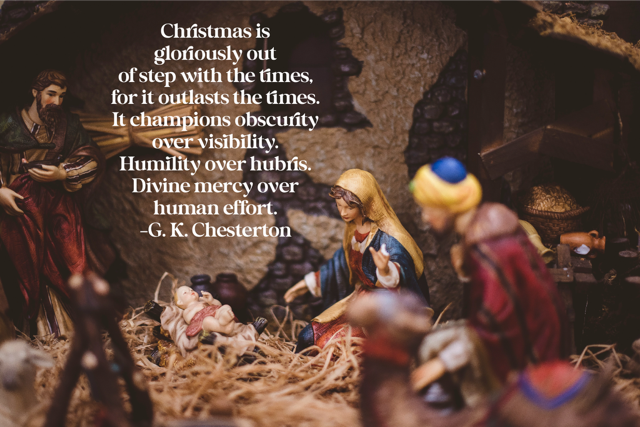
Christmas is gloriously out of step with the times, for it outlasts the times. It champions obscurity over visibility. Humility over hubris. Divine mercy over human effort.
–G. K. Chesterton

Laudable Linkage

Laudable Linkage

Here’s my last list of links for this month:

How Can the Command to “Honor Your Father” Apply to Good and Bad Fathers Alike? HT to Challies. “Think about it, the biblical command to honour your dad cannot be a licence for dads to be horrible knowing that their christian children have to suck it up and honour them. You are called to honour your dad. But the type of dad your dad is shapes the ways and the extent that you honour him.”

Till He Was Strong, HT to Challies. “Did you know that it is not only the weak who are in danger of a spiritual fall? There are those who think, ‘if only I were stronger, then I wouldn’t be so (fill in the blank).’ But this isn’t true. Over and over again in God’s word, it is the strong who find themselves in the worst predicaments. Uzziah is one example. He was famous. He was helped by God. ‘Till he was strong.’ Do you feel the warning?”

The Golden Rule for Hard Conversations, HT to Challies. “The question of when or how to have hard conversations is one that requires wisdom. As believers in Christ, we are commanded to get involved when we see a brother or sister wondering from the truth (Galatians 6:1-2; Matthew 18:15; Ephesians 4:25). The Proverbs remind us that ‘a word fitly spoken is like apples of gold in a setting of silver’ (25:11). ‘Better is open rebuke than hidden love. Faithful are the wounds of a friend; profuse are the kisses of an enemy’ (Proverbs 27:5-6). We recognize even in those instructions that we are responsible for making sure our rebuke is ‘a word fitly spoken,’ meaning appropriate. I’m sure we’ve all seen the harm in overzealousness in this area.”

A Thousand Wheels of Providence, HT to Challies. “In a situation like this, Jeremiah Burroughs points out that when we consider God’s work in Providence, we can only see things in pieces. We cannot see or understand many things that God does. Burroughs then compares it to the wheels in a watch.”

One of the Best Ways We Can Love Our Loved Ones. “In waiting rooms and living rooms, bedrooms and examination rooms. In the garden, the shower, the pickup line, the checkout line. Love prays.

Writing (and Reading!) as Hospitality, HT to the Story Warren. “As a long-time member of The Habit, a community of writers, I’ve heard many bits of advice from authors of all stripes, but one idea that has profoundly impacted me over the years is Jonathan Rogers’ assertion that writing is a form of hospitality.”

The essence of idolatry

The essence of idolatry is the entertainment of thoughts about God that are unworthy of Him. A. W. Tozer