Time Alone with God

Time Alone With God

One of my college roommates didn’t seem to be able to study alone. Often, when I came back to my dorm room after dinner, I’d find a group of girls studying (and talking and laughing) with my roommate. A roommate’s study group in my room meant I had to find another quiet place to study. I’m the type that can’t concentrate when there is noise and commotion in the room.

I knew students who couldn’t seem to go to lunch or the bookstore or much of anywhere without a companion.

Of course, the opposite is true of some. I liked to go many places (other than lunch) alone because it was more efficient. If you have three or four girls running errands together, it’s going to take three or four times as long to get done. But sometimes the fellowship is worth the extra time. We need a balance of time alone and time with others.

The same is true in the church. The last several years, I have seen an emphasis on community among believers, along with reminders that we’re not “lone rangers.”

While that emphasis is needed, I feel some take it too far. Some say we were never meant to read God’s Word alone, but in community. It’s true that for many years, people didn’t have their own copies of the Scriptures. All they had was what was shared and discussed when they gathered together. But that doesn’t mean no one should ever read the Bible alone now.

One writer said the preaching time at church is our main spiritual meal. I’m not sure what she based that conclusion on. It’s a vital part of our Christian life, but meeting God alone is vital as well. In fact, though I learn a lot and have been convicted during church and Bible studies, I think the main time I do serious business with God is home alone when I can process what I have heard.

Those who believe in the Lord Jesus Christ as Savior are part of God’s family. Yet we don’t relate to Him only as “one of the kids.”

God knew us individually before we were born. “Before I formed you in the womb I knew you, and before you were born I consecrated you” (Jeremiah 1:5; see also Psalm 139:13-16).

God knows us by name. “The sheep hear his voice, and he calls his own sheep by name and leads them out” (John 10:3).

God knows our thoughts. “O Lord, you have searched me and known me! You know when I sit down and when I rise up; you discern my thoughts from afar. You search out my path and my lying down and are acquainted with all my ways. Even before a word is on my tongue, behold, O Lord, you know it altogether” (Psalm 139:1-4).

God knows our ways. “I the Lord search the heart and test the mind, to give every man according to his ways, according to the fruit of his deeds” (Jeremiah 17:10).

Even the number of our hairs is known by Him. “Are not five sparrows sold for two pennies? And not one of them is forgotten before God. Why, even the hairs of your head are all numbered. Fear not; you are of more value than many sparrows” Luke 12:6-7).

We’ll each give account of ourselves personally to God. “For we must all appear before the judgment seat of Christ, so that each one may receive what is due for what he has done in the body, whether good or evil” (2 Corinthians 5:10).

The psalms in the Bible are songs which were sung by the children of Israel. Some of them have plural pronouns, but many have personal pronouns. That means even though the congregation is singing about the truths of the passage together, the passage was written by someone’s experience with the Lord alone. Those singing can take those truths into their own individual relationship with the Lord.

I sought the LORD, and he answered me and delivered me from all my fears (Psalm 34:4).

He drew me up from the pit of destruction, out of the miry bog, and set my feet upon a rock, making my steps secure. (Psalm 40:2).

My soul will be satisfied as with fat and rich food, and my mouth will praise you with joyful lips, when I remember you upon my bed, and meditate on you in the watches of the night; for you have been my help, and in the shadow of your wings I will sing for joy. My soul clings to you; your right hand upholds me (Psalm 63:5-8).

I rise before dawn and cry for help; I hope in your words. My eyes are awake before the watches of the night, that I may meditate on your promise (Psalm 119:147-148).

God spoke to individuals as well as groups. Many New Testament letters were written to individuals (Luke, Acts, Titus, Philemon, 1 and 2 Timothy) as well as churches.

Saints of old had some of their most meaningful encounters with God alone.

Moses met with God alone many times.

David “encouraged himself in the Lord” (1 Samuel 30:6) when the men of Israel were ready to stone him.

Joseph spent years as the only apparent believer in the one true God when he was a slave in Egypt. His witness spread to others. But he had to remind himself of God’s truth on his own.

Two turning-point meetings with God in Jacob’s life happened when he was alone.

Daniel had friends of the same faith, but he faced the lion’s den alone, received visions alone, and prayed alone.

Paul ministered with companions but sometimes was alone.

Jesus dealt with crowds of people yet sought His Father alone.

In Revelation 2:17, God says, “He who has an ear, let him hear what the Spirit says to the churches. To the one who conquers I will give some of the hidden manna, and I will give him a white stone, with a new name written on the stone that no one knows except the one who receives it.”

Spurgeon wrote in the October 12 reading from Morning and Evening, “There are times when solitude is better than society, and silence is wiser than speech. We should be better Christians if we were more alone, waiting upon God, and gathering through meditation on His Word spiritual strength for labour in His service. We ought to muse upon the things of God, because we thus get the real nutriment out of them. “

Elisabeth Elliot wrote in On Asking God Why, “Few people know what to do with solitude when it is forced upon them; even fewer arrange for solitude regularly. This is not to suggest that we should neglect meeting with other believers for prayer (Hebrews 10:25), but the foundation of our devotional life is our own private relationship with God. . . . Christians may (and ought to) pray anytime and anywhere, but we cannot well do without a special time and place to be alone with God.”

We’re to meet together frequently (Hebrews 10:25), “stir one another up to love and good works” (Hebrews 10:24), learn from the incredible gifts God gave to the church in pastors and teachers (Ephesians 4:11-13), sing worshipful, Scripture-based songs together (Colossians 3:16).

Time with other believers learning God’s Word is vital and wonderful. I learn much from the observations of others. But we only meet together once or twice a week. The Bible is our spiritual food, and we need to eat more than that.

Our time alone with God should feed into our time with others, and our time in the Word together should edify our inner souls and equip us in our daily walk.

We often tell unbelievers that Christianity is not a religion, but a personal relationship with God. Relationships are developed with communication and interaction. God loves and cares about us individually as well as a body of believers. We don’t have to pit time alone with God against time with Him as a group. We need both.

Psalm 59:10a

(After I wrote a portion of this post, I searched my blog and saw I had written on this topic a couple of times before. So I pulled excerpts from both of those posts into this one.)

(I often link up with some of these bloggers.)

Laudable Linkage

Laudable Linkage

This is a busy time of year, but here are a few good reads you might find thought-provoking when you have a moment:

Uncomfortable Christmases, HT to Challies. I saw this last year after Christmas and saved it for this year. “But for some of us, going to a holiday gathering (or hosting one) can be fraught with spiritual tension when few (or none) share our Christian faith. And given numerous trends in our society, the tension may only get worse in the days ahead.”

Eleven Hindrances to Answered Prayer. HT to Challies.

Thinking About Bruce Willis and Jesus, HT to Challies. “We often talk as Christians about the suddenness of death. We talk to unbelievers about how important it is to not put off a decision for Jesus until later, because what if death comes calling when you don’t expect it. I wonder though have often we talk about or think about for ourselves, the suddenness of debilitation or disablement; how fast we can go from a fully functioning person, to our arms not working, our legs not working, our kidneys not working or even our mind not working.”

Keep This in Mind When There Is “Too Much to Do,” HT to Challies. This is written to pastors but has good advice for all.

Proverbs 31 Is Not Just for Women. Marli has an interesting perspective on this chapter that I’d not heard before.

How to Read and Remember, HT to Challies. “Someone recently asked me how to stay focused and retain what they read. It’s an important question, especially for anyone devoted to a life of profitable reading and learning.”

The Almighty Bean: When God’s Good Gift Becomes an Idol. “Maybe you own the t-shirt that says, ‘I need a little bit of coffee and a whole lot of Jesus.’ In truth, we just need Jesus—coffee optional.”

Wrap Up Some Stuff this Christmas, HT to Challies. “Our consumer-driven mentality is out of control, and we feel it everyday as more and more waste piles up around us. Sometimes a good answer is to slow down, cut back, and remove the unused things in our lives. But sometimes it’s not. Because you and I were created for a world full of things.”

More Than a Feeling: Be Ruled by Peace. “I’ve often fallen into the trap of thinking that peace is primarily a feeling. So when circumstances outside my control arise—my kids’ health situations, strained relationships, or some other crisis—peace feels elusive . . . drowned out by anxiety, sadness, anger, or overwhelm. This is why it’s important to understand peace as a reality that does not change when we encounter trials and suffering. Peace originates in the unchanging person of Jesus, and it never runs dry, regardless of what we’re facing or what our emotions might tell us. “

I sometimes think of changing the name of my “Laudable Linkage” posts, and one reason is that it seems weird to include links back to my own posts under such a title. But there are two that I think might be helpful this time of year:

Christmas Grief, Christmas Hope, Christmas Joy. Both of my parents and my grandmother all died in December, in different years. It seems every year I know of someone with a fresh loss during the holiday season. Even “old” grief can flare this time of year.

You Don’t Have to Choose a Word for the Year. Some do this rather than New Year’s resolutions and find great benefit in it. If it’s helpful, great. But it’s not a must. “What’s more vital than a word for the year is daily seeking God in His Word.”

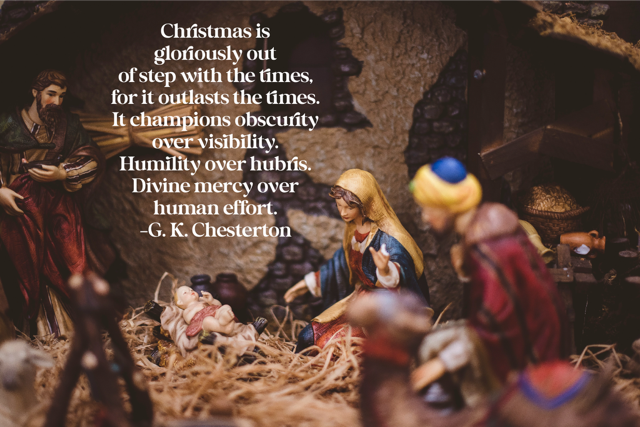
G. K. Chesterton Christmas quote

Christmas is gloriously out of step with the times, for it outlasts the times. It champions obscurity over visibility. Humility over hubris. Divine mercy over human effort.
–G. K. Chesterton

Laudable Linkage

Laudable Linkage

Here’s my last list of links for this month:

How Can the Command to “Honor Your Father” Apply to Good and Bad Fathers Alike? HT to Challies. “Think about it, the biblical command to honour your dad cannot be a licence for dads to be horrible knowing that their christian children have to suck it up and honour them. You are called to honour your dad. But the type of dad your dad is shapes the ways and the extent that you honour him.”

Till He Was Strong, HT to Challies. “Did you know that it is not only the weak who are in danger of a spiritual fall? There are those who think, ‘if only I were stronger, then I wouldn’t be so (fill in the blank).’ But this isn’t true. Over and over again in God’s word, it is the strong who find themselves in the worst predicaments. Uzziah is one example. He was famous. He was helped by God. ‘Till he was strong.’ Do you feel the warning?”

The Golden Rule for Hard Conversations, HT to Challies. “The question of when or how to have hard conversations is one that requires wisdom. As believers in Christ, we are commanded to get involved when we see a brother or sister wondering from the truth (Galatians 6:1-2; Matthew 18:15; Ephesians 4:25). The Proverbs remind us that ‘a word fitly spoken is like apples of gold in a setting of silver’ (25:11). ‘Better is open rebuke than hidden love. Faithful are the wounds of a friend; profuse are the kisses of an enemy’ (Proverbs 27:5-6). We recognize even in those instructions that we are responsible for making sure our rebuke is ‘a word fitly spoken,’ meaning appropriate. I’m sure we’ve all seen the harm in overzealousness in this area.”

A Thousand Wheels of Providence, HT to Challies. “In a situation like this, Jeremiah Burroughs points out that when we consider God’s work in Providence, we can only see things in pieces. We cannot see or understand many things that God does. Burroughs then compares it to the wheels in a watch.”

One of the Best Ways We Can Love Our Loved Ones. “In waiting rooms and living rooms, bedrooms and examination rooms. In the garden, the shower, the pickup line, the checkout line. Love prays.“

Writing (and Reading!) as Hospitality, HT to the Story Warren. “As a long-time member of The Habit, a community of writers, I’ve heard many bits of advice from authors of all stripes, but one idea that has profoundly impacted me over the years is Jonathan Rogers’ assertion that writing is a form of hospitality.”

The essence of idolatry

The essence of idolatry is the entertainment of thoughts about God that are unworthy of Him. A. W. Tozer

Laudable Linkage

Laudable Linkage

Here’s another list of good reads found this week:

A Mother’s Day Message for the Childless Woman. “You probably won’t be publicly honored this Mother’s Day. You likely won’t get a card. But you are a spiritual mother and you are making an eternal difference. So here’s what I’d share with you if I was given the chance to write a Mother’s Day message to you, my Christian sisters without children of your own.”

For the Ones We Were Told to Abort. “On behalf of parents everywhere who did not receive the perfectly healthy baby they prayed for but did welcome into their arms a bundle of joy given by a generous God, here’s my letter to the doctor who told me to choose differently.”

A Response to Dr. John McArthur’s Statement on Mental Health, HT to Challies. “To be clear, this article is not an attack on the person or character of Dr. MacArthur, a Christian brother for whom I have much respect and who has been a bulwark of solid reformed theology for many decades. Nevertheless, there are several things within the statement that, as a professional working in Christian psychiatry I would like to address.”

Fear of Missing Out, HT to Challies. “FOMO gets a bad rap because it is often caused by envy—the feeling that others are enjoying things you are missing. My FOMO is less about envy and more about growth and opportunity. I fear becoming comfortable and complacent and missing out on what God has in store outside my comfort zone.”

Study the Bible in 5, 15, or 30 Minutes, HT to Knowable Word. “God isn’t prescriptive about this in his Word (Deut. 6:5–6; Phil. 2:16; John 15:4). He wants us to prioritize meeting with him through Scripture, however it looks. He wants us to hunger for him, the Bread of Life, not a formula. He wants us to pursue our perfect Savior Jesus, not a perfect quiet time, as if there were such a thing (John 5:39–40).” I love this, but I’d disagree with a bit at the end concerning church being our main spiritual meal in God’s Word. I agree that it’s vital, but I wouldn’t say it’s more important than regular time alone with the Lord.

Am I Out of Asks? HT to Challies. “‘Oh, but God,’ I muttered, ‘Please hear this one.’ I have experienced the Lord not answering my prayer in the way I hoped, so fear unexpectedly gripped my heart as I prayed, pleaded, doubted, and as I wondered whether I had used up my asks of God. But this is not the way our Father works.”

The Beauty of Intergenerational Friendship, HT to Challies. “We’re naturally drawn to people with whom we have much in common. Moms with young ones cluster together, sharing parenting tips. The silver-haired saints seek out the similarly crowned. And single women seek companionship among the unattached. Commonality eases connection. But when we step outside our comfort zone, we often find beauty, wisdom, and a connection that can be forged only by the work of the Holy Spirit.”

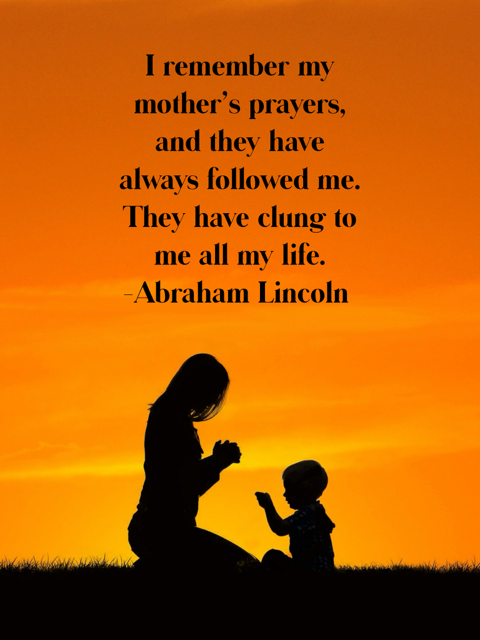
Lincoln quote about mother's prayers.

I remember my mother’s prayers, and they have always followed me.
They have clung to me all my life.
–Abraham Lincoln

Happy Mother’s Day tomorow to the Moms out there!
Never forget that your ministry as a mother is a vital one.

When People Don’t Understand

When People Don't Understand

Whenever Hannah’s story is taught from the Bible, one phrase stands out to me that I rarely hear comment on.

Hannah dearly longed for a child. In those days, men had more than one wife, and her husband’s other wife did have children. That would have been hard enough, but this rival wife “used to provoke her grievously to irritate her, because the Lord had closed her womb.” This went on for years.

It seems understandable that Hannah would be grieved. But her husband, Elkanah, said, “Hannah, why do you weep? And why do you not eat? And why is your heart sad? Am I not more to you than ten sons?”

This is the part of the story I don’t hear teaching about. Elkanah seems a little clueless here. At the worst he sounds arrogant: “Hey, you’ve got me. What else do you need?”

To give him the benefit of the doubt, he may have been thinking of the shame associated with childlessness in that day, or the concern that a childless widow would have no one to care for her after her husband died. Perhaps he means, “Don’t worry about those things, Hannah. My status and provision are enough.”

Even with the best of intentions, Elkanah didn’t seem to understand the longing of his wife’s heart, not just for status or elder care, but for her own child to love. Her yearning for a child did not lessen her love for her husband.

So what did Hannah do? She went to the temple to pray.

Normally this would be a good thing to do. We’re often told these days to draw close to our spiritual community. But sometimes our community rubs salt in the wound instead of helping.

This story occurred during the time of the judges, when “everyone did what was right in his own eyes,” leading to some of the most bizarre behavior recorded in the Bible. This was a low point in Israel’s history. Apparently, the priest, Eli, had seen so little fervent prayer that he thought Hannah was drunk and rebuked her.

So what’s a woman to do when her loved ones and her spiritual community don’t understand her, and, in fact, add to her burden?

Hannah poured out her heart to the Lord. She “was deeply distressed and prayed to the Lord and wept bitterly.” She could safely share the depths of her feelings and cares with Him. She knew He was the only one who could meet her need.

She answered kindly. When Eli accused her of being drunk, she didn’t lash out at him. She just explained a little about her heart’s burden. There’s no record that she responded to her rival in kind or fussed at Elkanah.

She did not become bitter. She could have harbored negative feelings against everyone involved, but there’s no record that she did.

She had faith. After she prayed and asked the Lord for a son, she promised to give her child back to God to serve Him. And then “her face was no longer sad.” She left her burdens at His feet. When God did answer her prayers with a son, she kept her vow and gave Him the glory and praise.

In our day, we have more of the Scripture than Hannah did. So we have an extra layer of help. Hebrews 2:17-18 says, “Therefore he [Jesus] had to be made like his brothers in every respect, so that he might become a merciful and faithful high priest in the service of God, to make propitiation for the sins of the people. For because he himself has suffered when tempted, he is able to help those who are being tempted.” The writer of Hebrews goes on to say in 4:15-16: “For we do not have a high priest who is unable to sympathize with our weaknesses, but one who in every respect has been tempted as we are, yet without sin. Let us then with confidence draw near to the throne of grace, that we may receive mercy and find grace to help in time of need.”

Jesus is more than our example: He is our Lord and Savior. But He has also suffered the same things we do and shown us how to cope with them.

I don’t know if anyone in history was more misunderstood than Jesus. His family, his disciples, and his community all questioned His teaching and His mission.

What did He do?

He kept sharing truth. He knew some would never understand. He knew His disciples wouldn’t understand much until later. He kept sharing truth anyway, trusting that one day it would make sense to them.

He prayed frequently to the One who did understand and could help others understand, His Father.

He kept loving and working with people even when they misunderstood.

He forgave those who wronged Him. “When he was reviled, he did not revile in return; when he suffered, he did not threaten, but continued entrusting himself to him who judges justly” (1 Peter 2:23).

When others misunderstand our hurts and concerns, it’s easy to pull away and wrap a protective cloak around ourselves.

Though He often does give us human helpers to counsel, encourage, uplift, and empathize, sometimes they fail us. We need not hold it against them: they’re only human. We fail others sometimes, so we shouldn’t be surprised when others fail us. And sometimes He takes them away so that we may draw closer to Him.

We can do what Hannah did: pour out our hearts to the only One who can truly understand our heart’s longings and our deepest needs. As the old hymn says, “No One Understand Like Jesus.” He may not answer our prayer exactly like we want. But we can trust He knows best.

Because He has been in our place, we know He empathizes with us. He understands thoroughly; He cares intimately; He alone has the power and the wisdom and the grace to meet our needs in the best possible time and way.

1 Kings 8:39

(Parts of this post have been revised from the archives.)

(I often link up with some of these bloggers.)

Laudable Linkage

Laudable Linkage

These are some of the posts that stood out to me this week:

Israel at War: Prayers, Hope, and Heartache. Some good prayer points during this time of upheaval.

A Well-Stocked Pantry, HT to Challies. “It’s not a question of if storms will come—storms will come for us, and we need to be ready with a soul packed tightly with God’s Word so we can draw on it in a time of need.”

Add a Little Extra Beauty. “God loves to add a little extra beauty. God could have made every time of day the same, but he gives sunrises—he adds a little extra beauty.”

The Secret to Abundant Life: Expressing Self-Love through Service. I’m not fond of the title, but the article is good.

How to Be a Growing Christian. This was a good message by Adrian Rogers I heard part of while making a late breakfast one morning. I was especially struck by the part about the middle of the sermon discussing the apostle John–what he was as an early disciple compared to what he was later as a gospel and epistle writer. The link goes to the overview, outline, and then transcript of the message, but if you’d rather listen than read, you can do that here.

The Transforming Power of Hopeful Love in Marriage, HT to Challies. Thoughts on what 1 Corinthians 13 means when it says love “hopes all things.” Good for any relationships, not just marriage.

Biblical Hope When It’s Time to Consider Residential Care. “You’ve got a decision to make about someone you love. You want to serve sacrificially. You want to do the ‘right thing.’ You want to honor God. As you move forward, let God’s Word illuminate your path, one tender and needy step at a time.”

We tend to use prayer as a last resort,
but God wants it to be our first line of defense.
We pray when there’s nothing else we can do,
but God wants us to pray
before we do anything at all.
—Oswald Chambers

Laudable Linkage

Laudable Linkage

I found a lot of good reading this week:

A Comforting Resource for People Who Have Lost Parents. My friend, Lois, lost both parents within five weeks of each other a few year ago. Some of her blog posts since then have been about processing their loss and working through grief. She found a lot of resources for losing a child or a spouse, but not much on losing parents. That seemed to be treated as just a normal part of life. Though the death of one’s parents is inevitable, grief still runs deep. Lois has just pulled these posts together in one resource page. She tells about it and links to the Help for Parent Loss page there.

How Can I Cultivate a Listening Life in a Noisy World? “Do we demonstrate through our choices that we truly believe that we NEED God’s Word? Are we still ‘the people of the Book?'”

Can a Christian Have Mental Illness? HT to Challies. “Some Christians believe that Christians cannot have mental illness. If a professing Christian is depressed, anxious, or bipolar, they think it’s because they are not a real Christian, or that there is some terrible sin they haven’t repented of, or that they need to repent of the depression or whatever the problem is. Nearly half (48 percent) of evangelicals believe that serious mental illness can be overcome with prayer and Bible study alone. The result of this condemnation of mental illness as sin is that many Christians do not admit they have a mental illness, they don’t talk about it, and they don’t reach out for help.”

We Need Every Word, HT to Challies. “I want to feast on the Bible passages I love, the ones that make me feel some note of pleasure or comfort. I want the reminders that I’m loved, the encouragements to hold fast, and the songs of praise that remind me of God’s faithfulness. I don’t always want the lists or the history or the stories that don’t seem to affect me.”

Why We Are Tempted not to Pray, HT to Challies. “Prayer should stupefy us. ‘You mean, this all-powerful God who keeps galaxies spinning is interested in you telling him about your day and might alter the course of the entire cosmos because you asked him if you could have a parking space?’”

Being Involved in Church as a Teen, HT to Challies. “But being born into a church as a baby, and then growing up through Sunday school and youth group, can often make it hard to be taken seriously. Even older Christians with the best intentions can miss the mark. It can feel a bit awkward when they ask you the same questions every time they see you in church. It takes time and effort from both sides to help and encourage one another, and ultimately, have more meaningful relationships.”

Is the Lord’s Day the Christian Sabbath? HT to Challies. “At the outset, I need to say that this issue is one that I think Christians should not divide over. The view I present below is not the one I grew up with, but I have no particular ambition to convert people to my view — except that, with regard to those who have the duty to teach God’s word, it is important to do so properly, ‘rightly handling the word of truth’, preaching the full counsel of God with all His authority, but never giving human ideas that same authority.”

The Ritual of Rearranging Books, HT to Linda. “Taking all the books down was a chance to organize and cull, but primarily, it was an experience in simply remembering what was there, how it got there, and why. You can look at shelved books until the cows come home, but it’s not the same as actually taking them off the shelves.”

Seeing the Light on Religious Fiction, HT to Linda. “As I complete my 40th year working with books, I’ve changed my mind about an entire publishing genre that I once held at arm’s length at best, and treated with something akin to critical dismissal at worst. I feel like the proverbial old dog who has suddenly learned a new trick. The genre? Religious fiction.” I especially loved this one!

Routine leads to devotion, especially in Bible study.

The quote here is from “Just Not Feeling It”: How Routine Awakens Devotion.

Laudable Linkage

Links to good reading

I have a question for those of you who receive my blog posts via email. Have you had any problems receiving them lately? Of course, if you have, you might not be seeing this. 🙂 I ask because a long-time reader just told me this week she hasn’t received my blog posts via email for some time now. I am trying to discern whether this is a widespread problem. I see them both via email and Feedly so I can make sure they’re coming through, and I have not had any problem with either venue. WordPress handles the sending, so I can let them know about it. But it helps to have as much information as I can when I report a problem to them. How long has it been since the emails stopped coming? If you try to subscribe, do you get any error messages? If so, what do they say? Thanks so much for your help.

Now on to this week’s links. I hope you see something that sparks your interest.

Come, HT to Challies. “He came to the dead; the bleeding; the hopeless. To the ones on the side of life’s roads, passed over. To the grieving and the outcast. To the ones desperate to be seen; those hungry to belong.”

Do Not Grieve the Holy Spirit. “What does it mean to grieve the Holy Spirit? My initial reaction to the word grieve in reference to the Holy Spirit was a negative one: Surely the Spirit of God does not actually grieve, does he? Perhaps this is a poor translation. Isn’t sorrow a too-human reaction to ascribe to the holy God? Doesn’t it diminish the Spirit to suggest that my sin can make him feel genuine sorrow?”

How Were the Books of the Bible “Chosen,” HT to Challies. “The earliest Christians did not view themselves as choosing books, nor did they view themselves as having the right/power to do such a thing. Instead, they viewed themselves as receiving the books that had been handed down to them by the apostles.”

A Light to My Path, HT to Challies. “When the sun streams into my kitchen window, it cheers my soul. Everything literally seems brighter. Its brilliance however, illuminates more than just the room. Particles of dust flicker through its rays, grandchildren’s sticky handprints on the window pane bother me, and tiny bits of red dirt speckle the floor. When the light shines into my room, I see things otherwise hidden.”

Are You Satisfied with Your Prayer Life or Is Prayer Simply a Means to an End? “In the Pie Chart that is your life, how big is the slice devoted to prayer? “I don’t ask to induce guilt or to point the finger of condemnation. It’s actually a question I’m asking myself, and it’s been prompted by a statistic I just bumped into once again.”

When You Feel Powerless to Influence Your Children. “More important, they revealed the lie I had believed—that my children were safe as long as I was nearby. And that I had the ultimate power to protect them from harm, bad influences, and spiritual apostasy. Without intending to, I had usurped God’s role, at least in my mind, as their guardian and protector.”

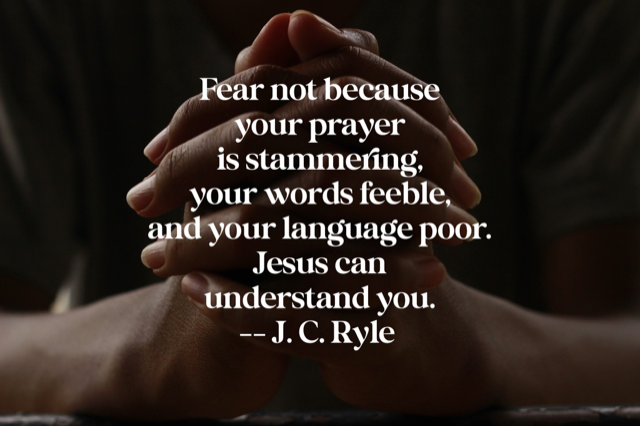
Jesus can understand your prayer despite feebleness or poor language.

Laudable Linkage

Happy first Saturday of January! As might be expected, a lot of posts I found this week dealt with getting ready for a new year.

His Feet, HT to Challies. “I was fourteen and small for my age, a reserved shy shadow of the man I might one day grow into. Others struck me for an unknown reason, some imagined offence I had committed. Verbal assault soon became physical, yet it wasn’t the impact of fist on face that hurt most. I felt alone. I felt small. I felt undone. But then his feet were there.”

Say It, HT to Challies. A short account of Charles Spurgeon’s conversion, which is always delightful to read, but with a few good points added.

Grant Me One Muslim Friend, HT to Challies. “The most strategic thing we could do to reach the Muslim world is for every Muslim to simply have a believing friend.”

Three Faith-Focused Strategies to Welcome the New Year. “Some of us deliberate over annual goals or resolutions while others invite God to give us a word for the New Year. As we invest time in these pursuits, let’s walk through the following four steps as we consider how He led us through last year and as we seek His guidance in the New Year.

How Can We Have Peace and Confidence in the New Year? “With all the turmoil and instability over the last few years, most of us want more peace, more joy, and more confidence in the future. Are we at the mercy of the government or the economy or the culture around us if we’re to have those things? Or is it possible that the right goals and habits can play a big part? If so, what kind of goals and habits?”

5 Tips to Reinforce Your Bible Study and Prayer Routine, HT to Knowable Word. Although aimed at church leaders, these are good for anyone trying to develop a “sustainable habit for personal Bible study and prayer.”

7 Reasons Winter Reminds Us to Hold on to Hope, HT to Challies. “Many people suffer from seasonal depression or feel down in the winter. The trees seem lifeless, we spend a lot more time inside, and it gets darker earlier and for longer stretches of the day. It can also mean we spend more time pondering upon the difficult seasons in our own lives.”

Assign It a Day and Time. A great time management principle!

8 Tips to Have a More Productive Year, HT to Lisa. “I am all about To Do lists and planners! However, that doesn’t always make me as productive I could be. There has to be some follow-through to be productive. I am going to share 8 tips on how to have a more productive year in whatever area you are working.”

Gladys Hunt on Little Golden Books, HT to the Story Warren. I loved the little Golden books as a child and read many of them to my own children. It was interesting to read the story behind them.

God Does Not Forget Prayers or Promises

400 years of silence.

That’s what Israel experienced after the last words of the Old Testament in Malachi. They had the law of Moses, their history, the poetry and wisdom of the psalms and Solomon’s writings, and the prophetical books.

But they had heard no new word from the Lord in 400 years.

So we can understand Zechariah’s being startled when suddenly an angel appeared before him.

After so long a time of silence, the first message God sends through an angel is, “Do not be afraid, Zechariah, for your prayer has been heard.”

Though I’ve read this passage many times, I was focused on the larger context of how it fit in the birth story of Jesus. I must have glossed over the part about answered prayer. Which prayer? Well, from the angel’s continued message, the prayer about a child.

“Your wife Elizabeth will bear you a son, and you shall call his name John.”

We can forgive Zechariah for being stunned. He replied, “How shall I know this? For I am an old man, and my wife is advanced in years.”

Zechariah had probably long ago given up on those prayers and counted God’s answer as a resounding “No.” And now—at this time, at their ages, they were going to have a baby?

As He so often does, God didn’t answer Zechariah’s “How?” He answered with “Who?”

“I am Gabriel. I stand in the presence of God, and I was sent to speak to you and to bring you this good news.”

God had sent this good news.

And the news wasn’t just good for Zechariah and Elizabeth. This baby would later become known as John the Baptist.

And you will have joy and gladness, and many will rejoice at his birth, for he will be great before the Lord. And he must not drink wine or strong drink, and he will be filled with the Holy Spirit, even from his mother’s womb. And he will turn many of the children of Israel to the Lord their God, and he will go before him in the spirit and power of Elijah, to turn the hearts of the fathers to the children, and the disobedient to the wisdom of the just, to make ready for the Lord a people prepared (Luke 1:14-17).

Gabriel told Zechariah that because the latter did not believe, he would be mute until the promise was fulfilled.

Hannah Anderson suggests that “perhaps God’s reproof was not a punishment for Zechariah so much as an invitation to experience his strength in a way that only happened in weakness. Perhaps God’s ‘now listen’ was not silencing Zechariah so much as quieting him, quieting him long enough to restore his hope” (Heaven and Nature Sing, p. 33).

When Elizabeth did give birth, and neighbors clamored to know the baby’s name, she said “John.” The people were astonished because no one else in their family was known by this name. They appealed to Zechariah, who confirmed by writing, “His name is John,” as the angel had instructed. John, meaning “God is gracious.”

“And immediately [Zechariah’s] mouth was opened and his tongue loosed, and he spoke, blessing God” Luke 1:64).

He acknowledged this child would not just bring joy to his and Elizabeth’s life, but he was a part in God’s grand plan of salvation, put in place before the beginning of the world.

And you, child, will be called the prophet of the Most High;
    for you will go before the Lord to prepare his ways,
to give knowledge of salvation to his people
    in the forgiveness of their sins,
because of the tender mercy of our God,
    whereby the sunrise shall visit us from on high
to give light to those who sit in darkness and in the shadow of death,
    to guide our feet into the way of peace (Luke 1:76-79).

Though God sometimes seems silent, He hears and He cares. And though He answers the immediate concern, He has the larger, longer picture in mind. Besides praying for a child, Zechariah had probably also been praying for the coming of the Messiah. Now their child would have a part in God’s grand plan of redemption. It was John the Baptist who said, “Behold, the Lamb of God, who takes away the sin of the world!” (John 1:29) and prepared the way of the Lord.

God had not forgotten His promises then, and He still hasn’t now. He might say “No” or “Not now” when those answers are best. Sometimes the answer to our prayer request is connected to God’s overarching purpose for others as well. When the time is right, He will answer.

(Top photo courtesy of http://www.LumoProject.com.)

(I often link up with some of these bloggers.)