Review: Be Worshipful

Be Worshipful by Wiersbe on Psalms

Psalms is the longest book of the Bible at 150 chapters, so Warren Wiersbe divided his commentaries on the Psalms into two books. The first is Be Worshipful (Psalms 1-89): Glorifying God for Who He Is.

“The book of Psalms has been and still is the irreplaceable devotional guide, prayer book, and hymnal of the people of God,” (p. 15). About one-third of the psalms don’t list an author, but King David wrote the majority of the others. The sons of Korah, Asaph, Solomon, Ethan, and Moses wrote others. All, however, wrote under the inspiration of the Holy Spirit.

Except for Moses’ psalm, the rest span the time of King David through the divided kingdom and Israel’s exile into Babylon.

“Some of the psalms are laments to the Lord, written by people in dire circumstances. There are also messianic psalms that point forward to the Lord Jesus Christ. There are also psalms of praise and thanksgiving, royal psalms, wisdom psalms, psalms of affirmation and trust, penitential psalms, and even imprecatory psalms calling down God’s wrath on the enemy” (p. 16).

The psalms’ poetry is not rhyming and rhythmic like English poetry. Hebrew poetry expresses itself in parallel lines. The second line of a pair might say the same as the first differently, or contrast with the first, or expand on the first. But the psalms uses similar literary devices as our poetry: simile, metaphor, imagery, symbolism, synecdoche (referring to one part to represent the whole, like keeping hands clean representing keeping one’s life clean), hyperbole, apostrophe (addressing a thing as if it were a person, like Wisdom), anthropomorphism, and others.

“There are over four hundred quotations or allusions to the psalms in the New Testament” (p. 16).

The psalms cover a lot of different subjects. “But primarily, the Psalms are about God and His relationship to His creation, the nations of the world, Israel, and His believing people” (p. 16).

“The psalms teach us to seek God with a whole heart, to tell Him the truth and tell Him everything, and to worship Him because of who He is, not just because of what He gives. They show us how to accept trials and turn them into triumphs, and when we’ve failed, they show us how to repent and receive God’s gracious forgiveness. The God described in the book of Psalms is both transcendent and immanent, far above us and yet personally with us in our pilgrim journey. He is ‘God Most High’ and ‘Immanuel—God with us'” (p. 18).

Wiersbe writes a few pages of comments on each psalm, explaining, drawing out truth, sharing insights. He includes discussion questions at the end of the book.

Many of the comments I have highlighted refer to specific contexts of psalms that would be impossible to explain without sharing all of Wiersbe’s comments on that particular section. But here are a few general comments I found helpful:

Those who have problems with the military aspects of some of David’s psalms should remember that David went to war only when the enemy attacked Israel. He did not invade other nations just to gain territory, and he was fighting the Lord’s battles (1 Sam. 17:47; 25: 28; 2 Chron. 20:15). The covenant God made with David (2 Sam. 7:11) assured him of victory over his enemies (p. 85).

Though David occasionally fell, as we all do, the habitual bent of his life was toward the Lord and His Word (p. 106).

The secret of David’s public confidence was his private obedience: He took time to fellowship with the Lord and get directions from Him. David knew that the most important part of his life was the part that only God could see, and this was one priority he would not negotiate” (p. 108).

David tried to “cover” his sins, but his schemes didn’t work. They never do (Prov. 28: 13), but when God covers the sins we confess to Him, they are hidden from sight and never seen again. (See Isa. 38:17; 43:25; 44:22; Jer. 31:34; 1 John 1:7–9.) (p. 121).

Chastening isn’t a judge punishing a criminal; it’s a loving Father dealing with His disobedient children to bring them willingly to the place of surrender. According to Hebrews 12:1–13, God’s chastening is proof that He loves us and that we are genuinely His children (p. 122).

[Re David praying against enemies} This was not a personal vendetta on David’s part, but a concern for the future of the nation of Israel and the dynasty of David. As ruler of the land, David wielded the sword of justice (Rom. 13:1–4), and nations today punish treason with death (p. 152).

The greatest danger a nation faces is not the invading enemy on the outside but the eroding enemy on the inside—a people gradually turning away from the faith of their fathers. Each generation must pass along to the next generation who the Lord is, what He has done, and what they must do in response to His goodness and faithfulness (71:18; 78:4, 6; 79:13; 109:13; 145:4; 2 Tim. 2:2) (p. 178).

It is our regular worship that prepares us for the crisis experiences of life (p. 207).

The psalms are not just emotional: they are full of truth and doctrine. Yet I love that the psalms show the writers’ hearts as they wrestle with problems, unanswered prayer, confusion, God’s seeming distance. Most of the psalms of lament end with the psalmist reminding himself the truth he knows about God and restoring his hope and confidence. And who can beat the praise psalms for lifting one’s heart in thanksgiving and worship.

The Bible tells us to study God’s Word, not just read it casually. Yet it’s possible to go too far the other way and examine a passage’s pieces, losing the main message or emphasis. I had to wrestle with this since I was using both the ESV Study Bible notes as well as Wiersbe’s commentary. Both were beneficial, but sometimes I left a passage with my head swimming. It helped to go back and read the passage again as a unit and as poetry after reading the comments and notes.

I appreciated the help Wiersbe’s commentary was to understanding and gaining more from the psalms.

Be Joyful

Paul’s theme of joy in Philippians is remarkable when you consider that he wrote the letter from prison.

He wrote believers in the city of Philippi to thank them for a gift, let them know how he was, and encourage them in their walk with God.

Paul didn’t have much to correct among the Philippians. He mentioned dissension among a couple of members and encouraged unity. Otherwise, the Philippian church seemed a healthy one.

He let them know that “what has happened to me has really served to advance the gospel” (1:12). In addition, other believers increased in boldness and confidence. You’d think the opposite would happen, that Paul’s imprisonment would make them afraid lest the same thing happen to them. But perhaps seeing that Paul flourished and that God used even imprisonment to accomplish His will helped them go forward.

Most of us would chafe in imprisonment, eager to get out and back to business. But Paul knew that “to me, to live is Christ and to die is gain” (1: 21). He says later that he had learned contentment in good or bad circumstances, knowing that God would give him strength to face anything (4:10-13).

Paul encourages the Philippians to “let your manner of life be worthy of the gospel of Christ” (1:27), pointing to the example of Christ’s humility and selflessness (2:1-11).

Warren Wiersbe’s commentary, Be Joyful (Philippians): Even When Things Go Wrong, You Can Have Joy, helped as a companion to Philippians.

In some of Wiersbe’s other commentaries, he combines several shorter books together. Philippians has only four chapters, so I expected to find its commentary bundled with others. However, Wiersbe gave Philippians its own book.

Because Wiersbe wrote so much about this book of the Bible, and my ESV Study Bible had copious notes as well, I decided to slow down through this book and follow Wiersbe’s chapter divisions, which each covered only a paragraph or two of Philippians. It’s easy to zoom through this short book of the Bible and not retain much. So I was glad for this slower focus on it.

These are some of the quotes that stood out to me:

What was the secret of this joy? The secret is found in another word that is often repeated in Philippians: It is the word mind. Paul uses mind ten times, and also uses the word think five times. Add the time he uses remember and you have a total of sixteen references to the mind. In other words, the secret of Christian joy is found in the way the believer thinks—his attitudes. After all, outlook determines outcome (p. 18).

When you have the single mind, you look on your circumstances as God-given opportunities for the furtherance of the gospel, and you rejoice at what God is going to do instead of complaining about what God did not do (p. 42).

We Christians are the citizens of heaven, and while we are on earth we ought to behave like heaven’s citizens (p. 53).

It takes more than an example on the outside; it takes power on the inside (p. 73).

The Christian life is not a series of ups and downs. It is rather a process of “ins and outs.” God works in, and we work out (p. 73).

The verb “work out” carries the meaning of “work to full completion,” such as working out a problem in mathematics (p. 74).

Like most religious people today, Paul had enough morality to keep him out of trouble, but not enough righteousness to get him into heaven. It was not bad things that kept Paul away from Jesus—it was good things. He had to lose his religion to find salvation (p. 96).

Once again, I am thankful for Dr. Wiersbe’s insights.

Be Patient: Waiting on God in Difficult Times

Job is not an easy book to read. The first two chapters and the last one aren’t bad, but all that bickering between Job and his friends in the middle is hard to follow. But taking it a section at a time with my ESV Study Bible and Be Patient (Job): Waiting on God In Difficult Times by Warren W. Wiersbe helped.

Job’s suffering was extreme. He lost all of his wealth and his ten children in one day. Then he lost his health. The person closest to him, his wife, was not much support (but then, she was grieving, too). Job’s friends came and sat with him in his grief for a whole week. They were better friends to him then than when they opened their mouths. They all wondered the same thing: Job, what in the world did you do to bring such suffering on yourself? God blesses the righteous and punishes the wicked, right? So you must have really done a number to warrant all this.

Job tried to point out, several times, that the wicked aren’t always punished–at least not in the time or way we would think. Therefore the opposite is true: people who do right sometimes suffer for no apparent reason.

God had said in the beginning that Job was an upright man. He didn’t allow Satan to torment Job for punishment. Rather, Satan had accused that Job only followed God because God had blessed him. Basically, he said God bought Job’s allegiance by all He had blessed him with. Take away all that, and “he will curse you to your face.”

Job never cursed God. He maintained his integrity and faith. Yet at times, knowing he was in the right caused him to question whether God was doing right in His treatment of His faithful servant.

In the end, God set straight the three friends plus Job.

Here are some of the insights Dr. Wiersbe offered:

In times of severe testing, our first question must not be, “How can I get out of this?” but “What can I get out of this?” (p. 24).

The problem with arguing from observation is that our observations are severely limited. Furthermore, we can’t see the human heart as God can and determine who is righteous in His sight. Some sinners suffer judgment almost immediately, while others spend their lives in prosperity and die in peace (Eccl. 8: 10–14) (p 37).

Nothing that is given to Christ in faith and love is ever wasted. The fragrance of Mary’s ointment faded from the scene centuries ago, but the significance of her worship has blessed Christians in every age and continues to do so. Job was bankrupt and sick, and all he could give to the Lord was his suffering by faith; but that is just what God wanted in order to silence the Devil (p. 52).

Beware of asking God to tell others what they need to know, unless you are willing for Him to show you what you need to know (p. 60).

Now Job had to put his hand over his mouth lest he say something he shouldn’t say (Prov. 30: 32; Rom. 3: 19). Until we are silenced before God, He can’t do for us what needs to be done (p. 186).

I especially appreciated what Wiersbe said at the conclusion of Job’s trials, after God had restored him: “Job’s greatest blessing was not the regaining of his health and wealth or the rebuilding of his family and circle of friends. His greatest blessing was knowing God better and understanding His working in a deeper way” (p. 192).

If you’d like even more resources on Job, I can recommend Beyond Suffering: Discovering the Message of Job by Layton Talbert and The Misery of Job and the Mercy of God, a poetic rendering of Job by John Piper (linked to my reviews of them). Also, I wrestled a few years ago with Where Is God’s Compassion and Mercy in Job?

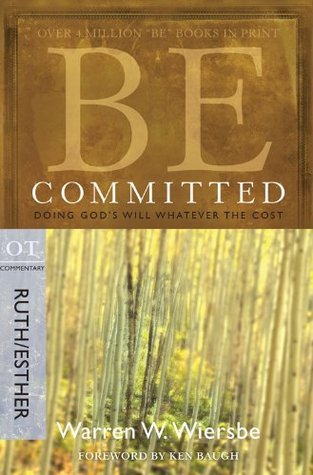
Be Committed: Commentary on Ruth and Esther

The books of Ruth and Esther are the only ones in the Bible named for women. The two women lived in different times and came from very different backgrounds. So why did Warren Wiersbe group them together in his commentary, Be Committed (Ruth and Esther): Doing God’s Will Whatever the Cost? He says:

Why do we bring these two women together in this study? Because, in spite of their different backgrounds and experiences, both Ruth and Esther were committed to do the will of God. Ruth’s reply to Naomi (Ruth 1: 16–17) is one of the great confessions of faith found in Scripture, and Esther’s reply to Mordecai (Est. 4: 16) reveals a woman willing to lay down her life to save her people. Ruth and Esther both summon Christians today to be committed to Jesus Christ and to do His will at any cost (pp. 15-16).

And then Dr. Wiersbe says something he has repeated in many of his commentaries: “Faith is not believing in spite of evidence but obeying in spite of consequence” (p. 16).

Ruth lived during the time of the judges, before Israel had kings. She was from Moab, people who were enemies to Israel. But her in-laws had come to Moab from Israel during a time of famine. Ruth had married one of their sons, but over time her father-in-law, husband, and brother-in-law all died. Ruth had come to believe in Naomi and Israel’s God, and she traveled with her mother-in-law, a bitter and broken, Naomi back to Israel.

The only recourse the women had for food was for Ruth to glean in someone else’s fields. The law at that time told farmers not to harvest every single piece of produce they grew, but to leave some for the poor. Ruth “happened” upon the fields of kind Boaz (one of my favorite OT people), who told his workers to leave some extra on purpose for her.

Near relations had the right to redeem the land of their deceased relatives, but part of the deal was marrying the widow. The nearest relation to Ruth’s husband was not willing to do this. But Boaz was the next nearest relation, and he was willing. Thus Ruth and Naomi were taken care of, and Naomi’s joy returned with the birth of her grandson–who became the grandfather of King David.

There’s much that could be said about this wonderful book. One point Wiersbe makes is this:

It is encouraging to see the changes that have taken place in Naomi because of what Ruth did. God used Ruth to turn Naomi’s bitterness into gratitude, her unbelief into faith, and her despair into hope. One person trusting the Lord and obeying His will can change a situation from defeat to victory (p. 43).

Esther lived hundreds of years after Ruth. Israel went through several kings, most of whom did not follow God. After much warning and preaching, with little response, God sent His people into exile in Babylon, which was later conquered by Persia. After 70 years, many Israelites were permitted to go back to their land. But Esther and her cousin, Mordecai, were among many Jews still in Persia.

Mordecai raised Esther because her parents had died. The pagan king, Ahasuerus, dismissed his wife for reasons found in Esther 1. His advisors encouraged him to gather the virgins of the land and . . try them out, and then choose from among them a new bride. Esther was one of the young women, and she happened to be chosen as the new queen.

Neither Esther nor Mordecai were known to be Jews at first. Wiersbe talks about the possibility that this may have meant they were not living according to God’s laws, because even the dietary laws would have separated them from other people in the land. We don’t know if this means they weren’t being faithful or if there were other reasons their nationality was not known. There also would have been problems with Esther, as a Jew, marrying a Gentile, and of course with her sleeping with the king before they were married (though she may not have had a choice about that).

At any rate, one person knew Mordecai was a Jew: Haman. Haman was a high official and hated that Mordecai would not bow to him like everyone else did. He was so angry, he plotted to kill not only Mordecai, but all the Jews. When he proposed this to the king, oddly, the king agreed without much discussion.

One interesting thing about the book of Esther is that God’s name is not mentioned once. But His fingerprints are all over the book. The suspense and irony of how God delivered the Jews from destruction is one of the most exciting stories in the Bible.

The highlight of the book is when Esther goes before the king to petition his protection for her people. According to the law of the land, if she came uninvited to see him, and he refused her, she could have been killed. But after fasting and praying for three days and asking others to do the same, she determined to go. Her “if I perish, I perish” (Esther 4:16) has rung through the centuries as an example of doing what’s right and what’s best for others despite what happens to us.

Both of these books show God’s guiding hand in the lives of His people, individually and as a nation. One encouragement to me was that God did this despite and even through a pagan king and an enemy to His people.

Finally, there is a powerful personal message in the book of Esther; for Esther, like Ruth, is a beautiful example of a woman committed to God. Ruth’s “Whither thou goest, I will go” (Ruth 1: 16 KJV) is paralleled by Esther’s “And if I perish, I perish” (Est. 4: 16 KJV). Both women yielded themselves to the Lord and were used by God to accomplish great things. Ruth became a part of God’s wonderful plan for Israel to bring the Savior into the world, and Esther helped save the nation of Israel so that the Savior could be born (p. 79).

We must never think that the days of great opportunities are all past. Today, God gives to His people many exciting opportunities to “make up the hedge, and stand in the gap” (Ezek. 22: 30 KJV), if only we will commit ourselves to Him. Not only in your church, but also in your home, your neighborhood, your place of employment, your school, even your sickroom, God can use you to influence others and accomplish His purposes, if only you are fully committed to Him (p. 80).

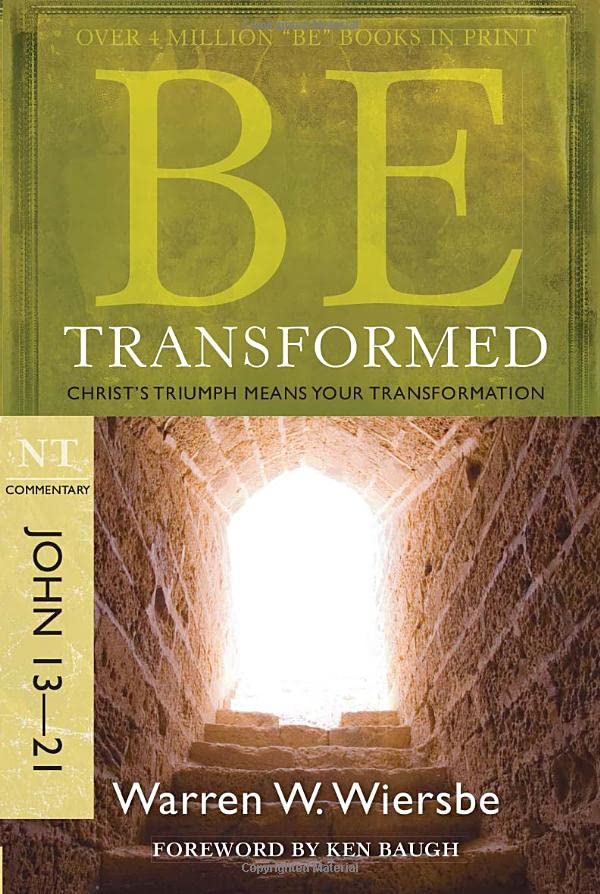
Be Transformed

Warren Wiersbe divided his commentary on the gospel of John into two books. The first was Be Alive (John 1-12): Get to Know the Living Savior. The second is Be Transformed (John 13-21): Christ’s Triumph Means Your Transformation. The first twelve chapters of John “focus on our Lord’s public ministry, especially the signs (miracles) that Jesus performed and the messages that grew from them” (Location 150, Kindle version). Chapters 13-21 share more of the private ministry of Jesus with His closest disciples, “preparing them for their future service when the Holy Spirit would come and empower them” (Location 150). Chapter 13 opens with the Passover meal the night before Jesus was betrayed where He washes the disciples’ feet and institutes what we call the Lord’s supper (communion). The rest of John details Jesus private discourse with the disciples that night, His betrayal, arrest, crucifixion, and resurrection.

John shares his purpose statement in John 20:31: “these are written so that you may believe that Jesus is the Christ, the Son of God, and that by believing you may have life in his name.” “The basic theme of John’s gospel is that Jesus Christ of Nazareth is the very Son of God, and all who believe in Him receive eternal life (20: 30–31). John’s subject is the deity of Christ. John’s object is to lead people into the life—eternal life, abundant life—that only Christ can give. John is both a theologian and an evangelist” (Location 150).

John attests to Jesus deity not only through His many signs, or miracles, but through other witnesses, through Jesus’ “I am” statements, through His fulfillment of the Old Testament festivals and prophecies about Himself.

John said throughout the first part of his book that Jesus’ “hour” had not yet come. Then in John 12:23, at this transition between public and private ministry and the week leading up to the cross, Jesus said, “The hour has come for the Son of Man to be glorified.” Jesus says a little later, in verse 27, ““Now is my soul troubled. And what shall I say? ‘Father, save me from this hour’? But for this purpose I have come to this hour.”

As I mentioned in Let Not Your Hearts Be Troubled, Wiersbe points out that Jesus comforted and reassured the disciples that though He was about to leave the earth, they had the Father’s love and care, the peace Jesus gave them, the comfort and ministry of the Holy Spirit within them, access in prayer, and a home in heaven to look forward to.

He then teaches them to abide in Him, as a branch abides in the vine (John 15). “The key word is abide; it is used eleven times in John 15: 1–11 (‘continue’ in John 15: 9 and ‘remain’ in John 15: 11). What does it mean to ‘abide’? It means to keep in fellowship with Christ so that His life can work in and through us to produce fruit. This certainly involves the Word of God and the confession of sin so that nothing hinders our communion with Him (John 15: 3). It also involves obeying Him because we love Him (John 15: 9–10)” (Location 777). “This abiding relationship is natural to the branch and the vine, but it must be cultivated in the Christian life. It is not automatic. Abiding in Christ demands worship, meditation on God’s Word, prayer, sacrifice, and service—but what a joyful experience it is!” (Locaion786).

Jesus tells them more of the work the Holy Spirit will do in their lives (John 16) and then offers up His wonderful “high priestly prayer” to the Father for us (John 17).

Then John tells of Jesus’ betrayal by Judas, His encounter with Pilate, His crucifixion, burial, resurrection, appearances to Mary and the disciples..

A few other quotes from Wiersbe’s commentary:

To “keep” His commandments means to value them, treasure them, guard them, and do them. “I have esteemed the words of his mouth more than my necessary food” (Job 23: 12) (Location 559).

Our English word comfort comes from two Latin words meaning “with strength.” We usually think of “comfort” as soothing someone, consoling him or her, and to some extent this is true. But true comfort strengthens us to face life bravely and keep on going. It does not rob us of responsibility or make it easy for us to give up. Some translations call the Holy Spirit “the Encourager,” and this is a good choice of words. Parakl ∑ tos is translated “Advocate” in 1 John 2: 1. An “advocate” is one who represents you at court and stands at your side to plead your case (Location 587).

Shalom—peace—is a precious word to the Jewish people. It means much more than just the absence of war or distress. Shalom means wholeness, completeness, health, security, even prosperity in the best sense. When you are enjoying God’s peace, there is joy and contentment. But God’s peace is not like the “peace” that the world offers (Location 662).

We do not study the Word of God in order to “argue religion” with people, or to show off our grasp of spiritual things. We study the Word to see Jesus Christ, to know God better, and to glorify Him in our lives (Location 1133).

“Be of good cheer!” is one of our Lord’s repeated statements of encouragement. Literally it means, “Cheer up!” There is the “good cheer” of His pardon (Matt. 9: 1–8), His power (Matt. 9: 18–22), and His presence (Matt. 14: 22–27). Here in John 16: 33, He announces the “good cheer” of His victory over the world. We are overcomers because He has first overcome for us (Location 1318).

Human history began in a garden (Gen. 2: 8ff.), and the first sin of man was committed in that garden. The first Adam disobeyed God and was cast out of the garden, but the Last Adam (1 Cor. 15: 45) was obedient as He went into the garden of Gethsemane. In a garden, the first Adam brought sin and death to mankind, but Jesus, by His obedience, brought righteousness and life to all who will trust Him. He was “obedient unto death, even the death of the cross” (Phil. 2: 8). History will one day end in another garden, the heavenly city that John describes in Revelation 21 and 22. In that garden, there will be no more death and no more curse. The river of the water of life will flow ceaselessly, and the tree of life will produce bountiful fruit. Eden was the garden of disobedience and sin; Gethsemane was the garden of obedience and submission; and heaven shall be the eternal garden of delight and satisfaction, to the glory of God (Location 1629).

It is a sad thing when well-meaning but ignorant Christians take up the sword to “defend” the Lord Jesus Christ. Peter hurt Malchus [the high priest’s servant whose ear Peter cut off), something no believer should do. Peter hurt the testimony of Christ and gave the false impression that His disciples hate their enemies and try to destroy them. (Note our Lord’s reply to Pilate in John 18:36.) (Location 1713).

The cup He prepares will never contain anything that will harm us. We may suffer pain and heartbreak, but He will eventually transform that suffering into glory (Location 1737).

God does not reveal new truth to us if we fail to act on the truth we already know (Location 2005).

I enjoyed spending time in December thinking of Jesus birth in the context of the rest of His life and ministry and teaching in John. Dr. Wiersbe, as always, was a helpful companion.

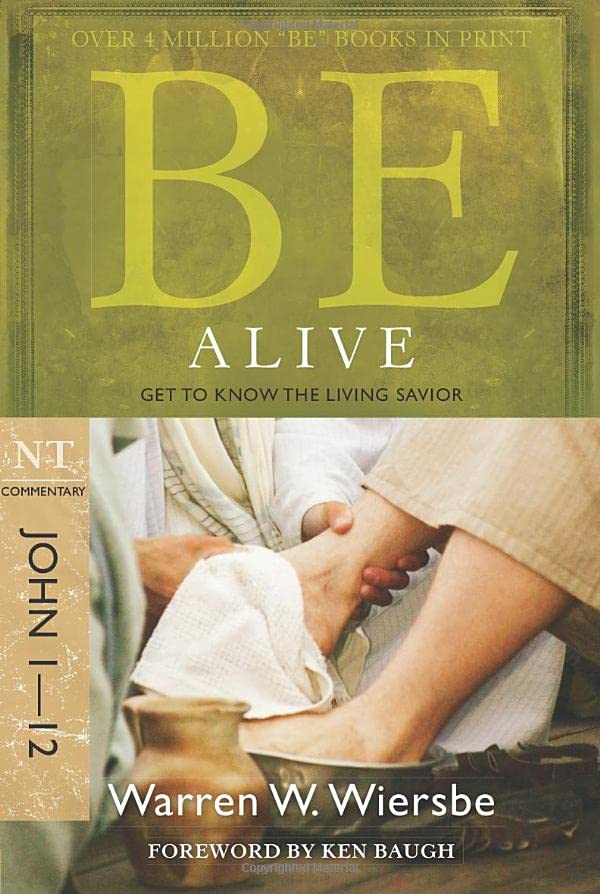
Be Alive: Get to Know the Living Savior

I veered from my Bible reading plan because I wanted to be in one of the gospels over December, and because the plan had not taken me through John in the last few years.

Warren Wiersbe divided his commentary on John into two books, the first being Be Alive (John 1-12): Get to Know the Living Savior.

Each of the four gospels presents Jesus from a different aspect. John’s gospel portrays Jesus as the Son of God.

John shares different titles for Jesus: the eternal, incarnate Word of God (“Much as our words reveal to others our hearts and minds, so Jesus Christ is God’s ‘Word’ to reveal His heart and mind to us”–p. 20); the light of the world; the eternal Son of God; the lamb of God; the Messiah, long promised and prophesied in the Old Testament; the king of Israel; the Son of Man; the good shepherd, the water and bread of life, the door.

When John shares some of the miracles Jesus did, he “seeks to share the inner meaning—the inner significance—of our Lord’s works, so that each miracle is a ‘sermon in action” (p. 38). “Our Lord’s miracles were testimonies (John 5: 36), giving evidence of His divine sonship; but they were also tests, exposing the hearts of the people (John 12: 37ff.). The same events that opened some eyes only made other eyes that much more blind (John 9: 39–41)” (p. 44).

One theme through John’s gospel is Jesus’ “hour.” Throughout, Jesus says His hour was not yet come. Then it was at hand, then it finally culminated in His death for us.

Another theme is that Jesus loves and came to die for the world, not just the Jews.

One of John’s major themes is that Jesus is the Savior of the world, not simply the Redeemer of Israel. He is the Lamb of God who takes away the sin of the world (John 1: 29). “For God so loved the world” (John 3: 16). The Samaritans rightly identified Him as “the Savior of the world” (John 4: 42). He gave His life for the world, and He gives life to the world (John 6: 33). He is the Light of the World (John 8: 12). The universal emphasis of John’s gospel is too obvious to miss. Jesus will bring the “other sheep” who are outside the Jewish fold (John 10: 16; and see 11: 51–52) (p. 190).

The crowds at first flocked to Jesus for His teaching and His provision. They hoped He would throw off Roman oppression and set up His kingdom. Some believed and became loving followers of Christ. Many began to fall away when He spoke of the cost of discipleship and when it became clear that He was not the type of Messiah they had envisioned.

The Pharisees were supposed to be experts in the law of God, but they missed the Savior portrayed in the law.

When a person starts to resist the light, something begins to change within him, and he comes to the place where he cannot believe. There is “judicial blindness” that God permits to come over the eyes of people who do not take the truth seriously. (The quotation of Isa. 6: 9–10 is found in a number of places in the New Testament. See Matt. 13: 14–15; Mark 4: 12; Luke 8: 10; Acts 28: 25–27; Rom. 11: 8.) It is a serious thing to treat God’s truth lightly, for a person could well miss his opportunity to be saved. “Seek ye the LORD while he may be found, call ye upon him while he is near” (Isa. 55: 6)” (p. 194).

John’s gospel is a full and rich portrayal of Christ. There is so much in it, I am not surprised Wiersbe took two books to cover it. I look forward to the next one.

Be Courageous (Luke 14-24)

The gospel of Luke is so full of good things that Warren Wiesrabe divided his commentary on Luke into two books. I mentioned the first, Be Compassionate (Luke 1-13): Let the World Know Jesus Cares, earlier in the month. Its companion is Be Courageous (Luke 14-24): Take Heart From Christ’s Example.

Luke 14 drops us right in the middle of Jesus’ ministry, with His healing of a man and then teaching through several parables. The next several chapters continue in much the same way. In addition to parables, Jesus teaches His disciples about the need to take up their cross and follow Him. In chapter 21, Jesus prophesies about the future.

Up to this point, the Pharisees, scribes, etc., have been keeping a close eye on Jesus, trying to trip Him up with questions, challenging His actions. In Chapter 22, things escalate with Judas offering to betray Jesus.

The narrative slows down in the next few chapters to focus on the events leading up to Jesus’ death. He celebrates the Passover with His disciples, institutes the Lord’s supper, is arrested, tried, and is found innocent, yet He is still given over to be crucified. Chapter 23 tells of His crucifixion and burial, and chapter 24 tells of His resurrection, appearance to the disciples, and ascension back to heaven..

There’s a lot in each of those chapters. In our discussion of five chapters at a time at church, we could only hit a few highlights in each one.

Luke’s books were written to his friend, Theophilus, to provide “an orderly account . . . that you may have certainty concerning the things you have been taught” (Luke 1:3-4).

Wiersbe ably explains things along the way, shares insights, and harmonizes Luke’s account with that of the other gospel writers. Some of his comments:

Our modern world is very competitive, and it is easy for God’s people to become more concerned about profit and loss than they are about sacrifice and service. “What will I get out of it?” may easily become life’s most important question (Matt. 19: 27ff.). We must strive to maintain the unselfish attitude that Jesus had and share what we have with others (pp. 21-22, Kindle version).

What does it mean to “carry the cross”? It means daily identification with Christ in shame, suffering, and surrender to God’s will. It means death to self, to our own plans and ambitions, and a willingness to serve Him as He directs (John 12: 23–28). A “cross” is something we willingly accept from God as part of His will for our lives (p. 26).

This chapter makes it clear that there is one message of salvation: God welcomes and forgives repentant sinners. But these parables also reveal that there are two aspects to this salvation. There is God’s part: The shepherd seeks the lost sheep, and the woman searches for the lost coin. But there is also man’s part in salvation, for the wayward son willingly repented and returned home. To emphasize but one aspect is to give a false view of salvation, for both the sovereignty of God and the responsibility of man must be considered (see John 6: 37; 2 Thess. 2: 13–14) (pp. 31-21).

Sin promises freedom, but it only brings slavery (John 8: 34); it promises success, but brings failure; it promises life, but “the wages of sin is death” (Rom. 6: 23). The boy thought he would “find himself,” but he only lost himself! When God is left out of our lives, enjoyment becomes enslavement (p. 36).

Peter’s self-confident boasting is a warning to us that none of us really knows his own heart (Jer. 17: 9) and that we can fail in the point of our greatest strength (p. 129).

I never noticed this before, but both the ESV Study Bible and Wiersbe point out that Luke begins and ends in the temple. In the first chapter, the birth of John the Baptist, the forerunner of Christ, is announced to his stunned father, Zechariah. In the last, Jesus’ followers “worshiped him and returned to Jerusalem with great joy, and were continually in the temple blessing God.

May we follow in their footsteps, joyfully worshiping and blessing Him.

Be Distinct (2 Kings and 2 Chronicles)

Be Distinct (2 Kings and 2 Chronicles): Standing Firmly Against the World’s Tides is Warren Wiesrbe’s short commentary on those two books of the Bible.

I read this book while reading 2 Kings 2, so it was nice to have the parallel material from 2 Chronicles, Isaiah, and Jeremiah to fill in the rest of the details.

2 Kings covers a sad time in Israel’s history. The northern kingdom was conquered by the Assyrians, and the southern kingdom of Judah continued its descent from what it had been during the reigns of David and Solomon. A few of Judah’s kings were godly and enacted various reforms away from idolatry and back to the worship of the one true God as He had laid out in His Word. But the next generation would fall away even further than they had before. Finally, Babylon conquered Judah, destroyed the temple, burned Jerusalem, and took most of the Israelites back to Babylon. Different prophets were sent with God’s warnings, but were largely ignored.

It’s not hard to see history repeating itself in our day. America is not Israel, of course. But any people who have had God’s light and turn away from it are going on a similar collision course. As Dr. Wiersbe says:

When society around us is in moral and spiritual darkness, God’s people need to be lights; and when society is decaying because of sin, we need to be salt. We must be distinctive! Paul calls us to be “children of God without fault in the midst of a crooked and perverse generation” (Phil. 2: 15 NKJV). . . .The hour has come for God’s people to be alert to the voice of God and obedient to the will of God—to be distinctive. God is seeking transformers, not conformers (p. 11, Kindle version).

Throughout the book, we also see the grace of God in keeping His promises to David and offering help multiple times.

Some quotes that stood out to me:

The gospel isn’t only a message to believe; it’s also a mandate to obey (p. 19).

During the years that I was privileged to instruct seminary students, I occasionally heard some of them say, ‘Why should we attend school? Charles Spurgeon never went to seminary, and neither did Campbell Morgan or D. L. Moody!’ I would usually reply, ‘If any of you are Spurgeons, Morgans, or Moodys, we’ll no doubt discover it and give you permission to stop your education. But let me remind you that both Spurgeon and Moody founded schools for training preachers, and Campbell Morgan was once president of a training college and also taught at a number of schools. Meanwhile, back to our studies.’ God has different ways of training His servants, but He still expects the older generation to pass along to the younger generation the treasures of truth that were given to them by those who went before, ‘the faith … once for all delivered to the saints’” (Jude 3 NKJV) (p. 21).

Never underestimate the power of a simple witness, for God can take words from the lips of a child and carry them to the ears of a king (p. 53).

To the humble heart that’s open to God, the Word generates faith, but to the proud, self-centered heart, the Word makes the heart even harder. The same sun that melts the ice will harden the clay (p. 74).

[Uzziah] had a wonderful beginning but a tragic ending, and this is a warning to us that we be on guard and pray that the Lord will help us to end well. A good beginning is no guarantee of a successful ending, and the sin of unholy ambition has ruined more than one servant of the Lord (p. 140).

Even though 2 Kings ends on a bleak note, God has not entirely forsaken His people. After 70 years in captivity, they would be allowed to return. And several hundred years later, the rightful ruler of the throne of David would come to earth. He would not to establish His physical kingdom at that time. But He would provide for their salvation.

Be Responsible (1 Kings)

Warren Wiersbe helps us glean understanding in Be Responsible (1 Kings): Being Good Stewards of God’s Gifts.

The book of 1 Kings begins with the death of David, Israel’s greatest king, and ends with the death of Ahab, one of Israel’s worst kings.

In-between those two kings, the temple was built, but then the kingdom of Israel split in two. The southern kingdom, Judah, was ruled by David’s line. The northern kingdom with the rest of the tribes was ruled by various people.

A few of the kings were good to some degree, but most were bad and led Israel in their besetting sin, idolatry.

God raised up prophets to warn the kings and the people about the danger they were in due to their disobedience. This book had Elijah’s famous showdown with the prophets of Baal and Elisha taking up Elijah’s mantle. But there were many unnamed prophets faithfully doing God’s will.

Here are some of the quotes that stood out to me from Wiersbe’s writing:

The two books of Kings record about four hundred years of the history of Israel and Judah, while the two books of Chronicles see the history of the united kingdom and then the kingdom of Judah from the priestly point of view. Besides recording history, these books teach theology, especially the faithfulness of God in keeping His covenant, the sovereignty of God in directing the destinies of all nations, and the holiness of God in opposing idolatry (p. 13).

Integrity is one of the vital foundations of society, but integrity involves taking responsibility and facing accountability. This includes leadership in the home and church as well as in the halls of academe and the political chambers. It’s one thing to make promises at the church altar or to take an oath of office, but it’s quite another to assume responsibility and act with courage and honesty and seek to please God (p. 11).

God took the consequences of David’s two worst sins—a piece of property and a son—and built a temple! “But where sin abounded, grace abounded much more” (Rom. 5: 20 NKJV). This isn’t an encouragement for us to sin, because David paid dearly for both of those transgressions, but it is an encouragement to us to go on serving God after we’ve repented and confessed our sins. Satan wants us to think that all is lost, but the God of all grace is still at work (1 Peter 5: 10) (p. 53).

“Because of our proneness to look at the bucket and forget the fountain,” wrote Watchman Nee, “God has frequently to change His means of supply to keep our eyes fixed on the source” (p. 160).

Responsibility means our response to His ability (p. 214).

I appreciate Dr. Wiersbe’s help in getting more from 1 Kings.

Be Encouraged: Wiersbe on 2 Corinthians

The church in Corinthians had lots of problems. 2 Corinthians is actually the fourth letter Paul wrote to the church at Corinth. His second letter to them is our 1 Corinthians. Some of Paul’s opponents had invaded the church and stirred up rebellion. A previous visit by Paul to deal with the issues had not gone well. Paul left and then sent by Titus a “severe” letter. He rejoiced that many in Corinth repented. So in this letter, Paul wanted to encourage those who had repented but warn those who had not.

He also had to defend his apostleship from various charges.

Plus, the Corinthians had promised some time before to send an offering for the poor in Jerusalem, but had not done so yet. Paul planned to pick up their donations to take along with what he had collected from other churches, so he encouraged them to give and give cheerfully. The offering would not only help meet material needs, but would help unite the Jewish and Gentile congregations.

Dr. Warren W. Wiersbe’s short commentary on 1 Corinthians is Be Encouraged (2 Corinthians): God Can Turn Your Trials Into Triumphs.

In the first chapter, Wiersbe writes:

One of the key words in this letter is comfort or encouragement. The Greek word means “called to one’s side to help.” The verb is used eighteen times in this letter, and the noun eleven times. In spite of all the trials he experienced, Paul was able (by the grace of God) to write a letter saturated with encouragement.

What was Paul’s secret of victory when he was experiencing pressures and trials? His secret was God. When you find yourself discouraged and ready to quit, get your attention off of yourself and focus it on God. Out of his own difficult experience, Paul tells us how we can find encouragement in God (p. 18).

Wiersbe also points out:

The words comfort or consolation (same root word in the Greek) are repeated ten times in 2 Corinthians 1: 1–11. We must not think of comfort in terms of “sympathy,” because sympathy can weaken us instead of strengthen us. God does not pat us on the head and give us a piece of candy or a toy to distract our attention from our troubles. No, He puts strength into our hearts so we can face our trials and triumph over them. Our English word comfort comes from two Latin words meaning “with strength.” The Greek word means “to come alongside and help.” It is the same word used for the Holy Spirit (“ the Comforter”) in John 14—16.

God can encourage us by His Word and through His Spirit, but sometimes He uses other believers to give us the encouragement we need (2 Cor. 2: 7–8; 7: 6–7) (p. 20).

Dr. Wiersbe also shares that “There are ten basic words for suffering in the Greek language, and Paul uses five of them in this letter” (p. 20).

I won’t go point by point through Corinthians–Wiersbe includes an outline as well as discussion. But some of the most well-known passages in this book of the Bible are these: God comforts us in all our affliction and we comfort others (1:2-7); when we behold God, we become more like Him (3:18), “we have this treasure in jars of clay, to show that the surpassing power belongs to God and not to us” (4:7-12), though outwardly we’re wasting away, inwardly we’re renewed day by day, and our “light momentary affliction” prepares for us “an eternal weight of glory beyond all comparison” (4:16-18), the ministry of reconciliation (5), Now is the day of salvation (6:2), we’re God’s temple and shouldn’t be yoked up with darkness (6:14-18), godly grief vs. worldly grief (7:5-12), grace giving (8:1-15), the cheerful giver, sowing and reaping (9:1-15), “God is able to make all grace abound to you, so that having all sufficiency in all things at all times, you may abound in every good work” (9:8), Paul’s thorn in the flesh, God’s strength in our weakness, (12:7-10), “Examine yourselves, to see whether you are in the faith” (13:5).

Some other quotes from Wiersbe that stood out to me:

The word sufficiency means “adequate resources within” (see Phil. 4: 11). Through Jesus Christ, we can have the adequacy to meet the demands of life. As Christians, we do need to help and encourage one another; but we must not depend on one another. Our dependence must be on the Lord. He alone can give us that “well of water” in the heart that makes us sufficient for life (John 4: 14) (p. 117).

God did not give Paul any explanations; instead, He gave him a promise: “My grace is sufficient for thee.” We do not live on explanations; we live on promises. Our feelings change, but God’s promises never change. Promises generate faith, and faith strengthens hope (p. 160).

How do people measure the ministry today? By powerful oratory or by biblical content? By what the media says or by Christian character? (p. 169).

Paul prayed for their perfection, which does not mean absolute sinless perfection, but “spiritual maturity.” The word is part of a word family in the Greek that means “to be fitted out, to be equipped.” As a medical term, it means “to set a broken bone, to adjust a twisted limb.” It also means “to outfit a ship for a voyage” and “to equip an army for battle.” In Matthew 4: 21, it is translated “mending nets.”

One of the ministries of our risen Lord is that of perfecting His people (Heb. 13: 20–21). He uses the Word of God (2 Tim. 3: 16–17) in the fellowship of the local church (Eph. 4: 11–16) to equip His people for life and service. He also uses suffering as a tool to equip us (1 Peter 5: 10). As Christians pray for one another (1 Thess. 3: 10) and personally assist one another (Gal. 6: 1, where “restore” is this same word perfect), the exalted Lord ministers to His church an makes them fit for ministry (pp. 170-171).

Sometimes the minister of the Word must tear down before he can build up (see Jer. 1: 7–10). The farmer must pull up the weeds before he can plant the seeds and get a good crop. Paul had to tear down the wrong thinking in the minds of the Corinthians (2 Cor. 10: 4–6) before he could build up the truth in their hearts and minds. The negative attitude of the Corinthians made it necessary for Paul to destroy, but his great desire was to build (pp. 171-172).

2 Corinthians closes with a well-known benediction: “The grace of the Lord Jesus Christ and the love of God and the fellowship of the Holy Spirit be with you all” (13:14).

Wiersbe says of this verse:

If each believer is depending on the grace of God, walking in the love of God, and participating in the fellowship of the Spirit, not walking in the flesh, then he will be a part of the answer and not a part of the problem. He will be living this benediction—and being a benediction to others! (p. 174).

Amen.