
Book Review: Be Rich (Ephesians) Gaining the Things That Money Can’t Buy

Warren Wiersbe’s Be Rich commentary on the book of Ephesians does not a promote the “prosperity gospel”—insert prayers and gifts to televangelists and receive health and wealth. No, as the subtitle goes on to say. “Gaining the Things That Money Can’t Buy.”

Ephesians 1:3 says God “has blessed us in Christ with every spiritual blessing in the heavenly places.” Just some of those blessings:

  • Chosen in Him (verse 4)
  • Adopted as sons (verse 5)
  • Redemption through his blood, the forgiveness of our trespasses (verse 7)
  • An inheritance (verse 11)
  • Believers are “sealed with the promised Holy Spirit, who is the guarantee of our inheritance until we acquire possession of it, to the praise of his glory” (verses 13-14).

Wiersbe says, “‘In Christ’ is the most frequently used phrase in the book of Ephesians, and the point is clear: If you’re in Christ, you have everything.”

Another theme in the book is unity. Not a unity that ignores truth, but unity based on truth. Paul, the author of the letter to the Ephesians, says God’s plan was “to unite all things in [Christ], things in heaven and things on earth” (1:10). The first half of chapter 2 tells how we can be reconciled with God; the second half says that God, through Christ, broke down the barriers between Jew and Gentile. “For through him we both have access in one Spirit to the Father. So then you are no longer strangers and aliens, but you are fellow citizens with the saints and members of the household of God … ” (2:18-19). Chapters 4-6 share practical ways that unity in Christ is worked out in the church community, in the home, and in the workplace.

I’ve got dozens of quotes marked, but here are a few:

The Bible is our guidebook; the Holy Spirit is our Teacher. As we search the Word of God, we discover more and more of the riches we have in Christ.

Salvation is a gift, not a reward. Salvation cannot be “of works” because the work of salvation has already been completed on the cross. This is the work that God does for us, and it is a finished work (John 17: 1–4; 19: 30). We can add nothing to it (Heb. 10: 1–14); we dare take nothing from it.

By His death and resurrection, Christ overcame the world (John 16: 33; Gal. 6: 14), and the flesh (Rom. 6: 1–6; Gal. 2: 20), and the Devil (Eph. 1: 19–23). In other words, as believers, we do not fight for victory—we fight from victory! The Spirit of God enables us, by faith, to appropriate Christ’s victory for ourselves.

The Christian life is not based on ignorance but knowledge, and the better we understand Bible doctrine, the easier it is to obey Bible duties. When people say, “Don’t talk to me about doctrine—just let me live my Christian life!” they are revealing their ignorance of the way the Holy Spirit works in the life of the believer. “It makes no difference what you believe, just as long as you live right” is a similar confession of ignorance. It does make a difference what you believe, because what you believe determines how you behave!

Of course, there’s much more to Ephesians and Wiersbe’s book.

Ephesians contains two of my favorite Biblical prayers that I sometimes pray for myself and others. I’ll leave you with those

For this reason, because I have heard of your faith in the Lord Jesus and your love toward all the saints, I do not cease to give thanks for you, remembering you in my prayers, that the God of our Lord Jesus Christ, the Father of glory, may give you the Spirit of wisdom and of revelation in the knowledge of him, having the eyes of your hearts enlightened, that you may know what is the hope to which he has called you, what are the riches of his glorious inheritance in the saints, and what is the immeasurable greatness of his power toward us who believe, according to the working of his great might that he worked in Christ when he raised him from the dead and seated him at his right hand in the heavenly places (1:15-20).

For this reason I bow my knees before the Father, from whom every family in heaven and on earth is named, that according to the riches of his glory he may grant you to be strengthened with power through his Spirit in your inner being, so that Christ may dwell in your hearts through faith—that you, being rooted and grounded in love, may have strength to comprehend with all the saints what is the breadth and length and height and depth, and to know the love of Christ that surpasses knowledge, that you may be filled with all the fullness of God. (3:14-19).

(Sharing with Worth Beyond Rubies, Carole’s Books You Loved, Booknificent Thursday)
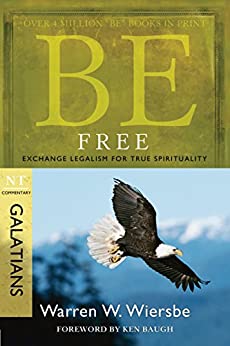
Book Review: Be Free (Galatians): Exchange Legalism for True Spirituality

 Be Free (Galatians): Exchange Legalism for True Spirituality by Warren Wiersbe is a commentary or study guide to read alongside the New Testament book of Galatians.

Paul wrote a rather strongly-worded letter to the Galatians with none of his usual thanksgiving and commendation for his readers. That’s because the Galatians were confusing law and grace.

The first Christians were Jewish and were quite stunned when Gentiles became believers. There was a lot of confusion at first about whether Gentile believers had to follow the same practices as the Jews (see Acts 10, 11, and 15).

The apostles and the elders were gathered together to consider this matter. And after there had been much debate, Peter stood up and said to them, “Brothers, you know that in the early days God made a choice among you, that by my mouth the Gentiles should hear the word of the gospel and believe. And God, who knows the heart, bore witness to them, by giving them the Holy Spirit just as he did to us, and he made no distinction between us and them, having cleansed their hearts by faith. Now, therefore, why are you putting God to the test by placing a yoke on the neck of the disciples that neither our fathers nor we have been able to bear? But we believe that we will be saved through the grace of the Lord Jesus, just as they will. (Acts 15:6-11, emphasis added).

The initial confusion was understandable. But some, called Judaizers, persisted in teaching that Gentile believers must keep the OT law, especially the Jewish rite of circumcision. Paul insisted this was trusting in works, not grace, and we’re not saved by works.

It wasn’t that circumcision was good or bad in itself. Paul mentions bringing Titus, a Gentile believer to Jerusalem with no thought of having him circumcised (Galatians 2:1-5). But later in Acts 16:1-3, Paul had Timothy circumcised. Was Paul being inconsistent? No, Timothy was half Jewish, half Greek, and Paul wanted to bring him along on his missionary journeys. As a part Jewish man, Timothy would never have been accepted or listened to by the Jews without being circumcised. So in his case, circumcision was a matter of not being a stumblingblock to those he wanted to minister to. (John Piper goes into this more here.) The difference was that neither Paul nor Timothy were trusting in circumcision as a means to salvation or to earn favor with God. The Judaizers were.

So Paul argues against law and for grace, appealing to the Galatians personally, doctrinally, and practically. They were in danger of teaching false doctrine, of forsaking and perverting the gospel. It was serious enough for Paul to write as he did.

I won’t go into all the details or Wiersbe’s outline here. But Wiersbe makes application to our day. Probably few of us are tempted to observe Jewish law for salvation as the Judaizers were. But we can easily lapse into trusting in the rules or standards of whatever faith group we’re a part of instead of trusting Christ alone for salvation.

Millions of believers think they are “spiritual” because of what they don’t do—or because of the leader they follow—or because of the group they belong to. The Lord shows us in Galatians how wrong we are—and how right we can be if only we would let the Holy Spirit take over.

When the Holy Spirit does take over, there will be liberty, not bondage—cooperation, not competition—glory to God, not praise to man. The world will see true Christianity, and sinners will come to know the Savior. There is an old-fashioned word for this: revival.

Here are a few other quotes.

We must never forget that the Christian life is a living relationship with God through Jesus Christ. A man does not become a Christian merely by agreeing to a set of doctrines; he becomes a Christian by submitting to Christ and trusting Him (Rom. 11: 6).

We not only are saved by grace, but we are to also live by grace (1 Cor. 15: 10). We stand in grace; it is the foundation for the Christian life (Rom. 5: 1–2). Grace gives us the strength we need to be victorious soldiers (2 Tim. 2: 1–4). Grace enables us to suffer without complaining, and even to use that suffering for God’s glory (2 Cor. 12: 1–10). When a Christian turns away from living by God’s grace, he must depend on his own power. This leads to failure and disappointment. This is what Paul meant by “fallen from grace” (Gal. 5: 4)—moving out of the sphere of grace and into the sphere of law, ceasing to depend on God’s resources and depending on our own resources.

God revealed Christ to Paul, in Paul, and through Paul. The “Jews’ religion” (Gal. 1: 14) had been an experience of outward rituals and practices, but faith in Christ brought about an inward experience of reality with the Lord. This “inwardness” of Christ was a major truth with Paul (2: 20; 4: 19).

Ever since Paul’s time, the enemies of grace have been trying to add something to the simple gospel of the grace of God. They tell us that a man is saved by faith in Christ plus something—good works, the Ten Commandments, baptism, church membership, religious ritual—and Paul made it clear that these teachers are wrong. In fact, Paul pronounced a curse on any person (man or angel) who preaches any other gospel than the gospel of the grace of God, centered in Jesus Christ (Gal. 1: 6–9; see 1 Cor. 15: 1–7 for a definition of the gospel). It is a serious thing to tamper with the gospel.

Justification is an act of God; it is not the result of man’s character or works. “It is God that justifieth” (Rom. 8: 33). It is not by doing the “works of the law” that the sinner gets a right standing before God, but by putting his faith in Jesus Christ.

Reading this book was a little different from reading the author’s Be Reverent on Ezekiel. Ezekiel has 48 chapters, so Wiersbe’s commentary covered broader sections in his chapters. But Galatians only has six chapters, so Wiersbe took two chapters to discuss each chapter of Galatians. If I had been reading this on my own, I would have just read one chapter of Wiersbe’s commentary on half a chapter of Galatians a day. But because I was reading one chapter a day of Galatians for our church Bible study, I had to read two chapters of Wiersbe to keep on track. It had my head spinning a couple of days, especially in the more doctrinal parts of the book. But Wiersbe in generally pretty easy to follow and comprehend.

(Sharing with Carole’s Books You Loved, Booknificent Thursday)

Book Review: Be Reverent

Warren Wiersbe has written a “Be” series commenting on almost every book of the Bible. The individual books cover more than a study Bible would, but they are not as in-depth as some commentaries. They are good study aides. Wiersbe gives background information, word meanings, different interpretations for passages as well as his reasons for the interpretation he chooses, and applications for modern-day believers. His style is easy to read.

The books are available in paperback, but I often see a few at a time on Kindle app sales for 99 cents to $1.99. I’ve collected most of them, but, I’m sorry to say, they stayed tucked away and forgotten in my app.

Our church has been reading trough Ezekiel for the last several weeks. Ezekiel is known for having some of the toughest passages in all of Scripture to understand and interpret, so I figured perhaps a bit more help than my study Bible might be needed.

Wiersbe sets the theme for Ezekiel right in the title: Be Reverent (Ezekiel): Bowing Before Our Awesome God. Judah had been taken over by the Babylonians, and most of the nation was sent to Babylon in three different deportations. God had called Jeremiah to warn the people before the kingdom fell to Babylon. He called Ezekiel to preach to the people in Babylon.

Many prophets would act out object lessons for the people. But Ezekiel seems to have been given not only the most of what the ESV Study Bible calls “street theater” messages, but also the most unusual. Wiersbe calls them “actions sermons.”

One of our former pastors taught that many of the prophets prophesied during the same era, and one reason was that different people responded to different personalities. Some may have thought Ezekiel a little weird or might have been uncomfortable watching him, but others would have been drawn especially because he was different.

Wiersbe points out several repeated phrases in the book:

  • God is called “Lord God” (“ Sovereign Lord” NIV) over four hundred times.
  • “I am the Lord” occurs fifty-nine times.
  • “You will know that I am the LORD” (6:7 NIV) . . . is found seventy times.
  • Ezekiel is called “son of man” ninety-three times.
  • “The phrase ‘the word of the Lord came’ is used fifty times in his prophecy and speaks of the authority of his message, and ‘the hand of the LORD’ is found also in Ezekiel 3: 14, 22; 8: 1; 33: 22; 37: 1; and 40: 1. The word of the Lord brings enlightenment and the hand of the Lord enablement (see Eph. 1: 15–23).”

Wiersbe notes that “The Jews were sinning against a flood of light” in that they had the books of Moses, “knew the terms of the covenant,” had heard the messages of several prophets, “yet persisted in disobeying God’s will.” “The attitude of the people wasn’t that of militant opposition but rather passive indifference.” “In their pride, they had cultivated a false confidence that the Lord would never allow His people to be exiled or His temple destroyed, but their sin had now ‘matured’ and both were now about to happen.”

We must correctly distinguish regret, remorse, and true repentance. Regret is an activity of the mind; whenever we remember what we’ve done, we ask ourselves, “Why did I do that?” Remorse includes both the heart and the mind, and we feel disgust and pain, but we don’t change our ways. But true repentance includes the mind, the heart, and the will. We change our minds about our sins and agree with what God says about them; we abhor ourselves because of what we have done; and we deliberately turn from our sin and turn to the Lord for His mercy.

Ezekiel assured the people that “Though His people were in exile and their nation was about to be destroyed, God was still on the throne and able to handle every situation. In His marvelous providence, He moves in the affairs of nations and works out His hidden plan.”

Ezekiel had to deal with the people about their sin and idolatry, but he also held out hope that one day God would set up a future shepherd (34:22-24), a covenant of peace (34:25-31), and His presence with them (34:30; 48:35).

One of the applications Wiersbe says Ezekiel brings out for us is “Too much so-called worship is only a demonstration of man-centered religious activity that fails to bring glory to the Lord.” He warns against falling into the trap Judah did in keeping outward forms of worship and religious activity without engaging the heart.

There is a lot of controversy in Ezekiel, too, especially over what the details of the new temple mean in the last few chapters.

There’s so much more, both to Ezekiel and Wiersbe’s comments. But perhaps this gives you taste of both. I’m looking forward to exploring more of the “Be series” in the future.

(Sharing with Carole’s Books You Loved, Booknificent)