
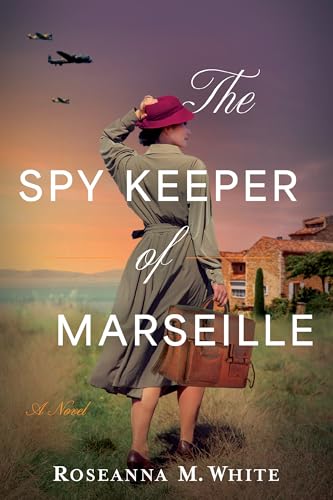
In The Spy Keeper of Marseille, a novel by Roseanna M. White, Zelie Bellerose is the widow of an Army officer in France with two young children during the German occupation of France during WWII. She becomes involved in the Resistance, with her children safely away from the area with her mother. When their leader is imprisoned, Zelie is the only one who can step in and take over the network. But this works to her advantage, as no one expects a woman to be in that position.
Marcel Laurent was a well-known concert pianist, but enlisted the the French army. He was captured and imprisoned in a POW camp for a year. He is freed in a prisoner exchange with the help of a wealthy businessman involved in the Resistance. Marcel is recruited to join them. He applies to be the conductor of a youth orchestra, picking up intel he hears, sharing news in code in the orchestra’s weekly broadcasts. To his surprise, a Nazi SS officer is assigned to oversee the orchestra, causing Marcel to have to exercise extreme caution.
Zelie and Marcel share a love for music, and that and their meetings for the Resistance draw them closer. But then a stunning betrayal threatens the whole alliance.
This story is based on real-life Marie-Madeleine Fourcade, who set up and then ran the Alliance network of spies in France during WWII to get information to MI6 in England. These spies were not professionals. The idea was to place people in areas like restaurants, museums, concert halls, etc., where Nazi visitors might be more relaxed and less on their guard, and pick up information they might let slip. Then they transferred anything pertinent through a series of secret radio transmissions.
Once again, Roseanna has written a gripping story with relatable characters. Their religion was Catholic, which is accurate for the time and place. But I disagreed with a couple of points.
And I thought there were a couple of implausible occurrences in the plot. Zelie’s son seemed much more mature than an average ten-year-old. And I wouldn’t think some of the operatives would discuss and choose new call signs in front of children. Though the children were away from the main action, there was still an underlying danger that they could be traced to Zelie. So it seems the adults would have kept much more from the children who, in their innocence and naivete, might share information they shouldn’t.
But other than those things, I enjoyed the story very much.
I listened to the audiobook which was nicely read by Megan Tusing.

