March Reflections

It’s hard to believe the pandemic has gone on for more than a year now. But in some ways, it feels like we’ve lived under pandemic guidelines for ages.

There’s hope on the horizon with vaccine availability. But COVID numbers are still rising in our area.

We still don’t know what’s ahead, whether COVID will ever really go completely away, what kind of “normal” might eventually emerge. But we walk by faith and not by sight, trusting God’s guidance and keeping.

I had mixed emotions about the vaccines. I feared that we hadn’t had enough time to see what long-term effects they might have. But then we figured the negative effects of COVID, with our health issues, probably outweighed the possible negative effects of the vaccine. Plus I don’t think quarantine conditions will lift significantly until the vaccine is more widespread. So when my husband’s workplace sponsored an afternoon of giving out vaccines in conjunction with a local pharmacy, and they had the J&J one that we wanted, we went ahead and got them. We had sore arms for a few days, but no other side effects so far.

Almost two weeks after receiving vacations, we went back to church in person for the first time in a year. Our church is small enough to socially distance inside the building. We’re asked to wear masks except during the service while sitting with our families. They’ve been meeting in person for several months, but left the Zoom option open for those who felt they shouldn’t come in person for health reasons. It was good to see everyone in person again, but it did feel weird. Maybe it will just tak a while to get used to beig around people again. Maybe it won’t really feel normal until COVID ebbs away enough that we can meet without masks.

Family

Our biggest news this month is that my youngest son, Jesse, moved out into his own apartment. He was later to “launch” than usual due to going back to college for a few years, then difficulty finding a job, then COVID. He’s super excited to have his own place and he’s learning how to cook. 🙂

We’re adjusting to being official empty nesters. It will take a while to get over the sensation that he’s right down the hall in his room. We’re learning different daily rhythms in everything from how often we need to do laundry, what groceries to buy, how much to cook, taking on the chores he used to do, etc. Plus we just miss his everyday presence. 🙂 But we’re thankful he’s not far away. And, as we experienced with our other boys, the relationship continues and grows. It’s fun to see him take the next steps on his journey.

March also held my husband and sister’s birthdays, Pi Day, and the first day of spring—all reasons to celebrate!

Creating

We’ve had some discussions about possibly getting an RV. We finally decided maybe we should rent one for a short trip and see how we like it first. But I used an RV theme for Jim’s birthday card.

The RV design was from the Cricut, and the background was from a woodland scrapbooking paper set. I printed out the words via computer, cut them out with decorative scissors, and outlined them with a marker.

The other thing I’m creating this month is a new sewing/craft room! I had all my “stuff” set up in the smallest bedroom. When Jesse moved out, I wanted to move my things to his larger room. But first my husband patched up holes, painted multiple coats, and used a wet-vac to clean the carpet.

The whole house interior is painted beige, and after 11 years, it all need to be redone anyway. We want to switch to a light grey. We’re using the bedrooms and bathrooms to try out different shades. There’s an unbelievably wide variety of light grey shades, from yellowish to bluish to whitish to dull to bright. After a couple of tries, we found one we really like.

I thought it would just be a matter of moving a few bits of furniture and cabinets from one room across the hall to the other. But I forgot how much little stuff I had in there! We got the biggest portion done Saturday, but I have several little things to finish up.

Once I get the old bedroom cleared out, Jim will patch holes, paint, etc., in there, and then we’ll buy a bed and turn that into a guest room.

I am so thankful for my husband’s willing hard work, both with painting plus moving my “stuff.”

Jesse had a pegboard in his room on which he displayed his collection of airsoft guns. When Jim asked me if I wanted to keep the pegboard, I wasn’t terribly excited about it, but I figured it would be more trouble to take down and patch up behind it than it was worth. So we kept it and he painted it for me. Then I found tons of craft room pegboard ideas on Pinterest. And I discovered a whole new world of cute pegboard accessories!

Watching/Listening

We haven’t really watched anything out of the ordinary this month. I’m still working my way through Lark Rise to Candleford on my exercise bike, but I m nearing the end of that.

I’m not a big fan of podcasts—I’d usually rather listen to audiobooks or music. But Hope has mentioned the Literary Life Podcast. When I checked it out, they were discussing Silas Marner, which I was listening to at the time. So I listened to and enjoyed those sessions. Then it took me a while to decide which classic to listen to next, so in the meantime I listened to Literary Life’s discussions of 84, Charing Cross Road by Helene Hanff, which I had enjoyed reading a few years ago, and Why Read Old Books. I’d like to listen to Why Read Fairy Tales sometime.

Reading

This month I’ve completed (titles link back to my reviews):

  • Nicholas Nickleby by Charles Dickens (audiobook) was actually completed right at the end of February, but reviewed at the beginning of this month. I had never read this Dickens classic, and I enjoyed it. I didn’t like it as well as David Copperfield, but it was good.
  • Silas Marner by George Elliot (audiobook). A man is betrayed by his best friend and falsely accused and disappointed by his church. He becomes something of a recluse, suffering another great loss, but taking in an orphaned child that changes his life. Very good.
  • Hudson Taylor and Maria: A Match Made in Heaven by John Pollock. A brief biography of the famous missionary who began the China Inland Mission, particularly in relation to his first wife.
  • The First Gardener by Denise Hildreth Jones, novel. The Tennessee governor’s family experiences a stunning loss and is helped by the governor’s mansion’s long-time gardener. A good story except for a couple of flaws.
  • Do More Better: A Practical Guide to Productivity by Tim Challies. Good perspective and tips.
  • The Warden by Anthony Trollope (audiobook), the first in his Chronicles of Barsetshire series. A meek warden of a local hospital is caught between a young reformer who thinks the funds are being mishandled and the staunch archdeacon who takes opposes the reformer. Took a while to get into, but I enjoyed it.
  • Be Holy (Leviticus): Becoming Set Apart for God by Warren Wiersbe.

I’m currently reading:

Blogging

Besides books reviews, Friday Fave Fives, and Laudable Linkages, I’ve shared on the blog this month:

This is one of my favorite times of year, changing from winter’s gloom and coldness, grass and trees greening up, buds forming, more daylight. Winter is having its (hopefully) last hurrah with temperatures in the twenties again at night this week, but the weather is often delightful during the day. We feel a little like bears coming out of hibernation. Somehow, more warmth and light gives us new energy.

How was your March?

(Sharing with Grace and Truth, Senior Salon, InstaEncouragements)

Be Holy: Becoming “Set Apart” for God

Leviticus probably is no one’s favorite book of the Bible. In fact, as one man in our church put it, Leviticus is where Bible reading plans go to die.

But Leviticus is part of God’s inspired word, and “whatever was written in former days was written for our instruction, that through endurance and through the encouragement of the Scriptures we might have hope” (Romans 15:4). It is “quoted or referred to over 100 times in the New Testament.” So it’s highly worthy of our study.

As our church came to Leviticus in our Bible reading schedule, the ESV Study Bible notes and Warren Wiersbe’s Be Holy (Leviticus): Becoming “Set Apart” for God were invaluable companions.

It doesn’t take long to see that God’s holiness is the main theme of Leviticus. “The word holy is used 93 times in Leviticus, and words connected with cleansing are used 71 times. References to uncleanness number 128. There’s no question what this book is all about.” As I mentioned before, a seminary professor teaching Leviticus had his students try to live by its regulations for a period of time. One result was that holiness was a primary focus throughout the day, in regard to everything the students did.

Also, as Ken Baugh points out in his introduction to this book, “Almost everything in Leviticus anticipates the life and death of Jesus. The sacrifices, festivals, rituals, and laws foreshadow God’s redemptive plan. Jesus becomes the means to remove the guilt and penalty for sin through His substitutionary death on the cross. His death provides the final atonement for all sin.”

Though I saw some of those glimpses of Christ in past reading of Leviticus, this time they seemed to be on every page.

A couple of quotes from the book that stood out to me:

God’s church is supposed to be “a holy nation” in this present evil world, to “declare the praises of him who called you out of darkness into his wonderful light” (1 Peter 2: 9 NIV). The Greek word translated “declare” means “to tell out, to advertise.”

“Woe to those who call evil good and good evil, who put darkness for light and light for darkness” (Isa. 5: 20 NIV). The first step toward disobedience is often “reclassifying” sin and making it look acceptable instead of abominable.

Have you ever heard a preacher or teacher say that seven is the number of perfection in the Bible? I had, but I didn’t remember ever hearing why that was so. Wiersbe explains here:

The Hebrew word for seven comes from a root word that means “to be full, to be satisfied.” It’s also related to the word meaning “to swear, to make an oath.” Whenever the Lord “sevens” something, He’s reminding His people that what He says and does is complete and dependable. Nothing can be added to it.

This book helped me get more out of Leviticus than ever before.

What we have studied should make us realize the awfulness of sin, the seriousness of confession and restitution, the graciousness of God in forgiving those who trust Jesus Christ, and the marvelous love of our Savior in His willingness to die for undeserving people like us.

(Sharing with Booknificent, Carole’s Books You Loved)

Easter Teaches Us of New and Better Life

Several years ago, we got word that a lady in our former church had been diagnosed with Alzheimer’s. She had been one of the merriest people I’d ever known. When we went back to that town for a visit, it was hard to see her in the church lobby looking confused and suspicious.

When our former pastor announced he had pancreatic cancer a few years ago, I was stunned that God would take someone in his prime with an active ministry and love for people who was doing so much good. Our pastor admitted he was going to have to take by faith that what God had for him in heaven was going to be so much better, because what he had on earth up til that time was pretty good.

I wondered why God would let one of His beloved children end up in pain or confusion.

But then I remembered this was not their end. Alzheimer’s and cancer were just stopping places in their long journey home. God promised that their sufferings would produce and eternal weight of glory.

 So we do not lose heart. Though our outer self is wasting away, our inner self is being renewed day by day. For this light momentary affliction is preparing for us an eternal weight of glory beyond all comparison, as we look not to the things that are seen but to the things that are unseen. For the things that are seen are transient, but the things that are unseen are eternal.. (2 Corinthians 4:16-18)

We get so caught up in the things we have to and want to do, our families, our ambitions, that we forget this world isn’t all there is.

We look forward to heaven . . . some day. But when we get there, we’ll probably wish we could have come sooner.

C. S. Lewis wrote to a friend of the unpleasant effects of aging: “the growing realisation that there were a great many things one wd. never have time to do,” studies one could never take up, facing retirement and “the infernal nuisance (to put it no higher) of patching up some sort of new life somewhere,” and so on. “I am therefore (with some help from the weather and rheumatism!) trying to profit by this new realisation of my mortality. To begin to die, to loosen a few of the tentacles which the octopus world has fastened on one.” He acknowledged that a good night’s sleep or a pleasant day would likely dispel his gloomy mood. But, he went on to say:

One ought not to need gloomy moments of life for beginning detachment, nor be reentangled by the bright ones. One ought to be able to enjoy the bright ones to the full and at that very moment have the perfect readiness to leave them, confident that what calls one away is better. . . (Letters of C. S. Lewis, October 15, 1949).

It was said of those in the “hall of faith” in Hebrews 11 that they desired “a better country, that is, a heavenly one. Therefore God is not ashamed to be called their God, for he has prepared for them a city” (verse 16).

I admit I am too caught up in the bright moments of this life. God kindly breaks in and turns my attention up and away to that world to come. “Eternal glories gleam afar . . .”

I’ve found a Friend, O such a friend! All pow’r to Him is given,
To guard me on my onward course, and bring me safe to heaven.
The eternal glories gleam afar, to nerve my faint endeavor;
So now to watch, to work, to war, and then to rest forever.

James G. Small, “I’ve Found a Friend, O Such a Friend

Easter speaks to me of many things—redemption, forgiveness, new life, and more. But this year it reminds me that this world and its pleasures and problems are temporary. We’re going to spend a lot more time in eternity than we did here. Are we ready?

Jesus came to earth as the Son of God, God in flesh. He lived a perfect life in our place because we never could. He died to take on the punishment for our sin so we wouldn’t have to. When we repent of our sin and believe on Him as Lord and Savior, His righteousness goes on our account: God sees Him instead of us.

Forgiveness of sin, His presence, His peace, his help, His grace—and heaven too!

Do you know Him? Are you ready for eternity?

(Sharing with Inspire Me Monday, Hearth and Soul, Scripture and a Snapshot, Senior Salon, Tell His Story, InstaEncouragements, Recharge Wednesday, Let’s Have Coffee, Share a Link Wednesday, Heart Encouragement, Grace and Truth, Faith on Fire)

Laudable Linkage

IMG_0195

Here are a few good reads from this week:

To Those Who Are Frustrated With the Church, HT to Challies. “It’s easy for a critic and the cynic to come into the local church and say, ‘Look at all this that is not yet done. Look at all this that is not yet complete. How can Jesus Christ be present in this?’ Jesus Christ is present in His church as the builder. The evidence of Christ’s presence is not that everything is complete, but that everything is in process. The fact that the church often feels more like a building site than a showroom is evidence of the presence of the builder.”

Help! I Want to Read the Bible, But I Find It Boring. “If we’re honest, I think we’ve all been there. It took years before I learned to enjoy and love the word—and that was after I became a Christian. Here are a few things I learned as a young person struggling to find a love for the Scripture.”

How My Mind Changed about End-of-Life Care, HT to Challies. My mother-in-law’s decline was a revelation in many ways. At one time I would have said that food and water should be given until the last moment. I didn’t realize that part of the body’s final shutting down means losing the ability to process food. Trying to get food into a person in that condition can cause problems. I don’t agree with withholding food and water just because someone is terminal. But there does come a time when treatment causes more harm than good.

Do You Have Enough Faith to Be Kind? HT to Challies. “If we are hesitant to be kind to one another in moments like this, it may be that we have more faith in brute force than the strength of our argument. Worse, it may be that we believe the power of public shame is greater than the power of the Holy Spirit. Our instinctive response answers an important question: Do we have enough faith to believe that ‘a soft answer turns away wrath’ (Prov. 15:1)?”

Help! My Kids Don’t Like to Read. Obstacles and tips.

As I read Shelly Hamilton’s update on her husband, Ron, his song “I’m Going Home” came to mind. At my first recall, I connected it with getting ready for heaven. But as I listened to it again, I remembered it’s a beautiful prodigal son song. I thought I’d share it with you:

Friday’s Fave Five

It’s Friday, time to look back over the blessings of the week
with Susanne at Living to Tell the Story and other friends.

It’s hard to believe we’re at the last Friday of March already. Here are a few good things from this week:

1. A visit and a repair. My computer has taken to flashing a blue screen and then restarting itself several times over a few weeks. I finally was able to take a picture of what the blue screen said (there wasn’t enough time to read it before the computer restarted itself) and sent it to my oldest son. I happened to catch him on a day he took off, so he remoted into my computer and updated a driver, and we had a nice chat. Unfortunately, the computer did crash again this week. He said in that case we might need to open it up and get the dust out. So that’s next—as soon as my husband or youngest son can get to that. I’m thankful I have people in the family who can help with things like this.

2. Jim is painting Jesse’s old room. I’ll let you know what’s in store for the room in my end-of-month post next week.

3. Church in person. Since we got our COVID vaccinations a couple of weeks ago, we felt it was probably ok to start attending church in person again. They ask that we wear masks coming in and out, but we sit in family groups distanced from each other and can take our masks off during the service. Last Sunday also happened to be the Sunday for bringing our own lunches and eating in lawn chairs (still distanced) on the pavilion (as opposed to the potluck dinners we used to have, so we don’t spread germs). It felt good to see everyone in person. But honestly, it also felt a little weird. I don’t know if it will just take a while to get used to being with people again, since we’ve been mostly home for a year—or if it will still feel weird until we’re able to put masks away. But, overall it was good and a step toward normalcy.

4. The first day of spring. I always love the official end of winter.

5. A new quick sweet snack. I wanted something sweet yesterday but didn’t have anything in the house I liked. I looked through an old cookbook I had put together from recipes torn out of one of Taste of Home’s old magazines, Cooking for One or Two (I wish it was still in publication). I was trying to find something simple and quick and came across Chocolate Chip Quesadillas. I used one tortilla cut in half and used margarine instead of oil. It hit the spot!

How was your week?

The Warden by Anthony Trollope

Last year I read Doctor Thorne by Anthony Trollope after enjoying a mini-series based on the book. I discovered Doctor Thorne was the third book of a six-part series called The Chronicles of Barsetshire. I liked Doctor Thorne so much, I decided to read the rest of the series.

The first book in the series is The Warden, a position held by a Mr. Septimus Harding. The warden had various functions in the local church. One role unique to this particular church was overseeing a hospital or almshouse for aged men. In previous years, a man named John Hiram had made provision in his will for such a hospital, for twelve men and a warden to care for them.

A young reformer, John Bold, becomes concerned that the set-up for the hospital is unfair to the patients. He thinks the arrangement is not being carried out according to the Hiram’s will and that the warden is getting more money than he should and the pensioners less. John Bold has no personal quarrel with Mr. Harding himself; in fact, he’s in love with Harding’s daughter, Eleanor. But he’s the type of personality that opposes the principle of the thing and can’t let it go. He begins a lawsuit. Newspapers get wind of the situation and cast aspersions at Mr. Harding’s character.

This might not sound like a riveting plot line, but what makes it interesting is the personalities. Mr. Harding is the meekest of men and only wants to do the right thing. He thought he had been doing right, but now he wants to have the will looked into to make sure. His son-in-law, Archdeacon Grantly, is just the opposite: a take-charge person used to running the show and having his own way. Grantly confers with lawyers to oppose the suit on technical grounds. Grantly probably is probably making too much money from his position: he is described several times as rich. He has no compassion for the old pensioners.

He knew well how strongly he would be supported by Dr Grantly, if he could bring himself to put his case into the archdeacon’s hands and to allow him to fight the battle; but he knew also that he would find no sympathy there for his doubts, no friendly feeling, no inward comfort. Dr Grantly would be ready enough to take up his cudgel against all comers on behalf of the church militant, but he would do so on the distasteful ground of the church’s infallibility. Such a contest would give no comfort to Mr Harding’s doubts. He was not so anxious to prove himself right, as to be so.

Trollope lived and wrote during Dickens’ time, and I wonder what they thought of each other. He satirizes a writer in the story who went by the name Mr Popular Sentiment and who sounds a lot like Dickens or one of his characters. Many of Dickens’ novels seem to have been written to raise awareness and inspire reform. Trollope is not against reform, but he seems to caution here that it can be carried out in a way that hurts innocent people, stirs up negative sentiment without the right basis in facts, and doesn’t accomplish anything good. The question could have been looked into without becoming adversarial. That’s a timely message for these days.

In former times great objects were attained by great work. When evils were to be reformed, reformers set about their heavy task with grave decorum and laborious argument. An age was occupied in proving a grievance, and philosophical researches were printed in folio pages, which it took a life to write, and an eternity to read. We get on now with a lighter step, and quicker: ridicule is found to be more convincing than argument, imaginary agonies touch more than true sorrows, and monthly novels convince, when learned quartos fail to do so.

I especially like Trollope’s characterizations of the newspaper, which in this story is called the Jupiter. I wonder what he’d think of news media today.

From here issue the only known infallible bulls for the guidance of British souls and bodies. This little court is the Vatican of England. Here reigns a pope, self-nominated, self-consecrated—ay, and much stranger too,—self-believing!—a pope whom, if you cannot obey him, I would advise you to disobey as silently as possible; a pope hitherto afraid of no Luther; a pope who manages his own inquisition, who punishes unbelievers as no most skilful inquisitor of Spain ever dreamt of doing—one who can excommunicate thoroughly, fearfully, radically; put you beyond the pale of men’s charity; make you odious to your dearest friends, and turn you into a monster to be pointed at by the finger!’

Oh heavens! and this is Mount Olympus!

It is a fact amazing to ordinary mortals that the Jupiter is never wrong.

A man may have the best of causes, the best of talents, and the best of tempers; he may write as well as Addison, or as strongly as Junius; but even with all this he cannot successfully answer, when attacked by The Jupiter. In such matters it is omnipotent. What the Czar is in Russia, or the mob in America, that The Jupiter is in England.

I like that Trollope addresses the reader, not just as the narrator and member of the community, but as the author.

It is indeed a matter of thankfulness that neither the historian nor the novelist hears all that is said by their heroes or heroines, or how would three volumes or twenty suffice! In the present case so little of this sort have I overheard, that I live in hopes of finishing my work within 300 pages, and of completing that pleasant task—a novel in one volume.

Our tale is now done, and it only remains to us to collect the scattered threads of our little story, and to tie them into a seemly knot. This will not be a work of labour, either to the author or to his readers

I also enjoyed the humorous asides:

The bishop did not whistle. We believe that they lose the power of doing so on being consecrated; and that in these days one might as easily meet a corrupt judge as a whistling bishop; but he looked as though he would have done so, but for his apron.

He never had time to talk, he was so taken up with speaking.

In matters of love men do not see clearly in their own affairs. They say that faint heart never won fair lady; and it is amazing to me how fair ladies are won, so faint are often men’s hearts!

[Said of a particular painting] There on her pedestal, framed and glazed, stood the devotional lady looking intently at a lily as no lady ever looked before.

Popularity spoilt him for all further real use, as it has done many another.

I’m thankful I read Doctor Thorne first. It took me a while to get into The Warden, but I came to enjoy it. I especially liked Harding and his youngest daughter, Eleanor. Of Eleanor it was said, “She had no startling brilliancy of beauty, no pearly whiteness, no radiant carnation. She had not the majestic contour that rivets attention, demands instant wonder, and then disappoints by the coldness of its charms. You might pass Eleanor Harding in the street without notice, but you could hardly pass an evening with her and not lose your heart.”

According to a few sources, Trollope had not intended to write a series when he published The Warden. But a few years later, he was inspired by the characters and setting to write another story. When his popularity picked up, publishers asked him for more books from Barsetshire. It wasn’t until after the sixth was published that the books were marketed together and called The Chronicles of Barsetshire.

I listened to the audiobook superbly read by Simon Vance.

I’m counting this book for the 19th century classic in the Back to the Classics Reading Challenge.

(Sharing with Booknificent, Carole’s Books You Loved)

Do More Better

After several days of feeling like I was just spinning my wheels and not getting anywhere, I decided to pick up Do More Better: A Practical Guide to Productivity by Tim Challies. I’ve read his blog for years and saw this book on a Kindle sale a while back.

When we think productivity, we often think of life hacks. But before Tim gets to practical advice, he lays a biblical foundation with clarity about usefulness and purpose of productivity.

Productivity is not what will bring purpose to your life, but what will enable you to live out your existing purpose (p. 10).

We somehow assume that our value is connected to our busyness. But busyness cannot be confused with diligence. It cannot be confused with faithfulness or fruitfulness. . . .  Busyness may make you feel good about yourself and give the illusion of getting things done, but it probably just means that you are directing too little attention in too many directions, that you are prioritizing all the wrong things, and that your productivity is suffering (pp. 20-21).

No amount of organization and time management will compensate for a lack of Christian character, not when it comes to this great calling of glory through good—bringing glory to God by doing good to others . . .there is no great gain in being a productivity monster if the rest of your life is out of control (pp. 24-25).

After sifting through what productivity is and isn’t good for and what our purpose in life is as Christians, Tim shares this pithy definition: “Productivity is effectively stewarding my gifts, talents, time, energy, and enthusiasm for the good of others and the glory of God.” (p. 16).

He deals with enemies of productivity and the need to define our responsibilities and roles.

Then he discusses tools. Old-school equivalents would be a task-management tool, like a Daytimer or to-do list, a calendar, and a filing cabinet of vital information. But Tim brings us into the 21st century by sharing how to use apps that serve these purposes.

He shares his routines for managing his time and energy. We only have limited amounts of each, yet more opportunities to use them that we can handle, so we need to make decisions. “Motivation gets you started, but habit keeps you going. You need to use those times of high motivation to build habits and to embed those habits in a system. That way, when motivation wanes, the system will keep you going” (p. 79).

He reminds us that “Your primary pursuit in productivity is not doing more things, but doing more good” (p. 39). Sometimes that good is not a physical or practical thing one can check off a list. I had to learn this over and over while visiting with my mother-in-law when she was in assisted living. I “felt” like I was accomplishing more when there was something physical I could do, like tidy up her room. But she would get agitated if I puttered around, saying it made her feel like a bad housekeeper—even though she wasn’t supposed to be doing the housekeeping then. What she needed most was someone to sit down with her, look her in the eye, and talk and listen.

Interruptions are inevitable, and we need to view them from God’s sovereign hand.

Because your life is so prone to interruption and redirection, you have to hold to your plans loosely, trusting that God is both good and sovereign. At the same time, you cannot hold to your plans too loosely or you will be constantly sidetracked by less important matters. The solution is to approach each situation patiently and prayerfully and to trust that, in all things, God will be glorified so long as you flee from sin (p. 95).

Tim has some worksheets that tie into the material in the book on his site. One appendix shares a system for taming email; the second lists “20 Tips to Increase your Productivity.”

I read a lot of management books in early married years, but it was good to brush up on vital principles. Plus I don’t think any of them included some of the perspectives Tim shares here. I like that he repeats certain key principles.

This was a short book—128 pages—but it’s full of wisdom and good advice.

(Sharing with InstaEncouragements, Grace and Truth, Senior Salon,
Booknificent,Carole’s Books You Loved)

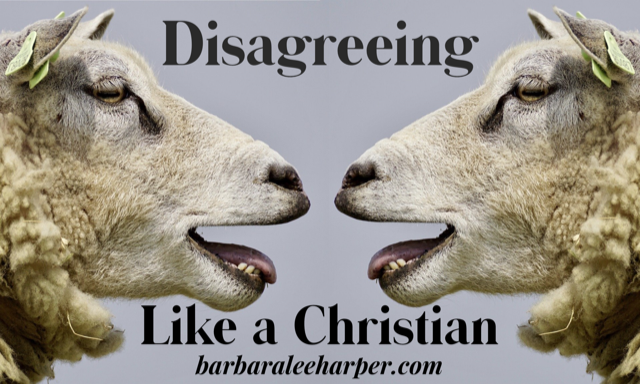
Disagreeing Like a Christian

how to disagree like a Christian

I’ve grieved the last few years over how angry and fragmented our society has become. Disagreements certainly aren’t new, but they seem to be more numerous and angry than I have ever seen.

Maybe it’s always been this way, and social media just brings it all out into the open. I don’t know.

But hatefulness and personal attacks seem more prevalent now than I have ever known.

I used to hear the phrase, “We’ll just have to agree to disagree.” People would discuss a point where they differed, come to an impasse, and set it aside. They didn’t let politics or policies come between their friendship. The issue in question might come up again, but they didn’t feel a need to hammer away at it every time they talked.

Nowadays, it seems people aren’t content to just disagree. They have to constantly poke at the issue on social media. They can’t stop with “I think you’re wrong.” They have to insinuate that people who think or do differently from themselves are stupid or somehow morally inferior.

It’s even more grievous when these zinger posts or snarky memes come at the hands of Christians.

Disagreements are inevitable. But is there a way to handle them without destroying our testimony or harming others or making things worse?

I think so. Here are some considerations.

Decide if it’s worth it to voice disagreement. You’ve heard the saying, “You don’t have to attend every argument you’re invited to.” Proverbs 26:17 says, “Like one who grabs a dog by the ears is a passerby who meddles in a quarrel not his own.” Paul told Timothy, “Have nothing to do with foolish, ignorant controversies; you know that they breed quarrels” (2 Timothy 2:23).

Now, Paul certainly engaged in controversy. He had no problem taking a stand and even naming people who were wrong. But his arguments were over the truth of the gospel and godly practice. People could be led astray from the Lord by what false teachers were spreading, so Paul had to take a stand. But there were other “foolish, ignorant controversies” that it would do more harm than good to get into.

Paul also told Titus, another young pastor, “But avoid foolish controversies, genealogies, dissensions, and quarrels about the law, for they are unprofitable and worthless” (Titus 3:9). He went on to say, “As for a person who stirs up division, after warning him once and then twice, have nothing more to do with him, knowing that such a person is warped and sinful; he is self-condemned” (verses 10-11). There are some people who love to bait others, to stir up controversy, to do little but argue. We’ve had to unfriend some of these kinds of people on social media after a number of appeals were ignored. Proverbs 26:4-5 says, “Answer not a fool according to his folly, lest you be like him yourself. Answer a fool according to his folly, lest he be wise in his own eyes.” There are times to answer someone and times not to. We need God’s leading and wisdom to know which.

Keep in mind our purpose. If our motive is scoring points for our side, that’s just pride. That’s not a good enough reason to engage. If we want to correct what we consider wrong in a person’s thinking or change their minds, we can’t just blast away at them. We need to keep in mind our bigger purpose, over and above our current disagreement: to love and please God, to love and minister to people.

Keep the right tone. Paul went on to instruct Timothy, “And the Lord’s servant must not be quarrelsome but kind to everyone, able to teach, patiently enduring evil, correcting his opponents with gentleness. God may perhaps grant them repentance leading to a knowledge of the truth, and they may come to their senses and escape from the snare of the devil, after being captured by him to do his will” (2 Timothy 2:24-26).

If I see something on Facebook or Twitter that gets me riled up, I know that’s not the time to respond. I have to give it enough time that I am not angry and I am thinking clearly. I lamented to my daughter-in-law recently that I had tried to be very careful and even on a certain controversial issue online, trying to state my case yet not provoke others. But other people seemed to just blast away without regard to whether they offended anyone else. I pondered out loud, “Why can’t I just say what I think?” She said, “Because the Holy Spirit in you is working.” I’m thankful He checks my spirit. I don’t always respond as I should, but I am trying.

James refers to “the meekness of wisdom” and says, “But the wisdom from above is first pure, then peaceable, gentle, open to reason, full of mercy and good fruits, impartial and sincere” (James 3:13, 17).

Make sure we understand their position. We need to ask questions and repeat back to them what we think they’re saying. If you follow some Facebook and Twitter threads, you see some people are way off track from the original statement. Proverbs 18:13 says, “If one gives an answer before he hears, it is his folly and shame.” The New Living translation puts it a little more colorfully: “Spouting off before listening to the facts is both shameful and foolish.” James says, “Know this, my beloved brothers: let every person be quick to hear, slow to speak, slow to anger; for the anger of man does not produce the righteousness of God” (James 1:19-20).

A fear years ago when I was a community guest columnist for the Knoxville News-Sentinel, someone took me to task over something I’d written. The only problem was, I had not said or implied what he inferred. But I could not seem to convince him that he had read into my writing what wasn’t there.

We need to be careful not to presume, infer, or extrapolate.

Look for areas of agreement. In today’s “cancel culture,” when a person publicly does one thing wrong or holds one unpopular opinion, they’re totally blasted on social media. But disagreeing on one point doesn’t mean we’re totally against everything the person says or stands for.

Acknowledge their strong points. Sometimes we think we need to demean or ridicule someone’s position in order to argue against it. That will only make them defensive and unwilling to listen. And often it’s dishonest.

In Andrew T. Le Peau’s book, Write Better, he says, “If we want to be honest persuaders, we will be on the lookout for and stay away from hasty generalizations, false analogies, demonizing opponents, avoiding or sidelining the central issue (that is, using red herrings), and more. Honesty means respecting the truth as best we can know it, respecting contrary viewpoints, giving due credit, and using logic” (p. 44). He points out that “presenting the arguments for these other viewpoints in as strong a form as possible” (p. 55) is not only honest, but doing so actually strengthens our own arguments and the solutions we offer.

Argue against the issue, not the person. We need to avoid getting personal. We don’t need to demean or put down the other person.

Avoid pride. My son commented that some positions are morally superior. That’s true. But if we defend them from a standpoint of pride or condescension, we’re not going to gain hearers.

Years ago, before Facebook and even message boards, people could gather together over shared interests through email subscription loops. Everyone who joined the loop would get all the emails of anyone who participated. I was on one for a medical condition around the time that stem cells began making news. Some of us were concerned about stem cells being harvested from fetuses. Others did not regard a fetus as a viable human being. The issue could have blown up into a shouting match and led to a division in the group. By carefully wording what we had to say, both sides were able to voice their concerns. We could come to a better understanding of each other even if we couldn’t agree.

Romans 14

In Romans 14, Paul discusses how to handle different convictions among Christians on issues where the Bible did not have clear dividing lines. He didn’t tell them to hammer things out until everyone was on the same page. He told them it’s possible to live in love and unity with others in the body of Christ even when people have different opinions. They weren’t to despise or judge each other (verses 3-4). They should do everything as unto the Lord—even if they were doing different things (verse 6). They should be “fully convinced in their own mind” (verse 5) and remember we’re all accountable to the Lord (verses 7-12). They needed to be careful not to cause others to stumble (verses 13-21).

One of the issues of that day concerned what was okay to eat. Paul reminded them, “Do not, for the sake of food, destroy the work of God.”

I’m afraid, in our zeal over controversy today, we haven’t put much thought into whether we’re destroying the work of God.

Jesus warned us that “on the day of judgment people will give account for every careless word they speak” (Matthew 12:36).

Most of these points take time and thought. And social media does not lend itself to context and nuance. Social media seems to thrive on drive-by barbs, on flinging verbal fuel for the fire rather than trying to put fires out. So social media may not be the best place to have meaningful discussions on hair-trigger issues. But It’s not impossible. We can let our lights shine there if we keep in mind God’s glory and our neighbor’s good.

Ephesians 4:29. Build each other up with grace

(Sharing with Sunday Scripture Blessings, Scripture and a Snapshot, Hearth and Soul, Selah, Inspire Me Monday, Senior Salon, Tell His Story, InstaEncouragements,
Recharge Wednesday, Let’s Have Coffee, Heart Encouragement, Faith on Fire,
Grace and Truth, Blogger Voices Network)

Laudable Linkage

A collection of good reading online

Here are a few noteworthy reads discovered in the last couple pf weeks.

On Deconversion. A plausible reason why we’re seeing more of this phenomenon.

Live According to a Plumb Line, not a Pendulum, HT to Challies.

Book Banning in an Age of Amazon, HT to Challies. “Forget the ‘firemen’ from Fahrenheit 451: You needn’t burn forbidden books if people can’t buy them in the first place.”

Is the Crucifixion of Christ Cosmic Child Abuse? HT to Challies. This video clip from the American Gospel film (which I haven’t seen but should) answers that charge as well as the question of why God needs sacrifice to forgive. It might be confusing if you don’t know who the people are in the video, but basically it shows clips from people on opposite viewpoints.

This World Is Passing Away. Beautifully written and a much-needed reminder.

Interactive Bird Map, HT to The Story Warren. This is pretty cool—follow the link to a site where you can click on a bird to see what it sounds like. We have some of these in our yard, but I had not connected which sounds went with which birds except the mourning dove.

“I See the Light” parody—with Ducks. HT to The Story Warren. This is one of my favorite Disney songs, but this parody made me laugh.

Finally, I loved this clip of a baby hearing violin music for the first time.

Happy Saturday!

Friday’s Fave Five

It’s Friday, time to look back over the blessings of the week
with Susanne at Living to Tell the Story and other friends.

Fridays do seem to come around rather quickly! It’s time for another pause to remember how God has blessed this week.

1. Jesse’s move went well. Rain was forecast for the day, but, thankfully, none fell while we were unloading. Jason came over to help. I mostly unpacked and washed the dishes, cookware, etc. that Jesse had bought or been given the last few years. It’s fun to see him excited about having his own place.

2. My daughter-in-law cooked up a storm last weekend. She brought dinner over here a couple of nights, then made several things for Jesse to just heat-and-heat. He won’t need to cook anything but these for at least a week.

3. Pi Day. Since the date 3.14 is the designation for pi—it’s a good excuse to have pie. Yes, we’re silly. 🙂 I didn’t even take a picture since my Facebook memories showed we’d had the same menu the last several years: Hamburger Pie, salad, and Chocolate Pretzel Pie. Here’s the picture from a couple of years ago—they looked the same this year:

53792523_10217796249674963_409987248679813120_n

4. Industrious Timothy. Jason texted me one day this week that Mittu had a migraine and laid down for a while. Timothy entertained himself while Jason worked and checked on him at intervals. One time Jason came out and saw Timothy dusting the blinds, and he said he had also swept the stairs.

5. Jesse’s first laundry visit. 🙂 He bought a washer and dryer, but they won’t be delivered for a couple of weeks. We had invited him to do laundry here even before he bought his own appliances. It was fun to have dinner together an catch up on his week.

Bonus: COVID vaccines. Jim’s company has sponsored a few vaccination sessions in conjunction with a local pharmacy for those in certain age groups or with certain physical conditions. Both of us had health issues that qualified us. This last session included the kind of vaccine we wanted, so we went ahead and got them. Normally I’m a little wary of vaccines, since many people I know with transverse myelitis, the illness I had, contracted it after a vaccine. But, all things considered, after doing our research, we felt the risks involved with the vaccine were less than the risks of getting COVID. Everything went well, and we didn’t have a very long wait. We didn’t have problems afterward except a sore arm for a couple of days.

And that wraps up another week! What’s something good from your week?