Unknown's avatar

About Barbara Harper

https://barbarah.wordpress.com

Laudable Linkage

IMG_0195

Welcome to my almost weekly list of good reads found around the Web.

This Dying Young Woman Has a Message for Us, HT to Challies. “Brooklyn may face dark moments, but they are never so dark that the light of Christ does not breakthrough. Along with telling her story, she wants to speak directly to us, and even when she wants to tell us hard truths, her sense of humor steps in to help us swallow the medicine. ‘I’m sick. Soon to die. But so are you. I’m just doing it faster.'” Brooklyn did pass away March 1.

Truth in Small Bites Is Truth Nonetheless. “When life takes a turn, most of us tend to push Bible reading aside until our circumstances return to normal. If you’re not able to sit down at your kitchen table for a quiet hour of in-depth study, you don’t even crack open God’s Word. Somewhere along the way, you’ve told yourself that if you’re not able to feast, you shouldn’t eat at all, not realizing that a handful of almonds in the middle of the night is far better than allowing your soul to starve.

Sexual Sin Is Not Inevitable, HT to Challies. “God never commands us to do anything without providing the resources to obey by the power of the Holy Spirit.”

Death, Miracles, and Tears from a missionary in Cameroon, HT to Challies. “About three years ago I took a girl in our village named Mami to get an ultrasound. At the clinic I met her boyfriend named Koo who was visibly concerned about her pregnancy. So much so that he made a deal with God: if his baby survived, he would dedicate his life to the Lord.”

The Friend Who Sharpens Me, HT to Challies. “While it’s great to have friends we agree with theologically and mentors who can teach us more about the historical faith we hold to, I’m learning that it’s important to make friends with those I disagree with. It’s important to learn from those with a different viewpoint than me.”

Tell Me a Story? “There are many nights when both Dan and I draw a complete blank. Four sets of eyes stare at us longingly as we frantically rake our minds for something to say, only to come up as empty as one of Pooh’s honey jars. Over the years we have developed a strategy for handling situations like this. It’s easy to implement, and it has never failed.”

This is a good reason to get those dust bunnies when they’re small and few. 🙂

Happy Saturday!

Friday’s Fave Five

Somehow, it’s March already!. Susanne at Living to Tell the Story invites us to pause a moment and recount the blessings of the week. Feel free to join in! Here are a few of mine:

1. In-store apps. I didn’t realize, until my sons told me, that grocery store apps can tell you where to find items. There’s one store I go to maybe every other week, and I get so frustrated at not being able to find things there. Their logic about how items should be laid out is different from my way of thinking, and apparently, that of other stores. It’s so nice to search for an item and then see what aisle to go to.

2. An Amazing Race watch party. Jason, Mittu, Timothy, and Jesse came over to watch the Amazing Race finale. The team we were rooting for was in the final three (and won!). It was fun to watch it together.

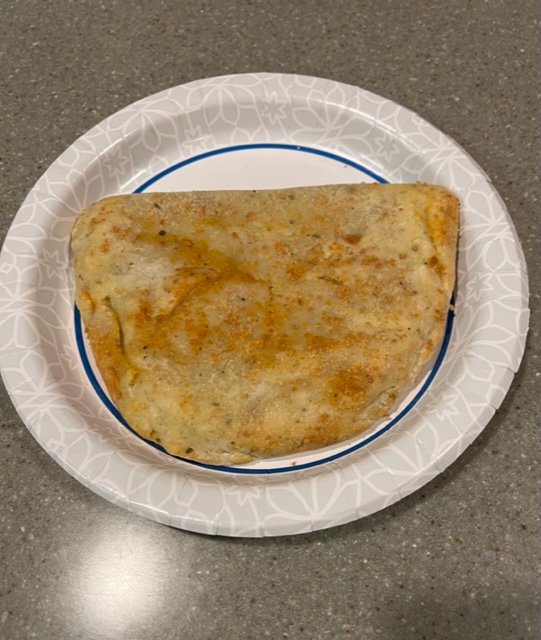
3. Calzones and pie. Mittu made calzones and lemon meringue pie for dinner the night of our watch party. She and Timothy are gluten-intolerant, and she just got a new gluten-free recipe book for Christmas. I think both dishes came from that cookbook. The calzone dough, if I remember correctly, only had three ingredients (I don’t remember what they were, except I think one was yogurt). Both were delicious!

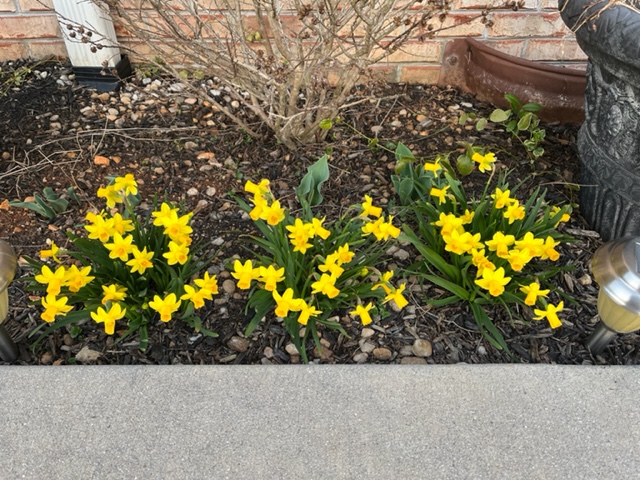
4. Daffodils are the first sign of spring to me, and I was happy to see some of ours in bloom this week. I’m especially thankful that the ones we transplanted survived and are blooming.

5. Nice temperatures and sunshine. It’s been a fairly spring-like week outside, getting into the 70s in the daytime and 40s at night. We’re not completely done with cold weather yet, but I love this harbinger of spring.

How was your week?

100 Best Bible Verses to Overcome Worry and Anxiety

100 Best Bible Verses to Overcome Worry and Anxiety is compiled from writings of several authors and published with Bethany House.

Each two- to three-page spread begins with a Bible verse. The author then adds a brief paragraph about the context the verse was set in. Then several paragraphs about the meaning of the verse and one or two of application are included. Then a few references are listed for additional reading.

When I first saw this book reviewed at Joanne’s, I thought it was a great idea. I’ve mentioned before that anxiety is probably not something that can be conquered by answering an altar call or sitting down for one massive Bible study. Rather, battling anxiety is a matter of continually feeding our souls truth. This book is a wonderful way to keep God’s provision, protection, and promises continually before us in small but substantial doses.

I very much appreciated that the writers delved into the context of the verses before explaining the meaning and applying them. The context enriches our understanding of the passage and keeps us from spinning our own take on a single sentence.

I’ve repeatedly heard that there are 365 Bible verses that say, “Fear not.” That declaration is often followed by the quip, “One for every day of the year.” I had thought this would be a collection of those verses. It’s not (though such a collection would be a great idea for a devotional book). I was surprised at some of the verses used, as they didn’t seem to directly relate to anxiety or worry. But I came to understand they were foundational verses about God’s character or promises. The more we know Him, the less reason we have to be anxious about anything.

Here are just a few of the quotes I marked in this book:

[On John 16:33] It’s a strange way to promise peace—Jesus starts by telling his disciples that they are about to go through a time of sorrow and fear. How is that peaceful? they might have wondered, especially after Good Friday, when their teacher was killed, and it seemed like the world had won.

Still, Jesus’ words, “Take heart!” are a command in the original language, not just an inspirational phrase but something God wanted them—and us—to actively do. It could be phrased “Choose hope!” or “Be encouraged!” (p. 39).

Some seasons, taking heart might be among the hardest of God’s commands to follow. Until we remember the rest of the verse: “I have overcome the world” (p. 40).

[On 2 Timothy 1:7] Fear is a tool of the enemy that exists to keep us from advancing the kingdom of God. It distracts us from trusting him, and instead tempts us to protect ourselves and rely on our own abilities” (p. 51).

In verses 7 and 8 [of Joshua 1], God connects being strong and courageous to faithfully following his Word. Not believing in God’s Word nor taking it seriously had been the sin that forced the Israelites to wander in the wilderness for forty years (p. 62).

[On Lamentations 3:57] His response will always be, “Do not fear.” Not condemnation for being afraid, but telling us there is no need for it. He is holding on to us tightly, a good Father whose perfect love casts out fear . . . if we just ask (p. 65).

[On Genesis 50:20] [Joseph] endured some of the most difficult circumstances and betrayals and still honored the Lord in the midst of them. He refused to see his journey as one setback after another, but instead chose to believe that God was writing a much bigger story (p. 78).

Allow your confidence to be informed by your faith, not your circumstance (p. 79).

[On Psalm 61:2] We don’t need to strive so hard to be self-sufficient when the chaos threatens to overwhelm us, but we can rest in the truth that God is infinitely more capable than we are (p. 121).

[On Psalm 23:4] Dark valleys don’t stay dark. The beauty of a valley is that it dips down but then rises back up. Valleys aren’t endless stretches of defeat, but stretches we walk through and rise from. What a beautiful promise. We are not alone in our valleys. Even as we “walk through,” we don’t need to sprint through in a panic; we will walk through our valley with Jesus by our side and emerge safely, made stronger by the experience (p. 125).

This book doesn’t just try to make readers feel better. It continually points the reader back to God’s character and His Word. Thus, it is an excellent resource when worries or fears try to pull our gaze away from Him.

Be Successful: 1 Samuel

The book of 1 Samuel in the Bible is something of a bridge between eras in Israel’s history. Samuel himself is something of a bridge. He’s the last of the judges. He’s a prophet. He anoints two different kings. He oversaw the transition between Israel as a group of tribes in which everyone “did that which was right in his own eyes” (the theme of Judges) to Israel as a unified nation under a king.

But the transition was not a smooth one. In desiring a king, Israel had rejected the Lord’s leadership. The first king, Saul, had much to recommend him, but he failed spectacularly. David was anointed king, but didn’t come to the throne for several years, and he was on the run from Saul much of that time.

Perhaps the contrast between David and Saul is why Warren W. Wiersbe titled his commentary on 1 Samuel Be Successful: Attaining the Wealth that Money Can’t Buy. But other characters in 1 Samuel have varying degrees of success in following and serving the Lord as well.

The book begins with a childless woman with a longing. Hannah had no children, and she pleaded with the Lord to grant her a son. She promised that she would give the child back to the Lord.

There’s so much treachery, bloodshed, and confusion recorded in 1 Samuel that it’s refreshing to meet at the very beginning of the book a woman who represents the very best that God has to give. The leaders of Israel had failed, so God sought out a woman He could use to help bring truth, peace, and order to His people. She served God simply by being a woman and doing what only a woman could do—give birth to a baby and dedicate that child to the Lord (p. 194).

It’s an awesome fact that, humanly speaking, the future of the nation rested with this godly woman’s prayers, and yet, how much in history has depended on the prayers of suffering and sacrificing people, especially mothers (p. 20).

Eli was a priest whose sons committed awful atrocities in their offices as priests. Eli knew what they were doing and rebuked them, but didn’t restrain them. When Hannah weaned Samuel, the child the Lord had given her, she brought him to Eli’s care in the tabernacle.Somehow Eli protected Samuel from the corruption of Eli’s sons.

The Bible says that during this time, “the word of the Lord was rare in those days” (1 Samuel 3:1). Wiersbe comments, “It was a tragic day in the nation of Israel when the living God no longer sent His people signs and prophetic messages (Ps. 74: 9; Ezek. 7: 26; Amos 8: 11–12; Mic. 3: 6). The silence of God was the judgment of God” (p. 32).

Yet at this time, God spoke to Samuel, and Eli taught Samuel to listen and respond, “Speak, Lord, for your servant hears” (1 Samuel 3:4-18). And “the Lord revealed himself to Samuel at Shiloh by the word of the Lord” (1 Samuel 3:21).

Blessed are those older saints who help the new generation know God and live for Him! However Eli may have failed with his own sons, he helped to point Samuel in the right direction, and the whole nation benefited from it. . . . Eli hadn’t been a great spiritual leader, but he was one small link in the chain that led to the anointing of David and eventually the birth of the Redeemer (pp. 195-196).

Samuel became a godly man who followed the Lord all his life and led the people faithfully. The one spot on his record is that his sons also abused their ministry. We don’t know the circumstances, but Samuel isn’t blamed for his sons’ behavior as Eli had been. Wiersbe offers some possibilities as to what could have gone wrong with Samuel’s sons, but ultimately we just don’t know. Samuel repeatedly pointed the people to the Lord.

Samuel is an example to all older believers who are prone to glorify the past, resist change in the present, and lose hope in the future. Without abandoning the past, Samuel accepted change, did all he could to make things work, and when they didn’t work, trusted God for a brighter future. God didn’t abandon the kingdom; He just chose a better man to be in charge, and Samuel helped to mentor that man. Every leader needs a Samuel, a person in touch with God, appreciative of the past (p. 197).

Saul started out well. He seemed humble in the beginning. But there doesn’t seem to have been much of a personal relationship between him and the Lord. Wiesrbe says, “His was the shallow heart of our Lord’s parable of the sower. There was no depth, the tears were temporary, and no lasting fruit ever appeared” (p. 195). Saul began taking matters into his own hands instead of waiting on God and following His directions. “Serving God acceptably involves doing the will of God in the right way, at the right time, and for the right motive” (p. 92). “To know God’s will and deliberately disobey it is to put ourselves above God and therefore become our own god. This is the vilest form of idolatry” (p. 95). Then Saul began to be jealous of David’s fame, then became murderous and unstable. His decline is one of the saddest parts of Scripture.

When Saul was chosen king, he was given authority from God and from the nation, but when he won this great victory, he gained stature before the people. It takes both to be an effective leader. The difficulties began later when Saul’s pride inflated his authority and began to destroy his character and his stature. David was humbled by his success, but Saul became more and more proud and abusive (p. 65).

Jonathan was Saul’s son and heir to the throne, yet Jonathan recognized his own father’s instability and David’s call. He was a true friend to David.

Jonathan leaves behind a beautiful example of what true friendship should be: honest, loving, sacrificing, seeking the welfare of others, and always bringing hope and encouragement when the situation is difficult. Jonathan never achieved a crown on earth, but he certainly received one in heaven. “Be thou faithful unto death, and I will give thee the crown of life” (Rev. 2: 10) (p. 200).

David was a “man after God’s own heart.” As I mentioned in an earlier post, pastor Stephen Davey says this doesn’t mean David was perfect, but his priority was God and His will and his relationship with God. Much could be said about David. He’s one of my favorite Bible characters, though I’ve grieved over the fall to come in the next book.

David was a unique blending of soldier and shepherd, musician and military tactician, commander and commoner. In spite of his sins and failures—and we all have them—he was Israel’s greatest king, and always will be until King Jesus reigns on David’s throne as Prince of Peace. The next time we’re tempted to emphasize the negative things in David’s life, let’s remember that Jesus wasn’t ashamed to be called “the son of David” (p. 200).

Finally, 1 Samuel isn’t just a book of exciting stories, downfalls and successes, battles and failures. “The Lord is mentioned over sixty times in 1 Samuel 1—3, for He is the chief actor in this drama” (p. 17). Throughout the book, God orchestrated His will to be done and His coming Messiah’s preparation.

How Well Do We Know Him?

Have you ever had anyone give you a gift that showed they didn’t know you very well at all?

Or introduce you to someone else with phrasing that made you wonder who they were talking about?

I think one of the deepest desires of our hearts is to be known for who we truly are. Though we may have several acquaintances and friends, our best friends are probably the ones who “get” us the most.

Getting to know each other requires effort. Usually there is some kind of instant connection or like interests that draw two people together. But really getting to know each other comes with years of talking, listening, and being together.

Even then, those kinds of friendships don’t mean we’ll always understand each other or will never learn anything new about each other.

And if being truly known is one of our deepest desires, one of our deepest frustrations is being misrepresented or misunderstood. In one town we lived in, my husband was involved in local politics and had some brief interactions with the local press. It was amazing how often the media got details wrong or inferred meaning that was not implied.

God is the one who knows us best and still loves us. He knows exactly what we need when we need it. He made us, He planned for us from before the foundation of the world. He knows our frame, he knows our deepest thoughts.

O Lord, you have searched me and known me!
You know when I sit down and when I rise up;
    you discern my thoughts from afar.
You search out my path and my lying down
    and are acquainted with all my ways.
Even before a word is on my tongue,
    behold, O Lord, you know it altogether (Psalm 139:1-4).

Have you ever had an answer to prayer that was so exquisitely detailed and perfectly met your needs that you knew it could only have come from God? Or have you ever been burdened about something, opened your Bible for the day’s reading, and found the answer to the very thing you were thinking about before? Few things make me feel so known and loved by God.

But how well do we know Him?

Wrong views of God abound in the world. As a child, I had a mental picture of Him as a scowling deity peering over a thundercloud with lightning bolts in His hand, just ready to zap me when I did wrong. Others picture a kindly, indulgent grandfather who will always smile, pat them on the head, and let them get away with anything.

J. I. Packer said in his classic book, Knowing God:

How often do we hear this sort of thing: “I like to think of God as the great Architect (or Mathematician or Artist).” “I don’t think of God as a Judge; I like to think of him simply as a Father.” We know from experience how often remarks of this kind serve as the prelude to a denial of something that the Bible tells us about God. It needs to be said with the greatest possible emphasis that those who hold themselves free to think of God as they like are breaking the second commandment. . . .

All speculative theology, which rests on philosophical reasoning rather than biblical revelation, is at fault here. Paul tells us where this sort of theology ends: “The world by wisdom knew not God” (1 Cor 1:21 KJV). To follow the imagination of one’s heart in the realm of theology is the way to remain ignorant of God, and to become an idol-worshipper, the idol in this case being a false mental image of God, made by one’s own speculation and imagination (pp. 47-48).

The Bible says there are those who “have a zeal for God, but not according to knowledge” (Romans 10:2) and who “profess to know God, but they deny him by their works” (Titus 1:16). Some who think they know Him and even call Him Lord will be surprised one day when He says, “I never knew you; depart from me” (Matthew 7:21-23).

How can we be sure we know Him, and know Him aright? Not only does the welfare of our souls depend on knowing God for who He truly is, but so does the welfare of those we speak and write to and influence.

Our spiritual life begins with coming to know Him. Jesus said to His Father in John 17:3: “And this is eternal life, that they know you, the only true God, and Jesus Christ whom you have sent.” When we understand that we’re sinners, deserving of God’s wrath, but He loved us and died to save us from that wrath, and we turn to Him in repentance and faith, we begin to know Him. (For more information, see How to Know God.)

Paul said in Philippians 3:8-11

Indeed, I count everything as loss because of the surpassing worth of knowing Christ Jesus my Lord. For his sake I have suffered the loss of all things and count them as rubbish, in order that I may gain Christ and be found in him, not having a righteousness of my own that comes from the law, but that which comes through faith in Christ, the righteousness from God that depends on faith— that I may know him and the power of his resurrection, and may share his sufferings, becoming like him in his death, that by any means possible I may attain the resurrection from the dead (emphasis mine).

First, Paul said that knowing Christ was worth the loss of everything else. Then, though Paul already knew God, he wanted to know Him more, to know Him better. Bible Study Tools’ commentary on this verse says:

This power and virtue the apostle had had an experience of, yet he wanted to feel more of it, in exciting the graces of the spirit to a lively exercise, in raising his affections, and setting them on things above, and in engaging him to seek after them, and set light by things on earth, and in causing him to walk in newness of life, in likeness or imitation of Christ’s resurrection, to all which that strongly animates and encourages.

Just as it takes time to know other people, it takes time to know God. Though He already knows all about us, He wants us to talk to Him in prayer. He has revealed Himself through nature, but He has revealed Himself most clearly in Christ and in His Word.

1 Samuel 3:21 says, “The Lord revealed himself to Samuel at Shiloh by the word of the Lord.” God reveals Himself to us the same way. Interestingly, verse 1 of that chapter says “the word of the Lord was rare in those days.” Then comes the incident where Samuel thinks Eli is calling to him, until Eli finally realizes it’s the Lord who is calling Samuel. Eli instructs Samuel to respond, “Speak, Lord, for your servant hears.”

Paul says in the Philippians 3 passage referred to above “that I may know him and the power of his resurrection”—we love that part— “and may share his sufferings.” We don’t like that last part so much. Yet when we endure sufferings by seeking Him in His Word and prayer, we come to know Him in ways that we couldn’t otherwise.

There will always be more we can know about God. 1 Corinthians 13 says we “know in part” (verse 9), “we see in a mirror dimly” (verse 12). But someday we’ll see Him “face to face. Now I know in part; then I shall know fully, even as I have been fully known” (verse 12).

But God has enabled us to know Him here and to continue to know Him better and more fully until we see Him.

For God, who said, “Let light shine out of darkness,” has shone in our hearts to give the light of the knowledge of the glory of God in the face of Jesus Christ (2 Corinthians 4:6).

That the God of our Lord Jesus Christ, the Father of glory, may give you the Spirit of wisdom and of revelation in the knowledge of him, having the eyes of your hearts enlightened (Ephesians 1:17-18a).

Until we all attain to the unity of the faith and of the knowledge of the Son of God, to mature manhood, to the measure of the stature of the fullness of Christ, so that we may no longer be children, tossed to and fro by the waves and carried about by every wind of doctrine, by human cunning, by craftiness in deceitful schemes. (Ephesians 4:13-14).

So as to walk in a manner worthy of the Lord, fully pleasing to him: bearing fruit in every good work and increasing in the knowledge of God (Colossians 1:10).

May grace and peace be multiplied to you in the knowledge of God and of Jesus our Lord. His divine power has granted to us all things that pertain to life and godliness, through the knowledge of him who called us to his own glory and excellence, by which he has granted to us his precious and very great promises, so that through them you may become partakers of the divine nature, having escaped from the corruption that is in the world because of sinful desire (2 Peter 1:2-4).

But grow in the grace and knowledge of our Lord and Savior Jesus Christ (2 Peter 3:18)

And we know that the Son of God has come and has given us understanding, so that we may know him who is true; and we are in him who is true, in his Son Jesus Christ. He is the true God and eternal life (1 John 5:20).

(I often link up with some of these bloggers.)

Laudable Linkage

Here are a few good reads found this week:

I Frequently Feel Like a Father Failure, HT to Challies. Moms feel like failures, too (see next article). My best comfort is that God knew parents weren’t going to be perfect before He gave them children. That knowledge is not an excuse for not doing our best as parents, but it admits we do need His grace.

Two Truths and a Lie about Being a Working Mom, HT to Story Warren. Though I didn’t work outside the home after my kids were born, I struggled with balance and guilt in being involved in other things, even ministry opportunities, instead of being with my children. “This life is a briar patch, tugging and pulling on our best-laid plans. Our inability to strike the balance as mothers is not always a mark of our failure—it’s a mark of our humanity on a broken earth. While we need to be good stewards of our time, God isn’t asking us to cobble together the perfect formula for a perfectly balanced life; he’s asking us to be humble enough to regroup when things aren’t working, to walk in the grace purchased for us in Christ, and remember that ‘the steps of a [mother] are established by the LORD, when [she] delights in his way’ (Ps. 37:23).”

Deeply Loved, Dearly Missed, HT to Challies. “The world could not possibly understand how one individual, so limited in natural ability, could possibly impact the lives of so many. But that’s exactly what James Bruce did.”

On Christians Reading Fiction: Developing Empathy. “Modern psychologists have done quite a bit of work on the fact that fiction readers tend to be more empathetic people. Most theorize that the same skill is required: putting yourself in someone else’s spot for a time. When we suspend our daily life to enter into the experiences of a fictional character, we exercise a muscle of living someone else’s life for a bit. If this muscle is strong enough, the argument goes, we are better able to do this in real life, as well.”

The Seven Works of the Holy Spirit, HT to Challies. “Later, many of those pastors came to me and asked, ‘Do you think that the things in that meeting were from the Holy Spirit or not?’ I loved it when these pastors came and asked this question. It gave an excellent opportunity to talk to them about what the Bible teaches about the Holy Spirit.”

The Ten Commandments Are a Mentor Leading Us to Christ, HT to Challies. “The Ten Commandments are a mentor to lead you to faith in Christ. A mentor is someone who can show you where you need to go and walk with you till you get there. Properly understood, that’s what the commandments will do.”

Finally, Victor Borge is always good for a smile:

Have a good Saturday!

Friday’s Fave Five

Another Friday is here, the last one for February. Susanne at Living to Tell the Story invites us to pause a moment and recount the blessings of the week. Feel free to join in! Here are a few of mine:

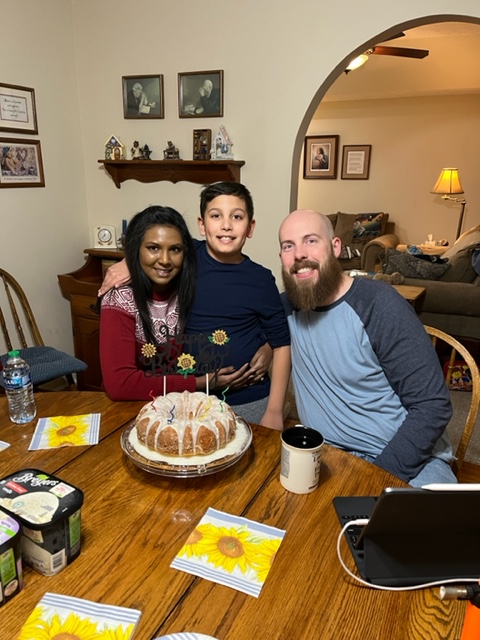
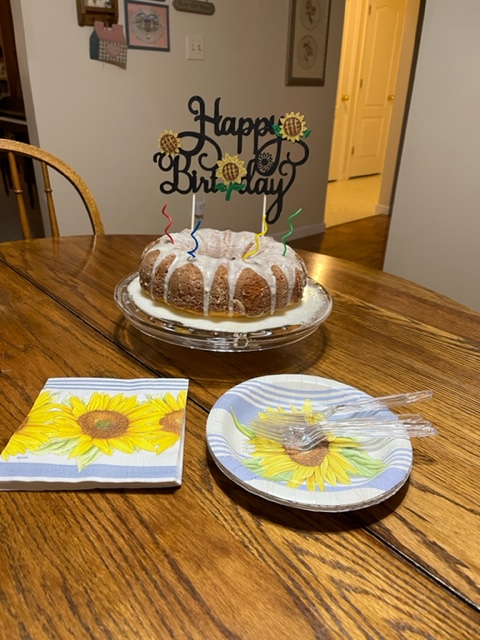
1. My daughter-in-law’s birthday. It’s a joy to celebrate her coming into the world and into our lives.

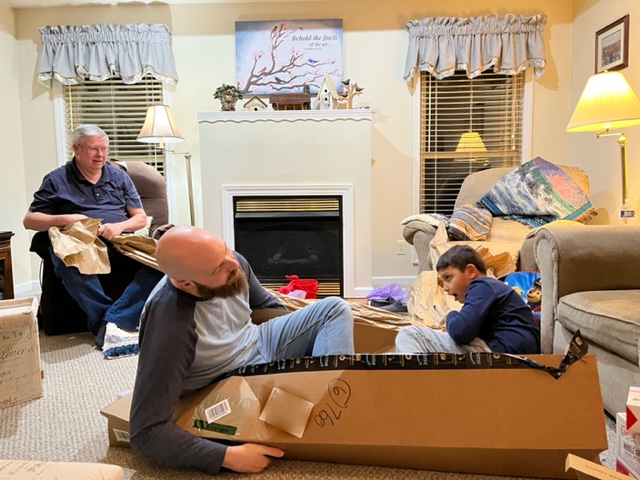
2. Big empty cardboard boxes. One of Mittu’s presents came in a long cardboard box which then became a boat in a storm chased by a sea worm (aka the brown packaging stuff) and lured by a siren (MIttu). I think our kids have had more fun with cardboard boxes (ones big enough to climb in) than with most other things, so seeing Timothy do the same brought back a lot of fun memories.

3. Medical test done. This has been on the horizon since early January and had to be rescheduled several times. It’s nice to have it over with. Plus God took care of all my concerns about the preparation and test itself.

4. An unexpected gift. One of my sisters sent all the rest of us a cute plaque she had made which read, “Side by side or miles apart, sisters will always be connected by heart.” Then she had all five of our names and a big heart at the bottom. She also included a little book for each of us that had a ton of interesting facts about our birth year. How fun to get a surprise package in the mail with sweet and thoughtful gifts!

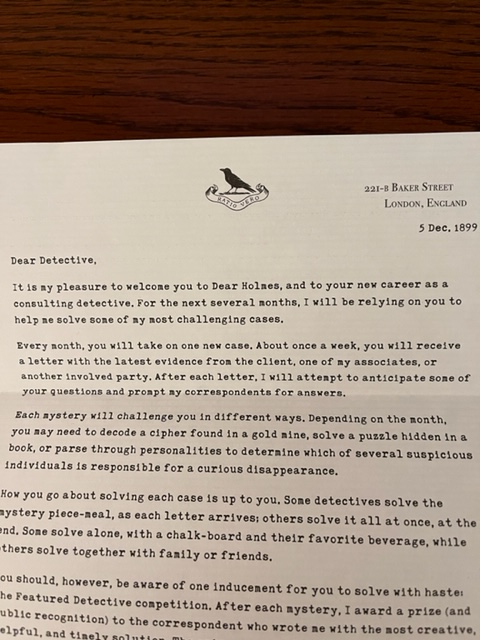
5. Dear Holmes club. For Christmas, my husband had enrolled me in the Dear Holmes mysteries. You get a letter every month with clues about a particular Victorian-era mystery and a challenge to send in answers before the reveal at the end of the month. Somehow in my first reading I had missed that it was a monthly challenge, so I had let a few letters pile up (when my husband brings in the mail, I’m usually finishing up at the computer and getting ready to start dinner, so I don’t usually open anything then that will take some thought or needs a response). I worked on them yesterday, figured out the culprit, but then saw the last was the letter from “Sherlock” with the mystery solved (and I was right in my guess!) Now that I have a handle on how it works, I’m looking forward to beating the detective next time. 🙂

Happy Friday! What’s something good from your week?

February Reflections

Once again the end of the month is still a few days away, but there will probably be other posts between now and then. So I thought this might be a good time for my end-of-month post.

February is when winter starts getting old. However, the month has its highlights. One is my daughter-in-law’s birthday. Another is Valentine’s Day, which we celebrate as a family. Another is that the daylight that has been steadily increasing since the winter equinox finally becomes enough to be noticeable.

This year we had the added benefit of the Olympics in February. I rarely watch sports on TV except when the Olympics are on. We watched mostly figure skating, but caught some skiing, bobsledding, and snowboarding as well. One night when we were looking for something from the Olympics to watch while eating take-out, all we could find was a curling match between the US and China on the NBC app. There’s a reason curling is only shown in clips in prime time! It’s not the most exciting sport to watch, though I am sure a lot of strategy is involved for the players.

My favorite Olympic moments: Nathan Chen’s gold medal free skate program, Lindsey Jacobellis and Nick Baumgartner’s win in the mixed snowboard cross (with the two of them being among the oldest Olympic competitors), and Shawn White’s last run and then closing interview with Mike Tirico.

Home and family

A couple of organizing projects had been tugging at me since before Christmas without the chance to do anything about them. I finally got to them this month. It would be too long and boring, probably, to tell all about them. But one involved getting things I only use once or twice a year, like seasonal cookie cutters and pumpkin-carving tools, out of a kitchen drawer and into the pantry. I didn’t take “before” pictures, but here are the bins in the pantry afterward:

And here’s the drawer, the deepest one on the kitchen. Imagine it with most of the stuff in those bins in here in plastic bags. It seemed whatever I wanted in here was always at the bottom of the drawer. I’m so much more pleased with it now.

I used to post Timothyisms, funny little things my grandson would say. He still says cute things, but I don’t think to write them down. He likes jokes now, so I collect them and share them with him. My favorite recent one: Why don’t anteaters get sick? Because they’re full of anty-bodies. 🙂

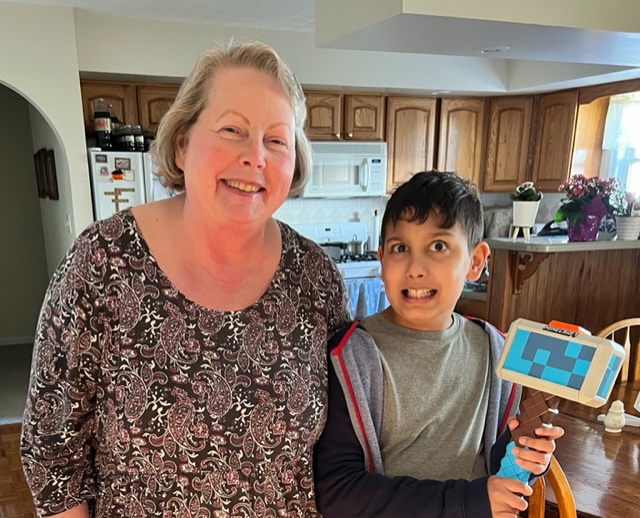
Jason just took this picture of Timothy and me last week. He’s only 8 (next month), but is almost as tall as I am!

And, yes, he’s in the making-funny-faces-for-the-camera stage of life. 🙂

Creating

February was a banner month for card-making, between Valentine’s Day and a couple of birthdays.

Going in chronological order, this was a card for a friend’s birthday. Only . . . I had the date wrong. I had it on my calendar and gathered a few things together and made her a card. Then the night before, I thought maybe I should check the church directory and make sure of her birth date. And I discovered it was in July, not February! I decided to go ahead and give everything to her since she’d probably get a kick out of it. We could almost call it her half-birthday. 🙂 Plus, I didn’t want to have to keep up with the things until summer. As it turned out, when I dropped the things off at her house, she had had a very draining couple of days. So an unexpected non-birthday gift was a day-brightener.

She likes blue-green and sunflowers. The flowers here were multi-layered stickers.

Here are the Valentine’s cards:

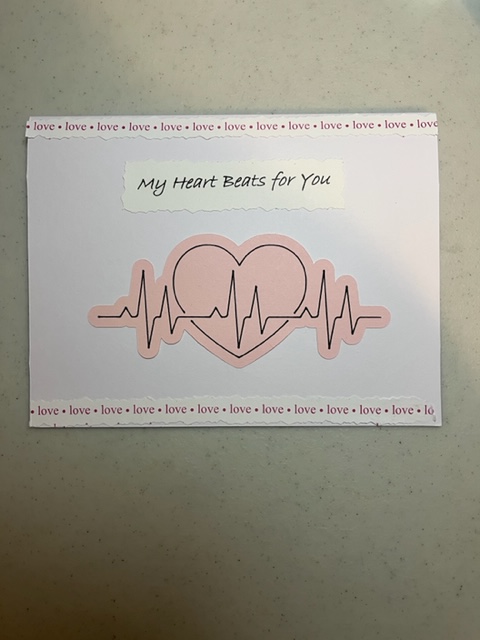
This one was for Jim:

The heart and EKG-type readout were done with the Cricut. The original idea I had seen for something similar to this said, “You make my heart beat faster.” Since I have afib, I thought that might not be the best wording. 🙂

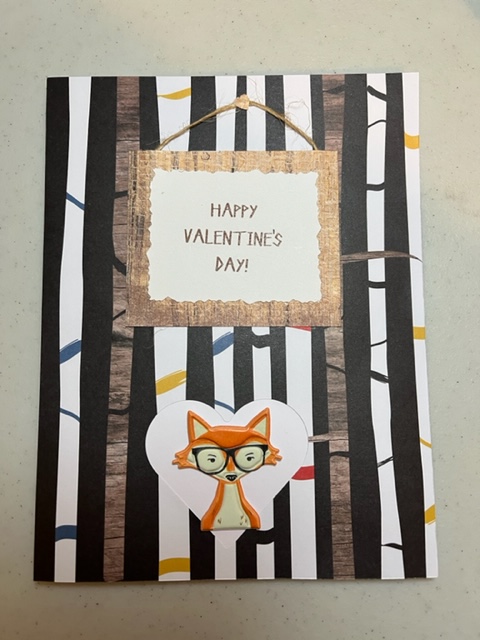
This was for Jeremy, who likes foxes:

The fox here is a puffy sticker. I used a heart-shaped punch for the cut-out and did the wording for the sign on the computer. Everything else is scrapbooking paper.

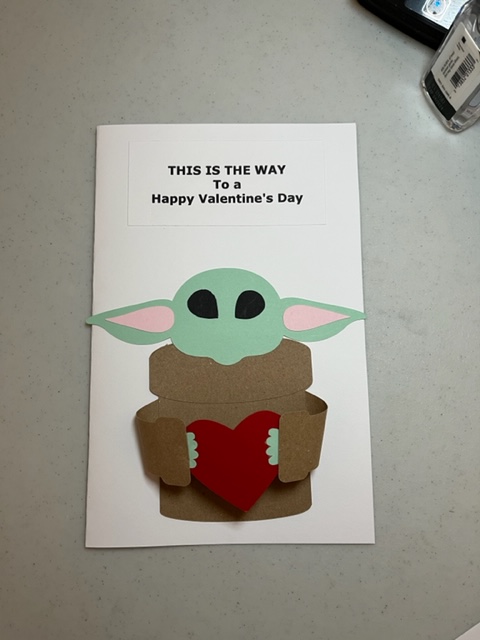
When I saw this, I couldn’t resist it for Jason, even though it meant downloading and printing a file rather than cutting and pasting. 🙂

If you are not familiar with these characters, they are from the Mandalorian. I don’t know much about Star Wars and haven’t even seen all the movies, but we loved this series. Jason especially like the fatherhood theme in it. “This is the way” is something the Mandalorians say repeatedly. This was designed by Karen, which she generously offered as a free download. It’s designed with multiple cards on one page that can be cut out and distributed to kids’ friends. I adapted it for a single larger card.

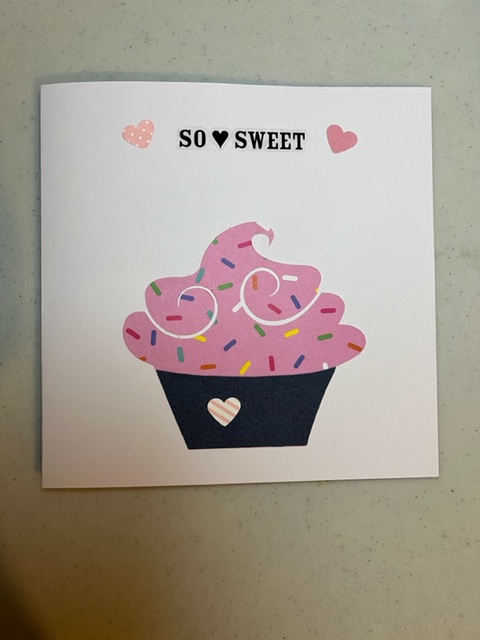
This one was for Mittu:

The cupcake was made with the Cricut, the hearts with hole punches, and the words with stickers.

This was Timothy’s:

It’s also Mandalorian-inspired, designed and generously offered free by Mandee. And she even included a link that explained how to download this into the Cricut to be cut there, so I learned a new facet of the Cricut. I hadn’t thought about Baby Yoda when I was at Hobby Lobby buying supplies, and I was relieved to have just the right shade of green paper among my stash.

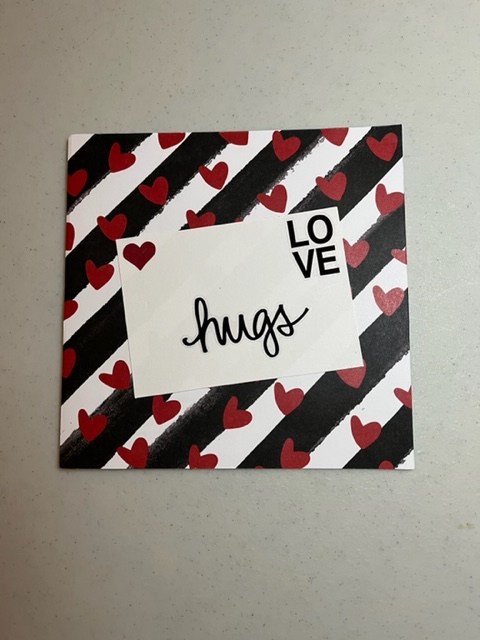
This was for Jesse. I just liked that paper for him, as he likes red but doesn’t like overly mushy cards.

The “love” and “hugs” were stickers.

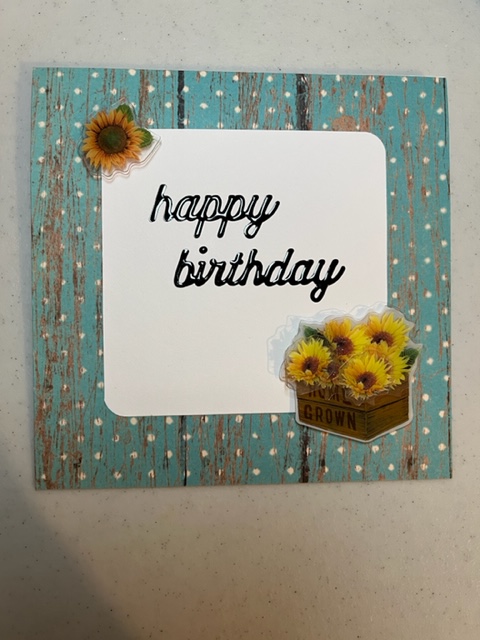
Finally, this was for Mittu’s birthday. She likes sunflowers and purple, but until now I had not seen paper that combined the two.

The “Happy birthday” and sunflowers by it were stickers. The rest was from a scrapbooking paper set.

Watching and Listening

As previously mentioned, the Olympics took up most of our viewing time this month. Though I enjoyed them, I’m kind of glad they’re over.

We’re still watching The Amazing Race and the Holderness family podcast/video recaps the day after each episode airs.

Around the World in 80 Days wrapped up on PBS. As I said last month, though no film adaptation is going to be exactly like the book, they rewrote too much of this one. Really, I felt they just hijacked the characters and main story arc to write their own program, adding in modern-day dilemmas and sensibilities. But . . . if I stopped comparing it to the book and just took it as it was, I enjoyed it. My husband had never read the book and enjoyed the series a lot. I tried to resist saying “In the book it was like this . . .” too often, but I did let it slip sometimes.

All Creatures Great and Small on PBS Masterpiece Theatre finished its second season this last Sunday. I’ve only read the first book in Herriot’s series, and that was a long time ago, so I am not sure how much was changed between book and film. But I loved this series–so heart-warming. I’m looking forward to their third season.

Jim and I watched the old movie The Guns of Navarone one night. Another night, we watched Good-bye Christopher Robin, kind of a sweet and sad telling of A. A. Milne and his family: how he came to write books about Christopher Robin (his real son’s name, though he didn’t go by it in real life), how the fame affected all of them. I knew that Christopher had liked the fame at first and then resented his father’s sharing of his life later on. This might be a cautionary tale for those who write about their real-life children. In the film, Christopher eventually overcomes his resentment when he realizes the comfort and joy the Pooh stories gave people in their childhoods, the memories of which brought comfort to them even as adults. I had Christopher’s book, The Enchanted Places, in my Kindle app and immediately started reading it, hoping he came to a similar conclusion in real life. Pooh was a big part of my children’s growing-up years, though we were more familiar with the Disney videos and toys than the original books. But Pooh and Christopher Robin and the rest will always have a soft spot in my heart.

One other series I watched was on PBS was the two-part A Very British Romance, tracing romantic rituals through English literature. Pluses: the literature, courtship history, host Lucy Worsley’s dressing up as some famous literary heroines, some elaborate original Valentines. Minuses: the feminist lens through which much of this was processed, the looking down on virtuous heroines and equating virtue with weakness, the amplification of sexual liaisons or reading into books more sexuality than was originally meant. Since I recently listened to The Other Bennet Sister by Janice Hadlow, where Mary Bennet read much of Thomas Carlyle, it was interesting to hear more about him here.

Reading

The Olympics cut into my reading-before-bed time. But here’s what I managed to finish this month:

  • Half Finished by Lauraine Snelling (fiction). A group of friends starts a UFO club, not for exploring extra-terrestrial life, but for finishing unfinished projects while fellowshipping with each other. Relationships form and people band together to help each other through the sorrows and joys they encounter.
  • The Road Home by Malissa Chapin (fiction). A woman running from her past encounters a recipe box in an antique shop. An attempt to return the box to the owner’s family leads to a road trip in a pink Cadillac and the story of another woman who tried to hide truth. A very good debut novel.
  • Framley Parsonage by Anthony Trollope, the fourth of his Barsetshire Chronicles (classic fiction, audiobook). A young vicar trying to get in with society’s elite gets into trouble. The village matron’s son falls in love with the vicar’s sister rather than the beautiful but cold society maiden his mother had picked out for him.
  • The Middle Matters: Why That (Extra)Ordinary Life Looks Really Good on You by Lisa-Jo Baker (nonfiction). Lisa-Jo discusses the impact of our middle years in eight areas: our bodies, marriage, parenting (which gets two chapters), in a breezy chatting-with-girlfriends style.

I’m currently reading:

  • 100 Best Bible Verses to Overcome Worry and Anxiety (still. Almost done.)
  • Be Successful (1 Samuel): Attaining Wealth That Money Can’t Buy by Warren W. Wiersbe
  • IBS for Dummies by Carolyn Dean and L. Christine Wheeler
  • The Enchanted Places: A Childhood Memoir by Christopher Milne
  • The Small House at Allington by Anthony Trollope (audiobook)
  • Just 18 Summers by Michelle Cox and Rene Gutteridge

Next in the queue: The Four Loves by C. S. Lewis, Another Gospel?: A Lifelong Christian Seeks Truth in Response to Progressive Christianity by Alisa Childers, The Last Chronicle of Barset by Anthony Trollope, Wiersbe’s “Be” book on 2 Samuel.

Blogging

Besides book reviews, Friday Fave Fives, and Saturday Laudable Linkage, I had these posts on the blog this month:

  • Ways to Disagree Without Tearing Each Other Down. Disagreements are inevitable, even among those we love best. But we can disagree graciously and constructively without belittling each other.
  • Don’t Let Truth Become Cliche. If some parts of the Bible seem trite or overly familiar to us, the solution is not to scale back on our Bible reading. I share some ways to refresh our view and renew our love for the Word.
  • Does He Still Love Me? Sometimes it’s hard to comprehend God’s love for us when we continue to mess up. Maybe that’s why Paul prayed the Ephesians might “know the love of Christ that surpasses knowledge” (Ephesians 3:19).
  • What Can We Know for Sure? Some say there is no absolute truth, even in Christianity. But, though people will argue about some things until we get to heaven, God has given us core truths that we can know for sure.

Incidentally, I noticed a while back that I had passed the 5,000 mark in posts. I’m at 5,059 now in 15 1/2 years of blogging.

As we wrap up February and turn to March, we look forward to my husband’s birthday early in the month and Pi Day (when we eat pie on 3/14). Then the calendar is pretty much free until mid-April. I hope to dig into some writing then.

I’m aware of the news, though I don’t mention it much here. I figure it’s mentioned plenty elsewhere. There’s not much we can do about any of it except pray, but that’s the biggest, best, most important thing we can do. Among my prayers: wisdom for our leaders (1 Timothy 2:1-4), that events will cause people to turn to the Lord, “that all the peoples of the earth may know your name and fear you” (1 Kings 8:43), that those suffering may know “The Lord is a stronghold for the oppressed, a stronghold in times of trouble. And those who know your name put their trust in you, for you, O Lord, have not forsaken those who seek you” (Psalm 9:9-10).

(I often link up with some of these bloggers.)

The Middle Matters

I’ve often thought that the “middle-aged spread” refers not to an expanding waistline, but to the number of years we claim middle age. Because what’s next after middle age? Old? Elderly? We need some designation between the middle and the end.

At any rate, even though I’m on the far side of middle age, Lisa -Jo Baker’s book caught my eye when it was on sale for the KIndle app: The Middle Matters: Why That (Extra)Ordinary Life Looks Really Good on You. I had heard Lisa Jo’s name but never read her, and I’ve not often seen books for this stage of life.

Lisa-Jo discusses the impact of our middle years in eight areas: our bodies, marriage, parenting (which gets two chapters), our homes, failures, friendship, and faith. “Discusses” is probably too formal a word. Each topic is addressed in three to seven essays. Lisa-Jo writes in a breezy chatting-with-girlfriends style.

It’s hard to summarize a series of essays, so I’ll just give you some samples.

One of my favorite chapters is “When You Think Your Love Story Is Boring.” The epigraph of this chapter comes from a teenager quoted in Huffington Post who feels her love life will never be adequate “until someone runs through an airport to stop me from getting on a flight.” Lisa-Jo shares many examples of love demonstrated in the everyday rather than the once-in-a-lifetime grand gesture.

He lays down his life, and it looks like so many ordinary moments stitched together into the testimony of a good man who comes home to his family driving the old minivan, the one with the broken air-conditioning (p. 40).

And this is a love life: to live each small, sometimes unbearably tedious moment… together. To trip over old jokes and misunderstandings. To catch our runaway tongues and tempers and tenderly trust them to the person who now knows firsthand our better and our much worse (p. 41).

He’s never run through an airport for me. But he goes to Walmart at 9: 30 p.m. for back-to-school supplies that we’ve had all summer to get and of course have left till the last minute. When he walks into the living room at 11: 00 p.m. with bags full of the obligatory red, green, yellow, and blue folders and all the million pre-sharpened number-two pencils, it’s the sexiest thing I’ve seen all week (p. 41).

Another chapter that I loved told of a joyous night with Lisa-Jo’s daughter’s triumph in a school program. When Lisa-Jo looked at the photos taken that evening, first she saw the joy. Then, looking more closely, she noticed a picture of her “generous muffin top bulging over her jeans as she presses up next to her daughter” (p. 26). Instead of being embarrassed or deleting the photo, she decided “There was too much happiness to ever diminish it by worrying about waistlines” (p. 26).

In “What You Don’t Know About Parenting,” Lisa-Jo tells of a time her daughter was in another program, where she struggled with what Lisa-Jo thought was pre-program jitters which would be fine once the performance started. But her daughter had full-blown stage fright, tears streaming as she danced her part. Lisa-Jo struggled with indecision as to the best course of action—sweeping her daughter off the stage or letting her finish. “I don’t know if we can ever actually protect our kids from their own fears. Maybe all we can do is show them how brave they are to face them” (p. 90). After the program was over and everything settled down, Lisa-Jo called her mother-in-law to pour out her heart.

And as mothers have always done, she listened and loved me and then encouraged me with the deep understanding born of her own lifetime of learning what you don’t know by simply walking through it. This is what we mothers do for each other—we offer our own failures as proof that our sisters and daughters, our nieces and grands, will make it through the perilous journey of mothering too. Because no matter how many books you read or podcasts you listen to, nothing can prepare you for the fall you weren’t expecting (p. 91).

When heroes fall, Lisa-Jo wants her children to know, “fame is not where we go when we’re looking for something to believe in. Neither is the pulpit nor the soccer field, nor the stage nor the movie studios, for that matter. . . . power and influence and fame can be a slippery, lying slope” (p. 95).

When her son wants to race in the Olympics:

When they ask you if you believe that they’ll make their way to the Olympics someday, what do you—that mother behind the steering wheel who can’t see the future—tell your son?

Do I really want to be the anchor here holding him back? How do I cheer for him while also being a plumb line for truth? (p. 163).

Concerning a twice-monthly potluck hosted at her home: “Some weeks I look forward to it. Some weeks I’m exhausted at the thought of it. But we just keep opening the door no matter how we feel” (p. 136).

A couple more quotes:

Sometimes friendship is a deep conversation. Sometimes it’s a shared ugly cry. But sometimes friendship is the gift of not being afraid of silence (p. 204).

I don’t have easy answers to the hard questions, whether they’re on the news or coming from your doctor or your kid’s teacher or your coworker or a dear friend. I have only the hope of a hand in mine. The hand of this man, Jesus, who isn’t afraid and who builds things that don’t sink (p. 242).

I enjoyed this book and found it very easy to read. Lisa-Jo definitely has a way with words and weaves them with humor and poignancy. Some reviewers felt the book was more of a memoir or only appealed to women in the exact same stage of life–forty-something, married with kids. But I benefited from it even though I am an older empty-nester. Even though Lisa-Jo’s style is not didactic, readers can learn much from what she shares.

(This book will count for the Nonfiction Reader Challenge, where I am doing the Nonfiction Grazer track of basically doing my own thing. 🙂 But this would also fit in the “Linked to a Podcast” category a of the challenge since Lisa-Jo has a podcast [which I have not yet listened to] with Christie Purifoy called Out of the Ordinary.)

What Can We Know For Sure?

One philosophy popular in the last several years espouses that there is no absolute truth.

This works out conveniently for those who want to follow nontraditional courses. If there are no absolute, inarguable truths, then everyone can define their own truth.

But what happens when individual truths differ, or even clash with each other?

Just spend a little time on social media, and you’ll see. Instead of allowing everyone to have his or her own truth, society “cancels” anyone whose “truth” falls outside current societal values.

This philosophy has even crept into the church, sounding something like this: none of us is God, after all, and none of us knows everything perfectly. Therefore, we can’t be too dogmatic about anything.

It’s true, none of us is God. And it’s true none of us has perfect knowledge of all things. We’ll always be learning, growing, adjusting our philosophy to Bible truth as we understand it.

It’s wise to search out answers to questions. We might (and probably will) end up at the point that God is bigger than we are, and we can’t understand everything He does. But that shouldn’t be the smack-down, conversation-stopping answer to questions. There are many reasons young people have left the faith of their upbringing, but I think one factor is that the church has sometimes treated questions themselves as rebellion instead of invitations to help the person search out answers about the faith

But though all these caveats are true, it does not therefore follow that there’s nothing we can know for sure spiritually. There are some questions theologians will argue over til kingdom come, but there are core truths God has laid out in His Word.

Here are just a few:

There is a Creator.

“For what can be known about God is plain to them, because God has shown it to them. For his invisible attributes, namely, his eternal power and divine nature, have been clearly perceived, ever since the creation of the world, in the things that have been made” Romans 1:19-20). Psalm 19:1-3 tells us: “The heavens declare the glory of God, and the sky above proclaims his handiwork. Day to day pours out speech, and night to night reveals knowledge. There is no speech, nor are there words, whose voice is not heard.”

God is the Lord

Isaiah 45:6 says, “that people may know, from the rising of the sun and from the west, that there is none besides me; I am the LORD, and there is no other.” The phrase “that you may know that I am the Lord” appears about 70 times in Ezekiel and several times through the Bible in other places.

I used to sometimes see the saying, “Coincidences are God’s way of remaining anonymous.” And I’d smile and shake my head, because God is not in the business of remaining anonymous. He wants people to see and know Him.

Jesus forgives sin

Jesus said he healed a paralyzed man “that you may know that the Son of Man has authority on earth to forgive sins” (Matthew 9:1-8; Mark 2:1-12; Luke 5:17-26).

Jesus is God

When Jesus forgave the paralytic man’s sin, mentioned above, The Pharisees answered, “Who can forgive sins but God alone?” They got the point, even if they rejected it.

Jesus told men who were going to try to stone Him, “If I am not doing the works of my Father, then do not believe me; but if I do them, even though you do not believe me, believe the works, that you may know and understand that the Father is in me and I am in the Father” (John 10:37-38).

You can know you have eternal life

I’ve known of people who felt it was arrogant to claim salvation, or at least to claim assurance of going to heaven. But there is no arrogance involved, because it’s “by grace you have been saved through faith. And this is not your own doing; it is the gift of God, not a result of works, so that no one may boast” (Ephesians 2:8-9).

John wrote, “Whoever has the Son has life; whoever does not have the Son of God does not have life. I have written these things to you who believe in the name of the Son of God, so that you may know that you have eternal life” (1 John 5:12-13).

A few decades earlier, John wrote, “Jesus performed many other signs in the presence of His disciples, which are not written in this book. But these are written so that you may believe that Jesus is the Christ, the Son of God, and that by believing you may have life in His name” (John 20:30-31). See other claims Christ made about Himself here.)

Paul prayed that the “eyes of your hearts” would be “enlightened, that you may know what is the hope to which he has called you, what are the riches of his glorious inheritance in the saints” (Ephesians 1:8).

God’s Power

The rest of Paul’s prayer “that you may know” in Ephesians 1, mentioned above, is “what is the immeasurable greatness of his power toward us who believe, according to the working of his great might that he worked in Christ when he raised him from the dead and seated him at his right hand in the heavenly places” (Ephesians 1:19-20). God’s power raised Christ from the dead and set Him “far above all rule and authority and power and dominion, and above every name that is named, not only in this age but also in the one to come. And he put all things under his feet and gave him as head over all things to the church, which is his body, the fullness of him who fills all in all” (verses 21-23). Paul prays we might know the greatness of that power. A God who can do that can take care of us as well.

God loves us.

John wrote in 1 John 4:15-16, “If anyone confesses that Jesus is the Son of God, God abides in him, and he in God. And we have come to know and believe the love that God has for us. God is love; whoever abides in love abides in God, and God in him.” Paul prayed that we might “know the love of Christ that surpasses knowledge” (Ephesians 3:19) (I wrote more about knowing God’s love for us here.)

We can know God.

Jesus said, “And this is eternal life, that they know you, the only true God, and Jesus Christ whom you have sent” (John 17:3).

David told his son, “And you, Solomon my son, know the God of your father and serve him with a whole heart and with a willing mind, for the Lord searches all hearts and understands every plan and thought. If you seek him, he will be found by you, but if you forsake him, he will cast you off forever” (1 Chronicles 28:9).

Israel prayed, “Let us know; let us press on to know the Lord” (Hosea 6:3a).

How to live for God

Peter tells us, “His divine power has given us everything we need for life and godliness through the knowledge of Him who called us by His own glory and excellence. Through these He has given us His precious and magnificent promises, so that through them you may become partakers of the divine nature, now that you have escaped the corruption in the world caused by evil desires (2 Peter 1:3-4).

These are just a few of the things we can know with certainty. These are all verses which mention “know” or “knowledge” in some way. Yet the whole Bible is given that we may know God and know certain things about Him: His sovereignty, the truth and reliability of His Word, His anger against sin, His protection of His own, and so much more.

I’ve mentioned before that one former pastor said that the Bible is “divinely brief.” A God whose thoughts are more than we can number picked out these specific things He wanted us to know about Him and His world and will. It behooves us to apply our lives to His Word and then apply His Word to our lives.

(I often link up with some of these bloggers.)