Unknown's avatar

About Barbara Harper

https://barbarah.wordpress.com

Laudable Linkage

IMG_0195

I’m way behind on my blog reading this week, but here are a few thought-provoking posts I came across:

Strength for the Weary, HT to Challies. “As I sat with the mid-week church group, the people around me had no idea how I felt. What they saw was a man dressed in business casual who had just come from a day of work, and he had a smile on his face. What they did not know was I was forcing that smile.”

Don’t Feel Sorry for or Fear for Your Kids; Raise Them up to Walk in Faith, HT to Challies. “Don’t feel sorry for or fear for your kids because the world they are going to grow up in is not what it used to be. God created them and called them for the exact moment in time that they’re in. Their life wasn’t a coincidence or an accident.” This encourages me as a grandparent—I admit I have been concerned about the world my grandson is growing up in.

Ask the Forbidden Question in Bible Study, HT to Challies. On asking, “What does this verse mean to me?” “The reality is, there is an objective truth. Every biblical text was written with authorial intent—human author and the Spirit. . . . We must ask what it means to us, to our lives, to our personal discipleship.”

What Response Are You Going For? Though written from the standpoint of a Bible teacher, I think it’s good for writers as well.

Netflix’s “Pray Away” Seethes with Contempt for Christianity, HT to Challies. “As someone who worked in Hollywood for decades, I’ve seen firsthand the contempt the entertainment industry has for Christianity. But only after I left my gay identity—in exchange for a new identity in Christ—did I realize the special resentment Hollywood reserves for converts like me.”

I’ve seen a couple of videos about baby sea turtles hatching and making their way to the sea. One source said they hatch through the year, but mostly in summer. What fun to catch sight of them.

Happy Saturday!

Friday’s Fave Five

It’s Friday, time to look back over the blessings of the week
with Susanne at Living to Tell the Story and other friends.

It’s been a busy few days, and I was thinking of skipping FFF this week. But then several favorites came to mind.

1. A sweet gesture. When we get Chinese take-out, we look at the fortune cookie messages just for fun. When my husband opened his, he said, “Nope, too late. She’s already here,” and then laid this in front of me.

2. Easy meals. I keep a couple of frozen meals or Hamburger Helper on hand for days when dinnertime comes and I need something simple, quick, and easy. I forgot a couple of those things until I went to get something else out of the freezer, so it was a nice surprise and a relief for this week.

3. Ticking off a to-do list. I have rather a sizeable one today, but got the idea (thank you, Lord!) to race through several of the smaller things on the list first thing this morning. That makes me feel more optimistic about the rest of it.

4. Anticipation. And why all this busyness and to-do lists? My oldest son is coming for a visit! I know he won’t care if everything on my list gets done—he’s seen the house at it’s worst and has helped me clean it for company in the past. But you know how it is. Suddenly you want spring cleaning done as well as half a dozen projects that have been sitting on the back burner. Still, I know it’s better to leave some things undone than to be frenzied or exhausted when he gets here. I have my list divided into musts and hope-tos. And it wouldn’t be a disaster if even some of the musts aren’t done, especially since I did the bathrooms yesterday. 🙂

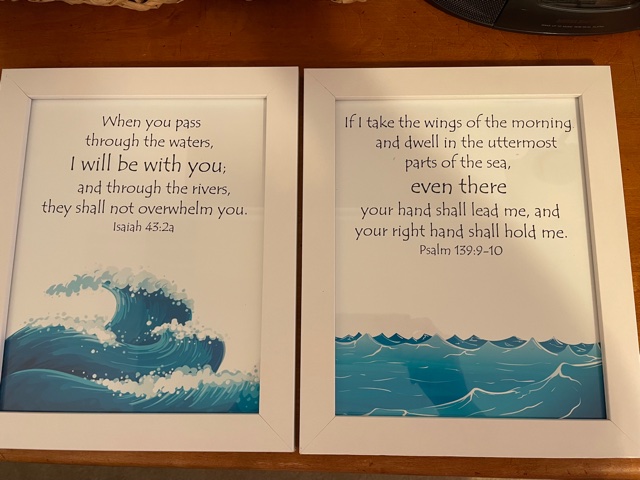
5. One project done. I had a couple of Scripture verses I wanted to incorporate into the guest room decorating. I’m working on a beachy/coastal theme in there. I found several ideas on Pinterest and Etsy and even got a couple of inexpensive printable downloads on Etsy. But they ended up looking green, when I preferred blue—and I don’t know how to adjust the coloring. So then I looked up free wave clip art and made my own. Even these are greener than I want, but they’ll do. (Sorry for the shadow.)

Now I just need to get them hung up.

Time to get back at it—hope you are having a good week!

Anne Morrow Lindbergh: Her Story

Before reading Anne Morrow Lindbergh: Her Story by Susan Hetrtog, I didn’t know anything about Anne except that she was the wife of famed aviator Charles Lindbergh and an aviator herself as well as an author.

Anne grew up as the daughter of the US ambassador to Mexico and a very ambitious mother. Anne was quiet, sensitive, and introverted. She felt her sister, Elizabeth, was everything she should be and wasn’t.

Charles Lindbergh became famous for making the first solo non-stop flight from New York to Paris. According to Wikipedia, this flight was “widely considered a turning point in world history for the development and advancement of aviation, ushering in a new era of transportation between parts of the globe.” Lindbergh’s feat turned him into an instant American hero and Time Magazine’s first “Man of the Year.”

Anne’s father became the financial advisor to Charles Lindbergh and invited him to their compound in Mexico for Christmas one year. Anne was enamored immediately, but expected Charles would fall for her sister. Charles didn’t seem to fall for anyone, but when he started thinking about marriage, Anne came to mind.

Anne thought long and hard about marriage to Charles before accepting. They’d have to deal with a lot of public attention: Hertog quotes one source as saying public interest in Lindbergh was about like that of the Prince of Wales. Another source said only the Kennedy family was more in the public eye.

Anne thought Charles was “beautiful,” but she was well-read, and he didn’t have much interest in reading (at least the kind of books she liked). She wasn’t sure she could live with someone without sharing this aspect of herself. She was sure that she would have to sacrifice for the relationship. But in the end, she decided she couldn’t live without Charles.

He taught her to fly and to navigate, and she accompanied him on many of his flights.

My biggest impression of Anne, at least from this book, is that she was a conflicted woman most of her life. She loved flying, but she missed her children when she flew. She loved domesticity, but resented how all-consuming it was and longed to have solitude and time to write. She both loved Charles and chafed under his leadership. She didn’t embrace her early Christian upbringing, but wrestled with sin and salvation and what it all meant (yet she said, “I wasn’t searching for God” but to understand herself, p. 427). She mixed in Buddhist and theosophist tenets with Christian ones. She espoused “Christian virtues,” yet seemed to miss its grace and salvation. “She went beyond the stern precepts of her ancestors’ Calvinism; she was searching for the ‘changeless light,’ looking inside herself, trying to make peace with God” (p. 411).

Charles was very domineering and could be incredibly insensitive, wanting Anne to spend days and weeks co-piloting with him and leaving their son with others on the son’s birthday and even one Christmas.

Anne believed in submitting to and supporting her husband, but didn’t seem to realize that submission and support didn’t mean never voicing a differing opinion. Anne had always been one to acquiesce, first to her mother and then to Charles. In fact, Charles and Anne’s mother argued over what should be included in their wedding while Anne sat back and let them decide.

The couple’s firstborn son was kidnapped from their home at the age of twenty months. According to Hertog, the investigation was totally inept, with differing agencies vying to be the one to solve the case. Ransom notes were delivered and Charles even paid a ransom, but the child was never recovered. Later the baby’s body was found buried not far from their home.

The kidnapping was a wound that never healed for Anne. The media frenzy drove the Lindbergh’s to England for several years.

As events were ramping up leading to WWII, Charles took an isolationist stance. He felt the cost of human life in a war against Germany would be too great. He was more concerned about Russian communism than German fascism and felt the former would take over Europe if the latter was defeated. But, to the shock of many, Charles said in radio addresses to the American people that he agreed that white people were a superior race and Americans didn’t need to fight other white nations over an issue that was not their problem.

Anne took her submission to Charles so far that she wrote a book expounding on his views, though it was “against her instincts” and she later regretted it.

Understandably, they fell out of favor. When war did come, Charles felt he should help his country even thought he disagreed with their fighting, but had a hard time finding anyone who would accept his help.

He condemned American cruelty during war, but somehow seemed to overlook Japanese and German cruelty. After the war, “Only a trip to a concentration camp, and a tour through the rubble led by a ‘skeleton’ boy, moved him to condemn the brutality of the Germans” (p. 418). “This kind of human destruction, he wrote in his diary, was not worth the fulfillment of political ends” (p. 419).

Somehow, the Lindberghs seemed to be forgiven after the war. Anne published several books, the most famous and enduring being Gift of the Sea.

Anne’s concern about the press proved true. Their attitude seemed to be “We made you, we have a right to you.” They made up stories when information wasn’t forthcoming. They endangered the Lindberghs—once “reporters stalked Jon (their second son) on his way to school. Sideswiping the Morrows’ car, they pushed it off the road and pulled open the doors to take the boy’s picture” (p. 278). Later, Charles’ ship arrived during a photographers’ ball. “On hearing of Lindbergh’s return, the conductor stopped the music, and the men, cameras in hand, rushed to meet the Aquitania. Stampeding on board, they hammered on Lindbergh’s door. When he refused to open it, one photographer broke into the adjoining cabin, took photos, and fled” (p. 348).

The author has access to the public (edited) letters and diaries and five years of interviews with Anne. She mentions one affair Charles had that was unknown to Anne until after his death. Wikipedia reveals that he had seven children by three different German women–perhaps these were unknown as well at the time of the book’s publication. The Lindbergh’s youngest daughter, Reeve, met with her German half-siblings.

One problem with this book was that it was hard to distinguish the author’s voice from Anne’s. The author spent a lot of time explaining what Anne wrote, but it’s hard to know if this interpretation was Anne’s or the author’s. It did seem the author inserted herself in the book more than was necessary and covered some of the same themes repeatedly.

Plus, I listened to the audiobook, and it wasn’t always clear when the narrative went from the author’s words into a quotation from Anne’s writing. I do have a hardcover copy of the book as well, which includes several photos. In some ways, I probably would have gained more and understood some of the connections better if I had read the book rather than listened to it. But, as it is quite long, I felt I’d get to it sooner via audio.

So, in the end, I know a lot more about the Lindberghs but respect them a lot less. There were traits to admire in each of them. But, like all of us, they were flawed people.

Strengthening Others

If someone had said to me personally, or before our church congregation, “I want to strengthen you today,” I would have thought, “Well, thanks, but only God can do that.”

But during my last trek through Acts, I noticed several times the Bible said someone strengthened others. That gave me pause. How did they strengthen others? Why did the Bible phrase it that way instead of saying God strengthened them? I made a note to come back and look at those occurrences some time, and did that last week.

According to BibleStudyTools.com, the Greek word for “strengthen” in these passages means “to establish besides, strengthen more; to render more firm, confirm.” The KJV and a few other translations use “confirmed,” but most use “strengthened.” There are synonyms to this word all through the Bible, but this particular Greek word seems to be only in Acts. So for now I confined my study there.

In the first passage, Acts 14:19-23, men came from Antioch and Iconium and stoned Paul and left him for dead. But Paul got up, traveled to another city, and preached there. Then he returned to Lystra, Iconium, and Antioch—the very places that men had come from to stone him—and began “strengthening the souls of the disciples, encouraging them to continue in the faith, and saying that through many tribulations we must enter the kingdom of God” (v. 22).

You can imagine how the disciples might have been shaken. If this could happen to Paul, it could happen to them. These guys had who stoned Paul had traveled to another city to do so—what would they do to Christians in their own towns? But Paul encouraged them: Yes, we’ll face persecution. It’s part of the Christian life. But this is the true faith.

Matthew Henry says in his Commentary on the Whole Bible, Volume VI.—Acts to Revelation:

But is this the way to confirm the souls of the disciples and to engage them to continue in the faith? One would think it would rather shock them, and make them weary. No, as the matter is fairly stated and taken entire, it will help to confirm them, and fix them for Christ (p. 185).

Henry then goes on for several paragraphs bringing up other verses that talk about persecution being part of the Christian life and something even Christ experienced. 

The rest of the passage says they appointed elders in the churches, prayed, fasted, and “committed them to the Lord in whom they had believed” (v 23). No doubt these were an outworking of Paul’s encouragement.

In the second passage in Acts 15, some men were teaching newly-believing Gentiles that they had to be circumcised and keep the law of Moses (verses 1, 5). The apostles and elders met together to discuss the issue. “After there had been much debate,” Peter shared his experience of being taught by the Lord that God “made no distinction between us and them, having cleansed their hearts by faith.” To put them under the OT law would be “placing a yoke on the neck of the disciples that neither our fathers nor we have been able to bear. But we believe that we will be saved through the grace of the Lord Jesus, just as they will.” Paul and Barnabus followed with their experiences reaching Gentiles. The council confirmed that the Gentiles did not have to keep the OT ceremonial law and just asked them to observe a few things. They sent a letter with Paul, Barnabus, Judas, and Silas to the brethren in Antioch. “And when they had read it, they rejoiced because of its encouragement. And Judas and Silas, who were themselves prophets, encouraged and strengthened the brothers with many words” (verses 31-32).

Here the disciples were strengthened with truth and the rest that comes from grace. Instead of coming under a religion of works that they could never live up to, they could rejoice in the grace of God. One commentary here noted “Their work was the very reverse of those who had previously come from Judea ‘subverting the souls of the disciples (Acts 15:24).'”

The rest of the verses, Acts 15:40-41; 16:4-5; and 18:22-23, just mention that Paul, along with various companions, traveled place to place strengthening the disciples.

So from these passages, we can draw out these principles of how the apostles strengthened others:

Their presence. The elders in Jerusalem sent a letter, but they sent it with people to deliver personally, who then went on to strengthen them. Paul went back to several churches he started, watering the seed that was planted, encouraging them in person.

They shared truth and grace. God gives us strength through His Word. “Strengthen me according to your word” (Psalm 119:28b). The passage where Paul was persecuted presages Peter’s later epistle encouraging disciples not to be surprised at persecution, but to “entrust their souls to a faithful Creator while doing good.” The truth encouraged them. Then the Acts 15 passage brought them back to the foundation of grace rather than the added-on works of tradition.

They showed loving concern. Paul was so concerned for the disciples that he went back to the city of those who stoned him to encourage them. Though he was the one who had suffered, he wanted to strengthen them. Matthew Henry says of Acts 16:4-5, “that spirit of tenderness and condescension which appeared in these letters plainly showed that the apostles and elders were herein under the guidance of him who is love itself” (p. 203). What a contrast to the Pharisees, who protested at people being healed on the Sabbath in violation, not of God’s law, but their own, and who were so full of hate that they sought to have Jesus killed.

They were empathic. I love Peter’s empathy when he asks why they would put a heavy yoke on the new disciples that they had not been able to bear themselves.

Paul didn’t lessen the truth that persecution would come, but he encouraged them to bear it for Christ.

There is a sympathy that weakens and a sympathy that strengthens. One thing that stood out to me in Walter and Trudy Fremont’s book from many years ago, Formula for Family Unity, was this thought:

Parents should not take the grit out of their children’s lives by protecting them from every hardship, blow, or disappointment. Remember, adversity strengthens character. . . .

Children are resilient; they can take a lot if Mother doesn’t make them feel abused and neglected by an overly sympathetic attitude. Such a statement as, “Oh, honey, it’s so cold out there; I’m afraid you’ll freeze on your paper route,” produces a negative attitude in the mind of the child. Mother ought to say, “When you finish your paper route, I’ll have a cup of hot chocolate waiting and a good breakfast” (pp. 103-104)(2).

The mother’s second statement acknowledges the child’s difficulty and her sympathy, but in a way that braces him for what he has to face rather than leaving him wallowing in self-pity.

We can do the same as we interact with others. Sometimes we slap truth on like a band-aid without taking time to enter into another’s situation. No wonder what we say hits them the wrong way instead of ministering to them. Instead, Jesus was “touched with the feeling of our infirmities” (Hebrews 4:15, KJV). Since He “has been tempted as we are, yet without sin. Let us then with confidence draw near to the throne of grace, that we may receive mercy and find grace to help in time of need.” (Hebrews 4:15b-16).

Why does Acts say the apostles strengthened others instead of saying God did or the Word of God did? Strength actually came from God and His Word, but He sent it through His messengers. God often works through people. How we need to be faithful messengers, loving, caring, personally interested, sharing truth and grace.

Matthew Henry sums it up perfectly:

[Paul] preached that to them which strengthened them, which confirmed their faith in Christ, their resolutions for Christ, their pious affections to him. Disciples need to be strengthened, for they are compassed about with infirmity; ministers must do what they can to strengthen them, to strengthen them all, by directing them to Christ, and bringing them to live upon him, whose strength is perfected in their weakness, and who is himself their strength and song (p. 240).

(I often link up with some of these bloggers)

Laudable Linkage

Here’s another list of good online reads:

To the Woman Who Is Deconstructing. “You’ve been raised with one understanding of who God is, what His Word means, and how you’re supposed to live, but lately the foundation of your faith feels a little . . . fractured. Something you’ve read or experienced or felt has changed you. It’s like you’re wearing a new pair of glasses. Everything you thought you knew about Jesus suddenly looks very different.” I don’t know that I’d equate deconstructing with questioning—though deconstruction probably begins with questions, it seems to indicate those who have gotten past the questions to actually dismantling their belief system. Nevertheless, this post has some good encouragement for when questions about faith come up.

Pastor, Your People Need the Hard Texts, HT to Knowable Word. Good for writers and teachers, too. “We love the highlights of Joseph and Genesis 39. But we also need the lowlights of Genesis 38. God meets us in the lowlights. It’s there in the wreckage of our lives that God shows us the way out.”

Who Gave You the Right? “The sanctified instinct of the Christian heart should not be to discourage but to encourage, not to further demoralize other people but to give them strength, to give them heart, to give them courage.”

Focusing on What I Can Measure, HT to Challies. “My physical health is more than the numbers I can measure. And my spiritual health is, too. It’s always tempting to focus on what I can measure in my relationship with God.”

Patience: More Than a Virtue for Motherhood, HT to The Story Warren. “The last thing I wanted to hear as I hurried the kids to get ready for church were the words I had spoken to them many times during the week, “Mom, remember patience is a virtue and a fruit of the Spirit.” They can’t remember to say thank you or where they last left their shoes, but they remember this?! I was beyond impatient. I was angry and aggravated—but also convicted. How easy it was to come up with such a memorable and catchy quotable to use on my kids, but how hard it was for me to receive it back from them!”

Identifying Stanzas in Lamentations. An interesting, different, and inspirational way to look at probably the most well-known passage in Lamentations—through the pronoun shifts.

How to Brainstorm a Nonfiction Writing Project. I think this would be good for brainstorming other things as well. I tend to just jot lists, but I can see value in this method.

How to Feel Comfortable in Front of a Camera. Often when trying to get a group photo, someone will protest that they hate having their picture taken. As people try to draw them in, they protest more. By trying not to call attention to themselves, they draw more attention. And I’ve often thought, “We all know what you look like anyway!” It’s not like no one else will see them because they’re not in a photo. But I have known of people who grieved because they had few photos of a departed loved one who always shied away from the camera. April‘s tips will help, whether you’re in a photo with a group or alone.

This video, HT to Steve Laube, reminds me of Psalm 8:3-4: “When I look at your heavens, the work of your fingers, the moon and the stars, which you have set in place, what is man that you are mindful of him, and the son of man that you care for him?” The God who created the vastness of all the planets and stars and space cares about us and the details of our lives.

Friday’s Fave Five

It’s Friday, time to look back over the blessings of the week
with Susanne at Living to Tell the Story and other friends.

It has been a good week for staying indoors. Here are some highlights from the beginning of August:

1. Dinner out and free pie. I had plans to meet a friend for lunch at O’Charley’s for their free pie Wednesday. Unfortunately, my friend texted me the day before that she was sick. I was sad that she wasn’t feeling well and couldn’t get together. And I had my taste buds all set for that pie. So I asked my husband if he wanted to take his wife out for dinner and pie, and he indulged me.

2. Dinners and a celebration. My and my son daughter-in-law invited us to their place Sunday night for enchiladas. Then yesterday she texted me to say she could bring over dinner Thursday night. I was a little surprised, since they had just made dinner for us so recently. Come to find out, the meal was a celebration of my 15th blogging anniversary, along with pink roses and a sweet card.

3. Lunch take-out. I didn’t intend to make my faves all about food this week, but not having to cook is always a favorite. There’s an Asian restaurant we like, but it’s a little too far out for takeout generally. However, it’s not far from our church, so we swung by there after the Sunday morning service to get lunch and bring it home.

4. An overdue haircut. The stylists at the place I go have always done an okay job, but I finally found one who does the layering the way I like it best.

5. A little project. I saw this idea of shells and fairy lights in a Mason jar, but when I saw this lantern in Hobby Lobby, I loved it. Thankfully it was half off and I had a gift card. I had a container of potpourri with shells and little blue balls and flowers that I filled the lantern with.

Bonus: An inspirational movie. I mentioned in my book review for Unconditional by Eva Marie Everson that I had watched the movie the book was based on. Jim came in for the last part of it. I thought it was very good, all the more so for being based on true events.

How was your first week of August?

Unconditional

Unconditional by Eva Marie Everson is based on a movie by the same name, which in turn was based on true events.

Samantha Crawford loves her life, living on a ranch with her beloved husband, Billy, riding her horses, and writing and sketching children’s books.

Then tragedy strikes. Billy is gunned down in an alley in a poor part of town.

Samantha loses her belief in God’s love and goodness. She doesn’t write any more.

At her lowest point, Samantha encounters a child hurt by a hit-and-run driver. Taking the child and the child’s brother to the hospital, Samantha runs into one of the children’s neighbors—her best from from school, Joe Bradford.

As Samantha reconnects with Joe, she learns he has kidney disease. But he spends his time ministering to the children in his neighborhood. He and his girlfriend, Denise, provide after-school snacks, attention, affirmation, and encouragement. But Joe’s time is running out unless he can get a kidney transplant.

Observing Joe’s simple faith and ministry, Samantha’s heart starts to warm again. But she’s also driven to find her husband’s murderer, convinced that the police have given up on the case. And she thinks she just may have found him—in Joe’s neighborhood.

I had not heard of the movie, but picked up this book on a Kindle sale because I had enjoyed some of Eva Marie Everson’s books. I didn’t know when I started reading it that it was based on a true story. “Papa Joe” Bradford started Elijah’s Heart to aid at-risk children.

Finding out the story was true made it even more heart-warming and inspirational than it already was. In an interview, Joe Bradford says about 97% of film is true to his life and the Samantha character is a composite of different friends.

The movie used to be on Netflix, but isn’t any more. However, it’s online here and on YouTube here. I enjoyed watching it last night. The book uses scenes and dialogue from the movie, but includes more information. Here’s a trailer for the film:

Have you seen or read Unconditional? If not, I hope you do.

15 Favorite Posts from 15 Years of Blogging

I mentioned in my end-of-July post that I forgot my blogging anniversary until WordPress sent me a reminder. It’s been fifteen years!

Often in the past I’ve done something special to observe my blogiversary. Since it caught me off guard this year, I didn’t have anything prepared.

I had been pondering ways to bring some of old posts back to the forefront, since they were published before I knew some of you. Then, voila! The idea came to list fifteen of my favorite blog posts to commemorate my fifteenth year of blogging. There won’t be one from each year—that would have taken too much time to search out. But these were either fun to write or were special to me in some way.

So here we go, in no particular order:

  1. Coping when a husband is away. This is my top-viewed post of all time. I had no idea it would touch such a chord. My husband had to travel heavily for at least half, maybe as much as two-thirds of our 41-year marriage. Though I didn’t like it, I am thankful God used what He taught me to help others.

2. How Not to Become an Old Biddie. After seeing examples of different kinds of older ladies, I realized I needed to start working on what kind of older lady I want to be now. (Related: Why Older Women Don’t Serve and Ways Older Women Can Serve.)

3. With All Our Feebleness. Reflections on serving God with physical and other limitations.

4. My Ebenezers. In 1 Samuel 7:12: “Samuel took a stone . . . and called its name Ebenezer; for he said, ‘Till now the Lord has helped us.’” “Ebenezer” means “stone of help.” In this post, I listed some of my verbal “Ebenzers,” commemorations of the Lord’s special help in my life.

5. Having Devotions When You’re not Feeling Very Devoted. We’ve all been there, I’m sure. (Related: When There Is No Hunger for God’s Word.)

6. Strong Women. What feminine strength means and doesn’t mean, with literary and Biblical examples.

7. Encouragement for Mothers of Small Children in the area of trying to find quiet time with the Lord.

8. The Back Burner. The stuff on the back burner is all the more flavorful for its time sitting and simmering. So with the things in our lives we have to set on the back burner: they’ll be all the better for the wait.

9. Why Read? Why Read Fiction? Why Read Christian Fiction? Every reason I could think of for reading all of them.

10. Can Frugality Go Too Far? Even good traits can be carried too far.

11. It’s Not For Nothing. Caregiving can seem monotonous and futile when the patient sleeps most of the time, can’t speak, and isn’t interested in food, as was the case for my mother-in-law her last two years in our home. These were truths that encouraged me. (Related: Remembering the Loved One Who Has Forgotten You.)

12. Manufactured Spirituality. Routines and programs can help us spirituality, but sometimes we focus on them to the detriment of real spirituality.

13. The Quiet Person in the Small Group. How not to torture your introverts.

14 Going to a Church with Problems. They all have them, even the ones in the Bible. (Related: What You Miss When You Turn Your Back on Church.)

15. Myths and Maxims of Ministry gleaned over many years. Myth #1: “Since this is being done for the Lord, everything should go smoothly.” Nope!

These are the posts that floated to mind. If I had actually searched every year’s posts, I might have had a different list. But there’s probably a reason these are the ones that came to mind.

As you’ve noticed, I cheated stretched my numbers a bit. Sometimes I couldn’t decide between a couple of posts on a similar topic, so I included one as “related.”

I’ve noticed that I should probably go back and edit some of the older posts. One of the tendencies my first critiquer at a writer’s conference pointed out was “long, convoluted sentences” that should be broken into two sentences (or three or four). Hopefully some day I can correct those in my older posts.

Thank you so much to all of you who read and comment. Without you, this would just be an online journal. Nothing makes me day like hearing that something here has blessed and helped someone.

(I often link up with some of these bloggers)

Under His Shadow

It’s hot. I’ve run errands in a high temperature, humidity, and heat index. My car has air conditioning, but the seats are hot and the AC takes a few minutes to cool off. After several hot-then-cool transitions, I’m feeling a little nauseated.

When I get home, shoes come off, the AC is turned up, the ceiling fan is turned on. I get a cold drink, and I sit down to cool off and dry out. I may even have ice cream or a root beer float.

Not so many years ago, all those options weren’t available. We didn’t have central air conditioning in our house when I was a child. We didn’t even have a room unit. We attempted to take parent-mandated naps with windows open and an oscillating fan cooling off head or feet, but not both at the same time.

When my aunt bought a home with central air, I thought it was so luxurious to nap in the coolness of her room with dark blue curtains that shut out the sunlight.

In older times, and even now in some countries, refuge from the scorching heat is first sought in shade: under a tree, in the shadow of a building, anything that will put a barrier between people and the blazing sun.

Shadows can represent many things: the Bible uses the metaphor of shadows to illustrate the brevity of life or the nearness of death. But often Scripture speaks of shadows in reference to God. His shade provides:

Protection. Keep me as the apple of your eye; hide me in the shadow of your wings (Psalm 17:8). David prayed this seeking refuge from enemies. We can pray it when weary of a world that opposes God or weary of our own fight against sin. Some of those seeking David’s life were a former friend and his own son. People will fail us: God never will.

Refuge. Be merciful to me, O God, be merciful to me, for in you my soul takes refuge; in the shadow of your wings I will take refuge, till the storms of destruction pass by (Psalm 57:1).

Provision. How precious is your steadfast love, O God! The children of mankind take refuge in the shadow of your wings. They feast on the abundance of your house, and you give them drink from the river of your delights (Psalm 36:7-8).

Joy. For you have been my help, and in the shadow of your wings I will sing for joy (Psalm 63:7).

Shelter. He who dwells in the shelter of the Most High will abide in the shadow of the Almighty. I will say to the Lord, “My refuge and my fortress, my God, in whom I trust.” (Psalm 91:1-2).

For you have been a stronghold to the poor, a stronghold to the needy in his distress, a shelter from the storm and a shade from the heat; for the breath of the ruthless is like a storm against a wall (Isaiah 25:4).

Keeping and care. The Lord is your keeper; the Lord is your shade on your right hand. The sun shall not strike you by day, nor the moon by night. The Lord will keep you from all evil; he will keep your life. The Lord will keep your going out and your coming in from this time forth and forevermore (Psalm 121:5-8).

Delight and sweetness. As an apple tree among the trees of the forest, so is my beloved among the young men. With great delight I sat in his shadow, and his fruit was sweet to my taste (Song of Solomon 2:3).

Forgiveness and fruitfulness. The prophet Hosea pleads, “Return, O Israel, to the Lord your God, for you have stumbled because of your iniquity. Take with you words and return to the Lord; say to him, ‘Take away all iniquity” (Hosea 14:1-2a). God promises that if they will do this, “I will heal their apostasy; I will love them freely, for my anger has turned from them. . . . They shall return and dwell beneath my shadow; they shall flourish like the grain; they shall blossom like the vine (Hosea 14:4-7b).

In the March 30 reading of Edges of His Ways, Amy Carmichael wrote, “If the Bible had been written in England, there would not have been nearly so many words about the comfort a shadow can be. But it was written in countries where the heat could be very great and where great open plains of burning sand make the shadow of a great rock something to be remembered.” She then shared her poem “I Follow Thee,” which captures the idea of shelter from heat as well as Israel’s flight from Egypt:

Shadow and coolness, Lord,
Art Thou to me;
Cloud of my soul, lead on,
I follow Thee.
What though the hot winds blow,
Fierce heat beats up below?
Fountains of water flow –
Praise, praise to Thee.

Clearness and glory, Lord,
Art Thou to me;
Light of my soul, lead on,
I follow Thee.
All through the moonless night,
Making its darkness bright,
Thou art my heavenly Light –
Praise, praise to Thee.

Shadow and shine art Thou,
Dear Lord, to me;
Pillar of cloud and fire,
I follow Thee.
What though the way be long,
In Thee my heart is strong,
Thou art my joy, my song –
Praise, praise to Thee.

Are you hot, weary, depleted, in need of shelter and refuge? Come under His shadow.

This is a beautiful piece based on the Song of Solomon passage, set to music by Elizabeth Poston: “Jesus Christ the Apple Tree”:

(I often link up with some of these bloggers)

Laudable Linkage

A collection of good reading online

Here are a few of the noteworthy reads found online this week:

Teachable, HT to Challies. What teachability is, isn’t, contrasts with faux teachability. This hit on a number of points I’ve been thinking about lately.

Joy and Idol-Smashing, HT to Challies. “If I’m not reading my Bible, praying diligently, loving my church, hiding God’s Word in my heart, then my earthly relationships, especially the closest ones, will suffer from my inattention to Jesus. I can’t see my idols if I’m not looking at Jesus.”

Judge Not Lest You Be Blind, HT to Edie Melson. “Choosing not to judge someone else? It’s called grace — and judging others, as Dietrich Bonhoeffer says, blinds us to grace. I want to be more lavish with grace, while ignoring the impulse to judge. After all, how would I want others to respond to me? With judgement … or with grace?”

Sticks, Stones, and Words . . . Can Cut Me Deeply, HT to Linda. “Words transform. They heal. And they can…and sometimes do…’hurt me.’”

The 7 Types of Rest that Every Person Needs, HT to Linda. “Have you ever tried to fix an ongoing lack of energy by getting more sleep — only to do so and still feel exhausted? If that’s you, here’s the secret: Sleep and rest are not the same thing, although many of us incorrectly confuse the two.”

Even to Your Old Age: New Life for Christian Grandparents, HT to Challies. “What does the Bible say about grandparenting? Very little. Although past generations matter significantly to the biblical authors, the Bible does not give grandparents specific attention. The word grandparent does not even appear in the English Bible. Nevertheless, we know this role is essential to God, our extended families, and our local churches.”

Recommended, HT to Challies, a not-so-hypothetical short story.

This was one of my favorite Olympic moments. A teenager from Tunisia won a gold medal when not expected to. When discussing the swimmers, the announcers didn’t even mention his name til almost halfway through the race. The last few seconds of the last lap were pretty exciting!

Happy Saturday!