Unknown's avatar

About Barbara Harper

https://barbarah.wordpress.com

Friday’s Fave Five

Β It’s Friday, time to look back over the blessings of the week with Susanne at Living to Tell the Story and other friends. Here are five favorite parts of the last week:

It’s been another good but busy week. Here are some of its highlights:

1. Improvement for my little grandson in the NICU. He is gaining weight and had his first bath this week. πŸ™‚ His heart rate still drops from time to time, but not as much as at first.

2. NICU support. Though the NICU probably wouldn’t be any parents’ preferred first stop for their child, the staff there have been very supportive and informative, plus it has been nice to have nurses at hand to ask questions and guide them through how to bathe and change him, etc. I remember with my firstborn that even though my youngest sister had been born when I was 17, and I had been the chief babysitter for her and for some other of my mom’s friends, I felt surprisingly nervous and unsure about taking care of my own baby. It would have been nice to have someone at hand to ask some of those new parent questions.

3. Preemie clothes. He should be able to start wearing them soon. They are so cute! All of my babies were over 9 lbs., so all these teeny tiny things seem even smaller to me.

4. Delivered meals. The ladies at church are preparing meals for my son and daughter-in-law, a great help as they are spending time at the hospital and she is still recovering.

5. New blooms. My brand new hibiscus plant that we just bought and planted lost all its blooms and its leaves look shriveled after an unexpected late frost, but it is putting out new blooms this week.

Bonus: I can’t believe I almost forgot to mention Easter. That seems like so long ago now! πŸ™‚ But we enjoyed a meaningful church service and then time with family over Easter dinner. Though we think of the death and resurrection of Jesus Christ and its meaning for us often throughout the year, it is a special blessing to have this focus on it.

Hope you’ve had a great week!

Book Review: The Little White Horse

LWHWhen I saw The Little White Horse by Elizabeth Goudge listed as Carrie’sΒ  Reading to Know Classics Book Club selection for March. I wanted to give it a try because I had seen Goudge highly recommended. This is one of her children’s books, but she has written for adults as well.

This story begins with recently orphaned Maria Merryweather and her governess, Miss Heliotrope, traveling to Moonacre Manor to live with Maria’s uncle. The first few chapters are a series of discoveries as Maria gets to know her new guardian, house, room, village, church, etc., and along the way she learns that she and Mrs. H. are the first females to set foot in the house in 20 years, that there are a group of wicked Men of the Dark Woods doing wicked things like poaching animals and blocking the way to Merryweather Bay. When she finds that there was a quarrel caused by her own ancestors that set off these bad men , she feels it is her duty and destiny to set things right. In the course of her quest, she also has to learn patience and self-control over her own anger and tendency to hasty words, the lack of which traits contributed to the original disagreement in the first place.

The story has the flavor of a fairy tale, with animals who seem to know what to do and help Maria along the way (including a cat who writes messages in hieroglyphics in the ashes of the fireplace), the appearance of the little white horse, who is actually a unicorn, at key points in the story, and the discovery that her “imaginary friend” in London actually is a real boy who had been visiting her in his dreams (which I thought odd on many levels. Wouldn’t he have visited her in her dreams?)

It took a while for me to get into the story. All the discoveries of her new place and descriptions were fine, but had me thinking, “OK, when are we going to get into the plot?” When we finally did, my interest picked up a little. I like “quest” stories, particularly when the main character has to conquer something in him- or herself along the way, so I liked that aspect, as well as the aspect that the first step in setting things right was to give Paradise Hill, formerly run by monks, back to God (I don’t know what Goudge’s religious views were, but there are mentions of Biblical principles sprinkled here and there.)

But somehow the book just didn’t grab me, and I can’t quite put my finger on why. I can’t say I strongly disliked it, but I just didn’t love it like I thought it would. As Bekah mentioned in her review, you have to suspend a lot of disbelief to enjoy the story, even knowing that it is a fantasy. I liked Goudge’s descriptions and characterizations for the most part, and I liked the general storyline ok. I liked her planting of little clues, like Maria’s regal bearing at the beginning, before she even knew she was descended from a Moon Princess, and Miss Heliotrope’s pointing out of the “house of her dreams,” before she has any clue that she will marry its owner in the end. I wasn’t really enthralled with Maria, but I liked her well enough. All of the elements were there to make for a charming story, but to me charm was the exact thing it was missing. It took me a long time to get through it just because I wasn’t motivated to pick it up. But that may just be me (and Carrie. πŸ™‚ ) A quick scan of other reviews show that many people love it, and it did win a Carnegie Medal.

For a couple of more positive reviews, see Amy‘s and Janet‘s. I do want to give Goudge another try though, perhaps with one of her adult books.

(This will also be linked toΒ Semicolonβ€˜s Saturday Review of Books.)

Book Review: The Seamstress

SeamstressI don’t recall where I saw The Seamstress: A Memoir of Survival by Sara Tuvel Bernstein recommended: I think it was probably through some of the What’s On Your Nightstand participants. But when I saw it on sale as an audiobook, I decided to try it. It was very wonderfully read by Wanda McCaddon.

Audiobooks don’t always include prefaces and introductions, but I am glad this one did as the co-author, Louise Loots Thornton, explained how the book came to be. Sara had attended a lecture on the Holocaust where the professor said that, although there were camps during WWII, the Jewish people embellished their experiences and made them sound worse than they were so people would “feel sorry for them and buy things in their stores.” Sara was so angry she decided she must write of her experiences. Louise had an MA in Creative Writing and Sara’s son had married into her family, so Sara asked her to help write her book.

The book begins with Sara’s birth (as Seren, which she is called throughout) and early childhood in Romania, where she was one of the youngest children of a Jewish mill owner. Persecution started early, as schoolchildren called her and her siblings “stinking Jews” or “dirty Jews” (after coming home from her first day of school, she smelled her clothes to see if they were indeed stinky. When her mother asked what she was doing and heard her answer, she waved it off with an “Oh that. Don’t even listen to it. It’s nothing.”) The priests presiding over the classroom and school would continually make disparaging remarks about Jews as “Christ-killers” and would respond negatively to the rabbi’s pleas for them to be let out for Jewish holidays. Periodically roving mobs would vandalize Jewish homes and businesses.

When Sara was in the fourth grade, she entered a contest where she was chosen to represent their school as a student in a more prestigious boarding school in another town. She was its first Jewish student. Things were not terribly different in this school, and when one teacher warned students to keep their distance from Jews during Passover because they used Gentile blood in their rituals, Sara threw an inkwell at him, marched to her room, packed up her things, and left.

She did not go home, however. She decided to try to apprentice as a dressmaking salon and found one salon owner who seemed to size up the situation and take her in. Sara did not tell her parents for a long while, as in the village she came from, young ladies did not work outside the home. When her father finally found out, he was furious: he had not wanted her to go to school there in the first place. But he finally came around.

When Sara completed her apprenticeship, she worked at the salon for many years and enjoyed outings with a group of friends. Many of them began sharing rumors they had heard about strange things happening to Jews in other areas, and then, suddenly, some of their number began disappearing one by one. As persecution escalated, Sara made it back home with the help of her supervisor’s son. There Jewish businesses were being closed down, and Sara and her father were arrested and accused of being spies. They were sent to a labor crew and then to prison. Sara was released, but her father was not. She then had to scramble to find work to support her mother and sisters. Eventually she moved to a different town with better prospects. Because she did not look like a Jew, with her blond hair and blue eyes, she got more work than she would have otherwise. Eventually two sistersΒ  joined her. When she was out with one sister, they were picked up and forced to work with a labor crew for months. When it was discovered her sister was pregnant, she was shot. Sara was released and went back to her other sister, but eventually all the Jews were rounded up and sent to prison camps. Sara, her sister, and two friends were taken to Ravensbruck, a concentration camp for women north of Berlin. I had not known that this camp was only for women and that not many survived: I did know that Corrie Ten Boom and her sister were there, but unfortunately there was not much chance of their meeting as the Jewish prisoners were kept in a separate barracks.

Sara tells of the beatings, starvation, and inhumanity of the camps. She and her sister and friends became a foursome who managed to stay together, although Sara was careful never to stand next to her sister in line-ups for counting (some of which lasted four hours long) so it would be less likely that anyone noticed their resemblance and used their relationship to torture either of them. Sara was the oldest and helped the others know what to do (like choosing a top bunk for the four of them, since the bottom bunks were by windows which caused some of those in them to freeze to death), sought for (and stole, sometimes) food for them.

As the war wound down and Germany was losing, they tried to evacuate the prisoners for seemingly endless days of being packed together in cars with little food and less water. I believe she said they started out with 10,000 women, but by the time they finally stopped they were down to a few hundred because so many died on the way. At every stop the soldiers removed all the corpses.

After the war Sara ended up in a hospital for several months, where she weighed 44 lbs. on arrival, and later found work in Germany. Even at that time, if Jews boarded a bus, the Gentiles would vacate the bus: if Sara stood in line at different stores for provisions, the butcher or grocer would just happen to run out as she finally got to the counter.

Sara married, and eventually she and her husband received permission to emigrate to Canada, and later on to the US. Her daughter fills in details from the rest of her life in the epilogue.

I found this account riveting. Man’s inhumanity to man just astounds me, but Sara faced all of the events in her life with pluck, courage, and wit. She had an independent spirit early on which stood her in good stead through her trials.

Though she was a Jew in ethnicity, unfortunately she was not in her faith. Her daughter shares in the epilogue that her mother continued with many of the Jewish rituals because they were comfortable and familiar, but she didn’t understand why her friend through the horrors of labor camp became devoutly religious. She couldn’t believe in a God who let such things happen, and she felt that if there was a hell, it couldn’t be worse than what she had already experienced. She would be sadly mistaken on that point, and I can only hope she found that out before it was too late. That’s the down side of an independent spirit: one doesn’t recognize or acknowledge that God sends His rain on the just and the unjust, that He was the one who led her to food in unexpected places or to a coat with money sewn in the hem or gave her the will and drive to survive and to help her friends as well. Unfortunately, her experiences with so-called Christians early on caused her to see “the cross was used as a backdrop for persecution of the Jews.” I hope somewhere along the way someone was able to share its true meaning with her.

I’ve skimmed through a number of reviews, and some of them mention that she describes some of the horrors as well as the deaths of friends and family seemingly unemotionally. I didn’t get that impression, perhaps due to the narrator’s sympathetic inflections, but I would guess that was perhaps the only way she could write about such gruesome, wrenching details was to distance herself from them a bit in the telling. It is also possible she would not have wanted to seem as if she was embellishing the facts or pulling on readers’ heartstrings with her own emotions: she wanted to details to speak for themselves.

This will probably be one of my top ten books of the year.

(This will also be linked toΒ Semicolonβ€˜s Saturday Review of Books.)

What’s On Your Nightstand: April 2014

What's On Your NightstandThe folks at 5 Minutes For Books host What’s On Your Nightstand? the fourth Tuesday of each month in which we can share about the books we have been reading and/or plan to read.

Oh wow – I was totally caught off guard for the Nightstand post this month. That’s more likely in months like this when there are five Thursdays, but I think I have an especially good excuse for being distracted since the premature birth of my little grandson. πŸ™‚ Anyway – here is the super-quick version:

Since last time I have completed:

Crowded to Christ by L. E. Maxwell, reviewed here.

Bleak House by Charles Dickens via audiobook, reviewed here.

Made to Crave Action Plan Participant’s Guide by Lysa TerKeurst and Ski Chilton, reviewed here.

My Man Jeeves by P. D. Wodehouse forΒ Carrie’s Reading to Know Classics Book Club April selection, review coming soon.

The Seamstress: A Memoir of Survival by Sara Tuvel Bernstein via audiobook, reviewed coming soon here.

I’m currently reading:

The Little White Horse by Elizabeth Goudge forΒ Carrie’sΒ  Reading to Know Classics Book Club for March. Yes, March. 😳 I just haven’t been inclined to pick this one up very much, but I am almost done.

Wednesdays Were Pretty Normal: A Boy, Cancer, and God by Michael Kelley

Mere Christianity by C. S. Lewis, a reread that I enjoyed it the first time but am getting much more from now.

Courageous by Randy Alcorn (audiobook).

Next up:

The Great Divorce by C. S. Lewis

The Book of Three by Alexander Lloyd, first book in the Prydain Chronicles.

I think I am going to skip the May and June selections from Carrie’sΒ  Reading to Know Classics Book Club, just because I have so many other books to get to, but I may get an early start on July’s choice of The Brothers Karamazov by Fyodor Dostoyevsky. I have a feeling that one will take a good while. πŸ™‚

Happy Reading!

Book Review: Made to Crave Action Plan Participant’s Guide

A few weeks ago I went through Made to Crave (linked to my review) by Lisa TerKeurst during an online study with the Proverbs 31 Ministries. After completing that book, they MadetoCraveActionPlanPGdecided to go through the Made to Crave Action Plan video series and workbook, so I signed up for that as well. The videos were only online for a week at a time (the rest of their posts on the series are here). This is a different series from one made to go along with the original book: this one was co-authored by a Dr. Ski Chilton.

Each video had an introduction by Lysa, a clip of her speaking about a couple of spiritual principles, a brief time of discussion with Dr. Chilton, closing remarks by Lysa, and then a testimony from someone who had benefited from the Made to Crave book.

The first Made to Crave book was primarily about “want to,” motivation to control impulses and get healthy, primarily spiritual motivation: this book purported to discuss more of the “how to.” They did not discuss a specific diet plan, but rather principles like drinking water, eating more fiber, exercising, taking Omega 3 and polyphenols, increasing fish, fruit, and vegetable consumption.

To me the biggest value in this book is the section of action plans in each chapter: readers were encouraged to look through various activities, choose one or two, and then work through them by the following week. Some focused on the spiritual principles, some on the physical. there are also a number of valuable charts and worksheets.

I didn’t know, until this book, that not all fish is good for you or what Omega 3s and polyphenols were all about.

Some of the quotes or principles I found especially helpful are:

“Temptation is Satan’s invitation to get our needs met his way rather than God’s way” (p. 63).

“Hidden behind a temptation is often a legitimate human need. The challenge comes in how we choose to meet that need…How do you imagine God might want to meet the legitimate need behind the temptation?” (p. 67).

Commenting on James 1:2-4 (Consider it all joy, my brethren, when you encounter various trials,Β knowing that the testing of your faith produces endurance.Β And let endurance have its perfect result, so that you may be perfect and complete, lacking in nothing): “We have to consider it because we won’t always feel it. When we consider something, we take time to think about it carefully. We concentrate on the issue and weigh the possibilities before taking any course of action” (p. 129).

“β€œBetween any trial and the blessing that comes from that trial, there is a pathway we must walk β€” that pathway is perseverance. Perseverance means having an urgency, firmness, resolve, and consistency.”

There were a few places, however, where I disagreed. One is where Dr. Chilton speaks about howΒ the food industry and lifestyles have changed over the years and how that makes it harder to make wise nutritional choices: he then says, “It’s not your fault. You are not bad, horrible, and lazy.” Actually, making wrong food choices is our fault, and we have to take the responsibility to make better choices even though it might be harder.

In another, Lysa told her pastor she was afraid of of β€œletting God down” by failing in her journey toward better health. her pastor replied, β€œYou can’t let God down. You weren’t holding Him up in the first place.” She thought that was great, but I thought it was flippant and unhelpful. I wrote more about this here, but in the same place I think I would have appreciated reassurances that God knows we’re going to fail, but He wants us to seek His grace for forgiveness and getting up again, etc.

In another, Lysa read a letter from someone talking about having trouble exercising regularly because she was lazy. Lysa spoke a great deal about lazy being a label the devil puts on us to discourage us and tells the writer that we’re not lazy, we’re courageous. I thought this missed the mark as well: the writer was probably speaking from past experience, and, again, if I were in her place and said that, I probably would have been looking for help to overcome that inertia to get moving and then to stay with it. Maybe thinking of laziness as a label helps other people. To me it doesn’t help to discuss it as a label when I know it is a reality (for myself.)

To me these were more a matter of being a bit off base rather than major doctrinal flaws. Overall I thought the book and videos were very helpful. I probably would not have bought the series, but since the videos were available for a while for this study, I’m glad I had the opportunity to go through them.

(This will also be linked toΒ Semicolonβ€˜s Saturday Review of Books.)

Friday’s Fave Five

Β It’s Friday, time to look back over the blessings of the week with Susanne at Living to Tell the Story and other friends. Here are five favorite parts of the last week:

It has been quite the week here! My #1 favorite below will likely be the favorite part of this year!

1. The birth of my first grandson. Though he is very premature, and we would’ve liked for him to have waited a little while til his body was more ready to meet the world, it has been nice to be able to see him and touch him. Everything is going well so far, though he will probably be in the NICU for a couple of months yet. My latest update is here.

photo(2)

2. An in-house dinner date. My youngest was out last Friday night, so I called my husband and he brought home take-out from Red Lobster. Good stuff.

3. Working on a project together. My husband and I went together last Saturday to pick out plants to replace some bushes he took out as well as some for hanging pots and for a row in front of the rose bushes. Then we came home and worked on the hanging pots together, then he planted the rest. Often we have to “divide and conquer” to get things done, so it was fun to do this together.

4. Replacement bush. Some of you may remember a “fave five” from several weeks ago where I mentioned finally getting rid of a bush by the front door that I never liked. We replaced it with a hibiscus and added another planter. I like it much better! I was going to take a before and after picture, but we had some unexpected frost this week that is making the hibiscus look a little shriveled. I hope it can bounce back.

5. Pizza from a place that I love but my husband doesn’t care for. I was craving it on the way back from the hospital earlier today and sprang for one. πŸ™‚

Hope you have a great weekend and a wonderful time reflecting on the meaning of this Easter season, that “Christ died for our sins according to the scriptures;Β And that he was buried, and that he rose again the third day according to the scriptures” (I Corinthians 15:3-4.)

Update on our little guy

Thanks so much for your kind words and especially prayers for our new little grandson. As I mentioned earlier, he was originally due in late June. He will probably be in the NICU for a couple of months, or until he meets certain milestones (maintaining body temperature, breathing well on his own, being able to eat on his own, etc.).

His breathing is doing pretty well. He was born crying, which all the doctors were surprised at with a preemie. That was a really good sign. They did put a tube down his throat the first day to put some medicine down in his lungs to keep them expanded, and he was on a CPAP for a few days which, if I understand it correctly, pushes air in something like gentle breaths. But as of Tuesday he was on just oxygen in a tube under his nose. He forgets to breathe every now and then until they stimulate him in some way, but overall he is doing well in that regard.

He’s a little jaundiced now, not unusual for even a full term baby. I don’t know if that is a little more critical for him since his liver isn’t fully developed yet, but they have him under a special light to help with that.

They put in a feeding tube yesterday to start giving him some formula, just a miniscule amount at first, to see if his digestive system handles it okay. Then they’ll gradually increase the formula or breast milk while decreasing his iv fluids. They say it will be a few weeks yet before he’s developed the skills to suck and then swallow and breathe all together without choking.

The first neonatal doctor who talked to my son and daughter-in-law said this will probably be more of an up and down journey, with highs and lows, good days and bad, rather than one of continual steady improvement. So far everything is going well, but it will be a long journey.

I’d appreciate your continued prayers for all of them: for the little guy, that he’d continue to improve and get to go home as soon as possible. for Mom as she recovers herself, for Dad as he tries to keep up with everything, for both of them as they pray and watch over him. I was thinking of my daughter-in-law last night in the sense that usually, when you have a newborn, you get to stay home in your pjs and cuddle and get to know him. Instead she is going out to the hospital a couple of times a day for several hours while still recovering and trying to get going with the breast pump, and she’s not able to hold him (other than just for a few minutes one day). Would appreciate your prayers for them for strength and stamina as well as grace for everything involved. They are doing well, but as the doctor said, this will be a long haul.

I did get to go to the NICU one night and then again this morning, and was able to touch him and talk with him. The rule in the NICU is that no one else can visit the baby unless a parent is there, so I have to coordinate going with when they are there (which is fine, because I want to see them, too. πŸ™‚Β  ) and when someone is here to care for my mother-in-law. We had just cut her caregiver’s hours back a couple of weeks ago, mainly for financial considerations, so that limits what times I can go out. I may be able to get permission to see him by myself, but I’d still like to go when my son and d-i-l are there, too, as much as possible.

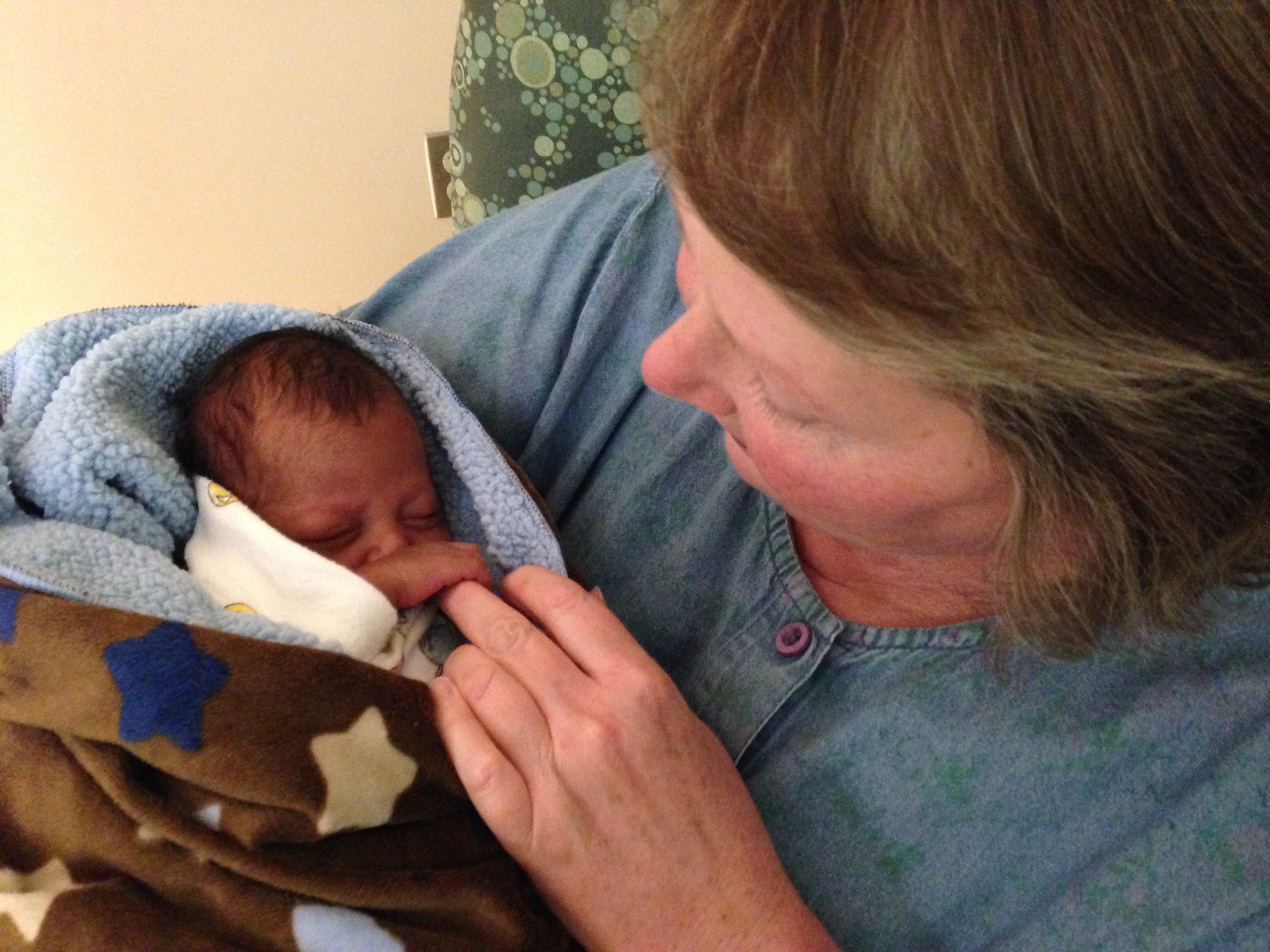
At this point I am not showing his face or sharing his name or any vital statistics on the blog, partly because I haven’t had a chance to ask his parents how they feel about it, but partly because things are just so vulnerable right now. My own kids were older when I started a blog, so as long as I wasn’t too specific about our location, I didn’t have a problem sharing pictures or their names. But it is different with a baby. πŸ™‚ However, I’ll give you just a glimpse:

photo(1)

photo(2)

Isn’t he sweet? πŸ™‚

Thanks again, so much, for your love, care, and prayers.

Someone decided to come early…

My little grandson, due late June, decided to make an early surprise appearance today!

He was crying as he came out, a good sign. But they will probably have to keep him in the NICU for possibly a couple of months.

Would appreciate your prayers for the little guy and the new parents.

I will probably not be on the blog for a few days πŸ™‚

Friday’s Fave Five

Β It’s Friday, time to look back over the blessings of the week with Susanne at Living to Tell the Story and other friends. Here are five favorite parts of the last week:

1. Safe travels for my son and daughter-in-law as they went to OK to visit her mom and attend a couple of baby showers folks were throwing for them. They had a little accident when someone scraped their car passing in a parking lot, but thankfully it wasn’t major and didn’t jolt the car enough to hurt anyone.

2. Baby things. It has been fun perusing my daughter-in-law’s baby registries and seeing all the cute things. I am looking forward to seeing what they got for their showers! I enjoyed receiving a video from my son showing us their new stroller/car seat combo – it was fun to see how excited he was about it. πŸ™‚

3. Nice temperatures. When I’ve been out and about this week, the weather has been sunny and the temperatures a little on the cool side but not so much as to need a sweater – my favorite.

4. New schedule working out well. We had to cut back my mother-in-law’s caregiver’s hours so as to manage my mother-in-law’s finances better, and also because there was not enough for the caregiver to do to justify paying for 9 hours a day. That means those hours the caregiver is no longer working fall to me. I’m having to watch the clock a bit to try to get my errands done while she’s here, and in some ways I feel a little more tied down, but I’ve been surprised at how nice it feels to have the house to myself more.

5. Losing 6 lbs. over the last few months. Woot! I’ve just been changing one thing at a time (beginning exercising regularly, cutting back on sweets), and there are many more measures I need to take, but it has been encouraging to see some results just from what I have done so far.

Happy Friday!

Adventures in Elder Care: Helping Parents As They Age

Eldercare

Before I wrapped up this series, I wanted to share some odds and ends thoughts about helping parents as they age. This list would probably vary from person to person because parents age differently: we know a man well into his 80s who stills travels internationally and just got remarried a couple of years ago, but both of my parents had serious health issues in their 60s and died before they turned 70. Some parents are pretty self-sufficient as a rule whereas others need a little more help. Some want help, some don’t. These suggestions arose primarily from our own experience of seeing my mother-in-law through the last dozen years or so of living alone, then not being able to live alone, then going from assisted living to a nursing home to home with us. Some arose from friends’ experiences. By all means tailor any of this to fit your situation. I’d welcome any suggestions or experiences you’d like to share in the comments.

1. Have “the talk” – about finances. It’s hard to say when this should be done, but it should be well before finances become an issue and before any kind of dementia has set it. I’ve heard of some with dementia who thought their kids were “after their money” when they tried to work out power of attorney and such when the parent could no longer handle their own affairs. Some parents will be on top of things and will initiate the conversation with you (which is preferable). One suggestion would be to ask your parents as they get close to retirement how they’re set for the coming years and what their preferences would be if anything should happen to make them unable to take care of things.

In our case, my mother-in-law was the one who handled the finances in her marriage, and after her husband died she was happy to give her oldest son power of attorney. When she moved here, power of attorney was given to Jim since he would be the one actually handling her finances, paying for assisted living, supplies, etc. He got a joint bank account with her name and his on it so either of them could write checks. For years she wrote checks for church and for Christmas presents, but he wrote checks for bills. She would sometimes ask about how things stood but seemed content with how things were being handled.

2. Have the other talk – about end of life issues. This can be a difficult or awkward situation, and some parents will not want to discuss it at all. If something should happen and your parents have not made any living will or advanced directives, all you can do is try to make the best decisions you can. I’d advise you to do some research before having to make a decision in a crisis. For instance, we thought feeding tubes should always be offered if needed, but then discovered there are situations where it would cause more problems than it solved. When my dad needed a ventilator, one sister-in-law was adamantly against them because she had seen people who were for all practical purposes gone, but were kept alive on a ventilator; however, my father only needed one for about ten days. I once felt that CPR should always be performed, but on an elderly person, chest compressions can break bones. If you can gather information beforehand, you’ll be better prepared to make these decisions in a crisis.

3. Sibling involvement. It helps if everyone can be involved in the discussions and decisions that have to be made. Some of these, particularly end-of-life issues, can be especially delicate and emotional. If all the siblings are nearby, it’s best if they can all be involved in a parent’s care, but realistically it does not always work out that way. If the lion’s share of care falls to one sibling (often due to distance), continue to stay involved, show interest, ask how things are going, etc.Β  Abide by their decisions unless there is neglect or abuse. If there is an elderly family member with no children, others need to step in. We knew of a situation where an older lady in our church lived with a daughter who had some kind of mental issues, was a hoarder, had stuff stacked all over the house with only a narrow pathway for the older lady to get around in her walker, had something like 16 cats, some of whom she kept tied on strings in one room, which smelled horrible. When we knew of all this, we tried to help, but found out that unless there was active abuse, there was not much we could do as “outsiders.” Someone called animal control. and they came and took a few of the cats, but that is all. Another lady tried to help the older lady find a different place to live, but ultimately she did not want to leave her daughter. At her funeral when I saw rows and rows of her relatives, all I could think was, “Where have you people been the last several years?”

4. Help where needed, but unobtrusively. Long before parents get to a place where they can’t live alone any more, they might need help here and there with a variety of issues. They begin to lose steam or get to the place where they can’t see well and may not even know of some problems.

We lived 2,000 miles away from my husband’s parents, but the last several times we visited, my husband would seek for something to be done around the house (like rebuilding the roof on the carport, etc.)Β  and suggest doing it while we were there. It gave him and his dad some time to do something together, helped with something that really needed to be done, and kept his dad from climbing a ladder to do it himself. πŸ™‚

We noticed the last several years that my mother-in-law was in her own home that things like dishes weren’t being done as well, not because she was letting them go, but because her eyesight and sense of touch was getting to the place that she didn’t realize she wasn’t doing as good of a job. I’m a bit germophobic, so when I’d drink a glass of ice water with “floaties” in it, I’d get pretty grossed out. This was before the days of readily available bottled water. She didn’t have a dishwasher, didn’t have room for one, and would not have wanted one anyway. We started getting paper plates and plastic cups when we visited, to “make things easier on her” – -which was technically true.Β  There were always piles of dishes after every meal, and sometimes she accepted help, but more often than not she liked to do them – it was her “thinking time.” Having some disposable products did help lighten that load, but it also helped us be assured that we were eating and drinking off clean utensils.

I mentioned earlier that sometimes household help can be hired, especially if the family doesn’t live nearby.

You may need to transfer things like Thanksgiving and Christmas to your house rather than the parents’ home, or at least spend time helping them get ready for it. You have to tread carefully with long-standing traditions like this: some might feel relieved not to have the pressure and work, but some might get their feelings hurt.

I mentioned helping unobtrusively: you don’t want to barge in and take over, or make them feel inadequate. Try to offer whatever help you think might be needed in a way that encourages them rather than demeans them.

And sometimes you just have to accept that things like the housekeeping might be at a lower standard than it once was. The last few years my mother-in-law lived alone, she pretty much let her dog have the run of the place, and every surface was covered with dog hair. It was a nuisance, but it wasn’t a safety or health issue, and his companionship meant a lot to her.

Sometimes helping means insisting on something they may not like. My mother-in-law was very much a status quo person who didn’t like to make any changes. Even when her hearing aid was not doing any good, she insisted it was fine, and we had to gently insist on going to the audiologist to be evaluated for a new one.

Sometimes helping may mean running interference. My mother-in-law had trouble with one physical therapist at the assisted living place (he had a Croatian accent and she couldn’t hear him well, couldn’t understand what he wanted her to do or why). He thought she was just being uncooperative. My husband had to take time to be with them for their first few sessions to help them interpret each other, but after they they got along great.

5. Help them to be as independent as possible as long as possible.Β At home or even in the lower-ranged assisted living care, there might be tools you can gets or little things you can do to help them be involved in their own care as long as possible: the seven-day pill holders to help keep their medications straight and help them remember what to take when; “reachers” to help them with hard-to-reach items (I use one of these myself!), an device to help open jars (I use one of those, too), etc. My husband tied bits of rope between his mother’s dresser drawer handles to make it easier for her to open them when she began to have trouble with them. He also put easier-to-read labels on the TV remote for the most-used buttons.

There will come a time when they will likely need help with just about everything, but for as long as possible let them do what they can do. We had elderly neighbors once, two sisters, who cut their own grass well into their 70s. One of them even painted her back steps at that age. My first impulse was, “Oh, we should go over and help them with that!” But one of them in particular liked being able to take care of herself. I just watched a Waltons episode when the grandmother came home after having a stroke, and every time she tried to do something, someone jumped up to do it and told her to relax. They meant well, but they made her feel helpless and useless. Even as their abilities diminish, let them do what they can safely do.

6. Don’t squelch talking about the past. As this post points out, they don’t have that much future left, and it may not look all that bright and cheery. This is a great time to ask them about their growing-up years – and a good time to write some of these things down for posterity. One of the things I regret with my mother-in-law is that I didn’t ask her more about these things and didn’t write down what she did say.

7. Help them find usefulness and purpose. This overlaps a bit with the above two points, but an older person can get pretty discouraged when they lose some of their abilities and even lose their home. Once when we had my mother-in-law here for dinner, a funny story from her past came up that we all enjoyed and laughed over: she did as well. Then she said, “Well, at least I’m good for a laugh.” It didn’t hit me until then that she might not have felt she was “good for” much of anything else. You can encourage a parent that as long as God has them alive, He has a purpose for them. Psalm 92:14 says, “They shall still bring forth fruit in old age; they shall be fat and flourishing.” Perhaps you can help them organize their photos into albums (something else I wish I had done) and hear the stories behind them. Remind them often that you’re glad they are here.

8. Always honor and respect them as your parents. I cringe a little at the phrase “parenting your parents” or the idea of “switching roles” with them. In one assisted living place, when we came to pick up Jim’s mom for something, one of the aides said, “It’s almost like you’re the parent now, isn’t it?” and then turned to his mom and said, “Your daddy is here.” Umm…no. Even as she has lost more of her abilities and we’ve taken on more of her care, we don’t think of her like that. As she has experienced a bit of dementia, Jim has had to remind her about some things from time to time (like using her fork rather than her fingers at meals or insisting her hands be washed), and sometimes that might have involved a sharper tone if she persists, but we don’t treat her as a child. I know family dynamics can be tricky and some parents can get more child-like, but as much as possible we still need to show them honor and respect.

9. Forgetfulness and dementia. My mother-in-law does not have Alzheimer’s, so I can’t really speak to that (and again, I’d welcome any perspectives you’d like to share in the comments). She has had a degree of dementia. It’s usually worse when under stress or when anything different is happening, and it has increased over the years.

As a general rule it doesn’t help to say, “Don’t you remember?” (Lisa suggests here to give them the answers rather than questioning them). Sometimes it does help to gently remind them of things: for instance, when Jim brought his mother here from ID, the folks at her church had all given her cards and told her good-bye, and all her kids and several grandkids had come to a combination 80th birthday/farewell party. Yet on the plane, she told Jim, “I think I’ll just stay for a few days and then head back home.” He wisely didn’t try to “set her straight” then and there, but later on he said, “Remember when all the folks at church gave you cards? Do you remember what those were for?” At some point she said, “Oh, that’s right. I’m moving to South Carolina.”

A nurse in the nursing home once told a member of a group from our church who were visiting that it is best not to alter their reality. Sometimes when they get “stuck” on something, distraction is the best tool. When Jim traveled with her, she’d say things like “I sure hope you know where we’re going” and get a little rattled by it all. Even though he is a seasoned traveler, instead of just telling her, “Don’t worry about it, I’ve got it covered,” he told her what gate he was looking for at the airport and asked her to help him look for it. That gave her something to occupy her thoughts. Recently she was “stuck” on needing to go to her daughter’s house. Jim wasn’t home when this started, and at first I tried to remind her that she lived in TN now and that her daughter was back in ID. But that wasn’t sinking in. It was one of our worst weather days this winter, and when Jim got home, he told her, “It’s snowing out now and the roads are icy, so we’re just going to stay here for the night.” He had to go over that a few more times, but after a while her thoughts turned a different direction.

Even in visiting in the “memory care” unit of assisted living, residents would stop us and ask us if we could help them get somewhere. At some level they knew they weren’t home, and some of them were constantly trying to figure out ways to get there. One lady stopped Jim once to say that something was wrong with her car and she needed to get to it. It was close to dinner time, and he said, “I tell you what, why don’t you stay and eat dinner, and we’ll see about your car later.” She felt so honored to be asked. πŸ™‚ (On a side note, when visiting a nursing home or a memory care or Alzheimer’s unit in an assisted living facility, sometimes it is best to avoid engaging the residents in much conversation. When we visited my m-i-l in regular assisted living, we talked with the other residents quite frequently. But we quickly found that in the “memory care” unit, they often wanted you to help them with something, and when you couldn’t, they would get agitated, sometimes angry, and even start yelling and cussing, which not only disturbed themselves and others but made it hard on the aides to get everyone settled back down. We learned to just cheerfully say hello in passing without stopping to talk, and if we did get stopped and asked for something, we’d point out one of the aides and say, “Maybe she can help you.” )

10. Helping them deal with government agencies. Even if you have power of attorney, there are many situations where an agency will want your parent there. Once when my husband was trying to deal with one particular issue (I forget what it was), the man he was talking to wanted to talk to my mother-in-law on the phone. My husband tried to tell him she was very hard of hearing and especiallyΒ  had trouble hearing on the phone, but the man insisted. So my husband went to her room at the assisted living facility, called the man, put the phone on speaker, and they tried to have a conversation. When she couldn’t hear and Jim was trying to convey to her what the man had said, the man shouted, “Don’t you dare tell her what to say!” Understand that they are trying to protect the elderly from being taken advantage of by unscrupulous relatives (unfortunately that does happen), but sometimes they do make it unnecessarily hard on those of us who are trying to help get necessary things done.

11. Smooth awkward moments. You don’t need to call attention to every mistake or fumble: if they’re aware of it, they probably feed bad enough already. Just help take care of spills or messes or whatever without making an issue of it. When they start needing help with personal issues, just handle it as matter-of-factly as possible – I took that cue from when I’ve had surgeries and illnesses and needed help with things I’d much rather have done on my own. Usually the nurses just came in and we got it done, and some of them were even cheerful about it. When my mother-in-law started needing help going to the bathroom, she’d say apologetically, “I bet you never thought when you got married that one day you’d have to help your mother-in-law go to the bathroom.” Well, no, I hadn’t. πŸ™‚ And helping someone that way or changing dirty Depends later on is not really anyone’s favorite thing to do, but it helps to just look at it as meeting her needs and to handle it with as much grace as possible. My husband is great at easing awkward issues with humor.

12. Don’t neglect spiritual needs. Linda had a great post on this. When they can’t read the Bible for themselves any more, take time to read it to them. Some can handle CDs to hear the Bible read. Jim’s mom liked to attend church Sunday mornings until perhaps the last year or so when she just got too feeble and had little energy. When she was in the nursing home, a group from a church we were familiar with had a church service there Sunday afternoons, and Jim went over and accompanied her to it.

13. Have patience. There can be a multitude of frustrations as a parent gets older, even when we understand that they can’t help what they are doing and saying. This is probably the area that I most often prayed for while my mother-in-law was in assisted living, and often while driving there I often prayed and quoted to myself Colossians 1:11: “Strengthened with all might, according to his glorious power, unto all patience and longsuffering with joyfulness.”

The ultimate principle is to “do unto others as you would have them do unto you” (Luke 6:31). Put yourself in their place and treat them with as much love and grace as you would want others to show to you in the same situation.

Grandmother’s Beatitudes

Blessed are those who understand
My faltering step and palsied hand.

Blessed are those who know that my ears today
Must strain to catch the things they say.

Blessed are those who seem to know
That my eyes are dim and my wits are slow.

Blessed are those who looked away
When coffee spilled at table today.

Blessed are those with a cheery smile
Who stop to chat for a little while.

Blessed are those who never say,
β€œYou’ve told that story twice today.”

Blessed are those who know the ways
To bring back memories of yesterdays.

Blessed are those who make it known
That I’m loved, respected, and not alone.

Blessed are those who know I’m at a loss
To find the strength to carry the Cross.

Blessed are those who ease the days
On my journey Home in loving ways.

– Esther Mary Walker

Related reading here at Stray Thoughts:

With All Our Feebleness.
Despise Not Thy Mother When She Is Old.
Caring For a Parent at Home.
Assisted Living and Nursing Homes.
Decisions for a Parent’s Care.
How Older Women Can Serve.
A Public Service Announcement Concerning Walkers.
Senior Version of “Jesus Loves Me”
Am I Doing Any Good?
The Winter of Life.

Related reading on the Web:

Insignificant Is Beautiful.
Maintaining Sanity During Dementia’s Cognitive Decline.
8 Things Not to Say to Your Aging Parents.
Elders Who Abuse Relatives Taking Care of Them.
Adapting Your Home For An Older Parent.
10 Ways Caring For Parents Is Different Than Caring For Children.
You Are My Sunshine.
Alzheimer’s…My Reflections.
I’m Still Here.
A Psalm For Old Age.