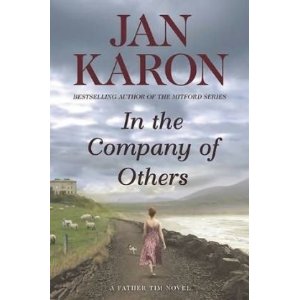
 In the Company of Others is the second of the Father Tim novels by Jan Karon. Father Tim, as most may know, was the central character in Karon’s delightful Mitford series, but the Father Tim novels take him out of his well-beloved town.
In this book, Father Tim and Cynthia finally embark on their long-awaited trip to Ireland, the land of his roots. He has been there once before but is looking forward to showing Cynthia the sights.
Trouble arrives fairly soon, though, as Cynthia injures her ankle, causing her to have to be off her feet, the lodge where they are staying suffers a series of burglaries, and the family who owns the lodge is wounded by a rebellious daughter and a distant mother/mother-in-law, a bitter old woman who experiences serious health issues. Even Dooley, back home in Mitford, phones them concerning serious problems with his girlfriend, Lace.
As Father Tim and Cynthia are unable to travel due to her ankle, they get caught up in the lives of the folks in the area and try to help where they can. As they recuperate they enjoy reading an old journal that eventually leads them to a clue of help in the current situation at the lodge.
Reading In the Company of Others was like a comfortable visit with old friends. I enjoyed hearing bits from and references to the old Mitford gang (loved hearing long-suffering secretary Emma’s personality come through her e-mails), and I often get a little misty at Father Tim’s wonder over his wife and his later-in-life marriage. I love his interaction with Cynthia and the personal conflicts he wrestles with — wanting to take Cynthia to Ireland but hating travel, trying to control his diabetes but being tempted by things he shouldn’t eat, hating controversy but needing to express truth.
Some of the most valuable sections in the book come from his advice to lodge proprietor Anna from his experience of dealing with his own “wounded boy,” his adopted son, Dooley:
“We think of love as warm and cozy, and that’s certainly part of it. But it was hard to muster those feelings toward someone who vented his life-long rage at me.”
“It’s not the sort of thing romantics wish to hear, but I found that in the end, love must be a kind of discipline. If we love only with our feelings, we’re sunk — we may feel love one day and something quite other the next…I realized I must learn to love with my will, not my feelings…”
“I learned over a long period of trial and error to see in him what God made him to be. Wounded people use a lot of smoke and mirrors, they thrust the bitterness and rage out there like a shield. Then it becomes their banner, and finally, their weapon. But I stopped falling for the bitterness and rage. I didn’t stop knowing it was there — and there for a very good reason — but I stopped taking the bullet for it. With God’s help, I was able to start seeing through the smoke.”
“Healing came as little drops of water, and never the mighty ocean when you need it.”
“There’s just no way to deal with their suffering, except through love. And there was no way I could gouge that kind of love out of my own selfish hide without the love of God” (pp. 238-240).
Though parts of the story are more ecumenical that I personally am comfortable with, and though I wouldn’t agree with every little point of theology portrayed in the book, gospel truth is clear but not obtrusive.
Though I appreciate the book more and more as I ponder it, and a great deal more than the first Father Tim novel, Home to Holly Springs, I probably enjoyed it maybe a smidgen less that the Mitford novels. I’m not sure why. Maybe it’s because of missing Mitford and its people, but I don’t think so — I really don’t think much more could be done with those characters. Maybe it’s because some of the plot lines seem a little edgier that those in Mitford, but then again, not really, either, considering Dooley’s back story. I did find it a little ironic that many characters in the book mention that they haven’t read much of the journal Father Tim and Cynthia read because it’s too dry and boring — and then great chunks of it are quoted in the text. Yet once I got used to the language and got straight who all the different people were, I began to enjoy those parts as well and was delighted at the way their stories were wrapped up in the end.
I’m not sure if Jan Karon is planning any more adventures with Father Tim and Cynthia, but I will be glad to visit with them again if she does.
(This review will be linked to Semicolon‘s Saturday review of books and the next 5 Minutes For Books I Read It column.)