Unknown's avatar

About Barbara Harper

https://barbarah.wordpress.com

Flashback Friday: Halloween

Mocha With Linda hosts a weekly meme called Flashback Friday. She’ll post a question every Thursday, and then Friday we can link our answers up on her site. You can visit her site for more Flashbacks.

The prompt for this week is:

What was Halloween like when you were growing up? Did your family participate? If not, was there a substitute activity? Did your school or church have a fall festival or carnival? Were there stipulations regarding costumes? What sorts of activities did they have? What about Halloween parties? Have you ever bobbed for apples or been on a hayride? What are your memories of “haunted houses”? (I’m not referring to the ultra-scary, secular ones, just the fun kid ones, with bowls of grapes and cold spaghetti!) If you went trick-or-treating, what were the rules, both for trick-or-treating and for candy consumption? What types of costumes did you wear? Were they store-bought or homemade? Did you carve a jack-o-lantern? How are your children’s experiences similar or different to yours? And the most important question: Do you like candy corn? What is your favorite (and least favorite!) Halloween candy?

My family did allow us to trick-or-treat. I can’t remember any of my costumes except I know I wanted to be a princess one year. We usually had store-bought costumes with the plastic face masks, and I can remember the masks getting all sweaty and irritating after a short while. But it was fun to dress up and get candy and wasn’t a terribly big deal.

One cousin did have not so much a haunted house but a creepy scary tour in his garage with low lights, boiled eggs for eyeballs, spaghetti for “guts,” etc, that we were supposed to run our hands through. It was pretty well done for his age and wasn’t scary so much as icky, but one other cousin got pretty shaken up by it. That’s the only thing like that I can remember going to — I had no interest in them as I got older.

I was a teen-ager before I heard of or attended an alternate party — the church I attended had something, but I don’t remember what it was called. It was basically a youth activity with games and food and fall decorations — wholesome, nothing scary, no costumes. I enjoyed it.

As a young wife and mom, I was pretty anti-Halloween. I had become a Christian as a teen-ager, and you can find a lot of reading material about the negative influences and symbolism of Halloween. Naturally I wanted to protect my children from anything evil. Plus the day seemed to stray from just innocent dressing up and gathering candy from neighbors to something darker and gory, and stories sprang up across the country about tainted candy. So I was very surprised when I saw faculty and staff from my Christian college let their kids trick-or-treat on campus in the faulty housing area. Of course, it was probably the safest place in the country to trick-or-treat, but, still, what about all those evil origins?

Well, over the years, after observing what several other Christian families did, I did come to the conclusion that it would be possible to celebrate the day as we did in my childhood, with just an opportunity to dress up and get candy, without endorsing evil. I never did feel comfortable letting my own children trick or treat, but we did give out candy as well as children’s tracts and a little leaflet a family in town published with a phone number kids could call to hear Bible stories. If I had young children today, I would probably let them trick-or-treat just on our street or maybe at a mall or zoo or somewhere like that with an organized candy distribution.I would still feel uncomfortable taking them to total strangers.

One of my close Mom friends did have a fall party several years in a row which I just loved. She purposefully kept it away from the day or week of Halloween for those who had problems with it, but she did ask kids to dress up. She had a theme each year: one year it was storybook or fairy tale characters (Jeremy and Jason were Robin Hood and Little John); another year it was clowns, another it was “what you want to be when you grow up.” She had games and prizes and fall decorations. It was a lot of fun.

One year when we were in GA and were discussing with the Awana leaders whether to have any kind of fall party with the kids, one couple strongly objected: they were so adamantly against Halloween that they were against doing anything at all related to costumes or candy or parties anywhere near the date. But I have no objections at all to alternate activities. In fact, in many missionary stories I read, they came up with alternate activities to some of the pagan or unwholesome ones on purpose to help the Christians who might have been tempted to go back to situations that would have proven a major temptation for them.

The only time I dressed up for Halloween as an adult was when I worked at  a fabric store in a mall and had to work Halloween Day. I made a Raggedy Ann costume and wore the dress (without the pinafore) for many years afterward. My kids used the “hair” for clown costumes.

Me as Raggedy Ann

Working at a fabric shop, it was fun to see what different people came up with.

I do remember bobbing for apples once — I didn’t like it very well (mainly getting water up my nose). Now the unsanitariness of several people putting their mouths (and sometimes noses) in the same tub of water grosses me out. I can remember going on a hayride or two —  it was ok, but I didn’t really see the point. I don’t remember ever carving a jack-o-lantern. I don’t like candy corn. I ate it some as a child and thought it was okay, thought not a favorite, but I can’t stand it now. My favorite candy is Lindt Lindor Truffles, but people don’t usually give those out at Halloween. 🙂 But I like the little fun-size M&Ms, Three Musketeers, and Reese’s Peanut Butter Cups as well as the Hershey’s Miniatures (except for the dark chocolate ones).

And for a nostalgic visit to some of the old-style candies —
15 Influential Authors

Diane tagged me with this on Facebook, and I thought I’d post it here as well:

Don’t take too long to think about it. Fifteen authors (poets included) who’ve influenced you and that will always stick with you. List the first fifteen you can recall in no more than fifteen minutes. Tag at least fifteen friends, including me, because I’m interested in seeing what authors my friends choose.

1. Elisabeth Elliot
2. C. S. Lewis
3. C. H. Spurgeon
4. Amy Carmichael
5. Isobel Kuhn
6. Jim Berg
7. Erwin Lutzer
8. David Martin Lloyd-Jones
9. J. Oswald Sanders
10. Jim Elliot
11. Charles Dickens
12. Nancy Leigh DeMoss
13. Darlene Diebler Rose
14. Edith Schaeffer
15. Gracia Burnham

I got the first 10 in three minutes; I had to think a little more about the last five.

I am not going to tag anyone, but let me know if you do this — I’d love to see the list of your most influential authors.

Colorlessness

I can tend to be too adversely affected by weather. Oh, not the occasional rainy day, but prolonged periods of cloudiness. I have an especially hard time with winter between New Year’s and Valentine’s Day. The numbing cold, for one thing, but more so the colorlessness depresses me.

I was just reveling in the height of color especially on the hills on the drive to church Sunday. I spent most of the 20 minute drive just drinking in the beauty.

But just two days later, many of the leaves on that same drive were blown off with high winds and rain and the hills were sporting several patches bald of color.

“No!” I thought. “Not yet!”

This morning I came across this in F. B. Meyer’s Our Daily Walk:

There are three things that make Springtide in the soul.

The sense of God’s Presence. We know that He is near, though the woods are bare, the frost holds the earth in its iron grip, and the wind gathers together the dead leaves; but we feel Him nearer when every hedgerow is clothed with flowers, every bush burns with fire, every tree claps its leafy hands, and every avenue is filled with sweet choristers.

The optimism of an illimitable hope. Spring is the minstrel of Hope. She takes her lyre and sings of the fair Summer, which is on her way, Life pours through a myriad channels, and shows itself stronger than death for Spring is victorious over Winter, as good shall prove to be over evil.

The exuberance of Love. Spring is the time of love. The whole creation is attracted by a natural affinity, and love rules in forest and field.

For us, the lesson is clear. Cherish the sense of the Presence of God; cultivate an illimitable Hope; be conscious of a Love flowing towards you and from you. Dwell on the loving-kindness and tender mercy that have preceded and followed you all the days of your life, and for you, too, the wilderness and solitary place will be glad. After all, life is not altogether what circumstances make it. They may be everything that heart can wish, and yet the Frost-King may reign within and east its icy mantle over all; whereas there are men and women who have everything adverse in their circumstances, but because they have Spring in their hearts, they find flowers and songs everywhere.

The rest of this devotional is here under October 27.

Though maybe cheerfulness and exuberant worship comes a little more naturally when the sun is shining and there is beauty everywhere, either in fall or spring, I can rejoice in the unchangeable truths of God’s love and care and Presence and hope no matter what the conditions are. A genuine counting of my blessings puts me back in a right frame of mind. Practically, good music, good books, warmth of family and friends, something of beauty to look at or work on in the home all help stoke the furnace of contentment as well, though I am reminded of biographies I have read where people did not have even those resources, yet still rejoiced in God alone.

Be still, sad heart! and cease repining;
Behind the clouds is the sun still shining;
Thy fate is the common fate of all,
Into each life some rain must fall,
Some days must be dark and dreary.

~ From Longfellow’s “The Rainy Day“

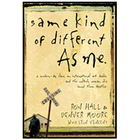
Book Review: Same Kind of Different As Me

When I first saw the book Same Kind of Different As Me by Ron Hall and Denver Moore popping up here and there, I saw the front cover went on to say, “A modern-day slave, an international art dealer, and the unlikely woman who bound them together.”

Hmm, I thought. Might be interesting. But not enough to compel me to get it. It just didn’t seem to “grab” me.

Then I began seeing it on more and more blogs, getting rave reviews by people I knew and respected.

Hmm, I thought. Maybe I’d better check it out.

So I got it. And put it on my shelf. And it sat there for weeks.

Finally I had a desire to pick it up and read it — after I found it in a box of books that wouldn’t fit on my bookcases.

Wow. I am so glad I did.

I don’t know if most of us have a truly correct view of poverty in this country. I’ve personally known people who lived quite comfortably and happily under what the government set as the poverty level. I’ve known others who felt they were poverty-stricken because they could not afford cable TV service. The poverty described in this book is raw, real, stark, and almost inescapable — almost unfathomable. Denver Moore escaped from virtual slavery on a plantation in Louisiana by riding the rails to what he truly perceived as a better life as a homeless man in Texas.

Ron Hall began serving at a homeless shelter only because his wife wanted him to come with her. “I hate to admit this now,” he writes, “but I had pictured myself more as a sort of indulgence benefactor: I would give him a little bit of my valuable time, which, had I not been so benevolent, I could have used to make a few more thousand dollars. And from time to time, I imagined, if Denver stayed cleaned up and sober, I’d take him of field trips from hobo land to restaurants and malls, a kind of peep show where he could glimpse the fruit of responsible living and perhaps change his ways accordingly” (p. 111).

It didn’t exactly turn out that way.

Both men were challenged, both learned of their own ignorance, assumptions, and prejudices, both were stretched beyond themselves and the world they had known. Both taught each other, learned from each other, and supported each other.

This is a riveting book. Parts of it horrified me, parts had me in tears, parts were sheer beauty.

And it’s true. A real story with real people.

(This review will be linked to Semicolon‘s Saturday review of Books and the next 5 Minutes For Books I Read It column.)


What’s On Your Nightstand: October

What's On Your NightstandThe folks at 5 Minutes For Books host What’s On Your Nightstand? the fourth Tuesday of each month in which we can share about the books we have been reading and/or plan to read. You can learn more about it by clicking the link or the button.

Wow, I can’t believe it is the last week in October already. The month just flew by.

Here’s what I read since last time:

Her Daughter’s Dream by Francine Rivers, the sequel to Her Mother’s Hope, reviewed here.

The Thorn by Beverly Lewis, reviewed here, the first of a new Amish series about two sisters on different paths.

I’m Outnumbered!: One Mom’s Lessons in the Lively Art of Raising Boys by Laura Lee Groves, reviewed here.

Faithful Women and Their Extraordinary God by Noel Piper, short biographies of Sarah Edwards, Gladys Aylward, Lilias Trotter, Esther Ahn Kim, and Helen Roseveare, reviewed here.

Same Kind of Different as Me by Ron Hall, Denver Moore, and Lynn Vincent, reviewed here, about an unlikely friendship between an art dealer and a homeless man.

I’ve started 50 People Every Christian Should Know: Learning From Spiritual Giants of the Faith by Warren Wiersbe and A Novel Idea: Everything You Need to Know about Writing Inspirational Fiction (that one wasn’t on my Fall Into Reading challenge goals, — it was on my shelf for “some day” — but I felt a sudden urge to start it) and just picked up Start Somewhere: Losing What’s Weighing You Down from the Inside Out by Calvin Nowell and Gayla Zoz.

Next up: Here Burns My Candle by Liz Curtis Higgs, In the Company of Others by Jan Karon, and something by Agatha Christie — still haven’t decided yet.

Happy Reading!

The Week In Words

Welcome to The Week In Words, where we share quotes from the last week’s reading. If something you read this past week  inspired you, caused you to laugh, cry, think, dream, or just resonated with you in some way, please share it with us, attributing it to its source, which can be a book, newspaper, blog, Facebook — anything that you read. More information is here.

Here are some that caught my attention this week:

The following is from Jeanne Damoff:

Fear is a liar and a thief. A liar, because it fills our minds with hypothetical horrors, and a thief because it steals precious hours we can never get back and strips them of peace. Fear is a cloud, obscuring what’s real, and what’s real is something that can’t be imagined. It can only be received and is only given when it’s needed.

I had never thought of fear in those terms, but that’s so true.

From Warren Wiersbe’s With the Word commenting on the memorial Israel was to set up in Joshua 4 and the need to memorialize or remember how God has led in the past not only to praise Him but as a testimony to future generations (Psalm 78:1-6):

When you have living faith in a living God, the past is not “dead history.” It throbs with a living reality.

I get aggravated when some people discount all of history since it is about “dead guys.” That’s pretty short-sighted!

And from the same book concerning Calebs’ claim to his inheritance in Joshua 14:

What an example for us to follow! Age did not hinder him, the disappointments of the past did not embitter him, and giants did not frighten him!

What particularly struck me about this was his not being embittered by the past. If you remember, Caleb and Joshua were the only ones willing to trust God and go forth when the Israelites came to Canaan the first time, but the others were afraid and refused. Israel was then assigned to the wilderness for forty years while the old generation died off, and Caleb had to wait and wander even though he had been faithful. Yet he didn’t complain and was never bitter — he patiently waited until it was God’s timing for him to receive portion. A lesson to me: I probably would have been inwardly chafing much of those forty years. (I Peter 2:19-25 has more to say on suffering when you’ve done right. What greater example is there of that than the Lord Jesus?)

If you’ve read anything that particularly spoke to you that you’d like to share, please either list it in the comments below or write a post on your blog and then put the link to that post (not your general blog link) in Mr. Linky below. I do ask that only family-friendly quotes be included. I hope you’ll visit some of the other participants as well and glean some great thoughts to ponder.

I Run to Christ

I run to Christ when chased by fear
And find a refuge sure.
“Believe in me,” His voice I hear;
His words and wounds secure.

I run to Christ when torn by grief
And find abundant peace.
“I too had tears,” He gently speaks;
Thus joy and sorrow meet.

_____

I run to Christ when worn by life
And find my soul refreshed.
“Come unto Me,” He calls through strife;
Fatigue gives way to rest.

I run to Christ when vexed by hell
And find a mighty arm.
“The Devil flees,” the Scriptures tell;
He roars, but cannot harm.

_____

I run to Christ when stalked by sin
And find a sure escape.
“Deliver me,” I cry to Him;
Temptation yields to grace.

I run to Christ when plagued by shame
And find my one defense.
“I bore God’s wrath,” He pleads my case—
My Advocate and Friend.

Words by Chris Anderson
Music by Greg Habeggar
Reprinted with permission

Some of you comment that you’re unfamiliar with the hymns I post. That will be especially true this time because it is a relatively new hymn! I am not sure when it was written, but I just became aware of it when Chris posted a mention of it on his blog a few days ago, and it spoke to my heart. You can peruse more of Chris and Greg’s hymns at their web site, Church Works Media. Notes on the text to this hymn are here and a lovely orchestration of it can be heard by scrolling to the end of this post.

Laudable Linkage and Grandma’s Connected

Just a few interesting things seen round the Web this week, then I have a fun poem I want to share with you.

Lisa shares 7 reasons why I still go to church. I have been thinking of writing a post about reasons to go to church, but this definitely hits the major ones.

Lisa also pointed me to this video of How (Not) to Invite Your Coworker to Church.

I have a sweater I love which is disintegrating in key places. I’ve been trying to figure out something to do to preserve and use it, and this purse made from a sweater might be just the thing.

This cupcake wrapper template to use with scrapbooking paper would be great theme parties or special occasions.

I’m not sure who the author of this poem is — I received it from the Good Clean Funnies List. I’m not a Grandma yet, and I hope to be a cookie-baking, book-reading Grandma, but I will definitely be a “connected” one, too! I’ve mused over at my mother-in-law’s assisted living place how those rooms might look when the connected generation gets into them.

Grandma’s Connected

In the not too distant past–
I remember very well–
Grandmas tended to their knitting
And their cookies were just swell.

They were always at the ready
When you needed some advice
And their sewing (I can tell you)
Was available–and nice.

Well Grandma’s not deserted you,
She dearly loves you still,
You just won’t find her cooking
But she’s right there at the till.

She thinks about you daily
You haven’t been forsook.
Your photos are quite handy
In her Pentium notebook.

She scans your artwork now, though,
And combines it with cool sounds
To make electronic greetings;
She prints pictures by the pounds.

She’s right there when you need her
You really aren’t alone.
She’s out now with her “puter” pals
But she took her new cell phone.

You can also leave a message
On her answering machine
Or page her at the fun meet
She’s been there since nine-fifteen.

Yes, the world’s a very different place,
There is no doubt of that,
So “E” her from her web page,
Or join her in a chat.

She’s joined the electronic age
And it really seems to suit her,
So don’t expect the same old gal,
’cause Grandma’s gone “Computer.”

Friday’s Fave Five

Welcome to Friday’s Fave Five, hosted by Susanne at Living to Tell the Story, in which we can share our favorite things from the last week. This has been a wonderful exercise in looking for and appreciating the good things God blesses us with. Click on the button to learn more, then go to Susanne’s to read others’ faves and link up your own.

Here are five of my favorites from the past week:

1. Dinner For Six. This is a program our new church has for people to get to know each other. Everyone who wants to participate signs up and then someone divides them into groups of six. Within each group of six, each couple (it’s usually married couples, but not always) takes turns hosting the others over the next three months, divides the meal among them (host family does the main course, one couple brings salad and bread, another brings dessert and beverage, then they rotate each month). We had our first dinner last Saturday, and I really enjoyed it.

2. Antibiotics. Jim was about as ill as I have ever seen him the first part of this week. First we thought it was an allergic reaction to something he ate, then we thought it was flu, then we thought maybe a urinary tract infection. He went to the doctor Tuesday and he was diagnosed with a UTI. I don’t think that accounts for all the symptoms he was having, but maybe it does. But within less than a day of being on antibiotics he was starting to feel better, and he was able to go back to work Thursday.

3. Leftovers. We’ve been having more of them with just the three of us home! I usually have leftovers for lunch but haven’t been able to keep up with them all. I was trying to decide what to do for dinner last night and didn’t really feel like expending a great deal of effort, and Jim suggested just heating up leftovers. It was nice to be able to do that — we had enough for a full meal and then some. Though probably not anyone’s first choice for a meal, it is nice for the cook sometimes.

4. 9 a.m. school. Jesse’s school usually starts at 8, but this past week they started at 9 every day except today because the church the school was associated with was having a mission’s conference. I’ve never heard of a school doing that, but it’s a great idea! It’s hard to take younger ones to evening meetings and then get going the next morning. And even though mine is older and we only went to one of the evening meetings since we do not attend that church, it was still nice.

5. Hearing Jesse’s choir sing. The high school choir sang at that church’s mission’s conference Tuesday night and did a great job. I had never heard the song before.

Another favorite is something that didn’t happen. Wednesday night I was taking a pan of enchiladas out of the microwave, and I dropped it. It wasn’t hot — it just slipped. It was a glass pan, and it fell on another glass pan, skidded off the top onto another smaller glass dish and landed on the counter — and nothing broke! I was certain dinner was ruined by bits of glass, but, thankfully, everything was intact. Thank You, Lord!

Flashback Friday: Families

Mocha With Linda hosts a weekly meme called Flashback Friday. She’ll post a question every Thursday, and then Friday we can link our answers up on her site. You can visit her site for more Flashbacks.

The prompt for today is:

How was your family structured when you were growing up? Did you grow up with both original parents in the home? If your parents divorced, did you go back and forth between them? Whether divorced or widowed, did your parent remarry? How old were you? Was yours a multi-generational household with grandparents living with you? Did your mom work outside the home, and if so, was it full-time or part-time? Was there a clearly delineated division of labor between your parents (or parent and step-parent) and how traditional was it? Did your parents believe in child labor?! That is, how structured were chores? What responsibility, if any, did you have for things like doing your own laundry, fixing your own school lunch, etc.? Were your parents do-it-yourself-ers or did they hire people for repairs, painting, etc.? Is your current marriage/family structure similar to the way you were raised? What do you do differently than you did then?

My parents married right after my mom got out of high school. They were originally going to wait two years and work and save money, but my father’s father was dying and told them that if they wanted him at their wedding, they’d better go ahead and have it. Years later, with the wisdom of hindsight, my mom said that if they had waited, they probably would not have gotten married. But then I wouldn’t be here. 🙂

My father was an alcoholic and a very insecure, jealous, angry man, though all of those characteristics were just in embryonic form at that point. He probably was not a full-fledged alcoholic then, but he did drink, and my mom thought that when they got married that would take care of the jealousy and insecurity. She was wrong, and may I say to anyone contemplating the same thing, you will most likely be wrong as well.

I grew up with both parents in a pretty traditional nuclear family the first several years. There was some period of time we lived with my mother’s father, but I don’t remember how long that was. Overall things were pretty stable — an occasional fight, and occasional drunken binge, smatterings of financial trouble. But I do remember feeling more happy than not, the occasional blow-ups passing through like a summer storm.

They had a fairly traditional marriage. My mom did various things as we grew up: sometimes she stayed home, sometimes she worked full time, sometimes she worked at night. When she worked, sometimes we had a baby-sitter come to our house, sometimes we were taken to a baby-sitters house, once we went to a daycare. The daycare was the worst; Mom at home was best. As the oldest, I became chief baby-sitter when my parents thought I was old enough. I think those experiences were some of the main influences towards my strong desire to be a stay-at-home mom. Even as a teen-ager, I hated coming home to an empty house after school.

But the anger and drinking escalated. I don’t know whether it was the natural progression of things or whether my dad just couldn’t handle life’s increasing pressures with five children or what, but it got to the point where neither my mom nor any of us kids could do much of anything right, there was constant tension and fear of saying or doing the wrong thing to set him off. I don’t remember physical abuse per se beyond an occasional undeserved spanking: I do remember my father slapping my mother once. Years later she said there was more physical abuse than that, but I don’t know whether I just blocked it out or they kept it behind closed doors. But the withering verbal abuse was bad enough.

When I was almost 16, my mother left my father after 18 years of marriage (and, as I shared in my testimony, God used these things to bring me to Himself) for another man who was 13 years younger than her, only seven years older than I was…and, yes, that was pretty strange at first. He and I did eventually come to respect and care for each other, and he and my mom were together until she passed away, I think some 22 years later. They had one child together, but I rarely think of her as my half-sister — we were all just siblings. My brother lived mostly with my dad, and my next oldest sister stayed with him for short periods of time, but the rest of us stayed with my mom.

My parents’ division of labor at home was pretty traditional. But when my mom and step-father got together, many Saturdays you’d fins him cooking and her cleaning out the garage, at least until she got older and started having health problems and became less active. The older she got the less she seemed to like to cook. My step-father makes a wonderful pepper steak — I crave it sometimes.

We kids didn’t often have specific regular chores when I was younger, but we were expected to help any time we were asked. As a teen-ager it was my responsibility to get dinner started: I’d call my mom at work and see what she wanted me to do, and, depending on what it was, I’d often have it pretty much ready by the time she got home. I know I helped with general house-cleaning, but I can’t remember if I had specific regular responsibilities or just generally pitched in.

Both my dad and step-dad were do-it-yourselfers. My step-dad was a wiz at fixing cars until they became computerized — I don’t know how many weekends some friend or another brought their car over for him to look at.

My own home is pretty traditional. I cook, though my husband grills sometimes. I do the bulk of the cleaning and shopping, though he sometimes pitches in. He would likely do anything I asked him to around the house, but he works long hours and I don’t want to pile more on him by expecting him to do housework as well, plus his weekends are usually pretty full. He takes care of the outside, the cars, and pays bills. I did have my kids do basics like picking up their toys and such when they were little, and I don’t remember when they first started having regular household chores, but for many years almost every Saturday I would make a list of what needed to be done — usually vacuuming, dusting, and taking out small garbage cans — and let them take turns having first pick of whatever jobs they wanted most preferred to do. They also took turns unloading the dishwasher and taking out the kitchen garbage every night after dinner. They were responsible for their own rooms (when they were very little we cleaned their rooms together, but of course as they got older they took on more and more of it on their own). We had to adapt that as they started going to college. Now with just one at home, I’m having to take back some of those chores! But there is less to do in the realm of laundry and dishes, so I guess it balances out. They were also expected to help out with family projects like painting rooms, taking down wallpaper and tile when we remodeled the bathroom, etc. It was not only a help to us, it was a learning experience for them, and it had moments of fun family fellowship as well. They also divided up the grass-cutting.

Back to my dad for a moment, I told more of his story here, and he eventually did come to know the Lord. As I wrote there:

I was surprised that I had a great deal of anger in the years after he died — anger that our relationship wasn’t what it could have been, and though I couldn’t talk to him about it, anger at his anger. I felt it was kind of silly, really, to be angry at that point when there was no way to reconcile anything with him. I have read, though, that those feelings are pretty normal. What helps is to know that since he did come to trust Christ, now in heaven, where “the spirits of just men [are] made perfect,” knowing what he knows now, everything is all right on his end and he would do things differently if he could.

I just wanted to share that for anyone wrestling with similar family issues. I can forgive him now on that basis but more importantly on the basis of Christ’s forgiveness of me.