Unknown's avatar

About Barbara Harper

https://barbarah.wordpress.com

Healing from Past Hurts

Before Jonathan Goforth became a widely-used missionary to China, he was a farm boy eager to go to Knox College in Toronto in the 1880s. Jonathan originally wanted to go into politics, but God saved him and called him to the ministry.

His mother, noted among the neighbours for her fine needlecraft, worked far into the night putting her best effort on the finishing touches to shirt or collar for the dear boy who was to be the scholar of the family (Rosalind Goforth, Goforth of China, p. 29).

Jonathan’s heart thrilled as he thought how soon he was to live and work with other young men who, like himself, had given themselves to the most sacred, holy calling of winning men to Christ. He had visions on reaching Knox of prayer-meetings and Bible study-groups where, in company with kindred spirits, he could dig deeper into his beloved Bible. So his joyous, optimistic spirit had reached fever heat when he arrived in Toronto and entered Knox College (p. 30).

However, instead of finding kindred spirits, Jonathan became the object of ridicule. “He was unconventional to a degree, and utterly unacquainted with city habits and ways” (p. 31). He realized his lovingly homemade clothes “would not pass muster.” He didn’t have much money, but he bought some cloth to take to a seamstress for a more appropriate outfit. But some of his fellow students found out.

Late that night a number of them came into his room, secured their victim, then, cutting a hole at one end of the material . . . they put his head through and forcing him out into the corridor, made him run the full length up and down through a barrage of hilarious students (p. 31).

Later, Jonathan became involved in a ministry to reach people in the slums. His “enthusiastic innocence” annoyed and amused his fellow students.

He became a subject for an ‘Initiation Ceremony’; hailed at midnight before his judges, students of Knox College, he was subjected, I learned, to indignities, and warned against further breaches of good form by his tales of his ‘experiences with sinners’ (p. 33).

Goforth was deeply hurt, not so much for himself, but that such a thing should happen in a Christian college (p. 33).

Jonathan reported the latter incident to the principal, who soothed his feelings but took no action against what he deemed “a silly prank of foolish boys.”

Many of us have experienced hurt from the past. Sometimes it’s been in the form of passive neglect. We have easily made friends in other schools or neighborhoods, but for some reason, in a new place, we can’t seem to make headway socially. People aren’t actively rude or mean, but we always remain at the bottom of the social pecking order, never really a part of the group.

Other times, like Jonathan, people experience active hazing, ridicule, meanness. Sometimes one person becomes the one everyone likes to pick on or make fun of.

Though I am thinking of incidents from school days, some of these things happen in later life as well.

And some incidents continue to hurt for decades.

What can we do to heal from them?

Draw close to God. After the first incident mentioned above, Jonathan

. . .knelt with his Bible before him and struggled through the greatest humiliation and the first great disappointment of his life. The dreams he had been indulging in but a few days before had vanished, and before him, for a time at least, lay a lone road (p. 32).

We see something similar in Joseph’s story in Genesis 37-50. His own brothers stripped him of the special coat their father had made for him, threw him into a pit, ignored his distress and cries (Genesis 42:21), and sold him into slavery. Then at his first place of service, he was lied about and imprisoned.

Just a few chapters later, we see Joseph taken out of prison and made Pharaoh’s right hand man. So, everything worked out for him in the end. But those chapters represent years of being alone. We see just a glimpse of Joseph’s suffering in the name he chose for his children: “Joseph called the name of the firstborn Manasseh. ‘For,’ he said, ‘God has made me forget all my hardship and all my father’s house.The name of the second he called Ephraim, ‘For God has made me fruitful in the land of my affliction'” (Genesis 41:51-52).

Though God made us to live in community, He seems to sometimes call His people to walk alone with Him for a time. David “encouraged himself in the Lord” (1 Samuel 30:6) when his followers turned against him, desiring to stone him. Joseph had to have done the same thing for him to later be able to face his brothers with grace and forgiveness and faith. Two life-changing encounters God had with Jacob happened while Jacob was alone. Paul spent a few years alone before becoming accepted by the other apostles and starting his ministry.

Though all others forsake us, Jesus never will. We can pour out our souls to Him.

Look to the right and see:
there is none who takes notice of me;
no refuge remains to me;
no one cares for my soul.

I cry to you, O Lord;
I say, “You are my refuge,
my portion in the land of the living.”
Attend to my cry,
for I am brought very low!

(Psalm 142: 4-6)

Trust God’s providence. When Joseph finally met up with his brothers years later, he was able to say that God had sent him ahead of them to provide for them in famine (Genesis 45:4-8). Rosalind Goforth said of Jonathan’s “lone road” that “It is not hard to see God’s hand in this, forcing him out as it did into an independence of action which so characterized his whole after life” (p. 32). This doesn’t mean Goforth became a “lone ranger.” But he pioneered missions in many areas and had to stand against the tide of modernism when it crept in.

Wrongdoers aren’t off the hook just because God brings good out of their bad. But God has promised “And we know that for those who love God all things work together for good, for those who are called according to his purpose” (Romans 8:28).

The example of passive neglect I mentioned earlier was my experience when we moved to a new area just before I went into 8th grade. I was so miserable, my mom had to almost literally push me from the car when she took me to school. Finally I found one other friend and then other acquaintances.

But I found out later God had a reason for keeping me from the popular group. Things were going on among them that would not have been good for me to be a part of. Plus, it would be just three years later before we moved to Houston and my life changed when I came to know the Lord. As hard as it was to move, it would have been even harder if I were more firmly entrenched with the group there. Plus, If I had gotten involved with them, my heart might not have been receptive to God later.

Some have used past wrongs to be more sensitive to others facing the same thing or to actively advocate for them.

Don’t get back at them. “Beloved, never avenge yourselves, but leave it to the wrath of God, for it is written, “Vengeance is mine, I will repay, says the Lord.” To the contrary, ‘if your enemy is hungry, feed him; if he is thirsty, give him something to drink; for by so doing you will heap burning coals on his head.’ Do not be overcome by evil, but overcome evil with good” (Romans 12:19-21).

Forgive and do them good. We might never again run into people who have hurt us. But they can keep hurting us if we hold onto bitterness. Jesus said, “Love your enemies! Do good to those who hate you. Bless those who curse you. Pray for those who hurt you” (Luke 6:27-28, NLT).

And Jesus provided an example Himself. “For to this you have been called, because Christ also suffered for you, leaving you an example, so that you might follow in his steps. He committed no sin, neither was deceit found in his mouth. When he was reviled, he did not revile in return; when he suffered, he did not threaten, but continued entrusting himself to him who judges justly” (1 Peter 2:21-23).

Separate truth from the flawed vessel that contains it. Some who felt neglected or hurt at church have walked away from Christian community entirely. But that would be a mistake. As we get to know God and His Word better, we can discern His truth from the false actions of others who profess His name. I’ve always loved what Jackie Hill Perry once tweeted (though she is no longer on Twitter): “Do you know who God used to heal me of my church hurt? The church.” If we’ve come from a bad church situation, we can pray for His leading to the place He would have us.

Disconnect if necessary. Some hurts from school days are the result of the immaturity of fellow students. But some people keep their penchant for hurting people, either with ridicule or hurtful remarks or worse. Romans 12:18 tells us, “If possible, so far as it depends on you, live peaceably with all.” While we need to obey this admonition, it frankly admits that there are some people that we can’t live peaceably with.

Let it go. Sometimes, long after such hurtful incidents are over, our thoughts can wander back to them. It can take a while to process and heal. But we can get stuck replaying such incidents over and over, especially if we’re feeling down for other reasons. We can remind ourselves, “That’s over. God loves me and cares for me. He’s brought better friends into my life (if not, we can pray for them). He’s given me His grace and work to do.”

I am not a counselor, and my advice is only from experience and Scripture. There are some issues that are deeper than the kinds of things I’ve talked about. Some may experience post-traumatic stress. In these cases, it would be helpful to talk with a pastor, counselor, or trusted mature friend. Abuse needs to be dealt with.

Before Jonathan Goforth graduated, “every student who had taken part in what had hurt and humiliated him . . . had, before he left the college, come to him expressing their regret” (Goforth of China, p. 34).

Further, though his fellow students originally “set him down as a crank” for his “missionary enthusiasm,” “this did not cool his ardor, and his enthusiasm proved contagious. Gradually there developed among the student body a remarkable interest in the cause of foreign missions” (p. 53). When Jonathan’s home church could not afford to send him to the mission field, fellow students raised funds to send him.

Not everyone who experiences hurt and humiliation sees such a turnaround. But it can happen. Until it does, keep walking with God, resting in His love and grace, doing His will.

Updated to add: Donna has a beauitful post this week titled Wounded Healers which takes these thoughts a step further. Go often uses our wounds to develop a sensitivity to others and a place of ministry to them of the same comfort we’ve received (2 Corinthians 1:3-4).

(I often link up with some of these bloggers.)

Laudable Linkage

Links of interest to Christians

Here’s my latest list if laudable links to good, thought-provoking, beneficial reading.

Staying on Your Feet is Really All About Grace. “God is not asking you to single-handedly plan a VBS, execute elaborate parties for your children, or maintain a spotless house.  He is not impressed by heroic efforts or long days or endless lists. He wants you to bend your knees.  He wants you to relax into the rhythm of his keeping.”

A Few Thoughts about Daily Devotions. “Taking time every day to draw near to God through His Word and prayer might be one of the most life-changing disciplines we can cultivate. Below are a few thoughts that I pray will help you develop the discipline of daily devotions.”

Read the Bible in Bigger Chunks, Too, HT to Challies. “Reading the Bible exclusively, or primarily, in small chunks is like that. When we do this, we’re spending our time focusing on the trees. And not only the trees, but the branches, and individual leaves of the trees. And we’re right to do this, of course. Those ‘small’ details matter. But when that’s all we focus on, if we don’t zoom out once in a while, we can miss the forest.”

7 Biblical Truths Countering the False Gospel of “Emotional Health and Wealth,” HT to Challies. We hear a lot about what’s wrong with the “prosperity gospel,” the false idea that God blesses those who obey Him with health and wealth. But sometimes we falsely believe that if we do everything “right,” God will take away any emotional distress as well.

Ten Diagnostic Questions for the Potential Ideologue, HT to Challies. “While boiling political positions and strategies down to binary choices may make for effective political campaigns, biblical faithfulness may not be so easily reduced.” Though this is mainly about handling differing political viewpoints with fairness and grace, the principles hold true for differences of opinion in any category.

When Your Kids Make Poor Parenting Choices, Do You Feel Like a Failure? “We forget that fulfillment for our kids and grandkids will be found only in obedience to God and not elsewhere. This may require that we get out of God’s way and trust his perfect parenting of our adult children.”

Friday’s Fave Five

It’s been a pleasant week. We had a mild cold snap, but overall the weather was fairly comfortable. I’m once again stopping for a bit to recount the week’s blessings with Susanne and friends at Living to Tell the Story. Feel free to join in!

1. A family outing. We all went to a “spring expo” at a nearby convention center with local crafts and small businesses. It turned out not to have very many vendors, but it was still fun to stroll through together. Then Mittu, my daughter-in-law, offered to make stroganoff for us. Jesse, my youngest, couldn’t come for that, but the rest of us enjoyed playing Uno Flip and Minecraft Uno.

2. Lunch with Melanie at a new-to-us place. We tried the Apple Cake Tea Room this month just to do something different. We decided it was too far away to go there regularly, but we enjoyed it. We had to have the namesake apple cake, of course, for dessert. Thankfully Melanie suggested splitting a piece. which turned out to be a great idea, because I was stuffed afterward. The quiche was good but the cake was luscious and just the right degree of warmth.

3. The first hummingbird sighting of the season. We have a hummingbird feeder right outside the kitchen window which had its first visitors this week.

4. The first roses of the season.

5. The biannual closet change-over. I love moving the darker, heavier winter clothes out and the lighter spring/summer clothes into my closet. These days, the off-season clothes are stored in the closet of the guest bedroom, so it’s not quite as big a deal as putting clothes into and out of boxes.

So the first Friday of May ends a week of mostly simple pleasures. How was yours?

The Extraordinary Deaths of Mrs. Kip

In The Extraordinary Deaths of Mrs. Kip by Sara Brunsvold, Aidyn Kelley has been a cub reporter for the Kansas City Star for a year. But she feels more than ready for a real assignment, not the research she’s done for other reporters and the few light pieces she’s written. She was an award-winning student journalist at the University of Missouri, after all. So she sends a note to the managing editor, bypassing her supervising editor, laying out the reasons she is qualified and eager for meatier assignments.

Aidyn learns there is a reason not to bypass one’s supervisor. The managing editor wants to fire Aidyn, but her supervisor, Woods, advocates giving her a stern-talking to and low-level assignments until she learns humility and respect for the rules.

The first assignment is to interview and write an obituary for a dying septuagenarian, Mrs. Clara Kip. Aidyn dreads visiting the hospice center and talking to a dying woman. But if she wants to keep her job, she has no choice.

Aidyn finds more than she bargained for in Mrs. Kip. But Mrs. Kip isn’t going to unfold her story all at once. She wants Aidyn to make up some extraordinary deaths for her, and for every one, she’ll be allowed to ask Mrs. Kip three questions.

I don’t want to say too much more about the plot, because discovering Mrs. Kip’s personality and background along with Aidyn is half the pleasure of reading this book. I had thought, at first glance, that the story line would be pretty predictable. But the author throws in lots of surprises.

Alongside Aidyn’s journey, Mrs. Kip is dealing with the fact that she is dying, having to accept the weakening of her body and her confinement to the hospice center. Even so, she feels God has a couple more things He wants her to do before she runs out of steam.

Some of the quotes that stood out to me:

She could only trust that the Lord was up to something. Because he usually was (p. 2).

Clara gazed at the sliding glass doors of Sacred Promise. Such an odd feeling to know that once she walked in, she would not walk out. She clung to the belief the Lord had something for her here, so she shuffled forward. (p. 12.).

“I did nothing amazing, Miss Kelley,” she insisted. “Despite what you’ve been told. I simply tried to love people as best I could for as long as I was privileged to be with them. We don’t stay long in each other’s lives—that’s the crux of our humanness. You have to be the friend people need while they are there with you, because it’s the only chance you’ll get.” (p. 198).

The Lord will give you all the words you need. It’s not about whether they sound pretty. It’s about what he will do with them (p. 200).

This was a touching and encouraging story in many ways.I enjoyed both Aidyn’s and Mrs. Kip’s journeys.

Circle of Spies

Circle of Spies is the third of Roseanna M. White’s Culper Spy Ring, a real life spy ring active during the Revolutionary War (Ring of Secrets was the first and Whispers from the Shadows was second). Although we don’t know that the ring continued, Roseanna said in the last book that someone in the CIA said it was possible. So Roseanna imagined how the spy ring could have worked during the War of 1812 in the second book, and now in the Civil War.

Marietta Hughes is an unlikely heroine at first. She has lived mostly for her own will and pleasure, not walking with the God of her parents. She married Lucien Hughes, wealthy president of a railroad company. But Lucien had been killed. Marietta had an understanding with his brother, Devereaux, that they would marry as soon as was proper after her period of mourning.

But then Marietta’s grandfather, Thaddeus Lane, informs her that the Hughes family is not staunchly Unionist, as they proclaim. Not only are they Confederate, but Devereaux is the head of a secret fifth column bent on killing Lincoln and seizing power.

As if that wasn’t enough to turn Marietta’s world upside down, Lane tells her that their family has been involved as a ring of spies since the Revolutionary War. Then he tells her that a Pinkerton man, Slade Osborne, is on his way to infiltrate the secret society to try to find proof that will lead to their arrests. Marietta’s job is to distract Devereaux as much as possible to facilitate Osborne’s investigation.

Thus begins a game of cat-and-mouse. Osborne is not altogether certain he can trust Marietta at first. Marietta is revolted at what she has learned about the Hughes family, but must keep pretending she is in love with Devereaux.

I ached with Marietta as she came to face what she had become and wondered if God could forgive her. Sometimes the realization of the magnitude of one’s sin breaks open to them more fully after they believe. Osborne, too, has a broken background, as well as complications from a twin brother whose values were the opposite of his.

By the end of this book, I wanted to put everything else aside to keep reading what happened. There were some quite exciting twists and turns!

I did disagree with one point, though, when a character says that God doesn’t speak for or against slavery. He does: I wrote once about the Bible and Slavery. But I did like what the character had to say about trying to reconcile the views of different Christians on the issue: “At last we realized we didn’t have to, because God so very rarely tells us what society should do—rather, He tells us how we, as believers, should behave in whatever society to which we belong” (p. 226).

In-between this book and the previous one was a little novella titled A Hero’s Promise. Julienne Lane has been helping a friend, Freeda, hide runaway slaves and get them to safety. Julienne is unsure whether to let her fiance, Jack Arnaud, in on the situation.

Meanwhile, Jack has postponed their wedding twice already but might have to do so again. A mentally unbalanced man is being set up by enemies to assassinate President Jackson, and the Culpers must intervene.

The assassination attempt was based on a true event.

I enjoyed these forays in early American history and spycraft. But even more, I enjoyed the journeys of faith Roseanna takes her characters through.

Mary’s Three Encounters with Jesus’ Feet

The first time we meet Mary of Bethany in the Bible, her family is hosting Jesus. Mary’s sister, Martha, was “distracted with much serving.” Luke 10:38-42 doesn’t say the disciples were with them or whether Martha was even preparing a meal, though I had always assumed both. Jesus was teaching, so probably more people were there than Him and the siblings. But however many people were there and whatever Martha was doing for them, she was “anxious and troubled.” I’ve been in poor Martha’s shoes many times. I can only imagine how frenzied I would be, wanting everything to be just right, if someone as important as Jesus was in my home.

I’ve always thought of Martha as the older sibling and Mary the younger. I’m not sure where their brother, Lazarus, fits in, but I’ve assumed the middle.

Mary is found at Jesus’ feet, listening to His teaching. Rabbis didn’t usually teach women, but Jesus welcomed Mary. Mary’s posture indicates she looked up to Jesus, both literally and figuratively. She was so caught up in what He was saying, she seemingly didn’t even notice Martha’s bustling about.

Martha spies Mary listening to Jesus. With older-sister indignation, Martha says, “Lord, do you not care that my sister has left me to serve alone? Tell her then to help me.”

I don’t know how well Martha knew Jesus at this time. John 11-5 says “Jesus loved Martha and her sister and Lazarus.” Jesus is often spoken of as coming to or from Bethany, so He probably visited with these siblings many times. But the beginning of this incident simply says, “A woman named Martha welcomed Him into her house” (Luke 10:38), as if they hadn’t known each other before. Martha is quite bold to speak to the Lord so, especially if this is their first encounter. She seemed confident that the Lord would side with her in her busy service.

But He didn’t. He acknowledged her care and concern, but He said, “One thing is necessary. Mary has chosen the good portion, which will not be taken away from her.”

Nancy Leigh DeMoss Wolgemuth paraphrases Jesus saying to Martha, “Your company means more to Me than your cooking. You are more important to Me than anything you can do for Me” (Place of Quiet Rest, p. 43).  

The second time we see the sisters, Lazarus is seriously ill (John 11). They send for Jesus, saying, “Lord, he whom you love is ill.” So by this time, the relationship between Jesus and the siblings is deep and well-established.

But Jesus purposefully waits to come and see them. By the time He arrives, Lazarus has been dead four days and has already been buried.

Martha comes away from the mourners to talk with Jesus. But Mary, coming a little later, “fell at his feet, saying to him, ‘Lord, if you had been here, my brother would not have died.'” Both women expressed faith, but in different ways. Mary was not afraid to share her sorrow and anguish. Perhaps she was also hurt and confused that Jesus had not come sooner. She laid it all at Jesus’ feet.

“When Jesus saw her weeping, and the Jews who had come with her also weeping, he was deeply moved in his spirit and greatly troubled.” “Surely he has borne our griefs and carried our sorrows” (Isaiah 53:4).

The final time we see Mary of Bethany is in John 12, just six days before Jesus’ final Passover with His disciples. Martha is serving once again, but uncomplainingly this time. Mary takes “a pound of expensive ointment made from pure nard, and anointed the feet of Jesus and wiped his feet with her hair. The house was filled with the fragrance of the perfume.” (This appears to be a different incident from that in Luke 7:36-50, though there are a few similarities.)

Mary’s action brought criticism. Judas wondered aloud why this ointment could not have been sold and distributed to the poor (not, Scripture indicates, because he was concerned about the poor, but because he kept the money for the group and helped himself to it.) He not only thought such extravagance was a waste on Jesus, but he coveted it for himself.

But Jesus came to Mary’s defense once again. “Leave her alone, so that she may keep it for the day of my burial.” A pound of ointment would have been much more than was needed for a pair of feet, so perhaps Jesus was saying that the rest would be used for His burial.

However, the New Living Translation says, “She did this in preparation for my burial,” and a few others have similar wording. If this is correct, Mary got what so many others missed: that Jesus was going to die.

I tried to discover what significance might be attached to anointing feet in Bible times. Scripture speaks of washing feet. People wore sandals on dusty, unpaved roads. So a host would have a servant wash the feet of guests. Jesus does this, taking on the role of a servant, in the Upper Room at the last supper. One article suggested Mary’s anointing Jesus’ feet is a foreshadowing of what Jesus would do.

Jesus is the Christ or Messiah, both of which mean “anointed one.” One article indicated Mary’s anointing was in recognition of Jesus as the Christ, the promised Messiah.

Isaiah 52:7 proclaims, “How beautiful upon the mountains are the feet of him who brings good news, who publishes peace, who brings good news of happiness, who publishes salvation, who says to Zion, ‘Your God reigns.’” Perhaps Mary was so thankful for the feet of Him who brought the good news of salvation to her that she wanted to anoint them.

But Jesus references His upcoming burial in connection with Mary’s anointing.

Several things stand out to me about Mary.

Her humility. In each of these encounters, Mary is at Jesus’ feet. I had known about each of these incidents, but I just recently made the connection that they all involved Jesus’ feet. James tells us, “God opposes the proud but gives grace to the humble” (James 4:6)

Her devotion. She was caught up in listening to and worshiping Jesus, no matter what else was going on around her. She was willing to give sacrificially to show how much she valued Him.

Her lack of self-consciousness. Scripture doesn’t indicate any of her actions were done for self-glory or attention from others.

Her lack of defending herself. She let the Lord handle criticism of her. She knew He understood, even if others didn’t.

Her confidence. She knew Jesus well enough to trust Him with both her worship and her sorrow.

Her intent listening. She hung on His every word.

Her perception. By listening, truly listening to Jesus, she apparently understood what others did not about His coming death.

The only words of Mary that the Bible records are after Lazarus’ death. Obviously, those are the only words of hers that the Holy Spirit wanted to reveal in Scripture. But this and Martha’s outspokenness seem to indicate that Mary was the quiet one. Another Mary, Jesus’ mother, “treasured up all these things, pondering them in her heart” (Luke 2:19). Mary of Bethany seems the same type of person. Jesus loved both sisters, and physical quietness is not necessarily more spiritual than outspokenness. But “a gentle and quiet spirit . . . in God’s sight is very precious” (1 Peter 3:4).

Mary could not have known that her humble and loving actions would become inspiration for Jesus followers for more than 2,000 years.

We can’t sit at Jesus’ feet physically, but we can join Mary there spiritually as we humbly and intently listening to His Word and lay our sorrow, confusion, questions, and loss before feet of the One who knows, loves, and cares for us best. We can worship with abandon, giving our all in His honor.

(I often link up with some of these bloggers.)

Laudable Linkage

Here’s my latest list of good online reads:

My Grandmother Would Tell You That, HT to Challies. “I could write out my grandmother’s full name and you wouldn’t recognize it. She wasn’t famous, wealthy, accomplished, or well-known. But her unremarkable life was truly remarkable because of who Jesus was to her.”

Martyn Lloyd-Jones, April Witkowski & the Myth of the Wasted Ministry, HT to Challies. “Our lives today will not be defined by our dreams, hopes, or expectations of what is to come (of what may never come) but will be defined by our faithful execution of the life and ministry God has given us in this moment. If we are faithfully serving God today in accordance with his Word and our calling and gifting, our lives are not a waste but rather the very definition of success.”

What Pins Are You Juggling? A Parenting Story, HT to Challies. One of the hard things about children growing up: “‘I have all these pins that I’m juggling and I have to keep them all up in the air and I can’t let any of them drop.’ I ended with a little sob of self-pity and mom-guilt that I am oh so good at. She came over to my chair and looked me in the eye. ‘But they’re not your pins.’”

Evidence of God’s Faithfulness in Ukraine, HT to Challies. After praying for this country for months now, it’s good to get a peek at some ways God is working there.

From the Heavens to the Depths: Sparking Wonder for Him Through Science. “When we shy away from science, we miss a breathtaking opportunity to open our kids’ eyes to the true majesty, the wonder, the artistry, and the magnificence of our Creator. The very foundations of science require acceptance of our universe as ordered, discoverable, and characterizable — a philosophy that lends itself to a higher, intelligent power who put it all into order in the first place. When we guide our kids through the mysteries and splendors of creation, we give them a glimpse of the brilliance, mastery, and goodness of the Creator, a glimpse that complements rather than contradicts the attributes He reveals through Scripture.”

5 Steps to Break Free from To-Do List Overwhelm. “As Christians we want to be faithful in the tasks the Lord has given us. But often we mistake busyness for productivity. We think if our to-do lists are full, and we are frantically working on them each day, surely we must be on the right track.”

How to Create an Effective Weekly Schedule, HT to Redeeming Productivity. “Every Monday for the past 5 years, I’ve taken the first 15 minutes to plan the week ahead. For me, this has been my single greatest productivity routine.” Great tips here for how to implement.

The Art of Moving On: When and How to Disengage from a Goal, HT to Redeeming Productivity. “When discussing goals, we typically talk about employing perseverance and persistence, even in the face of adversity and setbacks. ‘Quitters never win, and winners never quit,’ and all that. While grit is essential to goal achievement, Wrosch argues that an equally important part of successful living is knowing when to give up and disengage from a goal. “

Friday’s Fave Five

It’s the last Friday of April already. Time to pause with Susanne and friends at Living to Tell the Story to count our blessings.

1. Ribs. Jason and Mittu received a gift card to Honey-Baked Ham and got some ribs to share with the family. They brought over potatoes, vegetables, rolls, and peanut butter fudge, too!

2. Getting calls made and little things done. Some of these have been on my to-do list for too long. Two calls led to two appointments–so one item crossed off leads to another. But at least they are in the process of getting taken care of.

3. Customer service resolved. My husband had a question about billing and had to talk to three different people over a few days, probably adding up to a couple of hours of time. The first one told us wildly different things than the last two. But the final person seemed to know what was going on and could explain it satisfactorily.

4. Timothy wanting to show us his adventures. Timothy and his parents went to the aquarium in Chattanooga, and then he and his dad did some dam-building scenarios with sand and magnet blocks on their back patio. Jason put pictures from his phone up on the big screen via the Apple TV to show us. I loved hearing Timothy say, “Show them the one about. . . “

5. Cookie mix. I got a little package of peanut butter cookie mix, I think made by Betty Crocker, and added some chocolate and peanut butter chips to it. The mix only made a dozen cookies, which was good for just the two of us. It was nice to satisfy a hankering for a little something sweet without all the to-do of baking them from scratch.

Bonus: A picture that made me smile. Jim took this picture from the kitchen window of life imitating art–a bunny on the window sill and in the back yard.

Bunnies

How about you? Any blessings from your week?

April Reflections

April reflections

I thought I’d go ahead and share my end-of-month post since I have other things scheduled for the last few days of April.

I found a quote from Mark Twain in my files that seems to describe April weather: “In the spring I have counted one hundred and thirty-six different kinds of weather inside of four and twenty hours” (from a speech titled “The Oldest Inhabitant-The Weather of New England”). It sure feels that way! We’ve had another cold snap this week, but I hope we’ve seen the last of 30-degree weather til next October.

We finally went to an annual “Chalk Walk” event downtown where artists drew masterpieces on Market Square. We enjoyed celebrating Easter and my grandson’s 9th birthday this month. But otherwise, April has been pretty low-key. Even still, it seems to be passing all too quickly.

One big change in our schedule is that my husband started working four days a week instead of five. He usually works much more than 8 hours a day anyway, so it was no hardship to change his work week to four ten hour days. Now he has Fridays off to get away from the pressures of work and get other things done or just relax. He took Timothy fishing last weekend.

The only problem with a four-day work week is that I get discombobulated on Fridays, feeling like they are Saturdays. 🙂

One sobering event this month was the death of the man who was a youth pastor in my home church during my college years. I was out of the youth group by that time, but I got to know him while working in the church office one summer while the church secretary was out sick. His wife gave me several recipes, one of which shows up regularly for dinner (Cherokee Casserole–this recipe is pretty similar except I use tomato sauce instead of tomatoes and American cheese instead of cheddar). He and his wife were missionaries in Mexico for several decades. He developed a sudden kidney problem and died the day before he was supposed to start treatment. I felt for his wife having to deal with everything in Mexico, but she said the folks at the churches there were a big help. She’s planning to stay there for now.

Then I mentioned last week that Ron Hamilton passed away. We did not not know him and his wife personally, but felt in some ways like we did. Our whole family listened to and sang his music since before our kids were born. His death was not unexpected, as he had been declining from early-onset dementia for years. It’s a mercy, in a way, that he is released from the effects of illness on his body. But I almost get teary when a song of his comes on the radio or my playlist.

Timothyisms

It’s been a long time since I shared one of these. Last night, Jim mentioned that our lilac bush was in bloom. He commented his grandmother usually wore lilac-scented perfume, so he always connected that scent with her. Mittu asked Timothy what his grandmother smelled like. He replied, “Cookies and clean laundry.” 🙂

Creating

As I looked on Pinterest for card ideas for Timothy’s birthday, I saw these free downloads for a Minecraft birthday party. I used one of their sign designs for a card. I figured that would be better than anything I could do by hand.

Watching and Listening

I have a couple of podcasts queued up that I haven’t listened to yet.

I enjoyed watching the latest season of The Mandalorian. As I mentioned before, I am not all that into Star Wars, but I really like this series.

My husband and I watched On a Wing and a Prayer, based on a true story about a man and his family who were passengers in a friend’s small plane when the pilot had a heart attack. It was not the best-made film we’ve ever seen. But it was enjoyable. I liked that during the closing credits it included some footage of the real-life man from the story who had to land the plane.

We also watched Ithaca, a coming-of-age story about a teenager during WWII. His father has passed away and his older brother is a soldier, so he takes on a job with the telegraph office to help out at home. In that era, however, most of the telegraphs he delivers are informing families of the death of their sons. His eyes are opened to hard things in the world. The movie moved very slowly. I told my husband, it could have been really sweet and poignant, but there was something missing. I just couldn’t put my finger on what. Then I learned this film was a remake of The Human Comedy, an older film starring a young Mickey Rooney. I may watch that some time for comparison.

Reading

Since last time I have finished (titles link to my reviews):

I’m currently reading:

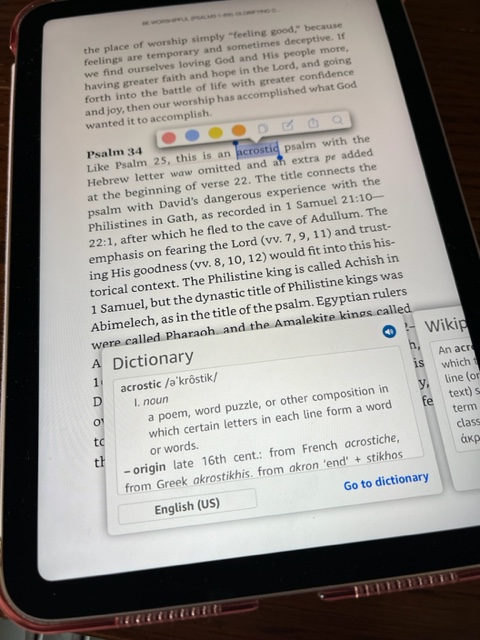
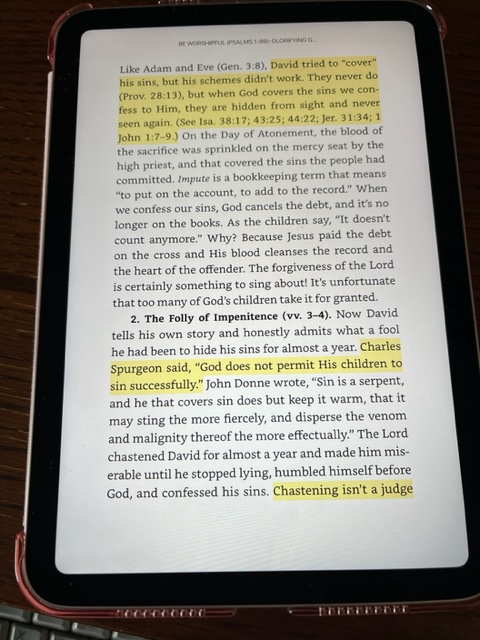
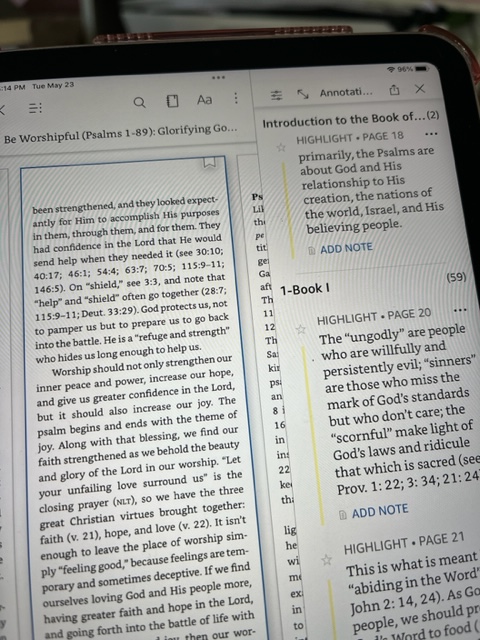
  • Be Worshipful (Psalms 1-89): Glorifying God for Who He Is by Warren Wiersbe
  • Humble Roots: How Humility Grounds and Nourishes Your Soul by Hannah Anderson
  • Blogging for God’s Glory in a Clickbait World by Benjamin Vrbicek and John Beeson
  • Circle of Spies by Roseanna M. White, audiobook
  • All That It Takes by Nicole Deese
  • The Dwelling Place by Elizabeth Musser

Blogging

Besides the weekly Friday Fave Fives, Saturday Laudable Linkage, and book reviews, I’ve posted these since last time:

A few weeks ago, I read Broken Links: How Often Should You Check and Fix Them on Your Blog. I used to fix old non-working links in my blog as I discovered them, mainly as a courtesy so someone who found an older post wouldn’t get frustrated by links that no longer went anywhere. But I didn’t know, until this article, that search engines would rank your blog lower if you have a lot of broken links. Plus, this author, Hugh, says spammers are more active on blogs with broken links. Both these effects result from broken links in the comments as well as in one’s post. He shared Broken Link Check Dot Com and told how to use it. So I’ve spent a couple of sessions ferreting out broken links and fixing or deleting them. I can only stand to do a handful at a time, so I have a long way to go yet.

Writing

No real headway this month. Hopefully I’ll get back into it next month.

How was your April? Are you looking forward to anything in May?

Murder Your Darlings

Murder Your Darlings is not a detective mystery or true crime drama.

Murder Your Darlings is writing advice. You see it a lot in writing circles these days, but it originally came from Sir Arthur Quiller-Couch, a British author and professor (known as Q, not to be confused with the WWII spy-gadget-maker). This phrase was first delivered in a lecture to his students in 1914 which was later published. In context, he said, “Whenever you feel an impulse to perpetrate a piece of exceptionally fine writing, obey it—whole-heartedly—and delete it before sending your manuscript to press. Murder your darlings” (p. 17).

Roy Peter Clark interprets Q’s advice thus: “Ask yourself, ‘Am I including this because it provides the reader with a memorable and delightful piece of evidence to prove the point of my text? Or is it beside the point even though it reveals what a good wordsmith I am?'” (p. 21).

In other words, the phrase, sentence, or paragraph that’s the most precious to you, but doesn’t really add anything to your thesis, must go. Clark opines that you don’t have to “commit verbicide on the words you love the most” (p. 17). You can save them in a file for another day.

Clark, known as “America’s writing coach,” shares advice from over 50 other writing sources in Murder Your Darlings: And Other Gentle Writing Advice from Aristotle to Zinsser. Clarks says, “I am not trying to steal their thunder. I am trying, instead, to amplify it, to pay back my debt to the authors who shaped my craft” (p. 8).

Some of these books are filled with writing advice, and Clark pulls out a lesson or two to discuss. “Most of what you will read here is why I appreciate them, what I or others have learned from them, and what I think you, the reader, can take away and apply to your own work” (p. 23).

Clark begins each chapter with a “toolbox,” a brief summary of the particular principle or writing instruction he’s going to discuss. Then he’ll give a little background about the work he is drawing from, the author, illustrations of the writing advice under consideration, whether he agrees or disagrees and to what extent. He ends each chapter with a short list of “Lessons” summarizing the main points of the chapter.

Clark’s book is quite readable. The Lessons at the end are particularly helpful to remind oneself of the salient tips from a chapter. Some of the writers he quotes from are well-known, others are not.

As you can imagine, I have multitudes of passages highlighted from the book. Here are a few:

It turns out that the internet is not an information superhighway. It is, instead, a polluted ocean with buried treasure sitting here and there on the bottom. Neutralize the poison of the propagandists, hackers, conspiracy theorists, trolls, and bullies by devoting your online efforts to the public good (p. 83).

Early writing is not sculpture, but clay, the stuff in which you will find the better work (p. 105).

An implied social contract exists between the reader and an author of nonfiction and that the contract reads, “Please believe me, my memory of events may be flawed, but none of this was intentionally made up.” If the author decides to veer from this standard, say, by using composite characters, the author must be transparent, revealing the strategies before the story begins, not in a footnote at the end (p. 222).

Donald Murray . . . advised writers to use “Shorter words, shorter sentences, shorter paragraphs at the points of greatest complexity” (p. 231).

Another Roman author, Horace, steps into the light with a sense of mission that is both public and aesthetic, arguing that the purpose of great literature is to delight and instruct or, on the good days, to do both! (p. 237).

This is a secular book, and there are words I wouldn’t use and situations and philosophies I wouldn’t agree with. But I found it fairly easy to sidestep those things just to glean the writing advice.

Clark’s book will help you hone your craft by sharing wisdom with you from sources that you might not have found yet. And the sources he quotes might inspire you to look up the authors’ original works.