The Mission for My Remaining Years

My Mission

After age 30 or so, each milestone birthday becomes more sobering. Age 60 hit me particularly hard. There’s no question that there are more years behind me than ahead of me. Though I hope to still have another two or three decades, my strength and stamina show obvious signs of slowing down.

I’ve never had trouble admitting my age until I turned 60. I was past the time of claiming to be middle-aged, yet I didn’t consider myself to be really old yet. I still felt relevant, but I was afraid younger people would see me as past my prime, no longer worthy to be listened to.

One frustration of aging is increasing health problems. I suppose most people don’t go full steam until the day they die. Most of us undergo a gradual breaking down of various functions. I heard a radio preacher say one reason our bodies start failing is to make us willing to let go of them. We have a strong instinct to survive, but at some point, this body will get to a place where we’ll realize it’s no longer worth trying to preserve it. But even long before that time, doctor’s visits and medications increase.

What’s even more unsettling for me is that the age I will turn this August is the same age both my parents died. They had bad health habits and conditions that I don’t have–but I have some that they didn’t have. I am reminding myself that my times are in God’s hands.

I’m encouraged by reports of people my age and older achieving great things. Laura Ingalls Wilder was 65 when she published her first book. Grandma Moses began serious painting at the age of 78. Harlen Sanders established the Kentucky Fried Chicken restaurants when he was 65. Peter Mark Roget published his first thesaurus at the age of 73.

Most of us don’t have such lofty goals for our later years (although I would like to publish a book). We’d be happy just to be able to get around on our own steam and not be a burden to anyone.

In a recent post by Tim Challies, he included a quote by De Witt Talmage that arrested me:

. . . there is something for you yet to do. Perhaps it may be to round off the work you have already done; to demonstrate the patience you have been recommending all your lifetime; perhaps to stand a lighthouse at the mouth of the bay to light others into harbor; perhaps to show how glorious a sunset may come after a stormy day.

Those are things any of us could do. With however many years I have left, I want to share with my family, readers here, and friends at church and elsewhere, that God is faithful, God is good, and God is worth knowing.

When it feels like God is silent or absent, He is not. He has promised never to leave or forsake His own. 

When answers to prayer seem a long time coming, God’s timing is best. 

When you feel forsaken, God is with you.

He is the truest friend, the wisest guide, the strongest ally, the most loving Father.

His Word is a treasure chest. Delve into as often as you can, not just as an exercise or ritual, but to know the Author. 

On all of my sons’ graduation materials, whether a card or the “senior page” in their yearbooks, I shared the first part of this verse:

And you, Solomon my son, know the God of your father and serve him with a whole heart and with a willing mind, for the LORD searches all hearts and understands every plan and thought. If you seek him, he will be found by you, but if you forsake him, he will cast you off forever. (1 Chronicles 28:9).

I usually share this verse on graduation cards:

You make known to me the path of life; in your presence there is fullness of joy; at your right hand are pleasures forevermore (Psalm 16:11).

I’ve also often shared this with others:

And now I commend you to God and to the word of his grace, which is able to build you up and to give you the inheritance among all those who are sanctified (Acts 20:32).

These are the messages I want to share and demonstrate for as long as I live. 

Rosalind Goforth shared this poem at the beginning of her book, Climbing: Memories of a Missionary Wife. It has stayed with me for years and epitomizes what I want my life, ministry, and legacy to be:

If you have gone a little way ahead of me, call back;
‘Twill cheer my heart and help my feet along the stony track;
And if, perchance, Faith’s light is dim, because the oil is low,
Your call will guide my lagging course as wearily I go.

Call back, and tell me that He went with you into the storm;
Call back, and say He kept you when the forest’s roots were torn;
That when the heavens thundered and the earthquake shook the hill,
He bore you up and held you where the very air was still.

O friend, call back and tell me, for I cannot see your face;
They say it glows with triumph, and your feet bound in the race;
But there are mists between us, and my spirit eyes are dim,
And I cannot see the glory, though I long for word of Him.

But if you’ll say He heard you when your prayer was but a cry,
And if you’ll say He saw you through the night’s sin-darkened sky
If you have gone a little way ahead, O friend, call back
‘Twill cheer my heart and help my feet along the stony track.

Author Unknown

Whatever else we can or can’t do as we get older, we can join with the psalmist in praying:

I will open my mouth in a parable;
I will utter dark sayings from of old,
things that we have heard and known,
that our fathers have told us.
We will not hide them from their children,
but tell to the coming generation
the glorious deeds of the Lord, and his might,
and the wonders that he has done.

He established a testimony in Jacob
and appointed a law in Israel,
which he commanded our fathers
to teach to their children,
that the next generation might know them,
the children yet unborn,
and arise and tell them to their children,
so that they should set their hope in God
and not forget the works of God,
but keep his commandments . . . 

Psalm 78:2-7

Psalm 78:4

(I often link up with some of these bloggers.)
Fading with Age

Fading with age

I remember sometime in my youth talking with an elderly person and noting that not only was his hair very white, but his skin was pale almost to the point of being white as well. Even his eyes seemed faded. I wondered, “Is that what happens when you get old? Do you just . . . fade away?”

Now that I’m nearer the category of “old,” I’ve learned that not everyone gets paler as they age. And no one ages in quite the same way: we’ve known people well into their eighties who traveled internationally as public speakers and even got married.

But it does seem we fade a bit in many ways. Win Couchman called it “The Grace to Be Diminished.”

First, energy decreases. We may not be able to do all we once did. We can’t push ourselves like we used to. Physical issues of various forms may creep up.

Then our influence can decrease. When we first visited a particular church in one state, a young woman was showing us where our Sunday School class would meet. As we passed one room, she said, “You don’t want to go there; that’s the old people’s class.” I suppose I should have felt gratified that she didn’t think I belonged in the old people’s class yet. But the attitude disturbed me. Later, in the same church, when facilitating a ladies’ group, a younger woman maybe in her mid-thirties told me she didn’t come to the ladies’ meetings because the attendees were all older women. Most of us were in our forties and fifties—we were by no means ancient. But I remember being shocked and hurt that someone would not want to be with us just because of our age.

We can lose our jobs and ministries as we retire.

We lose our independence as we have to give up our car keys and may not be able to live alone any more.

We lose our dignity as someone else has to feed and change us.

And eventually, we lose life itself.

That would all sound pretty dreary if that were the end of things.

But we were told that life would be fleeting.

“What is your life? For you are a mist that appears for a little time and then vanishes” (James 4:14).

“My days are swifter than a weaver’s shuttle” (Job 7:6).

The years of our life are seventy, or even by reason of strength eighty; yet their span is but toil and trouble; they are soon gone, and we fly away (Psalm 90:10).

“We all do fade as a leaf” (Isaiah 64:6, KJV).

A radio preacher said one reason our bodies start falling apart as we get older is to encourage us to let loose of them. We need the reminder that this life is not forever.

C. S. Lewis said in The Problem of Pain, “Our Father refreshes us on the journey with some pleasant inns, but will not encourage us to mistake them for home.” “For here we have no lasting city, but we seek the city that is to come” (Hebrews 13:14). This world, as the old song says, is not our ultimate home. Our transitions as we age help prepare us for our true home.

Does that mean when we reach a certain age, we just sit in our rocking chairs and wait to die? By no means.

Elisabeth Elliot has said that our limitations don’t hinder our ministry; they define our ministry. We may not be able to coordinate VBS for 100 children any more (if you can, go for it!) But we can pray with the psalmist, “O God, from my youth you have taught me, and I still proclaim your wondrous deeds. So even to old age and gray hairs, O God, do not forsake me, until I proclaim your might to another generation, your power to all those to come” (Psalm 71:17-18).

How we proclaim His might and wondrous deeds may vary. We might be able to teach a class, write a book, or speak to groups. However, I’ve often thought that when Paul told older men and women to teach the younger, he probably didn’t have classes and retreats in mind. There’s nothing wrong with those; I have been blessed by many of them. But they probably weren’t done in Bible times. I think he probably had in mind interaction in the everyday course of life.

Godly women have influenced my life in just that way. One family had me over frequently as a teenager who came to church alone. I don’t think the wife of the family thought of me as a “project.” She was just being hospitable. Yet visiting their family and seeing her interact as a wife, mother, and homemaker was instructive for me.

Another woman passed along a vital piece of advice as we worked on a church bulletin board together that shaped my thinking in parenting teens. Another said something in passing while we worked in the church nursery that greatly encouraged me. Another was an invaluable and unwitting example to me as she was trying to prepare an event for a group, and her husband asked her for something in a critical moment. She didn’t snap; she closed her eyes briefly and then calmly directed him to what he needed.

Jesus said that we speak with our mouths out of the abundance of our hearts. As we fill our souls with God’s presence and Word and seek His guidance, then we will be able to share about Him in odd moments as we interact with others.

As another psalmist said, we can tell “things that we have heard and known, that our fathers have told us. We will not hide them from their children, but tell to the coming generation the glorious deeds of the Lord, and his might,and the wonders that he has done. . . that the next generation might know them, the children yet unborn, and arise and tell them to their children, so that they should set their hope in God and not forget the works of God, but keep his commandments” (Psalm 78:3-4, 6-7).

We don’t have to approach our old age with dread.

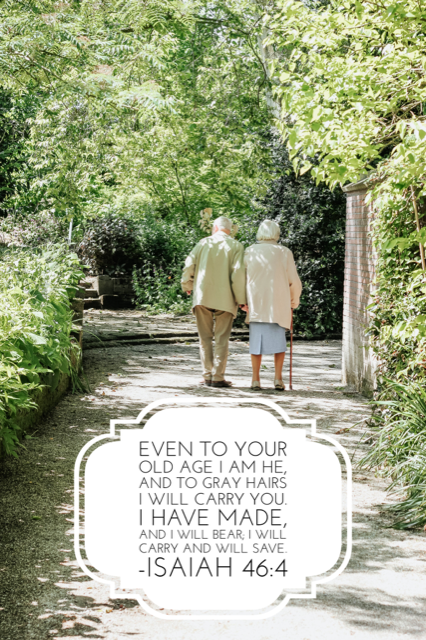
God has promised to take care of us: “Even to your old age I am he, and to gray hairs I will carry you. I have made, and I will bear; I will carry and will save” (Isaiah 46:4).

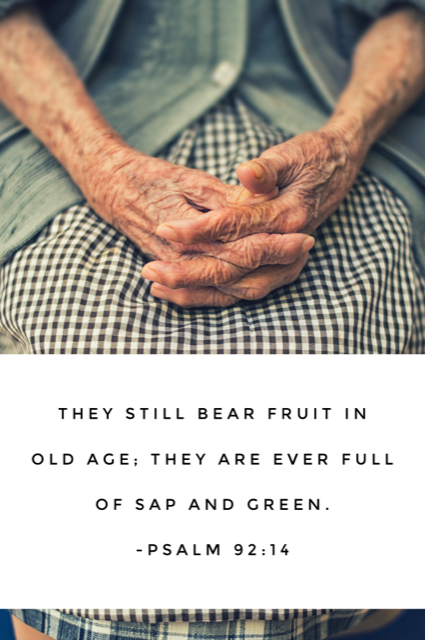
He has promised our fruitfulness: “They still bear fruit in old age; they are ever full of sap and green, to declare that the Lord is upright; he is my rock, and there is no unrighteousness in him” (Psalm 92:14-15).

He has promised a bright future to those who know Him. “So we do not lose heart. Though our outer self is wasting away, our inner self is being renewed day by day. For this light momentary affliction is preparing for us an eternal weight of glory beyond all comparison, as we look not to the things that are seen but to the things that are unseen. For the things that are seen are transient, but the things that are unseen are eternal” (2 Corinthians 4:16-18).

As we look back at His faithfulness all our lives, we can trust Him for the future. These stanzas from John Greenleaf Whittier’s poem, “My Birthday,” encourage me: I hope they’ll encourage you as well.

I grieve not with the moaning wind
As if a loss befell;
Before me, even as behind,
God is, and all is well!

His light shines on me from above,
His low voice speaks within,–
The patience of immortal love
Outwearying mortal sin.

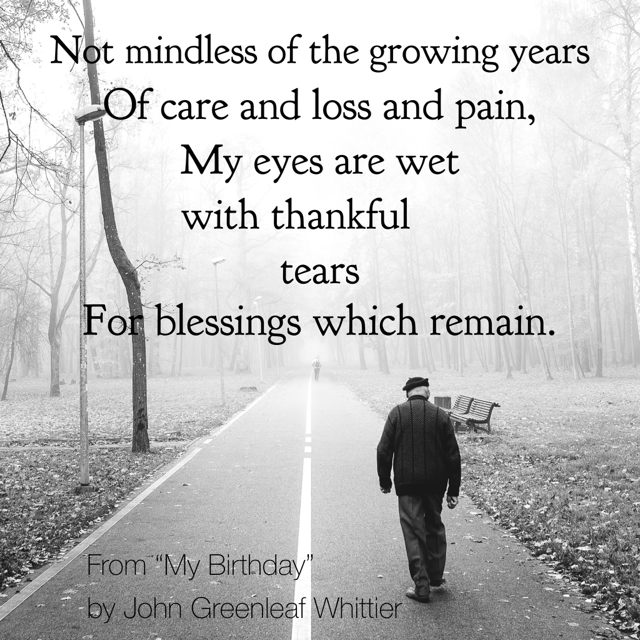
Not mindless of the growing years
Of care and loss and pain,
My eyes are wet with thankful tears
For blessings which remain.

Let winds that blow from heaven refresh,
Dear Lord, the languid air;
And let the weakness of the flesh
Thy strength of spirit share.

And, if the eye must fail of light,
The ear forget to hear,
Make clearer still the spirit’s sight,
More fine the inward ear!

Be near me in mine hours of need
To soothe, or cheer, or warn,
And down these slopes of sunset lead
As up the hills of morn!

Psalm 71:18

(I often link up with some of these bloggers.)
Old Age Syndromes to Avoid

Old Age Syndromes to Avoid

In our early married days, I worked in a fabric shop where we had a variety of customers of all ages. Among older ladies, there seemed to be two distinct types. One was very sweet, thankful for any little thing we did to assist them. The other was . . . not sweet.

I remember thinking, “I hope I am the nice kind of older lady when I get that age.”

At some point it dawned on me that if I wanted certain attributes when I got older, I needed to incorporate them while I was young.

“Old” always seems twenty to thirty years beyond my current age. But I am older, and I don’t know that I am yet the kind of older lady I want to be or should be. We’re all a work in progress, no matter how long we’ve lived.

But as I have been around the block a few times, I’ve seen some behaviors I want to avoid.

The “Know it All” Syndrome. When we’ve read the Bible and walked with the Lord for decades, hopefully we’ve acquired some wisdom along the way. But we misuse it if we try to answer most of the questions in Bible Study or Sunday School or feel we have to have the last word that sets everyone straight.

I’ve struggled with this recently. Bible teachers want participation. But I don’t want to monopolize the conversation. Yet I do want to share if I have something helpful to say. I’ve started praying before class that God would give me wisdom to know when to share and when to be silent.

The “We’ve Always Done It This Way” Syndrome. Every new generation brings with it new vocabulary, new technology, new methods. Older people can help younger ones discern between new methods and old truth and try to keep the latter from sliding into oblivion, but we shouldn’t insist that everything be done the way we always did it (or gripe when it isn’t).

The Busybody Syndrome. Busybodies can be any age. Paul is speaking of young widows when he speaks of “idlers, going about from house to house, and not only idlers, but also gossips and busybodies, saying what they should not” (1 Timothy 5:13). But older women can tend this way, too.

Many years ago, an older lady in our church at the time told one young mom of seven that she was having too many children too close together. She told another young married lady, who, with her husband, wanted to wait until he was out of school before starting a family, that she needed to get busy and start having children. You can imagine that both women were hurt and offended. I am sure that was not the older woman’s intent and that she thought she was helping others with the benefit of her accumulated wisdom. But she overstepped. Before sharing advice, we need to seek the Lord about whether it is really needed and how and when it should be shared.

Gossip Syndrome can also occur at any age or gender, but it’s something Paul specifically mentions in Titus 2 when speaking of the commendable kind of older woman. She’s not to be a “slanderer”–other translations say “gossiper” or “false accuser.” Slander can involve saying things that are untrue about someone else. Gossip can be untrue but seems to include spreading things around that may be true but aren’t anyone else’s business. The Bible has much to say about right and wrong uses of our words.

The Old Wives’ Tales Syndrome. The KJV and a few other Bible versions mention these in 1 Timothy 4:7: “But refuse profane and old wives’ fables, and exercise thyself rather unto godliness.” Other versions, like the ESV, leave out the “old wives” part and just say, “Have nothing to do with irreverent, silly myths. Rather train yourself for godliness.”

This overlaps gossip a bit, but “old wives’ tales” or fables often seem to involve health issues or warnings that aren’t based on fact. These days, they take the form of urban legends. When we were expecting our first child, someone told us not to get a cat because cats can suck a baby’s breath away. When my husband responded skeptically, the woman teared up because she was just trying to “help” us.

I see a version of this when people share dire warnings on FaceBook without fact-checking “just in case” it’s true. Some people do this so often, it’s like the old story of the “boy who cried wolf”: people don’t take the sharer seriously any more. Once again, we need to be careful of sharing falsehoods and unnecessarily scaring people. It’s usually easy these days to search online and find out the facts before we share.

The “Good Old Days” Syndrome. When we look back, our younger days can seem idyllic. We tend to forget or gloss over the negative aspects of certain eras. It’s not wrong to talk about some of the changes that have occurred over our lives or share history we’ve experienced. But we shouldn’t live in the past. We need to be alert for the good gifts God put in our present time as well.

The “I’ve Done My Time” Syndrome. I hear of women who are still teaching VBS or serving in the church kitchen well into their nineties. Good for them. 🙂 Many of us lose a certain amount of oomph over the years and can’t do all we used to. I wrote posts a few years ago on Why Older Women Don’t Serve and How Older Women Can Serve. We’re always in the Lord’s service as long as we live, but how we serve will probably change over the years. We shouldn’t have the mindset of checking out of active service. We might not be plugged into an official church ministry, but we can still minister to people by walking closely with God and being alert for opportunities to listen, giving a word of encouragement, praying, sending a note, etc.

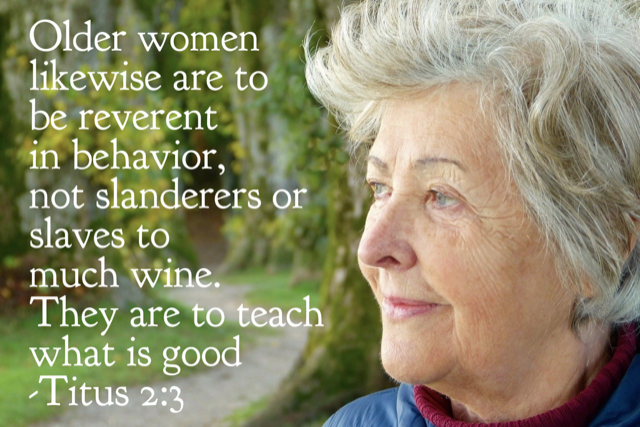
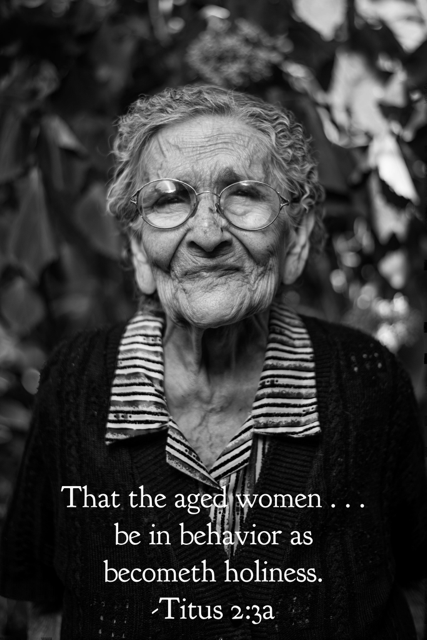
It’s good to not only look at what to avoid, but what to emulate. Godly older women are to be “reverent in behavior, not slanderers or slaves to much wine. They are to teach what is good” (Titus 2:3). They have “a reputation for good works: if she has brought up children, has shown hospitality, has washed the feet of the saints, has cared for the afflicted, and has devoted herself to every good work” (1 Timothy 5:10).

Thankfully, in every stage of life, God has placed godly women just ahead of me to observe and learn from.

Instead of gossip, slander, and fables, we share truth. Instead of showing off our accumulated knowledge, we humbly seek God’s timing to share His truth. We hold fast to truth but stay flexible about methods where we can. Instead of tearing down, we build up and encourage. Instead of being busybodies or folding inward towards self, we take kind interest in others and seek to serve however He opens doors.

May God give us grace to walk with Him and serve Him and others well at every stage of life.

Titus 2:3

Revised from the archives

(I often link up with some of these bloggers.)

Birthday Meditations on Aging

Birthday meditations on aging

Since my birthday is this week, and I had a “milestone” birthday last year, I’ve been thinking about aging.

My husband and I often remark that we don’t feel “old” (“old,” to me, has always been about twenty years beyond where I am now). We might tire a little more easily and have a plethora of aches and pains. But looking closely in the mirror often yields unpleasant surprises. When did that happen?

Seeing my mother-in-law through her last ten years of life brought up a long list of concerns about what we’ll face as we age. I once heard a preacher say that one reason our bodies start to fail us as we get older is so that we’ll be more willing to let loose of them. Each year reminds us that we’re in a temporary habitation.

But probably what most concerns me about aging is not being taken seriously any more, being thought of as out of touch or irrelevant.

On the other hand, there are perks to getting older. I’m more settled in my own skin. I’ve wrestled through questions and problems. Hopefully I’ve gained some wisdom through the years.

I wish Elisabeth Elliot had written a book on aging. She was my mentor-from-afar since my college days and helped me prepare for womanhood, marriage, motherhood, and Christian life and service. I did just discover that she had a series about aging on her radio program. I might spend my birthday week listening to those.

But I found in my files of her old e-mail devotionals an excerpt from her book On Asking God Why titled “Happy Birthday—You’re Heading Home.” She writes what she would say to an old friend on her birthday. The last few paragraphs encourage me:

You’ve heard those bad news/good news jokes. Well, this isn’t cheap birthday card humor. The bad news is that another year has gone by and we haven’t done all we meant to do and it’s not going to come back to give us another chance. The good news is the Gospel. We can be reconciled to God–sins forgiven, fears taken care of. That old cross, the emblem of suffering and shame, stands between us and our sins and fears, our past and future, and on its outstretched arms we see Love. The Love that would die for us is the Love that lives for us–Jesus Christ, Lord, Master, Savior of the World, wanting to give you (for your birthday if you’ll take it) something that will really quench your thirst, rivers among the sand dunes and wells in the valley; wanting to hold your hand, help you, give you–not only a happy birthday, but everlasting joy.

I’m not the least bit bashful about telling my age. I’m glad for every birthday that comes, because it is the Lord, my faithful Guide, who “summoned the generations from the beginning.” I look in the mirror and see the increasingly (and creasingly) visible proofs of the number of years, but I’m reconciled. Christ reconciles me to God and to God’s wonderful plan. My life is his life. My years are his years. To me life is Christ, and death is nothing but gain. When I remember that, I really can’t think of a thing I ought to be afraid of. I can’t be sorry I’m a year older and nearer to absolute bliss.

I pray for you on your birthday, that your path, as is promised to the just man, will shine not less and less but more and more; that you will still bring forth fruit in old age; that the Lord will give you a thankful heart like the psalmist’s who sang,

O God, thou hast taught me from boyhood,
all my life I have proclaimed thy marvellous works:
and now that I am old and my hairs are gray,
forsake me not, O God….
Songs of joy shall be on my lips;
I will sing thee psalms, because thou has redeemed me.
All day long my tongue shall tell of thy righteousness.

(Psalms 71:17, 18, 23, 24 NEB)

So–happy birthday! If you have friends and parties and presents, be thankful for such bonuses. If you have no friends with you today, no party, not a package to open, you still have a long list of things to thank God for, things that matter much more. A birthday filled with thanksgiving and hope is the happiest kind of birthday. Have one of those! Deck yourself with joy!

I agree with Elisabeth and Paul that “to me to live is Christ, and to die is gain” (Philippians 1:21) and that heaven will be bliss. But I am encouraged that many through Scripture pleaded for more years of this life in which to serve and praise the Lord.

Elisabeth quoted the first part of Psalm 71:18. The whole verse, along with 17, stood out to me as I read it recently:

So even to old age and gray hairs,
    O God, do not forsake me,
until I proclaim your might to another generation,
    your power to all those to come.

That’s what I want to do with as many days as God gives me.

(I often link up with some of these bloggers.)
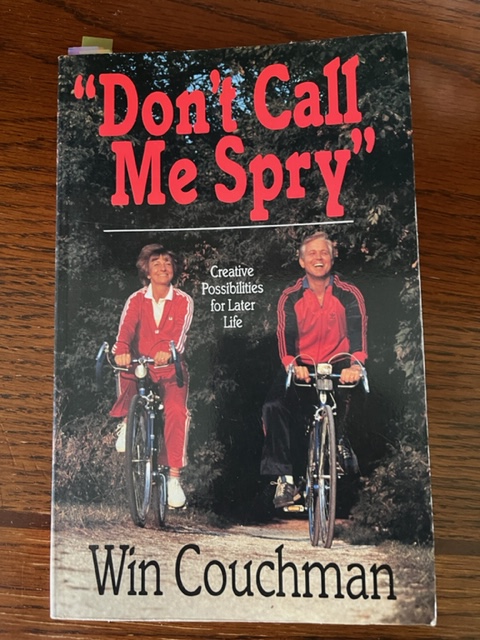
“Don’t Call Me Spry”

It’s a shock to the system when you realize someone thinks of you as “old.”

For me, it happened when a fast-food cashier rang up my order with a senior discount—and I was only 50.

For Win Couchman, it happened when she ran into an old friend who commented, “You’re so spry!” “Spry” was a “compliment reserved for exclusively for old people.”

As the shock of this well-meant statement brought Win to tears, she began to consider aging.

I am at the young end of old: junior-high old. Youth is gone and now, also, middle age. My life at sixty-four is rich, adventurous, blessed, and full of joy (p. 2).

I am not only wrinkling. I am growing. And while I am forgetting some things, I am learning much that is new. This season of my life is as fearsome and exciting as turning fourteen. Nobody told me it would be this way (p. 3).

She decided to investigate “what it means to grow old” from the Bible, culture, the examples of older people in her life (“Not everything I learned from Grandmother about aging was glamorous, but all of it was valuable” [p.84]). She wanted to “notice and enjoy the perks that come with old age” (p. 4).

The results of her study and contemplation is “Don’t Call Me Spry”: Creative Possibilities for Later Life.

Win noted, “The halves of my life each merit my attention. The tension between the material and spiritual aspects of reality are normal. The struggle is to keep a balance: to live in light of the unseen while resetting the washer from ‘permanent press’ to ‘delicate fabrics.’ In order to live for God’s glory and not lose heart, I have the perspective of the eternal as a gift” (p. 4).

In their fifties, Win and her husband, Bob, began to pray and consider what to do when he retired. For many years, they had hosted a ministry called Forever Family which combined hospitality, mentoring, counseling, and teaching. But they were sensing maybe the time had come to do something different.

Through a series of events and contacts, the door eventually opened for them to minister in a variety of other countries eight months out of the year. They enjoyed the novelty and the opportunities to minister, resulting in some never-to-be forgotten experiences.

But they also experienced stresses with travel and continual adjustments, and they handled them differently. She liked to talk things out when stressed or anxious; he withdrew and became quiet. I’m sure those tendencies were always a part of their personalities, but these new experiences brought them to the forefront and required them to meet each other half-way.

Bob’s retirement brought other stresses and adjustments, like sharing space that she had previously had to herself.

Then new stresses arose when Win developed a heart issue which brought not only their international travel to a close, but their full-time active ministry as well. She had to rethink what she could do within her new reality. “It grieved me to give up thinking I could do anything anyone even a generation or two younger than I can do” (p. 45).

It saddened me to give up the illusion that I could always push myself a bit more if I needed to, that pushing was the thing to do. I could no longer be casual about getting too tired. I was newly aware of another true separation between me and those who are younger (p. 46).

She tells how God led her to other types of ministry, mainly mentoring, prayer, being involved with her grandchildren. She still taught and spoke on a limited basis.

One of my favorite chapters is “The Downside,” dealing with some of the negative aspects of aging. “When you ask me how I am, sometimes it is a little hard to know how to answer” (p. 107).

But even though Win describes herself as a pessimist, overall the book is hopeful and positive. The Bible assures that God’s care and love and grace will always be with us. In addition:

As I have looked repeatedly into the mirror of these verses, I have not only been provided with new assurance of God’s caring for me, but I have a greatly enhanced concept of the possibility of lifelong usefulness (p. 136).

While searching for more information about Win, I came across this video of her.

I had not heard of Win before until I read a chapter by her in The Wonder Years: 40 Women over 40 on Aging, Faith, Beauty, and Strength compiled by Leslie Leyland Fields. I didn’t discover until recently that her chapter, “The Grace to Be Diminished,” originally came from a magazine here. Then I found her poignant article, “The Beds I Have Known,” about living separately from her husband of 72 years when she could no longer care for him. I saw somewhere that she had written this book, so I searched for it. It’s out of print, but I found a used copy in good condition for $5 at Amazon.

I am glad to have found and read it. It gave me much encouragement as I look ahead.

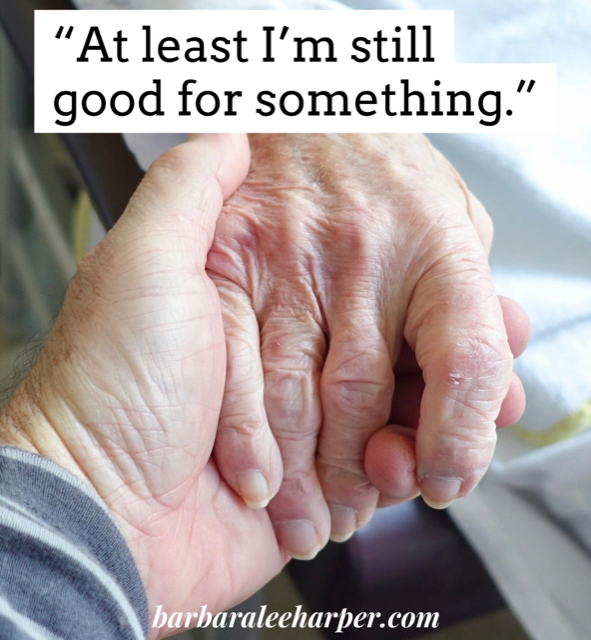
“At least I’m still good for something.”

When we first moved my mother-in-law over 2,000 miles to live in an assisted living facility near us, we would have her over for dinner sometimes, take her to my youngest son’s basketball games, and take her to church and other outings.

At one dinner, a favorite family story came up. Some years ago, my mother-in-law inadvertently said something inappropriate, using a term with double meaning of which she was unaware. Everyone laughed because they knew she hadn’t meant it in the way people would take it today. The incongruity of such a thing coming from her made it all the more funny.

As we told the story to our kids, who had either not heard it before or had forgotten it, we all laughed, even my mother-in-law.

After the laughter died down, though, she quietly said, “At least I’m still good for something.”

I don’t know if anyone else heard her say it or caught the significance. But her sentence went like an arrow to my heart. She wasn’t complaining or blaming anyone, but she didn’t feel useful any more.

When we first moved her into assisted living, my husband told her, “You’ll never have to cook to clean again.” That sounded pretty good after 70 or years of those activities.

Her only hobby was reading, and she delighted in being able to read all day to her heart’s content. She had always been a homebody, and just going to meals three times a day with a room full of other people taxed her. When aides would knock on her door to see if she wanted to go see the musicians, the magicians, the church choir, or whomever, she politely declined.

I don’t think she was discontent with her circumstances. But we all want to feel we’re of use in the world. There is a feeling of satisfaction and pleasure when we’ve accomplished something, but she didn’t have anything to accomplish any more.

In “The Grace to Be Diminished,” Win Couchman wrote of turning 80 and having to give up driving, changing from their usual place in the balcony at church to a place on the main floor where they didn’t have to fear falling, her husband’s hearing loss and short-term memory loss which caused him to be “silent and isolated at social functions.” But the “diminishment” that particularly touched my heart was when “one of the women who coordinates the potlucks called me and said with winsome authority, ‘Win, enough already. You have been involved with these evenings for about twenty years now, I think. You have done your bit. We want you and Bob to be at every one, but you are not to bring any more food, you hear?'”

Only then did I realize how the slowness with which I function now, and the accompanying late afternoon fatigue, was beginning to color my anticipation with some dread.

Gladly I responded, “Okay.” It’s awkward to walk into someone’s house on potluck Saturdays empty-handed just as another couple arrives loaded with goodies. In that moment, I silently look to God for the grace to be diminished.

Win and her husband, and I am sure my mother-in-law as well, graciously accepted the decline that comes with age, knowing that:

 So we do not lose heart. Though our outer self is wasting away, our inner self is being renewed day by day. For this light momentary affliction is preparing for us an eternal weight of glory beyond all comparison, as we look not to the things that are seen but to the things that are unseen. For the things that are seen are transient, but the things that are unseen are eternal (2 Corinthians 4:16-18).

Yet I think we should be careful not to diminish them unnecessarily.

In Atul Gawande’s book Being Mortal: Medicine and What Happens in the End, he writes of a woman who was responsible for her father’s care when he could no longer live alone. Yet her desire to keep him safe culminated in his living in a small room with nothing to do, “safe but empty of anything [he cared] about” (p. 109). 

What touched off this train of thought today was a section in Anthony Trollope’s The Last Chronicle of Barset, the sixth and last in his Chronicles of Barsetshire series. Mr. Harding was the main character in the first book, The Warden. Now, in the last book, he has become very old and increasingly feeble. He used to love to play the violincello, but can’t manage it any more. “He had encountered some failure in the performance of the slight clerical task allotted to him, and the dean had tenderly advised him to desist.” He loved going to the cathedral every day, to listen to the organ, read a theology book, or just walk around. But his feebleness caused his fearful housekeeper to write to his daughter, who came to encourage him that perhaps his days of walking alone to the cathedral might need to come to an end. He replied, “I do not like not going;—for who can say how often I may be able to go again? There is so little left, Susan,—so very little left.”

That line was heartbreaking—that there was so little left. Eventually Mr. Harding made peace with the fact that God had given him a good life and he had a better one to look forward to. He found the “grace to be diminished” and decline.

Another line in Gawande’s book says, “Making life meaningful in old age…requires more imagination and invention than making them merely safe does” (p. 137).

Hindsight is always so much clearer, of course, but I wish I had made my mother-in-law’s life more meaningful. When she was still able, I wish I had thought of small tasks she could do to help with meals. Cooking had been her love language of sorts. Though we thought we were honoring her by doing for her, perhaps she would have felt more useful with a way to contribute. I could have made a project of putting her photos in albums with her. I did ask about her early life—high school, how she met her husband, etc.–and even learned some things I hadn’t known before. But I wish I had done that more. Although our visiting almost every day and then bringing her home for her last years showed how much we regarded her, I wish I had often told her that we loved her and were happy to have the opportunity to care for her. Though she had intrinsic value as a being created in God’s image, we should have let her know more often that she was valued and important.

As I look ahead to growing older, a couple of passages especially comfort me. One is Isaiah 46:4: “even to your old age I am he, and to gray hairs I will carry you. I have made, and I will bear; I will carry and will save.”

Another is Psalm 92:12-15:

The righteous flourish like the palm tree
and grow like a cedar in Lebanon.
They are planted in the house of the Lord;
they flourish in the courts of our God.
They still bear fruit in old age;
they are ever full of sap and green,
to declare that the Lord is upright;
he is my rock, and there is no unrighteousness in him.

During my mother-in-law’s last years, when she slept most of the time, I wondered what kind of fruit she was bearing in that state. A few came to mind. Her godly life—not perfect, but steadily walking with God and seeking to serve Him the best she could in her circumstances. Her uncomplaining patience. Her taking things with humor. Her willingness to “go with the flow.” Her testimony of peace and joy before her caregivers.

I wish these things had come to mind when she wondered what she was “good for.” I trust her Lord’s, “Well done, thou good and faithful servant” assured her that He was able to use her in many ways. And I hope that these thoughts will remind me to let others know the ways God used them in my life.

(I often link up with some of these bloggers.)

What We’re to Be Before We Teach

When Titus 2 is taught in any women’s gathering, we almost always hone in on what older women are instructed to teach the younger: “to love their husbands and children, to be self-controlled, pure, working at home, kind, and submissive to their own husbands, that the word of God may not be reviled” (verses 4-5).

But we either lightly touch or skip over what Titus 2 says older women are to be in the verses preceding these.

But before we get there, let’s zoom out a bit to see the context. Paul is writing to one of his coworkers, Titus, whom he had left in charge of the church in Crete. Paul had directed Titus to ordain elders in the churches from among those with certain godly characteristics in Titus 1. Paul sums up that instruction with verse 9: “He [an elder] must hold firm to the trustworthy word as taught, so that he may be able to give instruction in sound doctrine and also to rebuke those who contradict it.”

Then Paul describes those who contradict sound doctrine: “insubordinate, empty talkers and deceivers . . . upsetting whole families by teaching for shameful gain what they ought not to teach . . . their minds and their consciences are defiled. They profess to know God, but they deny him by their works. They are detestable, disobedient, unfit for any good work” (1:10-15).

Remember there are no chapter divisions in the original text. When we study chapters individually, we sometimes forget to connect them to what came before. The very next paragraph in Titus begins, “But as for you”—in contrast to the kind of people he was just talking about—“teach what accords with sound doctrine” (2:1). Then Paul gives specific instruction to older men, older women, younger men and women, servants.

So these instructions aren’t just nice thoughts or ways to have a happy church or for everyone to get along. These behaviors that Paul wants taught are “in accord with sound doctrine.” Our beliefs and our behavior should work hand in glove. Our actions shouldn’t contradict our doctrine.

So what are older women to be like?

Reverent in behavior.” Most of the non-paraphrased translations use the word “reverent.” The KJV says, “in behaviour as becometh holiness.” The commentary at the bottom of this page says, “The Greek word rendered ‘in behaviour,’ or ‘in demeanour,’ includes dress, appearance, conversation, manner; includes an outward deportment dependent on something more internal. The elder Christian woman in her whole bearing should exhibit a certain dignity of sacred demeanour; there should be something in her general appearance, in her dress, in her speech, in her every-day behaviour, which the younger and more thoughtless sister could respect and reverence–an ideal she might hope one day, if the Master spared her so long, herself to reach.”

Being reverent or dignified or holy doesn’t mean one never has fun, laughs, or tells jokes. Joy is part of the fruit of the Holy Spirit. Proverbs 17:22 tells us “A joyful [merry, KJV] heart is good medicine, but a crushed spirit dries up the bones.” Richard Baxter said, “Keep company with the more cheerful sort of the godly; there is no mirth like the mirth of believers” (The Practical Works of Richard Baxter, p. 24). Henry Ward Beecher said, “A man without mirth is like a wagon without springs, in which everyone is caused disagreeably to jolt by every pebble over which it runs.”

There’s a joy and humor in keeping with reverence and holiness.

But a godly older woman knows the things of the Lord are serious. She takes care to honor God in her life and teaching, whether formal instruction or just sharing passing encouragement.

Not slanderers.” Some translations say “false accusers” or “gossips.” Obviously we shouldn’t spread anything that is untrue. Lying and slander are definitely not in keeping with a God of truth.

Gossip is a little harder to define. It’s not always wrong to talk about someone else’s wrongdoing. Paul mentions people by name in his epistles who have erred in various ways. Sometimes talking with another Christian is a way to process whether someone’s actions are right or wrong. As we’ve encountered problems in various churches we’ve attended (and there is no church without problems), we’ve discussed the issues with our family. But discretion is needed as to what is discussed with whom and how. There’s a difference between needful processing and just gossiping. Gossip seems to have malicious intent.

As an example, years ago a couple who had been members of our church went out as missionaries to another country. They seemed exemplary in every way, having a real fervor for the Lord. After some years of seemingly successful ministry, the husband was found in an adulterous relationship with another woman. Their mission board called them home. When the church leadership met with the man, he refused to repent, saying he loved his sin too much to give it up.

Of course, this situation sent shock waves through the community he left, his mission board, our church, and probably everyone at every level that he had ever dealt with. It wasn’t something that could be kept quiet. There was much discussion. How should we respond to him? How can we minister to his heartbroken wife? And most of all, how could this have happened?

We all needed to work through that kind of processing. But to talk about the situation just to talk would have been wrong.

I think we have to show restraint sometimes even in sharing good news that might not be ours to share. Once at a church committee meeting I attended, one newly-pregnant lady lamented that she didn’t even have a chance to tell her closest friends that she was expecting because word spread so quickly. That convicted me. There’s something delicious about being the one with news to share.

So if our motive for talking about situations is to feel important because we have news, or to feel superior because someone has done wrong, we’d better put the brakes on. We need much wisdom and Holy Spirit leading that our conversation would be edifying and not destructive.

Not slaves to much wine.” I think, in context, this phrase is not just saying older women shouldn’t be drunkards. This verse uses the word “likewise,” pointing back to what had been told to older men, that they should be “sober-minded, dignified, self-controlled, sound in faith, in love, and in steadfastness” (v. 1). Self-control is also mentioned to the younger women (verse 5) and younger men (verse 6) with another “likewise.” So I think the larger picture is that she shouldn’t be enslaved to anything, that she should live a life of self-control (another part of the fruit of the Holy Spirit in Galatians 5:22-23).

To teach what is good.” To teach what is good, one has to know what is good. We can’t teach subjects we don’t know, can we? We need to spend much time in the Word of God not only so that we know what He wants to teach us, but also so that, as we have opportunities to share with others, we can direct them the right way.

To “train the young women to love their husbands and children, to be self-controlled, pure, working at home, kind, and submissive to their own husbands, that the word of God may not be reviled” (verses 4-5), we have to have enough experience walking with God to be able to share His truth in these areas.

That makes the whole thing scary. None of us has lived in this way in perfection. But God knows that. He doesn’t ask us to teach from our perfection, but from His. Sharing our own failures and stumbles helps other women to know that God gives grace. Pointing, not to ourselves, but to Him helps others to look to the only One who can enable them.

Older women have a reputation for being cranky, crochety, and critical of anything that’s not done like it was “back in my day.” Thank God, most of the older women I have known have not been like that. God has put some sweet, godly women of stellar character in my path over the years.

May we all seek His grace, whatever our ages, to please Him and to be a godly influence on those around us.

Some of my past posts related to these subjects:

(I often link up with some of these bloggers.)
The Middle Matters

I’ve often thought that the “middle-aged spread” refers not to an expanding waistline, but to the number of years we claim middle age. Because what’s next after middle age? Old? Elderly? We need some designation between the middle and the end.

At any rate, even though I’m on the far side of middle age, Lisa -Jo Baker’s book caught my eye when it was on sale for the KIndle app: The Middle Matters: Why That (Extra)Ordinary Life Looks Really Good on You. I had heard Lisa Jo’s name but never read her, and I’ve not often seen books for this stage of life.

Lisa-Jo discusses the impact of our middle years in eight areas: our bodies, marriage, parenting (which gets two chapters), our homes, failures, friendship, and faith. “Discusses” is probably too formal a word. Each topic is addressed in three to seven essays. Lisa-Jo writes in a breezy chatting-with-girlfriends style.

It’s hard to summarize a series of essays, so I’ll just give you some samples.

One of my favorite chapters is “When You Think Your Love Story Is Boring.” The epigraph of this chapter comes from a teenager quoted in Huffington Post who feels her love life will never be adequate “until someone runs through an airport to stop me from getting on a flight.” Lisa-Jo shares many examples of love demonstrated in the everyday rather than the once-in-a-lifetime grand gesture.

He lays down his life, and it looks like so many ordinary moments stitched together into the testimony of a good man who comes home to his family driving the old minivan, the one with the broken air-conditioning (p. 40).

And this is a love life: to live each small, sometimes unbearably tedious moment… together. To trip over old jokes and misunderstandings. To catch our runaway tongues and tempers and tenderly trust them to the person who now knows firsthand our better and our much worse (p. 41).

He’s never run through an airport for me. But he goes to Walmart at 9: 30 p.m. for back-to-school supplies that we’ve had all summer to get and of course have left till the last minute. When he walks into the living room at 11: 00 p.m. with bags full of the obligatory red, green, yellow, and blue folders and all the million pre-sharpened number-two pencils, it’s the sexiest thing I’ve seen all week (p. 41).

Another chapter that I loved told of a joyous night with Lisa-Jo’s daughter’s triumph in a school program. When Lisa-Jo looked at the photos taken that evening, first she saw the joy. Then, looking more closely, she noticed a picture of her “generous muffin top bulging over her jeans as she presses up next to her daughter” (p. 26). Instead of being embarrassed or deleting the photo, she decided “There was too much happiness to ever diminish it by worrying about waistlines” (p. 26).

In “What You Don’t Know About Parenting,” Lisa-Jo tells of a time her daughter was in another program, where she struggled with what Lisa-Jo thought was pre-program jitters which would be fine once the performance started. But her daughter had full-blown stage fright, tears streaming as she danced her part. Lisa-Jo struggled with indecision as to the best course of action—sweeping her daughter off the stage or letting her finish. “I don’t know if we can ever actually protect our kids from their own fears. Maybe all we can do is show them how brave they are to face them” (p. 90). After the program was over and everything settled down, Lisa-Jo called her mother-in-law to pour out her heart.

And as mothers have always done, she listened and loved me and then encouraged me with the deep understanding born of her own lifetime of learning what you don’t know by simply walking through it. This is what we mothers do for each other—we offer our own failures as proof that our sisters and daughters, our nieces and grands, will make it through the perilous journey of mothering too. Because no matter how many books you read or podcasts you listen to, nothing can prepare you for the fall you weren’t expecting (p. 91).

When heroes fall, Lisa-Jo wants her children to know, “fame is not where we go when we’re looking for something to believe in. Neither is the pulpit nor the soccer field, nor the stage nor the movie studios, for that matter. . . . power and influence and fame can be a slippery, lying slope” (p. 95).

When her son wants to race in the Olympics:

When they ask you if you believe that they’ll make their way to the Olympics someday, what do you—that mother behind the steering wheel who can’t see the future—tell your son?

Do I really want to be the anchor here holding him back? How do I cheer for him while also being a plumb line for truth? (p. 163).

Concerning a twice-monthly potluck hosted at her home: “Some weeks I look forward to it. Some weeks I’m exhausted at the thought of it. But we just keep opening the door no matter how we feel” (p. 136).

A couple more quotes:

Sometimes friendship is a deep conversation. Sometimes it’s a shared ugly cry. But sometimes friendship is the gift of not being afraid of silence (p. 204).

I don’t have easy answers to the hard questions, whether they’re on the news or coming from your doctor or your kid’s teacher or your coworker or a dear friend. I have only the hope of a hand in mine. The hand of this man, Jesus, who isn’t afraid and who builds things that don’t sink (p. 242).

I enjoyed this book and found it very easy to read. Lisa-Jo definitely has a way with words and weaves them with humor and poignancy. Some reviewers felt the book was more of a memoir or only appealed to women in the exact same stage of life–forty-something, married with kids. But I benefited from it even though I am an older empty-nester. Even though Lisa-Jo’s style is not didactic, readers can learn much from what she shares.

(This book will count for the Nonfiction Reader Challenge, where I am doing the Nonfiction Grazer track of basically doing my own thing. 🙂 But this would also fit in the “Linked to a Podcast” category a of the challenge since Lisa-Jo has a podcast [which I have not yet listened to] with Christie Purifoy called Out of the Ordinary.)

An Old Poem For a New Year

Last week, I listened to Elisabeth Elliot’s Gateway to Joy series about aging. In one episode titled Being Part of the Permanent, she quoted a stanza of a poem by John Greenleaf Whittier. The words so seized me, I had to stop and look them up.

The poem is titled My Birthday. Whittier was 64 when it was published, a significant age in the 1800s. Though all the poem is a touching look at an “older” birthday, the first few stanzas seem to me to apply also to a new year. We’re not so far from the beginning of this one, so perhaps they’ll speak to you as they did to me. The stanza Elisabeth quoted is at the end of what I am sharing here, but there are many more stanzas besides.

Beneath the moonlight and the snow
Lies dead my latest year;
The winter winds are wailing low
Its dirges in my ear.

I grieve not with the moaning wind
As if a loss befell;
Before me, even as behind,
God is, and all is well!

His light shines on me from above,
His low voice speaks within,–
The patience of immortal love
Outwearying mortal sin.

Not mindless of the growing years
Of care and loss and pain,
My eyes are wet with thankful tears
For blessings which remain.

(I often link up with some of these bloggers.)
Goals for the Second Half

There’s always something to look forward to just beyond the horizon.

When we were children, we looked forward to high school and driver’s licenses. Then we couldn’t wait for dating and college. Then we longed for marriage and children.

Perhaps your life track has run a different course: perhaps your goals were tenure at your university, or making partner at your firm. Personal and professional goals intertwined.

And if God grants all of those gifts, we look forward to still more.

When we reach somewhere between age 40 and 50, we realize we’re at about the halfway point, if everything goes well. Soon we’ll be in the “second half” of life, with more days behind us than ahead of us. But there are still things we want to do. Some look forward to traveling during the “empty nest” years. Others finally projects off the back burner. We want to see our grandchildren grow, develop, learn, marry, and have children. We want to be here to have a part in influencing them for the Lord.

A few weeks ago, I was arrested by a couple of verses in the psalms reflecting the writer’s purpose for his remaining years:

O God, from my youth you have taught me,
    and I still proclaim your wondrous deeds.
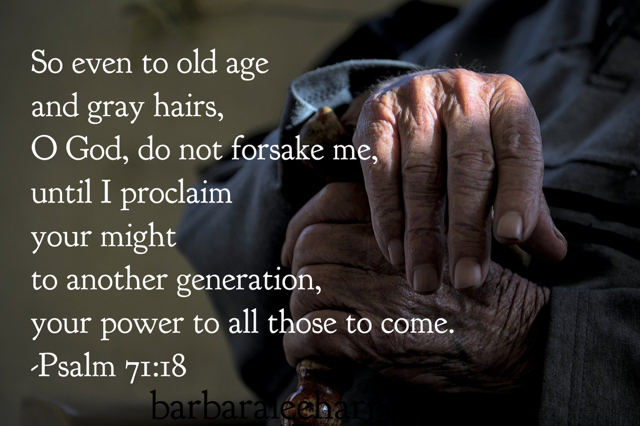
So even to old age and gray hairs,
    O God, do not forsake me,
until I proclaim your might to another generation,
    your power to all those to come.
Psalm 71:17-18, ESV

I recently read of a man who was active in public ministry all his life. When his wife developed Alzheimer’s, he took care of her as long as he could at home. When she needed more care than he could give, she went to an assisted living facility. But he did not want the two of them to be separated: he joined her. He has an active ministry there leading Bible studies and services and talking with residents.

When my mother-in-law was in a memory care unit, I would feel somewhat down long after leaving the facility after visiting her. I can’t imagine voluntarily living in such a place while still in your right mind.

I think of this man’s national and even international ministries contrasted with his life now. His ministry is not evaluated by how many people he is reaching. He is faithfully serving the Lord right where he is supposed to be.

Many of us find that our “older years” turn out quite different from what we had expected due to illness (ours or our spouse’s), parents’ or children’s needs, financial considerations, or any number of issues. But wherever He has put us, we can proclaim His might and His power. We can share those with everyone, but the psalm above particularly speaks of “another generation…those to come.”

One generation shall commend your works to another,
    and shall declare your mighty acts.
On the glorious splendor of your majesty,
    and on your wondrous works, I will meditate.
They shall speak of the might of your awesome deeds,
    and I will declare your greatness.
They shall pour forth the fame of your abundant goodness
    and shall sing aloud of your righteousness.

Psalm 145:4-7, ESV

Psalm 78 also speaks of “things that we have heard and known, that our fathers have told us,” telling “to the coming generation the glorious deeds of the Lord, and his might, and the wonders that he has done,” “that the next generation might know them, the children yet unborn, and arise and tell them to their children, so that they should set their hope in God and not forget the works of God, but keep his commandments” (verses 2-7).

We can tell the next generation (whether our own descendants or others God brings across our path) the history of how God has worked in the lives of His people, as Psalm 78 goes on to do. We can share His Word, His law, His grace. And we can also share our Ebenezers, testimonies of how He ministered to us and provided for us. We can assure them that He is not just a God afar off in history, but He is God here and now, active in our lives and theirs.

Moses’s prayer in Psalm 90 asks God in the midst of the flying years (verse 10) to “teach us to number our days that we may get a heart of wisdom” (verse 12). Moses concludes:

Let your work be shown to your servants,
    and your glorious power to their children.
Let the favor of the Lord our God be upon us,
    and establish the work of our hands upon us;
    yes, establish the work of our hands!
Psalm 90:16-17, ESV

It was down at the feet of Jesus,
O the blessed, happy day!
Where my soul found peace in believing,
And my sins were washed away.

It was down at the feet of Jesus,
Where I found such perfect rest,
Where the light first dawned on my spirit,
And my soul was fully blest.

It was down at the feet of Jesus,
Where I brought my guilt and sin,
That he paid my debt and forgave me,
For He died my soul to win.

Refrain:

Let me tell the old, old story
Of His grace so full and free;
Let my heart keep giving Him the glory
For His wondrous love to me.

~ Original words by Elisha Hoffman

(Sharing with Inspire Me Monday, Literary Musing Monday, Let’s Have Coffee, Porch Stories, Wise Woman, Woman to Woman Word-filled Wednesday, Faith on Fire)