Book Review: The Damascus Way

The Damascus Way, is the third installment in biblical fiction series Acts of Faith by Janette Oke and Davis Bunn, yet I think it could easily be read as a stand-alone book if you’ve not read the previous two in the series.

If you’re very familiar with the story of the Apostle Paul’s conversion on the road to Damascus in the book of Acts, then the title of this book would suggest to you that it might be about him. It does cover that incident, but until it reaches that point, Paul — known as Saul pre-conversion — is seen once and referred to many times. He is less a character in the story through most of it than a sort of dark cloud of threatening persecution of the believers.

That increasing persecution drove many of the early believers from Jerusalem in the Bible, having the effect of scattering the gospel with them across the land, and that’s the background of the story that is portrayed here. Abigail, the widow of Stephen, reluctantly leaves with her young daughter, Dorcas, and a group of believers heading one way. Jacob, her brother, is a guard for a wealthy merchant’s caravan and becomes a courier for the underground network of believers. One of his contacts, to his surprise, is Julia, the beautiful daughter of his employer.

Julia is the only daughter of the merchant, and though well-to-do, she realizes that she and her mother are not welcomed in the community. Discovering why shakes her world to its core, and her turmoil leads to faith in Christ. She and Jacob are the primary characters in this story, though there are strong subplots involving Abigail as well as Linix and Alban, two Roman soldiers who became believers in the previous books.

I enjoyed seeing how believers from various backgrounds and nationalities who would formerly have been enemies became one in Christ.

And one passage that came back to mind many times after reading it involved the testimony of what we call “the woman at the well.” I knew that she came out to draw water alone at a time when other women were not there because of her shame and her status. I knew that she was surprised that Christ spoke to her in the first place and that He knew all about her. But one sentence in the story said, “He seemed to know all about her, yet He did not shun her” (p. 265). Though the last few words are not explicitly said in Scripture, they are implied, and though I knew that in one sense, in this reading the contrast between the shunning of “good people” and the kindness and respect shown by the Savior really stood out to me.

For all the possible intrigue of the dangerous activities of the couriers and the secrecy of the believers to avoid persecution, you would think this would have been a real page-turner, but the plot seemed to drag to me in a few places, which I don’t remember happening in the previous books. But I may have just been a little “off” somehow while reading it — other reviews of it I have read use words like “sweeping,” “intriguing,” and “vivid.”

Nevertheless, I am glad to have read it and can recommend it. I’m not sure if there will be further books in the series — since it is covering the book of Acts and there are several more chapters after Saul’s conversion, I would hope so. If so, I’ll be looking forward to them.

(This review will also be linked to Semicolon‘s Saturday Review of Books.)
Book Review: One Thousand Gifts

One Thousand Gifts: A Dare to Live Fully Right Where You Are by Ann Voskamp began as something of a teasing dare: a friend had named one hundred things she loved and asked Ann if she could name 1,000. Ann began keeping a notebook open in her kitchen to record things she was thankful for, little dreaming how it would impact her life.

But this is no Pollyanna-ish “glad game.” Ann discusses finding joy even through loss and pain and circumstance that don’t make sense and childish skirmishes. And giving thanks, she finds, does more than engender gratitude and praise to God, though that’s plenty: it also wards off things like anxiety, because when we’re in the habit of giving thanks, we’re in the habit of seeing evidence of God’s love and care all around us.

Ann’s writing style here is much the same as it is on her blog, and it is hard to know how to describe it: it has a poetic quality to it, somewhat ethereal, seemingly stream-of-consciousness, though it is not random: there is definite movement and flow toward a purpose and end. And it’s not fluff, for there is serious study underneath. My own writing style is more practical and straightforward: neither is right or wrong, better or worse, they’re just different, and my different way of thinking left me feeling a little lost sometimes, but other times I was moved to tears or touched to the core.

I wish I had jotted down notes from the main points in each chapter. Some of the main ones are repeated and easy to take with you from the book. But here are some quotes that I marked:

Daily discipline is the door to full freedom, and the discipline to count to one thousand gave way to the freedom of wonder…(p. 84)

Joy and pain, they are but two arteries of the one heart that pumps through all those who don’t numb themselves to really living. (p. 84).

Can it be that, that which seems to oppose the will of God actually is used of Him to accomplish the will of God? (p 88).

I am beset by chronic soul amnesia. I am empty of truth and need the refilling. I need come every day — bend, clutch, and remember — for who can gather the manna but once, hoarding, and store away sustenance in the mind for all of the living? (p. 106).

How do you open the eyes to see how to take the daily, domestic, workday vortex and invert it into the dome of an everyday cathedral? (p. 120-121).

Peace can shatter faster than glass (p. 174).

My own wild desire to protect my joy at all costs is the exact force that kills my joy (p. 178).

I wouldn’t agree with every little theological point, but that could probably be said of many books that I read, and I am not going to dissect the differences here. I will just mention a couple of things, though.

In the last chapter, titled “The Joy of Intimacy,” Ann uses what could be called sexually charged language to describe intimacy with God, such as, “I fly to Paris and discover how to make love to God” (p. 201) and “To know Him the way Adam knew Eve. Spirit skin to spirit skin” (p. 217)…and others I am not comfortable putting here. I know how she means it: she doesn’t mean anything physical or inappropriate: she’s merely discussing spiritually unfettered union and communion. There are Bible passages that speak of God as a husband, the church is called the Bride of Christ, and the last few verses of Ephesians 5 say that the marriage union is symbolic of that between Christ and the church. But still…it’s jarringly graphic, and sadly, I think a stumblingblock to many readers: some have only discussed that chapter on their blogs, and from comments there and on various book reviews, some people have laid aside the book after coming to or hearing about those passages. Personally I wouldn’t lay aside the whole book because of those references, but I would just say read cautiously and with discernment, as we should with any book. (Update: Ann comments on her use of language in this chapter in the second comment here.)

Another disturbing thing to me was a quote from Mother Teresa — not the quote itself but the regarding of her as a spiritual authority, which I don’t believe her to be for these reasons. I don’t want to offend my Catholic friends, but as I have said before, a person is not saved by or because of their denomination: we’re saved by grace through faith in Christ alone.

For these and other reasons, I couldn’t endorse the book 100%, but I did benefit from it in many ways.

There is a book club discussing this book at bloom (in) courage where two other ladies discuss the individual chapters with Ann. The videos are long, about 10-12 minutes for each chapter, and I’ve only watched five or six of them. Some of the discussions are more helpful than others, but they did help to relate to Ann better, hearing her talk in everyday language.

A little taste of the book and it’s style can be seen here in its trailer:

(See also Tim Challies’ review here.)

(This review will also be linked to Semicolon‘s Saturday Review of Books.)

Book Review: The Book Lover’s Devotional

The Book Lover’s Devotional: What We Learn About Life From 60 Great Works of Literature is compiled by various authors, one of whom is blog friend Laura Lee Groves of Outnumbered Mom.

As the title suggests, 60 different books, ranging from old classics like The Count of Monte Cristo and War and Punishment to modern works like The Boy in the Striped Pajamas and A Prayer For Owen Meany are discussed in light of their spiritual truths. Most of the books are not written from a Christian worldview, yet even secular books convey spiritual truth: as someone once said, “All truth is God’s truth.”

The format of the devotionals gives a bit of background information about the book and usually a plot summary and then something that the devotional writer gleaned spiritually from the book. Each devotional ends with a Bible verse and a couple of questions for further thought. In a few cases just a scene from the book is discussed. In many cases the spiritual viewpoint may not be the overriding theme of the book, but rather just an aspect. In many cases as well, what the devotional writer may have seen was not necessarily what the book author intended: for instance, the chapter discussing Anne of Green Gables is titled “A Father to the Fatherless” and discusses how we come to God as orphans, and as a loving Father, He takes us to Himself and adopts us as His own. From everything I have read about Montgomery’s writing of Anne, I don’t think she had that theme in mind as she wrote, but it is certainly a valid spiritual application. That’s one thing that makes discussing books enjoyable: hearing what others got from them. But overall, the spiritual take-away is more direct: Captain Ahab’s hatred for Moby Dick dragging him down, both literally and spiritually, for instance.

I was a little apprehensive of reading the devotionals for those books I had not read yet for fear of spoilers, but overall they only enhanced my desire to read the book. My to-be-read list has grown after reading this book.

This was a very pleasant read and I am glad to recommend it.

(This review will also be linked to Semicolon‘s Saturday Review of Books.)

Book Review: A Memory Between Us

A Memory Between Us by Sarah Sundin is set in WWII. Lieutenant Ruth Doherty is an army nurse stationed in England. The shame of her past and the pressure of supporting her younger siblings causes her to keep to herself. She welcomes neither the outreach of friends nor the overtures of servicemen, but her efficient and cheerful labors make her a favorite among patients.

Major Jack Novak finds himself a patient of Ruth’s one day. He’s as attracted to her as the other guys, but he realizes he’ll have to tread carefully to break through her “no dating” policy. Meanwhile he wrestles with the expectations of his father that he will become a pastor and his own desires and abilities as an officer. He develops a plan of action to win Ruth’s heart as well as a promotion against a rival.

The optimistic confidence of WWII soldiers is appealing, but Jack has to learn that he can’t trust in his own plans and God-given abilities: he needs to trust in the Lord directly. And Ruth needs to learn that the walls she has built around herself are no protection and in fact hinder her from receiving support from friends — support that she doesn’t think she needs at first.

I loved these characters — I don’t feel as if I am doing them justice. I loved the fact that they’re both flawed, but they both make progress in their walk with God, and I loved that their interaction at the end wasn’t suave and smooth but sweet and a little goofy.

Sarah Sundin did a masterful job drawing me into the characters and the raw emotion of their struggles, and the setting is perfectly balanced: not so overrun with details so as to lose the story but informative enough to make me feel I was experiencing it for myself. I didn’t want to put this book down, and I wished there was more of it to read when I finished it.

This book is the second in the Wings of Glory series, the first being A Distant Melody (my brief review here) about Jack’s brother Walt, but I believe it could be easily enjoyed alone. I’m very much looking forward to the next installment about third Novak brother Ray this summer.

(This review will also be linked to Semicolon‘s Saturday Review of Books.)

What’s On Your Nightstand: February

What's On Your NightstandThe folks at 5 Minutes For Books host What’s On Your Nightstand? the fourth Tuesday of each month in which we can share about the books we have been reading and/or plan to read. You can learn more about it by clicking the link or the button.
It’s funny how, at the beginning of last month’s nightstand post, I commented on how quickly January seemed to have flown by, but in this shorter month of February, last month’s nightstand seems ages ago. I don’t know what accounts for the difference in how quickly or slowly the same amount of time seems to be passing.Sickness in the house probably had something to do with it — my son’s, not mine, but that significantly slowed the activities and errands. Thankfully all are well now.

Anyway, since last time I have read:

Anne of Windy Poplars, the fourth in Lucy Maud Montgomery’s Anne of Green Gables series, reviewed here.

50 People Every Christian Should Know: Learning From Spiritual Giants of the Faith by Warren Wiersbe, a review and several quotes from it here. An excellent resource.

Looking for Anne of Green Gables: The Story of L. M. Montgomery and Her Literary Classic, by Irene Gammel, a look at Montgomery’s published and unpublished journals, scrapbooks, letters, former stories, as well as magazines and the culture of the times to see what influences might have led to the Anne books. I had mixed emotions about this one: loved the background information but didn’t agree with some of the author’s conjecture. My review is here.

Living with Purpose in a Worn-out Body: Spiritual Encouragement for Older Adults by Missy Buchanan which I saw by way of Mocha With Linda‘s recommendation. Excellent book, my review is here.

Song of Renewal by Emily Sue Harvey, reviewed here. Good story about a family’s strained relationships coming nearly to the breaking point after a daughter’s accident and the healing/renewal on several levels, though it would have been better without a couple of objective (to me) elements.

I am currently reading:

A Memory Between Us by Sarah Sundin, set in WWII — riveting. hard to put down.

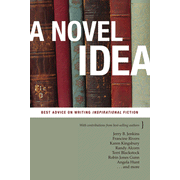
A Novel Idea: Everything You Need to Know about Writing Inspirational Fiction — I’ve been reading sections of this between other books.

The Book Lover’s Devotional: What We Learn About Life From 60 Great Works of Literature by various authors, one of whom is blog friend Laura Lee Groves of Outnumbered Mom.

Still on my nightstand: Faithful by Kim Cash Tate, Just Between You and Me by Jenny B. Jones, One Thousand Gifts by Ann Voskamp, The Damascus Way, biblical fiction by Janette Oke and Davis Bunn, and several others. I’m not sure which to choose next!

Book Review: Living with Purpose in a Worn-out Body: Spiritual Encouragement for Older Adults

When I saw Mocha With Linda mention Living with Purpose in a Worn-out Body: Spiritual Encouragement for Older Adults by Missy Buchanan, I knew I had to get it for my mother-in-law and myself. Missy was a daily caregiver to her mother, who lived to be 92, and now Missy spends much time visiting with other residents in the senior residence center where her mother spent her last days. Her experiences make the  devotionals she began writing for senior adults ring with authenticity.

This book covers several areas: pain, loneliness, feeling forgotten, the treasure of friends, sleep, purpose, clutter, medicine, bingo, laughter, sensible shoes — many aspects of an older person’s life. The devotionals address these issues in a genuine way. Some are poignant, some are fun, but all bring the reader back to focus on God in every issue. Here is a sample:

Sometimes I wonder why you have left me on this earth.
Ia have outlived so many family and friends. Why do I linger?
What purpose could you have for me now?
Look at my hands. Once strong and sure, they are unsteady and frail.
My mind, once quick and incisive, now falters under the weight of names and faces.
What real purpose do I serve knitting away the hours, surfing the channels, dozing through the afternoon?
Then Your Spirit stirs my heart and convicts my soul.
You are not a wasteful God!
The length of my earthly days is a mystery to me, but one thing I know for sure. You have created me with an eternal purpose.
How can I be more like Christ today?
Whose life can I touch with kindness?
Lord, give me an extra measure of grace when I feel that I’m too old to be useful.
Help me as I take my limitations in stride as I search for opportunities to serve you.
My purpose has not withered away with another birthday.
It is rooted in eternity.

Psalm 33:11:
But the plans of the LORD stand firm forever,
the purposes of his heart through all generations.

The text in the book is large print, yet the book as a whole is slim.

I would highly, highly recommend this to any “senior saint” you know as well as family members and caregivers.

(This review will also be linked to Semicolon‘s Saturday Review of Books.)

Book Review: Song of Renewal

I don’t often accept books for review, both because I have so many others stacked up that I want to read and because I have been disappointed in many of the ones I did accept. But something about Song of Renewal by Emily Sue Harvey sounded like it might be a poignant read.

Garrison and Liza Wakefield begin as a happy couple, deliriously in love, expecting their first child. As the years pass, however, relationships wane. Garrison’s focus on maintaining his family’s lifestyle cause him to lay aside his promising art career and become an emotionally-distanced workaholic. Liza willingly gives up her ballet to be a stay-at-home mother, but projects her aspirations onto her teenage daughter, Angel, who isn’t really interested. The pressures of ballet and the pain of her father’s disinterest weigh heavily on Angel, leading her to an eating disorder.

A car accident on a rainy night puts Angel in a coma and kills her boyfriend, throwing the family into turmoil. The fissures in the Wakefield’s relationship widen under the pressures of this crisis, the expenses of medical care, and the less than hopeful prognosis.

The book explores the journey of renewal on several levels: faith, recovery, purpose, marriage, parenthood, and other relationships.

The writer did an excellent job conveying the progress of Garrison and Liza’s relationship, from the bloom of first love to complacency and distraction to blame, distancing, and anger after the accident to eventual forgiveness and understanding. I was almost in tears at times in their struggle. Angel’s struggles physically and emotionally during her recovery hit home as well.

There were a couple of things that marred the story for me, though. One was a smattering of language that I don’t usually find in the types of books I read. It’s fairly tame compared to a lot of what’s out there, but still, to me it was off-putting and I know it would be to some of you as well. Secondly, the frequency and intensity of the couple’s sexual life was meant, I’m sure, as a barometer measuring how well their relationship was going, and it fit naturally in the story and wasn’t terribly explicit, but it still was more than I personally wanted to know.

Though this book does mention the importance of faith, repentance, and forgiveness, I am not sure whether it will be promoted as Christian fiction. I have a feeling that those who read it who aren’t Christian might be put off by the faith aspect, though it is handled naturally and not at all in a preachy or didactic manner, and those who are reading from a Christian perspective will be put off by the language and sexuality.

I think the writer’s main intent was to convey hope in the many problems faced by her characters (and by extension, her readers), and she did that very well.

Special thanks to Lou Aronica at  The Story Plant for sending me a review copy. I was not required to write a positive review. The opinions I have expressed are my own.

(This review will also be linked to Semicolon‘s Saturday Review of Books.)

Book Review: Looking for Anne of Green Gables: The Story of L. M. Montgomery and Her Literary Classic

Looking for Anne of Green Gables: The Story of L. M. Montgomery and Her Literary Classic by Irene Gammel is not so much a biography, at least not a full-fledged one, as I had first thought. Concentrating on the years just before, during, and after the writing of Anne of Green Gables, the author mainly looks at Lucy Maud Montgomery’s life and times for clues about how Anne came to be, asserting that Maud’s published comments about Anne’s origins were not the complete story.

The author extensively researched Maud’s published and unpublished journals, scrapbooks, letters, other writings about her life and work as well as the magazines Maud would have had in her home  and other sources about the culture in which she lived.

Many parts of the book were very interesting. There are photos from ads of the time for dresses with puffed sleeves so dear to Anne’s heart, LMM’s home, and various places she names as inspiration for her book. There are literary allusions I had missed in my reading, and the discovery of those enriched my enjoyment of Anne. There is much background detail, such as the search for the face that inspired Anne: Maud had cut out a photo that she liked from a magazine and said later that this was what Anne looked like in her mind, but the author spends what feels to me an inordinate amount of time researching the model’s life and wondering how much Maud knew of her. Diana’s name was first going to be Laura, and then Gertrude (Gertrude?). The author brings up some elements of Anne that appeared in Maud’s earlier short stories.

Anne is not an autobiographical representation of Maud (Emily is said to be), but there are many parallels, among them: Maud’s mother died when she was young and her father was away most of her childhood, and Maud was raised by her grandmother (similar to Elisabeth in Anne of Windy Poplars). When she was writing of Marilla perhaps needing to sell Green Gables after Matthew died, Maud’s grandmother was facing the loss of her home due to a family situation.

Fortunately I had read Carrie‘s reviews of some of Maud’s biographies and journals, so I already knew that she and her husband both suffered from depression and their marriage was not happy. “To read her as a rosy-hued optimist who only wrote romances with happy endings is to misread her profoundly” (p. 125). Maud wrote of another character in a short story titled “A Correspondence and a Climax,” “So I wrote instead of the life I wanted to live — the life I did live in imagination” (p. 51), and that seems to be what Maud herself did as well, righting wrongs and relationships, giving Anne the college degree she never achieved (though she did provide for a close friend to go to college), etc. If you’re not familiar with her personality and personal life, you might end up not liking her as much as you read of her, but she is a very complicated woman with many layers and facets of personality, and it was interesting to learn more of her. As I mentioned when I reread Anne of Green Gables last year, at first having learned of the unhappiness of her life shadowed my enjoyment of the book, but after a while the evident joy she found in writing took over, and I could rejoice that she found at least a measure of happiness there.

However, there were a few things that disturbed me. First, Gammel explains that paganism and the Druids were being widely discussed at the time, one such article appearing in a magazine in which one of Maud’s stories also appeared, and asserts that Diana’s name as well as Anne’s love of nature “belong to the irreverent world of wood nymphs and dryads. This pagan world poked fun at solemn Sunday School decorum” (p.84). I always felt that Anne’s mention of such creatures and her belief that plants had souls was more literary and imaginative than religious or “pagan.” Gammel uses the word a lot, in fact, almost every time nature is discusses, as if only pagans enjoyed nature or brought flowers and ferns into their homes and churches. The author does say that in a letter Maud “shared her pagan spiritualism, her belief that heaven was a rather boring place, and that Christ might have been a willful imposter” (p. 135), but she doesn’t quote the letter directly. I don’t know if paganism truly inspired Maud to a great degree or if this is conjecture on the author’s part.

Secondly, Gammel also asserts that some of Maud’s “bosom friendships” as well as that between Anne and Diana were more than just platonic. Though I’ve not read any of LMM’s other biographies (that I can remember — if I have it’s been decades and I’ve forgotten them), my feeling is that this is conjecture based partly on the fact that Maud’s friendships with women seemed closer and more intense than those with men, and girls and women in that time were “gushier” than we generally are today. I see no reason to read lesbian thought into  any of those friendships.

Third, though there are places where LMM referred to certain things that inspired details of her Anne books, there seems to be a lot of conjecture as well based on what Maud would have been reading and what cultural references she knew. I have a lot of magazines in my home, or that have passed through my home, but it would be a mistake to think that I read everything in them or agreed with everything I did read, and I can’t help but feel the same would have been true with Maud. I think it’s fine to look at those sources and suggest that perhaps they went into Maud’s consciousness and perhaps even influenced her unawares, but I think that’s as far as you can go without a source where she says directly what influenced her. Many times Ms. Gammel does stop just there, but in my opinion many times she goes further.

I also disagreed with the quote that “It may be the ludicrous escapades of Anne that render the book so attractive to children, but it is the struggles of Marilla that give it resonance for adults” (pp. 188-189). Through Carrie’s LMM reading challenges, it seems several women “discovered” Anne when they were adults, as I did, and were attracted not only by her “escapades” but by her growth. Though understanding Marilla more than a child would, I think most readers still identify with and read for Anne. I disagreed as well that it was “the edgy and tempestuous Anne” readers fell in love with, “an Anne they did not want to grow up and become a polite society lady” (p. 126). Again, I enjoyed seeing her grow into maturity while keeping a lively spirit, learning control and socially acceptable ways to deal with others while still standing firm to her own convictions.

I’ve spent a little more time with what I’ve disagreed with mainly because people have told me they trust my judgment in reviews, and I wouldn’t want to let some of these things pass without comment. I have to defer to Ms. Gammel’s expertise and research, yet I do disagree with her conclusions in these areas where I believe conjecture is involved. Maybe some of you who have read more of LMM’s biography or journals can speak to some of these issues.

This book may be a bit academic for some, and those wanting a full biography may want to find another source (this book ends with the writing of Anne of Ingleside). But a dedicated Anne or LMM fan who wants to read most everything they can find on them might be interested.

(This review will also be linked to Semicolon‘s Saturday Review of Books.)

Booking Through Thursday: Ground Floor

btt  button Booking Through Thursday is a weekly meme which poses a question or a thought for participants to discuss centering on the subject of books or reading. The question for this week is:

There’s something wonderful about getting in on the ground floor of an author’s career–about being one of the first people to read and admire them, before they became famous best-sellers.

Which authors have you been lucky enough to discover at the very beginning of their careers?

And, if you’ve never had that chance, which author do you WISH you’d been able to discover at the very beginning?

I “met” Laura Lee Groves at her blog, Outnumbered Mom, through Susanne‘s weekly meme Friday’s Fave Fives. We are at similar stages of life and both have all boys and I enjoyed her writing style. It was only after I had been reading her blog for a while that I discovered she was working on a book, and it was exciting to hear about the final stages and then see it come to fruition. I was happy to buy her book, I’m Outnumbered!: One Mom’s Lessons in the Lively Art of Raising Boys, and to review it here, and even gave away a copy on my blog and then again in in person to a friend. I also found out about The Book Lover’s Devotional: What We Learn About Life From 60 Great Works of Literature through her blog, which would have interested me anyway, but knowing she wrote for parts of it makes it even more appealing. I just received my copy yesterday and can’t wait to start it. Plus she has mentioned working on a fiction book now, and it’s fun to hear a little bit about its progress and to look forward to seeing it come out.

I discovered The Secret Life of Becky Miller, the first book by Sharon Hinck, while just walking around the Christian bookstore looking for something to read. I loved this book about a young mom who experiences Walter Mitty-like daydreams of heroism while trying to figure out how to do “great things for God” in real life. I think my review of Becky was my first on my blog — and Sharon’s response was the first time I ever heard from an author here. I’ve read and enjoyed (and I think reviewed) her six subsequent books since and hope the Lord allows her more. She’s been waylaid by illness the last couple of years and I pray God grants her healing. She also wrote part of the introduction for A Novel Idea: Everything You Need to Know about Writing Inspirational Fiction.

I came across either Adam Blumer or his brother — or maybe both, I got them confused at first — at a Christian message board I sometimes frequent. When I heard he was writing a novel, I eagerly awaited it. His book Fatal Illusions was published in 2009 and was “keep you on the edge of your seat” good, and I am eagerly awaiting the sequel.

I didn’t know Jamie Langston Turner personally, but she teaches at my alma mater, so I also anticipated her first book, Suncatchers, from the time I first heard about it, and I have bought all of her books since.

There may be other authors I’ve followed since their first book or earlier, but these are the ones that come to mind. I enjoy following their careers and hearing about the progress of a book they’re working on.

Book Review: 50 People Every Christian Should Know

In the preface to 50 People Every Christian Should Know: Learning From Spiritual Giants of the Faith, author Warren Wiersbe states that he has been greatly helped by reading biographies. “The past is not an anchor to drag us back but a rudder to help guide us into the future.” I love to read biographies as well, and this book included some that were new to me.

I didn’t realize until I received the book that it was compiled from two former books by Wiersbe, Living With the Giants and Victorious Christians You Should Know, which in turn were originally columns in the magazines Moody Monthly and The Good News Broadcaster, which are no longer being published. I am glad these testimonies have been preserved in this book.

Of the 50 (51, actually: one chapter combines two men), I had previously read biographies of six; I knew something about or had read books by about fifteen others, and the rest were new to me except for just a few whose names I had heard. There are four women, a few missionaries, but most are preachers.

Wiersbe gives a brief history of each person as well as suggestions for books by that person or other biographies of them for further reading. Some of the chapters were a little drier to me than others, but often that occurred when I was trying to read too many of them at one time. The stories I already knew were a good refresher, and some of the others were a good springboard toward finding new biographies to read. Though most of the time Wiersbe tried to convey what the person was like rather than just what they did, there were a couple of chapters where I didn’t get that sense of personality. I did appreciate that the individuals were listed in chronological order, so that we could see the effect of the issues of the day or other people on each person.

A couple of the inclusions confused me, though, as Wiersbe said they “did not preach the atonement”: one, in fact, went from a grace-based faith to a works-based religion. I don’t see how such persons could be considered “giants of the faith,” though Wiersbe did say there were things he learned from them.

One of the overall lessons this books left with me was that God can use anybody. These 51 agreed on most core, fundamental doctrines yet were from various denominations, from opposite sides of the Calvinist/Arminian and other controversies, from differing viewpoints on end times and how ministry should be conducted, from widely different personalities and academic tendencies. and yet God used each one. Does that mean none of those issues matters? No, each individual is responsible to  study the issue, the Bible, and in their own conscience before God determine what they believe and how to live it out. But seeing how God used varieties of people helps me to be a little less critical, though I trust no less analytical. We can even learn from the fact that some were gifted in one area but had faults in others, as we are all in the same state.

I marked more passages and quotes than I can possibly share in one post…

But here are a few that stood out to me:

Often, after hearing his father preach, Matthew [Henry] would hurry to his room and pray that God would seal the Word and the spiritual impressions made to his heart so that he might not lose them (p. 25).

An excellent exercise. Perhaps that’s part of what made him the commentator he was.

No place is like my study. No company like good books, especially the book of God. ~ Matthew Henry (p. 27).

My endeavor is to bring out of Scripture what is there and not to trust in what I think might be there ~ Charles Simeon (p. 49.)

Amen. Would that all preachers would so do.

“Tried this morning specially to pray against idols in the shape of my books and studies. These encroach upon my direct communion with God, and need to be watched” ~ Andrew Bonar (p. 77).

Books and studies are helpful but even they can take the wrong place in our hearts and minds.

“I can see a man cannot be a faithful minister, until he preaches Christ for Christ’s sake, until he gives up striving to attract people to himself, and seeks only to attract them to Christ” ~ Robert Murray McCheyne (p. 82).

“To efface one’s self is one of a preacher’s first duties. The herald should be lost in the message” ~Alexander Maclaren (p. 109)

Surprisingly, Maclaren was haunted all his life by a sense of failure. Often he suffered ‘stage fright’ before a service, but in the pulpit he was perfectly controlled. He sometimes spoke of each Sunday’s demands as ‘a woe,’ and he was certain that his sermon was not good enough and that the meeting would be a failure” (p. 109).

Though I am not a preacher, I can identify with those feelings. In fact, I have felt that maybe they were an indication I should not be in the ministries I was in, but I guess that’s not always the case. Similarly, John Henry Jowett wrote of his Yale lectures, which I have heard reference to as a great help by more than one preacher:

The lectures are a nightmare to me, and I am glad of getting rid of them this week! (p. 284).

And later,

Preaching that costs nothing accomplishes nothing (p. 284).

We could say that is true of much service, not just preaching. What the Lord uses in our lives may not always be the incidents where we “feel” spiritual or feel like we’re accomplishing something for Him. This next quote is a help:

“All God’s giants have been weak men, who did great things for God because they reckoned on His being with them” ~ J. Hudson Taylor (p. 133).

“Don’t go about the world with your fist doubled up, carrying a theological revolver in the leg of your trousers.” ~ Charles Spurgeon (p. 143).

I’m smiling because this reminds me of my friend from yesterday’s post. On the other hand,

[Alexander] Whyte was so much of an encourager that he forgot that Christians cannot accept every doctrine men preach, though the men may be fine people (p. 169).

“Fathers and brethren,” Whyte cried, “the world of mind does not stand still! And the theological mind will stand still at its peril.” True. but the theological mind must still depend on the inspired Word of God for truth and direction. Once we lose that anchor, we drift (p. 169).

Religious sentiment, if it is worth anything, must be preceded by religious perception. ~ George Matheson on devotional writing (p. 200).

It is urgently needful that the Christian people of our charge should come to understand that they are not a company of invalids, to be wheeled about, or fed by hand, cosseted, nursed, and comforted, the minister being head physician and nurse — but a garrison in an enemy’s country, every soul of which should have some post of duty, at which he should be prepared to make any sacrifice rather than quit it. ~ F. B. Meyer (p. 216).

“Passion does not compensate for ignorance. ” ~ Samuel Chadwick (p. 249).

“We cannot make up for failure in our devotional life by redoubling energy in service.” ~ W. H. Griffith Thomas (p. 264).

“The Bible never yield itself to indolence.” G. Campbell Morgan (p. 278).

“The ‘soul-saving passion’ as an aim must cease and merge into the passion for Christ, revealing itself in holiness in all human relationships” [Oswald Chambers]. In other words, soul winning is not something we do, it is something we are…and we live for souls because we love Christ (pp. 324-325).

The applause of the crowd is not always the approval of the Lord (p. 370).

Christian leaders must realize that if they suffer from shallowness, the malady will spread throughout their entire organization (p. 370).

When a friend told William Whiting Borden that he was “throwing his life away as a missionary,” William calmly replied, “You have never seen heathenism” (p. 342).

Of Borden, who died at the age of 26 after just starting on the mission field:

Why should such a gifted life be cut short?…”A life abandoned to Christ cannot be cut short” ~ Sherwood Day (p. 345).

I think what he means is that that was what God appointed for him — that amount of time, that mission — and he fulfilled it well and God used him — and still does.

There is a very sweet poem written by Francis Ridley Havergal to Fanny Crosby — I don’t think I had realized they were contemporaries:

Dear blind sister over the sea
An English heart goes forth to thee.
We are linked by a cable of faith and song,
Flashing bright sympathy swift along;
One in the East and one in the West,
Singing for Him whom our souls love best,
“Singing for Jesus,” telling His love,
All the way to our home above.
Where the severing sea, with its restless tide,
Never shall hinder, and never divide.
Sister! what will our meeting be,
When our hearts shall sing and our eyes shall see!

The whole poem/hymn is here.

There were some amusing things in the “My how times have changed” department: D. L. Moody “felt that the bicycle, because of its popularity, was the greatest enemy of the Sabbath” (p. 291). I wonder, 100 years from now, what things people will shake their heads at in wonder that we thought “worldly.”

I imagine some of you who read here regularly will be glad to see this one done — it’s been appearing on my Nightstand posts for months. 🙂 It was neither hard nor tedious to read: it’s just best read a bit at a time rather than plowing straight through. With 50 chapters you could easily take one a week and finish it in a year — or one a day and finish it in a couple of months. Either of those or something between would give you a rich variety of people to learn from.

Though there were some names missing I would have liked to have seen here — Jim Elliot, Jonathan and Rosalind Goforth, J. O. Fraser, Henry Ward Beecher, Martyn-Lloyd Jones (he is referred to a few times), J. Oswald Sanders, Isobel Kuhn — I do understand that every author and book has its limits. 🙂 Overall I enjoyed the book very much.

I’ll close with something William Borden wrote in his notebook in college, something that many of these would echo:

“Lord Jesus, I take hands off, as far as my life is concerned. I put Thee on the throne in my heart. Change, cleanse, use me as Thou shalt choose. I take the full power of Thy Holy Spirit. I thank Thee.” Then he added this revealing sentence: “May never know a tithe of the result until Morning” (p. 345).

(This review will also be linked to Semicolon‘s Saturday review of books.)