The Telling is the last in the Seasons of Grace series by Beverly Lewis about an Amish wife and mother who suddenly and inexplicably leaves her family. Over the last two books, the family has dealt with practical and emotional ramifications of her absence and discovered a couple of clues as to where she might be while the mother, Lettie, searches for a way to make peace with her past. Lettie’s daughter, Grace, receives permission from her father to go to the last known place Lettie has been to try to find her, and her Englisher friend, Heather, offers to drive her there.
Meanwhile Lettie has gone as far as she can to try to set things right and determines she must go home and confess to her family and church, wondering all the while if they will receive and forgive her.
Heather deals with a course of holistic treatment for her cancer and some unexpected information about her own past.
Grace must continue to deal with the impact of her mother’s absence and then the consequences of her return while trying to be a friend to Heather and wondering what to do about the seeming interest of a young man named Yonnie.
I enjoyed this book very much and was well satisfied with the ending, even while seeing it coming. Various aspects of repentance, forgiveness, and grace are shown in by each of the characters involved. It will be a little sad to leave these characters behind now.
(This review will be linked to Semicolon’s Saturday Review of Books.)
I had planned to choose which book of a couple I have finished that I wanted to review today, and while I was puttering around on Facebook, I fell asleep in my desk chair. 😳 Now I not only have a couple of stiff muscles, but I need to get on with other tasks for the day. But I did want to share this that I saw on Robin Lee Hatcher‘s Facebook page. Hilarious!
The folks at 5 Minutes For Books host What’s On Your Nightstand? the fourth Tuesday of each month in which we can share about the books we have been reading and/or plan to read. You can learn more about it by clicking the link or the button.
Wow, it’s so hard to believe it’s the last week of April already!!
The Hidden Flame by Janette Oke and Davis Bunn, the second in the Acts of Faith series set during the time of the early church in Acts, reviewed here.
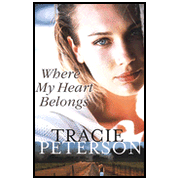
Where My Heart Belongs by Tracie Peterson, about a prodigal daughter who comes home and the older sister who stayed behind, and their conflicts and attempts at reconciliation, reviewed here.
Take 3, the third in the Above the Line series about Christian filmmakers by Karen Kingsbury. I didn’t really review it but mentioned it a bit more here.
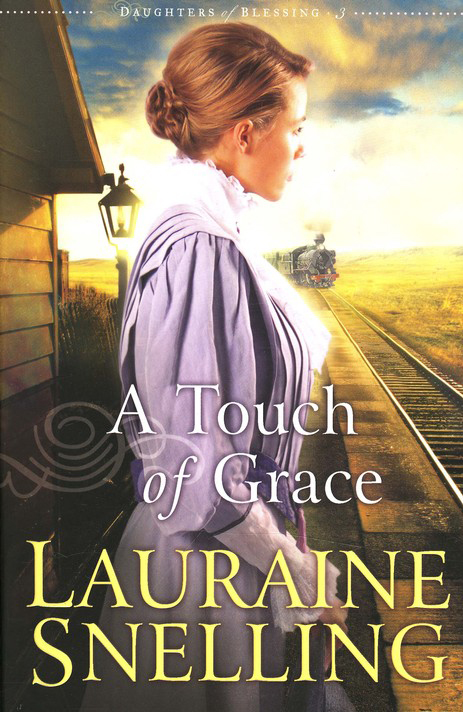
A Touch of Grace by Lauraine Snelling is the third in her Daughters on Blessing series about of a Norwegian farming family in North Dakota in the 1900s, reviewed here.
I am currently reading:
Port of Two Brothers by Paul Schlener, a village along the Amazon River in Brazil named for two brother missionaries and their families who worked there.
The Telling, next in the Seasons of Grace series by Beverly Lewis about an Amish mother who left her family without explanation in order to try to make something right from her past.
After these I’d like to get to another classic, maybe Emma by Jane Austen or an Agatha Christie novel. Plus I still have a few left from my Spring Reading Thing list plus a new book I just received by Eva Marie Everson titled This Fine Life.
If you like to read, to share about what you’re reading, and/or to get good ideas for your own reading list, I hope you’ll join us at What’s On Your Nightstand.
Take Three is the third in the Above the Line series by Karen Kingsbury about Christian filmmakers, their families, and the problems they run into. I don’t feel I can say much about the plot without revealing more spoilers than I want to, so I’ll just say it is a continuation of the journey, that Andi faces some serious consequences of her actions, and that there is finally some movement in the Cody/Bailey/Tim storyline. I enjoyed it and am looking forward to the next installment.
A Touch of Grace by Lauraine Snelling is the third in her Daughters on Blessing series. I had gotten it from a clearance table of a Christian bookstore over a year ago, and though I knew it was part of a series at first, I had forgotten that when I finally picked it up. At first I felt like I had been dropped in the middle of something, and realizing that I was in the middle of a series helped. I finally decided to stop trying to keep the characters straight except for the main ones, and eventually it all became clear.
Grace Knutson is the daughter of a Norwegian farming family in North Dakota in the 1900s. Though she is deaf, she copes well and works as hard as the others. Jonathan Gould is the son of an old family friend who happens to be wealthy and who thinks his son can learn hard work and responsibility by living with the Knutsons during the summer before he goes to college. Grace likes a young man named Toby whom her family disapproves of, but begins to be aware that Jonathan has feelings for her. Jonathan, for his part, finds that he loves farm work, but knows that his parents would never approve of his turning to a life of farming as a career.
I thought the story was a good depiction of farm life in that time, though perhaps a little too detailed in such instances as a thorough description of biscuit-making (though maybe I am mistaken in thinking that most people already know how it is done), and eventually I was drawn in to the characters and the conflicts they faced. At this time I don’t plan to go back and read the first two books in the series, but I’d like to read the ones that follow.
100. The Egypt Game – Snyder (1967) 99. The Indian in the Cupboard – Banks (1980) I liked them until I got to the end and was very disappointed at what was behind it all.)
98. Children of Green Knowe – Boston (1954)
97. The Miraculous Journey of Edward Tulane – DiCamillo (2006)
96. The Witches – Dahl (1983) 95. Pippi Longstocking – Lindgren (1950) (Saw a film years ago, not sure if I ever read it — don’t think so.)
94. Swallows and Amazons – Ransome (1930) 93. Caddie Woodlawn – Brink (1935) 92. Ella Enchanted – Levine (1997) (Saw the film, haven’t read the book) 91. Sideways Stories from Wayside School – Sachar (1978) (I don’t think I read this, but my oldest son did and enjoyed it.) 90. Sarah, Plain and Tall – MacLachlan (1985) (Saw the Glenn Close film and I think I read the book, but I can’t remember for sure.)
89. Ramona and Her Father – Cleary (1977)
88. The High King – Alexander (1968)
87. The View from Saturday – Konigsburg (1996)
86. Harry Potter and the Chamber of Secrets – Rowling (1999) 85. On the Banks of Plum Creek – Wilder (1937)
84. The Little White Horse – Goudge (1946)
83. The Thief – Turner (1997)
82. The Book of Three – Alexander (1964)
81. Where the Mountain Meets the Moon – Lin (2009)
80. The Graveyard Book – Gaiman (200 8)
79. All-of-a-Kind-Family – Taylor (1951) 78. Johnny Tremain – Forbes (1943)
77. The City of Ember – DuPrau (2003)
76. Out of the Dust – Hesse (1997)
75. Love That Dog – Creech (2001)
74. The Borrowers – Norton (1953)
73. My Side of the Mountain – George (1959)
72. My Father’s Dragon – Gannett (1948)
71. The Bad Beginning – Snicket (1999)
70. Betsy-Tacy – Lovelace (1940)
69. The Mysterious Benedict Society – Stewart ( 2007)
68. Walk Two Moons – Creech (1994)
67. Jeremy Thatcher, Dragon Hatcher – Coville (1991)
66. Henry Huggins – Cleary (1950)
65. Ballet Shoes – Streatfield (1936)
64. A Long Way from Chicago – Peck (1998)
63. Gone-Away Lake – Enright (1957)
62. The Secret of the Old Clock – Keene (1959)
61. Stargirl – Spinelli (2000)
60. The True Confessions of Charlotte Doyle – Avi (1990) 59. Inkheart – Funke (2003) (Saw the film)
58. The Wolves of Willoughby Chase – Aiken (1962)
57. Ramona Quimby, Age 8 – Cleary (1981)
56. Number the Stars – Lowry (1989)
55. The Great Gilly Hopkins – Paterson (1978)
54. The BFG – Dahl (1982) 53. Wind in the Willows – Grahame (1908)
52. The Invention of Hugo Cabret (2007)
51. The Saturdays – Enright (1941)
50. Island of the Blue Dolphins – O’Dell (1960)
49. Frindle – Clements (1996)
48. The Penderwicks – Birdsall (2005)
47. Bud, Not Buddy – Curtis (1999) 46. Where the Red Fern Grows – Rawls (1961) (Saw the film, think I read the book, can’t say for sure.)
45. The Golden Compass – Pullman (1995)
44. Tales of a Fourth Grade Nothing – Blume (1972)
43. Ramona the Pest – Cleary (1968) 42. Little House on the Prairie – Wilder (1935)
41. The Witch of Blackbird Pond – Speare (1958) 40. The Wonderful Wizard of Oz – Baum (1900) (Who hasn’t seen the film? But I haven’t read it. Janet has.)
39. When You Reach Me – Stead (2009)
38. HP and the Order of the Phoenix – Rowling (2003)
37. Roll of Thunder, Hear My Cry – Taylor (1976)
36. Are You there, God? It’s Me, Margaret – Blume (1970)
35. HP and the Goblet of Fire – Rowling (2000)
34. The Watsons Go to Birmingham – Curtis (1995) 33. James and the Giant Peach – Dahl (1961) (Saw the film, didn’t care for it.)
32. Mrs. Frisby and the Rats of NIMH – O’Brian (1971)
31. Half Magic – Eager (1954) 30. Winnie-the-Pooh – Milne (1926)
29. The Dark Is Rising – Cooper (1973)
28. A Little Princess – Burnett (1905)
27. Alice I and II – Carroll (1865/72)
26. Hatchet – Paulsen (1989) 25. Little Women – Alcott (1868/9)
24. HP and the Deathly Hallows – Rowling (2007) 23. Little House in the Big Woods – Wilder (1932)
22. The Tale of Despereaux – DiCamillo (2003)
21. The Lightening Thief – Riordan (2005) 20. Tuck Everlasting – Babbitt (1975) (Saw the film.) 19. Charlie and the Chocolate Factory – Dahl (1964) (Saw the film, think I may have read it, not sure. I think oldest son did.)
18. Matilda – Dahl (1988)
17. Maniac Magee – Spinelli (1990)
16. Harriet the Spy – Fitzhugh (1964)
15. Because of Winn-Dixie – DiCamillo (2000)
14. HP and the Prisoner of Azkaban – Rowling (1999)
13. Bridge to Terabithia – Paterson (1977) 12. The Hobbit – Tolkien (1938)
11. The Westing Game – Raskin (1978)
10. The Phantom Tollbooth – Juster (1961) 9. Anne of Green Gables – Montgomery (1908) 8. The Secret Garden – Burnett (1911)
7. The Giver -Lowry (1993) 6. Holes – Sachar (1998) (Saw the film.)
5. From the Mixed-Up Files of Mrs. Basil E. Frankweiler – Koningsburg (1967) 4. The Lion, the Witch, and the Wardrobe – Lewis (1950)
3. Harry Potter #1 – Rowling (1997) 2. A Wrinkle in Time – L’Engle (1962) 1. Charlotte’s Web – White (1952)
Some of these I’ve not heard of. Some I have wanted to get to but haven’t yet. I am surprised to see The Hobbit classified as a children’s novel.
Some I have read that are not here:
The rest of the Anne of Green Gables series by L. M. Montgomery
The rest of the Little House books by Laura Ingalls Wilder
The rest of Louisa May Alcott’s books that could be classified as being children’s novels (Little Men, Jo’s Boys, Eight Cousins)
The rest of the Narnia series by C. S. Lewis
The Little Lame Prince Five Little Peppers and How They Grew (sweet story) Heidi
One or two of the Boxcar Children series
Several Encyclopedia Brown books
A few Hardy Boys novels Twenty Thousand Leagues Under the Sea (I think…) The Adventures of Tom Sawyer or Huckleberry Finn or maybe both. Black Beauty
The first few Lemony Snicket books Keep the Lights Burning, Abbie (though that is probably classified as a chapter book rather than a novel.
…and possibly others I am not remembering. By the time my kids got to novels, either their reading had dropped off dramatically (my younger two) or their reading outpaced my own (my oldest).
Let me know if you do this so I can come over and compare lists. 🙂
The Hidden Flame by Janette Oke and Davis Bunn is the second in the Acts of Faith series set during the time of the early church in Acts. The first book, The Centurion’s Wife (reviewed here) took place just after the death and resurrection of Christ. The Hidden Flame picks up right where the action left off in the earlier book, but then there is a two-year gap before we see the early disciples in their new patterns of life.
The main character of this book is Abigail, a friend of Leah’s from the previous book. Abigail thought she had lost her entire family, but discovered her brother alive at the end of the first book. Now they have become integrated with the disciples, and despite Abigail’s previous injuries from a cauldron of boiling water spilling onto her, she is an active member, busy ministering in the kitchens and in distributing food to the poor. Two men are after her hand: one an older, wealthy Jewish merchant, the other a young Roman soldier. The problem, though, is that neither of them are believers, which is something she strongly desires in a mate, but women in that day had little say about whom they were given to in marriage.
I mentioned in my review of the first book that I approach Biblical fiction somewhat warily as too often the author’s imagination can take off and obscure or even supersede the facts. But David Bunn and Janette Oke are as careful as I think they can be. The reader has to understand that the characters who are developed a little more than the Bible gives us information about are products of the author’s imagination and therefore not entirely Biblical, but I think the authors do a good job of fleshing out what they think the Biblical characters might have been like.
The main events from the book of Acts here are the way the church dealt with the persecuted or displaced early believers, the deaths of Ananias and Sapphira, the naming of the first deacons, and the stoning of Stephen. I especially appreciated the way the situation with Ananias and Sapphira was handled. We tend to breeze right through that passage on the way to the next, but this caused me to think for the first time how the incident must have impacted both the community and the believers, who I imagine would have been very shaken. As the different believers in the story wrestle with what has happened and discuss it with each other, we hear varying views of possible reasons the Lord handled the situation in just that way without a one dogmatic, overriding view.
I am assuming there will be more books in the series: there were no loose ends at the conclusion, but there was a feel that there was more of the story to come. I look forward to it.
(This review will be linked to Semicolon‘s Saturday Review of Books.)
Where My Heart Belongs by Tracie Peterson is a prodigal daughter story. Amy changed her name at the age of eighteen, demanded her inheritance from her father, and left home without another word for twelve years. Suddenly she shows back up on the old homestead doorstep wanting to renew family ties. Her older sister, Kathy, is understandably wary at first and wrestles with her own feelings of anger and betrayal.
Tracie does a good job with what could have been, but is not, a clichéd story (not that the Biblical prodigal story itself is clichéd — it is a marvelous parable of redemption.) I found myself empathizing with both characters as they worked through their various issues and alternately took steps toward and then away from understanding and forgiving each other. There were layers to each that I would not have originally anticipated.
My only quibbles were that the latter part of the book seemed a little rushed, and it ended maybe a little too perfectly, but on the other hand, every now and then it is nice to have things end in the ideal way we all really wish would happen, and after all the anguish both characters suffer, it is good to see things turn around for them.
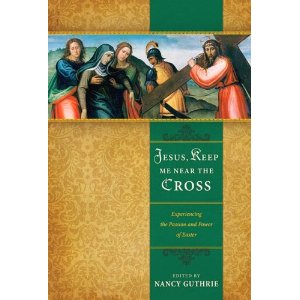
Over the last couple of years, I saw the book Come Thou Long Expected Jesus mentioned on several blogs. It was compiled by Nancy Guthrie and included excerpts from the writings and sermons of godly Christians through the ages. I read and enjoyed it very much last Christmastime, and then when I saw Nancy had put together a similar book for Easter, Jesus, Keep Me Near the Cross: Experiencing the Passion and Power of Easter I got it to read this Easter season.
The preface says:
Oh, what we miss out on when we rush past the cross of Christ.Oh, the richness and reward when stop to linger before it, when we take the time to “consider him who endured from sinners such hostility against himself” (Hebrews 12:3). In a culture where crosses have become commonplace as architecture and jewelry, how we need to truly gaze upon the cross of Christ in all its ugliness and beauty, in its death and in its healing, in the painful price paid there, and in its free gift of grace. Jesus, keep us near the cross.
And that is just what the book endeavors to help us do. Each of the twenty-five chapters is an excerpt from a book or sermon from various, mostly well-known Christians throughout the ages, from Augustine, Luther, Edwards, and Spurgeon all the way to John Piper, John MacArthur, J. I. Packer, and others. There were a handful of names I did not recognize, so please don’t count this as an endorsement of everything ever written or said by every author, but for the most part I agreed with everything in this book.
The chapters all deal with Christ’s death and resurrection, some in general, some on a particular aspect, such as C. J. Mahaney’s chapter on “The Cup,” exactly what was meant, what cup Christ was talking about when he said, “O my Father, if it be possible, let this cup pass from me: nevertheless not as I will, but as thou wilt’ (Matthew 26:39), or an exploration of some of the things Christ said from the cross, or J. I. Packer’s treatment of what was meant in Christ’s descent into hell and ascension into heaven. Just yesterday I found here a list of all the chapters and authors with a quote from each chapter, but today that link brings up a window about exceeded bandwidth: hopefully that will be rectified soon. Each chapter is 3-5 pages long, and it was very manageable to read one a day. I wouldn’t recommend reading more than that at a time: just soaking on one chapter and thinking over it through the day is rich meditation.
All the chapters did not resonate with me equally, but that may have been due to sleepiness or distraction on my part on given mornings. Probably my favorites were C. J. Mahaney’s on “The Cup,” C. H. Spurgeon’s “Then They Did Spit Upon His Face,” and Raymond Ortlund’s on “The Most Important Word in the Universe.” I shared several quotes from the last one yesterday, but two that impacted me were:
In human religions, it’s the worshipper who placates the offended deity with rituals and sacrifices and bribes. But in the gospel, it is God Himself who provides the offering.
And:
The God you have offended doesn’t demand your blood; he gives his own in Jesus Christ.
Overall the book did fulfill it’s purpose set out in the preface: it did cause me to slow down and meditate on what Christ did for me, to appreciate it anew, to revive my love for Him and thankfulness to Him. I plan to make this book a regular part of my Easter preparations in the coming years, but of course the topic is not confined to Easter: this book will help you contemplate the cross and what it means for you any day of the year.
The folks at 5 Minutes For Books host What’s On Your Nightstand? the fourth Tuesday of each month in which we can share about the books we have been reading and/or plan to read. You can learn more about it by clicking the link or the button.
It seems strange to be doing a “nightstand” post when there is still a week left in March, but these come up on the fourth Tuesday of the month rather than the last Tuesday. On months we have a fifth Tuesday, we have the Classics Bookclub.
Dr. Sa’eed of Iran: Kurdish Physician to Princes and Peasants Nobles and Nomads by Jay M. Rasooli and Cady H. Allen, reviewed here. Another good one, a true story about a young Islamic man who became a Christian. The persecution he faced put me to shame, but it was encouraging to know that the light of the gospel can penetrate even hearts determined to oppose it.
Carry On, Jeeves by P. D. Wodehouse, reviewed here. I was in the mood for a lighter read, and this definitely fit the bill.
The Hidden Flame by Janette Oke and Davis Bunn, the second in the Acts of Faith series set just after the life, death, and resurrection of Christ.
I just began Where My Heart Belongs by Tracie Peterson, about a prodigal daughter who comes home and the older sister who stayed behind, and their conflicts.
I am sure that I’ll pick up next Take 3, the third in the Above the Line series about Christian filmmakers by Karen Kingsbury, as it is due out this week. After that, I’m not sure, but it will likely be something from my Spring Reading Thing Goals.
I don’t know how I first became aware of Jeeves and Wooster: I think possibly through a clip on someone’s blog of an old program of the pair starring a young Hugh Laurie and Stephen Fry. But after searching around, I discovered that P. D. Wodehouse wrote a whole series of books based on the characters of English gentleman Bertram Wooster and his valet, Jeeves (or, as he calls himself, a gentleman’s personal gentleman) on which the programs were based.
After reading several very good but very serious books, I was in the mood for something lighter. I perused our little branch library and found Carry On, Jeeves. I don’t know if it was the first in the series, but the first chapter told how Jeeves came into Mr. Wooster’s employ, so that seemed a good place to start.
Bertram is a pleasant, but not overly bright gentleman. Jeeves is the quintessential English valet, the soul of decorum, who seems to just noiselessly appear when needed, never offends, always seems to have the right answer and knows what to do, but he is not above quiet, unobtrusive manipulation. Jeeves is particularly offended, however, when Bertram insists on fashion of which Jeeves disapproves.
This particular book seems a collection of stories of Wooster’s various friends who run into some kind of trouble. They appeal to Jeeves for help, and he comes up with some kind of ruse which usually has unintended consequences and is the base for the book’s comedy. Though the plot is a little formulaic, the characters are generally well-drawn. What I enjoyed most about Wodehouse’s writing, though, was his phraseology. For instance, this is one response when Bertram is expecting Jeeves to have a comeback or argue with him, but Jeeves only says, “As you say, sir.”
I felt as if I had stepped on the place where the last stair ought to have been, but it wasn’t. I felt defiant, if you know what I mean, and there didn’t seem anything to defy.
Both the above and this give that feeling of “I know just what you mean — what an imaginative way to say it.”
It was one of those still evening you get in the summer, when you can hear a snail clear its throat a mile away.
After one plan to help a friend went horribly and awkwardly wrong, Bertram says,
I hardly knew what to do. I wanted, of course, to rush down…and grip the poor blighter silently by the hand; and then, thinking it over, I hadn’t the nerve. Absent treatment seemed the touch. I gave it to him in waves.
Another time when Bertram was suddenly challenged about something that had gone wrong and tried unsuccessfully to think of a response, he thinks to himself:
I strained the old bean til it creaked, but between the collar and the hair parting, nothing stirred.
Of course, this is not a Christian book, and there are a few objectionable elements: a handful of instances of the word “damn,” a good bit of alcohol usage, and an abundance of lying.
I don’t now that I’ll visit another volume of Jeeves and Wooster any time soon, but I enjoyed getting a little better acquainted with them.

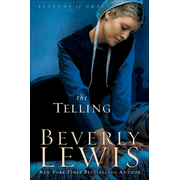 The Telling is the last in the Seasons of Grace series by Beverly Lewis about an Amish wife and mother who suddenly and inexplicably leaves her family. Over the last two books, the family has dealt with practical and emotional ramifications of her absence and discovered a couple of clues as to where she might be while the mother, Lettie, searches for a way to make peace with her past. Lettie’s daughter, Grace, receives permission from her father to go to the last known place Lettie has been to try to find her, and her Englisher friend, Heather, offers to drive her there.
 The folks at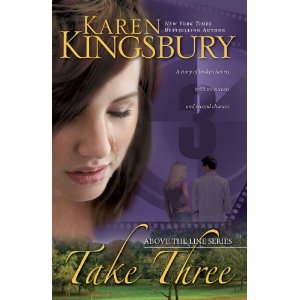
 The Hidden Flame