Book Review: To Kill a Mockingbird

To Kill a Mockingbird by Harper Lee is ostensibly about a white man defending a black man accused of raping a white girl in the Alabama of the 1930s. But it has so many more layers. It is about irrational and ludicrous attitudes of the pre-civil rights south. It is also about one decent man trying to do the right thing and about children discovering the strength of character of their father.

The story is told through the eyes of Scout, the young daughter of wise, warm, and gentle lawyer, Atticus Finch. The events of the story take place from her sixth to almost ninth year, and at first the book seems a memoir to carefree childhood as she and her older brother Jem and friend Dill fabricate new schemes to try to see elusive neighbor Boo Radley or to entice him out of his house. In fact, at first I was tempted to grow impatient with this part of the book, wondering when we were going to get to the “real” story, but I had faith that the author had a a purpose to this section. And, indeed, we are introduced to the family, neighbors, town and culture. Most of all, the character of Atticus is revealed through small conversations and interchanges.

Slowly awareness begins to dawn that trouble is brewing for Scout’s father. When she hears him being defamed, she defends his honor the only way she knows how, by fighting. Atticus tells Scout, “You might hear some ugly talk about it at school, but do one thing for me if you will: you just hold your head high and keep those fists down. No matter what anybody says to you, don’t let ’em get your goat. Try fighting with your head for a change…it’s a good one even if it does resist learning.” She later overhears a conversation he has with his brother about the case, the impossibility of it but the necessity of it, the fact his children are going to have a hard time of it, but he hopes they come through without bitterness and without the prejudices of the town, then he calls to her in her hideout and tells her to go on to bed. She says, “I never figured out how Atticus knew I was listening, and it was not until many years later that I realized he wanted me to hear every word he said.”Later he tells her, “It’s never an insult to be called what somebody thinks is a bad name. It just shows you how poor that person is, it doesn’t hurt you.”

So often we want to make things as easy for our children as possible, but I was impressed that Atticus wanted his children to face the coming trials with self-control, and in addition he wanted them to love and respect their friends and neighbors even when they were in the wrong. Fighting injustice, even in people’s hearts, doesn’t justify hating those people.

It was an interesting choice, and a wise one, for the author to tell the story through a child’s eyes, through the gradual unfolding of understanding and conscience. To a child’s mind, a teacher’s denouncing of Hitler’s treatment of the Jews doesn’t line up with her disparaging remarks about black people, and the point is made in all its truth and simplicity without being didactic.

It’s sad that the book has sometimes been banned for its portrayal of black people when part of the author’s intent was to defend black people and to speak against prejudice. Her portrayal is a sketch of how it was, not how it should be. I can see holding off the reading of it for younger people. The themes are definitely for a mature reader. There is a smattering of bad language, the bulk of which occurs when Scout is trying to convince her father she picked up such words at school in the hope that he won’t send her back. I wish that language was not there, both because I don’t want to hear it, and because it is not necessary, and because it keeps some from the book who would otherwise enjoy it. I did grow up in a non-Christian family and I do know some people speak that way in real life, but still I don’t want to put such things in my mind. Normally I avoid books with bad language, but I did want to explore this classic.

For such serious and awful subject themes, there is a lot of humor and warmth in the book. I enjoyed the author’s irony and subtlety. Before reading the book, I could not understand how the title related to the subject, but it becomes clear when Atticus explains to his children why it is a sin to kill a mockingbird.

I just watched the film for the first time last night. Gregory Peck is perfectly cast as Atticus. Of course, in the limited time frame of a film, many scenes were left out, and, as usual, reading the book is a much richer experience, but I did enjoy the film, too.

(This review will be linked to Semicolon‘s weekly book reviews on Saturday.)
Book Review: Children of the Storm

Some of you may remember the name of Georgi Vins. He was a Ukrainian pastor in prison for his “religious activities” in the Soviet Union several years ago. I was a BJU student praying for him in the Slavic Mission Prayer Band in the late 70s, and it was with great joy I heard years later that he had been exiled to the USA in exchange for Soviet spies.  Children of the Storm, written by his daughter, Natasha, and published by BJU Press, tells of her perspective during those years of persecution.

Natasha was about nine years old when persecution began in her school (though ridicule of Christianity had begun years before), and it seemed to increase as the years went by. Teachers would hold her up for ridicule in front of her classmates and blame her for her class’s not making it into certain competitions. She was assigned to write a report on a boy held up as a Soviet hero who turned his father in to the KGB for keeping back a little of his grain for his starving family. The other children began to taunt and threaten her or just avoid her. She was threatened with being removed from her home and “re-educated.” These things struck a chord with me when I first read this book because my youngest was at the age Natasha was when some of this was happening, and I just could not imagine him going through these things. Yet as it all struck me as so sad, the Lord reminded me that He marvelously kept her through that time. And she was not even saved yet!

In later years she had a teacher who had similar interests, befriended her, was kind to her, and then began to undermine her Christian beliefs. This time Natasha listened, thought some of what her teacher said made sense, and began to question. When her father came home from a prison camp and she had an opportunity, she talked with him. Imagine coming home from being in prison for your faith to have your own daughter question your faith. Yet he did not express anger or disappointment: he just answered her questions as best he could. Not long afterward Natasha was saved.

At this time and place one truly had to count the cost of following Christ. Natasha was denied finishing her studies in her field of choice because of her Christianity. Her father had had to go “underground” by this time and sent word that he would like her to join him in the printing ministry. She helped for many years in vital ways, and even got to see her father here and there. Once they were to meet with someone who at the last minute had to postpone meeting with them for a couple of hours. Natasha and her father used the time to walk around the city and talk. He thought it highly likely that he would be arrested again, and his talks with her that day helped her to make it through the time when he was indeed arrested. Imagine having to prepare your child not for the remote possibility but for the very real likelihood of your imprisonment…and to do so in a way that does not leave her mourning or sad or bitter or feeling sorry for you or herself, but leaves her strengthened and resting in the Lord.

Natasha’s grandmother was also arrested when she was in her sixties and thought she would die in prison, yet the Lord delivered her.

The book tells also of Natasha’s mother and siblings, of visits to her father and grandmother in prison, of the persecuted church, of struggling to maintain a Christian attitude toward persecutors, of their reaction when her father was suddenly and unexpectedly exiled, of the family’s preparing to join him, of their impressions of America: one of the younger siblings was astounded that everyone carried Bibles to church. Natasha wept upon seeing a Christian bookstore. They left Russia with sorrow because it was their homeland, but before too long they began to see how the Lord could use them in the USA.

The epilogue of the book tells of the Lord’s help through their adjustments to the US, and then opportunities for ministry by publishing newsletters and several books and establishing a mission. After 11 years of exile, in 1990, Pastor Vins was able to make several return trips to the former Soviet Union, visiting and preaching openly, discussing with church leaders how the mission in America could best help them. He passed away Jan. 11, 1998, leaving not only a continuing ministry, but a legacy of godly man and his family.

Book Review: It Happens Every Spring

Gary Chapman and Catherine Palmer coauthored It Happens Every Spring, the first of a series, in order to illustrate through fiction some of Chapman’s teachings about dealing with seasons of marriage. I don’t think I have read any of Chapman’s books, but I have enjoyed several of Palmer’s.

The group of ladies in different stages of marriage meet in the “Just As I Am” beauty salon (though I love the truth of the song by the same name, I thought it was kind of ironic for the name of a place where people go to change something about themselves) which also has a tea room where the ladies chat while waiting for their appointments.  Though we see glimpses into all of the marriages, the main focus of this book is on Brenda and Steve, a middle-aged couple whose children are grown and gone, one to the mission field and two to college. Brenda’s dreams of spending their empty nest years doing things together are dimmed when Steve finds a second wind in a new career and is gone from the house most of the time, even taking clients out to eat most evenings a week. They both know that they have problems, but they both withdraw and inwardly blame the other, until the resulting vulnerability of Brenda brings the marriage to a crisis.

I thought the subject was handled well and the changes in point of view illustrated how each other’s behavior looked and was interpreted by the other. The conflicts and feelings were realistically expressed and handled. The other ladies show a great range in ages and personalities as well as seasons in relationships. Even though in some places it seemed obvious that the plot was fitted around Chapman’s teaching points, overall if flowed well and the book was a good read. I am looking forward to the next in the series.

This book review is being linked to Semicolon’s Saturday Review of Books.

Booking Through Thursday: Gold Medal Reading

btt button

I haven’t done a Booking Through Thursday for a while, but today’s question intrigued me:

First:

  • Do you or have you ever read books about the Olympics? About sports in general?
  • Fictional ones? Or non-fiction? Or both?

And, Second:

  • Do you consider yourself a sports fan?
  • Because, of course, if you’re a rabid fan and read about sports constantly, there’s a logic there; if you hate sports and never read anything sports-related, that, too … but you don’t have to love sports to enjoy a good sports story.
  • (Or a good sports movie, for that matter. Feel free to expand this into a discussion about “Friday Night Lights” or “The Natural” or whatever…)

To answer the second question first, I am not a sports fan in general. In fact, I have had to wrestle through some negative feelings about sports. I don’t have an athletic bone in my body and P.E. was always my valley of humiliation in school. Even in friendly church games I didn’t miss the rolling of eyes, sighs of exasperation, or the nearly knocking over of people (myself and others) by the more competitive who were trying to get the shot they were sure we’d miss (and then they’d wonder why I decided to just sit on the sidelines and watch…) And in small schools, sometimes the athletes and their fans form the “in crowd” and everyone else is just “out.” And any involvement in sports these days just seems to take over a family’s time and life.

But I did come to see that there could be many benefits to sports. There are the obvious physical benefits, of course, and the learning to work together in team dynamics, learning to win or lose with grace, learning to stretch yourself in various ways. My oldest son’s very first baseball coach was a teddy bear of a man with an encouraging style who always brought home spiritual illustrations: I can remember his giving out team trophies and reminding them that, as special as those trophies were now, someday they would gather dust in the attic, and encouraging them to “Lay not up for yourselves treasures upon earth, where moth and rust doth corrupt, and where thieves break through and steal: But lay up for yourselves treasures in heaven, where neither moth nor rust doth corrupt, and where thieves do not break through nor steal: For where your treasure is, there will your heart be also” (Matthew 6:19-21).

And there is just something about the Olympics that draws me, particularly the gymnastics and swimming at the summer games and the ice skating at the winter ones.

And, as the question indicated, I can enjoy a good sports story even though I am not generally a sports fan. One of the first I specifically sought out was the story of Pete Maravich after seeing clips of an interview with him on 20/20 that were being replayed after his death. I had heard several celebrities who professed to some kind of faith but whose lives didn’t reflect it, and my first impression of Pete was that he seemed thoroughly genuine. I found his auto-biography, Heir to a Dream, published about a year before he died. It told how he was groomed to be a basketball player (with a basketball tucked into his childhood bed at night rather than a teddy bear), his rise to fame, the realization that sports and glory don’t satisfy, and how he came to know the Lord.

Another favorite sports-related book was the biography of Eric Liddell, the runner made famous in the film Chariots of Fire. He was a believer and refused to run on Sunday during the 1924 Olympics in Paris. Because of that he missed the race he trained for and he was put into another — and won the gold medal and broke a world record. Just before the race, a masseur has passed to him a piece of paper on which was written 1 Samuel 2:30, “Those who honor me I will honor.” Eric later became a missionary to China. The Japanese took over the mission where he was stationed during WWII and he and other missionaries as well as children from the China Inland Mission Chefoo school were held at the Weihsien Internment Camp, where he later died of an inoperable brain tumor. The particular biography I read was not very well written, so I won’t mention it here as there are others which I am sure are better, but another book which tells of Eric in the prison camp is called A Boy’s War by David Michell, who was a child in the Chefoo school during this internment.

Other favorites were Comeback and When You Can’t Come Back by Dave Dravecky, the baseball player whose career came back but then ended after a tumor in his shoulder. I had seen an interview with him on 20/20 as well and was inspired to read more.

When it comes to sports films, one of my favorites is The Rookie with David Quaid based on the true story of pitcher Jim Morris.

Children’s Classics: Chapter Books

Children's ClassicsThe 5 Minutes For Books site us starting a monthly focus on children’s classics, and this month the topic is chapter books for 8-12 year olds.

My oldest son was my only avid reader at this age, and one of his favorite series was Encyclopedia Brown, Boy Detective. He was analytical and enjoyed figuring things out, so detective stories fit the bill for him. As far as I can remember they were clean and wholesome: looking them up now I see they’s updated the covers: I hope they haven’t “updated” the stories, because that usually doesn’t bode well. He read them in the mid-90s: I am not familiar with any in the series after that.

He read some of the Hardy Boys when he got older, but didn’t seem to take to them as well.

The Little House series by Laura Ingalls Wilder is good for this age as well. We read one or two of them out loud together when we were homeschooling.

Unfortunately, I don’t remember as many of these books as I do the books for younger kids, probably because at this point he branched off into reading on his own rather than our reading together. For a while I tried to read everything he read, but he had a lot more time to read than I did then. 🙂

And though I was a voracious reader as a child, I don’t remember what specific books I read then, either.

But you can find others’ recommendations here.

And although the subject is classic books, and, though what is a classic is loosely defined, these books haven’t been around long enough to be called classics, I would highly recommend the Journey Forth division published by BJU Press. They are well written, wholesome, character-building books. Our absolute favorites were the Peabody Adventure series by Jeri Massi, and we also enjoyed A Father’s Promise by Donnalynn Hess, about a boy living through WWII, Medallion by Dawn Watkins, the Bracken Series by Jeri Massi, The Treasure of Pelican Cove by Milli Howard, and These Are My People by Milli Howard, about missionary Gladys Aylward.

Green Leaf in Drought

In 1950, Arthur and Wilda Mathews and their 13 month old baby, Lilah, traveled to Hwangyuan, China. China had fallen to Communism, and other missionaries were leaving, yet the Chinese church had invited them to come, with the approval of the Communist government. They felt this was a miraculously opened door God would have them go through.. Yet, when they arrived, they could sense that all was not well. The Christians pastors who met them were strained, and they discerned that between the time of their invitation and arrival, the Chinese learned that association with the white people would be a liability under Communism, not a asset. The Mathews thought perhaps then that, if they could not be a help to the church, they could endeavor to evangelize the unreached Mongols in the area and nearby. They had a few weeks in which to minister, but soon found that they were restricted in ways they could help. They endeavored to set up an inn with which to reach the Mongols, but Chinese troops took it over the day before it was to open. Arthur protested, but soon found it would have been wiser to have said nothing. In two days a policeman came to the mission compound to announce that no one there could do village work without permission, and the white people were forbidden everything: they could not have meetings outside the compound, they could not give out tracts or dispense medicine. They were restricted to the mission compound.

They finally decided that since they were more of a hindrance than a help, they would apply for exit visas. They thought, since the government did not want them, they would be allowed to leave quickly, and so gave away or sold dishes, curtains, etc., keeping just the bare minimum to function until they could leave. Arthur was summoned to the police station and asked to sign a statement that he was for world peace. He had heard of another missionary having to sign some document before leaving, so he signed without thinking much of it. The government official then asked what contribution Arthur was then willing to make toward world peace, outlining a plan in which Arthur would go to India and essentially be a Communist spy. Arthur realized that the Communist definition of world peace was a world dominated by communism, and of course could not consent.

A government official called Arthur in and promised his exit visas if he would do something for them, like write a report of five other missionaries. At first Arthur did write glowing reports of the missionaries in question, but someone told him he dare not turn that in: the Communists would change what he had written but keep his signature. So Arthur threw his report in the fire and told the official he could not be a Judas. The official then told him that he could have given him a pass, if he had cooperated, but now a charge had been laid against him which must be investigated, and “investigations take a long time.”

Thus began a two and a half year ordeal. Their provisions from their mission were frozen by the government, which made Arthur submit a report of what he would need, and then they doled out to him much less than what the report said he needed. Every victory they mentioned in a letter seemed to be immediately challenged by the enemy of their souls: once when they wrote what a blessing Lilah was, she then came down with scarlet fever, and they almost lost her. All of them had turns being ill. Eventually they were told that no one could speak to them, and they could only leave home to draw water from the creek and get food.

They wrestled with the “what-ifs” and the frustration of what they called “second causes,” finally coming to the conclusion that they had to trust that the Lord was in control and had them there for a reason, though it was hard to discern that reason when they were so restricted. Yet the Lord did use them even when they could not speak to the people. The few weeks they had had to minister before restrictions set in, people knew their hearts and saw their love. When the Mathews could no longer speak openly, the people saw them in tattered clothes, persecuted, attacked by illness without much medical aid, laughed at, jeered, humiliated, doing menial, degrading work just to survive, tantalized by the government offering release and then not giving it or doling out money that was theirs in the first place. They saw the Lord provide miraculously for them in many ways. Yet more than that, they saw them endure graciously and joyfully until, finally, the Mathews became the last CIM missionaries to leave China.

How the Lord provided for them and ministered through them in unexpected ways are some of the most exciting parts of the book Isobel Kuhn wrote of their story titled Green Leaf in Drought. She says,

But most amazing of all was their spiritual vigour. Whence came it? Not from themselves: no human being could go through such sufferings and come out so sweet and cheerful. As I was in a small prayer meeting… one prayed thus: ‘O Lord, keep their leaf green in times of drought!’ I knew in a moment that this was the answer. Jeremiah 17:8: “He shall be as a tree planted by the waters, and that spreadeth out her roots by the river, and shall not see when heat cometh, but her leaf shall be green; and shall not be careful in the year of drought, neither shall cease from yielding fruit.” That was it! There was an unseen Source of secret nourishment, which the Communists could not find and from which they could not cut them off…That is needed by all of us. Your drought may not be caused by Communism, but the cause of the drying up of life’s joys is incidental. When they dry up — is there, can we find, a secret Source of nourishment that the deadly drought cannot reach?…Is it possible for a Christian to put forth green leaves when all he enjoys in this life is drying up around him?

The answer, by God’s grace, is yes!

“Thy Calvary stills all our questions.”

The following is excerpted from Rose From Brier by Amy Carmichael, a book compiled from letters she wrote to those in the hospital on the Dohnavure compound after she herself had been bedridden and in pain for many years. This is from the chapter “Thy Calvary Stills All Our Questions.”

Yet listen now,
Oh, listen with the wondering olive trees,

And the white moon that looked between the leaves,
And gentle earth that shuddered as she felt
Great drops of blood. All torturing questions find

Answer beneath those old grey olive trees.

There, only there, we can take heart to hope

For all lost lambs – Aye, even for ravening wolves.

Oh, there are things done in the world today
Would root up faith, but for Gethsemane,

For Calvary interprets human life;
No path of pain but there we meet our Lord;

And all the strain, the terror and the strife
Die down like waves before his peaceful word,
And nowhere but beside the awful Cross,
And where the olives grow along the hill,
Can we accept the unexplained, the loss,
The crushing agony – and hold us still.

Children who love their Father know that when He says, “All things work together for good to them that love God,” He must mean the best good, though how that can be they do not know. This is a Why? of a different order from that of the little mosquito. It is immeasurable greater. It strikes at the root of things. Why is pain at all, and such pain? Why did God ask Satan the question which (apparently) suggested to the Evil One to deal so cruelly with an innocent man? Why do the innocent so often suffer? Such questions generally choose a time when we are in keen physical or mental suffering, and may (the questioner hopes will) forget our comfort. They seize us like fierce living things and claw at our very souls.

Between us and a sense of the pain of the world there is usually a gate, a kind of sluice gate. In our unsuffering hours it may be shut fast. Thank God, it is shut fast for tens of millions. But let severe pain come, and it is as though the torture in us touched a secret spring, and the door opens suddenly, and straight upon us pour the lava floods of the woe of a Creation that groans and travails together….

O Lord, why?

…I have read many answers, but none satisfy me. One often given is our Lord’s to St. Peter: “What I do thou knowest not now; but thou shalt know hereafter.” And yet it is not an answer. He is speaking there of something which He Himself is doing, He is not doing this. “Ought not this woman whom Satan hath bound be loosed?” That was always His attitude toward suffering, and so that blessed word is not an answer to this question, and was not meant to be.

There are many poetical answers; one of them satisfied me for a time:

Then answered God to the cry of His world:
“Shall I take away pain,
And with it the power of the soul to endure,
Made strong by the strain?
Shall I take away pity that knits heart to heart,
And sacrifice high?
Will you lose all your heroes that lift from the fire
White brows to the sky?
Shall I take away love, that redeems with a price,
And smiles at its loss?
Can you spare from your lives that would climb unto mine
The Christ on His cross?”

But, though, indeed, we know that pain nobly born strengthens the soul, knits hearts together, leads to unselfish sacrifice (and we could not spare from our lives the Christ of the Cross), yet, when the raw nerve in our own flesh is touched, we know, with a knowledge that penetrates to a place which these words cannot reach, that our question is not answered. It is only pushed farther back, for why should that be the way of strength, and why need hearts be knit together by such sharp knitting needles, and who would not willingly choose relief rather than the pity of the pitiful?

No, beautiful words do not satisfy the soul that is confined in the cell whose very substance is pain. Nor have they any light to shed upon the suffering of the innocent. They are only words. They are not an answer.

What, then, is the answer? I do not know. I believe that it is one of the secret things of the Lord, which will not be opened to us till we see Him who endured the Cross, see the scars in His hands and feet and side, see Him, our Beloved, face to face. I believe that in that revelation of love, which is far past our understanding now, we shall “understand even as all along we have been understood.”

And till then? What does a child do whose mother or father allows something to be done which it cannot understand? There is only one way of peace. It is the child’s way. The loving child trusts.

I believe that we who know our God, and have proved Him good past telling, will find rest there. The faith of the child rests on the character it knows. So may ours, so shall ours. Our Father does not explain, nor does He assure us as we long to be assured… But we know our Father. We know His character. Somehow, somewhere, the wrong must be put right; how we do not know, only we know that, because He is what He is, anything else is inconceivable. For the word sent to the man whose soul was among lions and who was soon to be done to death, unsuccored, though the Lord of Daniel was so near, is fathomless: “And blessed is he whosoever shall not be offended in me.”

There is only one place we can receive, not an answer to our questions, but peace — that place is Calvary. An hour at the foot of the Cross steadies the soul as nothing else can. “O Christ beloved, Thy Calvary stills all our questions.” Love that loves like that can be trusted about this.

Book Review: Peculiar Treasures

I had enjoyed all of Robin Jones Gunn‘s Sisterchicks series, so when I saw a new release from Robin titled Peculiar Treasures, I picked it up.

If I had realized it was a continuation of the Christy Miller series, aimed, I think, at teens and younger women, I probably wouldn’t have picked it up since I am not in that target audience. But I am glad I did. It was a good story, plus it was a reminder of the kinds of things women that age face.

The story opens with Katie’s maid of honor duties at Christy’s wedding. Katie has just finished her junior year of college, has summer school classes, a part-time job, an “almost boyfriend,” an almost-rival, an offer for a new job and level of responsibility, questions about her major and direction in life, hurts from the lack of involvement and care from her parents an incredibly busy senior year ahead, and adjustments to make as one friend has just gotten married, another friend and her husband are expecting their first child, and another friend is out of the country.

How did any of us ever survive that time of life?

But Katie survives and thrives, growing and learning along the way with grace and humor.

I think this book is not only good for women in this age group but also for any of us who have women in this age group in our lives. It’s a good reminder for those looking back and an encouragement for those looking ahead that God’s grace is sufficient for even the busiest seasons of life.

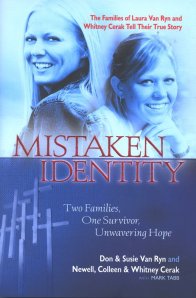
Book Review: Mistaken Identity

I had seen the book Mistaken Identity on bookshelves, but hadn’t really looked at it. I thought it was fiction, and I had read other fiction books with a mistaken identity plot line, and, though they were interesting reads, there was still an air of unreality about them. This couldn’t really happen, at least not to this extent where closest family members are mistaken.

But it can. And it did.

I caught an interview with the families on one of the evening news magazine programs, and my heart was knit to theirs as their faith shined through their tragedies. I then went out and bought the book as soon as possible.

Laura Van Ryn and Whitney Cerak were among several university students riding in a van back to school after working at a banquet when they were all involved in a horrific accident. Five people died, and Laura was taken to the hospital with several broken bones and a traumatic brain injury. Only it wasn’t Laura: it was Whitney. She was misidentified based on a nearby purse with Laura’s driver’s license in it. Though at first glance the girls look different enough to tell apart, when you look at individual features, they share an uncanny resemblance. Laura’s family had no reason to believe this girl was not Laura, and all the little inconsistencies could be explained by the accident (calling her sister by four different names, for instance, was consistent with the type of brain injury she had). Whitney’s family had chosen not to see her body; they wanted to remember her as she was.

It was not until five weeks later, when Whitney was able to communicate a little more clearly, that they realized she had been misidentified. The Ceraks were at first unbelieving but then overjoyed to find their daughter alive while the Van Ryns had to come to terms with their daughter’s death, and they all had to deal with unwelcome media attention during these events.

What touched my heart even more than their stories was the way their faith was evident at every turn. The Scriptures shared at various junctures perfectly upheld them, though of course it did not take away from the pain they experienced. Their grace in dealing each each other, the truck driver who caused the accident, and everyone along the way is evidence of God’s grace in their lives.

In Isobel Kuhn’s book, In the Arena, she quotes I Corinthians 4:9 (“For I think that God hath set forth us the apostles last, as it were appointed to death: for we are made a spectacle unto the world, and to angels, and to men”) and explains that Paul probably had in mind the Roman arena where Christians were thrown in to be devoured by wild animals. Our trials great and small can have multiple purposes, but, she says, one of them surely is to reveal God, His power, character, and grace as it is worked out in His people’s lives (not only to people, both believers and unbelievers, but to “principalities and powers in heavenly places“) . I often think of that when I hear news stories that have captivated the nation and then find out that the people involved are Christians.

One of the paragraphs that most grabbed me was a journal entry by Carly, Whitney’s sister, before she knew that Whitney was still alive:

Death is Satan’s greatest way to attack this world. Amazingly, then God takes what Satan uses to attack us and uses it to bring us together and reveal Himself the most. Through Satan’s greatest strength, God’s power still overcomes and is stronger.

I had never thought of death in that way, but it is so true that even at Satan’s strongest point, God overcame not only to resurrect those who have died but to provide immeasurable comfort to those who are left behind.

I highly recommend this book to you.

Book Review: The Count of Monte Cristo

I was only vaguely aware of the title of The Count of Monte Cristo by Alexandre Dumas until…I saw the Wishbone version on PBS years ago. (Don’t laugh — I benefited from a lot of culture on children’s programming. 🙂 ) But that put the intriguing story on my mental list of books I wanted to read some day. I have been working my way through some of the classics over the last few years and have just finished reading the Count.

In the past I had read The Three Musketeers and The Man In the Iron Mask by Dumas, and I have to say I was disappointed in them, in the darkness of the latter especially. The ending differs from any film version of it I have seen. So I approached the Count with a little bit of trepidation, but it is my favorite of these three Dumas books.

Originally published in the 1840s, the story is that of Edmund Dantes, a young sailor on the verge of being promoted to captain of his ship and of marrying his longtime sweetheart, Mercedes, in France during the era just before Napoleon’s Hundred Days. Edmund has enemies he is not wary enough of, a jealous shipmate and another who loves Mercedes, and these two plot together to implicate him as a Bonapartist traitor. The main piece of evidence comes into the hands of one prosecutor who could potentially be harmed by its contents, so to protect himself he destroys the evidence and lets Edmund go to prison.

Edmund, of course, despairs, tries to see the governor of the prison to plead his cause, and is rewarded with bring thrown further into the dungeon. He decides to starve himself until he hears the faint sounds of digging, and the possibility of interacting with another human being other than his jailer revives his desire to live. He and the other prisoner, Abbe Faria, do make contact, and the Abbe becomes something of a mentor to Edmund, teaching him all he knows both of education and society. Thus his fourteen years in prison actually serve to make him the man he later becomes.

When the Abbe dies, Edmund sees his chance to escape by placing the Abbe’s body in his cell and hiding himself in the Abbe’s burial shroud, which is tosses into the river. The Abbe had told him of and bequeathed to him a treasure buried on the island of Monte Cristo, which Edmund finds and the uses to perfect his new persona as the Count of Monte Cristo. He then sets himself to reward those who were loyal to him and stood by him and to exact vengeance on the three men who were instrumental in imprisoning him.

The story is quite intriguing as the reader understands the Count’s ultimate purpose but wonders exactly what he is up to as events unfold. Some characters who appear at first to be a distraction to the main plot are found actually to be integral to it. Though at first his designs fall into place perfectly, the Count eventually finds many unintended consequences of his actions and has to wrestle with his conscience before God to determine the best way to ultimately do the right thing by the various people affected by his actions.

Wikipedia describes this as an adventure novel, and it certainly is that, but it is full of intrigue as well. Though I would not call it a Christian book, there are many Christian principles throughout. Modern readers would find it a bit melodramatic in places — at least six times, various people threaten to kill themselves due to shame or loss. I don’t know if that was a popular mode of dealing with problems at the time or popular literary plot device. Though it does drag a bit in places overall the book is very well crafted.

The 1998 Tom Doherty associates version that I read says that it is complete and unabridged, which is what I wanted, but I was disappointed to find that it was not complete: in reading over the Wikipedia summary, I found several strands of the plot that were not in this book. Some of the situations now make more sense to me. I wouldn’t look at the Wikipedia listing, though, until after you have read the book as it does detail most of the plot and you’ll lose the fun of discovery if you read it.

I’ve seen reference to several film versions, and if you have read the book and seen any of the films I’d love to know which film version you think is best.