Lamb of God

But he was pierced for our transgressions;
    he was crushed for our iniquities;
upon him was the chastisement that brought us peace,
    and with his wounds we are healed.
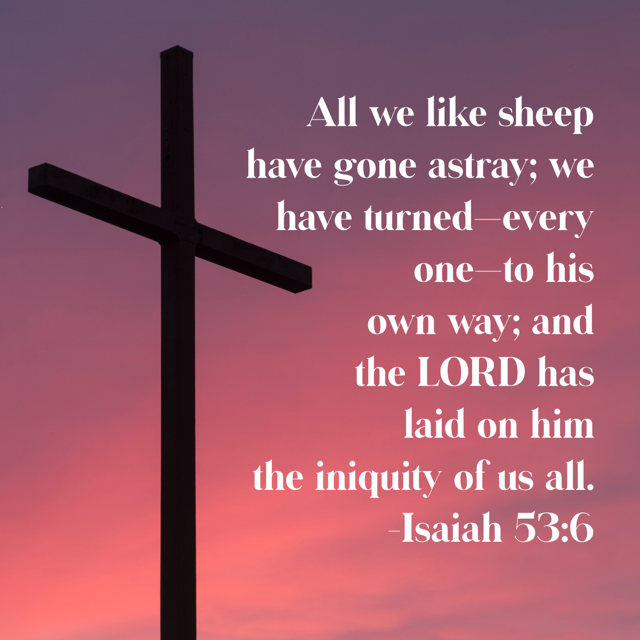
All we like sheep have gone astray;
    we have turned—every one—to his own way;
and the Lord has laid on him
    the iniquity of us all.

Isaiah 53:5-6

Years ago I heard a story about a guest preacher who was just getting ready to board his train after speaking at a church. A man hurried to him, saying he had been in the meeting and was anxious about his spiritual state. Could the preacher take time to talk to him?

The preacher’s train was the last of the night, and it was about to leave. All he had time to tell the man was to read Isaiah 53:6, and then to go in and the first “all” and come out at the last “all.”

The man was puzzled, but when he went home. he looked up Isaiah 53:6: “All we like sheep have gone astray; we have turned—every one—to his own way; and the Lord has laid on him the iniquity of us all.” As the man read the passage several times, understanding dawned. He was a sheep gone astray, stubbornly following his own way. But Jesus took his iniquity. If he trusted in Jesus, he would be saved and forgiven.

I don’t know if this is a true story, but the point it makes is true.

For Christ also suffered once for sins, the righteous for the unrighteous,
that he might bring us to God (1 Peter 3:18).

For God so loved the world, that he gave his only Son,
that whoever believes in him should not perish but have eternal life (John 3:16).

Stricken, smitten, and afflicted,
see him dying on the tree!
‘Tis the Christ, by man rejected;
yes, my soul, ’tis he, ’tis he.
‘Tis the long-expected Prophet,
David’s Son, yet David’s Lord;
proofs I see sufficient of it:
’tis the true and faithful Word.

Tell me, as you hear him groaning,
was there ever grief like his,
friends through fear his cause disowning,
foes insulting his distress?
Many hands were raised to wound him,
none would intervene to save;
but the deepest stroke that pierced him
was the stroke that justice gave.

If you think of sin but lightly
nor suppose the evil great,
here you see its nature rightly,
here its guilt may estimate.
Mark the sacrifice appointed,
see who bears the awful load;
’tis the Word, the Lord’s anointed,
Son of Man and Son of God.

Here we have a firm foundation,
here the refuge of the lost:
Christ, the Rock of our salvation,
is the name of which we boast;
Lamb of God, for sinners wounded,
sacrifice to cancel guilt!
None shall ever be confounded
who on him their hope have built.

Thomas Kelly, 1804

Isaiah 53:6

(I often link up with some of these bloggers.)

Dormant Souls

One of my least favorite parts of winter is the barrenness of the landscape. Besides a few fir trees, nothing is growing and everything looks dead and gray.

The plants and trees aren’t dead, of course. They’re just dormant, suspending their usual growth process for their protection. Life is still inside the plants and their roots, ready to spring forth when conditions are ripe again.

I think our souls sometimes go through periods of dormancy, too. We all have ups and downs, times when we “feel” more fervent and spiritual than others. We know we don’t rely on feelings, but they can sure make things easier or harder.

Grief can look like dormancy. Just like a broken leg needs time to heal, a broken heart does as well. Much of a grieving person’s energy goes towards healing. They’re still very much alive, spiritually and otherwise. Some say that their deepest periods of growth have come during their most sorrowful times. But they may not look or act like their normal selves and may not appear to be as fruitful as they usually are.

King David’s life seems to me to display dormancy after his great sin with Bathsheba and his unthinkable plot to have her husband killed. The first part of his life had gone well as he followed God closely. He wasn’t perfect, but he was “a man after God’s own heart.”

But after these sins, David tried to cover his tracks for several months. Then God’s prophet confronted him, and David broke down. He confessed his sin and repented.

Yet even forgiven sin has consequences. David’s household was in turmoil for years afterward. One son raped his half-sister. Another son killed the first and tried to take over David’s kingdom.

And David said nothing to rebuke his sons. Did he feel he had no right in light of his failures? Did he feel the events in his family were part of his punishment? It would have been better to be honest with them about his sin, to warn them about the dangers of temptation and the necessity to nip it in the bud, to point out that he didn’t “get away with it,” as perhaps they hoped to do, but he was under God’s chastening hand.

In fact, David is pretty quiet from the time of his sin until his return to the kingdom after Absalom’s rebellion. But he doesn’t seem fully himself again until 1 Kings, as he helps Solomon get ready to build the temple.

In today’s cancel culture, David’s career would be over and his esteem among his people would have been lost.

But God wasn’t done with David. David’s spiritual life wasn’t dead: just read Psalm 51, written after his repentance. According to this site, Psalms 32, 86, and 122 were also written after this time.

John Newton captured this idea of reviving in spring in a couple of poems. One, written in April of 1776, begins “Pleasing spring is here again” and goes on to capture evidences of spring. The next few stanzas say:

What a change has taken place!
Emblem of the spring of grace;
How the soul, in winter, mourns
Till the Lord, the Sun, returns;
Till the Spirit’s gentle rain,
Bids the heart revive again;
Then the stone is turned to flesh,
And each grace springs forth afresh.

Lord, afford a spring to me!
Let me feel like what I see;
Ah! my winter has been long,
Chilled my hopes, and stopped my song!
Winter threatened to destroy
Faith and love, and every joy;
If thy life was in the root,
Still I could not yield thee fruit.

Speak, and by thy gracious voice
Make my drooping soul rejoice;
O beloved Saviour, haste,
Tell me all the storms are past:
On thy garden deign to smile,
Raise the plants, enrich the soil;
Soon thy presence will restore
Life to what seemed dead before.

In the last stanza, Newton longs for his eternal home where winter will be no more.

In “Waiting for Spring,” written a couple of years later in March of 1778, Newton revisits this idea. In the first three stanzas, he talks about the change of seasons as part of God’s decree. Then he writes:

Such changes are for us decreed;
Believers have their winters too;
But spring shall certainly succeed,
And all their former life renew.

Winter and spring have each their use,
And each, in turn, his people know;
One kills the weeds their hearts produce,
The other makes their graces grow.

Though like dead trees awhile they seem,
Yet having life within their root,
The welcome spring’s reviving beam
Draws forth their blossoms, leaves, and fruit.

Then he prays in the last stanza:

Dear Lord, afford our souls a spring,
Thou know’st our winter has been long;
Shine forth, and warm our hearts to sing,
And thy rich grace shall be our song.

It’s one thing when circumstances or sorrows cause us to draw in and heal, or God’s chastening weighs us down for a while. It’s another thing if we’re dormant because we’ve neglected God’s means of growth.

Like plants, we need light.

There are many who say, “Who will show us some good? Lift up the light of your face upon us, O LORD!” (Psalm 4:6)

The Lord bless you and keep you;
the Lord make his face to shine upon you and be gracious to you;
the Lord lift up his countenance upon you and give you peace (Numbers 6:24-26).

The unfolding of your words gives light; it imparts understanding to the simple. (Psalm 119:130).

Again Jesus spoke to them, saying, “I am the light of the world. Whoever follows me will not walk in darkness, but will have the light of life” (John 8:12).

We need water.

Christ loved the church and gave himself up for her, that he might sanctify her, having cleansed her by the washing of water with the word (Ephesians 5:25-26).

Jesus stood up and cried out, “If anyone thirsts, let him come to me and drink. (John 7:37).

And we need nourishment.

I have treasured the words of his mouth more than my portion of food (Job 23:12).

Your words were found, and I ate them, and your words became to me a joy and the delight of my heart, for I am called by your name, O LORD, God of hosts. (Jeremiah 15:16).

Jesus said to them, “I am the bread of life; whoever comes to me shall not hunger, and whoever believes in me shall never thirst.” (John 6:35).

Whether your soul is feeling sluggish and sleepy or in full bloom, or in-between, will you turn to His light and let it warm you? Will you take in His water and let it soak down deep in your soul? Will you partake of His nourishment to strengthen your roots and bring forth fruit in your life?

After two days he will revive us; on the third day he will raise us up, that we may live before him.

Let us know; let us press on to know the Lord; his going out is sure as the dawn; he will come to us as the showers, as the spring rains that water the earth (Hosea 6:2-3).

(I often link up with some of these bloggers.)

From a Weight of Care to a Weight of Glory.

In the midst of Job’s suffering, he remarked, “Man who is born of a woman is few of days and full of trouble” (Job 14:1).

We might sometimes lament, “Why does life have to be so hard?”

God didn’t originally create life to be so troublesome in Eden. But sin affected everything, from the people God created to the earth they lived in (Genesis 3). Humans had work to do before sin entered the world (Genesis 2:15). But it would have been something like working at your favorite hobby with nothing going wrong. However, after sin entered the world, part of God’s curse was that thorns and thistles would spring up and labor would cost sweat and pain (Genesis 3:16-19).

Besides daily work becoming hard, personal relationships would suffer because now everyone would have a sin nature. Misunderstandings, anger, selfishness, pride, and more would war in hearts and against others. The very first person born to Adam and Eve murdered his brother.

And human history went downhill from there.

Each of us has experienced the fallenness of the world.

From early childhood we fall and get scraped up, hear taunts, teasing, and put-downs from other children, get into trouble when we do wrong, feel misunderstood and mistreated.

As teenagers we either strive to get into the popular crowd and then not lose our place, or we lament that we’ll always be on the outside. Then there’s acne, puberty, hormones, questions about the future.

As adults we struggle to make a living against increasing prices. Workplace feuds and misunderstandings crowd out enjoyment in our jobs. Someone else gets the promotion we were due. Someone takes the credit for our idea.

We struggle against our own sin nature and lament the continual pull of selfishness.

As we get older, aches and pains take over our bodies. Sight dims, and we can’t do the things we used to.

Along the way, friends and loved ones get sick and die. Innocent little children get cancer. Car crashes maim or kill loved ones. Murders and wars increase.

We try to share our faith, but people mostly don’t want to hear it. Some will actively persecute us. There are countries where sharing Christianity and handing out Bibles is a crime and conversion is punishable by death.

We have needs. Our families have needs. Friends have needs. Our country has needs and opposite opinions about how to deal with them. Our church has needs. The world at large has needs. Orphans, widows, victims, medical research, so many needs that are more than we can even begin to manage.

When we feel the weight of a fallen world, we’re tempted to just crawl into a corner and wait for it to be over.

But thinking of that weight, Paul says, “ For I consider that the sufferings of this present time are not worth comparing with the glory that is to be revealed to us” (Romans 8:18). In another place he says:

For this light momentary affliction is preparing for us an eternal weight of glory beyond all comparison, as we look not to the things that are seen but to the things that are unseen. For the things that are seen are transient, but the things that are unseen are eternal (2 Corinthians 4:17-18).

Once when we came across this passage in a ladies’ Bible study, one of the women had been going through a terrible physical battle. She was a little hurt and angry that the Bible seemed to brush off her heavy affliction as light.

But Paul isn’t minimizing the affliction. He’s saying our glory will be greater than our affliction. Sin, tears, pain, mourning, loss, problems, as weighty as they are, will seem lightweight and short-lived compared to what we’ll experience when Jesus comes for His own. Speaking of that time, Paul tells the Thessalonians, “Therefore encourage [some translations say ‘comfort’] one another with these words” (1 Thessalonians 4:8).

‘Well,” we might be thinking, “that will be great when we get to heaven. But is there no hope and help til then?”

There is.

Just before that section in 2 Corinthians, Paul says, “So we do not lose heart. Though our outer self is wasting away, our inner self is being renewed day by day” (4:16).

God gives grace and strength to meet every trial. “God is our refuge and strength, a very present help in trouble” (Psalm 46:1).

God invites us to cast our care on Him (1 Peter 5:7).

God gives strength in our weakness. “But he said to me, ‘My grace is sufficient for you, for my power is made perfect in weakness.’ Therefore I will boast all the more gladly of my weaknesses, so that the power of Christ may rest upon me. For the sake of Christ, then, I am content with weaknesses, insults, hardships, persecutions, and calamities. For when I am weak, then I am strong” (2 Corinthians 12:9-10).

Jesus sympathizes with our weakness and promises grace to help in time of need. “Since then we have a great high priest who has passed through the heavens, Jesus, the Son of God, let us hold fast our confession. For we do not have a high priest who is unable to sympathize with our weaknesses, but one who in every respect has been tempted as we are, yet without sin. Let us then with confidence draw near to the throne of grace, that we may receive mercy and find grace to help in time of need” (Hebrews 4:14-16).

Okay, it’s a relief to know we have God’s help to get through this life. But what about joy? Do we just bear with life til it’s over?

No, God gives joy as well. He gives physical blessings: “You cause the grass to grow for the livestock and plants for man to cultivate, that he may bring forth food from the earth and wine to gladden the heart of man, oil to make his face shine and bread to strengthen man’s heart” (Psalm 104:14-15).

He gives comfort in sorrow. “Weeping may tarry for the night, but joy comes with the morning” (Psalm 30:5b).

Joy is one aspect of the fruit of God’s Holy Spirit in believers (Galatians 5:22-23).

He gives us the joy of His presence: “You make known to me the path of life; in your presence there is fullness of joy; at your right hand are pleasures forevermore” (Psalm 16:11). “Then I will go to the altar of God, to God my exceeding joy, and I will praise you with the lyre, O God, my God” (Psalm 43:4).

When the world is too much, we can’t hide our head in the sand. But neither can we solve the world’s problems. We’re not meant to. We only need to walk in fellowship with “God our exceeding joy,” take everything to Him in prayer, and do what He calls us to within our sphere of influence.

As the hymn says:

Pardon for sin and a peace that endureth,
Thine own dear presence to cheer and to guide,
Strength for today and bright hope for tomorrow,
Blessings all mine with ten thousand beside.

Great is Thy faithfulness!
Morning by morning new mercies I see;
All I have needed Thy hand hath provided.
Great is Thy faithfulness, Lord, unto me.

From “Great Is Thy Faithfulness” by Thomas Obediah Chisholm

(I often link up with some of these bloggers.)

Comforted by the Ways God Uses Us

We took care of my mother-in-law in our home for five years. Many of you were reading here at that time and offered much prayer, love, and encouragement.

I had a sudden realization about that period of our lives this week. It was such a jolt, and then a comfort, that I thought I’d share it with you.

We had moved my mother-in-law, Colleen, from Idaho, where she lived for 30+ years, to SC, where we then lived, to an assisted living facility. She had to move again when we moved to TN. Then she had to be moved twice when her physical state declined to the point that the facilities could no longer care for her. She ended up in a nursing home, where she declined rapidly. She was 90 lbs. and in a constant fog. We felt she was being neglected, so we brought her home, thinking we were bringing her home to die. But with one-on-one care, she gained weight and became clearer and lived for another five years. I wrote about our experiences, things I learned, challenges we faced, etc., and filed them under Adventures in Eldercare.

My biggest regret from our caregiving experience was that I chafed under most of it. I wanted her to be well cared-for. But I didn’t want to be the one to do it. Of all the things I wanted to be when I grew up, a nurse was never one of them.

Plus, our “nest” was emptying, and though I missed our kids, I had big plans for my free schedule. I was going to write a book and all sorts of things (in the three years since she passed, I still haven’t finished the book, so obviously caregiving wasn’t the main roadblock).

I had to remind myself many times over those years that if caregiving was God’s will for me at that time, that He would give grace to do it; that He doesn’t always place us in positions that use our strengths, but often He puts us where we feel totally weak, that we might find our strength in Him; that caring for one person, even a mostly unresponsive person, in a back room is as much a ministry as preaching to thousands or writing a best-selling book or whatever.

But I can’t say I ever “got” those lessons in a way that stayed with me. I had to repeat them often, sometimes daily.

For some reason, one morning this week my mind wandered to some of the caregivers both in facilities and in our home who . . . let’s say, did not do a good job. I could tell you stories . . . At first I put several of those stories here, but then decided to delete them.

You think, when you’ve researched facilities and placed a loved one in one, that they’ll get the best care possible, that everyone knows what they are doing. But that’s not the case. There are a lot of kind, caring caregivers who do their best. Our dear Jessica, who was Colleen’s main caregiver for 3 1/2 or so years, was a treasure worth her weight in gold. But there were others who were just punching the clock. There were some about whom we wondered what ever brought them into health care in the first place. Did they think it would be an easy job to prepare for or to do? Did they used to be good but then got burned out?

Some of them did a good job as far as the physical things they were responsible for. But they seemed to forget that they were dealing with a person, especially when that person didn’t speak. They’d talk over her to each other instead of to her.

So this particular morning, as my thoughts ran through some of the caregiving situations we encountered, I began to realize that maybe what Colleen had needed most from me was not my nursing care. Maybe what she needed most from me was someone to watch out for her, to advocate for her, to insist that she be cared for in not only the best physical ways, but the most humane ways.

It’s not that we griped to caregiver managers or corrected all the time. We didn’t want to come across as know-it-alls or can’t-ever-be-pleased nitpicky types. We didn’t bring up every single little thing we felt was wrong. We only chose the most vital issues to discuss with the staff at her facilities or at the home health care agency. Still, there seemed to be way too much that we needed to speak to them about.

Years ago, before there were so many personality tests and ways of classifying them as they are now, the main way of sorting personalities was the four spiritual temperaments. I remember poring over Beverly LaHaye’s The Spirit-Controlled Woman. Though no personality classification is perfect, this one made sense to me and seemed a lot simpler than many of the personality classifications today.

My personality, according to that system, was melancholic—an unfortunate name since it sounds like I’m depressed or sad or morose, which I am not. One aspect of melancholics is perfectionism, which, like most personality traits, can be good or bad. Perfectionism can drive one to do the best possible job rather than leaving things done half-hardheartedly. You’d want your brain surgeon to be a perfectionist. But perfectionism can also lead to hyper-criticism and misery when you and everyone else can’t live up to your ideals. This trait “clicked” for me when a guest preacher in our church several years ago, Jim Binney, said that melancholics see things that are wrong and want to set them right.

I felt like much of the care I provided for my mother-in-law felt outside my natural gifts. As I mentioned before, that situation cast me on the Lord like nothing else.

But this particular morning, I realized God had used me in the ways He made me by helping me see the things that were wrong in her care, helping to right them, and eventually bringing her home. It’s not just that this area was one thing I did right in the midst of so much I felt I did wrong or struggled with. But I just felt particularly known and loved and useful in God’s hands. I hope that makes sense.

Whether God uses us as we feel gifted or totally outside our gifts and personality, our sufficiency is from Him.

(I often link up with some of these bloggers.)
How Do We Adorn the Doctrine of God?

Have you ever come across a passage of Scripture that you’ve read for years, even for decades, and then found yourself questioning what a word or phrase meant that you’ve just glossed over before?

I had that experience recently with the last part of Titus 2:10, which says, “in everything they may adorn the doctrine of God our Savior.”

I puzzled over that word “adorn.” My initial thoughts ran something like this: we think of adornments as something we add on, like jewelry or hair ornaments, to make us prettier or more attractive.

But the gospel of God is perfect as it is—we can’t add anything to it to make it better. So what does the Bible mean that we’re to adorn it?

Does “adorning the doctrine of God our Savior” mean making a beautifully stitched or lettered plaque with the gospel message on it? There’s nothing wrong with that, but Paul has a deeper meaning in mind.

I looked up the Greek word for adorn here. In the KJV, it’s translated as “adorn, trim, or garnish.” Other translations say “make attractive.” According to BibleStudyTools.com, the Greek word can mean:

  1. to put in order, arrange, make ready, prepare
  2. to ornament, adore
  3. metaph. to embellish with honour, gain honour

That didn’t help a whole lot. So I looked up the definition of the English word adorn, since translators felt that was a good rendering of the Greek word. According to Dictionary.com, the first definition is the one we usually think of first: “to decorate or add beauty to, as by ornaments.” The second definition shed a little more light: “to make more pleasing, attractive, impressive, etc.; enhance.”

I went back to Titus to look at the verse in context. Titus is a letter from the apostle Paul to one of his helpers, Titus, who was then pastoring in Crete. In chapter 1, Paul stresses the importance of ordaining elders who are men of godly character. He laments those who are “insubordinate, empty talkers and deceivers” (1:10). “They must be silenced, since they are upsetting whole families by teaching for shameful gain what they ought not to teach. . . . Therefore rebuke them sharply, that they may be sound in the faith” (1:11, 13).

By contrast, Titus was to teach “what accords with sound doctrine” (2:1). Paul then goes into instructions for older men and women, younger women and men, so that their works and character lines up with sound doctrine.

Then Paul addresses bondservants. That term makes us bristle these days. I’ve written before about slavery in the Bible, so I won’t repeat all of that here. In an example of God’s timing, I was pondering this passage Wednesday night, and on Thursday morning while making breakfast I heard part of Stephen Davey’s message on Surprising Submission from 1 Peter 2. He explains that slavery in Biblical times was not like slavery as we think of it from the 1800s and before in this country. The Old Testament condemns the type of slavery we usually think of: Deuteronomy 24:7: “If a man is found stealing one of his brothers of the people of Israel, and if he treats him as a slave or sells him, then that thief shall die. So you shall purge the evil from your midst.” So does the New Testament: 1 Timothy 1:8-11 lists enslavers (in the ESV; “menstealers” in the KJV) among those not in accord with sound doctrine. In OT times, often slavery was a way of working off a debt, like an indentured servant. In Rome, Dr. Davey explained, most of the people who weren’t Roman citizens were considered servants. These would be the everyday “worker bees” who made society run smoothly. A relatively small number of Christians was not going to be able to overthrow the Roman economy. God’s instruction was to transform people from the inside out with the truth that everyone is created in the image of God, and in the kingdom of heaven, these distinctions didn’t make any difference.

So, Paul’s instruction to bondservants here doesn’t mean he was condoning the system. His instructions for everyone had to do with how to live within their circumstances in a way that honored and glorified God.

That said, in context this passage says:

Bondservants are to be submissive to their own masters in everything; they are to be well-pleasing, not argumentative, not pilfering, but showing all good faith, so that in everything they may adorn the doctrine of God our Savior.

For the grace of God has appeared, bringing salvation for all people, training us to renounce ungodliness and worldly passions, and to live self-controlled, upright, and godly lives in the present age, waiting for our blessed hope, the appearing of the glory of our great God and Savior Jesus Christ, who gave himself for us to redeem us from all lawlessness and to purify for himself a people for his own possession who are zealous for good works. (Titus 2:9-14).

Even though the word “adorn” is used towards servants, I think it applies to everyone in this passage (and within the church), because Paul’s theme to each group is the same: live lives that are in keeping with God’s truth.

So, then, how do we adorn the doctrine of God our Savior? The whole rest of the letter to Titus tells us how. Here are a few ways:

First of all, we have to believe God’s truth. “And without faith it is impossible to please him, for whoever would draw near to God must believe that he exists and that he rewards those who seek him” (Hebrews 11:6).

Then Philippians 2:12 says, “work out your own salvation with fear and trembling.” That doesn’t mean work for your salvation: salvation is a free gift of God’s grace. Later in Titus Paul writes:

But when the goodness and loving kindness of God our Savior appeared, he saved us, not because of works done by us in righteousness, but according to his own mercy, by the washing of regeneration and renewal of the Holy Spirit, whom he poured out on us richly through Jesus Christ our Savior, so that being justified by his grace we might become heirs according to the hope of eternal life (Titus 3:4-7).

But we work out our salvation. One of our former pastors used to say it’s like working out a math problem to its logical conclusion. We take those high and lofty ideals and work them out into our everyday lives. God is a God of truth, so we live by truth and tell the truth. God is a God of love, so we show love to Him and others.

The word “self-controlled” comes up a lot in this book, and self-control is one facet of the fruit of the Spirit in Galatians 5:16-26. We don’t blast people with angry words when we feel like it. We don’t steal other people’s goods or steal from our employers by not giving them a good day’s work.

We obey the authorities God has placed over us. That’s not always fun, especially when their faults and foibles are obvious. But we work as unto God.

Paul mentions being “well-pleasing.” Does that mean we’re obsequious sycophants? No, but we make a deliberate effort to get along with others. 

Not argumentative,” Paul says. Later in Titus, Paul writes, “But avoid foolish controversies, genealogies, dissensions, and quarrels about the law, for they are unprofitable and worthless. As for a person who stirs up division, after warning him once and then twice, have nothing more to do with him, knowing that such a person is warped and sinful; he is self-condemned” (Titus 3:9-11).  Elsewhere he writes, “Do all things without grumbling or disputing, that you may be blameless and innocent, children of God without blemish in the midst of a crooked and twisted generation, among whom you shine as lights in the world” (Philippians 2:14-15). Ouch. Probably half of social media involves grumbling and disputing. Yet even there we should “shine as lights in the world.”

After exploring the passage in context, I looked up other sources on this verse. Spurgeon has a good sermon on this passage here. I liked what Warren Wiersbe said in his Be Faithful commentary on 1 and 2 Timothy and Titus:

This will “embellish with honor” the Word of God (WUEST). When we serve faithfully, we “beautify the Bible” and make the Christian message attractive to unbelievers. When Paul addressed the slaves in Timothy’s church (1 Tim. 6: 1), he used a negative motive: “that the name of God and his doctrine be not blasphemed.” But the positive motive, to make God’s message attractive, and the negative motive, to keep God’s teaching from being slandered, ought to control our lives.”

I don’t think making the gospel attractive to unbelievers means telling them all their problems will be solved when they believe. That would be a lie. Every believer in the Bible had problems. But the gospel is attractive because in Christ we find forgiveness, peace, righteousness, help, guidance, and so much more.

When I started this study, I leaned toward a definition of adornment as making attractive or honoring. While I think those do apply, I can also see the “put in order, arrange, make ready” aspect of the Greek word for “adorn.” We’re to order and arrange our lives to reflect accurately our Savior and the gospel.

Normally my blog posts aren’t so Bible-study-ish. I’ve thought about trying to rework this into something that might look a little more inspirational to read. But I decided to leave it as is. I don’t find such study dry. Each step opened my understanding a bit more. Now I can not only approach this word with more depth next time I read this passage, but I have an overarching principle to keep in mind as I go about daily life: are my thoughts and actions adorning the gospel or marring it?

How about you? Has a word or phrase or concept in your Bible reading ever sent you off on a study? Had you encountered before what it means to adorn the gospel?

(I often link up with some of these bloggers.)

The Dangers of Success

There are scores of books, articles, blog posts, podcasts, and sermons about dealing with trials and suffering. And that’s good, because we need them.

But I don’t know that I have ever seen any material about the dangers of success.

What danger can there be in success? Especially success that we’ve prayed and trusted God for?

One potential danger of success is forgetting who gave us that success. God had warned Israel about forgetting Him once they got settled in their land.

Take care lest you forget the Lord your God by not keeping his commandments and his rules and his statutes, which I command you today, lest, when you have eaten and are full and have built good houses and live in them, and when your herds and flocks multiply and your silver and gold is multiplied and all that you have is multiplied, then your heart be lifted up, and you forget the Lord your God, who brought you out of the land of Egypt, out of the house of slavery, who led you through the great and terrifying wilderness, with its fiery serpents and scorpions and thirsty ground where there was no water, who brought you water out of the flinty rock, who fed you in the wilderness with manna that your fathers did not know, that he might humble you and test you, to do you good in the end. Beware lest you say in your heart, ‘My power and the might of my hand have gotten me this wealth.’ You shall remember the Lord your God, for it is he who gives you power to get wealth, that he may confirm his covenant that he swore to your fathers, as it is this day. And if you forget the Lord your God and go after other gods and serve them and worship them, I solemnly warn you today that you shall surely perish. Like the nations that the Lord makes to perish before you, so shall you perish, because you would not obey the voice of the Lord your God (Deuteronomy 8:11-20).

The New Testament echoes this truth: “What do you have that you did not receive? If then you received it, why do you boast as if you did not receive it?” (1 Corinthians 4:7).

Another danger of success is pride. Perhaps forgetfulness leads to pride. Uzziah started out as a good king of Judah who “did what was right in the eyes of the Lord, according to all that his father Amaziah had done. He set himself to seek God in the days of Zechariah, who instructed him in the fear of God, and as long as he sought the Lord, God made him prosper” (2 Chronicles 26:4-5). The Bible goes on to tell of Uzziah’s accomplishments, feats, and even inventions. Then we read this sobering statement: “He was marvelously helped, till he was strong. But when he was strong, he grew proud, to his destruction” (2 Chronicles 26:15-16).

Saul, Israel’s first king, fell into the same pattern. When he was chosen king, he hid among the baggage and people had to look for him (1 Samuel 10:17-24). He saw himself as “little in his own eyes” (1 Samuel 15:17). But then he became too concerned with how the people regarded him.

“One’s pride will bring him low, but he who is lowly in spirit will obtain honor” (Proverbs 29:23).

Both of these kings went from pride to presumption. They stepped into duties God had given priests, not kings. God then rejected Saul as king (1 Samuel 13:8-15) and turned Uzziah into a leper (2 Chronicles 26:16-23).

Presumption led to further disobedience (1 Samuel 15). Saul’s decline is one of the saddest stories in history. He became jealous, irrational, untruthful, and even murderous. “Pride goes before destruction, and a haughty spirit before a fall” (Proverbs 16:18).

It’s an odd thing, isn’t it, to know God’s help, to know success was only available because God provided it, and then to be proud because of it–proud not of God, but of self, as if we did anything all by ourselves. Yet it happens all too easily.

Rosalind Goforth, one of my heroes for many reasons, writes in Climbing: Memories of a Missionary’s Wife of marvelous answers to prayer. Often she was supposed to speak to a group of women, yet her schedule was so full with caring for her children, homemaking, and regular ministry work that she couldn’t make time to study and prepare as she would like to. She writes of jotting down notes or studying her Bible while nursing a baby, or crying out to God in prayer before a speaking engagement and then being given a perfect outline of a message.

Sadly and humbly, I must confess that many, many times when I cried out to the Lord for power in speaking and evident power was given, I had not left the platform before the thought would come, “I have done well today.” Then would come the cry for forgiveness (pp 112-113).

I can confess to similar experiences.

How can we counter that tendency to exalt self instead of God?

My dear mother-in-law once said she had such a tendency toward spiritual pride that she withdrew from any kind of ministry in front of people. I understand her heart. But if we all did that, how would any of us minister to anyone else? We can’t do everything anonymously, though there are times to meet people’s needs “behind the scenes.” We’re not supposed to hide our lights under bushels.

Here are a few actions that help me:

Remember. Remember the ways God has led us along, His “Ebenezers” to us. Remember His Word; be in it regularly to keep our minds saturated with God’s perspective.. Remind ourselves that without Him we can do nothing  (John 15:4-5), that His strength is made perfect in our weakness (1 Corinthians 12:8-10).

Humble ourselves. “Humble yourselves before the Lord, and he will exalt you” (James 4:10). “God opposes the proud but gives grace to the humble” (James 4:6). Humbling is not the same thing as belittling. “There’s no need to shrink yourself down or deflate your gifts. That’s not humility any more than inflating your importance. Take an honest look at who you are and what you’ve been given” (Influence: Building a Platform That Elevates Jesus (Not Me) by Kate Motaung and Shannon Popkin). Martin Luther said, “God created the world out of nothing, and so long as we are nothing, He can make something out of us” (quoted in Influence, p. 65).

Acknowledge our dependence on God. I try to pray most mornings that God would fill me with the fruit of His Spirit as a way to remind myself I can’t manufacture a right spirit on my own.

Focus on ministering as unto the Lord. “Whatever you do, work heartily, as for the Lord and not for men, knowing that from the Lord you will receive the inheritance as your reward. You are serving the Lord Christ” (Colossians 3:23-24).

Focus on others. Philippians 2:3-4 says, “Do nothing out of selfish ambition or empty pride [I love the KJV word vainglory here], but in humility consider others more important than yourselves. Let each of you look not only to his own interests, but also to the interests of others.” Jesus said that whoever would be great must serve others, and even He did not come to be ministered to, but to minister (Mark 10:42-45).

Be grateful. Thanking God for His provision and enabling helps remind us that everything came from Him.

Look to Jesus: We become more like Him by beholding Him.

Have this mind among yourselves, which is yours in Christ Jesus, who, though he was in the form of God, did not count equality with God a thing to be grasped, but emptied himself, by taking the form of a servant, being born in the likeness of men. And being found in human form, he humbled himself by becoming obedient to the point of death, even death on a cross. Therefore God has highly exalted him and bestowed on him the name that is above every name, so that at the name of Jesus every knee should bow, in heaven and on earth and under the earth, and every tongue confess that Jesus Christ is Lord, to the glory of God the Father (Philippians 2:5-11).

Kevin DeYoung and Trevin Wax discuss a modern-day dilemma along these lines: book publishers expect authors to promote their own books, to build a “platform.” Yet how can one do that without being prideful? I appreciate their thoughts here, especially this from Trevin:

But I’m still conflicted about blogging about my book. Maybe that’s where I need to be. Maybe this is the Spirit’s method of rooting out sinful motivations and spurring me on to holiness.

Maybe God is saying, “I don’t ever want you to be totally comfortable with self-promotion, even if some promotion will result in more people buying a book that is beneficial to the church.” Maybe God wants me to remember that my motives are never completely pure, and even my best intentions are tainted with sin.

That tension between promoting the message God gave us and yet wanting to be careful not to exalt or promote self can help keep us balanced.

Ecclesiastes 7:14 sums it up well: “In the day of prosperity be joyful, and in the day of adversity consider: God has made the one as well as the other.” Both success and failure have their purposes. May we keep our eyes on Him in either case.

(I often link up with some of these bloggers.)
We Don’t Know What to Do

A few years ago, I compiled a list of prayers in the Bible that I sometimes use in my own prayers.

It’s perfectly fine to just speak to our Father from our hearts. We don’t have to use certain words like an incantation in order for Him to hear us.

But prayers in the Bible help give our prayers more guidance and depth. It’s great to pray for God to bless someone and give them a good day. However, praying that they “may be filled with the knowledge of his will in all spiritual wisdom and understanding” (Colossians 1:9) or “that according to the riches of his glory he may grant you to be strengthened with power through his Spirit in your inner being, so that Christ may dwell in your hearts through faith” (Ephesians 3:16-17a) just goes so much further.

Plus, when we pray Scriptural prayers, or turn a passage of Scripture into prayer, we can know we’re praying according to God’s will.

Often we have some idea how to pray.

When someone is sick, we pray for healing, if it is God’s will, and for grace and help for everyone involved. We pray for wisdom for the doctors, freedom from pain, good reports from medical tests.

When we’re burdened for loved ones who don’t know the Lord, we pray that “the eyes of [their] hearts” would be “enlightened” (Ephesians 1:18), that God would draw them to Himself as only He can (John 6:44), that God would send someone to talk to them and live before them a good testimony (Matthew 9:37-38), that their hearts would be “good ground” (Matthew 13:1-23), that the Holy Spirit would reveal truth to them (John 16:13).

If someone loses a job or has a specific need, we pray for God to supply, while asking Him if there is anything He would have us do (James 2:15-16).

Sometimes, however, we just don’t know how to pray, except “Your will be done.” And that’s fine. It’s not like God needs our ideas or suggestions.

In those times, Jehoshaphat’s prayer in 2 Chronicles 20 is one I lean on heavily.

Jehoshaphat was king of Judah when he was told a “great multitude” from several nations was coming against him. “Then Jehoshaphat was afraid and set his face to seek the Lord, and proclaimed a fast throughout all Judah. And Judah assembled to seek help from the Lord; from all the cities of Judah they came to seek the Lord” (verses 3-4).

Jehoshaphat reminded himself who his God was (verse 6). He reminded himself of God’s promises to Israel about their land and the fact that they belonged to Him (verses 7-10). He told God the problem (verses 10-11). Then he confessed, in one of my favorite Bible verses, “we are powerless against this great horde that is coming against us. We do not know what to do, but our eyes are on you” (verse 12).

There are things in this world too big for me. In some national and world-wide issues, I have no idea the best course of action. Sometimes I don’t even know what’s true amid conflicting news reports. Sometimes I have a strong opinion about what should happen, but I am personally powerless to do anything about it.

Besides not being able to affect change on a large scale, I can’t change anyone’s heart. I can pray for them as mentioned above. I can speak or try to influence. But would that be useful or would I be “nagging?” Would I help or push them farther away?

Sometimes we have a major decision ahead of us. I can see pros and cons of each choice.

I don’t know what to do.

I don’t know what to do, but my eyes are on Him.

I’m powerless, but He is not. He sees the big picture. He knows what’s best when. I can rejoice that He is big enough and wise enough to know what’s best and and powerful enough to accomplish it. I can trust Him to guide me and work through me. Or, like in Judah’s plight in 1 Chronicles 20, He may have me do nothing but watch Him work.

Corrie ten Boom once said, “The wonderful thing about praying is that you leave a world of not being able to do something, and enter God’s realm where everything is possible. He specializes in the impossible. Nothing is too great for His almighty power. Nothing is too small for His love.”

Prayer makes a difference—sometimes in us, sometimes in our circumstances, sometimes both. Even when we’re not sure how to pray, we can take our requests and burdens to the Lord.

Likewise the Spirit helps us in our weakness. For we do not know what to pray for as we ought, but the Spirit himself intercedes for us with groanings too deep for words. And he who searches hearts knows what is the mind of the Spirit, because the Spirit intercedes for the saints according to the will of God (Romans 8:26-27).

(I often link up with some of these bloggers.)
How Well Do We Know Him?

Have you ever had anyone give you a gift that showed they didn’t know you very well at all?

Or introduce you to someone else with phrasing that made you wonder who they were talking about?

I think one of the deepest desires of our hearts is to be known for who we truly are. Though we may have several acquaintances and friends, our best friends are probably the ones who “get” us the most.

Getting to know each other requires effort. Usually there is some kind of instant connection or like interests that draw two people together. But really getting to know each other comes with years of talking, listening, and being together.

Even then, those kinds of friendships don’t mean we’ll always understand each other or will never learn anything new about each other.

And if being truly known is one of our deepest desires, one of our deepest frustrations is being misrepresented or misunderstood. In one town we lived in, my husband was involved in local politics and had some brief interactions with the local press. It was amazing how often the media got details wrong or inferred meaning that was not implied.

God is the one who knows us best and still loves us. He knows exactly what we need when we need it. He made us, He planned for us from before the foundation of the world. He knows our frame, he knows our deepest thoughts.

O Lord, you have searched me and known me!
You know when I sit down and when I rise up;
    you discern my thoughts from afar.
You search out my path and my lying down
    and are acquainted with all my ways.
Even before a word is on my tongue,
    behold, O Lord, you know it altogether (Psalm 139:1-4).

Have you ever had an answer to prayer that was so exquisitely detailed and perfectly met your needs that you knew it could only have come from God? Or have you ever been burdened about something, opened your Bible for the day’s reading, and found the answer to the very thing you were thinking about before? Few things make me feel so known and loved by God.

But how well do we know Him?

Wrong views of God abound in the world. As a child, I had a mental picture of Him as a scowling deity peering over a thundercloud with lightning bolts in His hand, just ready to zap me when I did wrong. Others picture a kindly, indulgent grandfather who will always smile, pat them on the head, and let them get away with anything.

J. I. Packer said in his classic book, Knowing God:

How often do we hear this sort of thing: “I like to think of God as the great Architect (or Mathematician or Artist).” “I don’t think of God as a Judge; I like to think of him simply as a Father.” We know from experience how often remarks of this kind serve as the prelude to a denial of something that the Bible tells us about God. It needs to be said with the greatest possible emphasis that those who hold themselves free to think of God as they like are breaking the second commandment. . . .

All speculative theology, which rests on philosophical reasoning rather than biblical revelation, is at fault here. Paul tells us where this sort of theology ends: “The world by wisdom knew not God” (1 Cor 1:21 KJV). To follow the imagination of one’s heart in the realm of theology is the way to remain ignorant of God, and to become an idol-worshipper, the idol in this case being a false mental image of God, made by one’s own speculation and imagination (pp. 47-48).

The Bible says there are those who “have a zeal for God, but not according to knowledge” (Romans 10:2) and who “profess to know God, but they deny him by their works” (Titus 1:16). Some who think they know Him and even call Him Lord will be surprised one day when He says, “I never knew you; depart from me” (Matthew 7:21-23).

How can we be sure we know Him, and know Him aright? Not only does the welfare of our souls depend on knowing God for who He truly is, but so does the welfare of those we speak and write to and influence.

Our spiritual life begins with coming to know Him. Jesus said to His Father in John 17:3: “And this is eternal life, that they know you, the only true God, and Jesus Christ whom you have sent.” When we understand that we’re sinners, deserving of God’s wrath, but He loved us and died to save us from that wrath, and we turn to Him in repentance and faith, we begin to know Him. (For more information, see How to Know God.)

Paul said in Philippians 3:8-11

Indeed, I count everything as loss because of the surpassing worth of knowing Christ Jesus my Lord. For his sake I have suffered the loss of all things and count them as rubbish, in order that I may gain Christ and be found in him, not having a righteousness of my own that comes from the law, but that which comes through faith in Christ, the righteousness from God that depends on faith— that I may know him and the power of his resurrection, and may share his sufferings, becoming like him in his death, that by any means possible I may attain the resurrection from the dead (emphasis mine).

First, Paul said that knowing Christ was worth the loss of everything else. Then, though Paul already knew God, he wanted to know Him more, to know Him better. Bible Study Tools’ commentary on this verse says:

This power and virtue the apostle had had an experience of, yet he wanted to feel more of it, in exciting the graces of the spirit to a lively exercise, in raising his affections, and setting them on things above, and in engaging him to seek after them, and set light by things on earth, and in causing him to walk in newness of life, in likeness or imitation of Christ’s resurrection, to all which that strongly animates and encourages.

Just as it takes time to know other people, it takes time to know God. Though He already knows all about us, He wants us to talk to Him in prayer. He has revealed Himself through nature, but He has revealed Himself most clearly in Christ and in His Word.

1 Samuel 3:21 says, “The Lord revealed himself to Samuel at Shiloh by the word of the Lord.” God reveals Himself to us the same way. Interestingly, verse 1 of that chapter says “the word of the Lord was rare in those days.” Then comes the incident where Samuel thinks Eli is calling to him, until Eli finally realizes it’s the Lord who is calling Samuel. Eli instructs Samuel to respond, “Speak, Lord, for your servant hears.”

Paul says in the Philippians 3 passage referred to above “that I may know him and the power of his resurrection”—we love that part— “and may share his sufferings.” We don’t like that last part so much. Yet when we endure sufferings by seeking Him in His Word and prayer, we come to know Him in ways that we couldn’t otherwise.

There will always be more we can know about God. 1 Corinthians 13 says we “know in part” (verse 9), “we see in a mirror dimly” (verse 12). But someday we’ll see Him “face to face. Now I know in part; then I shall know fully, even as I have been fully known” (verse 12).

But God has enabled us to know Him here and to continue to know Him better and more fully until we see Him.

For God, who said, “Let light shine out of darkness,” has shone in our hearts to give the light of the knowledge of the glory of God in the face of Jesus Christ (2 Corinthians 4:6).

That the God of our Lord Jesus Christ, the Father of glory, may give you the Spirit of wisdom and of revelation in the knowledge of him, having the eyes of your hearts enlightened (Ephesians 1:17-18a).

Until we all attain to the unity of the faith and of the knowledge of the Son of God, to mature manhood, to the measure of the stature of the fullness of Christ, so that we may no longer be children, tossed to and fro by the waves and carried about by every wind of doctrine, by human cunning, by craftiness in deceitful schemes. (Ephesians 4:13-14).

So as to walk in a manner worthy of the Lord, fully pleasing to him: bearing fruit in every good work and increasing in the knowledge of God (Colossians 1:10).

May grace and peace be multiplied to you in the knowledge of God and of Jesus our Lord. His divine power has granted to us all things that pertain to life and godliness, through the knowledge of him who called us to his own glory and excellence, by which he has granted to us his precious and very great promises, so that through them you may become partakers of the divine nature, having escaped from the corruption that is in the world because of sinful desire (2 Peter 1:2-4).

But grow in the grace and knowledge of our Lord and Savior Jesus Christ (2 Peter 3:18)

And we know that the Son of God has come and has given us understanding, so that we may know him who is true; and we are in him who is true, in his Son Jesus Christ. He is the true God and eternal life (1 John 5:20).

(I often link up with some of these bloggers.)
What Can We Know For Sure?

One philosophy popular in the last several years espouses that there is no absolute truth.

This works out conveniently for those who want to follow nontraditional courses. If there are no absolute, inarguable truths, then everyone can define their own truth.

But what happens when individual truths differ, or even clash with each other?

Just spend a little time on social media, and you’ll see. Instead of allowing everyone to have his or her own truth, society “cancels” anyone whose “truth” falls outside current societal values.

This philosophy has even crept into the church, sounding something like this: none of us is God, after all, and none of us knows everything perfectly. Therefore, we can’t be too dogmatic about anything.

It’s true, none of us is God. And it’s true none of us has perfect knowledge of all things. We’ll always be learning, growing, adjusting our philosophy to Bible truth as we understand it.

It’s wise to search out answers to questions. We might (and probably will) end up at the point that God is bigger than we are, and we can’t understand everything He does. But that shouldn’t be the smack-down, conversation-stopping answer to questions. There are many reasons young people have left the faith of their upbringing, but I think one factor is that the church has sometimes treated questions themselves as rebellion instead of invitations to help the person search out answers about the faith

But though all these caveats are true, it does not therefore follow that there’s nothing we can know for sure spiritually. There are some questions theologians will argue over til kingdom come, but there are core truths God has laid out in His Word.

Here are just a few:

There is a Creator.

“For what can be known about God is plain to them, because God has shown it to them. For his invisible attributes, namely, his eternal power and divine nature, have been clearly perceived, ever since the creation of the world, in the things that have been made” Romans 1:19-20). Psalm 19:1-3 tells us: “The heavens declare the glory of God, and the sky above proclaims his handiwork. Day to day pours out speech, and night to night reveals knowledge. There is no speech, nor are there words, whose voice is not heard.”

God is the Lord

Isaiah 45:6 says, “that people may know, from the rising of the sun and from the west, that there is none besides me; I am the LORD, and there is no other.” The phrase “that you may know that I am the Lord” appears about 70 times in Ezekiel and several times through the Bible in other places.

I used to sometimes see the saying, “Coincidences are God’s way of remaining anonymous.” And I’d smile and shake my head, because God is not in the business of remaining anonymous. He wants people to see and know Him.

Jesus forgives sin

Jesus said he healed a paralyzed man “that you may know that the Son of Man has authority on earth to forgive sins” (Matthew 9:1-8; Mark 2:1-12; Luke 5:17-26).

Jesus is God

When Jesus forgave the paralytic man’s sin, mentioned above, The Pharisees answered, “Who can forgive sins but God alone?” They got the point, even if they rejected it.

Jesus told men who were going to try to stone Him, “If I am not doing the works of my Father, then do not believe me; but if I do them, even though you do not believe me, believe the works, that you may know and understand that the Father is in me and I am in the Father” (John 10:37-38).

You can know you have eternal life

I’ve known of people who felt it was arrogant to claim salvation, or at least to claim assurance of going to heaven. But there is no arrogance involved, because it’s “by grace you have been saved through faith. And this is not your own doing; it is the gift of God, not a result of works, so that no one may boast” (Ephesians 2:8-9).

John wrote, “Whoever has the Son has life; whoever does not have the Son of God does not have life. I have written these things to you who believe in the name of the Son of God, so that you may know that you have eternal life” (1 John 5:12-13).

A few decades earlier, John wrote, “Jesus performed many other signs in the presence of His disciples, which are not written in this book. But these are written so that you may believe that Jesus is the Christ, the Son of God, and that by believing you may have life in His name” (John 20:30-31). See other claims Christ made about Himself here.)

Paul prayed that the “eyes of your hearts” would be “enlightened, that you may know what is the hope to which he has called you, what are the riches of his glorious inheritance in the saints” (Ephesians 1:8).

God’s Power

The rest of Paul’s prayer “that you may know” in Ephesians 1, mentioned above, is “what is the immeasurable greatness of his power toward us who believe, according to the working of his great might that he worked in Christ when he raised him from the dead and seated him at his right hand in the heavenly places” (Ephesians 1:19-20). God’s power raised Christ from the dead and set Him “far above all rule and authority and power and dominion, and above every name that is named, not only in this age but also in the one to come. And he put all things under his feet and gave him as head over all things to the church, which is his body, the fullness of him who fills all in all” (verses 21-23). Paul prays we might know the greatness of that power. A God who can do that can take care of us as well.

God loves us.

John wrote in 1 John 4:15-16, “If anyone confesses that Jesus is the Son of God, God abides in him, and he in God. And we have come to know and believe the love that God has for us. God is love; whoever abides in love abides in God, and God in him.” Paul prayed that we might “know the love of Christ that surpasses knowledge” (Ephesians 3:19) (I wrote more about knowing God’s love for us here.)

We can know God.

Jesus said, “And this is eternal life, that they know you, the only true God, and Jesus Christ whom you have sent” (John 17:3).

David told his son, “And you, Solomon my son, know the God of your father and serve him with a whole heart and with a willing mind, for the Lord searches all hearts and understands every plan and thought. If you seek him, he will be found by you, but if you forsake him, he will cast you off forever” (1 Chronicles 28:9).

Israel prayed, “Let us know; let us press on to know the Lord” (Hosea 6:3a).

How to live for God

Peter tells us, “His divine power has given us everything we need for life and godliness through the knowledge of Him who called us by His own glory and excellence. Through these He has given us His precious and magnificent promises, so that through them you may become partakers of the divine nature, now that you have escaped the corruption in the world caused by evil desires (2 Peter 1:3-4).

These are just a few of the things we can know with certainty. These are all verses which mention “know” or “knowledge” in some way. Yet the whole Bible is given that we may know God and know certain things about Him: His sovereignty, the truth and reliability of His Word, His anger against sin, His protection of His own, and so much more.

I’ve mentioned before that one former pastor said that the Bible is “divinely brief.” A God whose thoughts are more than we can number picked out these specific things He wanted us to know about Him and His world and will. It behooves us to apply our lives to His Word and then apply His Word to our lives.

(I often link up with some of these bloggers.)
Does He Still Love Me?

Before I became a Christian, God’s law showed me I needed a Savior. I had fallen far short of God’s requirements. But my sins also made me afraid to face Him. It was God’s love that melted me and drew me.

God loved us before we knew Him: “For God so loved the world, that he gave his only Son, that whoever believes in him should not perish but have eternal life” (John 3:16). While we were yet sinners, Romans 5:8 says, Christ died for us. He didn’t wait until we had our act together to show love to us or to die for us. Hosea 11:4 says God drew His own with “cords of kindness, with the bands of love.” “In love you have delivered my life from the pit of destruction, for you have cast all my sins behind your back” (Isaiah 38:17). When the man we know as the “rich young ruler” came to Jesus, naively claiming he had kept all the commandments, “Jesus, looking at him, loved him” (Mark 10:21). Then Jesus, in love, pointed out to the young man his main flaw. The young man walked away sorrowing, unwilling to give up his idol. But my hope is that he eventually did come to faith in Christ.

Does God still love me when I fail? After I became a Christian, when I failed yet again, when I allowed something back in my life that I had sworn I was done with, I was afraid to face Him. I feared punishment like sudden lightning. I dreaded profoundly disappointing Him.

Yet He loved me still. I had to learn that the love that saved me would also keep me and that sanctification (growing more Christlike) was a lifelong endeavor.

The Lord is merciful and gracious,
    slow to anger and abounding in steadfast love.
He will not always chide,
    nor will he keep his anger forever.
He does not deal with us according to our sins,
    nor repay us according to our iniquities.
For as high as the heavens are above the earth,
    so great is his steadfast love toward those who fear him;
as far as the east is from the west,
    so far does he remove our transgressions from us.
As a father shows compassion to his children,
    so the Lord shows compassion to those who fear him.
For he knows our frame;
    he remembers that we are dust (Psalm 103:8-14).

Does this catastrophe mean God doesn’t love me? When various trials and testings came into my life, I wondered what I had done wrong to merit them. I did not yet know that God has many reasons for suffering, that He allows them to do work in our lives that can’t be accomplished in other ways. As Joni Eareckson Tada so often says, “God permits what He hates to accomplish what He loves.”

Does God really want the best for me? Sometimes I’d hear people say that God works everything out for our good and His glory (probably based on Romans 8:28). Occasionally I would think, “His glory, yes. But our good?” Scripture shows over and over again God going to extreme measures to show His love for His wayward people. Even though it might not feel like it in the moment, yes, He works everything together for our good.

Maybe this too-frequent tendency to forget or doubt God’s love is one reason why Paul prayed this for the Ephesians:

“. . . that Christ may dwell in your hearts through faith—that you, being rooted and grounded in love, may have strength to comprehend with all the saints what is the breadth and length and height and depth, and to know the love of Christ that surpasses knowledge, that you may be filled with all the fullness of God” (Ephesians 3:17-19), emphasis mine).

Paul follows up this stunning prayer with the statement that God is “able to do far more abundantly than all that we ask or think, according to the power at work within us” (verse 20). We tend to pull this verse out when we have Really Big Prayer Requests to reassure ourselves that God is able to answer them. But Paul applied it to his prayer in verses 14-19.

“To know the love of Christ that surpasses knowledge.” How can we know something that surpasses knowledge, that is beyond knowing fully?

One commentary at the bottom of the Bible Hub page on this verse says it partly means that we “may always go on from faith to faith, from knowledge to knowledge, and yet find new depths still to be fathomed.” Another says, “As the breeze fills the sails and bears forward the ship, so the love of Christ fills the soul and moves it in the direction of God’s will. But in its fullness it passeth knowledge; it is infinite, not to be grasped by mortal man, and therefore always presenting new fields to be explored, new depths to be fathomed.”

God’s goodness (another subject for another time) and God’s love are the two guardrail truths that keep me steady when things happen that I can’t understand. God will always do right, and His love for us is unshakeable.

Who shall separate us from the love of Christ? Shall tribulation, or distress, or persecution, or famine, or nakedness, or danger, or sword? As it is written, “For your sake we are being killed all the day long; we are regarded as sheep to be slaughtered.” No, in all these things we are more than conquerors through him who loved us. For I am sure that neither death nor life, nor angels nor rulers, nor things present nor things to come, nor powers, nor height nor depth, nor anything else in all creation, will be able to separate us from the love of God in Christ Jesus our Lord (Romans 8:35-39).

When we become fully assured of God’s love, we can rest in Him and quiet our fears.

The LORD your God is in your midst, a mighty one who will save; he will rejoice over you with gladness; he will quiet you by his love; he will exult over you with loud singing (Zephaniah 3:17).

In addition to these verses, hymns grounded in Biblical truth are rich reminders and assurances of God’s love. Here are a few of my favorites, with a sample stanza or two of each:

From “Jesus, I Am Resting, resting” by Jean Sophia Pigott:

Oh, how great Thy loving kindness,
Vaster, broader than the sea:
Oh, how marvelous Thy goodness,
Lavished all on me!
Yes, I rest in Thee, Beloved,
Know what wealth of grace is Thine,
Know Thy certainty of promise,
And have made it mine.

Simply trusting Thee, Lord Jesus,
I behold Thee as Thou art,
And Thy love, so pure, so changeless,
Satisfies my heart,
Satisfies its deepest longings,
Meets, supplies its every need,
Compasseth me round with blessings,
Thine is love indeed.

From “I Am His and He Is Mine” by George Robinson, 1876:

Loved with everlasting love,
Led by grace that love to know;
Gracious Spirit from above,
Thou hast taught me it is so!
Oh, this full and perfect peace!
Oh, this transport all divine!
In a love which cannot cease,
I am His, and He is mine;
In a love which cannot cease,
I am His, and He is mine.

From “O Love That Wilt Not Let Me Go” by George Matheson, 1882:

O Love that will not let me go,
I rest my weary soul in thee.
I give thee back the life I owe,
that in thine ocean depths its flow
may richer, fuller be.

From “The Love of God” by Frederick Martin Lehman:

The love of God is greater far
Than tongue or pen can ever tell.
It goes beyond the highest star
And reaches to the lowest hell.
The guilty pair, bowed down with care,
God gave His Son to win;
His erring child He reconciled
And pardoned from his sin.

Could we with ink the ocean fill,
And were the skies of parchment made;
Were every stalk on earth a quill,
And every man a scribe by trade;
To write the love of God above
Would drain the ocean dry;
Nor could the scroll contain the whole,
Though stretched from sky to sky.

From “Here Is Love” by William Reese:

On the mount of crucifixion
fountains opened deep and wide;
through the floodgates of God’s mercy
flowed a vast and gracious tide.
Grace and love, like mighty rivers,
poured incessant from above,
and heav’n’s peace and perfect justice
kissed a guilty world in love.

From “Depth of Mercy” by Charles Wesley (We only hear a few verses of this song, when we hear it at all, and not always the same ones. This appears to have all the stanzas.)

Depth of mercy! Can there be
Mercy still reserved for me?
Can my God His wrath forbear,
Me, the chief of sinners, spare?

I have long withstood His grace,
Long provoked Him to His face,
Would not hearken to His calls,
Grieved Him by a thousand falls.

Jesus speaks, and pleads His blood!
He disarms the wrath of God;
Now my Father’s mercies move,
Justice lingers into love.

There for me the Savior stands,
Shows His wounds and spreads His hands.
God is love! I know, I feel;
Jesus weeps and loves me still.

These verses and hymns are just small samples of the vast riches of a study of God’s love. What verses or hymns especially speak to you of God’s love?

(I often link up with some of these bloggers.)