The Highest Calling?

Have you ever heard someone say that being a preacher is the highest calling? Or that being a wife and mother is the highest calling for women? I have. But I don’t recall the Bible making those claims.

In my own youth, during invitation times at the end of a service, the call was usually for salvation, surrender, or “full-time” Christian service. The last just seemed like “the ultimate,” the natural progression of someone who wanted to live all out for God. I heard one youth pastor say that even though he knew God could use anyone in any profession, he didn’t like to acknowledge that during an invitation lest it stop the momentum of the invitation geared toward getting people to surrender to God’s call in their lives (as if God’s call depended on momentum and not the Holy Spirit’s working.) I’ve known young women who only wanted to marry a preacher, evangelist, or missionary, as they felt that was the best way to serve the Lord with their lives – even the only way in their minds. I know one mom who strenuously objected to the jaunty little song, “I’m a policeman dressed in blue,” especially the line “No one has a better job than mine” because she wanted her child to aspire higher than that (I always took that line to mean he loved his job.)

There is certainly a hierarchy of leadership and roles within Christendom, with pastors being the leaders in their church. I Corinthians 12:28 says, “And God hath set some in the church, first apostles, secondarily prophets, thirdly teachers, after that miracles, then gifts of healings, helps, governments, diversities of tongues.” But I don’t think it indicates one calling is more special to God than another. The very next verse goes on to say, “Are all apostles? are all prophets? are all teachers? are all workers of miracles?  Have all the gifts of healing? do all speak with tongues? do all interpret?” No one has all the gifts: the Bible teaches that everyone uses his gift to work together to edify the body of Christ.

In the preparation of the tabernacle, God “called by name Bezaleel the son of Uri, the son of Hur, of the tribe of Judah: And I have filled him with the spirit of God, in wisdom, and in understanding, and in knowledge, and in all manner of workmanship” in gold, silver, brass, cutting and setting stones, and carving (Exodus 31:1-6). God’s best, highest calling for Bezaleel was this kind of work.

When my youngest was in high school, the pastor of the church associated with the school once brought out the need to train the whole body of Christ, not just those in “full-time” Christian service. He cited an incident in which his good friend, who was his back surgeon, was at a meeting where the speaker urged that everyone should be in gospel ministry, and then ironically spoke to this doctor afterward about needing to make an appointment with him because of some health issues he was having.

Every Christian is called to full-time ministry. No matter what our vocation, we’re called to be fully Christian 100% of the time. That doesn’t mean if someone is a firefighter or banker he should neglect his work to witness or counsel people. The Bible has multiple verses along the lines of “Whatsoever thy hand findeth to do, do it with thy might” (Ecc. 9:10) and Servants, be obedient to them that are your masters according to the flesh, with fear and trembling, in singleness of your heart, as unto Christ;  Not with eyeservice, as menpleasers; but as the servants of Christ, doing the will of God from the heart;  With good will doing service, as to the Lord, and not to men” (Ephesians 6:5-7). People aren’t going to listen to the words of our testimony if we’re slacking off in our work.

But full-fledged Christians can have a great ministry in whatever line of work they’re in. My husband has been able to talk to people in the course of his work who would never come to church and who would be guarded around a pastor. When we took my father to the hospital in critical condition, it was a blessing to me to see several among the staff who had attended my Christian college.

Likewise, we read or hear some say, or at least seem to indicate, that being a wife and mother is a woman’s highest calling. I think such rhetoric may have sprung up in response to the devaluing of marriage and motherhood over the last several years. But where does that leave single, childless, or empty-nest women?

Lay people, single people, and childless women are not “second class” in the kingdom of God. God has something for each of us to do with the gifts, personality, and life situations He puts us in. God’s highest calling for is unique to each individual.

(Sharing with Inspire me Monday, Literary Musing Monday, Wise Woman, Testimony Tuesday, Tell His Story, Woman to Woman Word-filled Wednesday, Faith on Fire)

Save

Save

Finishing Well

I am reading in Chronicles just now. Though it has a reputation for being pretty dry, it actually has many great truths in it. Chronicles covers the history of the kings of Israel and Judah from the time of Solomon until the Babylonian captivity. Most of the kings were bad, in that they did not follow Jehovah God in the way He prescribed, and many followed idols and false gods instead. Most of the few who did start out well did not finish well. And though “finishing well” is probably not what “the” theme of the book is, it stands out for consideration.

Solomon, for all his wisdom and all the blessings he experienced during his early reign, fell away when his many wives led him to other gods.

“Asa did that which was good and right in the eyes of the LORD his God” (II Chronicles 14:2), was marvelously helped in battle after prayer, took down idols, removed even his own mother from her position because of the image she made. But in later years he sought the help of a pagan king instead of God and even imprisoned the prophet who came to warn him (16:1-10). He ended up with diseased feet for which he did not seek the Lord at all.

“Joash did that which was right in the sight of the LORD all the days of Jehoiada the priest” (24:2), but after Jehoiada died, Joash fell away to the point of killing Jehoaida’s son (24:19-27).

Amaziah “did that which was right in the sight of the LORD, but not with a perfect heart” (25:2). He received great help from the Lord when he did things His way, yet instead of continuing to follow Him, he “he brought the gods of the children of Seir, and set them up to be his gods, and bowed down himself before them, and burned incense unto them.  Wherefore the anger of the LORD was kindled against Amaziah” (25:14-15).

Uzziah, “as long as he sought the LORD, God made him to prosper” (26:5), and “And God helped him against the Philistines” and other enemies, “and his name spread abroad even to the entering in of Egypt; for he strengthened himself exceedingly” (26:7-8). “And his name spread far abroad; for he was marvellously helped, till he was strong. But when he was strong, his heart was lifted up to his destruction: for he transgressed against the LORD his God, and went into the temple of the LORD to burn incense upon the altar of incense” (26:15-16). The NASB puts it this way: “But when he became strong, his heart was so proud that he acted corruptly, and he was unfaithful to the LORD his God.”

Josiah was one of Judah’s best kings, leading a revival after the book of the law was found during temple repairs, yet he went to battle and “hearkened not unto the words of Necho from the mouth of God” and ended up dying of wounds received in that battle.

Will I forget the things I knew, like Solomon did, and be led away by other loves, or will I keep my first love? Will I forget from whence my help comes, like Asa did, and look for help elsewhere? Will I fall away after my spiritual mentors are gone, like Joash? Do I serve God with a perfect (complete) heart, or am I holding anything back, like Amaziah? Will I be lifted up with pride like Uzziah? Will I neglect to listen to wise counsel from God’s Word, like Josiah?

May I heed the warnings and lessons in these examples. May God save me from these and other failures and help me to keep my eyes on Him and to finish well.

(Adapted from the archives)

(Sharing with Inspire Me Mondays, Literary Musing Monday, Testimony Tuesday, Tell His Story, Wise Woman, Woman to Woman Word-filled Wednesday, Faith on Fire)

Save

Save

Save

Save

“That’s Just the Way I Am”

When my youngest son was small, he was a real chatty little guy. In fact, sometimes he could talk too much. I didn’t want to squelch his openness with people or his ability to strike up a conversation, as those are valuable traits (which don’t come naturally to me!) But on the other hand, no one wants to be around someone who talks incessantly. Once he was talking to the wife and mother of a visiting missionary family at church who was trying to soothe a fussy baby and graciously step away from him, and he kept chatting merrily on. When I tried to suggest that perhaps he was talking a little too much, he flashed his bright smile and said, “That’s just the way God made me.”

“Well,” I thought, “What do I say to that?”

After a while the Lord did bring to mind a few principles to share with him, such as the fact that God made us to eat, yet it is wrong to eat too much or the wrong things; God made us to sleep, but warns against loving sleep too much and being lazy, etc. He gives us responsibility to use our natural bent and inclinations in the right way. We talked about the warning signs that you’re talking too much — when other people look bored, sleepy, or glazed, or when they’re trying to step away or start another conversation with someone else, etc.

I’ve heard variations on that response from time to time. I used to really struggle under the leadership of someone who was not good with details: when he overlooked something that caused problems, frustrations, more work, etc., for the people under him, he’d just smile and say, “You’ll have to forgive me, I’m not good with details. I’m just not wired that way.” I’ve heard someone apologize for an angry outburst by saying, “I’m sorry, I just have a bad temper.” I’ve known people who think they have the spirituals gifts of prophesy or exhortation to harshly lambast a person or movement (and take great pleasure in doing so), forgetting that “the servant of the Lord must not strive; but be gentle unto all men, apt to teach, patient, In meekness instructing those that oppose themselves; if God peradventure will give them repentance to the acknowledging of the truth” (II Timothy 2:24-25).

When my middle son was in about the 6th or 7th grade, he was lamenting that he studied for spelling tests and yet still received disappointing grades, and a classmate hardly studied at all and yet made A’s. I explained that everyone has an aptitude for certain areas, and this friend obviously happened to have an aptitude for spelling. He brightened, thinking that since he didn’t have a natural aptitude for spelling, he didn’t really have to worry about it. I had to say, no, that doesn’t mean you don’t have to work on your spelling: in fact, in means you have to work harder!

The person who is not good with details is not excused from having to deal with them; in fact, he may have to work harder to handle them, or hire an assistant to help him. The person with a bad temper is not allowed to give it free reign because he can’t help himself. The shy or introverted person had to extend himself sometimes, even though it’s uncomfortable. Even spiritual gifts such as exhortation or mercy or giving have to be kept in balance. A person whose gift is giving for example, can’t run his family into debt or neglect their needs to give to others. He is responsible to exercise that gift in conjunction with other Scriptural instruction under God’s leadership. Scripture contains several passages of instruction concerning how to exercise spiritual gifts.

Understanding they way we’re “wired” does help us to know what direction to go in life, what ministries or vocations to choose, etc. For instance, I am not good with numbers: I can add the same list of numbers up three times and get three different answers — even with a calculator. So I would not look for a job as an accountant. I get rattled in a busy, noisy environment, so I wouldn’t likely work best there  – as a teen I lasted working for a fast-food place for only a week.

However, sometimes God does call people to do what doesn’t come naturally — Moses felt he could not lead or speak, yet God did not accept any of his excuses. Jeremiah said, “Ah, Lord GOD! behold, I cannot speak: for I am a child. But the LORD said unto me, Say not, I am a child: for thou shalt go to all that I shall send thee, and whatsoever I command thee thou shalt speak” (Jeremiah 1:6-7). We think of the apostle Paul as bold and wise, yet he said, “And I was with you in weakness, and in fear, and in much trembling. And my speech and my preaching was not with enticing words of man’s wisdom” — but he goes on to say, “but in demonstration of the Spirit and of power: That your faith should not stand in the wisdom of men, but in the power of God” (I Corinthians 2:3-5). Sometimes God uses people in the ways they seem to be bent, but other times He calls them to do something that doesn’t come naturally to them to show His power and His grace through them.

Whether dealing with a sin issue, a personality bent, or even a spiritual gift, “That’s just the way I am” is not a good excuse. God wants us to seek Him for deliverance from the power of sin, for power and grace to maintain right balances and to be diligent even in areas where we don’t have natural gifts, and for help to grow continually more Christlike every day we live. He does not want us to remain “just the way we are.” “But we all, with open face beholding as in a glass the glory of the Lord, are changed into the same image from glory to glory, even as by the Spirit of the Lord” (II Corinthians 3:18). We’re changed….by beholding Him.

IMG_0190

See also: The means of change.

(Revised from the archives)

(Sharing with Inspire me Monday, Literary Musing Monday, Testimony Tuesday. Wise Woman, Tell His Story, Woman to Woman Word-Filled Wednesday, Faith on Fire)

Save

Save

Save

Save

Save

Save

I Need Thee, Precious Jesus

I need Thee, precious Jesus,
For I am full of sin;
My soul is dark and guilty,
My heart is dead within.
I need the cleansing fountain
Where I can always flee,
The blood of Christ most precious,
The sinner’s perfect plea.

I need Thee, precious Jesus,
For I am very poor;
A stranger and a pilgrim,
I have no earthly store.
I need the love of Jesus
To cheer me on my way,
To guide my doubting footsteps,
To be my strength and stay.

I need Thee, precious Jesus,
I need a friend like Thee,
A friend to soothe and pity,
A friend to care for me.
I need the heart of Jesus
To feel each anxious care,
To tell my every trouble,
And all my sorrows share.

I need Thee, precious Jesus,
I need Thee, day by day,
To fill me with Thy fullness,
To lead me on my way;
I need Thy Holy Spirit,
To teach me what I am,
To show me more of Jesus,
To point me to the Lamb.

I need Thee, precious Jesus,
And hope to see Thee soon,
Encircled with the rainbow
And seated on Thy throne.
There, with Thy blood bought children,
My joy shall ever be,
To sing Thy praises, Jesu,
To gaze, O Lord, on Thee.

~ Frederick Whitfield

Faithful in Obscurity

Many years ago, our former pastor preached a series of messages about Jesus’s 12 disciples. Several concentrated on Peter, naturally: he’s the one who is mentioned most often in the gospels and Acts and who also wrote two books himself. James and John, with Peter, made up the closest inner circle. We have memorable and telling scenes in the gospels with Matthew (aka Levi), Nathanael (also called Bartholomew), Philip, Andrew, and Thomas. And, of course, much could be observed about Judas. But there are several about whom we know little except their names and the fact that they were chosen of Jesus and were there in all the situations that involved the twelve.

My pastor pointed out that one lesson we can learn from them is faithfulness in obscurity. Their names might not be the ones everyone remembers: in fact, theirs might be the hardest to come up with in a trivia challenge. But they had their purposes and their duties.

Sometimes God has us “in the background” for a season. I’ve just been reading the first few chapters of 1 Samuel was was struck by how often it’s said that “Samuel was ministering before the Lord” or “Samuel continued to grow both in stature and in favor with the Lord and also with man” in contrast with Eli’s wicked sons. His time of more public ministry came later, and I’m sure he had no idea how far-reaching it would be. But he faithfully served God whether in the background or the limelight. Paul spent three years in Arabia, a section of his life we know little about, before becoming well-known.

Sometimes we’re in obscurity because our mission is to be the help and support behind the one out in front. Perhaps you’ve heard mention of Mr. Edward D. Kimball, perhaps not, but he is the Sunday School teacher who led D. L. Moody to the Lord. From what I have read of him, he faithfully served in that capacity for years, and his ministry in the life of each of his students is as valuable as the one that resulted in a world-famous evangelist. John Newton’s mother was only able to influence her son for Christ for under seven years before she died. But God took the seed sown, watered it, and brought it to fruition years later. I read once where C. H. Spurgeon credited much of the success of his ministry to those who prayed for him behind the scenes.

Some experience a time of seeming obscurity after a wide and public ministry. Philip experienced quite a successful ministry in the city of Samaria, but he was just as faithful and just as useful when called to speak to one man on a desert road. Amy Carmichael had a very busy ministry in India when an accident left her an invalid for the last several years of her life. She might have felt more obscure and less useful, but God used her writings after that time to influence multitudes for years to come. Paul, as well, might have felt pretty obscure in a Roman prison after years of missionary journeys and preaching to crowds, but what we know as the prison epistles were born in that scenario. As Elisabeth Elliot said, our limitations don’t hinder our ministry: they define our ministry.

But probably the great majority of us are like those few disciples in the background. Our name isn’t meant for the spotlight. Maybe we couldn’t handle it. Maybe that’s just not where God wants us to be. People might not ever see or know what we do. But God does. Faithfulness to Him and whatever ministry He has called us to are what matters.

Though this isn’t a post primarily about blogging, some years ago a blogging friend wrote of something that has stayed with me all these years. She was struggling with the desire for more readers. But God helped her with the concept of “feeding those at the table”: being faithful to those who were within her reach and trusting Him with the size of the audience.

In what we call “the parable of the talents,” different people were given different amounts of the master’s money to steward. We’re not told why different ones had different amounts. But the person with only three wasn’t to covet the ten given to another: he was to faithfully invest what was entrusted to him.

It’s not necessarily wrong to seek a wider audience, especially when we’re trying to convey truth and encouragement. And it’s wrong to avoid a larger sphere of ministry if that’s what God is calling us to. But we’re to be faithful whether we’re ministering to few or many, whether our opportunities are wide or seemingly narrow. What matters is doing whatever we do as unto Him, and “thy Father which seeth in secret himself shall reward thee openly” (Matthew 6:4, 6).

(Sharing with Inspire me Monday, Testimony Tuesday, Woman to Woman Word-Filled Wednesday)

Save

Save

Save

My Father’s Love

I have this song on a couple of CDs, and a lady in the church we used to attend in another state sang it occasionally. It always ministers to me, especially the last two lines of the refrain.

The world’s wealth and riches can be bought and sold.
But I possess a treasure far greater than gold;
‘Twas a gift passed down to me from heaven above,
‘Twas the gift of my Father’s love.

And my Father’s love is strong and true,
Always believing, always seeing me through.
So no matter what happens in His grand design,
I’ll be fine with my Father’s love.

Safe and secure now in His love alone,
I find here my place of worth as one of His own.
And I don’t need ev’rything this world wants to give,
‘Cause I live with my Father’s love.

And my Father’s love is strong and true,
Always believing, always seeing me through.
So no matter what happens in His grand design,
I’ll be fine with my Father’s love.

So, no matter what happens in His grand design,
I’ll be fine with my Father’s love,
with my Father’s love.
I have my Father’s love.

Text and music by Amy Susan Foster, Mike Harland and Niles Borop, recorded by the Soundforth Singers on their CD A Strong Tower and also by Sena Rice on Love Lifted Me. I don’t know who the folks are in this video, but the arrangement and accompaniment are much like the recordings I have.

Trusting God in the Dark

IMG_0113

I’ve been rediscovering a CD that I’ve had for a while that had somehow gotten buried in my little basket I keep on the kitchen counter for CDs: Beyond All Praising by the BJU Singers and Orchestra. One of the songs that stands out to me from this CD is “In Your Silence,” words by Eileen Berry and music by Molly IJames, on the theme of trusting God even when He seems silent and distant.

In Your word I find the echoes of the questions in my mind;
Have I fallen from Your favor, is Your ear to me inclined?
When Your silence is unbroken, though my prayer ascends each day,
Father, keep my faith from failing in the face of long delay.

While You wait in gracious wisdom and my doubts begin to rise,
I recall Your loving kindness, and lift my hopeful eyes.
While Your hand withholds the answer, I will not withhold my heart.
I will love you in Your silence, I will trust You in the dark.

When the troubled thoughts within me hold me wakeful in the night,
And the shadows that surround me seem to hide me from Your sight.
Father, bring to my remembrance mercies shown in days gone by.
Help me rest upon Your promise: You will not neglect my cry!

While You wait in gracious wisdom and my doubts begin to rise,
I recall Your loving kindness, and lift my hopeful eyes.
While Your hand withholds the answer, I will not withhold my heart.
I will love you in Your silence, I will trust You in the dark.

It is performed beautifully here:

I think many Christians go through times like this. Biblically Job and the psalmists share similar thoughts, and this song echoes some of the Psalms: the second stanza brings to mind Psalm 63. The last two lines of the chorus particularly resonate with me: “While Your hand withholds the answer, I will not withhold my heart. I will love you in Your silence, I will trust You in the dark.”

This song also brings to mind a section in Evidence Not Seen by Darlene Deibler Rose (linked to my review). The following occurred while she was in a Japanese prison camp, having been captured while a missionary to the New Guinea during WWII.

I knew that without God, without that consciousness of His Presence in every troubled hour, I could never have made it…Quite suddenly and unexpectedly, I felt enveloped in a spiritual vacuum. “Lord, where have You gone? What have I said or done to grieve You? Why have You withdrawn Your Presence from me? Oh Father—” In a panic I jumped to my feet, my heart frantically searching for a hidden sin, for a careless thought, for any reason why my Lord should have withdrawn His Presence from me. My prayers, my expressions of worship, seemed to go no higher than the ceiling; there seemed to be no sounding board. I prayed for forgiveness, for the Holy Spirit to search my heart. To none of my petitions was there any apparent response.

 I sank to the floor and quietly and purposefully began to search the Scriptures hidden in my heart…

 “Lord, I believe all that the Bible says. I do walk by faith and not by sight. I do not need to feel You near, because Your Word says You will never leave me nor forsake me. Lord, I confirm my faith; I believe.” The words of Hebrews 11:1 welled up, unbeckoned, to fill my mind: “Now faith is the substance of things hoped for, the evidence of things not seen.” The evidence of things not seen. Evidence not seen — that was what I put my trust in — not in feelings or moments of ecstasy, but in the unchanging Person of Jesus Christ. Suddenly I realized that I was singing:

When darkness veils His lovely face,
I rest on His unchanging grace.
In every high and stormy gale,
My anchor holds within the veil.

 On Christ the solid Rock I stand;
All other ground is sinking sand.

I was assured that my faith rested not on feelings, not on moments of ecstasy, but on the Person of my matchless, changeless Savior, in Whom is no shadow caused by turning. In a measure I felt I understood what Job meant when he declared, “Though He slay me, yet will I trust in Him” (13:35). Job knew that he could trust God, because Job knew the character of the One in Whom he had put his trust. It was faith stripped of feelings, faith without trappings. More than ever before, I knew that I could ever and always put my trust, my faith, in my glorious Lord. I encouraged myself in the Lord and His Word.

We don’t always know why God seems distant. Sometimes it is sin: though He is with us always, that fellowship can be broken when we’re sinning against Him. Sometimes, as in Darlene’s case, He is teaching us to trust in Him and His Word and not in our feelings. Sometimes, like for Daniel, answers are delayed due to spiritual opposition. There may be other reasons as well, but the answer is the same: reminding ourselves of and resting on His Word.

Though this is not a “dark” time for me, it is for a few friends, so I hope this encourages them, and I can shore these truths up for myself for when those times might come around in the future.

Who is among you that feareth the Lord, that obeyeth the voice of his servant, that walketh in darkness, and hath no light? let him trust in the name of the Lord, and stay upon his God. Isaiah 50:10

(Reposted from the archives)

(Sharing with Inspire me Monday, Literary Musing Monday, Wise Woman, Testimony Tuesday, Tell His Story, Woman to Woman Word-Filled Wednesday, Faith on Fire)

Save

Save

Save

Save

Save

Manufactured Spirituality

I’ve had this draft sitting here since last July, and had jotted some notes and spent a lot of thought on it even before that. I’ve (obviously) had a hard time bringing my thoughts into a cohesive and coherent unit. I thought about calling it form vs. function, or the mechanics of ministry, or using artificial means to accomplish spiritual ends. Finally what seemed most apt was manufactured spirituality.

I see this on three different levels:

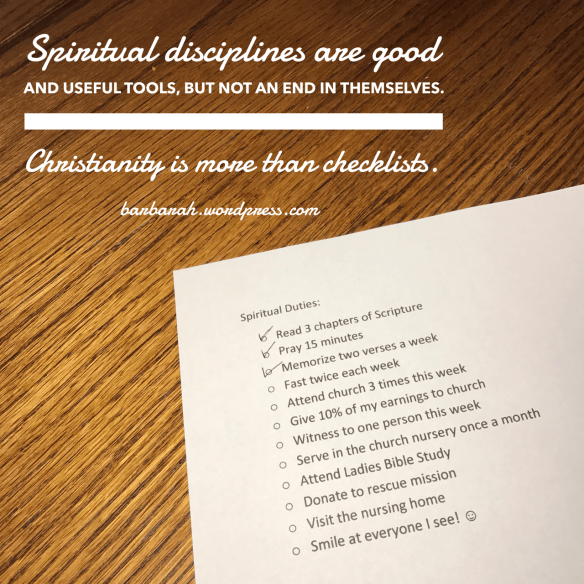
1. To try to be more self-disciplined, we establish habits to aid in godliness, like regular times of reading the Bible or prayer, church attendance, etc.  And that’s a good thing. But we all know what it is to have days when we’re just going through the motions, when our eyes are dragging across the page and we check “Have devotions” off your list of things to do for the day but haven’t really engaged with the text or been affected spiritually. Or we “feel spiritual” if we’ve crossed that duty off or don’t “feel spiritual” if we haven’t.

2. To try to minister more effectively as a church, we set up various programs or committees. But sometimes our routines and programs not only don’t accomplish the ministry for which they are intended, they can even hinder them. For instance, we’d all agree it’s a good thing for church members to greet visitors. But once when we were visiting a new church, no one spoke to us or even looked at us the whole time we were there – except at the hand-shaking time built into the service.They had squeezed all their greeting into that few moments, leaving visitors feeling awkward and not really greeted at all.

We can fall into the trap of thinking that when we show up for church visitation, then we’ve gotten our witnessing obligation in for the week, or because we have official greeters at church, none of the rest of us needs to greet new people, or because there is a committee to take care of x, y, or z, we don’t have to be involved.

3. We try to force results. For instance, we can feel that small groups would be good for the congregation to get to know one another better, and they work best if everyone participates. So we “make” the quiet person participate by putting undue pressure on them to say something, calling them out and putting them on the spot. Then we feel self-satisfied that the group went quite well today because everyone spoke, when we left the quiet person miserable and determined not to come back. Or, as happened to us once in a new church, whatever the pastor was talking about (I’ve forgotten now), at the end he asked everyone to break into family groups and discuss and pray right then and there about how to implement what he preached on. That seemed to my husband and me like forcing the issue or “making” people respond instead of letting God use His Word to convict and change. Another example: we want people to “go deep” in their conversations and relationships, so we have “turn to your neighbor and bare your heart on command” sessions instead of letting those opportunities arise in a more natural way. We’ve known people who made a profession of faith after a zealous Christian buttonholed them and would not back off until the person responded, yet there was no life change, no interest in the Lord afterward. By contrast, Jesus let people walk away sometimes.

Setting up good habits and routines and even programs can greatly aid us in our walk with God. But we have to keep in mind what they are for and not get lost in them for their own sake.

A book I read recently about getting more from our reading of God’s Word emphasized applying what we learn. That’s a good thing: we’re told to be doers of the Word, not just hearers. But his illustration went something like this: we need to apply God’s Word in measurable ways, not vague ones. So if, say, we come to a passage about prayer, instead of saying to ourselves, “We really should pray more,” according to this book, we should instead make plans to pray six minutes every day. As if God cared how many minutes we pray. The better approach, in my opinion, would be to stop and think about what I could and should be praying for. That in itself would generate a longer prayer list than I could probably keep up with (some people divide their prayer lists into categories over several days). Then the next step would be to study the prayers in the Bible, particularly in the epistles. Paul’s prayers in Philippians 1, Ephesians 1 and 3, and Colossians 1 are wonderful examples. Granted, that author probably intended that, if a person planned to pray six minutes and ran out of things to pray in three, that would lead him to these other ways of expanding his prayer life. But the emphasis on “measurable results” can lead to outward exercises without always the accompanying inward change. Similarly, if I read a passage and am convicted about needing to be more loving and less selfish, it might help to think of specific ways in which I need to do those things. But it would be wrong to check those off my list at the end of the day and think, “There! Done! Good work!” Sometimes instead I need to carry those thoughts with me all throughout the day and apply them in ways I couldn’t know I would need to when I first read them.

Years ago we were visiting my in-laws, and a couple of ladies from the church came by to visit my husband’s mother. I think it may have been her birthday, or maybe they were just visiting her as an “older” church member, but they brought a small plant, and, I believe, a card. She tended to be profuse in her thanks, and perhaps to counteract that a bit after she thanked them several times, one of them responded, “Well, you were on our list.” Wow, what a way to deflate any good feelings about someone coming to visit. She never said anything about it after they left, but it would have been understandable if she had thought, “They don’t really care: they just came because I was on ‘a list’ to visit.”

Our ministry isn’t boxed into a particular time, place, or group of people. Our programs don’t take care of all of our obligations. There is a sense in which we should always be “on,” always at the ready to serve. Even if there are official greeters at church, we can greet people when we see them or help a confused visitor find the right place. Even if there is someone designated to send cards to sick Sunday School class members, we can send one, too. If God has placed on our hearts that we need to help someone else in the church, we need to pray about how to do that rather than just dismissing it because our church has a benevolence committee to take care of those things.  If there is trash on the floor, we can pick it up instead of thinking, “There is a custodian for that.”

On the other hand, I’ve known women who felt terrible for not “serving” in church when their whole lives were ministering in “unofficial” ways. One lady would often apologize for not being more involved in our ladies’ group, but she lived next to and helped her elderly mother, cared for a disabled son, was the go-to baby-sitter for the rest of the family. She sang in the choir and took an interest in people, yet felt she wasn’t really being used of the Lord because she couldn’t plug into some of the ministries. Another had to step down from a position for which she was uniquely qualified, and I watched and was blessed as she found various other ways to minister: greeting newcomers, inviting ladies over for lunch, and other ways that didn’t fit in with any particular official ministry in the church, but ministered very well to the people involved.

Habits, routines, programs help greatly in organizing a ministry, and we need to use whatever systems are set up (reporting a plumbing problem to whoever is in charge, signing up for taking a meal to someone so she doesn’t receive two or three in one night or receive something she’s allergic to, etc.). And sometimes we do need those systems and routines because we don’t always “feel like” doing what we need to. A former pastor once said that the best time of prayer he ever has was when he didn’t feel like praying and had to confess that to the Lord right off the bat. Sometimes just doing what we should whether we feel like it or not is the first step to feeling like it.

But we should seek God’s grace to serve not just out of duty, and not to check off all the designated boxes, but with a right heart. The mechanics of ministry and spiritual disciplines are tools, but not the main focus, not the end-all of our efforts. Routines, habits, programs are an avenue of ministry, not an end in themselves, and ministry doesn’t take place only within those parameters. On the other hand, sometimes we can perfectly follow all of our routines, and our programs can seem to be going swimmingly, but we’re unaware that we’re missing something vital.

The simplicity which is in Christ is rarely found among us. In its stead are programs, methods, organizations and a world of nervous activities which occupy time and attention but can never satisfy the longing of the heart. The shallowness of our inner experience, the hollowness of our worship and that servile imitation of the world which marks our promotional methods all testify that we, in this day, know God only imperfectly, and the peace of God scarcely at all. If we would find God amid all the religious externals, we must first determine to find Him, and then proceed in the way of simplicity. Now, as always, God discovers Himself to “babes” and hides Himself in thick darkness. ~ A. W. Tozer, The Pursuit of God

God created whole systems of programs and routines for Israel in the Old Testament. But there were times He told them He hated their sacrifices and feasts – the very sacrifices and feasts He had commanded them (here, here, and here, for a few). Why? Sometimes because they harbored sin in their hearts even while performing their religious duties outwardly. Sometimes because they missed the main point, like those who kept the systematic observations but failed to minister on a personal level, or like Pharisees whose religious zeal was wrapped up in keeping not just God’s law, but their additions to it. God said to them through Hosea, “For I desired mercy, and not sacrifice; and the knowledge of God more than burnt offerings” (6:6). We’re no longer under those systems, but in the same way I think He would want us to implement whatever habits, routines, systems, or programs are helpful, yet not get lost or fixated on them for their own sake, and to keep in mind that the main point is to know Him and make Him known and minister to others in their need in His Name and by the power of the Holy Spirit.

And this is eternal life, that they know you, the only true God, and Jesus Christ whom you have sent. John 17:3

Not by the way of eye-service, as people-pleasers, but as bondservants of Christ, doing the will of God from the heart. Ephesians 6:6

img_0057

 (Sharing with Inspire me Monday, Testimony Tuesday, Woman to Woman Word-Filled Wednesday)

Save

Save

Save

Protection for wounded spirits

img_0052As many of you know, I broke and dislocated my little toe about ten days before Christmas. I had never broken any bone before, and this has left me feeling very glad that I hadn’t and hoping that I never will again. Even though it’s just a little toe, the pain, discomfort, and inconvenience have had an impact on me as well as the rest of the family.

The first week I was to stay off of it as much as possible and keep it elevated as much as possible. When I saw the doctor for a follow-up visit a week after the injury, I was hoping for some specific directions for the next weeks. But the doctor was rather vague. He said it should heal in six or so weeks, and if it hurt, that meant I should stay off of it a bit. I was hoping to avoid hurting it.

One thing the doctor did emphasize, though, was protecting the toe. I didn’t have to “buddy wrap” it to the next one like the doctor did the first week, but he gave me adhesive tape to wrap lightly around the foot to keep the toe in place and told me to continue wearing the boot I was given or a good walking shoe. Thankfully we’re coming up on the six week mark, when it should be fully healed.

The emphasis on protecting the broken toe while it heals caused me to think of other injuries or wounds that we don’t really associate with needing protection: spiritual or emotional hurts. The protection for a broken bone involves supporting the broken member so the bone heals correctly. For an open wound, protecting it not only keeps other things from bumping it and causing pain, but covering it keeps it from infection. But we don’t usually think about protecting those who have been wounded in non-physical ways, except perhaps the first few days. And how would we even go about that, anyway?

You might think the answer would be that Christian community should surround and support the wounded member. “Community” seems to be the popular, go-to solution for everything these days. And, yes, we are to “Bear one another’s burdens, and so fulfill the law of Christ” (Galatians 6:2) and “weep with those who weep” (Romans 12:15). Community can do much to help and aid.

But what if community is part of the problem?

When you’re single, longing for someone to love, and there are no prospects on the horizon, but at a wedding people ask, “So when is it going to be your turn?”

When you’ve had four miscarriages, with only the first made public, and someone asks, “So when are you guys going to start a family?”

When you’re mourning on the anniversary of a loved one’s death, and a friend says, “Shouldn’t you be over that by now?”

When years later your family is still suffering the effects of a trauma that, to other eyes, seems to be all over, and someone says, “Shouldn’t you have moved on from that by now?”

When you’re visiting a new church in a new town with some trepidation, and the members of your small group or class aren’t cliquish in the sense that they deliberately keep others out, but they have all been friends for so long that anyone new feels out of the loop. When an observer mentions aside to the leader that perhaps they could take pains to reach out to the new ones, the leader says, “Well, the Bible says if you want to have friends, you should be friendly. They need to extend themselves.”

When people say the wrong things, we need to extend grace and assume they meant well. Thank God for sensitive, Holy Spirit-filled and led people who truly know how to come alongside and help, who know how to comfort as they have been comforted. Lisa shared a wonderful post recently on Invisible Band-aids and the need to be alert and attentive to those wounds which don’t show.

But other people can’t be there all the time, and in a sense it’s true that, as the old hymn says, no one understands like Jesus.

The best protection and support for wounded hearts, minds, and spirits is God’s truth, whether we apply it ourselves or share it with someone else..

When Hannah was childless and her rival provoked her and her husband didn’t understand the full weight of her sorrow, she poured out her heart to the Lord, knowing He was the only one who could meet her need.

When Joseph was betrayed, lied about, and forgotten, he trusted that God was sovereign and meant it for good.

When David’s men blamed him when the Amalekites raided their camp and kidnapped their families, to the point that they were going to stone him, David encouraged himself in the Lord.

When the psalmists brought problems and trials and anguish before the Lord, they eventually reminded themselves of His character, power, and love.

Paul was “troubled on every side, yet not distressed; we are perplexed, but not in despair;  Persecuted, but not forsaken; cast down, but not destroyed; Always bearing about in the body the dying of the Lord Jesus, that the life also of Jesus might be made manifest in our body” (2 Corinthians 4:8-10).

All throughout the Bible, you see people in various troubles or problematic situations reminding themselves of what they knew to be true of God, staking their souls on what He said, no matter how things looked or felt at the time.

A few other parallels between physical and internal wounds came to mind. You often don’t realize what muscles are used where until something is injured. I didn’t realized my toes dug in to keep balance when I picked up something on the floor, or that I pushed off with my toes when reaching for something from a cabinet, or moved my toes when I stretched in bed, and I got some rude awakenings when I did those things. Years ago, recovering from an old-fashioned gallbladder surgery before they started doing them laparascopically, one of the things I had been told to hold off doing was vacuuming. I thought that was odd – vacuuming didn’t seem strenuous to me. But the first time I tried it, I discovered, wow, you do use abdominal muscles when you vacuum! Similarly, after the deaths of my parents, I was unprepared for being blindsided by waves of grief set off by the most innocent things.

Both of them passed away at Christmas time, so for the first few years, though we celebrated, rejoiced, and even laughed, we just weren’t into what a friend called the “froth” of the season. I remember thinking that I wished sometimes that we still wore mourning clothes for a season after the death of a loved one to let others know to be sensitive. With my “boot” now, or when I used a walker or cane after transverse myelitis, I’ve been glad that I had some way of conveying to others that there was a reason I was walking a little more slowly, and hoped those devices signaled them to be careful and not to jostle me. We don’t have any such signalers after a trauma or loss or heartbreak.

Even though the intensity lessens over time, that spot still may be tender for a very long time. One friend whose husband was in prison for several years is very sensitive to jokes about prisoners, or condescending stereotypical remarks about them, or things like baby onesies made to look like prison uniforms, and after her experience, I’m more sensitive to them, too.

We need to take appropriate measure to promote healing – setting a bone, resting, taking medicine for physical wounds; for spiritual ones, we might need to confront an offender, confess any wrong on our parts, forgive, and seek reconciliation. Both health and spiritual ills usually get worse when they are not dealt with. We do have to be careful that we’re not preventing healing or making things worse by nursing our wounds.

But we can no more tell someone with a broken spirit to “get over it” any more than we could someone with a broken limb. Healing takes time. Community can and should help. But ultimately we need to splint our souls to God’s truth, to prevent the infection of bitterness by resting in His love and care, to protect our broken hearts and spirits by trusting in His grace.

The Lord is near to the brokenhearted and saves the crushed in spirit. Psalm 34:18

He healeth the broken in heart, and bindeth up their wounds. Psalm 147:3

Remember your word to your servant, in which you have made me hope. This is my comfort in my affliction, that your promise gives me life. Psalm 119:49-50

Let, I pray thee, thy merciful kindness be for my comfort, according to thy word unto thy servant. Psalm 119:76

Unless thy law had been my delights, I should then have perished in mine affliction. I will never forget thy precepts: for with them thou hast quickened me. Psalm 119:92-93

The hymn “Still, My Soul, Be Still” has ministered to me since I first heard it, and the last couple of stanzas especially bring out the need to stake ourselves on God’s truth:

Still my soul be still
Do not be moved
By lesser lights and fleeting shadows
Hold onto His ways
With shield of faith
Against temptations flaming arrows

Still my soul be still
Do not forsake
The Truth you learned in the beginning
Wait upon the Lord
And hope will rise
As stars appear when day is dimming

God You are my God
And I will trust in You and not be shaken
Lord of peace renew
A steadfast spirit within me
To rest in You alone

~ Words and Music by Keith & Kristyn Getty & Stuart Townend

(Sharing with Inspire Me Monday, Testimony Tuesday, Woman to Woman Word-Filled Wednesday, Tell His Story, Thought-provoking Thursday)

Save

Save

Save

Save

Save

“The Beauty of the Bone”: Finding Beauty in Bleakness

img_00231A couple of weeks into January, and the excitement of Christmas and new beginnings has died away. Darkness comes early, the skies are often overcast, it’s cold, the landscape seems barren with no hope of any new blooms or growth for months yet. Our family makes a big deal of Valentine’s Day, so we have that to look forward to as well a few birthdays before spring. But otherwise this time of year seems bleak and colorless. I feel I’m just longing for that first warm breeze and green shoot indicating spring.

John Updike’s poem “November,” from A Child’s Calendar, seems more suited to January for me except for the last verse and the line about the year being old:

The striped and shapely
Maple grieves
The loss of her
Departed leaves

The ground is hard
As hard as stone.
The year is old.
The birds are flown.

And yet the world,
Nevertheless,
Displays a certain loveliness–

The beauty of
The bone. Tall God
Must see our souls
This way, and nod.

Give thanks: we do,
Each in his place
Around the table
During grace.

The first time I ever read this, the quote I was reading stopped at “the beauty of the bone,” and that phrase arrested me. (This, by the way, is not a total endorsement of Updike: I’m not familiar with his other work.)

Leafless trees do have “a certain loveliness.” You see the structure, the symmetry, the basic form that is usually hidden underneath the leaves. Artist Andrew Wyeth is quoted as saying, “I prefer winter and fall, when you feel the bone structure of the landscape – the loneliness of it, the dead feeling of winter. Something waits beneath it, the whole story doesn’t show.”

The lack of foliage also allows other sights to come into view. On the “scenic route” to church, there’s a stretch where trees line the road. But in the wintertime, when the leaves are gone, I can see what was hidden before: a pond with various animals coming to drink from it. Mountains covered in varying leaves most of the year display houses and meadows I would never have known of without the missing leaves.

These observations led to reflections about winter times of the soul, when everything (financially, relationally, or otherwise) seems stripped down to the bone. My own salvation was like that. Everything in my life that I had ever leaned on was no longer available: my parents divorced; my mom, with whom I had always been very close, was distant for a while; we moved from a very small town of less than 200 to Houston, a city of over a million, causing a major culture shock, especially when I started school; I had no contact with friends or relatives for a time. I never felt so totally alone in my life. I had not grown up in a church-going family, but I had heard enough in going occasionally with friends and relatives to know where to turn. I had made a profession as a child that I struggled with, but at this point I desperately needed to know God was there and He cared for me. Through a series of events and seeming “coincidences,” God led me to a Christian school and then a church where I was regularly under solid teaching and eventually made sure of my salvation.

When life seems like a barren winter landscape, we can see and understand spiritual truths we never realized before, or at least not in the same depth. In a different metaphor, Hebrews speaks of  ” the removal of things that are shaken—that is, things that have been made—in order that the things that cannot be shaken may remain” (12:27, ESV). Spurgeon said in the June 22 reading of Morning and Evening:

We have many things in our possession at the present moment which can be shaken, and it ill becomes a Christian man to set much store by them, for there is nothing stable beneath these rolling skies; change is written upon all things. Yet, we have certain “things which cannot be shaken,” and I invite you this evening to think of them, that if the things which can be shaken should all be taken away, you may derive real comfort from the things that cannot be shaken, which will remain. Whatever your losses have been, or may be, you enjoy present salvation. You are standing at the foot of his cross, trusting alone in the merit of Jesus’ precious blood, and no rise or fall of the markets can interfere with your salvation in him; no breaking of banks, no failures and bankruptcies can touch that. Then you are a child of God this evening. God is your Father. No change of circumstances can ever rob you of that. Although by losses brought to poverty, and stripped bare, you can say, “He is my Father still. In my Father’s house are many mansions; therefore will I not be troubled.” You have another permanent blessing, namely, the love of Jesus Christ. He who is God and Man loves you with all the strength of his affectionate nature–nothing can affect that. The fig tree may not blossom, and the flocks may cease from the field, it matters not to the man who can sing, “My Beloved is mine, and I am his.” Our best portion and richest heritage we cannot lose. Whatever troubles come, let us play the man; let us show that we are not such little children as to be cast down by what may happen in this poor fleeting state of time. Our country is Immanuel’s land, our hope is above the sky, and therefore, calm as the summer’s ocean; we will see the wreck of everything earthborn, and yet rejoice in the God of our salvation.

Sometimes when things are shaken to their core, we see the strength of that core of God’s truth; we see what really matters. Corrie ten Boom said, ” “You can never learn that Christ is all you need, until Christ is all you have.” Or, taken in reverse, when Christ is all you have, you find He is all you need.

Nancy Guthrie wrote in  Holding on to Hope. “Trusting God when the miracle does not come, when the urgent prayer gets no answer, when there is only darkness—this is the kind of faith God values perhaps most of all. This is the kind of faith that can be developed and displayed only in the midst of difficult circumstances. This is the kind of faith that cannot be shaken because it is the result of having been shaken. “

Our winters shall not frown for ever; summer shall soon smile. The tide will not eternally ebb out; the floods retrace their march. The night shall not hang its darkness for ever over our souls; the sun shall yet arise with healing beneath his wings. – ‘The Lord turned again to the captivity of Job.’ Our sorrows shall have an end when God has gotten his end in them. ~ Spurgeon

Glory follows afflictions, not as the day follows the night but as the spring follows the winter; for the winter prepares the earth for the spring, so do afflictions sanctified prepare the soul for glory. ~ Richard Sibbes

The tendinous part of the mind, so to speak, is more developed in winter; the fleshy, in summer.  I should say winter had given the bone and sinew to literature, summer the tissues and the blood. ~ John Burroughs

So winter is still not my favorite season, but I have learned it has its purposes. I almost never see a bare tree any more without thinking of that phrase, “the beauty of the bone.” Sometimes winter is a time of rest or preparing for new growth. A friend who describes herself as a homesteader loves winter for catching up on reading and knitting and planning for her garden, things she can’t do when planting, weeding, harvesting, and tending animals are all in full swing. Hard freezes kill bugs. And if nothing else, winter helps us appreciate spring and summer all the more. So in spiritual “winters,” we can “hunker down” with the bedrock of God’s truth, nourish our souls with it, and trust that spring will come.

Thou hast set all the borders of the earth: thou hast made summer and winter. Psalm 74:17.

See also:

Colorlessness.
Help for the “Winter Blues.”
The Winter of Life.

(Sharing with Inspire me Mondays, Testimony Tuesday, Woman to Woman Word-Filled Wednesday, Thought-provoking Thursday)

Save

Save

Save

Save