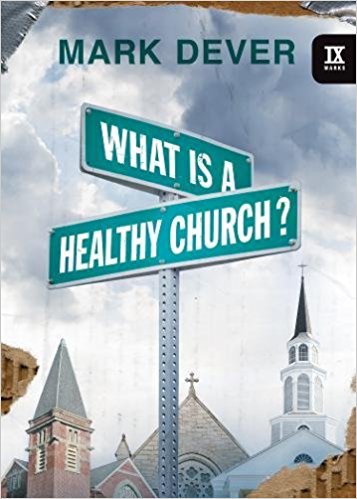
Book Review: What Is a Healthy Church?

Healthy ChurchMark Dever opens What Is a Healthy Church? by pointing out that much of what we look for in a church is determined by our own particular culture: the type of music, pastor, preaching, etc., that we’re used to. He encourages readers to consider Biblical marks of a healthy church. Why does he address a book like this to Christians in general rather than church leaders? Because, he points out, most of the NT epistles, which contain much instruction about church as well as personal life, were written to congregations, not just pastors.

Then he explains briefly what a Christian is, what the church is and isn’t, what the church is for, and why Christians need a church. Ultimately the church “is called to display the character and glory of God to all the universe, testifying in word and action to his great wisdom and work of salvation” (p. 48).

The church finds its life as it listens to the Word of God. It finds its purpose as it lives out and displays the Word of God. The church’s job is to listen and then to echo…The primary challenge churches face today is not figuring out how to be “relevant” or “strategic” or “sensitive” or even “deliberate.” It’s figuring out how to be faithful–how to listen, to trust and obey (pp. 55-56).

He then discusses one by one what he considers nine marks of a healthy church, dividing them into three essential marks (expositional preaching, Biblical theology, Biblical understanding of the Good News) and six important ones (Biblical understanding of conversion, evangelism, membership, church discipline, discipleship and growth, and church leadership).

You and I cannot demonstrate love or joy or peace or patience or kindness sitting all by ourselves on an island. No, we demonstrate it when the people we have committed to loving give us good reasons not to love them, but we do anyway (p. 29).

If a healthy church is a congregation that increasingly displays the character of God as his character has been revealed in his Word, the most obvious place to begin building a healthy church is to call Christians to listen to God’s Word. God’s Word is the source of all life and health. It’s what feeds, develops, and preserves a church’s understanding of the gospel itself (p. 63).

Martin Luther found that carefully attending to God’s Word began a Reformation. We, too, must commit to seeing that our churches are always being reformed by the Word of God (p. 67).

Sometimes, it’s tempting to present some of the very real benefits of the gospel as the gospel itself. And these benefits tend to be things that non-Christians naturally want, like joy, peace, happiness, fulfillment, self-esteem, or love. Yet presenting them as the gospel is presenting a partial truth. And, as J. I. Packer says, “A half truth masquerading as the whole truth becomes a complete untruth.”

Fundamentally, we don’t need just joy or peace or purpose. We need God, himself. Since we are condemned sinners, then, we need his forgiveness above all else. We need spiritual life. When we present the gospel less radically, we simply ask for false conversions and increasingly meaningless church membership lists, both of which make the evangelization of the world around us more difficult (p. 77).

My thoughts:

I don’t think I have ever read anything by Dever before and was only vaguely aware of his organization, 9Marks. This book seems to be a compact version of what he has written more extensively elsewhere. We received it in a gift bag from a church we visited. Generally I agree with what’s here with a couple of exceptions, one relatively minor.

1) In the chapter on preaching he makes the statement “Has not every step of growth in grace occurred when we heard from God in ways we hadn’t heard from him before?” (p. 66). For me, significant growth in grace has occurred sometimes from being reminded of something I already knew from God’s Word that I needed to return to or refocus on.

2) I think he’s too dismissive of differences in preference of music styles in churches. He seems to consider it almost a non-issue.

Remembering that the church is a people should help us recognize what’s important and what’s not important. I know I need the help. For example, I have a temptation to let something like the style of music dictate how I feel about a church. After all, the style of music a church uses is one of the first things we will notice about any church, and we tend to respond to music at a very emotional level. Music makes us feel a certain way. Yet what does it say about my love for Christ and for Christ’s people if I decide to leave a church because of the style of its music? Or if, when pastoring a church, I marginalize a majority of my congregation because I think the style of music needs to be updated? At the very least, we could say that I’ve forgotten that the church, fundamentally, is a people and not a place (p. 35).

If it were just a matter of preferences, that would be true. What I think he might not understand is that some people consider certain types of music not just not preferable, but wrong. We’ve heard teaching for years about what’s wrong with certain types of music. On the other hand, the Bible doesn’t say anything about particular music styles, and I think some of that specific teaching went far beyond what the Bible has to say about music. But I don’t think that means “anything goes.” So we’re trying to sort out what’s coming from conscience or conditioning, but I don’t think we can ignore conscience or conditioning, either. Music makes up a significant part of a church service, so, while it’s not “the” main issue, or even part of the “nine marks,” it is still an issue.

Aside from those, I thought this was a good overview of what a healthy church should be. I also appreciated his encouragement to both pastor and people to be patient if a church isn’t “there” yet and his reminder that growth takes time. Once when we were getting ready to move to another state, our dear pastor at the time advised us to look not just at where a church is, but where it’s heading, and I think that dovetails nicely with the instruction in this book. No church will be perfect, but we should look for one with a good foundation and growth in these ways.

(Sharing with Semicolon‘s Saturday Review of Books, Literary Musing Monday)
My Sin Is Not Someone Else’s Fault

When I have to confess something to the Lord or apologize to someone else, I tend to want to explain the reasons I did what I did, as if that somehow justifies my wrong response.

The very first people committing the very first sin did the same thing.

One day I was totally arrested by this thought:

My sin is not someone else’s fault.

Wait – aren’t they responsible for what they did? Don’t other people sometimes deliberately try to get us to sin?

Sure. And they’re answerable for their own actions.

But what does God tell His children?

No temptation has overtaken you that is not common to man. God is faithful, and he will not let you be tempted beyond your ability, but with the temptation he will also provide the way of escape, that you may be able to endure it. (1 Corinthians 10:13, ESV)

When we give account of ourselves to God, we won’t be able to point the finger at anyone else.

I used to take refuge in the King James version of 1 Corinthians 13:5, especially in that word easily in the phrase “love…is not easily provoked.” And then a trusted pastor told us that the word “easily” isn’t in the original text. If you look up the Strong’s numbers for this verse, which link to the Greek or Hebrew words and their translations – there is no link for “easily.” Many other translations leave it out.

So I can’t use that as an excuse: “I tried to resist, you know, and did for a while, but really, it was just too much. Anyone would have reacted that way at that point.”

No, God has promised “a way of escape” in each temptation. Too often I am looking for a reason to give in rather than a way to get out of temptation.

We all fall and fail every day. What are we to do?

1. Accept responsibility. Acknowledge what we did wrong and own up to it. (And if I can interject this here, we also need to teach our children to do this. Yes, we understand that they act out when they’re tired, hungry, etc., and we attend to those issues first. But when they do something deliberately wrong, we need to avoid making excuses for them and teach them to own up to what they did.)

2. Confess it to the Lord.

If we confess our sins, he is faithful and just to forgive us our sins and to cleanse us from all unrighteousness. 1 John 1:9

Whoever conceals his transgressions will not prosper, but he who confesses and forsakes them will obtain mercy.  Proverbs 28:13, ESV

I’ve been told that to “confess” means “to say the same thing as.” In other words, call it what the Bible says it is. I didn’t tell a little fib: I lied. I wasn’t just a little out of sorts: I was selfish and irritable and unkind.

3. Rest in His promise of forgiveness.

4. Confess it to anyone else involved. A trusted former pastor once said that the circle of confession needs to be as wide as the circle of the sin. If I spoke harshly to someone in private, I need to go back to that person, apologize, and ask their forgiveness. If someone embezzles funds, well, that’s a much wider circle.

5. Make restitution if necessary. If something was stolen or property was destroyed or damaged, we’re responsible to to return, replace, or pay for it. If someone’s reputation was damaged, we do what we can to acknowledge our own blame and clear the other person.

6. Mortify (kill) the sin. I admit this is a concept I struggle with, because if you “kill” something, then you don’t expect to have trouble with it the very next day – or hour. But Romans 8:13 says, “For if you live according to the flesh you will die, but if by the Spirit you put to death the deeds of the body, you will live.” (ESV; the KJV uses the word “mortify”). A helpful explanation is here, but an idea that helps me don’t give it life support. Do all you can to undermine it, to weaken it, rather than to give it any impetus. “But put on the Lord Jesus Christ, and make no provision for the flesh, to gratify its desires” (Romans 13;14, ESV).

7. Seek victory. Pray and seek God’s Word for His help in overcoming sin. Perhaps memorize applicable Scriptures or copy them and put them on a card in a prominent place as a reminder.

8. Plan ahead when possible. The young man in Proverbs 7 who got taken in by  the wrong kind of woman was where he should not have been in in the first place (v. 7-9). We might need to avoid certain places. If we’re going into a situation where there might be trouble, we can make a plan of action: for instance, if I have a tendency for gluttony and a lack or control around food, before the company Christmas party I can plan exactly how much I’ll allow myself, perhaps eat a little beforehand so I am not hungry, seek to talk to people instead of prowling around the refreshments.

9. Look for the way of escape that God’s Word promises. So often when we’re thinking about doing something that, deep down, we know we shouldn’t, a “still, small voice” will be trying to talk sense to us and talk us out of it all the time we’re trying to justify it. We need to ask the Lord to help us, but we also need to take action and flee.

10. Yield to God. Give Him “the right of way.”

Neither yield ye your members as instruments of unrighteousness unto sin: but yield yourselves unto God, as those that are alive from the dead, and your members as instruments of righteousness unto God (Romans 6:13).

11. Follow the right way. The same verse that talks about “fleeing youthful lusts” goes on to tell us to “pursue righteousness, faith, love, and peace” (2 Timothy 2:22). We need to concentrate as much or more on doing as on don’ting. Erwin Lutzer said in How to Say No to a Stubborn Habit that if someone tells you not to think of the number 8, all of a sudden that’s all you can think about. The best way to deal with a wrong thought is to replace it with another thought. We tend to follow what we focus on.

12. Behold Him.

But we all, with open face beholding as in a glass the glory of the Lord, are changed into the same image from glory to glory, even as by the Spirit of the Lord. II Corinthians 3:18

For we do not have a high priest who is unable to sympathize with our weaknesses, but one who in every respect has been tempted as we are, yet without sin. Hebrews 4:15

Our sanctification as well as our salvation rests on the finished work of Christ. We don’t become any more or less saved or more or less loved when we sin. But sin keeps our relationship from the full fellowship we would otherwise enjoy, hinders our testimony, dishonors the Lord, and so many other things. God expects for His children to grow in Him. So when we do sin, we need to confess it and rest in the love of a Father who is more than ready to forgive.

The Lord is merciful and gracious, slow to anger and abounding in steadfast love. Psalm 103:8

*I’ve been addressing people who are already born again and have become children of God. Forgiveness of sin and grace to overcome it is only possible when we have that relationship with God. If you’ve never believed on Christ as savior, please read more here.

(Sharing with Inspire Me Monday, Glimpses, Literary Musing Monday, Tell His Story, Woman to Woman Word-filled Wednesday, Coffee for Your Heart, Porch Stories, Faith on Fire)

Keeping Minimalism in Balance

IMG_0506

Years ago in a college Home Economics class called Home Furnishings, one thing that stood out to me was that the decorating pendulum tends to swing back and forth between extremes. For example, the Rococo era was characterized by excessiveness, playfulness, pastel colors, and curves, followed by Neoclassicism, which went back to straight lines, less color, and simple forms.

In my early married days, the “country” look was prevalent with a lot of wood and knickknacks. Then a lot of people went to a type of Victorian decorating, more sophisticated and fussy. Now the watchword is minimalism.

Decorating styles often reflect and/or influence what’s going on in society. Minimalism as a design concept actually started after World War II. But these days minimalism is a life concept.

Minimalism is not about ascetic denial, being spartan, or living with as little as you can. It’s about deciding what’s most important and getting rid of everything that distracts you from your core values. That means it will look different for different people. It’s also a reaction against consumerism, the constant pull to get more and have more and do more. With less “stuff” to store, oversee, and maintain, not only our living spaces, but also our minds are less cluttered and more free for what matters most.

And those are all good things! But like anything, it’s possible to become unbalanced one direction or another. As I have read more and more blog posts and articles about it, a few concerns have cropped up. You might be a little off-balanced in your quest for minimalism if:

1. You’re obsessed with it.

Minimalism tends to go hand in hand with simple living. I’ve seen a few people read articles or books on either minimalism or simple living and then feel driven to go through the attic, garage, every closet, every storage space, and I’ve thought, “That sure doesn’t sound simple.” Sure, we all need to sort through and get rid of things from time to time. But to turn the house upside down in a frenzy seems in conflict with the peace many minimalists are after.

I read a blog post just this morning from someone obsessing over, among other things, the fact that she had two whisks. Fine – set one aside to give away. But it’s not that big a deal. I have more than two and in different sizes, because sometimes I need more than one for one meal preparation, and different sizes work best in different containers.

Also, if minimalism or simplifying are near-constant subjects of thought and conversation, you might be overbalanced. The point of minimalism is to free your mind and time of stuff so you can spend it on more valuable things. You can still be obsessed with stuff even while trying to lessen your stuff.

2. You judge others for not being as minimalist as you are.

One of the tenets of minimalism is that it’s about keeping what makes you happy, so someone’s else’s home or lifestyle will not look exactly the same. But if you walk in and inwardly condemn their “clutter,” or somehow feel more self-righteous because of your minimalist stance, then you might have gotten off-balance. The whisk-worrier might see my collection of whisks and think me excessive if she didn’t understand my reasons for having them.

3. You’re constantly having to replace items you got rid of.

I knew a family with four children who sold their baby equipment after every single one and then had to get new. Maybe they didn’t have the storage space for it between pregnancies; maybe they didn’t plan on having more. I don’t know. But it seems simpler, less work, and less expensive over the long haul to store it in some way. Personally, I take a lot of time for certain big purchases, furniture in particular, to look at the options, assess the best deal and what would work best for our family, etc., so I don’t like having to go through that again any time soon.

4. You go without things you need in the name of minimalism.

This is not a tenet of minimalism – that’s one reason it’s a sign of being off-balance. My dear mother-in-law was a product of post-Depression era frugality, but even a good characteristic like frugality can go too far, if you don’t get things you really need or live in an unhealthy way just for the principal of frugality or minimalism.

5. You seek peace in minimalism.

Minimalism can definitely make for a more peaceful mind and household. But it’s not the ultimate source of peace. For one thing, it’s kind of elusive if it is a goal rather than a lifestyle. We have to evaluate our possessions again from time to time as we acquire more (sometimes through gifts) or as other items wear out or outlive their usefulness. But even more than that, we can get to a comfortably minimalist lifestyle and still miss lasting inner peace. True peace comes only through Christ.

I probably would never call myself a minimalist, but neither am I a hoarder. I like stories where kids go up in Grandma’s attic and find old treasures, but I do see the need to sort through things there before I am no longer able to so that my children aren’t burdened with it. (We’re planning on that some day when the weather is neither too hot or too cold). I have decorating stuff I don’t use in a closet because I am undecided about it. I have pulled things out of there to use, so I don’t go by the “if you haven’t used it in x years, get rid of it” mantra. Sir Walter Scott is quoted as saying, “If you keep a thing for seven years, you are sure to find a use for it.” Plus some of it is irreplaceable or would be too expensive to replace, so, since I have space, I hang onto it until I am fully ready to let it go. If we have to downsize at some point, I’d have to go through those things with a more critical eye. We saved some toys from our own kids that my grandson plays with now, but we were careful to dispose of any that were broken or unappealing. Even with that, there are a few things I wish we had kept. One year I bought a Christmas decoration that looked like a old-time Model A type car with a holly leaf on it. I don’t know why – I probably saw it on sale and thought the boys would like it. But then I don’t remember getting it out much, maybe because there was no room for it then. Now, however, it’s one of my grandson’s favorite decorations, so I am glad I kept it even though doing so went against conventional wisdom.

On the other hand, I do get rattled when my storage spaces are too full, and having less to clean and sort and tend to appeals to me. A good article on what minimalism is and isn’t is here. So while I tend to keep more than someone who is truly minimalist, I am evaluating what I have and what I consider acquiring more and more, which is a good thing.

(Sharing with Inspire Me Monday, Literary Musing Monday, Glimpses, Tell His Story, Wise Woman, Woman to Woman Word-filled Wednesday, Coffee for Your Heart, Porch Stories, Faith on Fire)

Watching angels

When one of my sons was a baby and was intently staring at the ceiling, as babies are wont to do, my mother-in-law remarked that she thought when babies did that, they were looking at their guardian angels. We smiled – I think we even chuckled. I think she got a little embarrassed, but insisted, “No, really, I think they do see them!” We always kept that as a sweet memory of a sweet thought, and often when we saw a baby staring at the ceiling, we’d observe, “There they go looking at their guardian angels again” with a smile.

When we brought my mother-in-law home from the nursing home four years ago, we thought we were bring her home to die. She was down to 90 lbs., very fuzzy-minded, and not very responsive. But one-on-one care, especially in relation to feeding, and getting her off the narcotic drug we had not even known she was on until we brought her home, all improved her general condition dramatically. She’s 89, though, and one can’t stop the ravages of time. After maybe her first year or so at home, she began to decline more and more, moving less, sleeping more. Over the last year or so, she has become less interactive. She stopped speaking about a year ago, but we could tell by her eyes that she recognized us and followed what we were saying. She’d smile, nod, or shake her head. Though sometimes she still does, more and more lately there’s no light in her eyes when she looks at us, no response.

As we got her ready for bed last night, I noticed her staring intently at the ceiling, and that old sweet thought came back: maybe she’s watching her guardian angel.

Who knows what little babies and elderly people actually see when they fixedly stare at some point like that. I don’t know if each person is assigned a guardian angel, but the Bible does say that God sends angels to help us in various ways. Our pastor saw angels before he passed away, and I’ve heard similar things from others.

There is a sense in which all who know the Lord are getting closer to heaven every day, but the older and more frail one gets, the more imminent it seems. “For while we are still in this tent, we groan, being burdened—not that we would be unclothed, but that we would be further clothed, so that what is mortal may be swallowed up by life” (2 Corinthians 5:2, ESV). Some day she’ll cast off this silent, crumpled frame and see, not just angels, but the One she has loved and faithfully served for decades, the One who loved her, died for her, redeemed her, and made it possible that she and the family she so loved and prayed for could be with Him.

For this perishable body must put on the imperishable, and this mortal body must put on immortality. When the perishable puts on the imperishable, and the mortal puts on immortality, then shall come to pass the saying that is written:

“Death is swallowed up in victory.”
“O death, where is your victory?
    O death, where is your sting?”


The sting of death is sin, and the power of sin is the law.  But thanks be to God, who gives us the victory through our Lord Jesus Christ. 1 Corinthians 15:53-57, ESV

Blessed be the God and Father of our Lord Jesus Christ! According to his great mercy, he has caused us to be born again to a living hope through the resurrection of Jesus Christ from the dead, to an inheritance that is imperishable, undefiled, and unfading, kept in heaven for you, who by God’s power are being guarded through faith for a salvation ready to be revealed in the last time. 1 Peter 1:3-5, ESV

IMG_0497

(Sharing with Inspire Me Monday, Glimpses, Literary Musing Monday, Wise Woman, Tell His Story, Coffee for Your Heart, Porch Stories, Woman to Woman Word-filled Wednesday)

Everyday gifts

A few friends linked to this cute video on Facebook.

https://vimeo.com/194989301

OK, some might think it a little cheesy. But it made a good point in a fun way. Though it was made with Christmas in mind, I thought it was perfect for Thanksgiving – or really, for any day – a reminder of all that we have. Much that we take for granted would have been considered luxuries throughout most of history, and in fact would still be considered luxuries by a lot of the world today.

This reminded me of an event several years ago when the church we attended then had a testimony time Thanksgiving Eve. Several young adults expressed longing to see God do something “big” in their lives. I couldn’t help but think of the children of Israel in the wilderness. The everyday manna was just as miraculous and just as much God’s provision as the parting of the Red Sea and victory in battle, yet they soon grew tired of that and wanted something else.

I don’t think those young people wanting to see God do something big in their lives that night were necessarily taking the everyday gifts for granted. I don’t know their hearts. But sometimes in longing for the “big” moments we can overlook the everyday evidence of God’s presence, love, and care – maybe a little like a husband or wife waiting for a grand, romantic gesture from the other rather than seeing the love in providing for each other, being attentive to each other’s needs and idiosyncrasies, and all the various little ways we evidence that “You’re the one that I love.”

May we see God’s hand and rejoice in His love and gifts in the everyday as well as in the milestone, once in a lifetime events.

It is a good thing to give thanks unto the Lord, and to sing praises unto Thy name, O most High: to show forth Thy lovingkindness in the morning, and Thy faithfulness every night. Psalm 92:1-2

(Sharing with Inspire Me Monday, Literary Musing Monday, Glimpses,
Tell His Story, Coffee For Your Heart, Porch Stories, Wise Woman, Faith on Fire)

The Strength of My Faith

When I faced surgery two years ago, I also faced a major battle with anxiety. First, with any medical procedure, they have to tell you everything that could possibly go wrong. Even though the things they describe aren’t likely to happen, there is some possibility they could happen. Some people probably are able to dwell in the “not likely” aspect of it, but some of us have trouble getting out of the “Yeah, but what if….” side of things. On top of that, though I am not diabetic or hypoglycemic, I do have low blood sugar issues sometimes. I usually can’t go past 9 or 10 a.m. without getting dizzy, shaky, and lightheaded, and the surgery wasn’t scheduled until 1 p.m., with nothing to eat or drink after midnight the night before. On top of that, I have irritable bowel syndrome, which can get into a vicious cycle with anxiety. It’s one more thing to get anxious about, and anxiety about it increases the likelihood of it being a problem, which increases the anxiety, and so on. I asked just about everyone I knew to pray about it, and God marvelously answered. The anxiety came to a peak two days before the surgery, but the morning of, God truly gave me “peace that passes understanding.”

Some of you who have read here for a while may remember that that procedure was not able to be completed. They thought I had one type of rhythm problem with my heart, but once they tried to treat it, they discovered I didn’t have that after all. I had a different kind, which was a totally different (and riskier, I was told at the time) procedure.

So two years later, which was this last August, that procedure was scheduled. The battle with anxiety was not as intense, I think due both to the fact that I had learned some things about dealing with it, and God had gotten me through all this before. But it was still a factor.

I had the notion that in order to keep the anxiety at bay, to avoid all these possible problems, and, most of all, to have a victorious experience spiritually, I had to maintain a certain level of faith. I saw anxiety as a failure of faith, and if I did experience any problems with blood sugar, IBS, etc., it would mean I had failed.

One can get rather weary feeling the weight of all that. A few days before the surgery, while once again several of these issues were going through my mind, a line from an old hymn by Ada Ruth Habershon revived in recent years came to mind:

When I fear my faith will fail, Christ will hold me fast.

It’s not the strength, size, intensity, or maintenance of my faith that makes the difference. It’s the One I have faith in.

This is not a new truth to me. I was brought to this focus way back when I was first saved, and it’s something I have to be reminded of from time to time.

The fact that God knew the depths of my heart and my struggles and ministered to me so personally and tenderly touched my heart so deeply, and this became one of the most special moments of my life. This is the first time I’ve mentioned it to anyone else.

I share it not only to glorify God, but to encourage you. A former pastor’s wife, an older lady who had walked with the Lord for decades, used to often say, when she was speaking or counseling, “Look away to Jesus.” Whatever you’re going through, look away to Him.

There is no God else beside me; a just God and a Saviour; there is none beside me. Look unto me, and be ye saved, all the ends of the earth: for I am God, and there is none else. I have sworn by myself, the word is gone out of my mouth in righteousness, and shall not return, That unto me every knee shall bow, every tongue shall swear. Surely, shall one say, in the Lord have I righteousness and strength. Isaiah 45:21b-24b, KJV

Turn my eyes from looking at worthless things; and give me life in your ways. Psalm 119:37, ESV.

For this is the will of my Father, that everyone who looks on the Son and believes in him should have eternal life, and I will raise him up on the last day. John 6:40, ESV

But as for me, I will look to the Lord; I will wait for the God of my salvation; my God will hear me. Rejoice not over me, O my enemy; when I fall, I shall rise; when I sit in darkness,  the Lord will be a light to me. Micah 7:7-8, ESV

O God, you are my God; earnestly I seek you; my soul thirsts for you; my flesh faints for you, as in a dry and weary land where there is no water. So I have looked upon you in the sanctuary, beholding your power and glory. Because your steadfast love is better than life, my lips will praise you. Psalm 63:1-3, ESV

I sought the Lord, and he answered me and delivered me from all my fears. Those who look to him are radiant, and their faces shall never be ashamed. This poor man cried, and the Lord heard him  and saved him out of all his troubles. Psalm 34:4-6, ESV

And when they lifted up their eyes, they saw no one but Jesus only. Matthew 17:8. ESV

Therefore, since we are surrounded by so great a cloud of witnesses, let us also lay aside every weight, and sin which clings so closely, and let us run with endurance the race that is set before us,  looking to Jesus, the founder and perfecter of our faith, who for the joy that was set before him endured the cross, despising the shame, and is seated at the right hand of the throne of God. Consider him who endured from sinners such hostility against himself, so that you may not grow weary or fainthearted. Hebrews 12:1-3, ESV

(Sharing with Inspire Me Monday, Literary Musing Monday, Glimpses, Tell His Story), Woman to Woman Word-filled Wednesday, Coffee for Your Heart, Porch Stories, Faith on Fire)

When God Asks the Impossible

One day while reading the account of the man with the withered hand, it occurred to me that what Jesus asked him to do – to stretch out his hand – was exactly what he could not do. Same with the paralyzed man whom Jesus told to rise, take up his bed, and walk. That’s exactly what he couldn’t do. Thankfully neither of these argued with Jesus about it. They just obeyed. And in the obedience they found the ability they’d not had before, given by God’s grace.

A popular saying is “God won’t give you anything you can’t handle.” Of course He does! He asks any number of things of us that we can’t do except with His help and grace.

This doesn’t mean we should start looking for impossible feats to accomplish. These were things Jesus asked – or rather, commanded of people, not foolhardy, reckless acts.

Nor does it mean that I should say “Yes” to every seemingly impossible opportunity that comes my way. Sometimes God puts limits or closed doors in our path to teach and guide us.

But it does mean that when He wants me to do something I don’t think I can do, instead of telling Him all the reasons I can’t, like Moses (which I am prone to do), or waiting to feel like I have the strength and the ability, I should just take the next step, put one foot in front of the other, obey, and trust Him for the ability.

It’s happened in the past. Jobs that were too big for me. Situations too hard to go through. Dealing with ongoing health issues. Events that, if I could have seen all that would be involved, would have sent me running to the hills. There have been situations I have looked back on and wondered how in the world I got through them.

I’ve thought of this truth in relation to those things, but recently I’ve begun to connect them not just to the “big” events of life, but the everyday fighting against temptation, facing mundane responsibilities, loving like Jesus loves when it’s far from easy. Those are just as impossible in my own strength.

Only by God’s grace. Only by His strength. That’s part of the reason for these situations: for our growth and faith, yes, but also so people will see it’s Him.

That they may know that this is thy hand; that thou, Lord, hast done it. Psalm 109:27

Even knowing all that, my default response is usually to quiver and say, “I can’t.” And I truly can’t. But He can, through me. And like Peter, who was asked the impossible action of walking on water, I need to keep my eyes not on the boisterous winds and waves, not on the circumstances that would make it impossible, but on Him.

Abide in me, and I in you. As the branch cannot bear fruit by itself, unless it abides in the vine, neither can you, unless you abide in me. I am the vine; you are the branches. Whoever abides in me and I in him, he it is that bears much fruit, for apart from me you can do nothing. John 15:4-5

For with God nothing shall be impossible. And Mary said, Behold the handmaid of the Lord; be it unto me according to thy word.Luke 1:37-38

But he said to me, “My grace is sufficient for you, for my power is made perfect in weakness.” Therefore I will boast all the more gladly of my weaknesses, so that the power of Christ may rest upon me. 2 Corinthians 12:9

I can do all things through him who strengthens me. Philippians 4:13

(Sharing with Inspire Me Monday, Glimpses, Literary Musing Monday,
Tell His Story, Coffee For Your Heart, Porch Stories, Faith on Fire, Woman to Woman Word-filled Wednesday)

A Stirred-up Woman

I keep a section in my “notes” app on my phone for jotting down things that strike me that I want to look into further, either for my own study or perhaps to develop into a blog post. In deleting some old notes recently, I came across a notation that said “The danger of a stirred-up woman: Acts 13:50.” In the KJV this passage says: “But the Jews stirred up the devout and honourable women, and the chief men of the city, and raised persecution against Paul and Barnabas, and expelled them out of their coasts.” Some other translations use the word “stirred”; some say “incited.” In this chapter, Paul and Barnabas had come to Antioch and shared the gospel, and many believed. “But when the Jews saw the crowds, they were filled with jealousy and began to contradict what was spoken by Paul, reviling him,” verse 45 (ESV), and then by verse 50 they stirred up others to expel the preachers.

I know the passage refers to men as well, but it struck me both as a woman reader and as someone who has seen the results of a stirred-up woman both in others and in myself.

I looked up the Greek word translated as “stirred” or “Incited” in this verse and found it is only used here. So I looked up other verses using the English word “stir.” An interesting study! One can be stirred up in a bad way (all ESV unless otherwise noted):

All day long they injure my cause; all their thoughts are against me for evil. They stir up strife, they lurk; they watch my steps, as they have waited for my life. (Psalm 56:5-6).

Deliver me from those who work evil, and save me from bloodthirsty men. For behold, they lie in wait for my life; fierce men stir up strife against me. For no transgression or sin of mine, O Lord, for no fault of mine, they run and make ready. (Psalm 59:2-3)

Deliver me, O Lord, from evil men; preserve me from violent men, who plan evil things in their heart and stir up wars continually. (Psalm 140:1-2).

Hatred stirs up strife, but love covers all offenses. (Proverbs 10:12).

A soft answer turns away wrath, but a harsh word stirs up anger. (Proverbs 15:1).

A hot-tempered man stirs up strife, but he who is slow to anger quiets contention. (Proverbs 17:18).

A greedy man stirs up strife, but the one who trusts in the Lord will be enriched. (Proverbs 28:25).

A man of wrath stirs up strife, and one given to anger causes much transgression. (Proverbs 29:22).

And they stirred up the people and the elders and the scribes, and they came upon him [Jesus] and seized him and brought him before the council (Acts 6:12).

 Then all the city was stirred up, and the people ran together. They seized Paul and dragged him out of the temple, and at once the gates were shut. And as they were seeking to kill him, word came to the tribune of the cohort that all Jerusalem was in confusion. (Acts 21:30-31). (There are several passages in Acts about people being stirred up after the apostles preached.)

As for a person who stirs up division, after warning him once and then twice, have nothing more to do with him, knowing that such a person is warped and sinful; he is self-condemned. (Titus 3:10-11).

…Or in a good way:

And they came, everyone whose heart stirred him, and everyone whose spirit moved him, and brought the Lord‘s contribution to be used for the tent of meeting, and for all its service, and for the holy garments. (Exodus 35:21).

And every skillful woman spun with her hands, and they all brought what they had spun in blue and purple and scarlet yarns and fine twined linen.  All the women whose hearts stirred them to use their skill spun the goats’ hair [for the tabernacle] (Exodus 35:25-26).

And Moses called Bezalel and Oholiab and every craftsman in whose mind the Lord had put skill, everyone whose heart stirred him up to come to do the work. (Exodus 36:2).

Then rose up the heads of the fathers’ houses of Judah and Benjamin, and the priests and the Levites, everyone whose spirit God had stirred to go up to rebuild the house of the Lord that is in Jerusalem. (Ezra 1:5).

 Let us hold fast the confession of our hope without wavering, for he who promised is faithful. And let us consider how to stir up one another to love and good works, not neglecting to meet together, as is the habit of some, but encouraging one another, and all the more as you see the Day drawing near. (Hebrews 10:23-25).

Wherefore I put thee in remembrance that thou stir up the gift of God, which is in thee by the putting on of my hands. (2 Timothy 1:6, KJV).

Therefore I intend always to remind you of these qualities [in verses 3-11], though you know them and are established in the truth that you have. I think it right, as long as I am in this body, to stir you up by way of reminder…(2 Peter 1:13).

This is now the second letter that I am writing to you, beloved. In both of them I am stirring up your sincere mind by way of reminder,  that you should remember the predictions of the holy prophets and the commandment of the Lord and Savior through your apostles. (2 Peter 3:1-2).

Furthermore, “stirring” can be done by God, by ourselves, by other people, and by situations.

Sometimes we need stirring. Hosea speaks of sinful people “like a heated oven
whose baker ceases to stir the fire” (7:4b). But sometimes we’re stirred up to the point of getting out of hand, and sadly, it’s usually the negative kind of stirring that does this the quickest.

So when i feel “stirred up,” I need to ask myself:

  • What is stirring me up? Is this from God, from myself, from others?
  • What emotions are stirred up? Anger, spite, selfishness, jealousy? Or love and compassion?
  • Am I being stirred up to a mindless, destructive frenzy or to purposeful usefuless?
  • What am I stirred up to do? Lash out? Exact vengeance? Harm? Put someone in their place? Use my gifts to help others? Serve? Love?

My initial thought of “the danger of a stirred-up woman” is only partially accurate. After this study, I’d instead refer to “the power of a stirred-up woman,” for evil or for good. Self examination in the light of God’s Word will help me understand whether that stirring is something I need to yield to or to confess and repent of.

(Sharing with Inspire Me Monday, Literary Musing Monday, Glimpses, Soul Survival, Wise Woman, Tell His Story, Porch Stories, Coffee For Your Heart, Faith on Fire)

Balance

(Photo courtesy of https://morguefile.com/)

22 years ago a virus attacked my spine, and my body, in an auto-immune response, attacked the myelin sheath around the nerves as well as the virus. This is called transverse myelitis, which I wrote about more extensively here. The main symptom, from a whole laundry list of them, was that I couldn’t walk on my own. With physical therapy and a lot of prayer, I progressed from a wheelchair to a walker to a cane to wobbly and then more firmly walking on my own.

Among the symptoms still remaining are lack of full feeling in my left hand and lower legs, weird nerve signals, and balance problems that are worse when I am standing still. One of the early exercises my physical therapist had me do was to stand on a pillow, close my eyes, and lean as far as I could in different directions. We did this in front of my bed so that I’d have a safe place if I fell backwards, and she promised to catch me if I fell forward. But she was a tiny little thing and I was afraid of crushing her! Thankfully that never happened.

Though the balance issues are much better than they were 20-22 years ago, they are still a problem. I’m not sure what makes them worse some days than others. But the one thing that helps most is touching something stationary, if I am standing, or firm if I am walking. Just touching something firm keeps me steady. Sometimes that means taking someone’s arm, or leaning against a wall or chair. When I was in choir, it used to be that the back of my calves touching the chair behind me was sufficient, but I had to quit when that no longer was enough to keep me steady. Even while standing and singing in the congregation, I’m usually touching or leaning against the pew in front of me. If my eyes are closed in the shower, I often have to touch the wall or the caddy holding the soap and shampoo. Stairs are almost an impossibility if they don’t have a handrail. Uneven or rocky ground requires an assistant.

Feeling unbalanced is disorienting, even scary sometimes, occasionally paralyzing. Balance is an essential part of walking. It’s hard to move forward if you’re constantly fearing a fall, but even aside from fear, without stability your mind and body can’t process moving forward.

~~~

It’s easy to feel disoriented, unstable, and even fearful in this world today. So many problems, so many issues, so many arguments without simple resolutions. The hymn echoes what Paul said, “fightings and fears within, without.”

Where can we find balance, safety, and stability? Where is something firm to lean on to hold us steady and help us move forward?

 Uphold me according unto thy word, that I may live: and let me not be ashamed of my hope. Hold thou me up, and I shall be safe: and I will have respect unto thy statutes continually. Psalm 119:116-117.

For you have delivered my soul from death, yes, my feet from falling, that I may walk before God in the light of life.  Psalm 56:13, ESV.

For thou hast delivered my soul from death, mine eyes from tears, and my feet from falling. I will walk before the Lord in the land of the living. Psalm 116:8-9.

But as for me, my feet were almost gone; my steps had well nigh slipped…Until I went into the sanctuary of God…

Nevertheless I am continually with thee: thou hast holden me by my right hand. Thou shalt guide me with thy counsel, and afterward receive me to glory. Whom have I in heaven but thee? and there is none upon earth that I desire beside thee. My flesh and my heart faileth: but God is the strength of my heart, and my portion for ever. Psalm 73:2, 17a, 23-26.

“Believe God’s love and power more than you believe your own feelings and experiences. Your rock is Christ, and it is not the rock that ebbs and flows but the sea.” ~  Samuel Rutherford

(Sharing with Inspire Me Mondays, Literary Musing Monday, Glimpses, Soul Survival, Tell His Story, Wise Woman, Faith on Fire)

Save

Save

For His Name’s Sake

It happened Thursday morning that my reading from Daily Light on the Daily Path intersected with my Bible reading. The Daily Light passage for September 28 is as follows:

They shall put my name upon the children of Israel; and I will bless them. Numbers 6:27.

O LORD our God, other lords beside thee have had dominion over us: but by thee only will we make mention of thy name. Isaiah 26:13. We are thine: thou never barest rule over them; they were not called by thy name. Isa. 63:19.

All people of the earth shall see that thou art called by the name of the LORD; and they shall be afraid of thee. Deut. 28:10. The LORD will not forsake his people for his great name’s sake: because it hath pleased the LORD to make you his people. I Sam. 12:22

O Lord, hear; O Lord, forgive; O Lord, hearken and do; defer not, for thine own sake, O my God: for thy city and thy people are called by thy name. Dan. 9:19. Help us, O God of our salvation, for the glory of thy name: and deliver us, and purge away our sins, for thy name’s sake. Wherefore should the heathen say, Where is their God? Psalm 79:9,10. The name of the LORD is a strong tower; the righteous runneth into it, and is safe. Prov. 18:10.

Obviously, what those verses all have in common is God’s name, and there are multitudes more in the Bible. We may be somewhat familiar with the last one, but have we ever prayed for forgiveness, as Daniel did, or help, as Asaph did in Psalm 79, for God’s sake, for the sake of His name, for His glory? I have to admit, most often my focus is on my own need and wanting it resolved as soon as possible.

Part of my Bible reading was in Psalm 79 on this same day, which is quoted in this day’s Daily Light. According to my MacArthur Study Bible, this psalm was probably written after Nebuchadnezzar’s destruction of the temple in Jerusalem. He comments that in that time and culture, defeat of a nation was taken to mean the defeat of its god as well. Maybe that’s one reason God manifested Himself to Nebuchadnezzar later on – to show him that He had not been defeated, as well as to show him his need of Him.

Knowing those things magnifies the poignancy of OT saints being concerned for God’s name and, in sense, His reputation. God associated His name with Israel in a particular way. But what of NT saints, especially NT Gentile saints? What is our relationship to His name?

Are we called by His name?

Simeon hath declared how God at the first did visit the Gentiles, to take out of them a people for his name…That the residue of men might seek after the Lord, and all the Gentiles, upon whom my name is called, saith the Lord, who doeth all these things. Acts 15:14, 17.

 For this cause I bow my knees unto the Father of our Lord Jesus Christ, Of whom the whole family in heaven and earth is named… Ephesians 3:14-15.

Nevertheless the foundation of God standeth sure, having this seal, The Lord knoweth them that are his. And, let every one that nameth the name of Christ depart from iniquity. 2 Timothy 2:19.

What benefits do we receive through His name?

But as many as received him, to them gave he power to become the sons of God, even to them that believe on his name. John 1:12.

And such were some of you: but ye are washed, but ye are sanctified, but ye are justified in the name of the Lord Jesus, and by the Spirit of our God. 1 Corinthians 6:11.

I write unto you, little children, because your sins are forgiven you for his name’s sake. 1 John 2:12.

For where two or three are gathered together in my name, there am I in the midst of them. Matthew 8:20.

And in that day ye shall ask me nothing. Verily, verily, I say unto you, Whatsoever ye shall ask the Father in my name, he will give it you. Hitherto have ye asked nothing in my name: ask, and ye shall receive, that your joy may be full. John 16:23-24.

Do our actions reflect on His name?

And this was known to all the Jews and Greeks also dwelling at Ephesus; and fear fell on them all, and the name of the Lord Jesus was magnified. Acts 19:17.

For the name of God is blasphemed among the Gentiles through you. Romans 2:24.

For God is not unrighteous to forget your work and labour of love, which ye have shewed toward his name, in that ye have ministered to the saints, and do minister. Hebrew 6:10.

Do not they blaspheme that worthy name by the which ye are called? James 2:7.

Does His name influence our actions?

 And Jesus came and spake unto them, saying, All power is given unto me in heaven and in earth. Go ye therefore, and teach all nations, baptizing them in the name of the Father, and of the Son, and of the Holy Ghost: Teaching them to observe all things whatsoever I have commanded you: and, lo, I am with you always, even unto the end of the world. Amen. Matthew 28:18-20.

Whosoever shall receive one of such children in my name, receiveth me: and whosoever shall receive me, receiveth not me, but him that sent me. Mark 9:37.

But the Lord said unto him, Go thy way: for he is a chosen vessel unto me, to bear my name before the Gentiles, and kings, and the children of Israel. Acts 9:15.

By whom we have received grace and apostleship, for obedience to the faith among all nations, for his name: Among whom are ye also the called of Jesus Christ. Romans 1:5-6.

Because that for his name’s sake they went forth…3 John 7.

I know thy works, and thy labour, and thy patience, and how thou canst not bear them which are evil: and thou hast tried them which say they are apostles, and are not, and hast found them liars: And hast borne, and hast patience, and for my name’s sake hast laboured, and hast not fainted. Revelation 2:2-3.

I know thy works, and where thou dwellest, even where Satan’s seat is: and thou holdest fast my name, and hast not denied my faith…Revelation 2:13a.

I know thy works: behold, I have set before thee an open door, and no man can shut it: for thou hast a little strength, and hast kept my word, and hast not denied my name. Revelation 3:8.

What might it cost us to bear His name?

Then shall they deliver you up to be afflicted, and shall kill you: and ye shall be hated of all nations for my name’s sake. Matthew 24:9.

If ye be reproached for the name of Christ, happy are ye; for the spirit of glory and of God resteth upon you: on their part he is evil spoken of, but on your part he is glorified. 1 Peter 4:14.

I hope these verses encourage you, as they do me, to enlarge my vision in my prayers, my life, and my actions to concern for His name.

And in his name shall the Gentiles trust. Matthew 12:21.

Wherefore also we pray always for you, that our God would count you worthy of this calling, and fulfil all the good pleasure of his goodness, and the work of faith with power: That the name of our Lord Jesus Christ may be glorified in you, and ye in him, according to the grace of our God and the Lord Jesus Christ. 2 Thessalonians 1:11-12.

(Sharing with and Literary Musing Monday, Inspire Me Monday, Glimpses, Soul Survival, Wise Woman, Tell His Story, Woman to Woman Word-filled Wednesday, Faith on Fire)

Save

Save