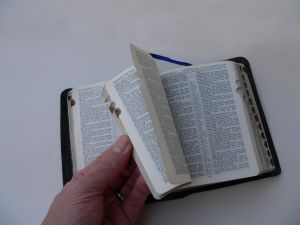
Reading the Bible

chbiblegrouping.gif

Often around this time of year people think about the need to read their Bibles more. I highly recommend it! (See Thirteen Reasons to Read the Bible.)

I wrote in an earlier post about devotional tips:

When I first became a Christian as a teen-ager, the church I was in then had a strong emphasis on reading the Bible through in a year. I am so glad, because I think that, more than anything else, got me grounded spiritually. There are many advantages to reading the Bible through in a year: it kept me focused; I knew where to read next instead of wandering around aimlessly; I discovered choice nuggets in places like II Chronicles and Zephaniah that I probably would never have discovered otherwise; it kept me balanced; it helped me understand passages in their context; and each time through I would understand the passage more.

There are a number of plans online for reading the Bible through. One here is based, I believe, on the One Year Bible plan. BibleGateway.com has a few different ones: a comprehensive one for reading the Bible through in a year, a 121-day biographical one covering some of the major people in the Bible, a 61-day survey schedule, and a 61-day chronological reading plan.

I mentioned in that post on devotional tips that I no longer read the Bible through in a year, but I do still read it through, for all the reasons mentioned above. But by going at my own pace I can take more time with particular passages if needed.

One resource I would highly, highly recommend is the book What Do I Know About My God by Mardi Collier. Whether you do her particular plan or not, the testimonies of how God has used His word in her life are inspiring. Another good resource is Alone With God by Jason Janz.

Anything is better than nothing, so I encourage you, if you’ve never made reading the Bible every day a part of your life, or you have but you’ve let it slip, it’s a worthy investment of your time. Whether you’re just starting or you’ve been reading it for years, I pray you’ll have a blessed year of getting to know God better and drawing ever closer to Him.

(Graphic courtesy of Creative Ladies Ministry.)

Between a rock and a hard place…

…or between the devil and the deep blue sea, as the sayings go. My morning Bible reading today covered Exodus 13-14, wherein Moses leads the children of Israel out of Egypt only to get caught between the Egyptians, who decided not to let them go after all, and the Red Sea.

One part of the passage that has always intrigued me is Ex. 13:17-18a: “And it came to pass, when Pharaoh had let the people go, that God led them not through the way of the land of the Philistines, although that was near; for God said, Lest peradventure the people repent when they see war, and they return to Egypt: But God led the people about, through the way of the wilderness of the Red sea.” God knew that going that particular way would be too much for the Israelites, even though it was the nearer way. I wonder, when we get to heaven, if there will be opportunity to look back over time from a glorified perspective and see what God spared us from that would have been too hard for us to deal with which we had no idea of at the time. This is a perfect illustration of I Corinthians 10:13: “There hath no temptation taken you but such as is common to man: but God is faithful, who will not suffer you to be tempted above that ye are able; but will with the temptation also make a way to escape, that ye may be able to bear it.”

Look where the “way of escape” led them, though: right into the encampment by the Red Sea where Pharoah and his armies could hedge them in. Yet, since God led them away from a situation that would have proved too much for them, it stands to reason that this would be a trial of faith they could face and not fail.

I’m not a fan of the saying “God won’t give me more than I can handle.” I guess there is a sense in which it is true, based on I Cor. 10:13. But I would modify it to say that God won’t give me anything I can’t handle without His grace. Very often I find that He does put me in situations too big for me so that I have to lean on Him for help, because there is no other way to handle it.

In Exodus 14:4, God reveals one of His reasons for sending Israel for that particular spot and for sending Pharoah after them: “I will be honoured upon Pharaoh, and upon all his host; that the Egyptians may know that I am the LORD.” That phraseology comes up often in Scripture: that he may know, that they may know, etc. I’ve thought it would make an interesting study some time to look up those phrases or make note of them as I’m reading through the Bible. All throughout the plagues of Egypt God was making known to them that their gods were no gods, that He was the only One — several of the plagues involved something that the Egyptians worshipped (one was the sun, and God showed His power over the sun by making it dark for a few days, etc.). It was not cruel for Him to do so: it was a mercy, so that they would see that they were trusting in something untrustworthy and would see that He is the all-powerful trustworthy One.

One of the many reasons God allows trials in our lives is so that others might see His power and grace. The blind man mentioned in John 9 was born that way so that “the works of God should be made manifest in him.” Elisabeth Elliot touches on this principle in a devotional titled “The World Must Be Shown.”

Sometimes when we find ourselves in those tight places, our first thought is to wonder, “Did I do something wrong?” If not, then we often wail, “Why is God doing this to me?” There may be many reasons: He may be pruning us to bring forth more fruit (John 15:2); to humble us and show us His sufficiency (Deuteronomy 8:2-3); to teach us patience, endurance, hope (Romans 5:3-5); to show us the insufficiency of whatever we are trusting in instead of him….or it just may be that someone within our sphere of influence needs to be shown something about God through our experience.

In Israel’s case, there are many indications throughout the preceding chapters and this one that some of the Egyptians were beginning to understand who the one true real God was. But the Egyptians weren’t the only ones. “And when the Israelites saw the great power the LORD displayed against the Egyptians, the people feared the LORD and put their trust in him and in Moses his servant” (Exodus 14:31). It happened in Job’s life as well: Satan was shown something about God and about genuine faith, and so were all of the people through the ages who have read Job’s story. But Job himself learned more about his God through the process as well. That happens with us, too — many people testify that through some fiery trial they got to know their God better and drew closer to Him.

Whatever trial we are going through, we can trust that God has allowed it for a purpose, and that if He allowed it, He will give us the grace to get through it, He will provide, He will lead, he will manifest Himself to us and to others who may be part of the process.

Hungering and thirsting

My Daily Light reading for this morning included these verses:

Blessed are they which do hunger and thirst after righteousness: for they shall be filled (Matthew 5:6).

He satisfieth the longing soul, and filleth the hungry soul with goodness (Psalm 107:9).

I got to wondering why we don’t hunger and thirst for Him and His righteousness more. The answer that came to mind: we’re full of other things. In physical life we can “spoil our dinner” (as my grandma used to say) by filling up with the wrong things; we can develop a taste for junk food and lose our appetite for nourishing meals. We can do that spiritually, too.

This brought to mind a song that some dear friends from PA taught us when they came to live in TX. I’ve never heard it anywhere else. I found the words attributed to Martha Snell Nicholson . It uses a different metaphor but makes the same observation:


One by one He took them from me,
All the things I valued most,
Until I was empty-handed:
Every glittering toy was lost.
And I walked earth’s highways grieving
In my rags and poverty
Til I heard His voice inviting,
“Lift your empty hands to Me!”

So I held my hands toward Heaven
And He filled them with a store
Of His own transcendent riches
Til they could contain no more.
And at last I comprehended
With my stupid mind and dull
That God could not pour His riches
Into hands already full.

The rest of the Daily Light reading lists His promises to fill us with His goodness when we do hunger and thirst for Him:

We shall be satisfied with the goodness of Thy house (Psalm 65:4).

I am the bread of life: he that cometh to me shall never hunger; and he that believeth on me shall never thirst (John 6:35).

He hath filled the hungry with good things; and the rich he hath sent empty away (Luke 1:53).

How excellent is thy lovingkindness, O God! therefore the children of men put their trust under the shadow of thy wings. They shall be abundantly satisfied with the fatness of thy house; and thou shalt make them drink of the river of thy pleasures. For with thee is the fountain of life: in thy light shall we see light (Psalm 36:7-9).

One thing have I desired of the LORD, that will I seek after; that I may dwell in the house of the LORD all the days of my life, to behold the beauty of the LORD, and to enquire in his temple (Psalm 27:4).

May we set aside the things that don’t satisfy and seek the One who does.

Bible “One Anothers”

I thought I had posted this before, but I couldn’t find it. Once I did a word search on the Bible for the “one another” passages that instruct us in how to minister to each other. It was very convicting! Here’s what I found:

Bible “One Anothers”

Wash one another’s feet—John 13:14.
Love one another—John 13:3; 15:12, 17; Romans 13:8; I Peter 1:22; I John 3:11, 23; 4:7, 11.
In honor preferring one another—Romans 12:10.
Don’t judge one another—Romans 14:13.
Receive one another—Romans 15:7.
Salute one another—Romans 16:16.*
Greet one another—I Cor. 16:20, II Cor. 13:12, I Peter 5:14.
Serve one another—Gal. 5:13.
Don’t provoke one another or envy one another—Gal. 5:26.
Bear one another’s burdens—Gal. 6:2.
Forbear one another in love—Eph. 4:2, Col. 3:13.
Forgive one another—Eph. 4:32, Col. 3:13.
Teach and admonish one another with song—Col. 3:16.
Comfort one another—I Thess. 4:18.
Edify one another—I Thess. 5:11.
Exhort one another— Heb. 3:13; 10:25.
Consider one another to provoke unto love and good works—Heb. 10:24.

(* Looking up the Strong’s definition, “salute” means “to draw to one’s self, to salute one, greet, bid welcome, wish well to, to receive joyfully, welcome,” even “retarding” one’s own journey to do so.)

Light in the darkness

Last night the daily reading from Joy and Strength compiled by Mary Tileston included the following:

He knoweth what is in the darkness, and the light dwelleth with Him.
DANIEL 2:22

TAKE it on trust a little while;
Soon shalt thou read the mystery right
In the full sunshine of His smile.
JOHN KEBLE

GOD is too wise not to know all about us, and what is really best for us to be, and to have. And He is too good, not to desire our highest good; and too powerful, desiring, not to effect it. If, then, what He has appointed for us does not seem to us the best, or even to be good, our true course is to remember that He sees further than we do, and that we shall understand Him in time, when His plans have unfolded themselves; meanwhile casting all our care upon Him, since He careth for us.
HENRY PARRY LIDDON

To be out of harmony with the things, acts, and events, which God in His providence has seen fit to array around us–that is to say, not to meet them in a humble, believing, and thankful spirit–is to turn from God. And, on the other hand, to see in them the developments of God’s presence, and of the divine will, and to accept that will, is to turn in the opposite direction, and to be in union with Him.
THOMAS C. UPHAM

Then the first verse in the Daily Light selection for today was:

When I sit in darkness, the LORD shall be a light unto me. Micah 7:8

I’m not going through any particularly dark moments just now, but I have lived long enough to know that they do come around from time to time. I stockpile truths like this against the times when I will especially need them.

Who is among you that feareth the LORD, that obeyeth the voice of his servant, that walketh in darkness, and hath no light? let him trust in the name of the LORD, and stay upon his God. Isaiah 50:10

God’s Unchanging Word

463462_searching_2.jpg

God’s Unchanging Word

For feelings come and feelings go,
And feelings are deceiving;
My warrant is the Word of God,
Naught else is worth believing.

Though all my heart should feel condemned
For want of some sweet token,
There is one greater than my heart
Whose word cannot be broken.

I’ll trust in God’s unchanging word
Til soul and body sever;
For, though all things shall pass away,
His word shall stand forever.

— Martin Luther

Thursday Thirteen: Favorite Bible Verses

thursdaybanner16.png

1. And ye shall seek me, and find me, when ye shall search for me with all your heart. Jeremiah 29:13.

2. Blessed are they which do hunger and thirst after righteousness: for they shall be filled. Matthew 5:6.

3. But he was wounded for our transgressions, he was bruised for our iniquities: the chastisement of our peace was upon him; and with his stripes we are healed. All we like sheep have gone astray; we have turned every one to his own way; and the LORD hath laid on him the iniquity of us all. Isaiah 53:5-6.

4. Fear thou not; for I am with thee: be not dismayed; for I am thy God: I will strengthen thee; yea, I will help thee; yea, I will uphold thee with the right hand of my righteousness. Isaiah 41:10.

5. The LORD hath appeared of old unto me, saying, Yea, I have loved thee with an everlasting love: therefore with lovingkindness have I drawn thee. Jeremiah 31:3.

6. For God so loved the world, that he gave his only begotten Son, that whosoever believeth in him should not perish, but have everlasting life. John 3:16.

7. The LORD thy God in the midst of thee is mighty; he will save, he will rejoice over thee with joy; he will rest in his love, he will joy over thee with singing. Zephanoah 3:17.

8. And Asa cried unto the LORD his God, and said, LORD, it is nothing with thee to help, whether with many, or with them that have no power: help us, O LORD our God; for we rest on thee, and in thy name we go against this multitude. O LORD, thou art our God; let no man prevail against thee. II Chronicles 14:11.

9. Rest in the LORD, and wait patiently for him: fret not thyself because of him who prospereth in his way, because of the man who bringeth wicked devices to pass. Psalm 37:7

10. How excellent is thy lovingkindness, O God! therefore the children of men put their trust under the shadow of thy wings. Psalm 36:7

11. The LORD is gracious, and full of compassion; slow to anger, and of great mercy. Psalm 145:8.

12: Put on therefore, as the elect of God, holy and beloved, bowels of mercies, kindness, humbleness of mind, meekness, longsuffering; Forbearing one another, and forgiving one another, if any man have a quarrel against any: even as Christ forgave you, so also do ye. Colossians 3:12-13.

13. Jesus saith unto him, I am the way, the truth, and the life: no man cometh unto the Father, but by me. John 14:6.

(See what other Thursday Thirteeners are up to here.)

What we have in the Lord

chbiblegrouping.gifOne of the passages from today’s selection in Daily Light on the Daily Path was from Isaiah 45:24: “In the LORD have I righteousness and strength: even to him shall men come; and all that are incensed against him shall be ashamed.” That gave me a lot to meditate on during the rest of my morning routine.

When I buy new t-shirts and put them in the drawers next to the old ones, I’m appalled at how grey the old ones look — the ones that looked white before. That’s just a paltry comparison of what our righteousness would look like next to God’s. Even what might look like righteousness to ourselves and others is only filthy rags. I am so glad the Lord is my righteousness! I certainly don’t have any of my own. I’m so thankful He made a way that we could be made righteous through Christ.

And then I also have strength in Him! I couldn’t get by a day without it.

“All that are incensed against him shall be ashamed.” Though in some ways I am looking forward to the day when the mockers and scorners of the world are set right, my hope is that as many as possible will see Him aright before it’s too late.

A short while after I read these verses, I was a reminded of a study I did some years ago about what we have in Christ. I’d recommend that study to you: it’s enriching in many ways. I looked up in my Online Bible program (you could use BibleGateway as well — it’s helpful to put the words you are looking for in quotation marks when you are looking for an exact phrase) phrases like “in Christ,” “in Jesus,” “in the Lord,” “in him” (though with the last one you would have to sort through to find the ones specifically about the Lord) and then listed them and underlined what we have in Him. Here are a few:

Romans 3:24: ” Being justified freely by his grace through the redemption that is in Christ Jesus.”

I Corinthians 1:30: ” But of him are ye in Christ Jesus, who of God is made unto us wisdom, and righteousness, and sanctification, and redemption.”

Acts 17:28: ” For in him we live, and move, and have our being; as certain also of your own poets have said, For we are also his offspring.”

I John 1:5: ” This then is the message which we have heard of him, and declare unto you, that God is light, and in him is no darkness at all.”

Colossians 2:9: ” For in him dwelleth all the fulness of the Godhead bodily.”

This study not only rejoices our hearts and strengthens us as we’re reminded of all that we have in Christ, but we can’t help but overflow with praise to Him for all that He is!

(Graphic courtesy of Creative Ladies Ministries.)

The Claims of Christ

Some years back I read that someone said that Jesus Christ never claimed to be God. I was astounded that anyone would say or think that. Sure, He never stood on a mountaintop and said, “I am God” in those exact words. But He did proclaim His Deity. The next time I read through the New Testament, I put a “C” (for “claim” next to every verse I found where Christ claimed something about Himself. Here’s what I found:

1) When the devil tempted Him to throw Himself off the pinacle of the temple if He was the Son of God, Jesus answered, “Thou shalt not tempt the Lord thy God.” I think He was referring not only to the situation of doing something foolish and expecting God to intervene, but I think He was also referring to Himself as God who should not be tempted. (Matthew 4:5-7)

2) He claimed the authority and the ability to forgive sins.

Matthew 9:6: But that ye may know that the Son of man hath power on earth to forgive sins, (then saith he to the sick of the palsy,) Arise, take up thy bed, and go unto thine house.

3) He claimed to be greater than the temple.

Matthew 12:6: But I say unto you, That in this place is one greater than the temple.

4) He claimed to be greater than Jonah.

Matthew 12:41: The men of Nineveh shall rise in judgment with this generation, and shall condemn it: because they repented at the preaching of Jonas; and, behold, a greater than Jonas is here.

5) He claimed to be greater than Solomon.

Matthew 12:42: The queen of the south shall rise up in the judgment with this generation, and shall condemn it: for she came from the uttermost parts of the earth to hear the wisdom of Solomon; and, behold, a greater than Solomon is here.

6) He confirmed that Peter’s proclamation of Him as the Christ, the Son of God, was revealed to Peter by the Father.

Matthew 16:15: He saith unto them, But whom say ye that I am?

16 And Simon Peter answered and said, Thou art the Christ, the Son of the living God.

17 And Jesus answered and said unto him, Blessed art thou, Simon Barjona: for flesh and blood hath not revealed it unto thee, but my Father which is in heaven.

7) He claimed to be the Lord of the Sabbath (in response to the Pharisees fussing about his activities on the Sabbath).

Mark 2:29: Therefore the Son of man is Lord also of the sabbath.

8 ) He proclaimed His purpose in coming was to give Himself a ransom.

Mark 10:45: For even the Son of man came not to be ministered unto, but to minister, and to give his life a ransom for many.

9) He claimed to be the Christ.*

Mark 14: 61 But he held his peace, and answered nothing. Again the high priest asked him, and said unto him, Art thou the Christ, the Son of the Blessed?

62 And Jesus said, I am: and ye shall see the Son of man sitting on the right hand of power, and coming in the clouds of heaven.

63 Then the high priest rent his clothes, and saith, What need we any further witnesses?

10) He claimed to be the One whom Moses, the prophets, and the Psalms foretold and the One in whose name repentance and remission of sins should be preached.

Luke 24: 44-47: And he said unto them, These are the words which I spake unto you, while I was yet with you, that all things must be fulfilled, which were written in the law of Moses, and in the prophets, and in the psalms, concerning me.
Then opened he their understanding, that they might understand the scriptures, And said unto them, Thus it is written, and thus it behooved Christ to suffer, and to rise from the dead the third day: And that repentance and remission of sins should be preached in his name among all nations, beginning at Jerusalem.

11) He claimed to be in heaven even while He was speaking to someone on earth, indicating omnipresence.

John 3:13: And no man hath ascended up to heaven, but he that came down from heaven, even the Son of man which is in heaven.

12) He claimed that whoever believed in Him would not perish but have everlasting life.

John 3:14-16: And as Moses lifted up the serpent in the wilderness, even so must the Son of man be lifted up. That whosoever believeth in him should not perish, but have eternal life. For God so loved the world, that he gave his only begotten Son, that whosoever believeth in him should not perish, but have everlasting life.

(Also John 6:47; 10:28-29)

13) He claimed to give “living water.”

John 4:10, 13-14: Jesus answered and said unto her, If thou knewest the gift of God, and who it is that saith to thee, Give me to drink; thou wouldest have asked of him, and he would have given thee living water….Jesus answered and said unto her, Whosoever drinketh of this water shall thirst again: But whosoever drinketh of the water that I shall give him shall never thirst; but the water that I shall give him shall be in him a well of water springing up into everlasting life.

John 7:37-39: In the last day, that great day of the feast, Jesus stood and cried, saying, If any man thirst, let him come unto me, and drink. He that believeth on me, as the scripture hath said, out of his belly shall flow rivers of living water. (But this spake he of the Spirit, which they that believe on him should receive: for the Holy Ghost was not yet given; because that Jesus was not yet glorified.)

14) He claimed to be the Messiah.*

John 4: 25-26: The woman saith unto him, I know that Messias cometh, which is called Christ: when he is come, he will tell us all things. Jesus saith unto her, I that speak unto thee am he.

15) He claimed to be the Son of God many times over: here are two examples:

John 5: 17 But Jesus answered them, My Father worketh hitherto, and I work.
18 Therefore the Jews sought the more to kill him, because he not only had broken the sabbath, but said also that God was his Father, making himself equal with God.

(The reaction He got indicates they understood what He meant in claiming to be the Son of God.)

John 9: 35 Jesus heard that they had cast him out; and when he had found him, he said unto him, Dost thou believe on the Son of God?

36 He answered and said, Who is he, Lord, that I might believe on him?

37 And Jesus said unto him, Thou hast both seen him, and it is he that talketh with thee.

38 And he said, Lord, I believe. And he worshipped him.

(See also John 10:36)

16) He claimed that whoever heard His word and believed on Him that sent Him would not come into condemnation, but would pass from death unto life.

John 5:24: Verily, verily, I say unto you, He that heareth my word, and believeth on him that sent me, hath everlasting life, and shall not come into condemnation; but is passed from death unto life.

17) He claimed that the Scriptures testified of Him.

John 5:39: Search the scriptures; for in them ye think ye have eternal life: and they are they which testify of me.

18 ) He claimed to be the bread of life.

John 6:35: And Jesus said unto them, I am the bread of life: he that cometh to me shall never hunger; and he that believeth on me shall never thirst.

John 6:48: I am that bread of life.

John 6:51: I am the living bread which came down from heaven: if any man eat of this bread, he shall live for ever: and the bread that I will give is my flesh, which I will give for the life of the world.

19) He claimed He would raise up those who believe on Him at the last day.

John 6:39-40: And this is the Father’s will which hath sent me, that of all which he hath given me I should lose nothing, but should raise it up again at the last day. And this is the will of him that sent me, that every one which seeth the Son, and believeth on him, may have everlasting life: and I will raise him up at the last day.

20) He claimed to be the light of the world.

John 8:12: Then spake Jesus again unto them, saying, I am the light of the world: he that followeth me shall not walk in darkness, but shall have the light of life.

(Also John 9:5)

21) He claimed to be from above and not of this world.

John 8:23: And he said unto them, Ye are from beneath; I am from above: ye are of this world; I am not of this world.

22) He claimed that if whoever does not believe in Him would die in their sins.

John 8: 24: I said therefore unto you, that ye shall die in your sins: for if ye believe not that I am he, ye shall die in your sins.

23) He claimed to be not only before Abraham but to be the “I am” who spoke to Moses (Exodus 3:13-14):

John 8:58: Jesus said unto them, Verily, verily, I say unto you, Before Abraham was, I am.

(The reaction to this statement shows they knew exactly what He meant [though they did not accept it] and to me this statement is one of the strongest proofs of Christ’s deity.)

24) He claimed to be the door of the sheep.

John 10: 7-9: Then said Jesus unto them again, Verily, verily, I say unto you, I am the door of the sheep. All that ever came before me are thieves and robbers: but the sheep did not hear them. I am the door: by me if any man enter in, he shall be saved, and shall go in and out, and find pasture.

25) He claimed He came that we might have life, and have it more abundantly.

John 10:10: The thief cometh not, but for to steal, and to kill, and to destroy: I am come that they might have life, and that they might have it more abundantly.

26) He claimed He is the good shepherd.

John 10: 11, 14: I am the good shepherd: the good shepherd giveth his life for the sheep. I am the good shepherd, and know my sheep, and am known of mine.

27) He claimed to be one with the Father.

John 10:30: I and my Father are one.

28 ) He foretold His betrayal so that when it happened they would know who He was.

John 13:18-19: I speak not of you all: I know whom I have chosen: but that the scripture may be fulfilled, He that eateth bread with me hath lifted up his heel against me. Now I tell you before it come, that, when it is come to pass, ye may believe that I am he.

29) He claimed to be the true vine without Whom we can do nothing.

John 15: 1, 5-6: I am the true vine, and my Father is the husbandman. I am the vine, ye are the branches: He that abideth in me, and I in him, the same bringeth forth much fruit: for without me ye can do nothing. If a man abide not in me, he is cast forth as a branch, and is withered; and men gather them, and cast them into the fire, and they are burned.

30) He claimed that we have peace in Him and that He had overcome the world.

John 16: 33: These things I have spoken unto you, that in me ye might have peace. In the world ye shall have tribulation: but be of good cheer; I have overcome the world.

31) He claimed that eternal life is knowing the Father and Himself.

John 17:3: And this is life eternal, that they might know thee the only true God, and Jesus Christ, whom thou hast sent.

*For an explanation of what is meant by the terms “Messiah” or “Christ,” please read this and put the word “Messiah” in the search box. I couldn’t get the link to work that went straight to the definition.

Well, I think that adds up, don’t you? If I have overlooked any, please let me know in your comments. Some of these make more sense and have greater meaning in context. There are other things that attest to Christ’s Deity: the fulfillment of prophecy (something I did at the same time as this study was to also put a “P” in the margin beside every verse in the gospels and the first few chapters of Acts which spoke of some prophecy being fulfilled), His works, the testimony of others, the testimony of the Father (“This is my beloved Son in Whom I am well-pleased.” )

I hope and pray that any of you who have not recognized Him as Lord and Saviour would believe on Him even today, and I hope that this helps to strengthen the faith of believers.

Thursday Thirteen: Reasons to read the Bible

I go back and forth on “Thursday Thirteens” between funny and serious ones. I didn’t realize at first that my thoughts about this post and the Works For Me Wednesday post were running along the same tracks.

Thirteen Reasons to Read the Bible

1. To learn of Christ

John 5:39: Search the scriptures; for in them ye think ye have eternal life: and they are they which testify of me.

2. To increase our faith.

Romans 10:17: So then faith cometh by hearing, and hearing by the word of God.

3. Guidance.

Psalm 119:105: Thy word is a lamp unto my feet, and a light unto my path.

4. Doctrine, reproof, correction, instruction in righteousness.

2 Timothy 3:16: All scripture is given by inspiration of God, and is profitable for doctrine, for reproof, for correction, for instruction in righteousness.

5. To give us hope and comfort.

Romans 15:4: For whatsoever things were written aforetime were written for our learning, that we through patience and comfort of the scriptures might have hope.

6. To help us avoid sin.

Psalm 119:9: Wherewithal shall a young man cleanse his way? by taking heed thereto according to thy word.

7. To compare what we are hearing with what God has said.

Acts 17:11 These were more noble than those in Thessalonica, in that they received the word with all readiness of mind, and searched the scriptures daily, whether those things were so.

8. Fruitfulness, stability.

Psalm 1

1 Blessed is the man that walketh not in the counsel of the ungodly, nor standeth in the way of sinners, nor sitteth in the seat of the scornful.

2 But his delight is in the law of the LORD; and in his law doth he meditate day and night.

3 And he shall be like a tree planted by the rivers of water, that bringeth forth his fruit in his season; his leaf also shall not wither; and whatsoever he doeth shall prosper.

4 The ungodly are not so: but are like the chaff which the wind driveth away.

5 Therefore the ungodly shall not stand in the judgment, nor sinners in the congregation of the righteous.

6 For the LORD knoweth the way of the righteous: but the way of the ungodly shall perish.

9. Quickening.

Psalm 119:25: My soul cleaveth unto the dust: quicken thou me according to thy word.

Psalm 119:50: This is my comfort in my affliction: for thy word hath quickened me.

10. Understanding.

Psalm 119: 103-104: How sweet are thy words unto my taste! yea, sweeter than honey to my mouth! Through thy precepts I get understanding: therefore I hate every false way.

Psalm 119:130: The entrance of thy words giveth light; it giveth understanding unto the simple.

11. Our rejoicing.

Psalm 119:162: I rejoice at thy word, as one that findeth great spoil.

Jeremiah 15:16: Thy words were found, and I did eat them; and thy word was unto me the joy and rejoicing of mine heart: for I am called by thy name, O LORD God of hosts.

12. Our sanctification.

John 17:17: Sanctify them through thy truth: thy word is truth.

13. To see Scripture fulfilled.

Matthew 26:56: But all this was done, that the scriptures of the prophets might be fulfilled. Then all the disciples forsook him, and fled.

John 2:22: When therefore he was risen from the dead, his disciples remembered that he had said this unto them; and they believed the scripture, and the word which Jesus had said. (See also Matthew 21:42; 26:54; Mark 12;10; 14:49; 15:28; Luke 4:21; 24:27; John 7:42; 13:18; 17:12; 19:24, 28, 36, 37; Acts 1:16; 18:28; Romans 1:2; Galatians 3:8; James 2:23; I Peter 2:6 – to name a few). 🙂

See More “Thursday Thirteen” lists here and here.

Thursday Thirteen banner courtesy of Lisa.