The Mother’s Hymn

The Mother’s Hymn

by William Cullen Bryant.

Lord, who ordainest for mankind
Benignant toils and tender cares!
We thank Thee for the ties that bind
The mother to the child she bears.

We thank Thee for the hopes that rise,
Within her heart, as, day by day,
The dawning soul, from those young eyes,
Looks, with a clearer, steadier ray.

And grateful for the blessing given
With that dear infant on her knee,
She trains the eye to look to heaven,
The voice to lisp a prayer to Thee.

Such thanks the blessed Mary gave,
When, from her lap, the Holy Child,
Sent from on high to seek and save
The lost of earth, looked up and smiled.

All-Gracious! grant, to those that bear
A mother’s charge, the strength and light
To lead the steps that own their care
In ways of Love, and Truth, and Right.

(HT to Ivory Spring, where I saw this a couple of years ago).

My heart echoes the last stanza especially, even though mine are grown men now.

Happy Mother’s Day!

mothers-day-flowers-13

Book Review: Big Love: The Practice of Loving Beyond Your Limits

Big LoveWhen Big Love: The Practice of Loving Beyond Your Limits by Kara Tippetts came through on sale for the Kindle app, I didn’t realize it was mainly about parenting. I probably would not have gotten it in that case since my kids are all grown. But I am glad I did, because the principles carry over into any relationship.

You might remember Kara’s name from her journey through cancer and death as shared on her blog, Mundane Faithfulness. I did not read there regularly but caught a few posts here and there when someone linked to them on Facebook. It was the urging of friends to share the contents of this book and the knowledge that her time was growing shorter that led her to write it.

The main theme of the book is Love is kind, from I Corinthians 13:4. The phrase impacted her in a big way when a preacher with a painful childhood shared them when speaking to the children at the school where she was teaching. She confesses she was “not naturally given to kindness,” preferring to feel “strong and successful” and “bent on winning.” She realized her love “was often self-serving, self-fulfilling, and self-centered.” This truth of God’s love “hit [her] at the perfect time and landed on soil that was ready to be planted with truth.”

She had not grown up in a family that practiced repentance, so the idea of walking in humility and confessing wrongs was new to her. She was married and expecting her first child at this time and wanted to interact with both husband and children in kindness and not have a home like the one she was raised in.

She shares a bit of her family background, how she came to believe on Jesus, how she met her husband, and how she was diagnosed with cancer. But for all that it’s a fairly short book. I read it in two sittings and probably could have in one, but wanted to stop and absorb before going on.

A few quotes from the book that stood out to me:

Competition among mothers kills community. I searched for ladies who were willing to be honest about faults. Honesty and a shared heart is such grace. Vulnerability and transparency encourage looking for grace.

Our kids are so often the reflection of sin that brings us to repentance. It was a beauitful, awful moment of light shining on my sin. I thought I was okay, so long as I wasn’t yelling. But what I saw in the face of my daughter was that I had sailed from the shore of kindness, and I needed Jesus to change my heart and return me to gentle kindness.

Discipline should never come as a surprise to a child. I think it is very important for children to always know what is expected of them. When discipline comes as a surprise, I typically find that I am parenting out of anger and not intentionally teaching and shepherding my children. If I know a child is entering a place where they struggle with obeying it is important to set clear boundaries.

That is our high calling as parents, to direct, train, nurture, love, and shepherd our children. It is important we move from irritation with our children and move toward opportunity for training. Whatever you choose to be your consequence, it must not be a surprise. Children should know clearly what is expected, and when they disobey, struggle, and sin, they need to be lovingly directed and disciplined. Disobedience is an opportunity. Children are not trying to embarrass you. Your children are not trying to create chaos in your life. Children need boundaries, direction, and limits that are all surrounded by a truckload of love. They do not come to us trained, obedient, and ready to listen. They need to know they are worth your time, your energy, and your strength to direct their hearts.

If I never point out the sin and struggle in the hearts of my children, and merely direct their behavior to please me, then when will they know they need a Savior?

I…follow through with the discipline and share honestly about my own struggle…I share my own need for forgiveness and grace. Empathy is a powerful tool in helping a child know you are FOR them. Letting your child know you understand their struggle and love them in the midst of it will help them be able to take an honest look at themselves. They will feel safe and not judged by you. They will know your heart is to direct them and not condemn them.

The Book of Romans tells us that it’s God’s kindness that leads us to repentance. I want to love with a kindness that nurtures a hard heart to desire to be soft. God is the only one able to transform someone else’s heart, but if I live a life submitted to Him, then His love will be reflected through me.

I longed to not withhold love when it was inconvenient to give it. Those faces [of her children] helped motivate me to want to know Jesus well, and to live near Him and listen to His Spirit as I walked in faith with my family.

When I am not drinking deeply from the inexhaustible well of love that is Jesus, it is impossible for me to share that love with the community behind closed doors as well as my greater community.

The heart of the gospel is lavish love being placed on me when I least deserved it.

The act of parenting isn’t excuses for bad behavior, it’s seeking reconciliation, redemption, and grace in our days.

The heart of being able to love big, BIG, BIG is being loved. Jesus loves you that big. He loved you so big he died a death He didn’t deserve to bring you to God. Admit you need Him, admit you don’t have it all figured out, and know His love. Quiet your heart enough to feel His love. Let Him teach you the beauty of sacrificial, humble love.

God’s nearness will be the strength to help you parent with kindness.

The sections I’ve emboldened are the ones that especially spoke to me in my current situation of life, including not just parenting but loving anyone I am called to love. Like Kara, too often I find that my love is “self-serving, self-fulfilling, and self-centered,” though that manifests itself a little differently for me than it did for her, as our personalities are very different. I guess the struggle to love as Jesus did will be a lifelong one, since we have our flesh to deal with. But by His grace, resting in His love for us and letting that overflow to others, we can grow.

There were a few formatting problems in the book – I wonder if that’s because it was designed for a different format than the one on which I read it. It was distracting just at first but then I was able to overlook it as I got into the story. I highly recommend the book especially to parents, but also to anyone seeking encouragement to love Biblically.

(Sharing at Literacy Musing Mondays.and at Semicolon‘s Saturday Review of Books)

Middle Child and Other Syndromes

My middle son like to tease about having “Middle Child Syndrome.” Recently he shared this:

Middle child

It’s true that there is such a thing as Middle Child Syndrome, with middle children feeling often overlooked between the oldest, who did everything first, and the youngest, who is new and cute and takes the focus off the middle one. But, really, each position has its problems and could have its own syndrome. I have always loved Erma Bombeck’s piece to each of her children and why she loved each one “best.”

The oldest is the guinea pig. Usually parents are most cautious with their firstborn because everything is new to them and they’re not sure what to do. That cautiousness usually rubs off on the child. Or, more rarely, I think, first-time parents are too sure of what to do and then have to find out the hard way that they’re not always right. Perhaps being surrounded by adults also usually makes him a little more serious and introvertish. He might have the biggest shock to his system when the next baby comes, compared to other children, because everything was his and only his before – his parents’ attention, every toy, piece of clothing, etc. Now it all has to be shared with a newcomer. The oldest also has a built-in set of responsibilities. He usually has to help mom and dad in various ways when another baby comes, has to watch them at times, has full-blown baby-sitting responsibilities when he’s older. Because the parents are usually just getting started and then having more children, money is tighter, so there may be fewer opportunities available. When the kids as a group get in trouble, he’s often held to a higher standard because he’s older and should have “known better.”

Middle children can indeed feel like they’ll never stand out because they’ll never be the first to walk, talk, etc. But their parents are usually a little more relaxed with them: the firstborn didn’t die from their mistakes, and they’ve learned that some of the things they worried about were not that big a deal after all. That in turn helps the child to be a little more relaxed. Middle children are usually more sociable and make friends more easily because they’ve been around other people near their age since birth. Middle children are said to be peacemakers: I didn’t see that in my own middle child growing up (or in my siblings, either), at least not with his brothers, but I do see it in him as an adult. Middle children have the advantage of seeing what’s involved when the oldest starts school, tries out for a sports team, starts piano lessons, etc., and that may work hand in hand with their more easygoing nature to make them less afraid to try new things.

Youngest children are accused of getting away with everything. If that is true because the parents are getting tired, distracted, and lax in their discipline, that is a definite problem. But often it just looks that way because the parents are even more relaxed, have more of a handle on what works and what doesn’t, what is concerning and what isn’t, etc. The youngest is usually even more sociable and makes friends easily, again, perhaps because he has always grown up with other people around. Youngest children may feel like they are never taken seriously, like their family will always see them as the baby. They may feel “picked on” by their older siblings. They may have unfinished baby books and the fewest baby pictures because the parents were busy with a growing family. They may get tired of hand-me-downs (or they may look forward to them: mine was delighted when his older brother game him a bunch of toys he had grown out of). The financial situation of the family can go two ways: if the older children have moved out on their own, there may be more money and therefore more stability and opportunities for the youngest. However, if older children are in college, etc., and the family has to care for grandparents, time and resources might be tighter for the youngest. I’ve felt bad for my youngest that he doesn’t remember a lot of the family trips and activities we participated in as a family because he was so young, and now, with his older brothers moved out and Great-Grandma moved in, there is not an opportunity for a family vacation in the sense of all of us going somewhere together. In his mind we “never” took a family vacation. But we have taken individual days to do fun things together in recent years. The parents of youngest children may be transitioning to empty-nest mindset while he is still there: my husband is the youngest of four, and when he was a teen-ager, he was often out for school or youth group functions or work during dinner time. His parents had gotten into the habit of eating dinner in front of the TV, and when he came home, they were distracted. He told me when we were first married that it meant a lot that I stopped and greeted him when he got home. The youngest also has parents who are older – which is better in some ways for their wisdom and life experience, but perhaps they might not be up for more physical pursuits. Siblings may be harder on them. They’re often not quite as sensitive as oldest kids because they’ve had to take a lot of flack from siblings as they grew up. I don’t mean not sensitive in a bad way, but in that they don’t get “crushed” when other kids say and do stupid things because they’re used to a certain amount of that from their own siblings. Youngest kids can feel loneliness as older siblings leave the nest – he may feel the most upheaval from the family constantly changing.

This isn’t an exhaustive list of birth order traits – there have been whole books and many articles written about them. These are just some thoughts that came to mind from my family’s experience. There are exceptions, of course, to every list of traits: in the articles I have read, no one list fits everyone in my family in its entirety (either my siblings or my own children).

The main thing I wanted to consider, though, is that God uses everything, even our place in our families and the good and bad parts of that experience, to shape us and to make us the kinds of vessels He wants us to be. Sometimes it’s even the very thing we most thought unfair or most felt we lacked that helps us focus on handling things differently with our own children. I am the oldest of six, and there were times I hated having to be “the responsible one.” Once when my mom called me her “built-in babysitter,” I wanted to stomp my foot and say, “I am NOT a baby-sitter! I am a daughter!” But I wasn’t allowed to do things like that. 🙂 As an adult, though, I am glad that sense of responsibility was forged into my character. Sure, I was overcautious and fairly tense, but God paired me with someone who is the youngest of four and much more relaxed. I didn’t even realize that about myself until after we had been married for a while, so I wouldn’t have thought to look for someone to offset that trait in me. I am thankful God did that for me. 🙂 And a cautious outlook is not entirely a bad thing, unless it’s paralyzing. Every trait has its good and bad sides. My more cautious nature has held me back sometimes but it has kept me out of trouble other times.

In the article The Secret Powers of Middle Children, the authors point out that “They achieve because of the way they’re being brought up. They develop strategies and skills that stand them in good stead as adults.” I didn’t agree with everything in the article, and not all of the traits mentioned are ones I have seen in my own child. But it was an interesting overview of middle children. Some of the very traits that middle (and oldest or youngest as well) children most disliked growing up go into making them the adults they become.

My own middle son was the first to spend an entire summer away from home, the first to travel to another country, the first to marry and have a child. I don’t know if any of those were done specifically in order to be the first at something or if they just happened that way – I think the latter. But I think it is an illustration that we don’t have to be bound by our birth order.

I chafed a bit at the article’s suggestion that middle children are “neglected” by parents. It may actually help them that they are not under the microscopic focus of parents like the oldest was. Personally, I was glad that I had some alone time with each child. My oldest was almost three when his brother was born, so I had those three years with him. Then when he went to school, I had a lot of alone time with my middle child until his younger brother was born when he was six. Then when my middle child went to school, I had a lot of alone time with the youngest. But I think even in families with more children than that or closer together than that, they strive to have some personal alone time with each one.

I also resented a bit the article’s assertion that “Middles have lower self-esteem than other birth orders because of their lack of uniqueness and attention at home.” We always felt that each child was unique and enjoyed finding the personality traits of each one, and, as I said above, strove to make sure each one had attention.

Another factor here, though, is that every parent will make mistakes, have blind spots, overlook or miss cues, etc. Even when parents strive to be the best, most attentive parents they can, they’re only human, and sinners as well.

But whatever our place in the order of our families, the type of families we have, the amount of parenting we did or didn’t have, and any other trait that went into our growing up – God uses all of it to develop in us traits we need. He can make up for any lack and pitfalls and help us to balance out in the areas we need to.


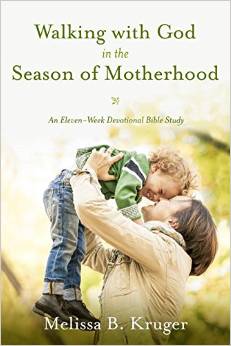
Book Review: Walking With God in the Season of Motherhood

Walking With GodI first saw Walking With God in the Season of Motherhood by Melissa B. Kruger when someone linked to her blog, and I saw this story of how the book came to be written. I thought it might be a good book to pass along to young moms, but I found much for my own heart, though my children are all grown.

This study grew out of Melissa’s desire for “a Bible study that intersected who I was as a believer with the role I had been given as a mother.” It’s not necessarily a “how to be a better parent” study. It’s more of a “how to walk with God and then let that relationship impact your ministry to your children” study.

She begins with our purpose – to glorify God and enjoy Him forever – then reminds us of our responsibility to teach the same to our children and our inability to do so for ourselves or for them on our own. Succeeding chapters discuss walking in faith, wisdom, prayer, carefulness, and then each facet of the fruit of the Spirit, ending with a discussion of the Perfect Mom Syndrome.

The study is laid out over eleven weeks, with four days of study per week and a fifth wrap-up summary of the truths covered in that week. I really like that the Bible verses are included within the study, so a busy mom trying to feed a baby or grab a few minutes of study while waiting for piano lessons or ball practice to end has everything needed right there within the book. There is an additional study guide at the back that would be great for a group study but is also helpful for personal use.

I have several quotes marked but will try to pull out just a few:

It is important to assess regularly whether my family is suffering from an overly busy calendar. However, rather than simply removing activities, my greatest need is to add one particular meeting to my schedule. Every day I need time with Jesus. While it seems counterintuitive, the addition of this one meeting promises to positively affect every other part of my day (pp. 30-31).

When impatience, anger, or discontent well up in our hearts, these are signs that we are mothering in our own strength. Rather than dealing only with our outward behavior, we need the Lord to renew and recharge our hearts…our souls find renewed energy only by abiding in Jesus. Without this time we will find ourselves depleted, discouraged, and unable to bear fruit (p. 33).

[Re the Proverbs 31 woman], We can view her as an older woman to learn from rather than a standard against which to measure ourselves (p. 73).

An additional benefit of a home at peace is that it overflows into loving care and service for our community. The goal is not to create a place to escape or avoid the world but to carefully build our home so that it is a light to the world, shining the grace of Christ to those who are without hope. A peaceful home offers a place of respite and care in the midst of a weary world (p. 76).

When we receive the abundant love of Christ, we are free to pursue others with love, not to gain their affection but to give back what we have already received (p. 93).

True joy does not discount real suffering; it shines all the greater in the midst of it (p. 115).

The ability to extend kindness requires an other-awareness. We are apt to miss the needs of those around us if we remain self-focused. Helping children to see the needs of others will bless them with perspective on their own lives, as well as propel them toward good works that display the kindness of God (p. 157).

God uses these moments to grow our hearts in grace. We can only bear the fruit of patience when we have something to be patient about (p. 164).

In Jesus the performance pendulum stops — both the pride of success and the despair of failure are absorbed by grace (p. 208).

I cannot protect my children from my weaknesses. As hard as I may try, at some point my sin will affect their lives. However, the way I deal with my failure can provide an example for them to follow. I am a sinner raising sinners. Each of my children will face the weight and sorrow of his or her own sins. Just as we teach daily hygiene habits like brushing teeth, our children need instruction on how to find cleansing for their souls. By teaching our children about confession and repentance as well as grace and forgiveness, we bless their lives for years to come (p. 213).

At some points the study seemed a bit long, both in number of weeks and in how long it took to complete the day’s reading and answer the questions. But it’s not, really – eleven weeks is a good length of time for a study. I went through the book in less time than that because I used it six days a week and went on to the next chapter after finishing one rather than reading one chapter per week, but I think the latter would be the better course, to really soak in the truths for that week before going on. And each day’s lesson only took about fifteen minutes. One could spend longer – I tend to answer the basic questions in writing but answer some of the more thoughtful ones in my head. If one did more with the writing sections, one could spend more time with each lesson. And if a day’s reading and questions take more time than one has, there is no reason you can’t take a couple of days or whatever time is needed to complete it. It’s better to go at one’s own pace and really dig into it than barrel through just to get it done. Melissa’s summaries at the end of each week’s lessons really help to review the material and help tie it all together.

I really enjoyed going through this study, found it very beneficial, and am happy to recommend it to you in whatever season you are in.

(This review will also be linked to Semicolon‘s Saturday Review of Books.)

Repost: The Back Burner

I’ve had some other obligations this week that have taken much of my computer time: I’ve been thinking about and working on some other posts, but they need to incubate a while longer. Meanwhile, this morning this post came back to mind, and I thought I’d share it again. Sometimes I chafe that there are still things on the back burner that I thought I’d be able to get to when my children got older. I have to accept that the circumstances God has me in are His will for me now, and if those other desires are truly from Him, He’ll make a way for them in His time. So even though the major thrust of this article has to do with parenting, it applies in any area where God wants us to wait on His timing.

This is one of the few articles I’ve had published. It appeared in Frontline magazine’s July-August 2005 issue. I wrote to Frontline asking permission to reprint the article here in January of 2008, which they granted: I am going to assume that permission extends to this repost as well.

IMG_1031

The Back Burner

Every mother, particularly one who has very small children, can get discouraged sometimes. Even though a woman has looked forward to being a mother all her life and delights in her child, there are those days when she feels she is accomplishing nothing beyond wiping noses and changing diapers, when she feels her mind is turning to mush after reading Dr. Seuss and Curious George all day, when she longs to do something “important.” Certain intellectual and creative pursuits have to be put on the back burner because there are only so many hours in the day. Even some ministry opportunities have to wait until the children are a bit older. It is easy to lament what we can’t do.

Of course, young mothers are not the only ones who have to put things on the back burner. Newlyweds, new teachers, students, young singles getting started in a career, middle-aged children taking care of an elderly parent, and any number of other life situations will cause us to have to focus on the business at hand and delay other pursuits. But motherhood is the area through which the Lord taught me about the back burner.

Some 15-20 years ago I read something in a secular women’s magazine that greatly encouraged me and has stayed with me ever since. Unfortunately, I can’t remember even what magazine it was, much less what author. The writer was talking those things that have to be put on the back burner. But, she wrote, what is usually on the back burner when we are cooking? Isn’t it something that has to simmer awhile, that is all the richer in flavor for the time it spent there on the back burner? The meat gets tender, the flavors blend, the smell wafts though the house, and we can hardly wait until dinnertime.

Oh, dear mother….what you are doing is vitally important. Your little one may not remember the specific things you did together or all your loving care in their early childhood, but those loving ministrations laid the foundation for your future relationship. The time you spend together reading, playing, rocking, feeding, nurturing a new little life that God has given to you to care for is precious.

As the children get older, their need of your care is still vital, though it is different from when they were small. Instead of feeling isolated at home, you may feel you are nearly living out of your car with all the places you have to take your children to. We have to keep a balance between giving them opportunities and spreading everyone too thin, but some of those times in the car can be precious as well. One of my sons does not open up to me if I sit across the table from him and ask him how things are going in his life, but a casual conversation or observation made while we are out and about can give me glimpses into his heart. Sometimes children feel a little freer to open up while we’re driving.

Someone once said, “With children, the days are long, but the years are short.” That is all too true. You have heard it before, but they do grow up so fast. You always have a ministry with them and an influence on them, but your main years of training them are when they are little. Redeem the time and enjoy it to the hilt.

Don’t worry about those things on the back burner. Give them a stir every now and then. Perhaps you can skim over the newspaper headlines or watch some of the evening news with your husband, or spend 15 minutes or so a day reading a good book to stimulate your mind. Buy a craft kit, take a class, jot down story ideas, or somehow “stir the pot” of whatever your areas of interest are. Take advantage of opportunities to get together with other ladies for fellowship. Explore what ministry opportunities you can within the constraints of your situation, but remember that ministry doesn’t only take place within the four walls of the church: getting to know your neighbor, inviting another mother from the baseball league to church, baby-sitting for another mother for a doctor’s appointment, giving a tract to the repairman are all outlets through which the Lord can use you as well as being an example to your children.

Then, as you stir those things on the back burner from time to time, perhaps you can take a small taste to test the readiness of it. After all, if you start to write the next great novel, and find the timing still isn’t right, you can let it simmer a little longer.

Don’t get discouraged if other women seem to have all their burners going at once, accomplishing things right and left. I used to lament that I couldn’t do as much as some other ladies til I finally had to come to grips with the fact that God made us with different capacities, abilities, and personalities.

Ultimately we have to entrust those back burner issues to our loving Lord and ask His guidance as to when and how to proceed with them. There may be some things He wants us to relinquish completely, and here our back burner analogy breaks down: there are some things He never intended for us to pursue, and we have to set aside what was a personal desire that was not His will. We have to remind ourselves that, no matter how strong and even good a desire was, if it is not God’s will, it would not have been good for us and may actually have been harmful and taken away from what He did have for us to do. On the other hand, we can’t let the back burner become a place of excuses and, due to laziness or fear, place things there that the Lord does want us to pursue now. How can we know the difference? By walking with him day by day, seeking His guidance, asking Him to open doors He wants open and close doors He wants closed. When it is His timing to finally serve one of those “back burner” dishes, it will indeed be “just right.”

31 Days of Inspirational Biography: Sarah Edwards As a Mother

Yesterday I wrote about the marriage of Jonathan and Sarah Edwards from the book Marriage to a Difficult Man by Elisabeth M. Dodds. As I mentioned then, the writer doesn’t mean that Mr. Edwards was “difficult” in the sense of being hard to get along with: she classifies him as a genius (which she feels made him misunderstood by some) but also lacking somewhat in social skills and willing to strongly preach unvarnished truth, which some would have trouble accepting. It is written from a historical viewpoint, so there are all sorts of neat little tidbits about life in that time. In fact, I am fairly sure that the writer is not saved and is writing from a historical interest rather than a Christian one, yet she still conveys the truth of Edward’s beliefs.

Today I want to just focus on a few passages about Sarah as a mother. She had 11 children, which was not unusual for the 1700’s: but what was unusual for the times was that they all lived past childhood. “Every account of the Edwards house has the same ring. All visitors seem to have been impressed that eleven children managed to be lively and individual as personalities, yet could act courteously with one another and function as a coordinated unit…[Sarah’s] way was not at all permissive. The requirements were completely clear. But she at the same time allowed the children areas of flexibility that were unusual for that day.” “A curious feature about the Edwards children is that this firmness did not squash individuality.”

The following four paragraphs are observations of Samuel Hopkins, one of many houseguests of the Edwards’, who lived with them for several months:

She had an excellent way of governing her children; she knew how to make them regard and obey her cheerfully, without loud angry words, much less heavy blows. She seldom punished them; and in speaking to them, used gentle and pleasant words. If any correction was necessary, she did not administer it in a passion; and when she had occasion to reprove and rebuke she would do it in a few words, without warmth and noise…In her directions in matters of importance, she would address herself to the reason of her children, that they might not only know her…will, but at the same time be convinced of the reasonableness of it. She had need to speak but once; she was cheerfully obeyed; murmuring and answering again was not know among them.

In their manners they were uncommonly respectful to their parents. When their parents came into the room they all rose instinctively from their seats and never resumed them until their parents were seated; and when either parent was speaking…they were all immediately silent and attentive. The kind and gentle treatment they received from their mother, while she strictly and punctiliously maintained her parental authority, seemed naturally to…promote a filial respect and affection, and to lead them to a mild tender treatment of each other. Quarreling and contention…were in her family unknown.

She carefully observed the first appearance of resentment and ill will in her young children, towards any person whatever, and did not connive at it…but was careful to show her displeasure and suppress it to the utmost; yet not by angry, wrathful words, which often provoke children to wrath…Her system of discipline was begun at a very early age and it was her rule to resist the first, as a well as every subsequent exhibition of temper or disobedience in the child…wisely reflecting that until a child will obey his parents he can never be brought to obey God.

For [her children] she constantly and earnestly prayed and bore them on her heart before God…and that even before they were born.

“The management of a large busy household took leadership and efficiency. Mothers then had to be administrators, because the food and clothing depended on the mother’s ability to produce it. Sarah had to learn to assign chores…Children then had the advantage of knowing that their chores were indispensable.”

“The Edwardses saw that the children learned to be orderly about money…[Sarah] herself took care to save anything of trifling value, or directed her children…to do so, or when she saw them waste any thing, she would repeat the words of our Savior — ‘THAT NOTHING BE LOST.'” (emphasis the author’s.) Edwards himself wrote sermons on the backs of shopping lists. Paper was precious in those days.

“The Edwardses made it a point to single out individual children from the humming family hive, to get to know each one in turn by himself.”

“Sarah’s way with their children did more than shield [him] from the hullabaloo while he studied…[He] poured his feelings about this in sermons which eventually appeared as a book, Christian Love as Manifested in the Heart and Life,which I have not yet read.

I am sure the Edwards weren’t perfect and wouldn’t claim to be. Modern biographies tend to show “warts and all” to provide a more real picture of the subject, whereas older biographies did not want to appear unkind or gossipy. In addition, most of the author’s material came through others, as Sarah was not much of a letter-writer and was too busy to keep a journal, and those sources probably did not know or were too kind to spread their faults. Mrs. Dodds does not present them as perfect: she claims they were both very complex individuals. So I think we can assume that all was not idyllic and there was an occasional misunderstanding or cross word, but we can still take inspiration from their walk with God knowing that though they were sinners just like we are, God gave them grace and wisdom in their marriage and the raising of their family.

I mentioned yesterday that the book was out of print, but used copies were available online. I did just find what appears to be a free audio version of the book here. The audio quality is not great – but it’s free. 🙂

photo 3(2)

For the 31 Days writing challenge, I am sharing 31 Days of Inspirational Biography. You can find others in the series here.


31 Days of Inspirational Biography: Georgi and Natasha Vins, Christianity Behind the Iron Curtain

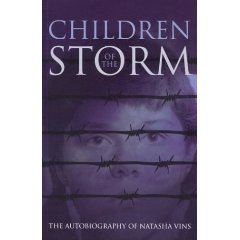
Some of you may remember the name of Georgi Vins. He was a Ukrainian pastor in prison for his “religious activities” in the Soviet Union several years ago. I was a student praying for him in the campus Slavic Mission Prayer Band in the late 70s, and it was with great joy I heard years later that he had been exiled to the USA in exchange for Soviet spies.  Children of the Storm, written by his daughter, Natasha, tells of her perspective during those years of persecution.

Natasha was about nine years old when persecution began in her school (though ridicule of Christianity had begun years before), and it seemed to increase as the years went by. Teachers would hold her up for ridicule in front of her classmates and blame her for her class’s not making it into certain competitions. She was assigned to write a report on a boy held up as a Soviet hero who turned his father in to the KGB for keeping back a little of his grain for his starving family. The other children began to taunt and threaten her or just avoid her. She was threatened with being removed from her home and “re-educated.” These things struck a chord with me when I first read this book because my youngest was at the age Natasha was when some of this was happening, and I just could not imagine him going through these things. Yet as it all struck me as so sad, the Lord reminded me that He marvelously kept her through that time. And she was not even saved yet!

In later years she had a teacher who had similar interests, befriended her, was kind to her, and then began to undermine her Christian beliefs. This time Natasha listened, thought some of what her teacher said made sense, and began to question. When her father came home from a prison camp and she had an opportunity, she talked with him. Imagine coming home from being in prison for your faith to have your own daughter question your faith. Yet he did not express anger or disappointment: he just answered her questions as best he could. Not long afterward Natasha was saved.

At this time and place one truly had to count the cost of following Christ. Natasha was denied finishing her studies in her field of choice because of her Christianity. Her father had had to go “underground” by this time and sent word that he would like her to join him in the printing ministry. She helped for many years in vital ways, and even got to see her father here and there. Once they were to meet with someone who at the last minute had to postpone meeting with them for a couple of hours. Natasha and her father used the time to walk around the city and talk. He thought it highly likely that he would be arrested again, and his talks with her that day helped her to make it through the time when he was indeed arrested. Imagine having to prepare your child not for the remote possibility but for the very real likelihood of your imprisonment…and to do so in a way that does not leave her bitter or feeling sorry for you or herself, but leaves her strengthened and resting in the Lord.

Natasha’s grandmother was also arrested when she was in her sixties and thought she would die in prison, yet the Lord delivered her.

The book tells also of Natasha’s mother and siblings, of visits to her father and grandmother in prison, of the persecuted church, of struggling to maintain a Christian attitude toward persecutors, of their reaction when her father was suddenly and unexpectedly exiled, of the family’s preparing to join him, of their impressions of America: one of the younger siblings was astounded that everyone carried Bibles to church. Natasha wept upon seeing a Christian bookstore. They left Russia with sorrow because it was their homeland, but before long they began to see how the Lord could use them in the USA.

The epilogue of the book tells of the Lord’s help through their adjustments to the US, and then opportunities for ministry by publishing newsletters and several books and establishing a mission. After 11 years of exile, in 1990, Pastor Vins was able to make several return trips to the former Soviet Union, visiting and preaching openly, discussing with church leaders how the mission in America could best help them. He passed away Jan. 11, 1998, leaving not only a continuing ministry, but a legacy of godly man and his family.

Reposted from the archives.

photo 3(2)

For the 31 Days writing challenge, I am sharing 31 Days of Inspirational Biography. You can find others in the series here.

Book Review: Courageous

CourageousCourageous is a novelization by Randy Alcorn of a movie by the same name written by  Alex and Stephen Kendrick and produced by the same church that produced Facing the Giants and Fireproof. I’ve never seen the film, but when the audiobook was on sale I decided to check it out.

The basic theme of the book is encouraging fathers to be men of integrity and to take the responsibility to raise their children in a godly manner as well as mentoring other young men. The story follows four men who are policemen and a fifth who is not on the force but becomes a good friend. Law enforcement has to be one of the toughest jobs on families, so I can see why the authors chose that profession for their characters.

A couple of the fathers are on the right track but need guidance and wisdom and maybe a little course correction, at least for one of them, before major trouble hits. One means well but is alienating his son with his lack of involvement and interest. Another fathered a child in a former relationship but hasn’t seen mother or child in years. When a tragedy strikes one of them, it sends repercussions throughout their whole group.

A subplot involves a gang that is wreaking havoc in the town of Albany, Georgia, their various encounters with the police force, and one fatherless wannabe gang member in particular.

Though the premise of the story is a good one, the writing is driven more by the points the author wants to make than by the plot or the characters, an accusation often aimed at Christian fiction. Nevertheless, the points are good ones, and if you think of it more as an extended parable or sermon illustration than a novel it’s a little easier to take.

I enjoyed a phone interview with Alcorn at the end of the audiobook in which he discussed the ramifications of expanding a two-hour screen play into a full length novel, when usually the process goes the opposite direction. I appreciated, too, the point he made that a film will reach many people, but when people read a book, they’re spending 10 or more hours with it and thus the principles involved have a longer time to affect the reader’s thinking.

One little quibble I had with the story involved the resolution that the fathers all eventually sign. One father came up with it after studying out what the Bible had to say about being a godly father, and when he told the others about it, they wanted to sign it, and eventually word of it and promotion for it went out to the whole church. The resolution sounds like a good thing in itself, but like so many of these kinds of things, the emphasis shifts to it rather than the principles behind it. After the resolution, instead of a character saying, “I can’t do this…” or “I must do this…” because of Biblical instruction or principle, they say I can’t or I must do such and such “because I signed the resolution.” When I was composing this post in my head before sitting down to write, my mind went to various scenarios where we tend to shift our focus to the tool rather than the reason for it: starting a Bible study program to aid in reading and understanding the Bible, and then getting caught up in the tenets of the program rather then delving deeper into the Bible, or having an accountability group to encourage one another in a certain area, and then experiencing a subtle change in our thinking to want to look good in the eyes of the members rather than growing in holiness before God. Small groups are not my favorite thing, but I do acknowledge they can be beneficial, and I acknowledge that they work best if everyone in the group participates, yet that participation doesn’t mean that every member must say something every meeting. I tend to say something if I have something to say, but sometimes I’m processing, sometimes I’m still on the point made ten minutes ago when the rest of the group has moved on, etc. Once when I hadn’t said anything in a couple of meetings, our group leader spoke to my husband and wondered if he should call on me during the meetings – perhaps he thought I was shy and needed the encouragement to speak out (though calling on a shy person in public would NOT be an encouragement to them!) My husband, thankfully, said that would probably not be the thing to do. Then a few days later, our leader’s wife called to ask me to do something for an upcoming activity, in what seemed a subtle attempt to “get Barbara involved,” when I was involved and participating all along, even if I wasn’t saying anything. That kind of thing puts pressure on a person to feels she has to dream up something to say every week so people don’t think she’s unspiritual, which is totally fake and, again, turns the focus on the tool (getting everyone to participate by making everyone speak in small group) rather than on the reason the group is meeting in the first place.

Please forgive the rabbit trail. 🙂 I don’t have a problem with the resolution itself (or any of these other tools), but with this tendency to focus on the tool rather than using the tool to help us focus on the Lord. I did also appreciate a point Alcorn made in the phone interview, that this book and film are not “the” tools, but just some tools that churches or groups could use. Most churches who preach and teach anything about godly fatherhood would incorporate the principles in the book, but it helps some to have a vehicle like this in which to do so, and that’s primarily what the authors wanted to do: to provide a film and book that would be food for thought and and encouragement to people in their walk with God.

I finished the book a week or two ago but had wanted to see the film before writing this review. However, there is no telling when I might get time for that, so I wanted to go ahead and get this review up. I thought the audiobook narrator, Roger Mueller, did a wonderful job reading the book, but I could have done without the dramatic music between chapters.

(This will also be linked to Semicolon‘s Saturday Review of Books.)

31 Days of Missionary Stories: Clint and Rita Vernoy: On Ethnocide and Raising Children in the Jungle

VernoysClint and Rita Vernoy are missionaries that our church in SC supported. I found Rita’s blog through a link from Susan‘s, and as I looked around I realized that this was one of our missionaries! Rita blogged at The Jungle Hut for several years and then moved to Livin’ la Rita Loca. Both sites have some great windows into life as a missionary.

I met Clint a couple of times when they were home on furlough, but Rita was not able to come either time. They ministered in the jungles of Venezuela for several years until the Communist government forced all foreign missionaries out. This post tells of their heartbreak at leaving a people and country they had come to love. They currently minister in Paraguay.

I wanted to highlight a couple of posts of theirs that I think would be very helpful and informative to read.

Let’s Define Ethnocide! is Clint’s response to a comment that he was committing “ethnocide,” purposely destroying an ethnic group or culture, by his missionary activities. I have mentioned a couple of times in this series that this sentiment is increasing in our culture these days, and Clint’s answer is a great one to read to inform yourself not only for your own information, but to answer these accusations when you come across them. Besides the spiritual benefit, which is huge but of course unrecognized or unacknowledged (or condemned) by a secular culture, missionaries generally also improve the hygiene, health, and quality of life of those to whom they minister while still keeping the culture intact. Who among us would still want to live as people did during the American Revolution or Little House on the Prairie days without the improvements and progress we have experienced since then? Rita also expanded on this in What About the Culture? I strongly encourage you to read both of these posts.

Another post I wanted to highlight is Rita’s daughter’s response to an anonymous commenter who said “that we had raised our children in an abusive environment by forcing them to live in the jungle in a mud hut without the amenities of civilization.” She assures, “While we appreciate your concern about our childhood, rest assured…we’re fine. Not a single one of us regrets our childhood, it was an awesome adventure, and we are grateful.” The rest of the post expands on some of the advantages and results of having grown up in the jungle.

I don’t know if anyone in the family has written a post on this yet – I haven’t seen one –  but I’d love to read Clint’s story of eating grub worms for the first time. 🙂 It was hilarious when he told it at church, though I am sure it didn’t feel so funny when it happened.

And if you have time, another great and thought-provoking post written for their mission board’s magazine is How Far Is Enough?

(You can see other posts in the 31 Days of Missionary Stories here.)

Legacy of an Adopted Child

November is National Adoption Month, so I’d like to take at least a couple of posts to highlight adoption. Today I want to share a poem that touched my heart, and later I want to highlight how adoption has impacted our family.

I first saw this in a Dear Abby column some years ago, cut it out — and just found it again last week.

Legacy of an Adopted Child

Once there were two women who never knew each other,
One you do not remember — the other you call Mother.

Two different lives shaped to make yours one.
One became your guiding star — the other became your sun.

The first gave you life and the second taught you to live in it.
The first gave you a need for love and the second was there to give it.

One gave you a nationality; the other gave you a name.
One gave you the seed of talent; the other gave you an aim.

One gave you emotions; The other calmed your fears.
One saw your first sweet smile; the other dried your tears.

One gave you up – It was all that she could do.
The other prayed for a child and God led her straight to you.

And now you ask me through your tears the age old question through the years:
Heredity or Environment – Which are you the product of?

Neither my darling, neither –
Just two different kinds of love.

~ Author Unknown

I’m not naive enough to think that all children placed for adoption are given in love: I have known people who adopted or were foster parents to children from abusive situations. But even then, the gift of life, allowing that child a chance to live in a loving family, to grow up, experience life, and become a productive adult, is always a better answer than abortion.